ENVIRONMENTAL
MANAGEMENT
SYSTEM
BY
JEFFIN JAMES
ENVIRONMENTAL MANAGEMENT
SYSTEM (EMS)
 A set of methods and procedures for aligning corporate strategies,
policies and operations with principles that protect ecosystems.
 An Environmental Management System identifies and establishes a
set of rules and practices to help everyone within an organization to
understand and accept how, through their actions, they can best
ensure high standards of environmental care.
 The term can also refer to software systems for organizational
environmental management which means it is intended to be
system dependent, not people dependent.
ISO 14000
ISO 14000 is a family of standards related to Environmental
management . It refers to a family of voluntary standards and guidance
documents to help organizations address environmental issues.
Includes:-
• Environmental Management Systems (14001,14002,14004)
• Environmental Auditing (14010,14011,14012)
• Environmental Labeling (14020,14021,14022,14023,14024,14025)
• Environmental Performance Evaluation (14031)
• Life-cycle Assessment (14040,14041,14042,14043)
ISO 14001
 ISO 14001 sets out the criteria for an environmental management system.
 It does not state requirements for environmental performance, but maps out
a framework that a company or organization can follow to set up an effective
environmental management system.
 Certification in meeting this standard allows companies to claim state-of-the-
art ecological responsibility
ISO 14001 is relevant to any organization seeking to improve and manage
resources more effectively.
This includes:
• Single site to large multi-national companies
• High risk companies to low risk service organizations
• Manufacturing, process and the service industries; including local
governments
• All industry sectors including public and private sectors
• Original equipment manufacturers and their suppliers.
Purpose of an EMS
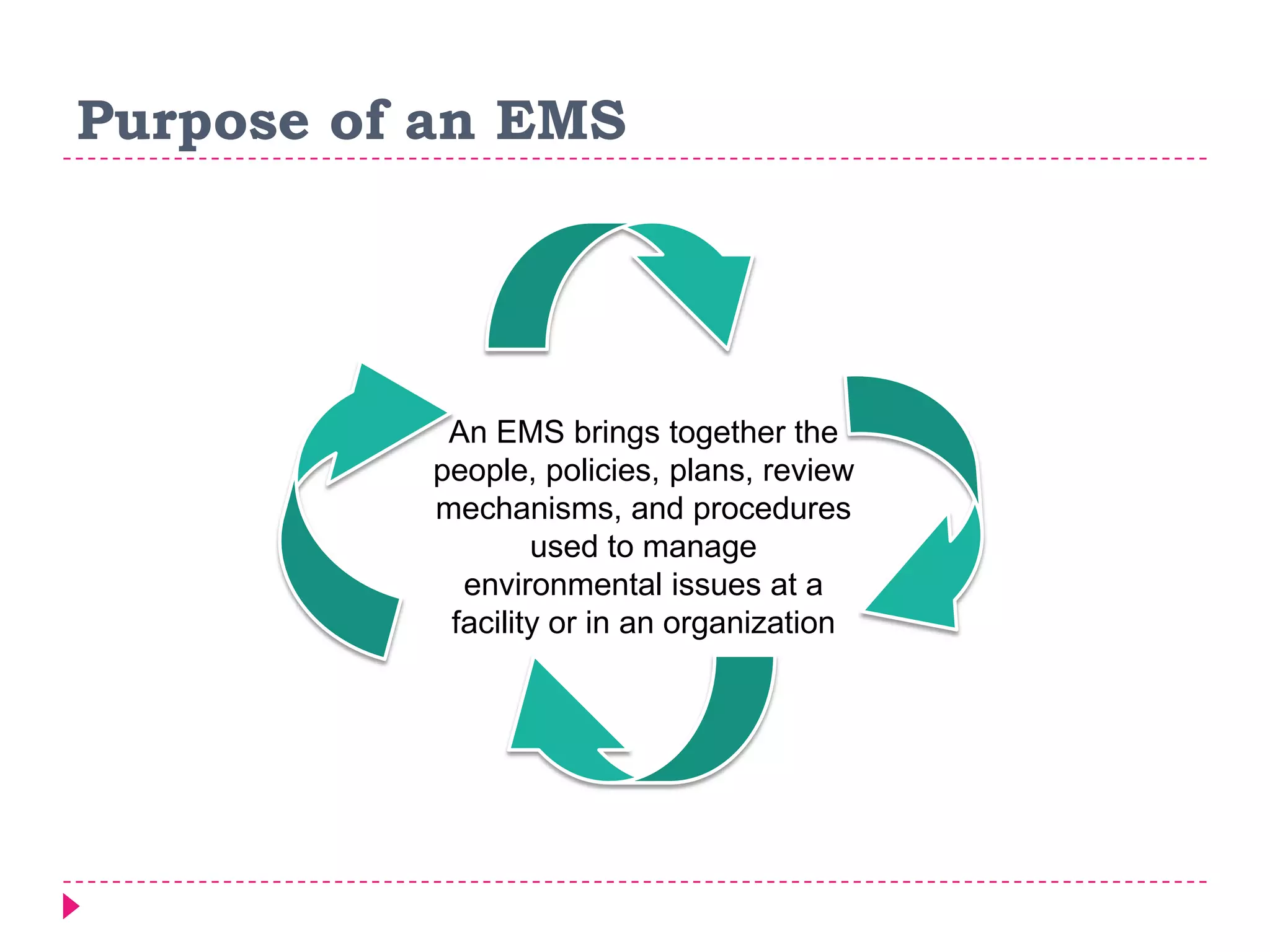
An EMS brings together the
people, policies, plans, review
mechanisms, and procedures
used to manage
environmental issues at a
facility or in an organization
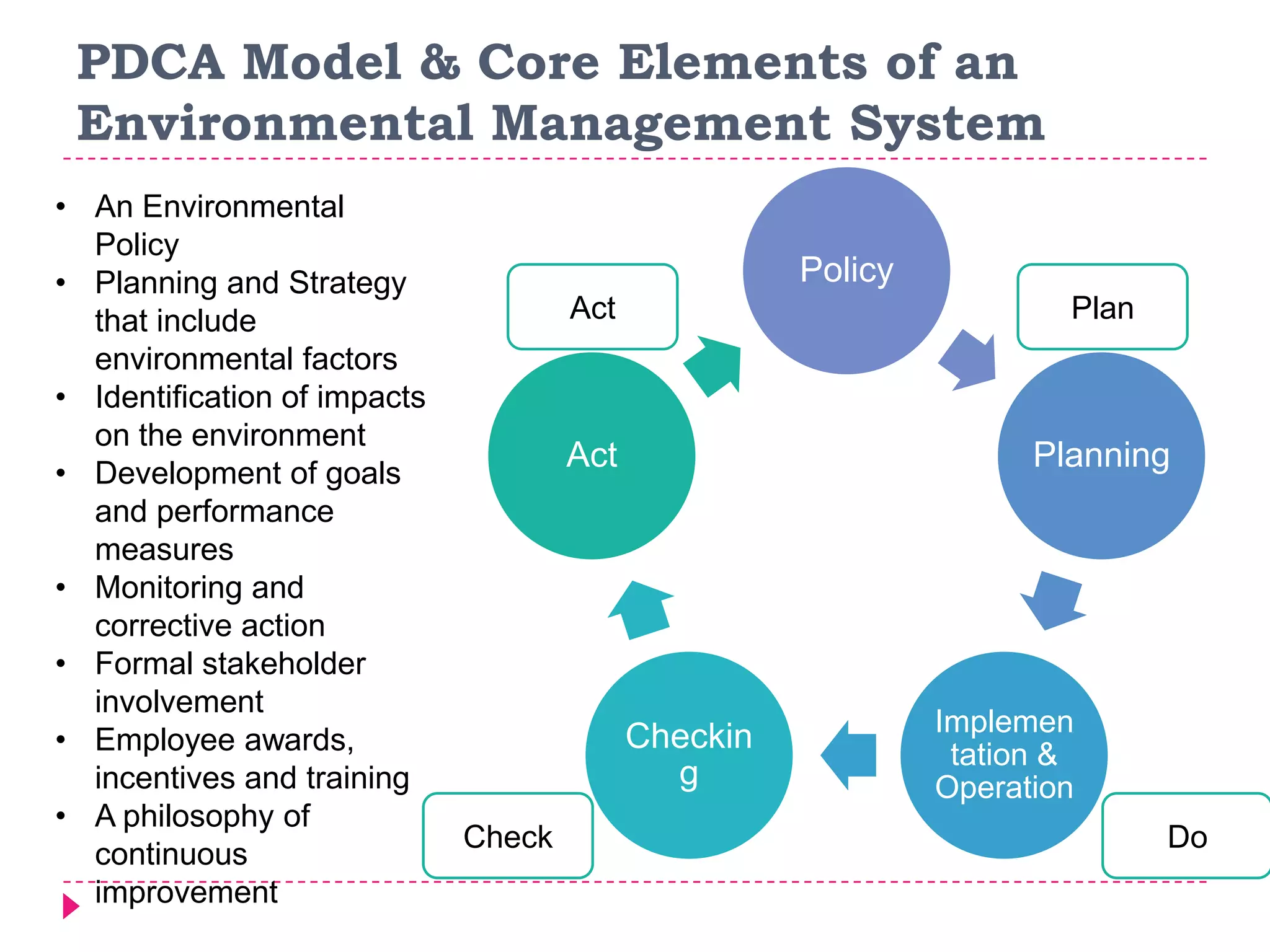
PDCA Model & Core Elements of an
Environmental Management System
Policy
Planning
Implemen
tation &
Operation
Checkin
g
Act
Do
Act Plan
Check
• An Environmental
Policy
• Planning and Strategy
that include
environmental factors
• Identification of impacts
on the environment
• Development of goals
and performance
measures
• Monitoring and
corrective action
• Formal stakeholder
involvement
• Employee awards,
incentives and training
• A philosophy of
continuous
improvement
General Benefits Of An Ems
 Drives Sustained Performance
 Set targets to reduce energy use, water use & waste to landfill
 Achieve cost savings
 Easier compliance
 Pollution prevention
 Increased efficiency
 Improved morale
TRAVIS PERKINS
 Travis Perkins have been supplying building materials to the trade for over
200 years
 One of the largest suppliers to the UK’s building and construction industry
with a national network of more than 600 branches.
 Provide more than 100,000 products to trade professionals including building
materials, plumbing and heating, landscaping materials, timber and sheet
materials, painting and decorating, dry lining and insulation, doors and
joinery, and hand and power tools
Travis Perkins fully intends to be a sustainable business. To be
sustainable, a business needs to:
 Generate profits for its shareholders
 Provide good employment conditions for its employees
 Trade fairly with its suppliers
 Look after the communities in which it operates
 Act as a guardian and improver of the environment.
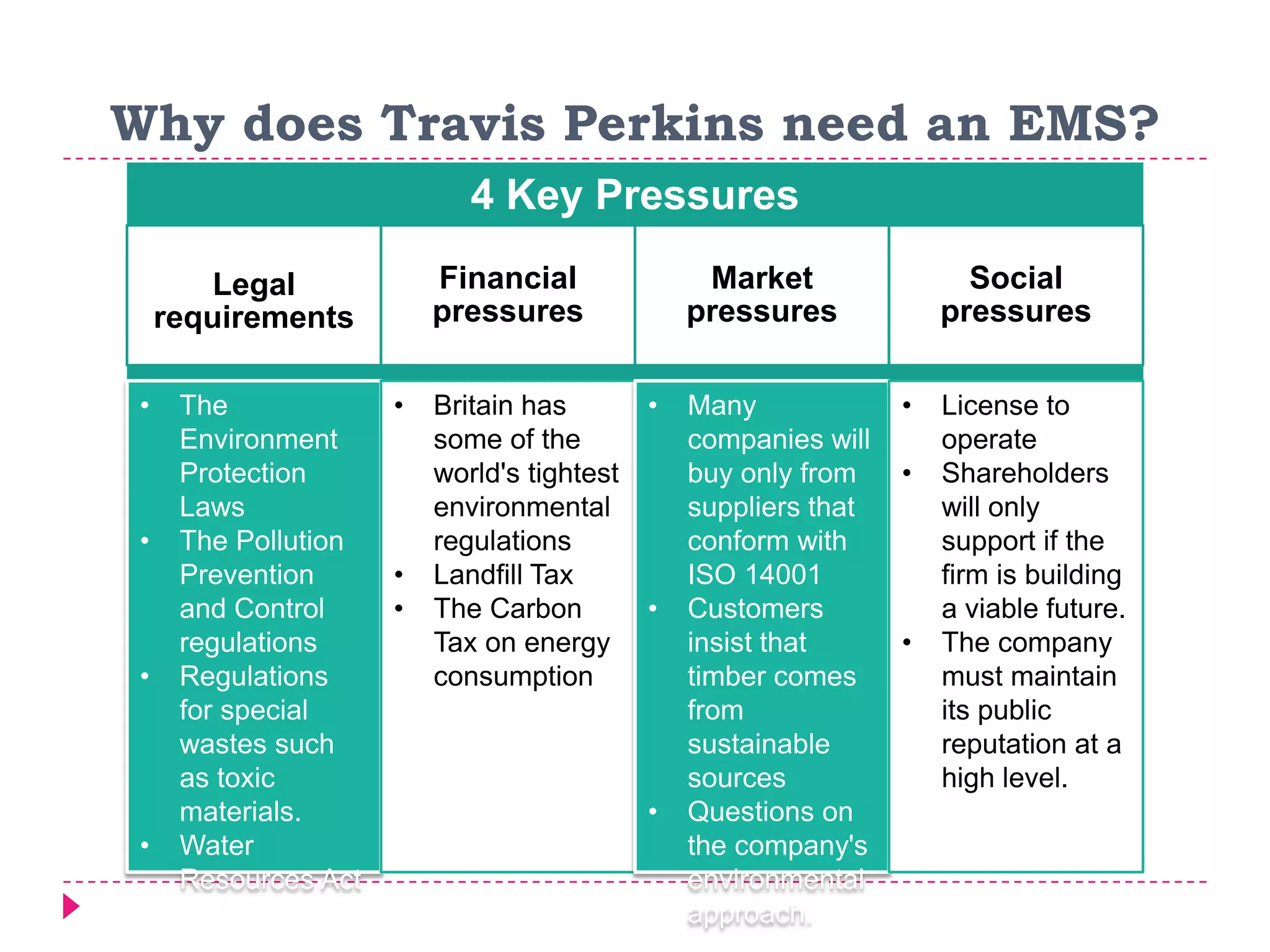
4 Key Pressures
Legal
requirements
Financial
pressures
Market
pressures
Social
pressures
• The
Environment
Protection
Laws
• The Pollution
Prevention
and Control
regulations
• Regulations
for special
wastes such
as toxic
materials.
• Water
Resources Act
• Britain has
some of the
world's tightest
environmental
regulations
• Landfill Tax
• The Carbon
Tax on energy
consumption
• Many
companies will
buy only from
suppliers that
conform with
ISO 14001
• Customers
insist that
timber comes
from
sustainable
sources
• Questions on
the company's
environmental
approach.
• License to
operate
• Shareholders
will only
support if the
firm is building
a viable future.
• The company
must maintain
its public
reputation at a
high level.
Why does Travis Perkins need an EMS?
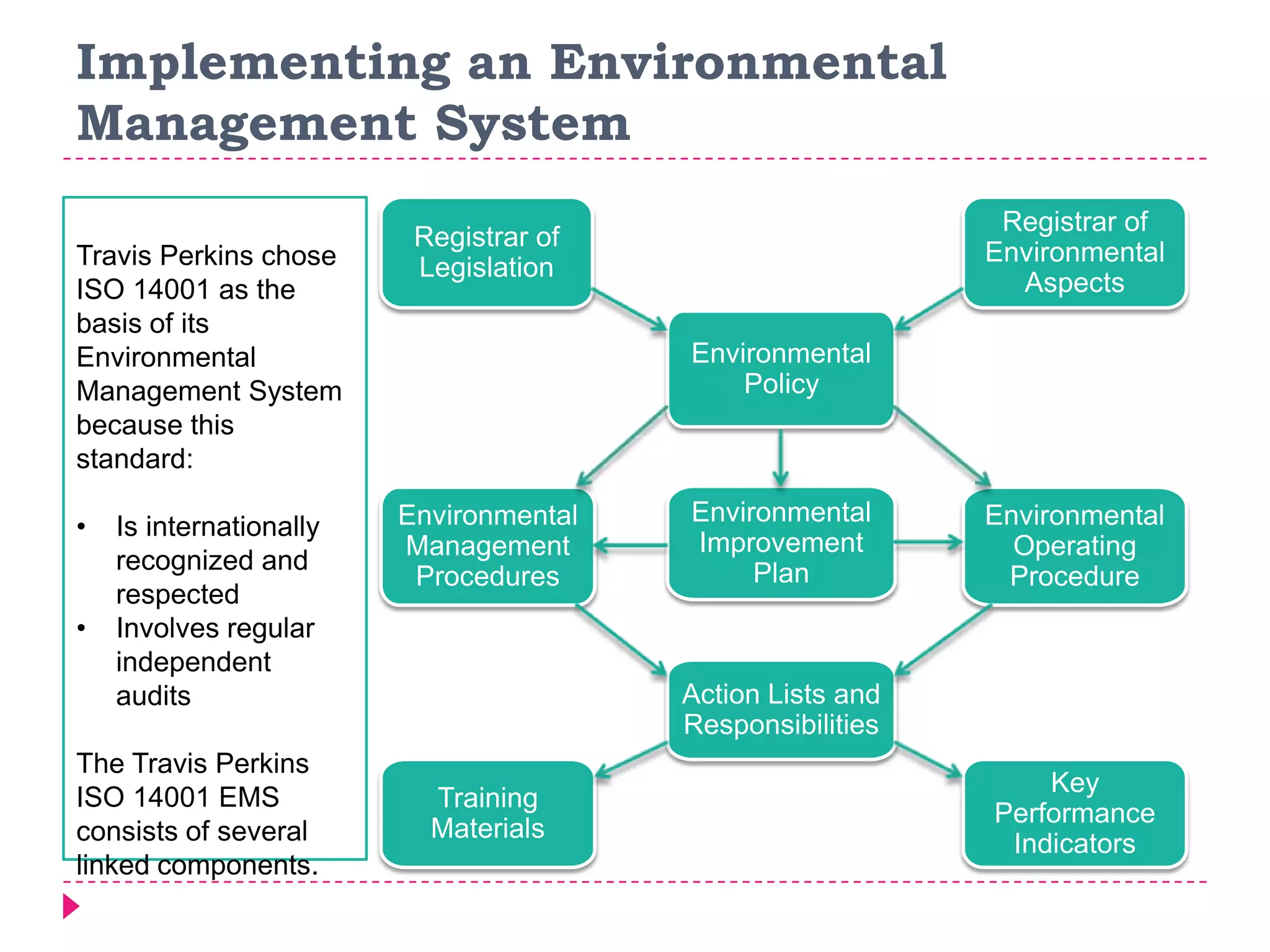
Implementing an Environmental
Management System
Registrar of
Legislation
Environmental
Policy
Registrar of
Environmental
Aspects
Environmental
Management
Procedures
Environmental
Improvement
Plan
Key
Performance
Indicators
Training
Materials
Action Lists and
Responsibilities
Environmental
Operating
Procedure
Travis Perkins chose
ISO 14001 as the
basis of its
Environmental
Management System
because this
standard:
• Is internationally
recognized and
respected
• Involves regular
independent
audits
The Travis Perkins
ISO 14001 EMS
consists of several
linked components.
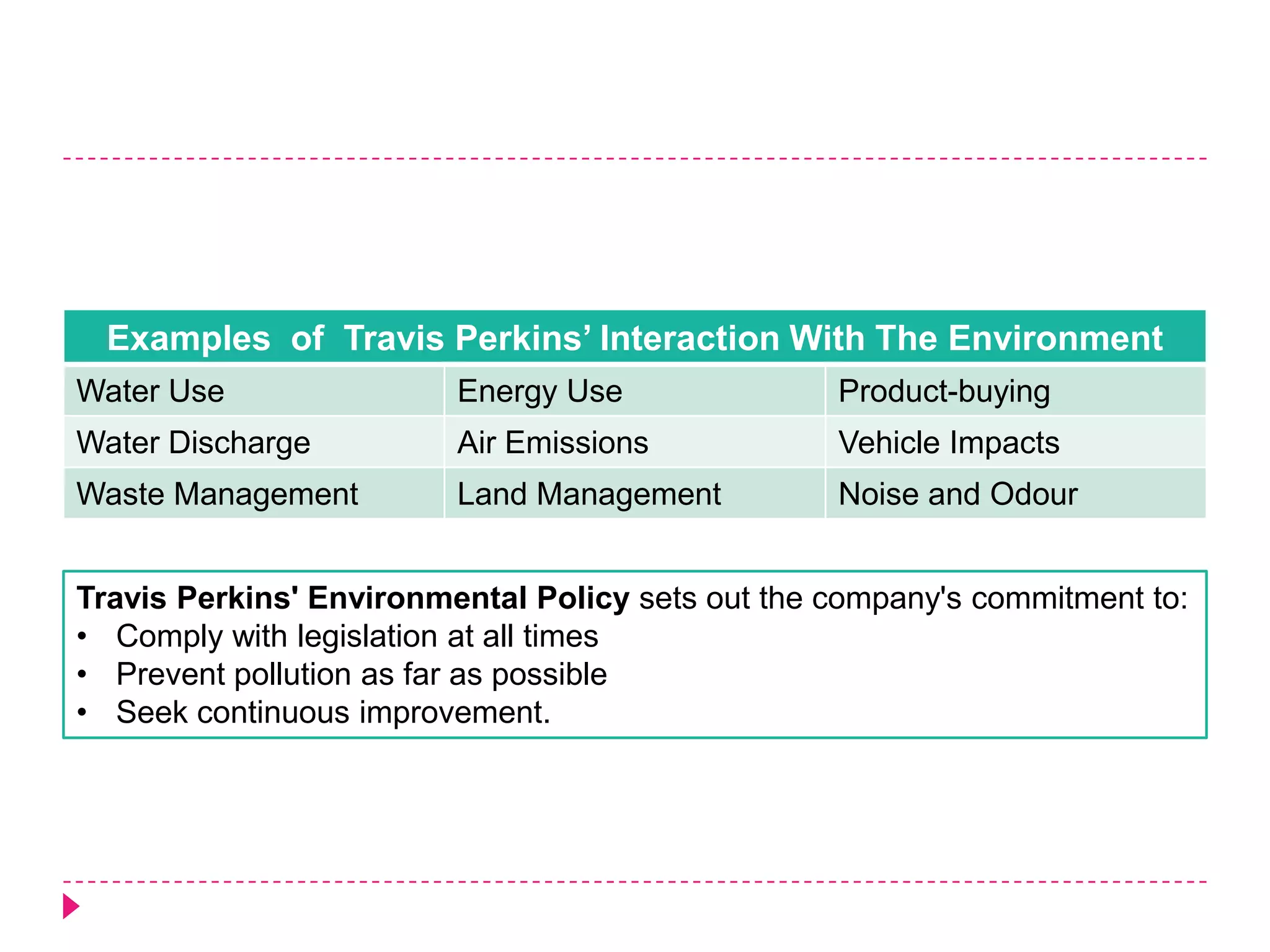
Examples of Travis Perkins’ Interaction With The Environment
Water Use Energy Use Product-buying
Water Discharge Air Emissions Vehicle Impacts
Waste Management Land Management Noise and Odour
Travis Perkins' Environmental Policy sets out the company's commitment to:
• Comply with legislation at all times
• Prevent pollution as far as possible
• Seek continuous improvement.
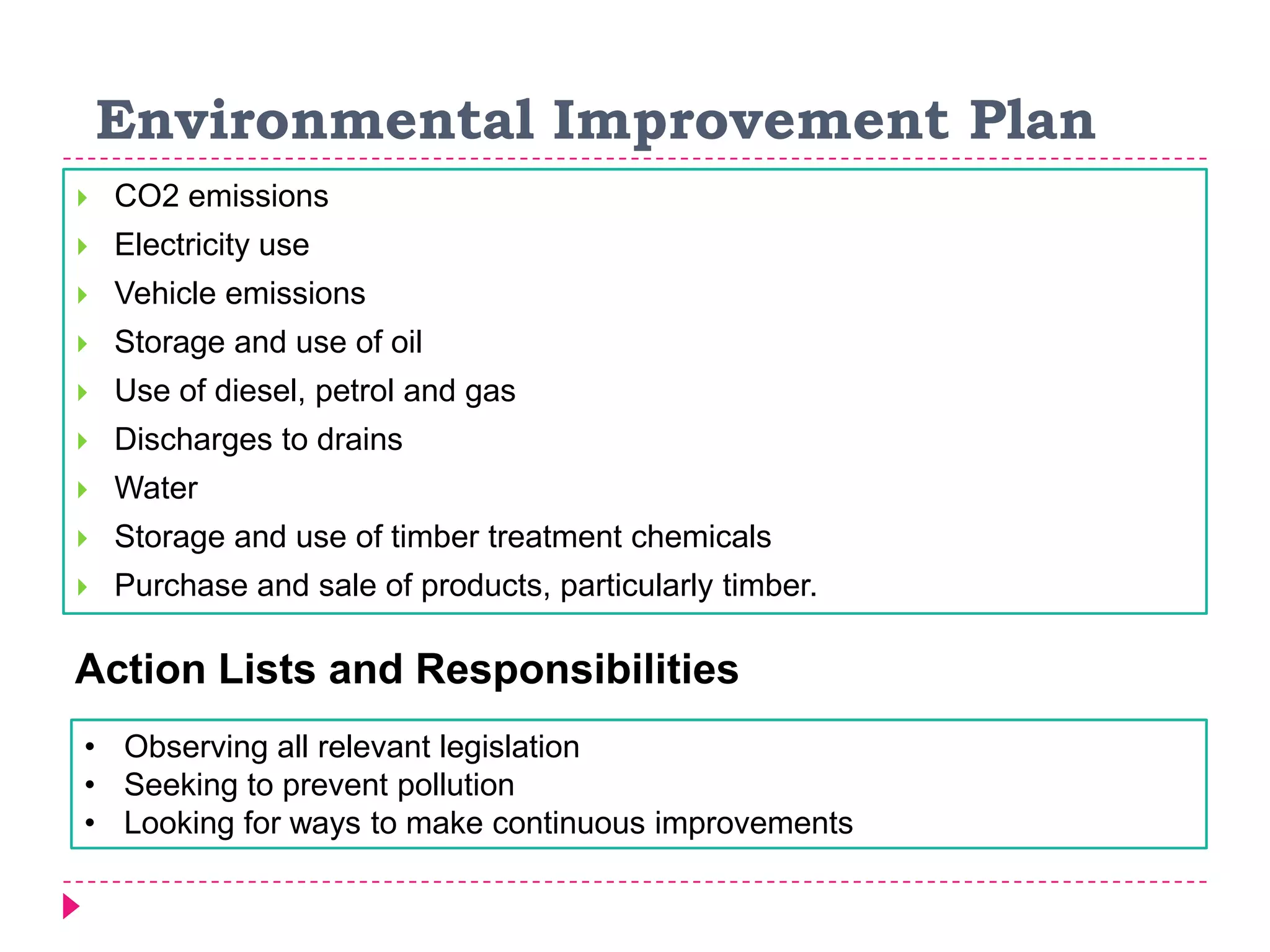
Environmental Improvement Plan
 CO2 emissions
 Electricity use
 Vehicle emissions
 Storage and use of oil
 Use of diesel, petrol and gas
 Discharges to drains
 Water
 Storage and use of timber treatment chemicals
 Purchase and sale of products, particularly timber.
• Observing all relevant legislation
• Seeking to prevent pollution
• Looking for ways to make continuous improvements
Action Lists and Responsibilities
Performance Indicators
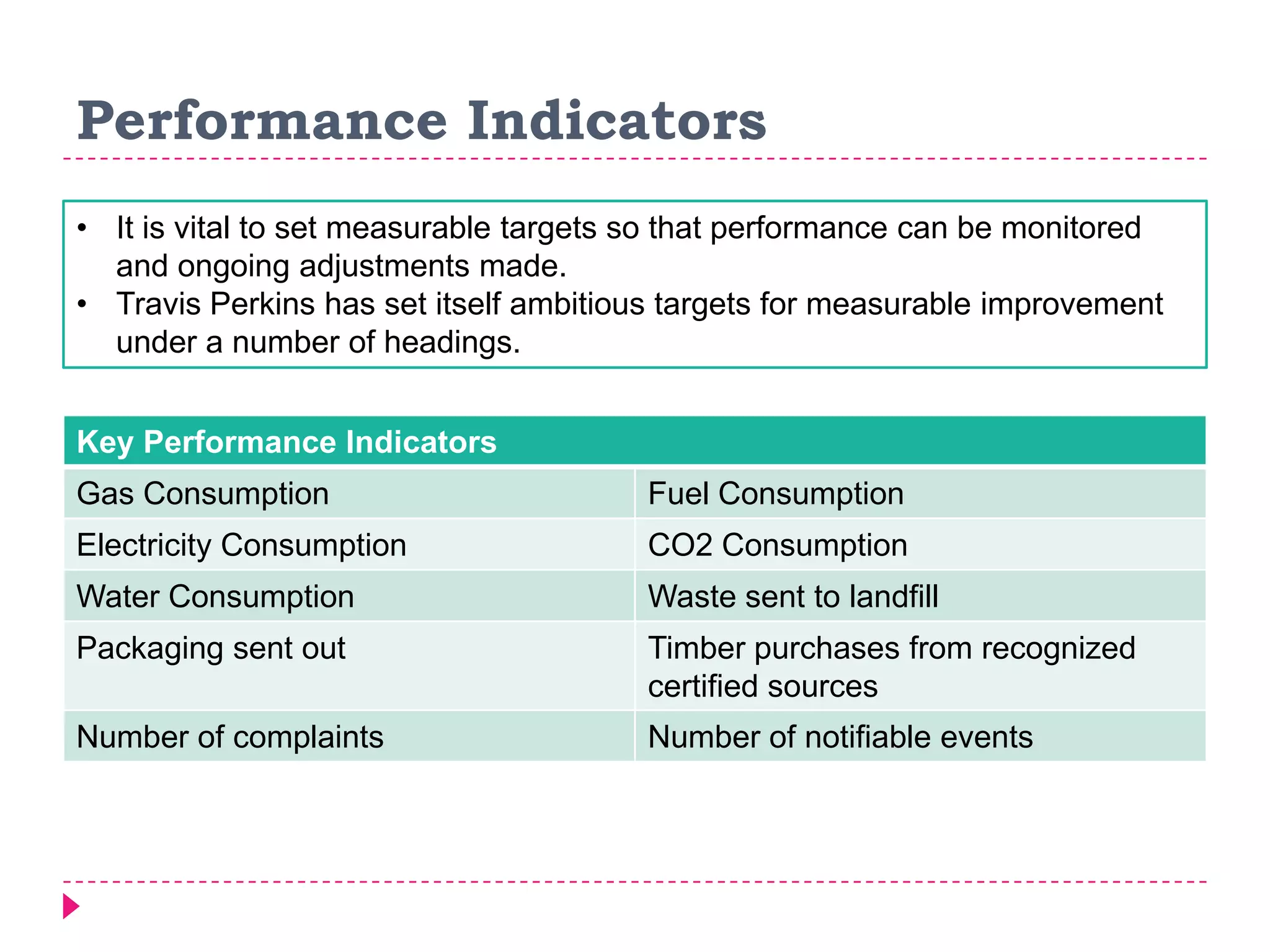
Key Performance Indicators
Gas Consumption Fuel Consumption
Electricity Consumption CO2 Consumption
Water Consumption Waste sent to landfill
Packaging sent out Timber purchases from recognized
certified sources
Number of complaints Number of notifiable events
• It is vital to set measurable targets so that performance can be monitored
and ongoing adjustments made.
• Travis Perkins has set itself ambitious targets for measurable improvement
under a number of headings.
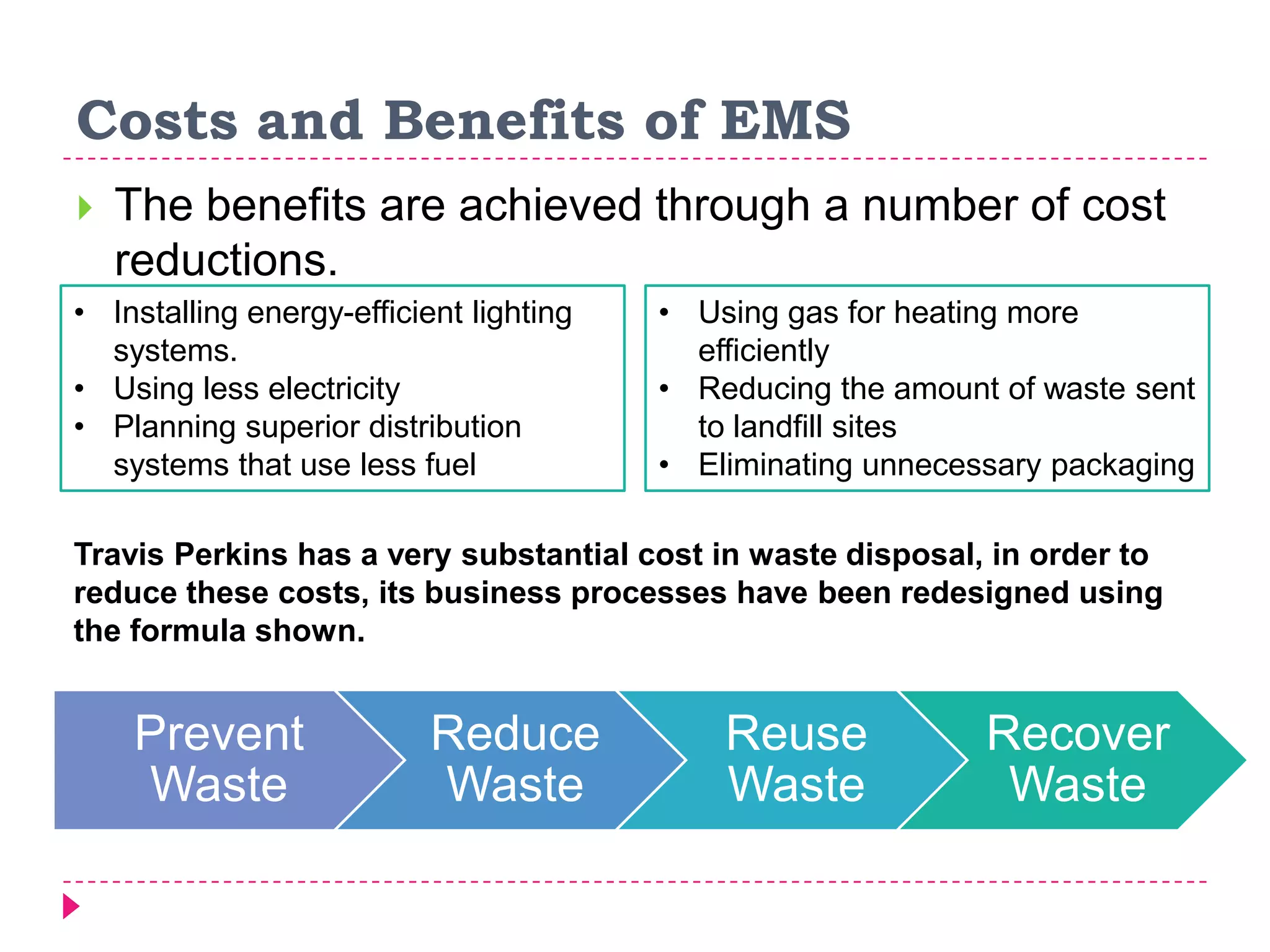
Costs and Benefits of EMS
 The benefits are achieved through a number of cost
reductions.
• Installing energy-efficient lighting
systems.
• Using less electricity
• Planning superior distribution
systems that use less fuel
• Using gas for heating more
efficiently
• Reducing the amount of waste sent
to landfill sites
• Eliminating unnecessary packaging
Travis Perkins has a very substantial cost in waste disposal, in order to
reduce these costs, its business processes have been redesigned using
the formula shown.
Prevent
Waste
Reduce
Waste
Reuse
Waste
Recover
Waste
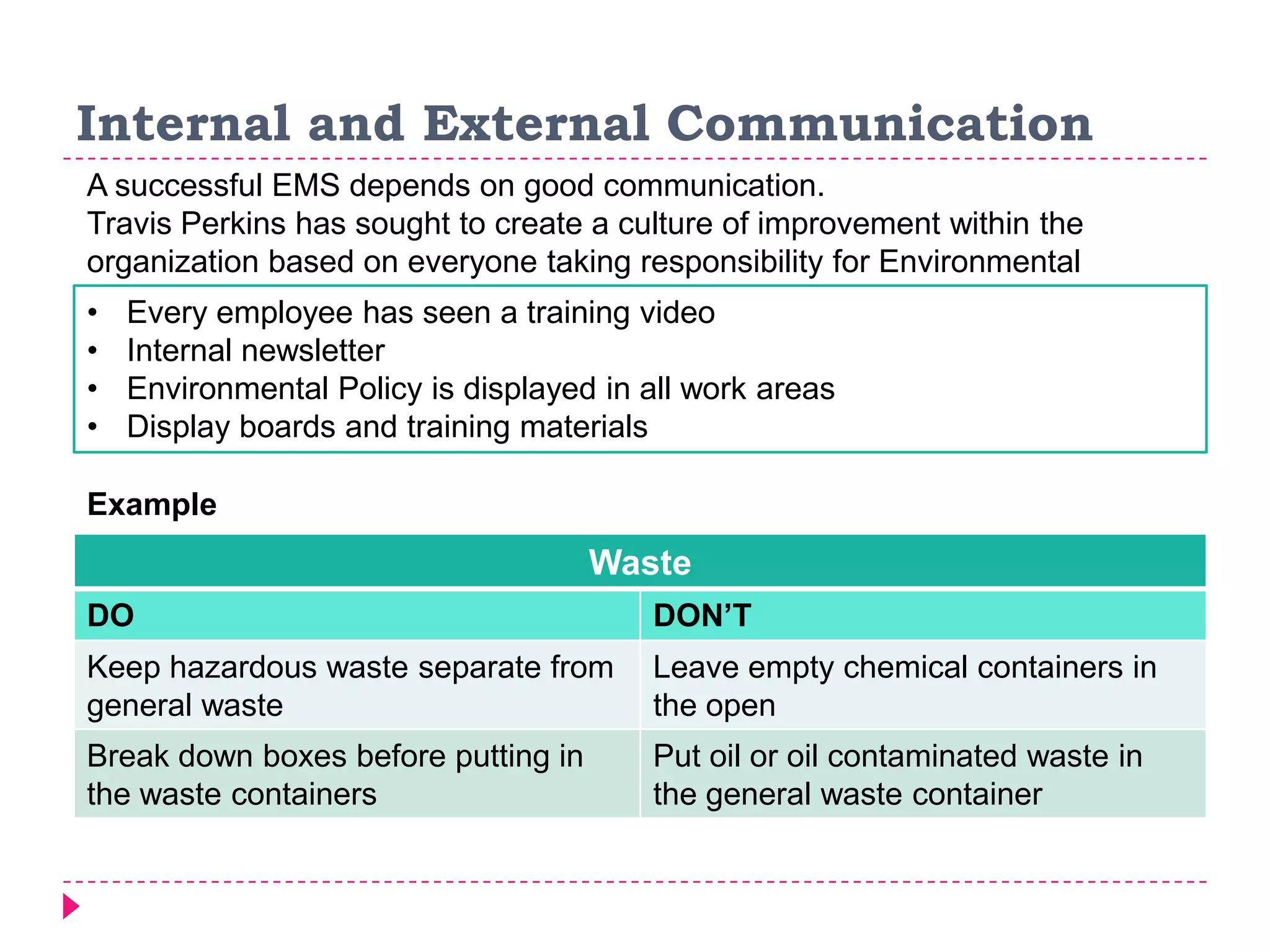
Internal and External Communication
Waste
DO DON’T
Keep hazardous waste separate from
general waste
Leave empty chemical containers in
the open
Break down boxes before putting in
the waste containers
Put oil or oil contaminated waste in
the general waste container
A successful EMS depends on good communication.
Travis Perkins has sought to create a culture of improvement within the
organization based on everyone taking responsibility for Environmental
Management• Every employee has seen a training video
• Internal newsletter
• Environmental Policy is displayed in all work areas
• Display boards and training materials
Example
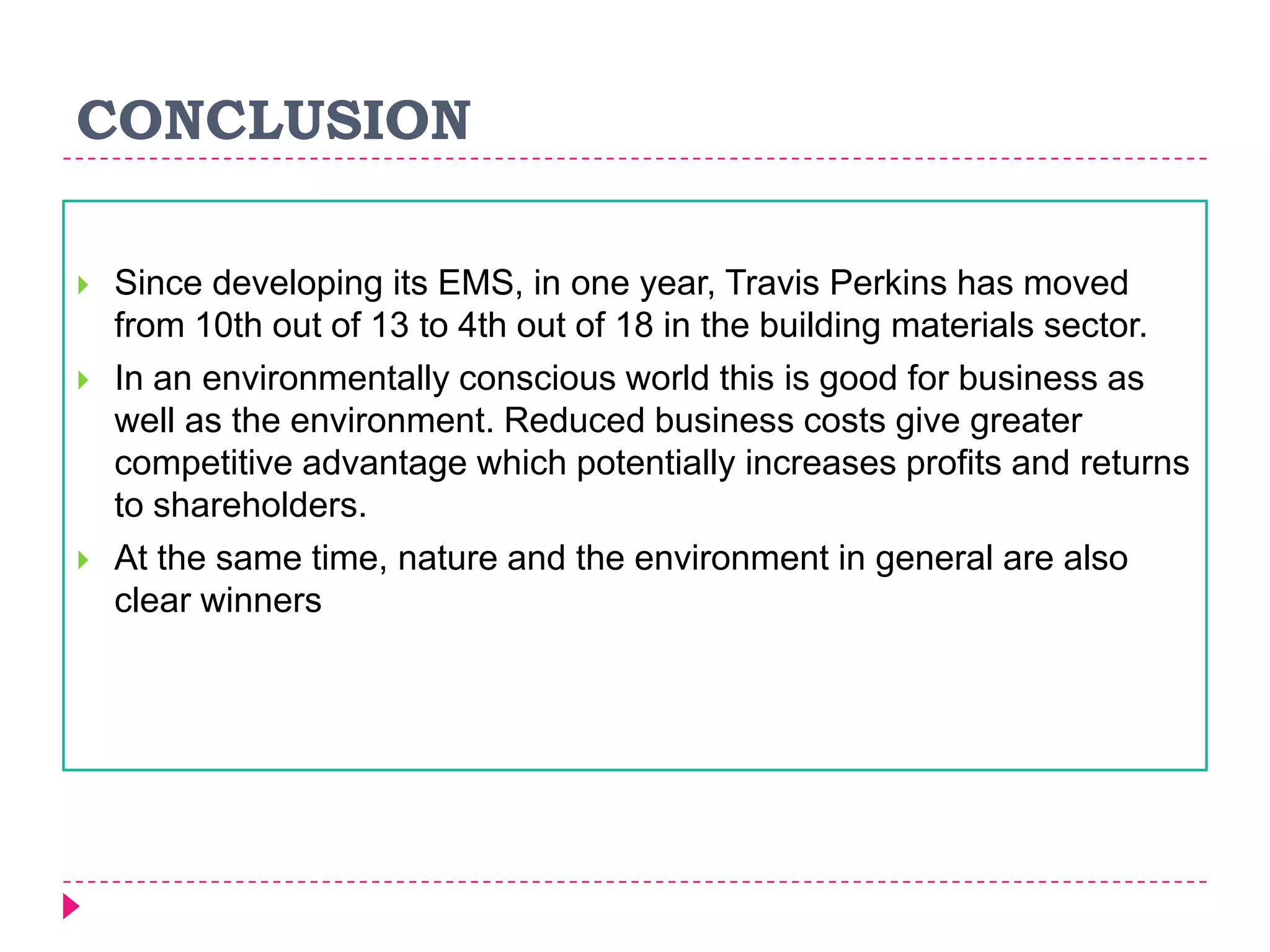
CONCLUSION
 Since developing its EMS, in one year, Travis Perkins has moved
from 10th out of 13 to 4th out of 18 in the building materials sector.
 In an environmentally conscious world this is good for business as
well as the environment. Reduced business costs give greater
competitive advantage which potentially increases profits and returns
to shareholders.
 At the same time, nature and the environment in general are also
clear winners
References
 http://businesscasestudies.co.uk/travis-perkins/how-an-
environmental-management-system-ems-helps-create-a-
sustainable-business.html
 http://www.saskatoon.ca/DEPARTMENTS/Utility%20Services/Enviro
nmental%20Services/PublishingImages/PlanDoCheckAct.jpg
THANK YOU

Environmental Management System

  • 1.
  • 2.
    ENVIRONMENTAL MANAGEMENT SYSTEM (EMS) A set of methods and procedures for aligning corporate strategies, policies and operations with principles that protect ecosystems.  An Environmental Management System identifies and establishes a set of rules and practices to help everyone within an organization to understand and accept how, through their actions, they can best ensure high standards of environmental care.  The term can also refer to software systems for organizational environmental management which means it is intended to be system dependent, not people dependent.
  • 3.
    ISO 14000 ISO 14000is a family of standards related to Environmental management . It refers to a family of voluntary standards and guidance documents to help organizations address environmental issues. Includes:- • Environmental Management Systems (14001,14002,14004) • Environmental Auditing (14010,14011,14012) • Environmental Labeling (14020,14021,14022,14023,14024,14025) • Environmental Performance Evaluation (14031) • Life-cycle Assessment (14040,14041,14042,14043)
  • 4.
    ISO 14001  ISO14001 sets out the criteria for an environmental management system.  It does not state requirements for environmental performance, but maps out a framework that a company or organization can follow to set up an effective environmental management system.  Certification in meeting this standard allows companies to claim state-of-the- art ecological responsibility ISO 14001 is relevant to any organization seeking to improve and manage resources more effectively. This includes: • Single site to large multi-national companies • High risk companies to low risk service organizations • Manufacturing, process and the service industries; including local governments • All industry sectors including public and private sectors • Original equipment manufacturers and their suppliers.
  • 5.
    Purpose of anEMS An EMS brings together the people, policies, plans, review mechanisms, and procedures used to manage environmental issues at a facility or in an organization
  • 6.
    PDCA Model &Core Elements of an Environmental Management System Policy Planning Implemen tation & Operation Checkin g Act Do Act Plan Check • An Environmental Policy • Planning and Strategy that include environmental factors • Identification of impacts on the environment • Development of goals and performance measures • Monitoring and corrective action • Formal stakeholder involvement • Employee awards, incentives and training • A philosophy of continuous improvement
  • 7.
    General Benefits OfAn Ems  Drives Sustained Performance  Set targets to reduce energy use, water use & waste to landfill  Achieve cost savings  Easier compliance  Pollution prevention  Increased efficiency  Improved morale
  • 8.
    TRAVIS PERKINS  TravisPerkins have been supplying building materials to the trade for over 200 years  One of the largest suppliers to the UK’s building and construction industry with a national network of more than 600 branches.  Provide more than 100,000 products to trade professionals including building materials, plumbing and heating, landscaping materials, timber and sheet materials, painting and decorating, dry lining and insulation, doors and joinery, and hand and power tools Travis Perkins fully intends to be a sustainable business. To be sustainable, a business needs to:  Generate profits for its shareholders  Provide good employment conditions for its employees  Trade fairly with its suppliers  Look after the communities in which it operates  Act as a guardian and improver of the environment.
  • 9.
    4 Key Pressures Legal requirements Financial pressures Market pressures Social pressures •The Environment Protection Laws • The Pollution Prevention and Control regulations • Regulations for special wastes such as toxic materials. • Water Resources Act • Britain has some of the world's tightest environmental regulations • Landfill Tax • The Carbon Tax on energy consumption • Many companies will buy only from suppliers that conform with ISO 14001 • Customers insist that timber comes from sustainable sources • Questions on the company's environmental approach. • License to operate • Shareholders will only support if the firm is building a viable future. • The company must maintain its public reputation at a high level. Why does Travis Perkins need an EMS?
  • 10.
    Implementing an Environmental ManagementSystem Registrar of Legislation Environmental Policy Registrar of Environmental Aspects Environmental Management Procedures Environmental Improvement Plan Key Performance Indicators Training Materials Action Lists and Responsibilities Environmental Operating Procedure Travis Perkins chose ISO 14001 as the basis of its Environmental Management System because this standard: • Is internationally recognized and respected • Involves regular independent audits The Travis Perkins ISO 14001 EMS consists of several linked components.
  • 11.
    Examples of TravisPerkins’ Interaction With The Environment Water Use Energy Use Product-buying Water Discharge Air Emissions Vehicle Impacts Waste Management Land Management Noise and Odour Travis Perkins' Environmental Policy sets out the company's commitment to: • Comply with legislation at all times • Prevent pollution as far as possible • Seek continuous improvement.
  • 12.
    Environmental Improvement Plan CO2 emissions  Electricity use  Vehicle emissions  Storage and use of oil  Use of diesel, petrol and gas  Discharges to drains  Water  Storage and use of timber treatment chemicals  Purchase and sale of products, particularly timber. • Observing all relevant legislation • Seeking to prevent pollution • Looking for ways to make continuous improvements Action Lists and Responsibilities
  • 13.
    Performance Indicators Key PerformanceIndicators Gas Consumption Fuel Consumption Electricity Consumption CO2 Consumption Water Consumption Waste sent to landfill Packaging sent out Timber purchases from recognized certified sources Number of complaints Number of notifiable events • It is vital to set measurable targets so that performance can be monitored and ongoing adjustments made. • Travis Perkins has set itself ambitious targets for measurable improvement under a number of headings.
  • 14.
    Costs and Benefitsof EMS  The benefits are achieved through a number of cost reductions. • Installing energy-efficient lighting systems. • Using less electricity • Planning superior distribution systems that use less fuel • Using gas for heating more efficiently • Reducing the amount of waste sent to landfill sites • Eliminating unnecessary packaging Travis Perkins has a very substantial cost in waste disposal, in order to reduce these costs, its business processes have been redesigned using the formula shown. Prevent Waste Reduce Waste Reuse Waste Recover Waste
  • 15.
    Internal and ExternalCommunication Waste DO DON’T Keep hazardous waste separate from general waste Leave empty chemical containers in the open Break down boxes before putting in the waste containers Put oil or oil contaminated waste in the general waste container A successful EMS depends on good communication. Travis Perkins has sought to create a culture of improvement within the organization based on everyone taking responsibility for Environmental Management• Every employee has seen a training video • Internal newsletter • Environmental Policy is displayed in all work areas • Display boards and training materials Example
  • 16.
    CONCLUSION  Since developingits EMS, in one year, Travis Perkins has moved from 10th out of 13 to 4th out of 18 in the building materials sector.  In an environmentally conscious world this is good for business as well as the environment. Reduced business costs give greater competitive advantage which potentially increases profits and returns to shareholders.  At the same time, nature and the environment in general are also clear winners
  • 17.
  • 18.