ENVIRONMENTAL DESIGN- I

      Supraja Irukumati
           KSSEM
         Bangalore
What is an Enivironmental design?

• It is not a new word , it has been part of our ancient architecture if
  we keenly observe engineering challenges were answered with a
  delicate design intelligence in our ancient structures.

Environmental design means technologically feasible, economically
   viable, an integrated approach ….etc many definitions arrive in to
   picture.
An environmental design is a way to show simplicity at each and every
   step of the process to achieve a sustainable and eco-friendly
   results.
Eg: In 500BCE ancient greeks designed their houses to capture the
   solar energy , by building south facing houses and this was followed
   by romans too.
Source of info : wikipedea
IS ED ESSENTIAL ?

• Necessity of ED is a must to protect our environment and
  securing our natural resources to our future generations.
• ED does’nt mean that we can redesign the product and
  processes, again which is an expensive job . ED and it’s
  principles must be applied at the initial stages only.
• ED focus is not only on products and processes but also
  utilitarian oriented.
• Eg. Best examples are some of the rail systems which
  covers a number of counties , results in a good control of
  traffic and fuel consumption. BART(Bay area rapid transit )
  started with covering 4 counties from Sanfransisco ,
  extended up to 9 counties with around 50 stations. The
  design was feasible for extension.
Principles of ED
• Environmental degradation can dampen or reverse the
  economic development. Thus we need some principles
  in environmental design
• 1. Various objectives required in design are taken in to
  account with respect to environmental design
  principles , where economic efficiency and practicality
  are the factors of environmental economics.
• 2.The core environmental objective is overall
  sustainability which includes use of resources , various
  stages of production. The end to end results include
  recycling, Discarding , waste management etc.
• 3. Sustainability is the main focus of ED , the other objectives are
  restoration and enhancement of landscapes.
• 4.Environmental objectives differ from project to project , so it
  should be stated explicitly in detail with respect to the principle
  objectives which needs acceptance from administrators, sponsors
  and designers.
• 5. Environment consists many sectors and it is multi-disciplinary.
  Thus the objectives of ED is also a multi-disciplinary exercise.
• 6. ED need to be designed with a more conscious definition, where
  integrated approach is possible.
• Eg: APPLE had given a detailed report .the following link contains
  it
• http://www.apple.com/in/environment/
Benefits of ED

 1.ED provides more business, by promising a healthy environment with your
    design. Use of ED can create a unique , beautiful appearance too.
2. The basic concepts of ED in any design should be able to
- Reduce environmental impact of product during the process
- Optimize the usage of raw materials and energy
- Mange waste and prevent pollution by gradually improving the conditions
- Cut costs , a economically viable design
- Meet the consumers need by reaching their expectations in terms of
    reasonable price, steady performance and quality of the product.
- Increase the market demand for that particular product.
Benefits of ED

• Benefits of ED cannot be restricted to a
  particular number, there are many
• Eg: environmental benefits of a life cycle
  design of concrete bridges. The following link
  contains the information.
• http://www.nrc-
  cnrc.gc.ca/obj/irc/doc/pubs/nrcc49675/nrcc4
  9675.pdf
Motivation for ED

• Motivation of ED can be implemented in either or both
   the ways of the following
- Internal drives ( with in the company)
- External drives ( with in the immediate surroundings)
 Internal Driving forces are :
- Need for increased product quality
- Image improvement
- Need to reduce costs
- Need to stimulate innovation
- Employee motivation
- Sense of responsibility
Motivation for ED

• External Driving forces are:
-   Government policies
-   Market demand /competiton
-   Trade/industrial organizations
-   Waste charges
-   Environmental requirements for design awards
Motivation for ED
 Conferences on environmental impact can bring much
   awareness and motivate. In jan 2011 national conference
   on green design was held at NEW DELHI. Link to the details.
http://www.grihaindia.org/events/ncgd/overview.php
 Environmental design research association had given great
   places award for SOAK explains mumbai in an estuary. Link
   gives detailed info.
http://www.edra.org/awards-mainmenu-31/great-places-
   awards-mainmenu-187/486-2010-great-places-award-
   winners-announced#SOAK
Like the above there are many examples which will allow
   more invention in ED by motivating.
ED and environmental practices
• Sustainable development is the main consideration during
  economic decission making. The present trend of ED and
  sustainable development plays a vital role in handling
  situations because of more awareness compared to
  previous two decades.
• Government and private organizations, individuals are part
  of the ED and sustainable development.
• Industry ecology is one of the field with more innovations
  which is leading to achieve a sustainable industrial
  production and international economy has been part of the
  process.
• Environmental practices and ED are the main factors in
  preventing pollution.
ED and environmental practices
• By handling the processes carefully at each every step of the
  production , recycling ,waste management is possible to prevent
  pollution.
• Securing natural resources and protecting tourism places is possible
  by introducing the ED and sustainable development. The following
  case study will give a basic idea.
• http://ecosynapsis.net/RANPAold/Contenido/MainPages/preAmac/
  articulosPDF/sustainable_tourism_in_pa_guidelines.pdf
• The following link too provides in handling chemical and gaseous
  wastes , union carbide’s gas leakage in Bhopal is taken as one of the
  major disasters in the world.
• http://ecosynapsis.net/RANPAold/Contenido/MainPages/preAmac/
  articulosPDF/sustainable_tourism_in_pa_guidelines.pdf
Occupational health and safety
• It is a cross disciplinary area linked with safety
  at the work place.
• Legal occupational requirements should be
  included with a serious law so that
  organizations will adhere to the moral
  responsibilities.
• ED can be helpful in this field with many
  strategies.
ED for manufactured products

• Manufacturing a product should promise that it has a life cycle in
  production which reduces environmental impact and economically
  feasible.
• Philips and Wipro with their energy saving methods and products
  are gradually heading to wards a great success.
• As Our book mentions Electrolux is a very good example .
• The various key factors which should be included in the ED and
  production are performance, appearance, manufacturing costs,
  durability, safety, service, ease of manufacture.
• Eureka forbes has their own institute of environment, which is a
  non-profit body is handling their products with a great care.
• http://www.eurekaforbes.com/aboutus/aboutUs-institute-
  environment.aspx
ED considerations in product life
                stages
• ED considerations and stages of life cycle
  varies from product to product, in general the
  following can be considered as implications
- Extraction of raw materials
- Manufacture
- Distribution and transportation
- Use and maintenance
- Disposal
ED tools
• Design for sustainability which requires ED tools to help the
  designers or scientists to insert the environmental
  requirements to complete the design.
• Any eco-design needs to promise a lifecycle assessment
  and sustainability of the product.
• ED follows various strategies like
- Product life extension , reliability and durability
- Extending the process by recycling
- Reduced use of materials
- switching from non-renewable to renewable resources
- Energy efficiency
- Pollution prevention
Environmental cycle assessment(ECA)

• This is the first comprehensive guide to green
  design, economic input-output life cycle
  assessment.
• LCA is a technique in estimating and accessing all
  of the environmental impacts associated with a
  production process .
• LCA is a time consuming process and huge data is
  required .
• The data gathering stage known as life cycle
  inventory(LCI) often gives a promise on
  improvement on its own.
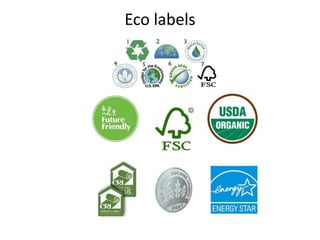
ECO - labelling

•    ECO labelling is broadly classified as
-    Type1
-    Type2
-    Type3

    An eco label is an approved label for green products. An
     eco label provides a authoritative guidance to the
     consumers to choose a product for environmental
     reasons and at the same time an encouragement for
     the product which is eco-friendly.
Eco labels
THANK YOU

Environmental design i

  • 1.
    ENVIRONMENTAL DESIGN- I Supraja Irukumati KSSEM Bangalore
  • 2.
    What is anEnivironmental design? • It is not a new word , it has been part of our ancient architecture if we keenly observe engineering challenges were answered with a delicate design intelligence in our ancient structures. Environmental design means technologically feasible, economically viable, an integrated approach ….etc many definitions arrive in to picture. An environmental design is a way to show simplicity at each and every step of the process to achieve a sustainable and eco-friendly results. Eg: In 500BCE ancient greeks designed their houses to capture the solar energy , by building south facing houses and this was followed by romans too. Source of info : wikipedea
  • 3.
    IS ED ESSENTIAL? • Necessity of ED is a must to protect our environment and securing our natural resources to our future generations. • ED does’nt mean that we can redesign the product and processes, again which is an expensive job . ED and it’s principles must be applied at the initial stages only. • ED focus is not only on products and processes but also utilitarian oriented. • Eg. Best examples are some of the rail systems which covers a number of counties , results in a good control of traffic and fuel consumption. BART(Bay area rapid transit ) started with covering 4 counties from Sanfransisco , extended up to 9 counties with around 50 stations. The design was feasible for extension.
  • 4.
    Principles of ED •Environmental degradation can dampen or reverse the economic development. Thus we need some principles in environmental design • 1. Various objectives required in design are taken in to account with respect to environmental design principles , where economic efficiency and practicality are the factors of environmental economics. • 2.The core environmental objective is overall sustainability which includes use of resources , various stages of production. The end to end results include recycling, Discarding , waste management etc.
  • 5.
    • 3. Sustainabilityis the main focus of ED , the other objectives are restoration and enhancement of landscapes. • 4.Environmental objectives differ from project to project , so it should be stated explicitly in detail with respect to the principle objectives which needs acceptance from administrators, sponsors and designers. • 5. Environment consists many sectors and it is multi-disciplinary. Thus the objectives of ED is also a multi-disciplinary exercise. • 6. ED need to be designed with a more conscious definition, where integrated approach is possible. • Eg: APPLE had given a detailed report .the following link contains it • http://www.apple.com/in/environment/
  • 6.
    Benefits of ED 1.ED provides more business, by promising a healthy environment with your design. Use of ED can create a unique , beautiful appearance too. 2. The basic concepts of ED in any design should be able to - Reduce environmental impact of product during the process - Optimize the usage of raw materials and energy - Mange waste and prevent pollution by gradually improving the conditions - Cut costs , a economically viable design - Meet the consumers need by reaching their expectations in terms of reasonable price, steady performance and quality of the product. - Increase the market demand for that particular product.
  • 7.
    Benefits of ED •Benefits of ED cannot be restricted to a particular number, there are many • Eg: environmental benefits of a life cycle design of concrete bridges. The following link contains the information. • http://www.nrc- cnrc.gc.ca/obj/irc/doc/pubs/nrcc49675/nrcc4 9675.pdf
  • 8.
    Motivation for ED •Motivation of ED can be implemented in either or both the ways of the following - Internal drives ( with in the company) - External drives ( with in the immediate surroundings) Internal Driving forces are : - Need for increased product quality - Image improvement - Need to reduce costs - Need to stimulate innovation - Employee motivation - Sense of responsibility
  • 9.
    Motivation for ED •External Driving forces are: - Government policies - Market demand /competiton - Trade/industrial organizations - Waste charges - Environmental requirements for design awards
  • 10.
    Motivation for ED Conferences on environmental impact can bring much awareness and motivate. In jan 2011 national conference on green design was held at NEW DELHI. Link to the details. http://www.grihaindia.org/events/ncgd/overview.php Environmental design research association had given great places award for SOAK explains mumbai in an estuary. Link gives detailed info. http://www.edra.org/awards-mainmenu-31/great-places- awards-mainmenu-187/486-2010-great-places-award- winners-announced#SOAK Like the above there are many examples which will allow more invention in ED by motivating.
  • 11.
    ED and environmentalpractices • Sustainable development is the main consideration during economic decission making. The present trend of ED and sustainable development plays a vital role in handling situations because of more awareness compared to previous two decades. • Government and private organizations, individuals are part of the ED and sustainable development. • Industry ecology is one of the field with more innovations which is leading to achieve a sustainable industrial production and international economy has been part of the process. • Environmental practices and ED are the main factors in preventing pollution.
  • 12.
    ED and environmentalpractices • By handling the processes carefully at each every step of the production , recycling ,waste management is possible to prevent pollution. • Securing natural resources and protecting tourism places is possible by introducing the ED and sustainable development. The following case study will give a basic idea. • http://ecosynapsis.net/RANPAold/Contenido/MainPages/preAmac/ articulosPDF/sustainable_tourism_in_pa_guidelines.pdf • The following link too provides in handling chemical and gaseous wastes , union carbide’s gas leakage in Bhopal is taken as one of the major disasters in the world. • http://ecosynapsis.net/RANPAold/Contenido/MainPages/preAmac/ articulosPDF/sustainable_tourism_in_pa_guidelines.pdf
  • 13.
    Occupational health andsafety • It is a cross disciplinary area linked with safety at the work place. • Legal occupational requirements should be included with a serious law so that organizations will adhere to the moral responsibilities. • ED can be helpful in this field with many strategies.
  • 14.
    ED for manufacturedproducts • Manufacturing a product should promise that it has a life cycle in production which reduces environmental impact and economically feasible. • Philips and Wipro with their energy saving methods and products are gradually heading to wards a great success. • As Our book mentions Electrolux is a very good example . • The various key factors which should be included in the ED and production are performance, appearance, manufacturing costs, durability, safety, service, ease of manufacture. • Eureka forbes has their own institute of environment, which is a non-profit body is handling their products with a great care. • http://www.eurekaforbes.com/aboutus/aboutUs-institute- environment.aspx
  • 15.
    ED considerations inproduct life stages • ED considerations and stages of life cycle varies from product to product, in general the following can be considered as implications - Extraction of raw materials - Manufacture - Distribution and transportation - Use and maintenance - Disposal
  • 16.
    ED tools • Designfor sustainability which requires ED tools to help the designers or scientists to insert the environmental requirements to complete the design. • Any eco-design needs to promise a lifecycle assessment and sustainability of the product. • ED follows various strategies like - Product life extension , reliability and durability - Extending the process by recycling - Reduced use of materials - switching from non-renewable to renewable resources - Energy efficiency - Pollution prevention
  • 17.
    Environmental cycle assessment(ECA) •This is the first comprehensive guide to green design, economic input-output life cycle assessment. • LCA is a technique in estimating and accessing all of the environmental impacts associated with a production process . • LCA is a time consuming process and huge data is required . • The data gathering stage known as life cycle inventory(LCI) often gives a promise on improvement on its own.
  • 18.
    ECO - labelling • ECO labelling is broadly classified as - Type1 - Type2 - Type3 An eco label is an approved label for green products. An eco label provides a authoritative guidance to the consumers to choose a product for environmental reasons and at the same time an encouragement for the product which is eco-friendly.
  • 19.
  • 20.