WASTE
MANAGEMENT
PROGRAMME: THE
SET UP AND
IMPLEMENTATION
Presented by Joyce Wanjiru Gachugi
Crown Plaza Hotel,
February 10-11th 2011
Structure of presentation
1.PART 1: Waste Management Programmes &
Models
2.PART 2: Data Collection – Process &
Relevance
3.PART 3: Waste Minimization Programme
PART 1 : Waste Management Programmes
& Models
Basis for a Waste Management Programme
●What? – Examine the definition of WMP
●Why? – Examine the relevance of a WMP ; What
is driving the need for WMPs
●How? – Examine the tools & models that are
needed
●Where? – Examine the entire supply chain
●Who? – Examine the responsibility of
implementing a WMP
Waste management programme
●Definition – A detailed, target oriented system,
set up within an organization or institution or
industry to manage waste.
●Relevance - Risk Management, Achieving your
bottom line /3P approach – people, planet, profit,
Occupational, Safety and Health Issue
●Tools – Audits, LCA, BPEO etc
●Scope – Entire supply Chain
●Responsibility – Selected and approved team
Models & Tools
●Life Cycle Assessment (LCA)
●Best Practicable Environmental Options (BPEO)
●Product Lifecycle Management (PLM)
●Eco-Efficiency Assessments (EEA)
●FLIPO Method
●Waste Audit
●Environmental Audit
●Environmental Impact Assessment
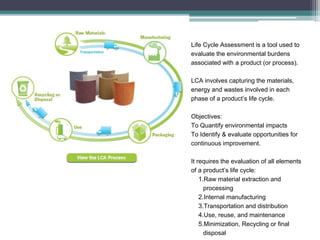
Life Cycle Assessment is a tool used to
evaluate the environmental burdens
associated with a product (or process).
LCA involves capturing the materials,
energy and wastes involved in each
phase of a product’s life cycle.
Objectives:
To Quantify environmental impacts
To Identify & evaluate opportunities for
continuous improvement.
It requires the evaluation of all elements
of a product’s life cycle:
1.Raw material extraction and
processing
2.Internal manufacturing
3.Transportation and distribution
4.Use, reuse, and maintenance
5.Minimization, Recycling or final
disposal
BPEO or BAT
●Best Practicable Environmental Option or Best Available
Technique
●BPEO are a set of procedures adopted in Great Britain
with the goal of managing waste and other
environmental concerns.
●Focuses on a broader scope – more activity based than
product based. (Program Vs. Plan)
●Practicability is based on the option that provides the
most benefits or the least damage to the environment, as
a whole, at acceptable cost, in the long term as well as in
the short term"
Classic BPEO Methodology
●Evaluation of the existing waste system - the capacity,operations
infrastructure, as well as the characteristics of each waste stream.
●Identification of options - Waste management options are identified,
incorporating provincial and national objectives and targets for waste
management, and existing waste management arrangements and
associated legislation.
●Assessment of options – Waste management options are broadly
assessed in terms of environmental, social, economic and
practicability criteria.
●Identification of the BPEO – Offers the current BPEO and Future
BPEO
Affecting your bottom line
●LCA and BPEO are good models to help grow
your bottom line by:
1.Cost cutting – operational, insurance for
employees etc
2.Closing the loop – nutrient, carbon etc
3.Minimizing risks
4.Improving brand perception to consumers
Obtain Management Commitment
●This is the 1st step in the WMP implementation
process.
●Management sets the priorities, assigns key
personnel, and allocates funding for the WMP
activities.
●Lack of top management commitment means a
lack of necessary support & resources for WMP
development and implementation.
How to obtain Committment
●The programme must be seen as vital to the functioning of the
organization and as a positive benefit, in terms of :
1.Financial terms or
2.Measures such as improved regulatory compliance status,
3.Increased production efficiency, or worker protection.
●Provide best practice examples from other industries Inform your top
management that organizations that consistently demonstrate
management support for pollution prevention and environmental
compliance generally performance the highest levels and will be
looked upon as environmental leaders.
●Once management commitment is gained, the commitment and
vision should be clearly communicated across the organization.
PART 2 : Data collection –
Process & Relevance
Data Collection & Assessment
●Is the heart of an effective waste management
programme
●Conducted at three key levels:
1.Preliminary
2.Operational
3.Monitoring
○When setting up a waste minimization
programme, a preliminary assessment must be
done at the onset.
○It forms the foundation for the BASELINE
Preliminary Assessment
●The objective of this activity is to collect all
necessary background information on the
organization’s operation.
●Conducted at the onset – to assess the gaps
that exist, current conditions etc
●Should be very detailed, focusing on all activities
and processes,
●Is announced to the entire work force before
hand,
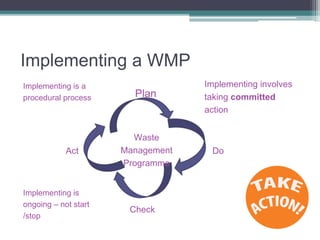
Implementing a WMP
Waste
Management
Programme
Plan
Do
Check
Act
Implementing involves
taking committed
action
Implementing is a
procedural process
Implementing is
ongoing – not start
/stop
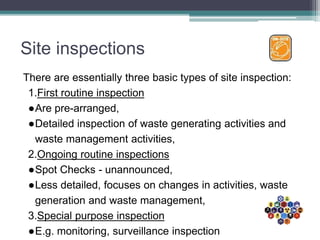
Site inspections
There are essentially three basic types of site inspection:
1.First routine inspection
●Are pre-arranged,
●Detailed inspection of waste generating activities and
waste management activities,
2.Ongoing routine inspections
●Spot Checks - unannounced,
●Less detailed, focuses on changes in activities, waste
generation and waste management,
3.Special purpose inspection
●E.g. monitoring, surveillance inspection
Environmental Evaluation (EE&A)
●Tool used to assess the impact of an activity
within a company/institution/ organization on the
environment,
●It incorporates both social and economic
aspects,
●Pre-determines as well as describes the current
scenario of operations,
●Mainly done for compliance reasons;
●Help identify points of intervention,
EE&A tools
●Include: Environmental Audits, EIAs etc.
●In most instances (Kenya), they does not take on
a cost- benefit analysis approach,
●Stretch your EE& A tools and techniques,
●Compliance is good but it rarely grows your
bottom line,
●Helps to determine which course of action
should be taken, based on which is the most
cost effective,
Environmental Audit
●The key protocol for this lies within the waste
management regulations,
●Is an environmental evaluation tool,
●A waste audit is a procedure for surveying
processes and/or equipment and identifying
waste minimization options,
●Can be conducted through visual audits, waste
characterization, desktop audits etc.
Objectives for an Audit
●Identify each and every gas, liquid and solid waste stream
generated by the industry, using flow diagrams.
●Quantify and characterize every waste stream, a material mass
balance is often a useful tool.
●Establish how and why the waste stream is generated.
●Calculate the costs incurred with pretreatment, storage, handling
and disposal.
●Determine the liabilities associated due to the generation of those
wastes, including compliance with NEMA etc
●Identify options for effective waste management so that a waste
management plan can be developed including waste minimization
potential.
Procedure:
1.Selection of an Audit team
2.Determination of Audit Scope
3.Collection of Preliminary Data
4.Identification and characterization of input materials,
products and waste streams
5.Material Balance
6.Comprehensive plant and environmental analysis
7.Evaluation of data and regulatory compliance
8.Preparation of Waste Audit Report
9.Submission to relevant personnel
PART 3: Waste Minimization Programme
Waste Minimization Programme
●Definition - source reduction practice.
●Objectives
1.To reduce or eliminate waste generation at the source;
2.To entrench environmentally sound recycling practices,
where source reduction is not economically practical.
●"Waste minimization is a "prevention strategy"
rather than an "end-of-pipe" treatment strategy
●Should be viewed as a tool to achieve
continuous environmental improvement, rather
than daily "firefighting“.
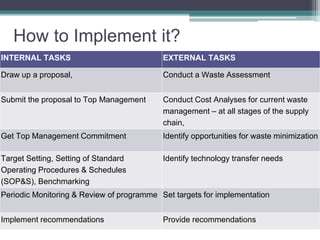
How to Implement it?
INTERNAL TASKS EXTERNAL TASKS
Draw up a proposal, Conduct a Waste Assessment
Submit the proposal to Top Management Conduct Cost Analyses for current waste
management – at all stages of the supply
chain,
Get Top Management Commitment Identify opportunities for waste minimization
Target Setting, Setting of Standard
Operating Procedures & Schedules
(SOP&S), Benchmarking
Identify technology transfer needs
Periodic Monitoring & Review of programme Set targets for implementation
Implement recommendations Provide recommendations
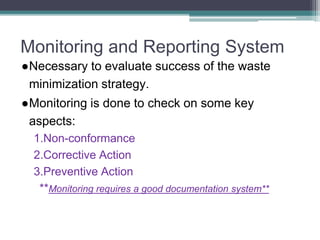
Monitoring and Reporting System
●Necessary to evaluate success of the waste
minimization strategy.
●Monitoring is done to check on some key
aspects:
1.Non-conformance
2.Corrective Action
3.Preventive Action
**Monitoring requires a good documentation system**
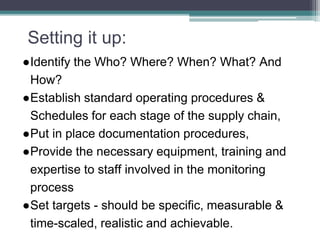
Setting it up:
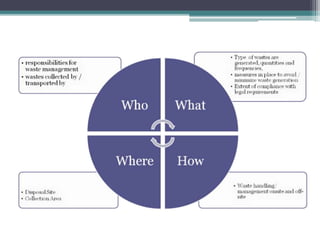
●Identify the Who? Where? When? What? And
How?
●Establish standard operating procedures &
Schedules for each stage of the supply chain,
●Put in place documentation procedures,
●Provide the necessary equipment, training and
expertise to staff involved in the monitoring
process
●Set targets - should be specific, measurable &
time-scaled, realistic and achievable.
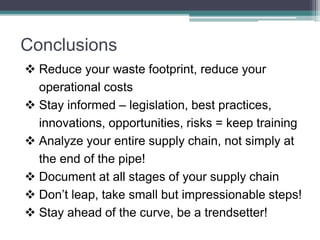
Conclusions
 Reduce your waste footprint, reduce your
operational costs
 Stay informed – legislation, best practices,
innovations, opportunities, risks = keep training
 Analyze your entire supply chain, not simply at
the end of the pipe!
 Document at all stages of your supply chain
 Don’t leap, take small but impressionable steps!
 Stay ahead of the curve, be a trendsetter!
Thank You!!
For any questions, please contact:
Joyce Wanjiru Gachugi
ECM Centre Limited
E-mail: joyce.gachugi@ecmcentre.com
Tel: +254 720 828 621 / +254 734 947882

Set up and implementing an effective wmp

  • 1.
    WASTE MANAGEMENT PROGRAMME: THE SET UPAND IMPLEMENTATION Presented by Joyce Wanjiru Gachugi Crown Plaza Hotel, February 10-11th 2011
  • 2.
    Structure of presentation 1.PART1: Waste Management Programmes & Models 2.PART 2: Data Collection – Process & Relevance 3.PART 3: Waste Minimization Programme
  • 3.
    PART 1 :Waste Management Programmes & Models
  • 4.
    Basis for aWaste Management Programme ●What? – Examine the definition of WMP ●Why? – Examine the relevance of a WMP ; What is driving the need for WMPs ●How? – Examine the tools & models that are needed ●Where? – Examine the entire supply chain ●Who? – Examine the responsibility of implementing a WMP
  • 5.
    Waste management programme ●Definition– A detailed, target oriented system, set up within an organization or institution or industry to manage waste. ●Relevance - Risk Management, Achieving your bottom line /3P approach – people, planet, profit, Occupational, Safety and Health Issue ●Tools – Audits, LCA, BPEO etc ●Scope – Entire supply Chain ●Responsibility – Selected and approved team
  • 6.
    Models & Tools ●LifeCycle Assessment (LCA) ●Best Practicable Environmental Options (BPEO) ●Product Lifecycle Management (PLM) ●Eco-Efficiency Assessments (EEA) ●FLIPO Method ●Waste Audit ●Environmental Audit ●Environmental Impact Assessment
  • 7.
    Life Cycle Assessmentis a tool used to evaluate the environmental burdens associated with a product (or process). LCA involves capturing the materials, energy and wastes involved in each phase of a product’s life cycle. Objectives: To Quantify environmental impacts To Identify & evaluate opportunities for continuous improvement. It requires the evaluation of all elements of a product’s life cycle: 1.Raw material extraction and processing 2.Internal manufacturing 3.Transportation and distribution 4.Use, reuse, and maintenance 5.Minimization, Recycling or final disposal
  • 8.
    BPEO or BAT ●BestPracticable Environmental Option or Best Available Technique ●BPEO are a set of procedures adopted in Great Britain with the goal of managing waste and other environmental concerns. ●Focuses on a broader scope – more activity based than product based. (Program Vs. Plan) ●Practicability is based on the option that provides the most benefits or the least damage to the environment, as a whole, at acceptable cost, in the long term as well as in the short term"
  • 9.
    Classic BPEO Methodology ●Evaluationof the existing waste system - the capacity,operations infrastructure, as well as the characteristics of each waste stream. ●Identification of options - Waste management options are identified, incorporating provincial and national objectives and targets for waste management, and existing waste management arrangements and associated legislation. ●Assessment of options – Waste management options are broadly assessed in terms of environmental, social, economic and practicability criteria. ●Identification of the BPEO – Offers the current BPEO and Future BPEO
  • 10.
    Affecting your bottomline ●LCA and BPEO are good models to help grow your bottom line by: 1.Cost cutting – operational, insurance for employees etc 2.Closing the loop – nutrient, carbon etc 3.Minimizing risks 4.Improving brand perception to consumers
  • 11.
    Obtain Management Commitment ●Thisis the 1st step in the WMP implementation process. ●Management sets the priorities, assigns key personnel, and allocates funding for the WMP activities. ●Lack of top management commitment means a lack of necessary support & resources for WMP development and implementation.
  • 12.
    How to obtainCommittment ●The programme must be seen as vital to the functioning of the organization and as a positive benefit, in terms of : 1.Financial terms or 2.Measures such as improved regulatory compliance status, 3.Increased production efficiency, or worker protection. ●Provide best practice examples from other industries Inform your top management that organizations that consistently demonstrate management support for pollution prevention and environmental compliance generally performance the highest levels and will be looked upon as environmental leaders. ●Once management commitment is gained, the commitment and vision should be clearly communicated across the organization.
  • 13.
    PART 2 :Data collection – Process & Relevance
  • 14.
    Data Collection &Assessment ●Is the heart of an effective waste management programme ●Conducted at three key levels: 1.Preliminary 2.Operational 3.Monitoring ○When setting up a waste minimization programme, a preliminary assessment must be done at the onset. ○It forms the foundation for the BASELINE
  • 15.
    Preliminary Assessment ●The objectiveof this activity is to collect all necessary background information on the organization’s operation. ●Conducted at the onset – to assess the gaps that exist, current conditions etc ●Should be very detailed, focusing on all activities and processes, ●Is announced to the entire work force before hand,
  • 17.
    Implementing a WMP Waste Management Programme Plan Do Check Act Implementinginvolves taking committed action Implementing is a procedural process Implementing is ongoing – not start /stop
  • 18.
    Site inspections There areessentially three basic types of site inspection: 1.First routine inspection ●Are pre-arranged, ●Detailed inspection of waste generating activities and waste management activities, 2.Ongoing routine inspections ●Spot Checks - unannounced, ●Less detailed, focuses on changes in activities, waste generation and waste management, 3.Special purpose inspection ●E.g. monitoring, surveillance inspection
  • 20.
    Environmental Evaluation (EE&A) ●Toolused to assess the impact of an activity within a company/institution/ organization on the environment, ●It incorporates both social and economic aspects, ●Pre-determines as well as describes the current scenario of operations, ●Mainly done for compliance reasons; ●Help identify points of intervention,
  • 21.
    EE&A tools ●Include: EnvironmentalAudits, EIAs etc. ●In most instances (Kenya), they does not take on a cost- benefit analysis approach, ●Stretch your EE& A tools and techniques, ●Compliance is good but it rarely grows your bottom line, ●Helps to determine which course of action should be taken, based on which is the most cost effective,
  • 22.
    Environmental Audit ●The keyprotocol for this lies within the waste management regulations, ●Is an environmental evaluation tool, ●A waste audit is a procedure for surveying processes and/or equipment and identifying waste minimization options, ●Can be conducted through visual audits, waste characterization, desktop audits etc.
  • 23.
    Objectives for anAudit ●Identify each and every gas, liquid and solid waste stream generated by the industry, using flow diagrams. ●Quantify and characterize every waste stream, a material mass balance is often a useful tool. ●Establish how and why the waste stream is generated. ●Calculate the costs incurred with pretreatment, storage, handling and disposal. ●Determine the liabilities associated due to the generation of those wastes, including compliance with NEMA etc ●Identify options for effective waste management so that a waste management plan can be developed including waste minimization potential.
  • 24.
    Procedure: 1.Selection of anAudit team 2.Determination of Audit Scope 3.Collection of Preliminary Data 4.Identification and characterization of input materials, products and waste streams 5.Material Balance 6.Comprehensive plant and environmental analysis 7.Evaluation of data and regulatory compliance 8.Preparation of Waste Audit Report 9.Submission to relevant personnel
  • 25.
    PART 3: WasteMinimization Programme
  • 26.
    Waste Minimization Programme ●Definition- source reduction practice. ●Objectives 1.To reduce or eliminate waste generation at the source; 2.To entrench environmentally sound recycling practices, where source reduction is not economically practical. ●"Waste minimization is a "prevention strategy" rather than an "end-of-pipe" treatment strategy ●Should be viewed as a tool to achieve continuous environmental improvement, rather than daily "firefighting“.
  • 27.
    How to Implementit? INTERNAL TASKS EXTERNAL TASKS Draw up a proposal, Conduct a Waste Assessment Submit the proposal to Top Management Conduct Cost Analyses for current waste management – at all stages of the supply chain, Get Top Management Commitment Identify opportunities for waste minimization Target Setting, Setting of Standard Operating Procedures & Schedules (SOP&S), Benchmarking Identify technology transfer needs Periodic Monitoring & Review of programme Set targets for implementation Implement recommendations Provide recommendations
  • 28.
    Monitoring and ReportingSystem ●Necessary to evaluate success of the waste minimization strategy. ●Monitoring is done to check on some key aspects: 1.Non-conformance 2.Corrective Action 3.Preventive Action **Monitoring requires a good documentation system**
  • 29.
    Setting it up: ●Identifythe Who? Where? When? What? And How? ●Establish standard operating procedures & Schedules for each stage of the supply chain, ●Put in place documentation procedures, ●Provide the necessary equipment, training and expertise to staff involved in the monitoring process ●Set targets - should be specific, measurable & time-scaled, realistic and achievable.
  • 30.
    Conclusions  Reduce yourwaste footprint, reduce your operational costs  Stay informed – legislation, best practices, innovations, opportunities, risks = keep training  Analyze your entire supply chain, not simply at the end of the pipe!  Document at all stages of your supply chain  Don’t leap, take small but impressionable steps!  Stay ahead of the curve, be a trendsetter!
  • 31.
    Thank You!! For anyquestions, please contact: Joyce Wanjiru Gachugi ECM Centre Limited E-mail: joyce.gachugi@ecmcentre.com Tel: +254 720 828 621 / +254 734 947882