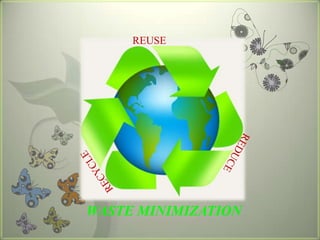
REUSE


WASTE MINIMIZATION
E-WASTE                             IRON WASTE
What is waste ?
        Waste includes all items that people no
       longer have any use for, which they either
          intend to get rid of or have already
                       discarded


 HOUSE CLEEN WASTE                      BIO-WASTE
What Is Minimization ?
         The act of reducing something to the least
          possible amount or degree or position.


                            D
                            E
                            C
  High waste                R
                            E          Low waste
                            A
                            S
What Is Waste Minimization?
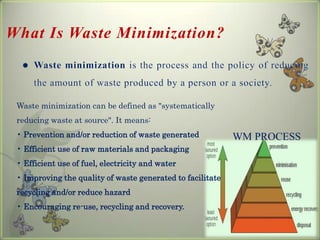
     Waste minimization is the process and the policy of reducing
      the amount of waste produced by a person or a society.

 Waste minimization can be defined as "systematically
 reducing waste at source". It means:
 • Prevention and/or reduction of waste generated           WM PROCESS
 • Efficient use of raw materials and packaging
 • Efficient use of fuel, electricity and water
 • Improving the quality of waste generated to facilitate
 recycling and/or reduce hazard
 • Encouraging re-use, recycling and recovery.
Environmental Legislation
   The Air (Prevention and Control of Pollution) Act, 1981.
   The Environment (Protection) Act, 1986.
   The Hazardous Waste (Management & Handling) Rules,
    1989.
   The National Environmental Tribunal Act, 1995.
   The Biomedical Waste (Management & Handling) Rules,
    1998.
   The Municipal Solid Waste (Management & Handling)
    Rules, 2000.
Categories of bio medical waste:
 Category                Waste category                            Treatment & disposal
 number                                                                  option
    1                Human Anatomical Waste                         Incineration / deep burial
                 (human tissues, organs, body parts)

    2                       Animal Waste                            Incineration / deep burial
            (animal tissues, organs, body parts carcasses,
            bleeding parts, fluid, blood and experimental
            animals used in research, waste generated by
             veterinary hospitals colleges, discharge from
                       hospitals animal houses)

    3            Microbiology & Biotechnology Waste              Local autoclaving /micro waving
              (wastes from laboratory cultures, stocks or                 / incineration
            specimens of micro-organism live or attenuated
            vaccines, human and animal cell culture used )

    4                       Waste Sharps                                  Disinfections
            (needles, syringes, scalpels, blades, glass, etc.)


    5             Discarded Medical and Cytotoxic                Incineration / destruction drugs
                Drugs (wastes comprising or updated,               disposal insecured landfills
               contaminated and is carded medicines)
Category                Waste category                          Treatment & disposal
number                                                                option

   6                          Solid Waste                              Incineration /
                (Items contaminated with blood, and                    Autoclaving /
                     body, fluids including cotton,                    Micro waving
                    dressings, soiled plaster casts,

   7                        Solid Waste                               Disinfections by
                 (wastes generated from disposable                  chemical treatment
                 items other than the waste sharps
                    Such as tubing‘s, catheters)

   8                       Liquid Waste                               Disinfections by
                 (waste generated from laboratory )                 chemical treatment


   9                       Incineration Ash                     Disposal in municipal landfill
           (ash from incineration of any bio-medical waste )

   10                     Chemical Waste                          Chemical treatment and
             (chemical used in production of biological,          discharge into drains for
           chemicals used in disinfections, as insecticides,   liquids and secured landfill for
                                 etc)                                       solids
COLOR CODING OF WASTE CATEGORIES :
        Color Coding       Type of Container and    Treatment options as per
                              Waste Category              Schedule I

Yellow                   Plastic bag Cat. 1, Cat. 2, Incineration/deep burial
                         and Cat. 3, Cat. 6.


Red                      Disinfected                Autoclaving/Microwavin
                         container/plastic bag      g/ Chemical Treatment
                         Cat. 3, Cat. 6, Cat.7.

Blue/White translucent   Plastic bag/puncture       Autoclaving/Microwavin
                         proof Cat. 4, Cat. 7.      g/ Chemical Treatment
                         Container                  and
                                                    destruction/shredding

Black                    Plastic bag Cat. 5 and     Disposal in secured
                         Cat. 9 and Cat. 10.        landfill
                         (solid)
SCHEDULE IV
                                     (see Rule 6)
             LABEL FOR TRANSPORT OF BIO-MEDICAL WASTE
                              CONTAINERS/BAGS
                   Day ............ Month ..............Year ...........
                       Date of generation ...................
Waste category No ........
Waste class ……………….
Waste description ………………..
Sender's Name & Address Receiver's Name & Address
Phone No ........ Phone No ...............
Telex No .... Telex No ...............
Fax No ............... Fax No .................
Contact Person ........ Contact Person .........
In case of emergency please contact
Name & Address :
Phone No. ……....
Note : Label shall be non-washable and prominently visible.
Implementation of
      BIO-MEDICAL WASTE RULES 1998

Health care waste includes
    Waste generated by the health care facilities
    Research facilities
    Laboratories

Biomedical waste in hospitals
    85% are non-infectious
    10% are infectious
    5% are hazardous
WM TECHNIQUES:
Modification
      of the waste generation
                               WM TECHNIQUES
process in order to transform the wasted
material of wasted materials in the instructions, supervision, awareness
  Reuse into a material that can same
                             Working be
  process or for another useful application
reused or recycled for another application training of workforce would
                             and regular
           RECYCLING                   SOURCE            PRODUCTION
within or the industry.
  within outside the company.
                           facilitate good housekeeping. MODIFICATION
                                    REDUCTION
      Modifications of the working procedures,technology, processing
                           Replacement of the machine-
  Substitution of input materialsprocess record keeping in in order to
      operating of existing and of eco- synthesis route, Good house-
                           sequence by
    Modificationinstructions production equipment and
          Onsite             Creation and/or Process
  friendly material the processes atwaste and emission generation can be
                              useful by Characteristics of the keeping
      order to and preferably havinghigher change
       recovery run        minimize      longer efficiency and   product
    utilities, for instance, by the addition of measuring
  service reuse waste generation and emissions. minimize the environmental
           time.
      with lower devices .
                              products  modified to
                           during production.
    and controlling
                                        impacts of its production or those of the
                                     product itself during or after its use
                    Input            (disposal). Equipment
                                   Better                         Technology
                   material       process        modification       change
                   change         control
How to Minimize Waste :
Waste can be minimized by looking at:
Inputs    ------- (for example, energy and raw materials)
Processes ------- (controlling them and improving them)
Outputs   ------- (for example, end products, solid waste, water and
                    effluent, waste raw materials, heat and energy losses)


A Waste Minimization Initiative should effectively manage all aspects of a
business’s waste.
What are the Benefits of Waste Minimization?
     Minimizing waste will help the business to:

          Keep waste disposal costs down.

          Keep raw material costs down.

          Comply with legislation.

          Reduce impact on the environment.

          Perhaps support other businesses – one business’s waste
           may be another business’s resource.
WASTE PRODUCTION:

             nappies &
              sanitary
                             plastic
                3%
                               8%
                     paper              organic
                      7%                  27%


               potentially
               hazardous
                  14%
                                                  glass
  rubber                                           4%
    1%
         textailes                     rubble
                                        16%
non-ferrous 4%
  metal ferrous metal
   1%        4%       timber, 11%
   AVSEQ01.DAT
Thank
you......
providing such an
 OPPURTUNITY

Waste minimization

  • 1.
  • 2.
    E-WASTE IRON WASTE What is waste ?  Waste includes all items that people no longer have any use for, which they either intend to get rid of or have already discarded HOUSE CLEEN WASTE BIO-WASTE
  • 3.
    What Is Minimization?  The act of reducing something to the least possible amount or degree or position. D E C High waste R E Low waste A S
  • 4.
    What Is WasteMinimization?  Waste minimization is the process and the policy of reducing the amount of waste produced by a person or a society. Waste minimization can be defined as "systematically reducing waste at source". It means: • Prevention and/or reduction of waste generated WM PROCESS • Efficient use of raw materials and packaging • Efficient use of fuel, electricity and water • Improving the quality of waste generated to facilitate recycling and/or reduce hazard • Encouraging re-use, recycling and recovery.
  • 5.
    Environmental Legislation  The Air (Prevention and Control of Pollution) Act, 1981.  The Environment (Protection) Act, 1986.  The Hazardous Waste (Management & Handling) Rules, 1989.  The National Environmental Tribunal Act, 1995.  The Biomedical Waste (Management & Handling) Rules, 1998.  The Municipal Solid Waste (Management & Handling) Rules, 2000.
  • 6.
    Categories of biomedical waste: Category Waste category Treatment & disposal number option 1 Human Anatomical Waste Incineration / deep burial (human tissues, organs, body parts) 2 Animal Waste Incineration / deep burial (animal tissues, organs, body parts carcasses, bleeding parts, fluid, blood and experimental animals used in research, waste generated by veterinary hospitals colleges, discharge from hospitals animal houses) 3 Microbiology & Biotechnology Waste Local autoclaving /micro waving (wastes from laboratory cultures, stocks or / incineration specimens of micro-organism live or attenuated vaccines, human and animal cell culture used ) 4 Waste Sharps Disinfections (needles, syringes, scalpels, blades, glass, etc.) 5 Discarded Medical and Cytotoxic Incineration / destruction drugs Drugs (wastes comprising or updated, disposal insecured landfills contaminated and is carded medicines)
  • 7.
    Category Waste category Treatment & disposal number option 6 Solid Waste Incineration / (Items contaminated with blood, and Autoclaving / body, fluids including cotton, Micro waving dressings, soiled plaster casts, 7 Solid Waste Disinfections by (wastes generated from disposable chemical treatment items other than the waste sharps Such as tubing‘s, catheters) 8 Liquid Waste Disinfections by (waste generated from laboratory ) chemical treatment 9 Incineration Ash Disposal in municipal landfill (ash from incineration of any bio-medical waste ) 10 Chemical Waste Chemical treatment and (chemical used in production of biological, discharge into drains for chemicals used in disinfections, as insecticides, liquids and secured landfill for etc) solids
  • 8.
    COLOR CODING OFWASTE CATEGORIES : Color Coding Type of Container and Treatment options as per Waste Category Schedule I Yellow Plastic bag Cat. 1, Cat. 2, Incineration/deep burial and Cat. 3, Cat. 6. Red Disinfected Autoclaving/Microwavin container/plastic bag g/ Chemical Treatment Cat. 3, Cat. 6, Cat.7. Blue/White translucent Plastic bag/puncture Autoclaving/Microwavin proof Cat. 4, Cat. 7. g/ Chemical Treatment Container and destruction/shredding Black Plastic bag Cat. 5 and Disposal in secured Cat. 9 and Cat. 10. landfill (solid)
  • 9.
    SCHEDULE IV (see Rule 6) LABEL FOR TRANSPORT OF BIO-MEDICAL WASTE CONTAINERS/BAGS Day ............ Month ..............Year ........... Date of generation ................... Waste category No ........ Waste class ………………. Waste description ……………….. Sender's Name & Address Receiver's Name & Address Phone No ........ Phone No ............... Telex No .... Telex No ............... Fax No ............... Fax No ................. Contact Person ........ Contact Person ......... In case of emergency please contact Name & Address : Phone No. …….... Note : Label shall be non-washable and prominently visible.
  • 10.
    Implementation of BIO-MEDICAL WASTE RULES 1998 Health care waste includes  Waste generated by the health care facilities  Research facilities  Laboratories Biomedical waste in hospitals  85% are non-infectious  10% are infectious  5% are hazardous
  • 11.
    WM TECHNIQUES: Modification of the waste generation WM TECHNIQUES process in order to transform the wasted material of wasted materials in the instructions, supervision, awareness Reuse into a material that can same Working be process or for another useful application reused or recycled for another application training of workforce would and regular RECYCLING SOURCE PRODUCTION within or the industry. within outside the company. facilitate good housekeeping. MODIFICATION REDUCTION Modifications of the working procedures,technology, processing Replacement of the machine- Substitution of input materialsprocess record keeping in in order to operating of existing and of eco- synthesis route, Good house- sequence by Modificationinstructions production equipment and Onsite Creation and/or Process friendly material the processes atwaste and emission generation can be useful by Characteristics of the keeping order to and preferably havinghigher change recovery run minimize longer efficiency and product utilities, for instance, by the addition of measuring service reuse waste generation and emissions. minimize the environmental time. with lower devices . products modified to during production. and controlling impacts of its production or those of the product itself during or after its use Input (disposal). Equipment Better Technology material process modification change change control
  • 12.
    How to MinimizeWaste : Waste can be minimized by looking at: Inputs ------- (for example, energy and raw materials) Processes ------- (controlling them and improving them) Outputs ------- (for example, end products, solid waste, water and effluent, waste raw materials, heat and energy losses) A Waste Minimization Initiative should effectively manage all aspects of a business’s waste.
  • 13.
    What are theBenefits of Waste Minimization? Minimizing waste will help the business to:  Keep waste disposal costs down.  Keep raw material costs down.  Comply with legislation.  Reduce impact on the environment.  Perhaps support other businesses – one business’s waste may be another business’s resource.
  • 14.
    WASTE PRODUCTION: nappies & sanitary plastic 3% 8% paper organic 7% 27% potentially hazardous 14% glass rubber 4% 1% textailes rubble 16% non-ferrous 4% metal ferrous metal 1% 4% timber, 11%
  • 15.
    AVSEQ01.DAT
  • 17.