Submitted by :
Anjan jyoti Bharali (ENE13004)
Arnab jyoti Konwar (ENE13022)
Babu Bikash Gogoi (ENE13011)
Dudul Das (ENE13002)
Shantanu Deka (ENE13023)
Swarangsat basumatari (ENE13019)
Carbon Cycle
Nature’s sources of CO2 are self regulating - which is released will be used again
Plants take in and store CO2 from the atmosphere through photosynthesis
Below ground microbes decompose organic matter and release organic
carbon back into the atmosphere
Anthropogenic carbon is not part of natures cycle (is in excess)
www.bom.gov.au/.../ change/gallery/9.shtml
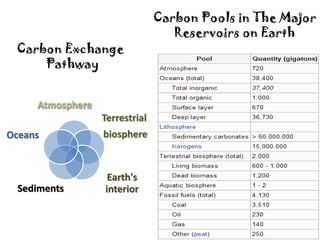
Carbon Pools in The Major
Reservoirs on Earth
Atmosphere
Terrestrial
biosphere
Earth's
interiorSediments
Oceans
Carbon Exchange
Pathway
Role of Carbon in the Environment
• Carbon based molecules are essentially there in the
biosphere
• Carbon (C) along with Oxygen (O2) constitute Carbon
dioxide (CO2)
• 0.03 % of the natural atmosphere is CO2
• Plants use this CO2 to perform photosynthesis
• CO2 causes Green House Effect, which keeps the
atmospheric temperature at 60°F
Then, how Carbon is a THREAT ?
Emission from anthropogenic sources amplify the GHG
concentration in the atmosphere and hence the Greenhouse Effect
causing Global Warming
Where Humanity’s CO2 comes from ?
Where Humanity’s CO2 goes?
World Carbon Emission
GHG Concentration in the Atmosphere
Global Atmospheric Temperature Variation
Some Upcoming Effects
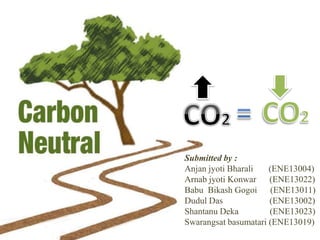
What is Carbon Neutrality?
Net ZERO Carbon emission
Wikipedia : Carbon Neutral, or having a net zero
carbon footprint, refers to achieving net zero carbon
emissions by balancing a measured amount of
carbon released with an equivalent amount
sequestered or offset, or buying enough carbon
credits to make up the difference.
Carbon Footprint
"A measure of the total
amount of CO2 and CH4
emissions of a defined
population, system or activity,
considering all relevant
sources, sinks and storage
within the spatial and
temporal boundary of the
population, system or activity
of interest. Calculated as
carbon dioxide
equivalent (CO2e) using the
relevant 100 year global
warming potential (GWP100)”
- journal Carbon Management by
Wright, Kemp, and Williams
Carbon Sequestration
 "The process of removing carbon from the atmosphere and
depositing it in a reservoir“
-"Glossary of climate change acronyms“, UNFCCC
 This may also be referred to as CO2 removal, which is a form
of geo-engineering.
 CO2 sequestration refers to large-scale, permanent artificial
capture and sequestration of industrially produced CO2 using
subsurface saline aquifers, reservoirs, ocean water, aging oil
fields or other carbon sinks.
Carbon Offset
Collins English Dictionary : A compensatory measure
made by an individual or company for carbon
emissions, usually through sponsoring activities or
projects which increase carbon dioxide absorption,
such as tree planting
Wikipedia : A carbon offset is a reduction in
emissions of carbon dioxide or greenhouse
gases made in order to compensate for or to offset
an emission made elsewhere
Carbon Credit
A carbon credit is a generic term for any tradable
certificate or permit representing the right to emit
1 tonne of CO2 or the mass of another greenhouse
gas with a carbon dioxide equivalent (CO2e)
equivalent to 1 tonne of CO2
a component of national and international attempts
to mitigate the growth in concentrations of GHGs
1 carbon credit is equal to 1 metric tonne of CO2, or
in some markets, CO2e gases
How to achieve Carbon Neutrality?
Reduce the Carbon Footprint till Zero net emission is achieved
If every individual does that, Global Carbon Neutrality will be
achieved
Steps to reduce Carbon Footprint
Measure the
total Carbon
Footprint
Setting
the Target
Manage
or reduce
direct
emissions
Offset the
balance of what
can’t be reduced
Key sectors to be considered
Energy
Transport
Industry
Waste Management
Agriculture
Reduction & Offset approaches
Efficient energy uses; better
technology
Shifting towards Renewable
energy sources
Introduction of Carbon-Capture
technologies in large and small
industries
Afforestation / reforestation
International, national, local
level government policies
Voluntary initiative by the
common mass
Approach from the grass-root level
At Individual Level
Turn off lights, television, computer etc. when not in
use.
Use energy efficient appliances.
Fill the kettle with only as much water as you need.
Do your weekly shopping in a single trip.
Plant trees.
At the Office
No more plastic disposable cups! Let everyone
bring in a mug or a glass from their home, and wash
it in the restroom.
Power down when you leave, from lights to
computers, everything should be off when you leave
the office.
Transportation
Use the bus or a train rather than your car.
For short journeys either walk or cycle.
Try to reduce the number of flights you take.
Next time you replace your car - check out diesel
engines. With one of these you can even make your
own Biodiesel fuel.
Do NOT…
Do…
Carbon neutral
Carbon neutral

Carbon neutral

  • 1.
    Submitted by : Anjanjyoti Bharali (ENE13004) Arnab jyoti Konwar (ENE13022) Babu Bikash Gogoi (ENE13011) Dudul Das (ENE13002) Shantanu Deka (ENE13023) Swarangsat basumatari (ENE13019)
  • 2.
  • 3.
    Nature’s sources ofCO2 are self regulating - which is released will be used again Plants take in and store CO2 from the atmosphere through photosynthesis Below ground microbes decompose organic matter and release organic carbon back into the atmosphere Anthropogenic carbon is not part of natures cycle (is in excess) www.bom.gov.au/.../ change/gallery/9.shtml
  • 4.
    Carbon Pools inThe Major Reservoirs on Earth Atmosphere Terrestrial biosphere Earth's interiorSediments Oceans Carbon Exchange Pathway
  • 5.
    Role of Carbonin the Environment • Carbon based molecules are essentially there in the biosphere • Carbon (C) along with Oxygen (O2) constitute Carbon dioxide (CO2) • 0.03 % of the natural atmosphere is CO2 • Plants use this CO2 to perform photosynthesis • CO2 causes Green House Effect, which keeps the atmospheric temperature at 60°F
  • 6.
    Then, how Carbonis a THREAT ? Emission from anthropogenic sources amplify the GHG concentration in the atmosphere and hence the Greenhouse Effect causing Global Warming Where Humanity’s CO2 comes from ? Where Humanity’s CO2 goes?
  • 7.
  • 8.
    GHG Concentration inthe Atmosphere
  • 9.
  • 10.
  • 14.
    What is CarbonNeutrality? Net ZERO Carbon emission Wikipedia : Carbon Neutral, or having a net zero carbon footprint, refers to achieving net zero carbon emissions by balancing a measured amount of carbon released with an equivalent amount sequestered or offset, or buying enough carbon credits to make up the difference.
  • 15.
    Carbon Footprint "A measureof the total amount of CO2 and CH4 emissions of a defined population, system or activity, considering all relevant sources, sinks and storage within the spatial and temporal boundary of the population, system or activity of interest. Calculated as carbon dioxide equivalent (CO2e) using the relevant 100 year global warming potential (GWP100)” - journal Carbon Management by Wright, Kemp, and Williams
  • 16.
    Carbon Sequestration  "Theprocess of removing carbon from the atmosphere and depositing it in a reservoir“ -"Glossary of climate change acronyms“, UNFCCC  This may also be referred to as CO2 removal, which is a form of geo-engineering.  CO2 sequestration refers to large-scale, permanent artificial capture and sequestration of industrially produced CO2 using subsurface saline aquifers, reservoirs, ocean water, aging oil fields or other carbon sinks.
  • 18.
    Carbon Offset Collins EnglishDictionary : A compensatory measure made by an individual or company for carbon emissions, usually through sponsoring activities or projects which increase carbon dioxide absorption, such as tree planting Wikipedia : A carbon offset is a reduction in emissions of carbon dioxide or greenhouse gases made in order to compensate for or to offset an emission made elsewhere
  • 19.
    Carbon Credit A carboncredit is a generic term for any tradable certificate or permit representing the right to emit 1 tonne of CO2 or the mass of another greenhouse gas with a carbon dioxide equivalent (CO2e) equivalent to 1 tonne of CO2 a component of national and international attempts to mitigate the growth in concentrations of GHGs 1 carbon credit is equal to 1 metric tonne of CO2, or in some markets, CO2e gases
  • 20.
    How to achieveCarbon Neutrality? Reduce the Carbon Footprint till Zero net emission is achieved If every individual does that, Global Carbon Neutrality will be achieved
  • 21.
    Steps to reduceCarbon Footprint Measure the total Carbon Footprint Setting the Target Manage or reduce direct emissions Offset the balance of what can’t be reduced
  • 22.
    Key sectors tobe considered Energy Transport Industry Waste Management Agriculture
  • 23.
    Reduction & Offsetapproaches Efficient energy uses; better technology Shifting towards Renewable energy sources Introduction of Carbon-Capture technologies in large and small industries Afforestation / reforestation International, national, local level government policies Voluntary initiative by the common mass
  • 24.
    Approach from thegrass-root level At Individual Level Turn off lights, television, computer etc. when not in use. Use energy efficient appliances. Fill the kettle with only as much water as you need. Do your weekly shopping in a single trip. Plant trees.
  • 25.
    At the Office Nomore plastic disposable cups! Let everyone bring in a mug or a glass from their home, and wash it in the restroom. Power down when you leave, from lights to computers, everything should be off when you leave the office.
  • 26.
    Transportation Use the busor a train rather than your car. For short journeys either walk or cycle. Try to reduce the number of flights you take. Next time you replace your car - check out diesel engines. With one of these you can even make your own Biodiesel fuel.
  • 27.
  • 28.