VARDHMAN SPECIAL STEELS
IDENTIFICATION OF KEY AREAS FOR CUSTOMER LEVEL IMPROVEMENT
IN A COMPLEX SUPPLY CHAIN
UNDER THE GUIDANCE OF
Mr. Rakesh Arora( HOD PPC)
Industries in 1980’s
During 1980’s quality improvement became important with improved
sales and profit performance.
Current Situation
• Now a days industries have been showing great commitment to
customers.
• Manufacturing skills are no longer key asset, customer service level
has been recognized as strategic value.
• Keep customer happy.
Key area of Service level improvement
Performance of supply chain is measured through two key performance
indicators when it comes to customer deliveries.
• FFCOFR(First fully confirmed order fulfilment rate): Related to delivery
ability. It measure whether industry can promise customer that his
order will be fulfilled given his requirement.
• OTIF( On time in full): Measures how reliable industry is in delivering
the customer the given quantity on time.
What is OTIF?
"Getting the right stuff to the right place at the right time, in the right location on the jobsite, in the right
condition with the right invoice–all day, every day."
• OTIF measures the whole company and the performance at each step.
• This isn't simply an operations report card;
• OTIF is a roll-up measure.
• To perform well on OTIF, everything that goes into it has to be correct.
The take-off and order entries have to be correct;
Purchasing has to maintain appropriate inventory levels;
Material has to be handled correctly, pulled correctly,
ON TIME:
• On-time is defined as delivering the order to the customer when you
promised.
• The measurement is the commitment the organization made, not
necessarily the time the customer requested
IN FULL:
• In-full measures order accuracy. It counts as in-full when everything
ordered is delivered with no errors, backorders, or substitutions.
Why OTIF?
The greatest value in measuring OTIF is that it allows you to see at a
glance how the company is doing.
Companies that measure and manage OTIF are unanimous in the value
of doing so. That value includes
• Reduced time lost to mistakes
• Time spent trying to locate materials
• Elimination of missing directions for drivers
• Increased accuracy, and so much more.
Calculation of OTIF:
Requirements for the OTIF measurement are:
• Have a delivery date (even hour for some organizations) on the
customer order.
• Measure the date or the hour of delivery and archive it in the system
• Maintain record of the reasons why an order was not OTIF.
Generally OTIF is calculated by taking into account the number of
deliveries:
OTIF ( % ) = number of deliveries OTIF ÷ total number of deliveries * 100
But he can also, according to organizations, be calculated according to
the number of orders or the number of the order lines.
•
Reasons for OTIF failure:
As OTIF performance is measured, failures and the reasons for them
are tracked. Generally these fall into four categories: vendor issues,
customer issues, internal issues, or other.
Vendor: includes late shipments, partial shipments, or wrong items
sent.
Customer: includes wrong delivery information provided by the
customer, last-minute changes/ add-ons.
Internal: includes sales order entry mistakes, inadequate time allowed
for special orders, inventory out-of-stocks, manufacturing error,
delivery error.
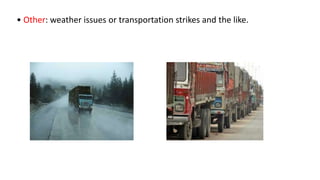
• Other: weather issues or transportation strikes and the like.
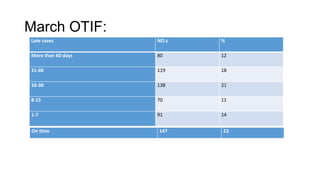
March OTIF:
Late cases NO.s %
More than 60 days 80 12
31-60 119 18
16-30 138 21
8-15 70 11
1-7 91 14
On time 147 23
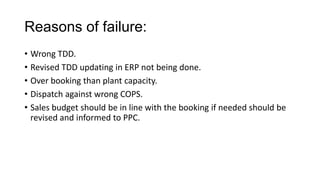
Reasons of failure:
• Wrong TDD.
• Revised TDD updating in ERP not being done.
• Over booking than plant capacity.
• Dispatch against wrong COPS.
• Sales budget should be in line with the booking if needed should be
revised and informed to PPC.
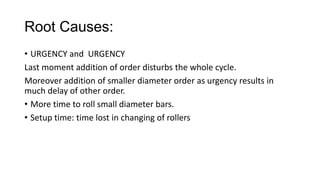
Root Causes:
• URGENCY and URGENCY
Last moment addition of order disturbs the whole cycle.
Moreover addition of smaller diameter order as urgency results in
much delay of other order.
• More time to roll small diameter bars.
• Setup time: time lost in changing of rollers
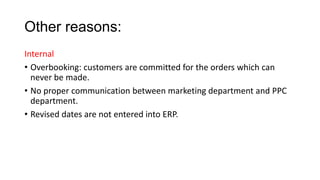
Other reasons:
Internal
• Overbooking: customers are committed for the orders which can
never be made.
• No proper communication between marketing department and PPC
department.
• Revised dates are not entered into ERP.
Hidden cause:
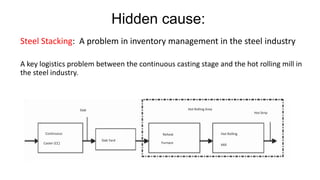
Steel Stacking: A problem in inventory management in the steel industry
A key logistics problem between the continuous casting stage and the hot rolling mill in
the steel industry.
Continuous
Caster (CC)
Slab
Slab Yard
Reheat
Furnace
Hot Rolling Area
Hot Rolling
Hot Strip
Mill
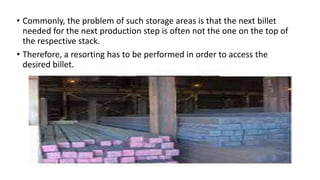
• Commonly, the problem of such storage areas is that the next billet
needed for the next production step is often not the one on the top of
the respective stack.
• Therefore, a resorting has to be performed in order to access the
desired billet.
Solutions:
• Before committing any special small order, marketing department
should inform PPC and ask if it is feasible.
• Proper calculation for time loss to be made if we are making any
special order. This time must include setup time lost due to changing
of rollers.
• Some time customer keep on extending the date of delivery and this
led to rise of inventory level on warehouses. So keep reminding
customer to take off their order and pay the remaining amount.
Work to do.
• Material requirement planning.
• To calculate how much raw material to order and at what point of
time it should be ordered.
• Study of MPS.
• Study of BOM for different grades.
• Lot sizing policy for all parts.
• Safety stock requirement.

Supply chain imporvement

  • 1.
    VARDHMAN SPECIAL STEELS IDENTIFICATIONOF KEY AREAS FOR CUSTOMER LEVEL IMPROVEMENT IN A COMPLEX SUPPLY CHAIN UNDER THE GUIDANCE OF Mr. Rakesh Arora( HOD PPC)
  • 2.
    Industries in 1980’s During1980’s quality improvement became important with improved sales and profit performance.
  • 3.
    Current Situation • Nowa days industries have been showing great commitment to customers. • Manufacturing skills are no longer key asset, customer service level has been recognized as strategic value. • Keep customer happy.
  • 4.
    Key area ofService level improvement Performance of supply chain is measured through two key performance indicators when it comes to customer deliveries. • FFCOFR(First fully confirmed order fulfilment rate): Related to delivery ability. It measure whether industry can promise customer that his order will be fulfilled given his requirement. • OTIF( On time in full): Measures how reliable industry is in delivering the customer the given quantity on time.
  • 5.
    What is OTIF? "Gettingthe right stuff to the right place at the right time, in the right location on the jobsite, in the right condition with the right invoice–all day, every day."
  • 6.
    • OTIF measuresthe whole company and the performance at each step. • This isn't simply an operations report card; • OTIF is a roll-up measure. • To perform well on OTIF, everything that goes into it has to be correct. The take-off and order entries have to be correct; Purchasing has to maintain appropriate inventory levels; Material has to be handled correctly, pulled correctly,
  • 7.
    ON TIME: • On-timeis defined as delivering the order to the customer when you promised. • The measurement is the commitment the organization made, not necessarily the time the customer requested
  • 8.
    IN FULL: • In-fullmeasures order accuracy. It counts as in-full when everything ordered is delivered with no errors, backorders, or substitutions.
  • 9.
    Why OTIF? The greatestvalue in measuring OTIF is that it allows you to see at a glance how the company is doing. Companies that measure and manage OTIF are unanimous in the value of doing so. That value includes • Reduced time lost to mistakes • Time spent trying to locate materials • Elimination of missing directions for drivers • Increased accuracy, and so much more.
  • 10.
    Calculation of OTIF: Requirementsfor the OTIF measurement are: • Have a delivery date (even hour for some organizations) on the customer order. • Measure the date or the hour of delivery and archive it in the system • Maintain record of the reasons why an order was not OTIF.
  • 11.
    Generally OTIF iscalculated by taking into account the number of deliveries: OTIF ( % ) = number of deliveries OTIF ÷ total number of deliveries * 100 But he can also, according to organizations, be calculated according to the number of orders or the number of the order lines. •
  • 12.
    Reasons for OTIFfailure: As OTIF performance is measured, failures and the reasons for them are tracked. Generally these fall into four categories: vendor issues, customer issues, internal issues, or other. Vendor: includes late shipments, partial shipments, or wrong items sent. Customer: includes wrong delivery information provided by the customer, last-minute changes/ add-ons. Internal: includes sales order entry mistakes, inadequate time allowed for special orders, inventory out-of-stocks, manufacturing error, delivery error.
  • 13.
    • Other: weatherissues or transportation strikes and the like.
  • 14.
    March OTIF: Late casesNO.s % More than 60 days 80 12 31-60 119 18 16-30 138 21 8-15 70 11 1-7 91 14 On time 147 23
  • 15.
    Reasons of failure: •Wrong TDD. • Revised TDD updating in ERP not being done. • Over booking than plant capacity. • Dispatch against wrong COPS. • Sales budget should be in line with the booking if needed should be revised and informed to PPC.
  • 16.
    Root Causes: • URGENCYand URGENCY Last moment addition of order disturbs the whole cycle. Moreover addition of smaller diameter order as urgency results in much delay of other order. • More time to roll small diameter bars. • Setup time: time lost in changing of rollers
  • 17.
    Other reasons: Internal • Overbooking:customers are committed for the orders which can never be made. • No proper communication between marketing department and PPC department. • Revised dates are not entered into ERP.
  • 18.
    Hidden cause: Steel Stacking:A problem in inventory management in the steel industry A key logistics problem between the continuous casting stage and the hot rolling mill in the steel industry. Continuous Caster (CC) Slab Slab Yard Reheat Furnace Hot Rolling Area Hot Rolling Hot Strip Mill
  • 19.
    • Commonly, theproblem of such storage areas is that the next billet needed for the next production step is often not the one on the top of the respective stack. • Therefore, a resorting has to be performed in order to access the desired billet.
  • 20.
    Solutions: • Before committingany special small order, marketing department should inform PPC and ask if it is feasible. • Proper calculation for time loss to be made if we are making any special order. This time must include setup time lost due to changing of rollers. • Some time customer keep on extending the date of delivery and this led to rise of inventory level on warehouses. So keep reminding customer to take off their order and pay the remaining amount.
  • 21.
    Work to do. •Material requirement planning. • To calculate how much raw material to order and at what point of time it should be ordered. • Study of MPS. • Study of BOM for different grades. • Lot sizing policy for all parts. • Safety stock requirement.