WASTE MINIMISATION –
ENVIRONMENTAL IMPERATIVES
by
Vishal Duggal
Alliance Engineers
7812/5, Passi Road, PATIALA (Punjab).
Ph.: 98766 05933, 98 140 059 33
email: visduggal@gmail.com; mailto@allianceers.com
for
National Productivity
Council
Chandigarh
CICU
Ludhiana
Resource Depletion
 Natural resources – Renewable and Non-renewable
 Resource depletion – exhaustion of resources/
materials from a region
 Use of resources beyond their rate of replacement
 Using resources in an unmanaged and unplanned
manner – causes pollution
Sustainable Development
“Development that meets the needs of the present without
compromising the ability of future generations to meet
their own needs”
Bruntland Report, 1987
Waste Minimisation – WHAT?
The policy and processes to have waste
minimization means to reduce the production
of waste at society and individual level
 Harvesting of resources
 Processing and production operations
 Distribution
 Consumption
 Reject handling and disposal
Waste Minimisation applies to all resources
 Natural or man-made
 Material or energy
Processes/Operations
INPUTS OUTPUTS REJECTS
 Materials
 Water
 Energy
 Products –
material
 Bye-products –
material
 Energy
 Losses
 Pollutants – solid,
liquid, gaseous,
noise, odours
 Waste energy
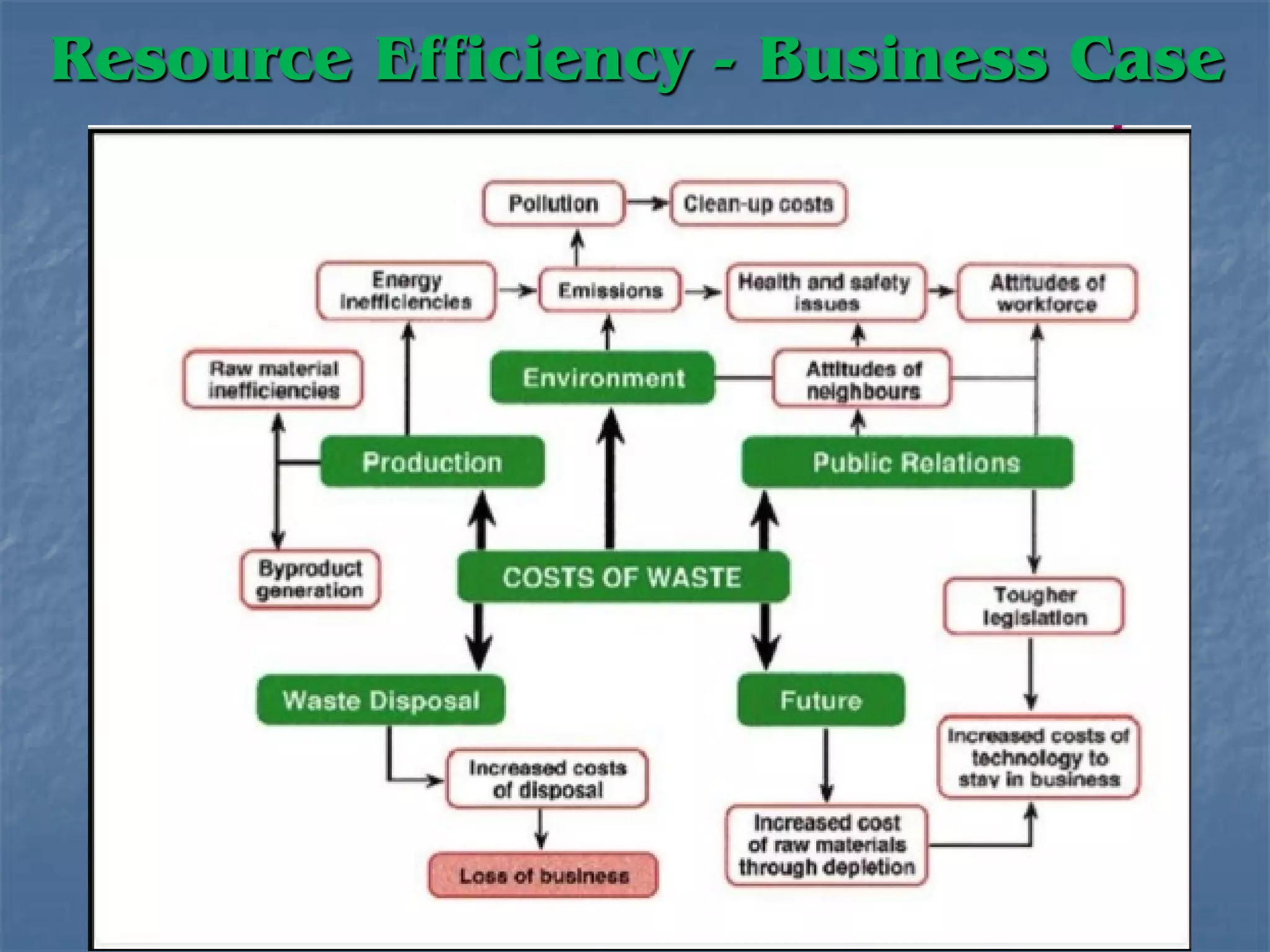
Resource Efficiency - Business Case
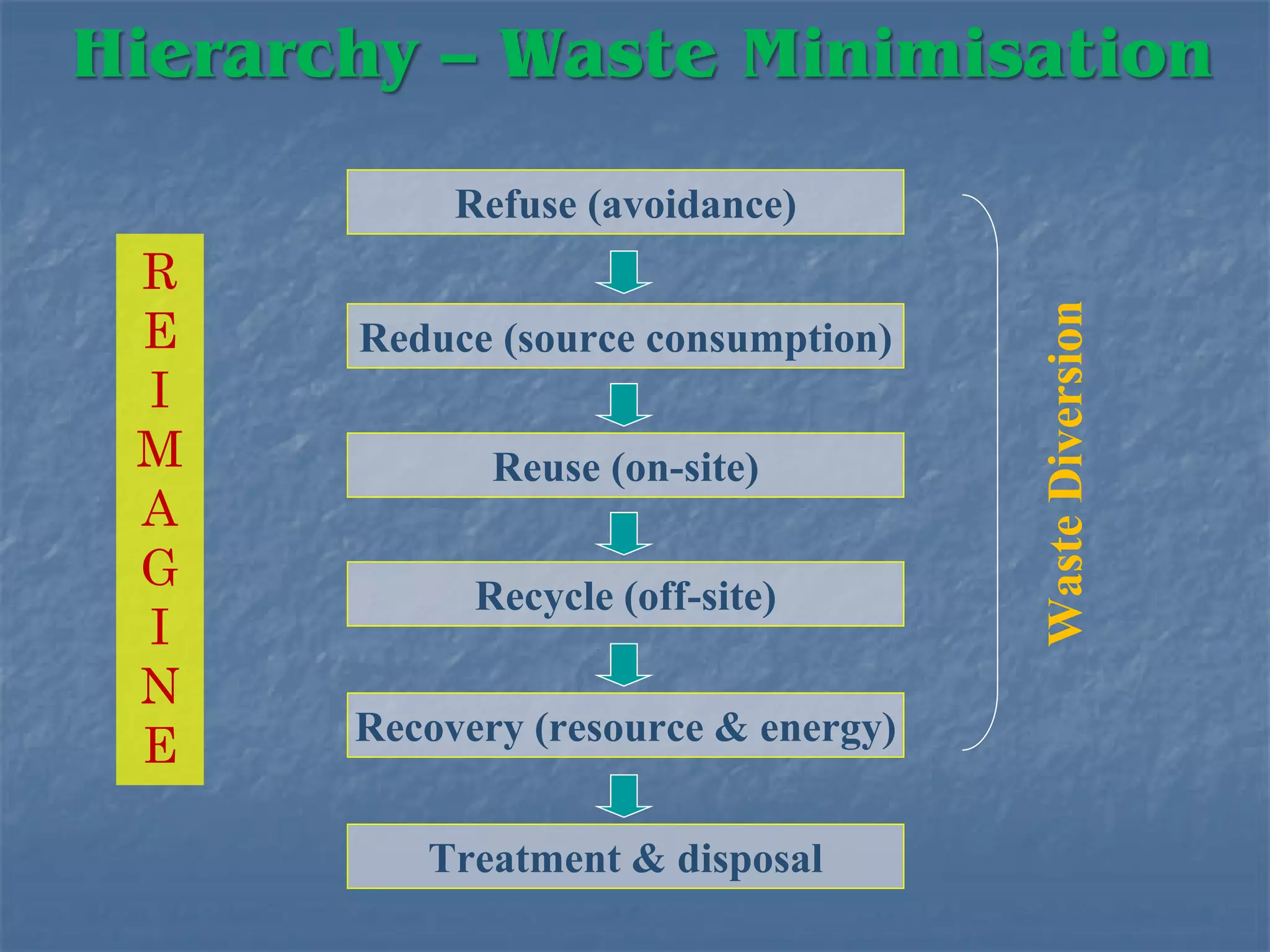
Hierarchy – Waste Minimisation
Reuse (on-site)
WasteDiversion
Reduce (source consumption)
Refuse (avoidance)
Recycle (off-site)
Recovery (resource & energy)
Treatment & disposal
R
E
I
M
A
G
I
N
E
Source Reduction
Opportunities
Source
reduction
Housekeeping
improvement
Product
reformulation
Input
material
alteration
Technology
alteration
Good operating
practices
Waste Minimisation -
Incentives
 Reduced costs
 Raw materials, energy, water
 Storage and handling
 Waste handling and disposal
 Health and safety
 Resource conservation
 Improved regulatory compliance
 Improved efficiency and productivity
 Improved social responsibility performance
Waste Minimisation - Barriers
 Economic barriers
 Technological barriers
 Regulatory barriers
Conventional approach;
 Waste collection
 Treatment for compliance (and to make the waste
compatible for disposal)
 Dispose
Alternative thoughts;
 Cheapest available solution just avoiding prosecution
 Best available solution not entailing excessive cost
Waste Management
Spend resources or face penalty
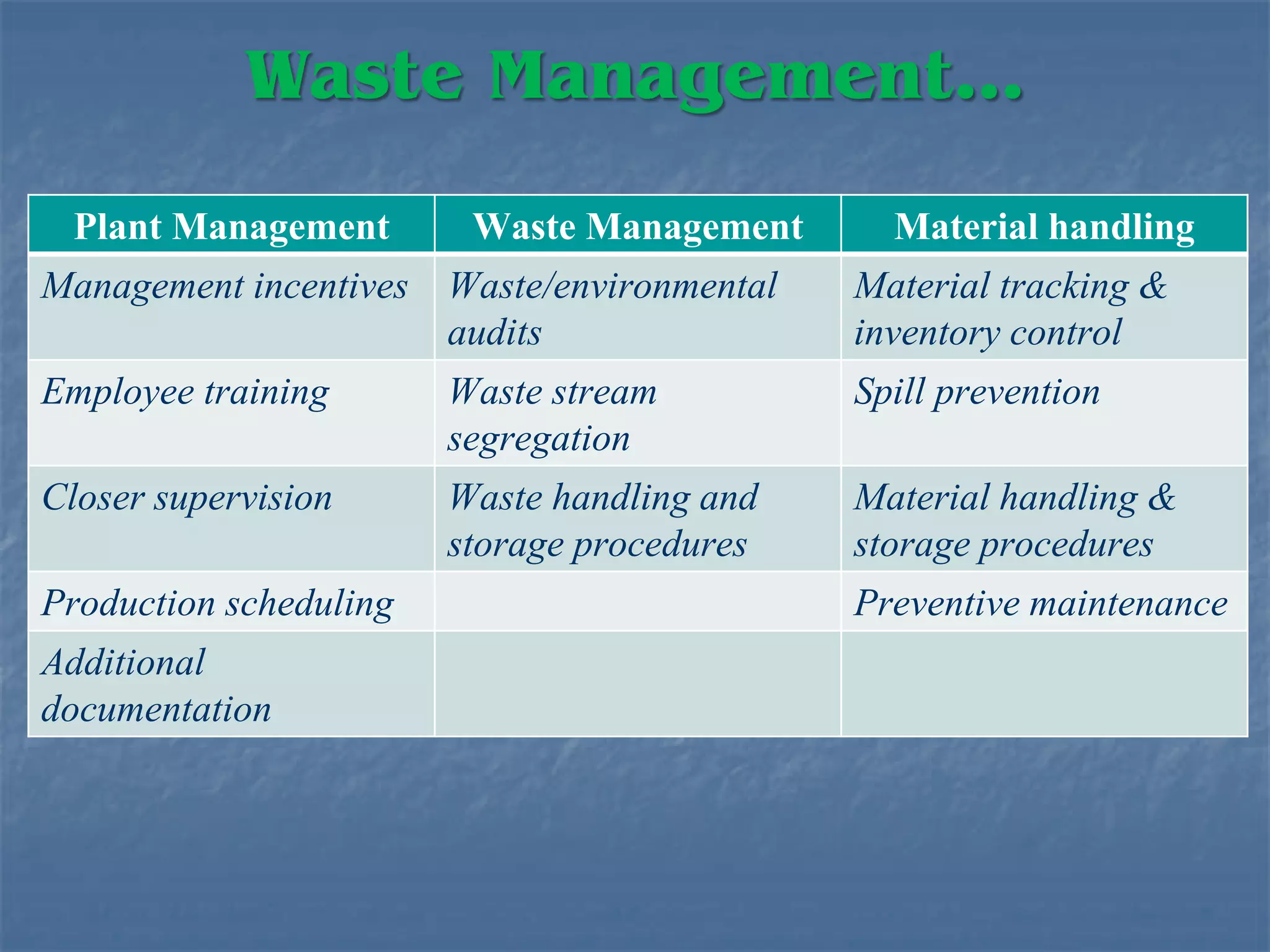
Waste Management…
Plant Management Waste Management Material handling
Management incentives Waste/environmental
audits
Material tracking &
inventory control
Employee training Waste stream
segregation
Spill prevention
Closer supervision Waste handling and
storage procedures
Material handling &
storage procedures
Production scheduling Preventive maintenance
Additional
documentation
Water Management
(Textile Wet Procesing)
CLICK HERE for Water Management Scheme in
Textile Dyeing Industry
 Use of high strength caustic (>20%)
 Results in process effluent having high alkalinity (~8-10%
caustic), TDS and COD
 Impractical to treat and dispose using conventional EOP
approach
Alternative thoughts;
 Use of liquid ammonia
 Reuse of Diluted alkali scouring, bleaching, or dyeing
 Recovery of alkali (recycle/reuse)
• Volume reduction (process modification)
• Neutralisation – use of flue gases (combustion
emissions from boiler)
• Caustic recovery – causticizing
Wastewater Management
(Denim Mercerizing)
 Bone gelatine manufacturing – an effluent stream rich in
calcium and chloride (~2-3%) from use of HCl for bone
leaching
 Impractical to treat and dispose using conventional EOP
approach
Alternative thoughts;
 Treatment to replace Ca2+ with H+
• Multi-stage pressure filteration (to remove TSS)
• Sulphuric acid treatment
• Barium chloride treatment
 Gypsum of >90% purity recoverable
 High purity BaSO4 available as bye-product
 Use of recovered wastewater for bone leaching process
Wastewater Management
(Crushed Bone Acid Leaching Process)
Any Questions …..???
Waste minimisation   environmental imperatives

Waste minimisation environmental imperatives

  • 1.
    WASTE MINIMISATION – ENVIRONMENTALIMPERATIVES by Vishal Duggal Alliance Engineers 7812/5, Passi Road, PATIALA (Punjab). Ph.: 98766 05933, 98 140 059 33 email: visduggal@gmail.com; mailto@allianceers.com for National Productivity Council Chandigarh CICU Ludhiana
  • 2.
    Resource Depletion  Naturalresources – Renewable and Non-renewable  Resource depletion – exhaustion of resources/ materials from a region  Use of resources beyond their rate of replacement  Using resources in an unmanaged and unplanned manner – causes pollution Sustainable Development “Development that meets the needs of the present without compromising the ability of future generations to meet their own needs” Bruntland Report, 1987
  • 3.
    Waste Minimisation –WHAT? The policy and processes to have waste minimization means to reduce the production of waste at society and individual level  Harvesting of resources  Processing and production operations  Distribution  Consumption  Reject handling and disposal Waste Minimisation applies to all resources  Natural or man-made  Material or energy
  • 4.
    Processes/Operations INPUTS OUTPUTS REJECTS Materials  Water  Energy  Products – material  Bye-products – material  Energy  Losses  Pollutants – solid, liquid, gaseous, noise, odours  Waste energy
  • 5.
    Resource Efficiency -Business Case
  • 6.
    Hierarchy – WasteMinimisation Reuse (on-site) WasteDiversion Reduce (source consumption) Refuse (avoidance) Recycle (off-site) Recovery (resource & energy) Treatment & disposal R E I M A G I N E
  • 7.
  • 8.
    Waste Minimisation - Incentives Reduced costs  Raw materials, energy, water  Storage and handling  Waste handling and disposal  Health and safety  Resource conservation  Improved regulatory compliance  Improved efficiency and productivity  Improved social responsibility performance
  • 9.
    Waste Minimisation -Barriers  Economic barriers  Technological barriers  Regulatory barriers
  • 10.
    Conventional approach;  Wastecollection  Treatment for compliance (and to make the waste compatible for disposal)  Dispose Alternative thoughts;  Cheapest available solution just avoiding prosecution  Best available solution not entailing excessive cost Waste Management Spend resources or face penalty
  • 11.
    Waste Management… Plant ManagementWaste Management Material handling Management incentives Waste/environmental audits Material tracking & inventory control Employee training Waste stream segregation Spill prevention Closer supervision Waste handling and storage procedures Material handling & storage procedures Production scheduling Preventive maintenance Additional documentation
  • 12.
    Water Management (Textile WetProcesing) CLICK HERE for Water Management Scheme in Textile Dyeing Industry
  • 13.
     Use ofhigh strength caustic (>20%)  Results in process effluent having high alkalinity (~8-10% caustic), TDS and COD  Impractical to treat and dispose using conventional EOP approach Alternative thoughts;  Use of liquid ammonia  Reuse of Diluted alkali scouring, bleaching, or dyeing  Recovery of alkali (recycle/reuse) • Volume reduction (process modification) • Neutralisation – use of flue gases (combustion emissions from boiler) • Caustic recovery – causticizing Wastewater Management (Denim Mercerizing)
  • 14.
     Bone gelatinemanufacturing – an effluent stream rich in calcium and chloride (~2-3%) from use of HCl for bone leaching  Impractical to treat and dispose using conventional EOP approach Alternative thoughts;  Treatment to replace Ca2+ with H+ • Multi-stage pressure filteration (to remove TSS) • Sulphuric acid treatment • Barium chloride treatment  Gypsum of >90% purity recoverable  High purity BaSO4 available as bye-product  Use of recovered wastewater for bone leaching process Wastewater Management (Crushed Bone Acid Leaching Process)
  • 15.