Packet SniffingCompiled By -KunalThakurVishalShirguppiJustin FrancisShazia Ali
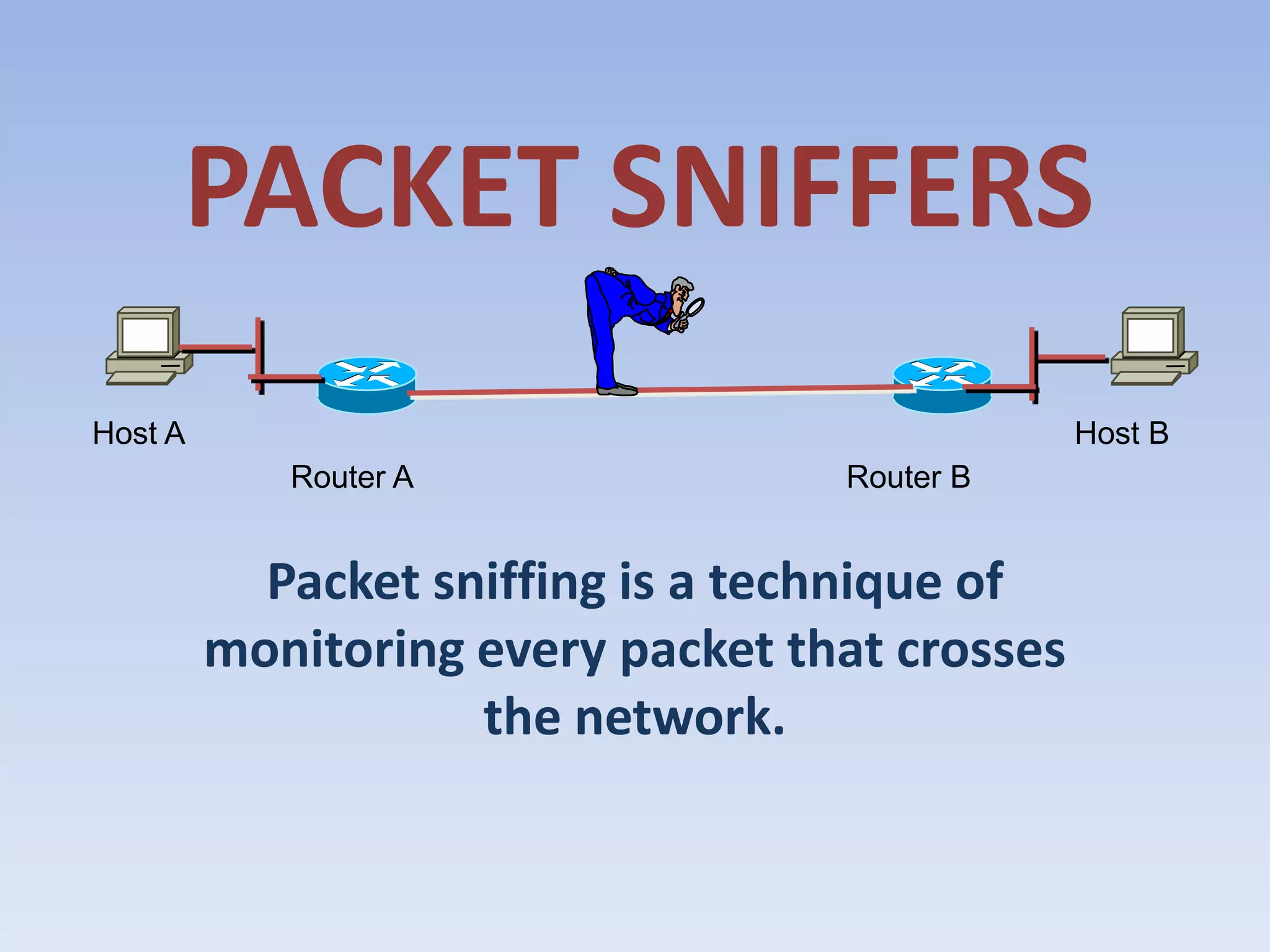
Packet sniffing is a technique of monitoring every packet that crosses the network.PACKET SNIFFERSHost AHost BRouter A Router B
Types of environments1. SHARED ETHERNET2. SWITCHED ETHERNET
Types of sniffing programs:Commercial packet sniffers.Underground packet sniffers
Uses of Packet SniffersCapturing clear-text usernames and passwordsCapturing and replaying Voice over IP telephone conversationsMapping a networkBreaking into a target computer and installing remotely controlled sniffing software.Redirecting communications to take a path that includes the intruder’s computer.Conversion of Network traffic into human readable form.Network analysis to find the bottlenecks.Network intrusion detection to monitor for attackers.
Sniffing Tools 1. tcpdump2. sniffit3. ethereal4. hunt5. dsniff6. Ip spoofing
Sniffing MethodSniffing method work’s in switched and non-switched network .Sniffing Methods-IP –Based sniffingMAC-Based SniffingARP-Based Sniffing
IP-Based SniffingThis is the original way of packet sniffing. It works by putting the network card into promiscuous mode and sniffing all packets matching the IP address filter. This method only works in non-switched networks.
With the help of this tool u can do -Perform batch and continuous pings on multiple servers.Lookup IP address for a single or list of domain names and vice versa.Find out the country associated with a single or list of domains or IP addresses. Trace IP addresses to their destination and investigate connection problems.Allow you to scan any given web site and produce a list of links (including htmcgiphp asp jsp jpg gif mp3 mpeg exe zip rarswf and more file tyies) found in the site, using several criteria to filter the results. Monitor all the TCP/IP connections from your computer to the internet automatically;
MAC-Based SniffingThis method works by putting the network card into promiscuous mode and sniffing all packets matching the MAC address filter.
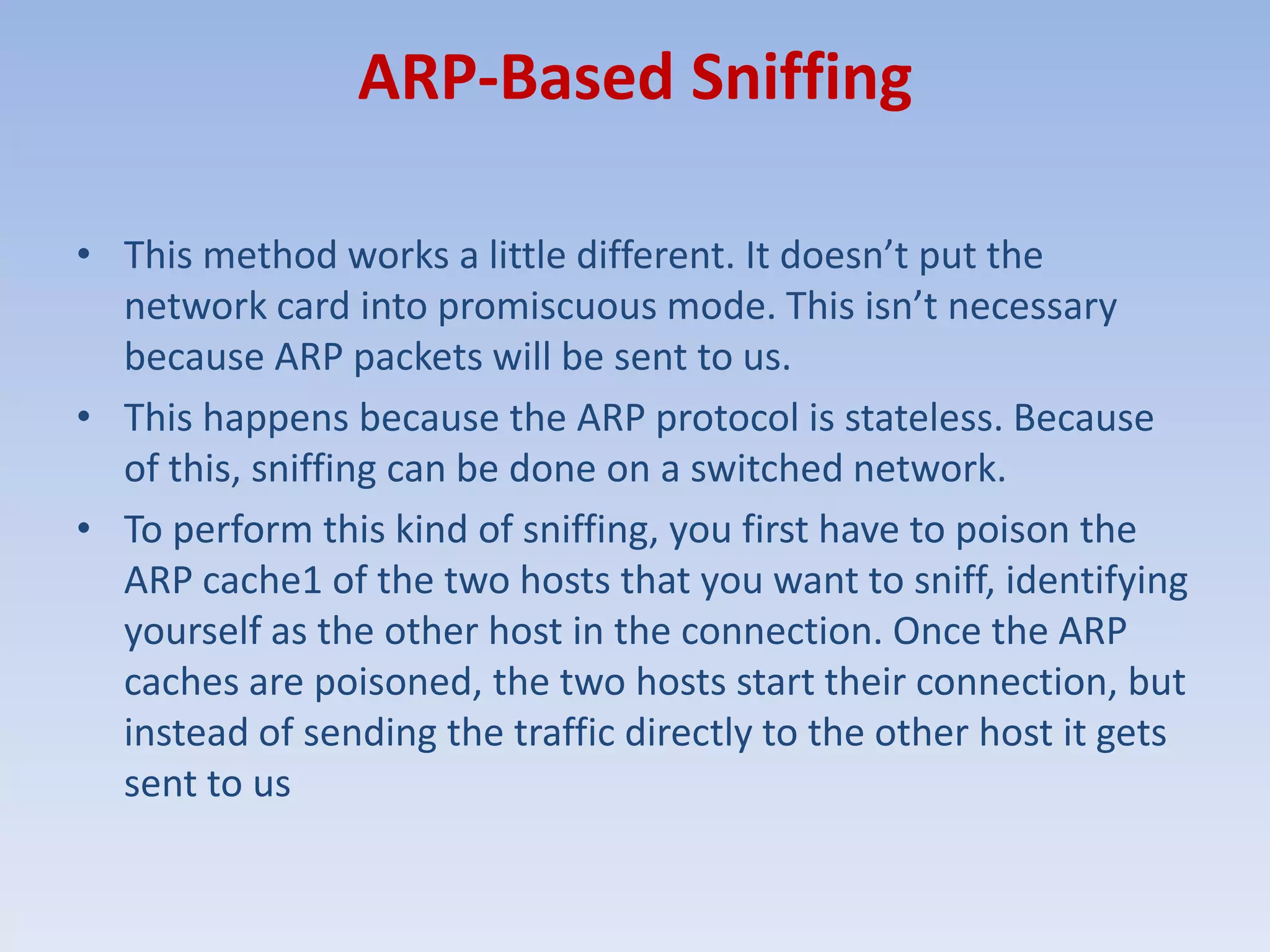
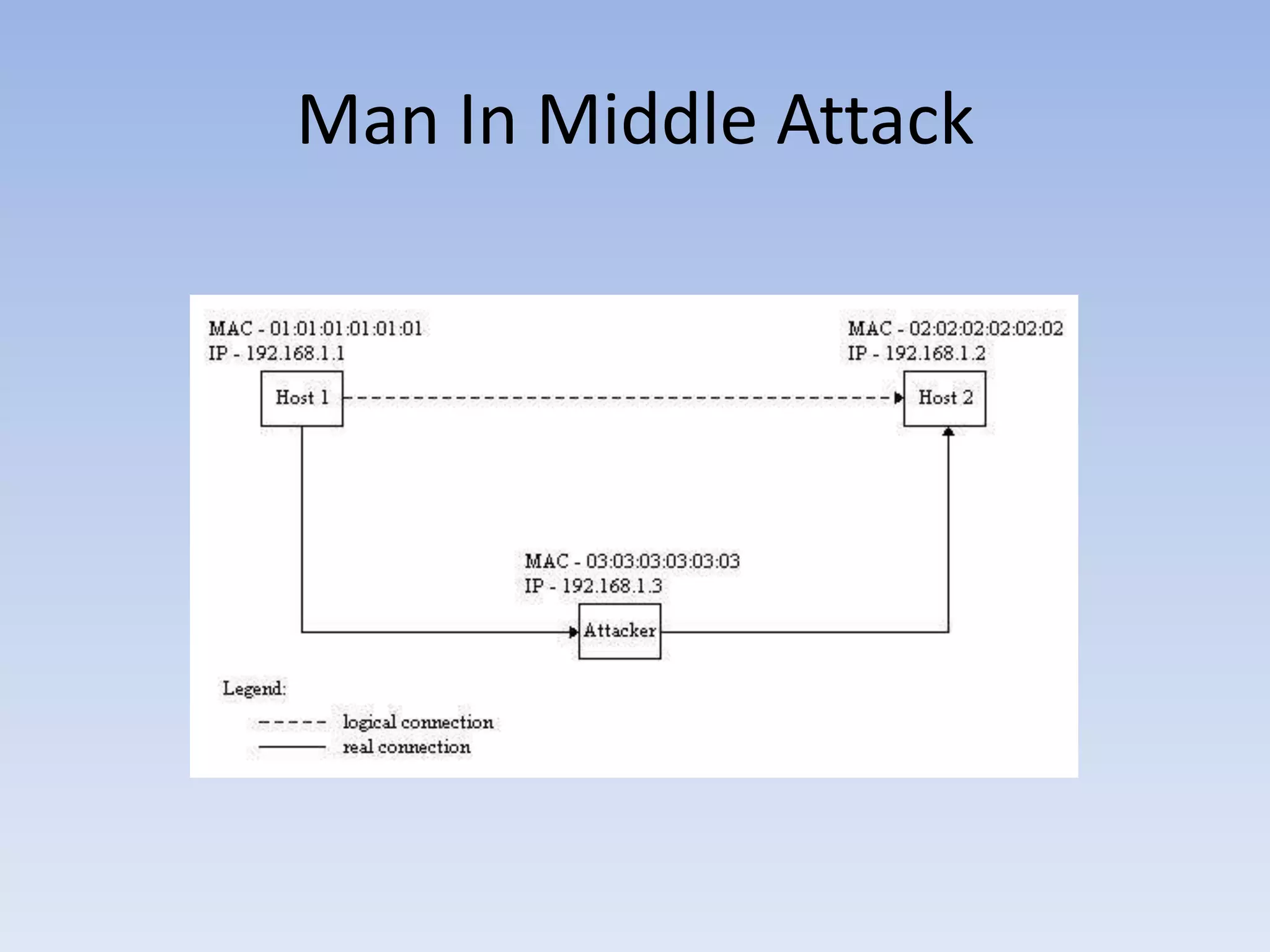
ARP-Based SniffingThis method works a little different. It doesn’t put the network card into promiscuous mode. This isn’t necessary because ARP packets will be sent to us.This happens because the ARP protocol is stateless. Because of this, sniffing can be done on a switched network. To perform this kind of sniffing, you first have to poison the ARP cache1 of the two hosts that you want to sniff, identifying yourself as the other host in the connection. Once the ARP caches are poisoned, the two hosts start their connection, but instead of sending the traffic directly to the other host it gets sent to us
Man In Middle Attack
AssumptionsOne assumption we have made is that the sniffer is an actual sniffer program running on a host. i.e we disallow the possibility that the sniffer is a dedicated device that a hacker physically attaches to the network. a lot of break-ins are done remotely by hackers with no physical access to the network whatsoever. Usually, a UNIX machine is broken in to , and the hacker logs on to the compromised machine and installs a sniffer with root access.
AssumptionsThe network segment which we wish to detect whether a sniffer is running or not, is an Ethernet segment. we also assume that TCP/IP is the protocol that the network is using. Although some of our techniques can be modified  to support other networking protocols, the implementation is based on TCP/IP since it is, by far, the most popular network protocol today.
ANTI-SNIFF DETECTION METHODS:MAC DETECTION MAC detection running on a Ethernet segment requires that the machine running the detector be on the same Ethernet segment as the host that is suspected of running a sniffer.This technique allows remote detection of sniffers on the same Ethernet segment, but not the remote detection of sniffers across different networks .
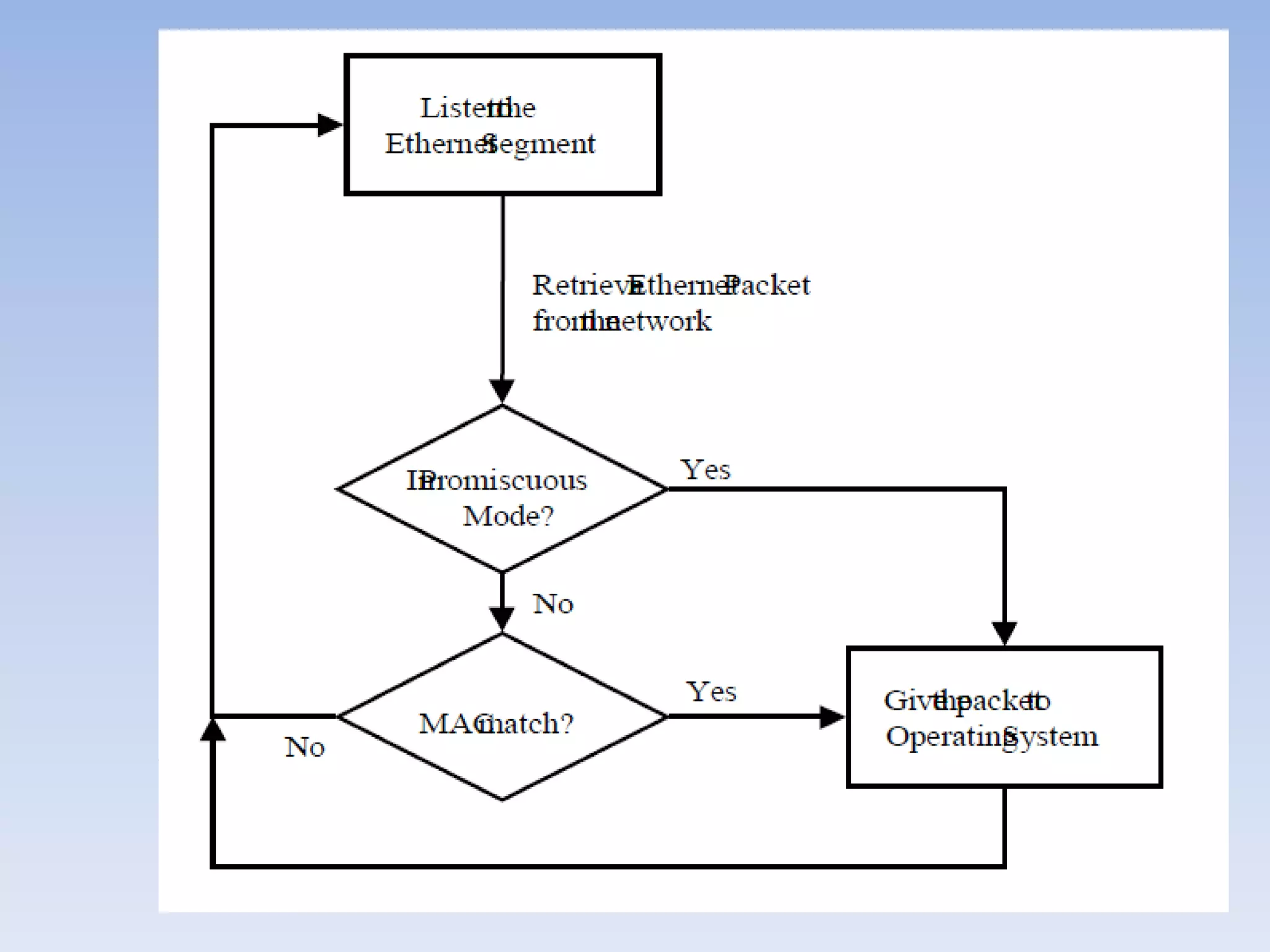
1.1 Ethernet Network Interface Cards:All network interface cards (NIC) can be uniquely identified by its MAC address. Ethernet controller chips implement a filter which filters out any packet that does not contain a target MAC address for the NIC Since sniffers are interested in all traffic on the Ethernet segment, NICs provide a promiscuous mode.In promiscuous mode, all Ethernet data packets, regardless of the target MAC address, are passed to the operating system.
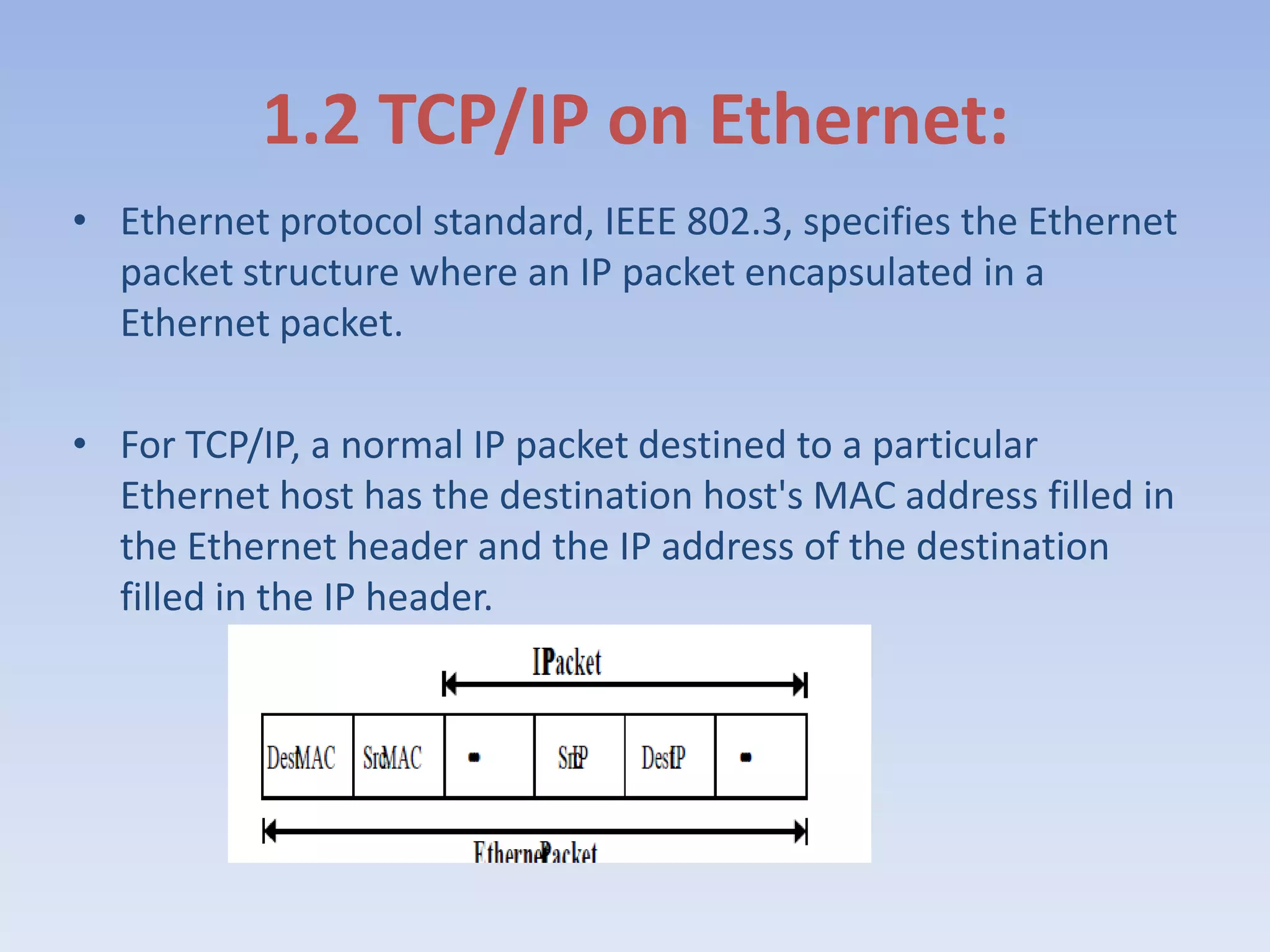
1.2 TCP/IP on Ethernet:Ethernet protocol standard, IEEE 802.3, specifies the Ethernet packet structure where an IP packet encapsulated in a Ethernet packet. For TCP/IP, a normal IP packet destined to a particular Ethernet host has the destination host's MAC address filled in the Ethernet header and the IP address of the destination  filled in the IP header.
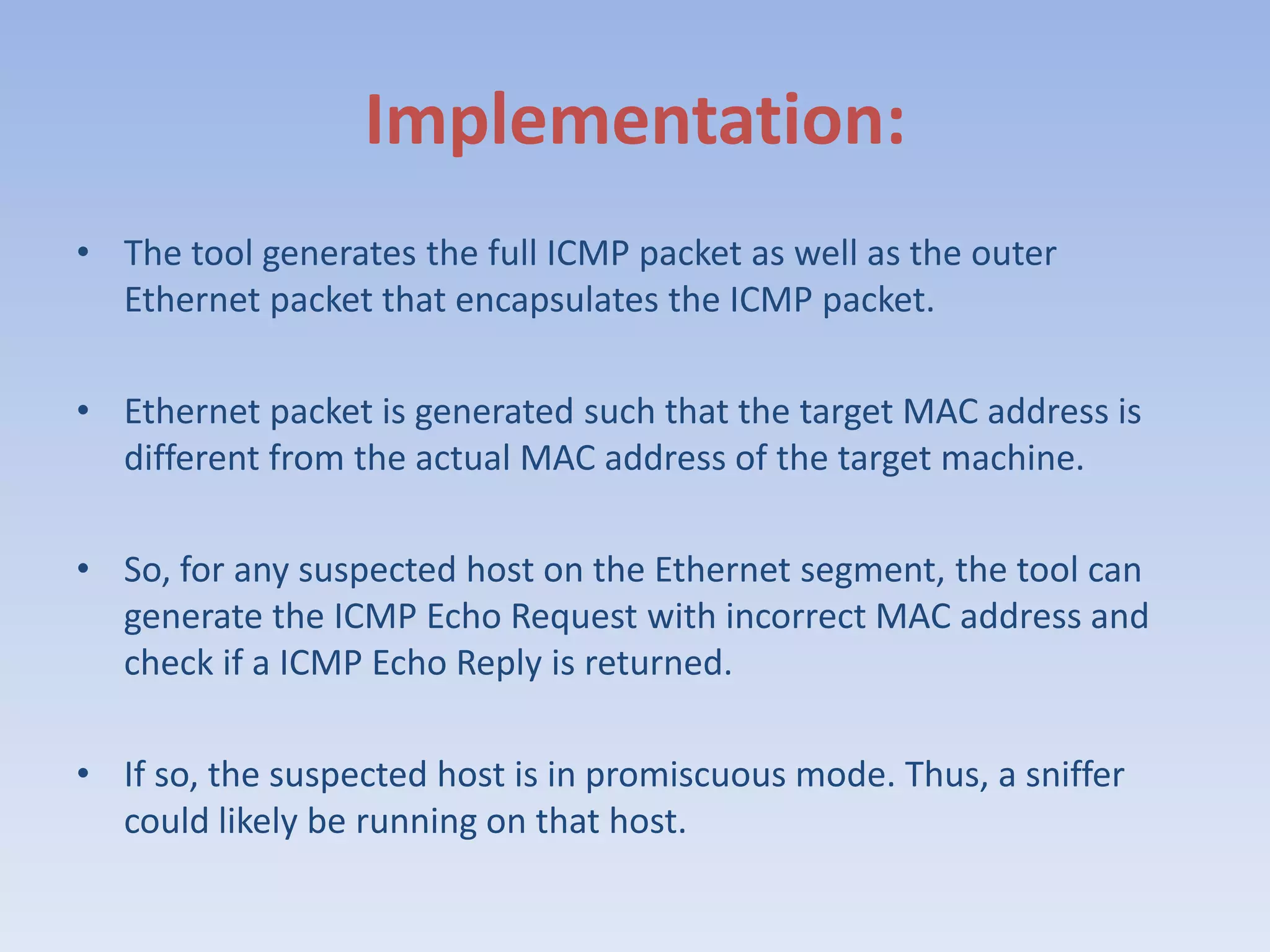
Implementation:The tool generates the full ICMP packet as well as the outer Ethernet packet that encapsulates the ICMP packet. Ethernet packet is generated such that the target MAC address is different from the actual MAC address of the target machine.So, for any suspected host on the Ethernet segment, the tool can generate the ICMP Echo Request with incorrect MAC address and check if a ICMP Echo Reply is returned.If so, the suspected host is in promiscuous mode. Thus, a sniffer could likely be running on that host.
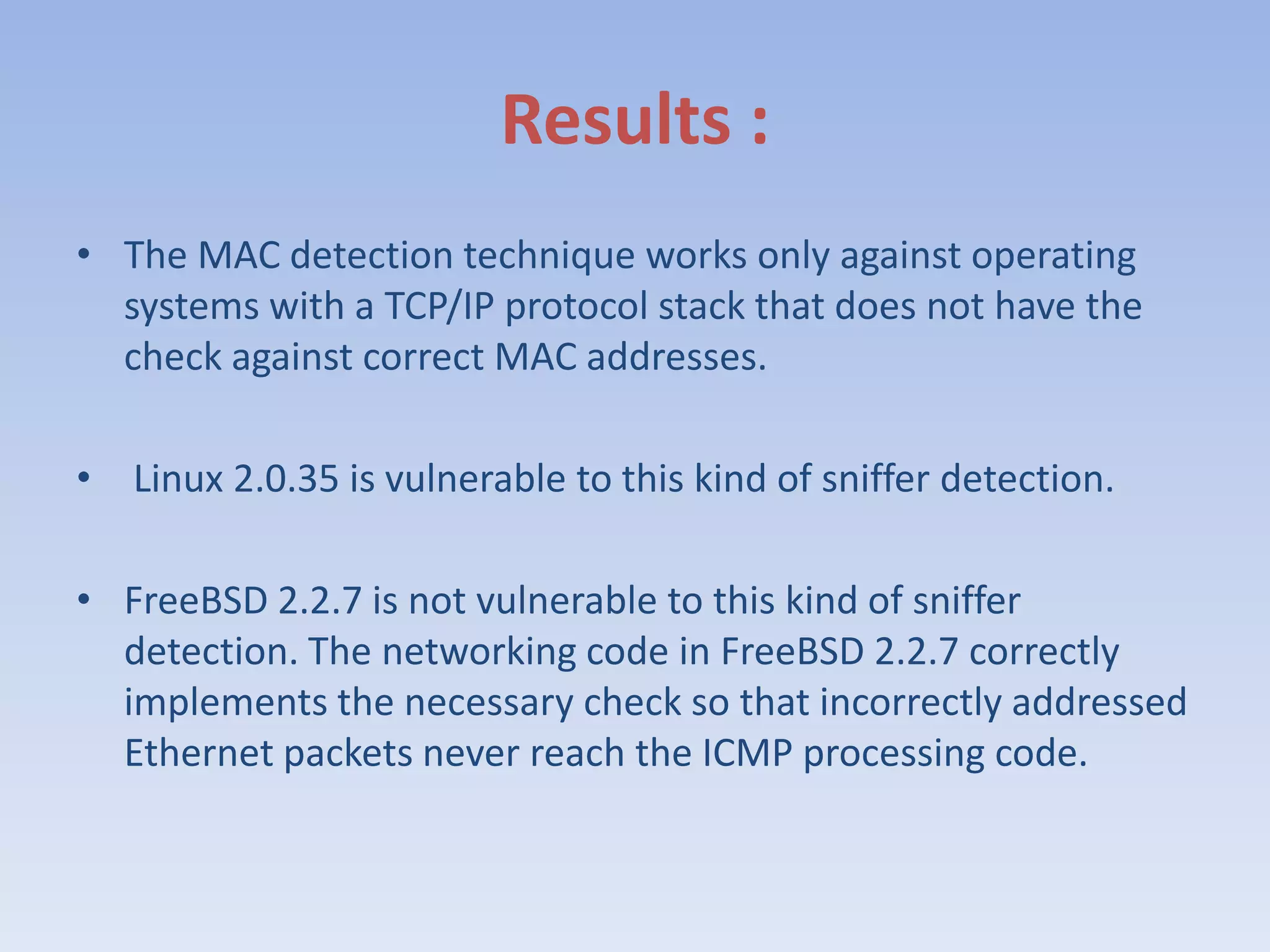
Results :The MAC detection technique works only against operating systems with a TCP/IP protocol stack that does not have the check against correct MAC addresses. Linux 2.0.35 is vulnerable to this kind of sniffer detection. FreeBSD 2.2.7 is not vulnerable to this kind of sniffer detection. The networking code in FreeBSD 2.2.7 correctly implements the necessary check so that incorrectly addressed Ethernet packets never reach the ICMP processing code.
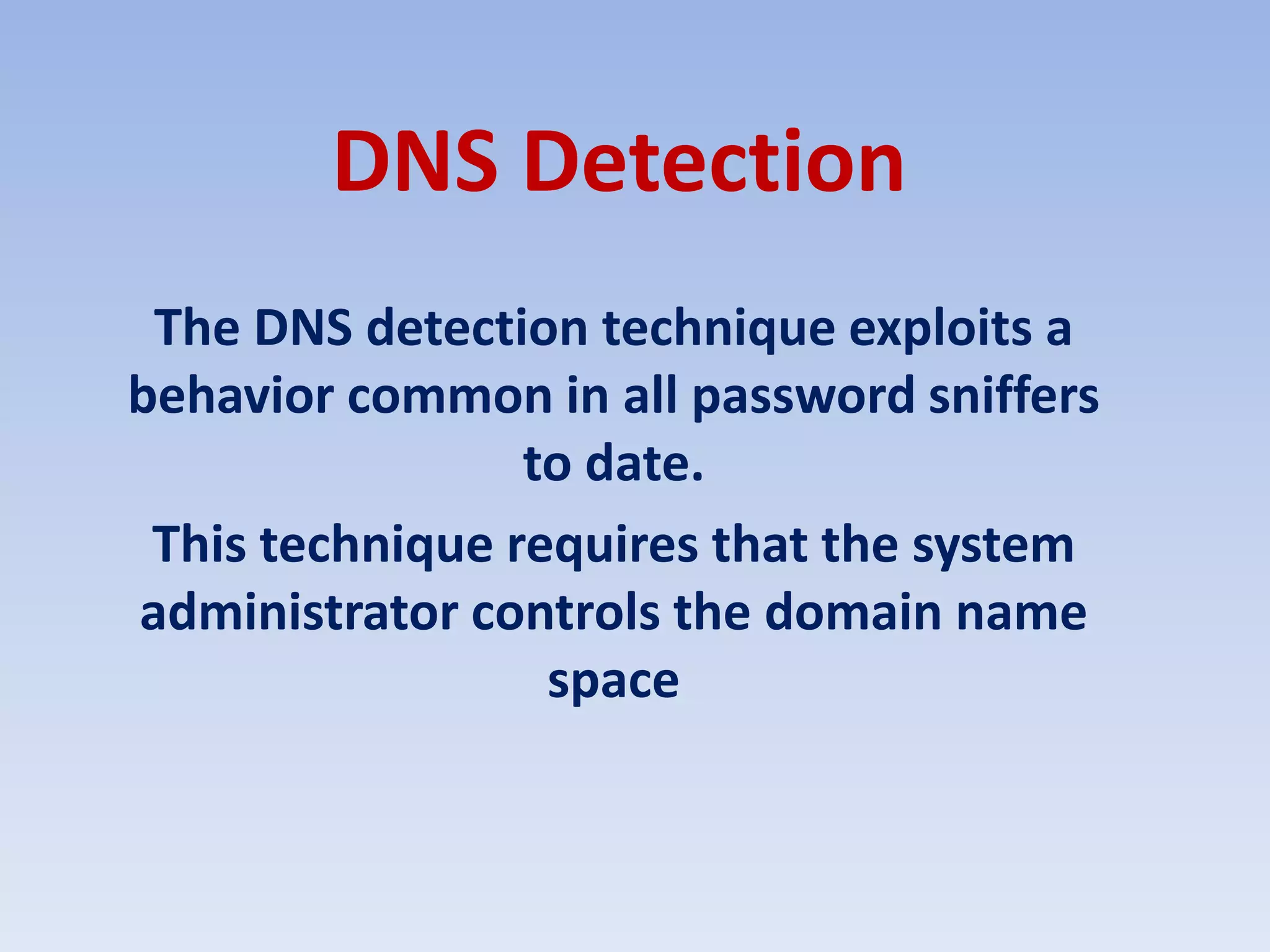
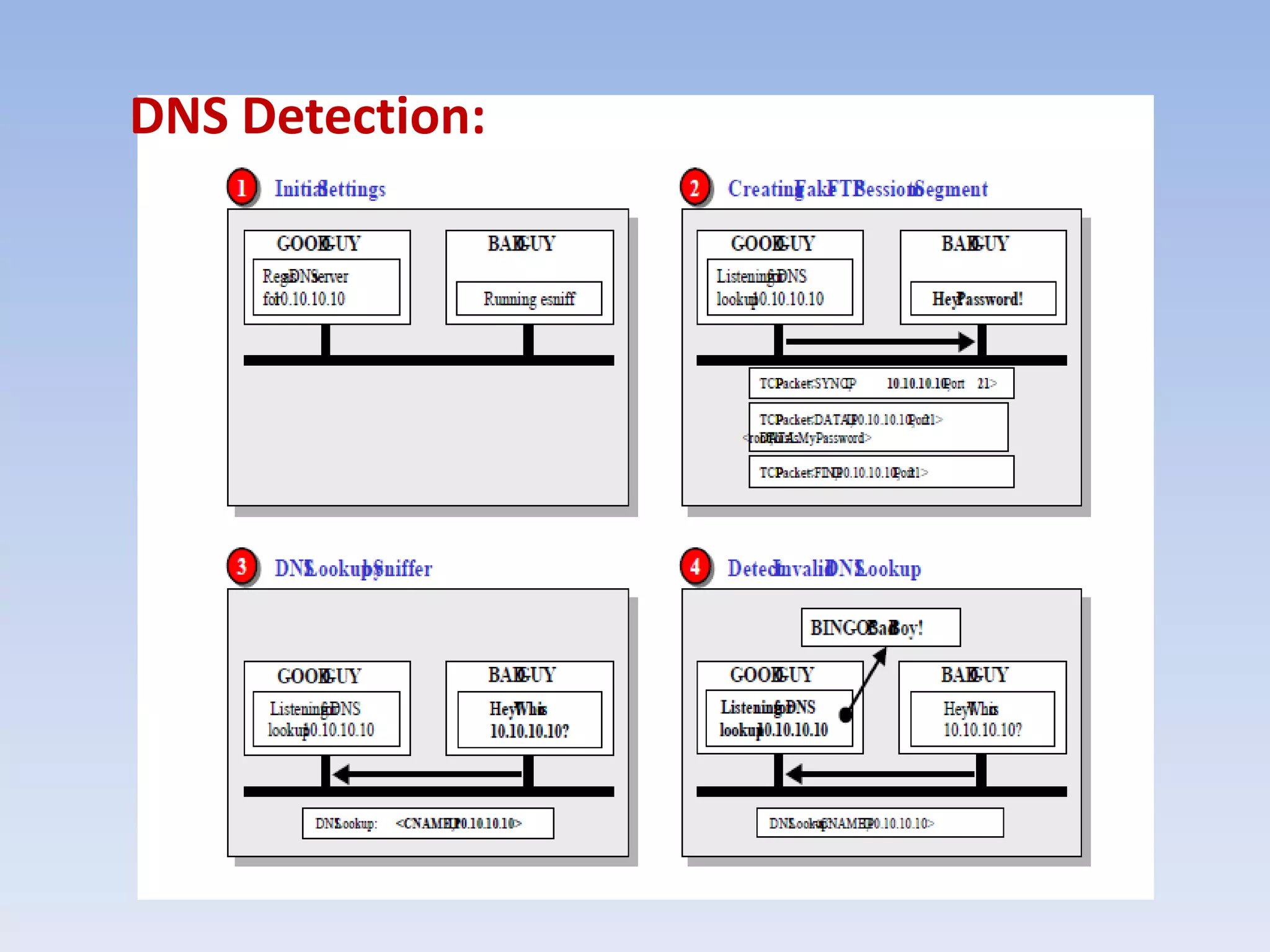
DNS DetectionThe DNS detection technique exploits a behavior common in all password sniffers to date. This technique requires that the system administrator controls the domain name space
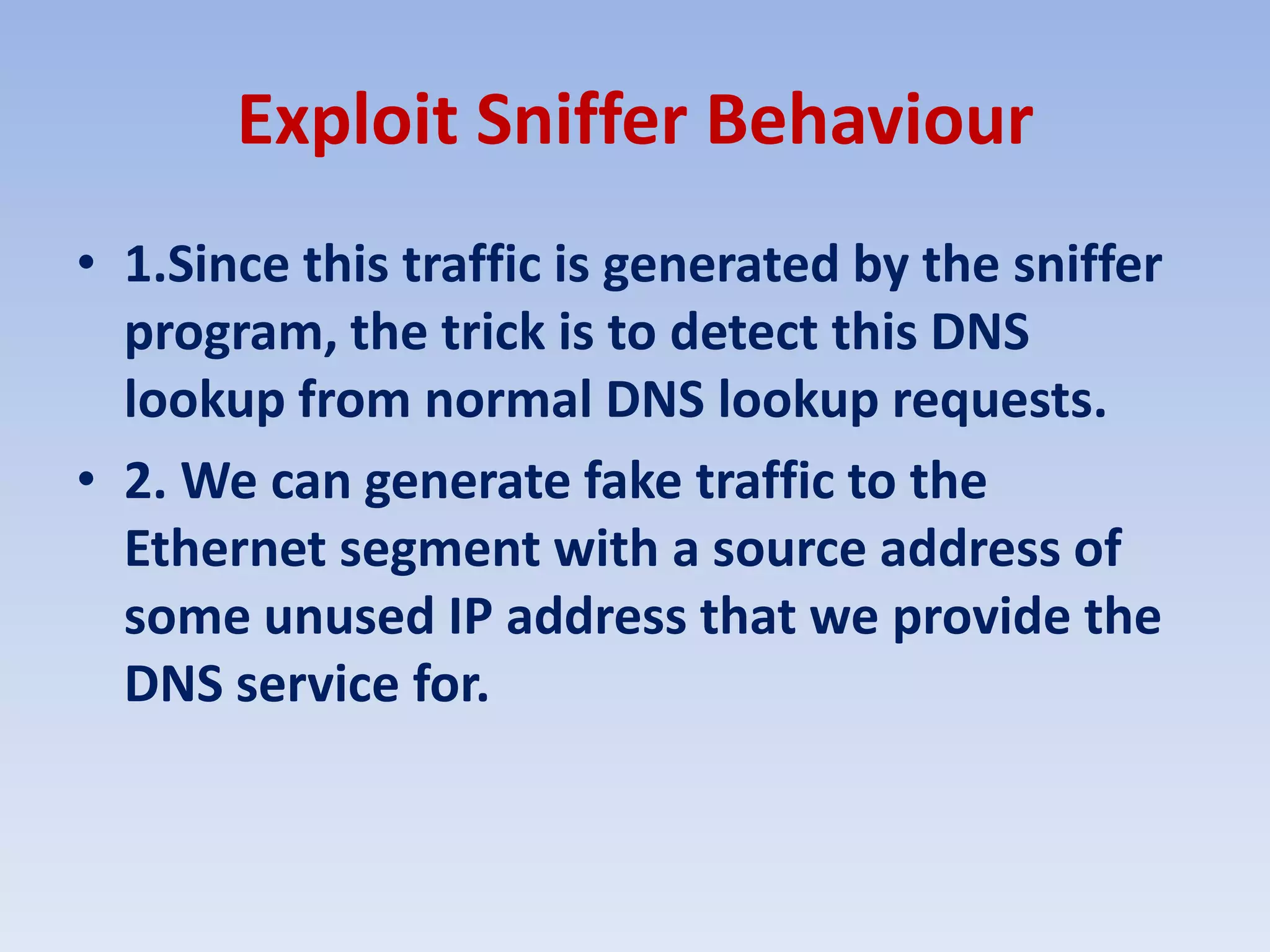
Exploit Sniffer Behaviour1.Since this traffic is generated by the sniffer program, the trick is to detect this DNS lookup from normal DNS lookup requests. 2. We can generate fake traffic to the Ethernet segment with a source address of some unused IP address that we provide the DNS service for.
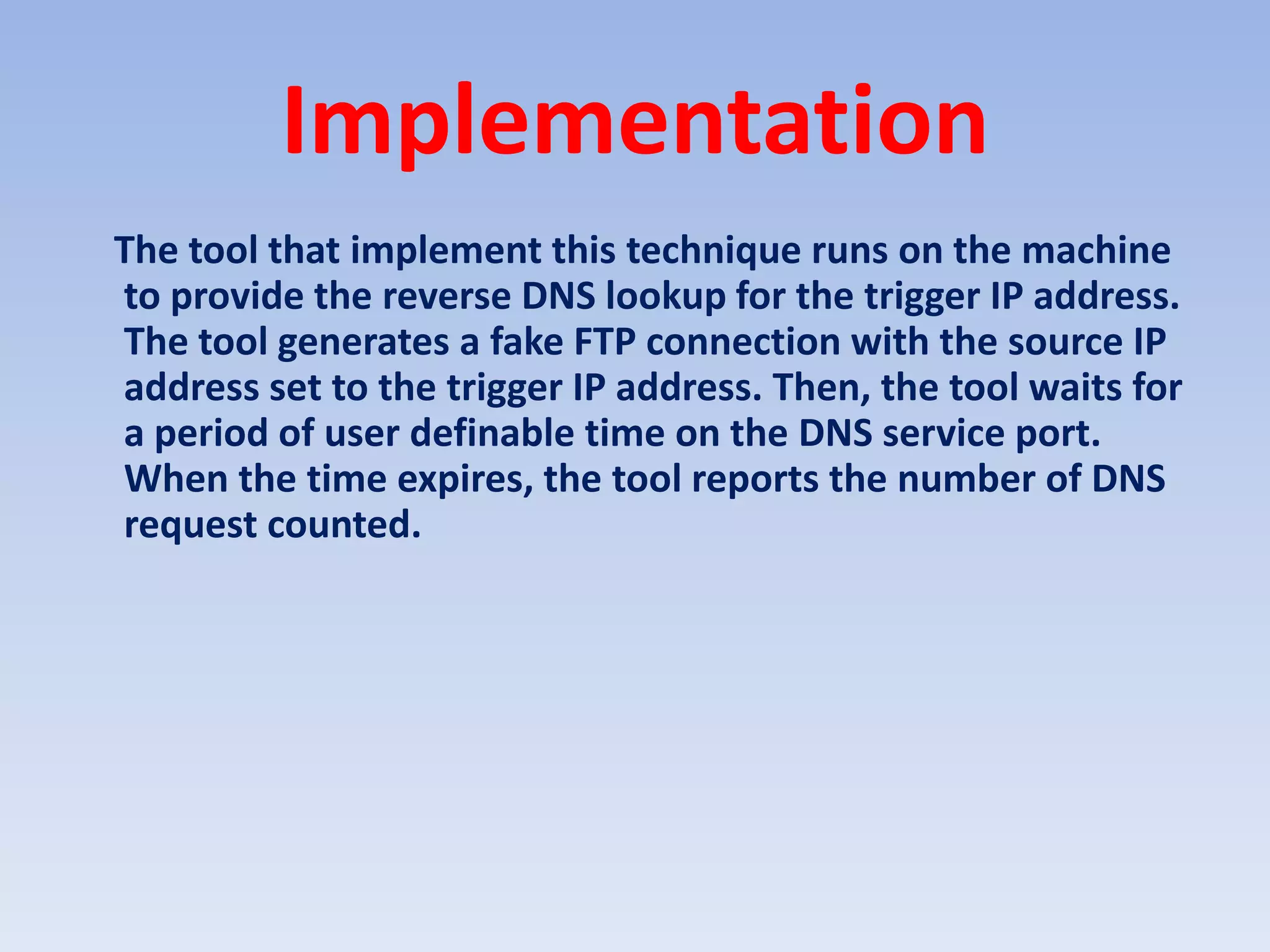
ImplementationThe tool that implement this technique runs on the machine to provide the reverse DNS lookup for the trigger IP address. The tool generates a fake FTP connection with the source IP address set to the trigger IP address. Then, the tool waits for a period of user definable time on the DNS service port. When the time expires, the tool reports the number of DNS request counted.
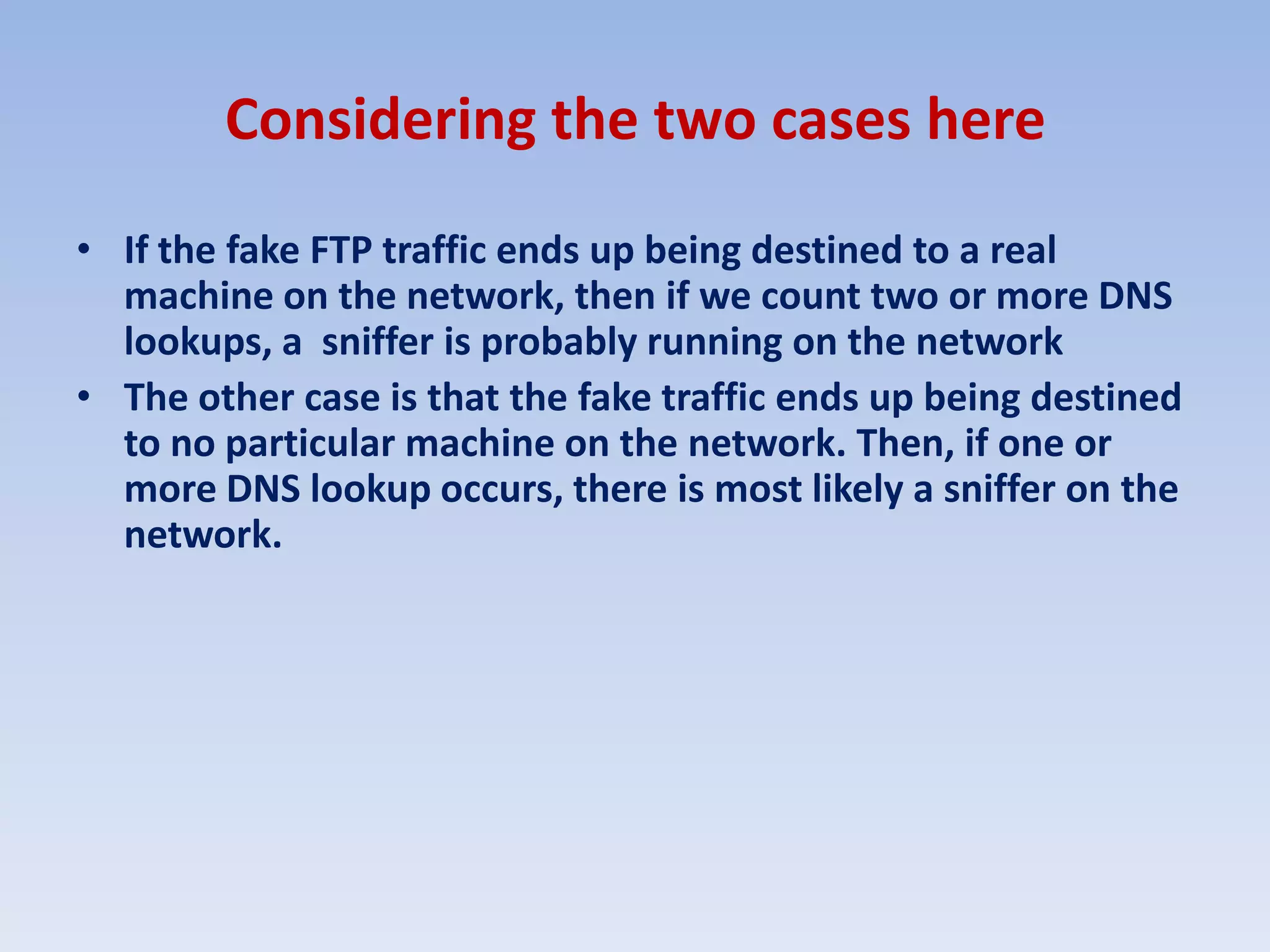
Considering the two cases hereIf the fake FTP traffic ends up being destined to a real machine on the network, then if we count two or more DNS lookups, a  sniffer is probably running on the networkThe other case is that the fake traffic ends up being destined to no particular machine on the network. Then, if one or more DNS lookup occurs, there is most likely a sniffer on the network.
RESULTThe DNS detection technique was able to detect sniffers running on a Ethernet segment with 100% accuracy regardless of operating system type.
DNS Detection:
ConclusionPacket sniffers can capture things like clear-text passwords and usernames or other sensitive material. Packet sniffers are a serious matter for network security. Since sniffing is possible on non-switched and switched networks, it’s a good practice to encrypt your data communications.
Special Thanks to: Prof. Sunil SurveMr.AjayKoli

Packet sniffers

  • 1.
    Packet SniffingCompiled By-KunalThakurVishalShirguppiJustin FrancisShazia Ali
  • 2.
    Packet sniffing isa technique of monitoring every packet that crosses the network.PACKET SNIFFERSHost AHost BRouter A Router B
  • 3.
    Types of environments1.SHARED ETHERNET2. SWITCHED ETHERNET
  • 4.
    Types of sniffingprograms:Commercial packet sniffers.Underground packet sniffers
  • 5.
    Uses of PacketSniffersCapturing clear-text usernames and passwordsCapturing and replaying Voice over IP telephone conversationsMapping a networkBreaking into a target computer and installing remotely controlled sniffing software.Redirecting communications to take a path that includes the intruder’s computer.Conversion of Network traffic into human readable form.Network analysis to find the bottlenecks.Network intrusion detection to monitor for attackers.
  • 6.
    Sniffing Tools 1.tcpdump2. sniffit3. ethereal4. hunt5. dsniff6. Ip spoofing
  • 7.
    Sniffing MethodSniffing methodwork’s in switched and non-switched network .Sniffing Methods-IP –Based sniffingMAC-Based SniffingARP-Based Sniffing
  • 8.
    IP-Based SniffingThis isthe original way of packet sniffing. It works by putting the network card into promiscuous mode and sniffing all packets matching the IP address filter. This method only works in non-switched networks.
  • 9.
    With the helpof this tool u can do -Perform batch and continuous pings on multiple servers.Lookup IP address for a single or list of domain names and vice versa.Find out the country associated with a single or list of domains or IP addresses. Trace IP addresses to their destination and investigate connection problems.Allow you to scan any given web site and produce a list of links (including htmcgiphp asp jsp jpg gif mp3 mpeg exe zip rarswf and more file tyies) found in the site, using several criteria to filter the results. Monitor all the TCP/IP connections from your computer to the internet automatically;
  • 10.
    MAC-Based SniffingThis methodworks by putting the network card into promiscuous mode and sniffing all packets matching the MAC address filter.
  • 11.
    ARP-Based SniffingThis methodworks a little different. It doesn’t put the network card into promiscuous mode. This isn’t necessary because ARP packets will be sent to us.This happens because the ARP protocol is stateless. Because of this, sniffing can be done on a switched network. To perform this kind of sniffing, you first have to poison the ARP cache1 of the two hosts that you want to sniff, identifying yourself as the other host in the connection. Once the ARP caches are poisoned, the two hosts start their connection, but instead of sending the traffic directly to the other host it gets sent to us
  • 12.
  • 13.
    AssumptionsOne assumption wehave made is that the sniffer is an actual sniffer program running on a host. i.e we disallow the possibility that the sniffer is a dedicated device that a hacker physically attaches to the network. a lot of break-ins are done remotely by hackers with no physical access to the network whatsoever. Usually, a UNIX machine is broken in to , and the hacker logs on to the compromised machine and installs a sniffer with root access.
  • 14.
    AssumptionsThe network segmentwhich we wish to detect whether a sniffer is running or not, is an Ethernet segment. we also assume that TCP/IP is the protocol that the network is using. Although some of our techniques can be modified to support other networking protocols, the implementation is based on TCP/IP since it is, by far, the most popular network protocol today.
  • 15.
    ANTI-SNIFF DETECTION METHODS:MACDETECTION MAC detection running on a Ethernet segment requires that the machine running the detector be on the same Ethernet segment as the host that is suspected of running a sniffer.This technique allows remote detection of sniffers on the same Ethernet segment, but not the remote detection of sniffers across different networks .
  • 16.
    1.1 Ethernet NetworkInterface Cards:All network interface cards (NIC) can be uniquely identified by its MAC address. Ethernet controller chips implement a filter which filters out any packet that does not contain a target MAC address for the NIC Since sniffers are interested in all traffic on the Ethernet segment, NICs provide a promiscuous mode.In promiscuous mode, all Ethernet data packets, regardless of the target MAC address, are passed to the operating system.
  • 18.
    1.2 TCP/IP onEthernet:Ethernet protocol standard, IEEE 802.3, specifies the Ethernet packet structure where an IP packet encapsulated in a Ethernet packet. For TCP/IP, a normal IP packet destined to a particular Ethernet host has the destination host's MAC address filled in the Ethernet header and the IP address of the destination filled in the IP header.
  • 19.
    Implementation:The tool generatesthe full ICMP packet as well as the outer Ethernet packet that encapsulates the ICMP packet. Ethernet packet is generated such that the target MAC address is different from the actual MAC address of the target machine.So, for any suspected host on the Ethernet segment, the tool can generate the ICMP Echo Request with incorrect MAC address and check if a ICMP Echo Reply is returned.If so, the suspected host is in promiscuous mode. Thus, a sniffer could likely be running on that host.
  • 20.
    Results :The MACdetection technique works only against operating systems with a TCP/IP protocol stack that does not have the check against correct MAC addresses. Linux 2.0.35 is vulnerable to this kind of sniffer detection. FreeBSD 2.2.7 is not vulnerable to this kind of sniffer detection. The networking code in FreeBSD 2.2.7 correctly implements the necessary check so that incorrectly addressed Ethernet packets never reach the ICMP processing code.
  • 21.
    DNS DetectionThe DNSdetection technique exploits a behavior common in all password sniffers to date. This technique requires that the system administrator controls the domain name space
  • 22.
    Exploit Sniffer Behaviour1.Sincethis traffic is generated by the sniffer program, the trick is to detect this DNS lookup from normal DNS lookup requests. 2. We can generate fake traffic to the Ethernet segment with a source address of some unused IP address that we provide the DNS service for.
  • 23.
    ImplementationThe tool thatimplement this technique runs on the machine to provide the reverse DNS lookup for the trigger IP address. The tool generates a fake FTP connection with the source IP address set to the trigger IP address. Then, the tool waits for a period of user definable time on the DNS service port. When the time expires, the tool reports the number of DNS request counted.
  • 24.
    Considering the twocases hereIf the fake FTP traffic ends up being destined to a real machine on the network, then if we count two or more DNS lookups, a sniffer is probably running on the networkThe other case is that the fake traffic ends up being destined to no particular machine on the network. Then, if one or more DNS lookup occurs, there is most likely a sniffer on the network.
  • 25.
    RESULTThe DNS detectiontechnique was able to detect sniffers running on a Ethernet segment with 100% accuracy regardless of operating system type.
  • 26.
  • 27.
    ConclusionPacket sniffers cancapture things like clear-text passwords and usernames or other sensitive material. Packet sniffers are a serious matter for network security. Since sniffing is possible on non-switched and switched networks, it’s a good practice to encrypt your data communications.
  • 28.
    Special Thanks to:Prof. Sunil SurveMr.AjayKoli