Packet sniffing is a term used to describe 
Capturing of packets that are transmitted over a network
Wireshark is a free and open-source packet analyser. It is used for network troubleshooting, analysis, software and communications protocol development, and education.
The SICSR network is susceptible to ARP spoofing which is a technique whereby an attacker sends fake (“spoofed”)Address resolution protocol(ARP) messages onto a LAN. 
Generally, the aim is to associate the attacker's Mac address with the IP of another host (such as the default gateway), causing any traffic meant for that IP address to be sent to the attacker instead.
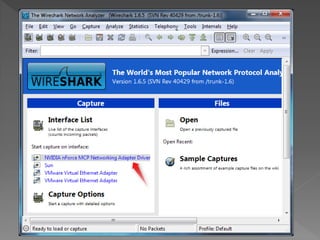
After downloading and installing Wireshark, you can launch it and click the name of an interface under Interface List to start capturing packets on that interface. For example, if you want to capture traffic on the wireless network, click your wireless interface. You can configure advanced features by clicking Capture Options, but this isn’t necessary for now.
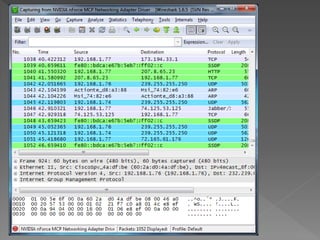
As soon as you click the interface’s name, you’ll see the packets start to appear in real time. Wireshark captures each packet sent to or from your system. If you’re capturing on a wireless interface and have promiscuous mode enabled in your capture options, you’ll also see other the other packets on the network.
The captured packets can be filtered according to protocol , IP, method and various other parameters.
Wireshark was a tool used to analyze the network and identify that ARP poisoning is possible on the network. 
The sniffer would not give any result if the poisoning failed.
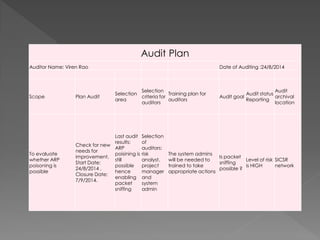
Audit Plan 
Auditor Name: Viren Rao 
Date of Auditing :24/8/2014 
Scope 
Plan Audit 
Selection area 
Selection criteria for auditors 
Training plan for auditors 
Audit goal 
Audit status Reporting 
Audit archival location 
To evaluate whether ARP poisoning is possible 
Check for new needs for improvement, Start Date: 24/8/2014 , Closure Date: 7/9/2014. 
Last audit results: ARP poisining is still possible hence enabling packet sniffing 
Selection of auditors: risk analyst, project manager and system admin 
The system admins will be needed to trained to take appropriate actions 
Is packet sniffing possible ? 
Level of risk is HIGH 
SICSR network
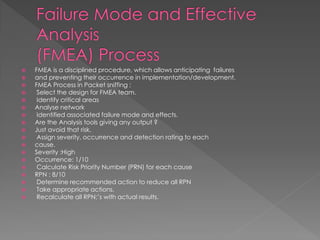
FMEA is a disciplined procedure, which allows anticipating failures 
and preventing their occurrence in implementation/development. 
FMEA Process in Packet sniffing : 
 Select the design for FMEA team. 
 Identify critical areas 
Analyse network 
 Identified associated failure mode and effects. 
Are the Analysis tools giving any output ? 
Just avoid that risk. 
 Assign severity, occurrence and detection rating to each 
cause. 
Severity :High 
Occurrence: 1/10 
 Calculate Risk Priority Number (PRN) for each cause 
RPN : 8/10 
 Determine recommended action to reduce all RPN 
 Take appropriate actions. 
 Recalculate all RPN;’s with actual results.
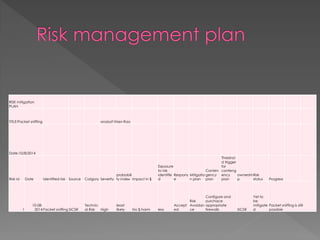
RISK mitigation PLAN 
TITLE:Packet sniffing 
analyst:Viren Rao 
Date:10/8/2014 
Risk id 
Date 
identified risk 
Source 
Catgory 
Severity 
probability index 
impact in $ 
Exposure to risk identified 
Response 
Mitigation plan 
Contengency plan 
Threshold trigger for contengency plan 
ownership 
Risk status 
Progress 
1 
10-08- 2014 
Packet sniffing 
SICSR 
Technical Risk 
High 
least likely 
No $ harm 
less 
Accepted 
Risk Avoidance 
Configure and purchace appropriate firewalls 
SICSR 
Yet to be mitigated 
Packet sniffing is still possible
Security is something that most organizations try to work upon . 
However it is observed that most organizations seldom look into an untouched area which is the Layer 2 of the OSI which can open the network to a variety of attacks and compromises.
Currently this vulnerability has not been exploited. If at all this vulnerability is exploited this could be a major security breach as all packets moving around a single subnet on the network can be intercepted .
To allocate resources and implement cost-effective controls, 
organizations, after identifying all possible controls and 
evaluating their feasibility and effectiveness, should conduct a 
cost-benefit analysis for each proposed control to determine 
which controls are required and appropriate for their 
circumstances. 
Benefits could be: 
 Tangible: Quantitative 
 Intangible: Qualitative
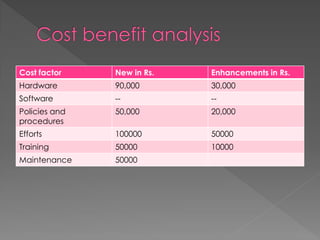
Cost factor 
New in Rs. 
Enhancements in Rs. 
Hardware 
90,000 
30,000 
Software 
-- 
-- 
Policies and procedures 
50,000 
20,000 
Efforts 
100000 
50000 
Training 
50000 
10000 
Maintenance 
50000
Man In The Middle attacks(MITM) which are done using ARP poisoning can be prevented in numerous ways. 
However all methods are not suitable in all scenarios .
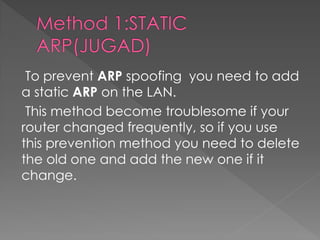
To prevent ARP spoofing you need to add a static ARP on the LAN. 
This method become troublesome if your router changed frequently, so if you use this prevention method you need to delete the old one and add the new one if it change.
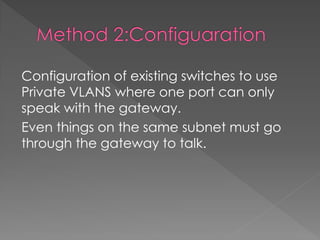
Configuration of existing switches to use Private VLANS where one port can only speak with the gateway. 
Even things on the same subnet must go through the gateway to talk.
According to a white paper ,Cisco Catalyst 6500 Series Switches have an mechanism to prevent such attacks .It provides a feature called Dynamic ARP Inspection (DAI) which helps prevent ARP poisoning and other ARP- based attacks by intercepting all ARP requests and responses, and by verifying their authenticity before updating the switch's local ARP cache or forwarding the packets to the intended destinations
The first method is This method is strictly not suitable for the SICSR network as it is a temporary solution for small networks. 
Considering the fact that we have Webservers running on our network, the second method will significantly hamper the performance of the network ,and therefore is not suitable for the network infrastructure. 
The third method is the best solution for this vulnerability and should be implemented on priority basis.
• Purpose: To assess the risk involved in packet sniffing. 
• Scope of this risk assessment: Components are SICSR network.
Briefly describe the approach used to conduct the risk assessment, 
such as— 
 Risk Assessment Team Members 
 Check whether PR poisoning is possible
Server, Network, Interface. 
 The mission is to avoid sniffing.
Packets on network can be intercepted.
List the observations: 
 Identification of existing mitigating security controls: Implementing use of tools to detect poisoning. 
 Likelihood and evaluation: low likelihood 
 Impact analysis and evaluation: High impact 
 Risk rating based on the risk-level matrix: Medium
Packet sniffing is a technical risk, Risk level is high, we can use features in new switches or configure existing switches for patching the risk
 Packet sniffing & ARP Poisoning

Packet sniffing & ARP Poisoning

  • 2.
    Packet sniffing isa term used to describe Capturing of packets that are transmitted over a network
  • 3.
    Wireshark is afree and open-source packet analyser. It is used for network troubleshooting, analysis, software and communications protocol development, and education.
  • 4.
    The SICSR networkis susceptible to ARP spoofing which is a technique whereby an attacker sends fake (“spoofed”)Address resolution protocol(ARP) messages onto a LAN. Generally, the aim is to associate the attacker's Mac address with the IP of another host (such as the default gateway), causing any traffic meant for that IP address to be sent to the attacker instead.
  • 6.
    After downloading andinstalling Wireshark, you can launch it and click the name of an interface under Interface List to start capturing packets on that interface. For example, if you want to capture traffic on the wireless network, click your wireless interface. You can configure advanced features by clicking Capture Options, but this isn’t necessary for now.
  • 8.
    As soon asyou click the interface’s name, you’ll see the packets start to appear in real time. Wireshark captures each packet sent to or from your system. If you’re capturing on a wireless interface and have promiscuous mode enabled in your capture options, you’ll also see other the other packets on the network.
  • 10.
    The captured packetscan be filtered according to protocol , IP, method and various other parameters.
  • 11.
    Wireshark was atool used to analyze the network and identify that ARP poisoning is possible on the network. The sniffer would not give any result if the poisoning failed.
  • 12.
    Audit Plan AuditorName: Viren Rao Date of Auditing :24/8/2014 Scope Plan Audit Selection area Selection criteria for auditors Training plan for auditors Audit goal Audit status Reporting Audit archival location To evaluate whether ARP poisoning is possible Check for new needs for improvement, Start Date: 24/8/2014 , Closure Date: 7/9/2014. Last audit results: ARP poisining is still possible hence enabling packet sniffing Selection of auditors: risk analyst, project manager and system admin The system admins will be needed to trained to take appropriate actions Is packet sniffing possible ? Level of risk is HIGH SICSR network
  • 13.
    FMEA is adisciplined procedure, which allows anticipating failures and preventing their occurrence in implementation/development. FMEA Process in Packet sniffing :  Select the design for FMEA team.  Identify critical areas Analyse network  Identified associated failure mode and effects. Are the Analysis tools giving any output ? Just avoid that risk.  Assign severity, occurrence and detection rating to each cause. Severity :High Occurrence: 1/10  Calculate Risk Priority Number (PRN) for each cause RPN : 8/10  Determine recommended action to reduce all RPN  Take appropriate actions.  Recalculate all RPN;’s with actual results.
  • 14.
    RISK mitigation PLAN TITLE:Packet sniffing analyst:Viren Rao Date:10/8/2014 Risk id Date identified risk Source Catgory Severity probability index impact in $ Exposure to risk identified Response Mitigation plan Contengency plan Threshold trigger for contengency plan ownership Risk status Progress 1 10-08- 2014 Packet sniffing SICSR Technical Risk High least likely No $ harm less Accepted Risk Avoidance Configure and purchace appropriate firewalls SICSR Yet to be mitigated Packet sniffing is still possible
  • 15.
    Security is somethingthat most organizations try to work upon . However it is observed that most organizations seldom look into an untouched area which is the Layer 2 of the OSI which can open the network to a variety of attacks and compromises.
  • 16.
    Currently this vulnerabilityhas not been exploited. If at all this vulnerability is exploited this could be a major security breach as all packets moving around a single subnet on the network can be intercepted .
  • 17.
    To allocate resourcesand implement cost-effective controls, organizations, after identifying all possible controls and evaluating their feasibility and effectiveness, should conduct a cost-benefit analysis for each proposed control to determine which controls are required and appropriate for their circumstances. Benefits could be:  Tangible: Quantitative  Intangible: Qualitative
  • 18.
    Cost factor Newin Rs. Enhancements in Rs. Hardware 90,000 30,000 Software -- -- Policies and procedures 50,000 20,000 Efforts 100000 50000 Training 50000 10000 Maintenance 50000
  • 19.
    Man In TheMiddle attacks(MITM) which are done using ARP poisoning can be prevented in numerous ways. However all methods are not suitable in all scenarios .
  • 20.
    To prevent ARPspoofing you need to add a static ARP on the LAN. This method become troublesome if your router changed frequently, so if you use this prevention method you need to delete the old one and add the new one if it change.
  • 21.
    Configuration of existingswitches to use Private VLANS where one port can only speak with the gateway. Even things on the same subnet must go through the gateway to talk.
  • 22.
    According to awhite paper ,Cisco Catalyst 6500 Series Switches have an mechanism to prevent such attacks .It provides a feature called Dynamic ARP Inspection (DAI) which helps prevent ARP poisoning and other ARP- based attacks by intercepting all ARP requests and responses, and by verifying their authenticity before updating the switch's local ARP cache or forwarding the packets to the intended destinations
  • 23.
    The first methodis This method is strictly not suitable for the SICSR network as it is a temporary solution for small networks. Considering the fact that we have Webservers running on our network, the second method will significantly hamper the performance of the network ,and therefore is not suitable for the network infrastructure. The third method is the best solution for this vulnerability and should be implemented on priority basis.
  • 25.
    • Purpose: Toassess the risk involved in packet sniffing. • Scope of this risk assessment: Components are SICSR network.
  • 26.
    Briefly describe theapproach used to conduct the risk assessment, such as—  Risk Assessment Team Members  Check whether PR poisoning is possible
  • 27.
    Server, Network, Interface.  The mission is to avoid sniffing.
  • 28.
    Packets on networkcan be intercepted.
  • 29.
    List the observations:  Identification of existing mitigating security controls: Implementing use of tools to detect poisoning.  Likelihood and evaluation: low likelihood  Impact analysis and evaluation: High impact  Risk rating based on the risk-level matrix: Medium
  • 30.
    Packet sniffing isa technical risk, Risk level is high, we can use features in new switches or configure existing switches for patching the risk