Presented by:
QuratulAin Najeeb
. • Advance persistent threat
. • Stages of APT
. • Problem in Detection
. • Events
. • Detection Framework
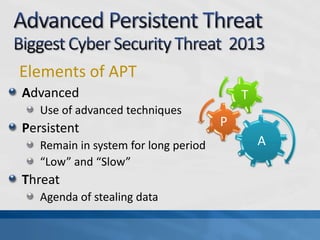
Advanced
Use of advanced techniques
Persistent
Remain in system for long period
“Low” and “Slow”
Threat
Agenda of stealing data
A
P
T
Elements of APT
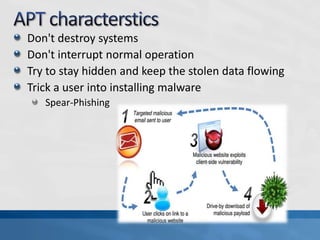
Don't destroy systems
Don't interrupt normal operation
Try to stay hidden and keep the stolen data flowing
Trick a user into installing malware
Spear-Phishing
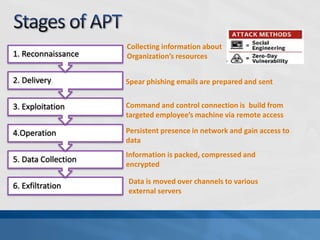
6. Exfiltration
5. Data Collection
4.Operation
3. Exploitation
2. Delivery
1. Reconnaissance
Collecting information about
Organization’s resources
Spear phishing emails are prepared and sent
Command and control connection is build from
targeted employee’s machine via remote access
Persistent presence in network and gain access to
data
Information is packed, compressed and
encrypted
Data is moved over channels to various
external servers
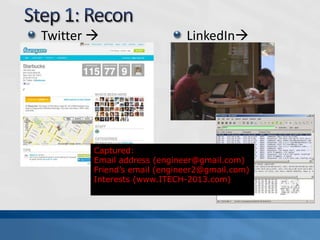
Twitter 
Starbucks
LinkedIn
Sniffing
Captured:
Email address (engineer@gmail.com)
Friend’s email (engineer2@gmail.com)
Interests (www.ITECH-2013.com)
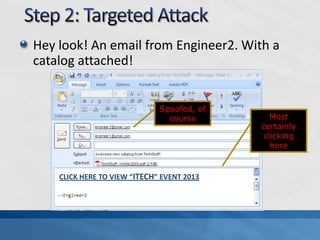
Hey look! An email from Engineer2. With a
catalog attached!
Spoofed, of
course Most
certainly
clicking
here
CLICK HERE TO VIEW “ITECH” EVENT 2013
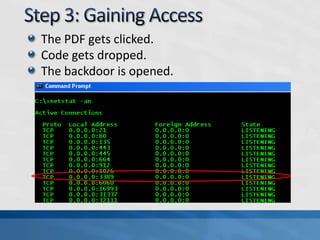
The PDF gets clicked.
Code gets dropped.
The backdoor is opened.
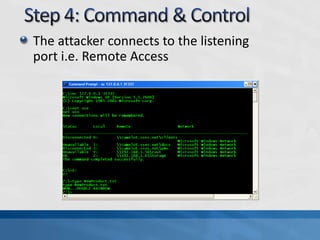
The attacker connects to the listening
port i.e. Remote Access
At this point, the attacker
could do any number of
things to get more
sensitive data
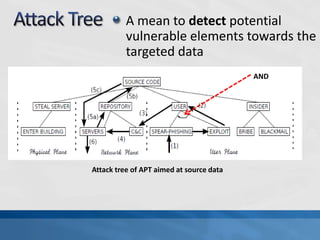
A mean to detect potential
vulnerable elements towards the
targeted data
Attack tree of APT aimed at source data
AND
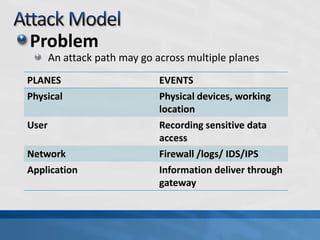
Problem
An attack path may go across multiple planes
PLANES EVENTS
Physical Physical devices, working
location
User Recording sensitive data
access
Network Firewall /logs/ IDS/IPS
Application Information deliver through
gateway
Candidate Events
Suspicious Events
Attack Events
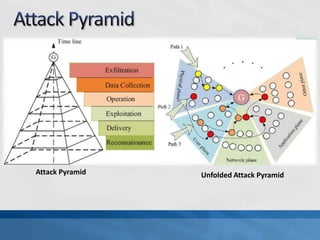
Attack Pyramid Unfolded Attack Pyramid
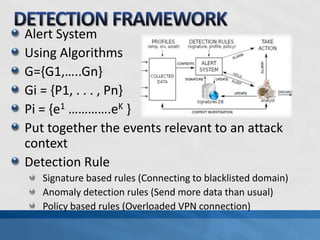
Alert System
Using Algorithms
G={G1,…..Gn}
Gi = {P1, . . . , Pn}
Pi = {e1 ………….eK }
Put together the events relevant to an attack
context
Detection Rule
Signature based rules (Connecting to blacklisted domain)
Anomaly detection rules (Send more data than usual)
Policy based rules (Overloaded VPN connection)
In research papers APT is defined, and proposed
an attack model for problem detection i.e.
Attack Pyramid
http://www.research.att.com/techdocs/TD_101075.pdf
http://www.infosecurityproject.com/2012/Download/K7_Advanced%20Persist
ent%20Threat%20and%20Modern%20Malware_Jones%20Leung.pdf

Advanced persistent threat (apt)