MEMS BASED
 INTEGRATED CIRCUIT
MASS STORAGE SYSTEMS


             Presented by
           prashant singh
            (imi2011003)
Highlights
New secondary storage technology that could revolutionize computer
 architecture.
   -Faster than hard drives
   -Lower entry cost
   -Lower weight and volume
   -Lower power consumption
Discuss physical description of device.
Disk Drive limitations
Disk-drive capacities double every 18 months
   -better 60% per year growth rate of semiconductor memories
Two major limitations of disk drives are…..
   -Access times decreases have been minimal
   -Minimum entry cost remains too high for many applications
Problem Specification

Requirement of mass storage system that can break both barrier
   -Access times
   -Minimum entry cost
New mass storage should also be significantly cheaper than non-volatile RAM
   -$100 now buys 1 GB of flash memory
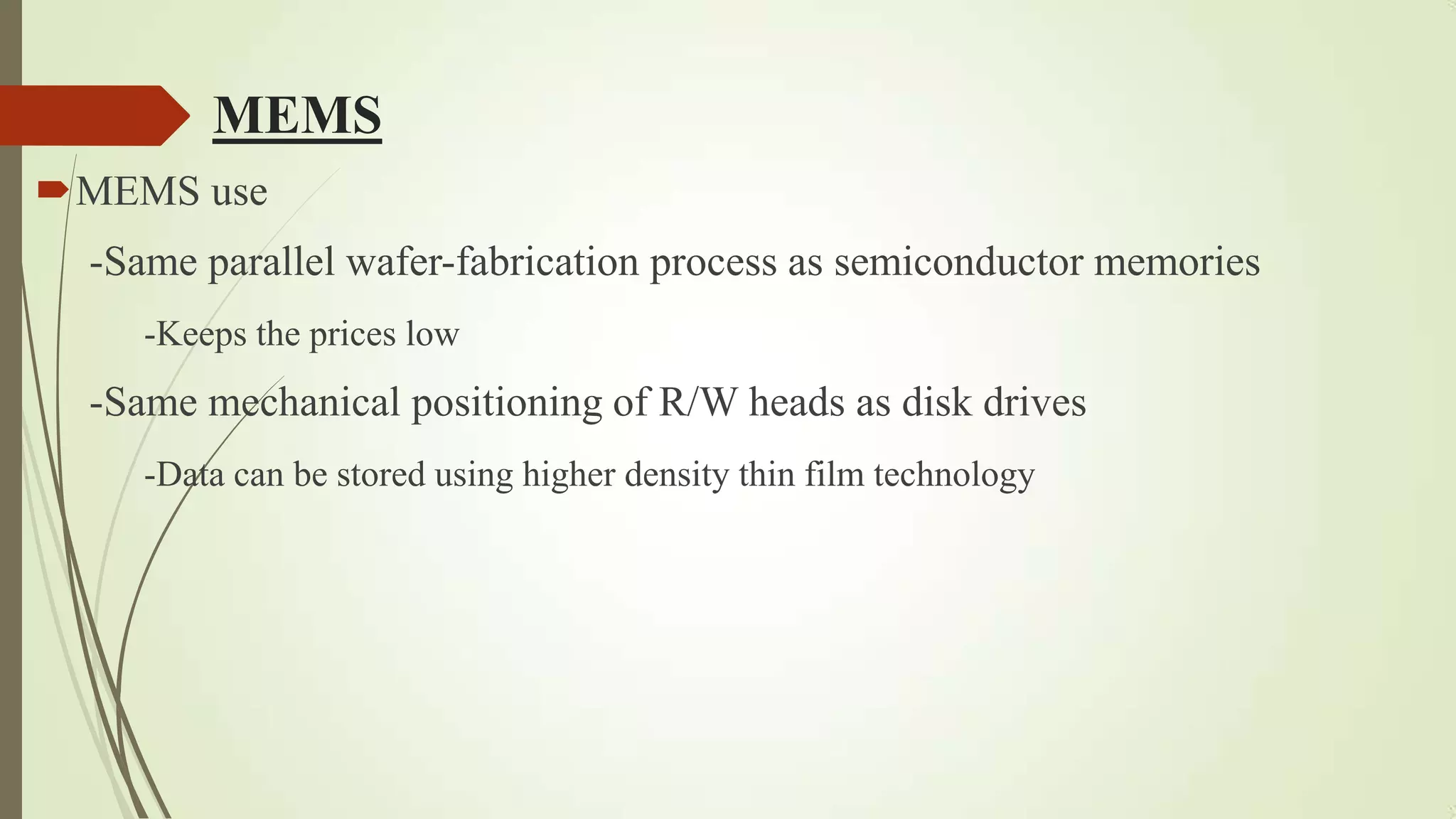
MEMS
MEMS use
  -Same parallel wafer-fabrication process as semiconductor memories
     -Keeps the prices low
  -Same mechanical positioning of R/W heads as disk drives
     -Data can be stored using higher density thin film technology
Main Advantages Of MEMS
 Potential for dramatic decrease in
   -Entry cost(10x cheaper than RAM)
   -Access time
   -Volume
   -Mass
   -Power dissipation
   -Failure rate
   -Shock sensitivity
 Integrate storage with computation
   -Complete system-on-chip integration
        -Processing unit
        -RAM
        -Non-volatile storage
MEMS storage prototype

Like a disk drive, it has
   -recording heads
   -a moving magnetic recording medium
Major departures from disk drive architecture are
   -MEMS recording heads-probe tips-are fabricated in a parallel wafer level
   manufacturing process
   -Media surface does not rotate(Data latency decreases)
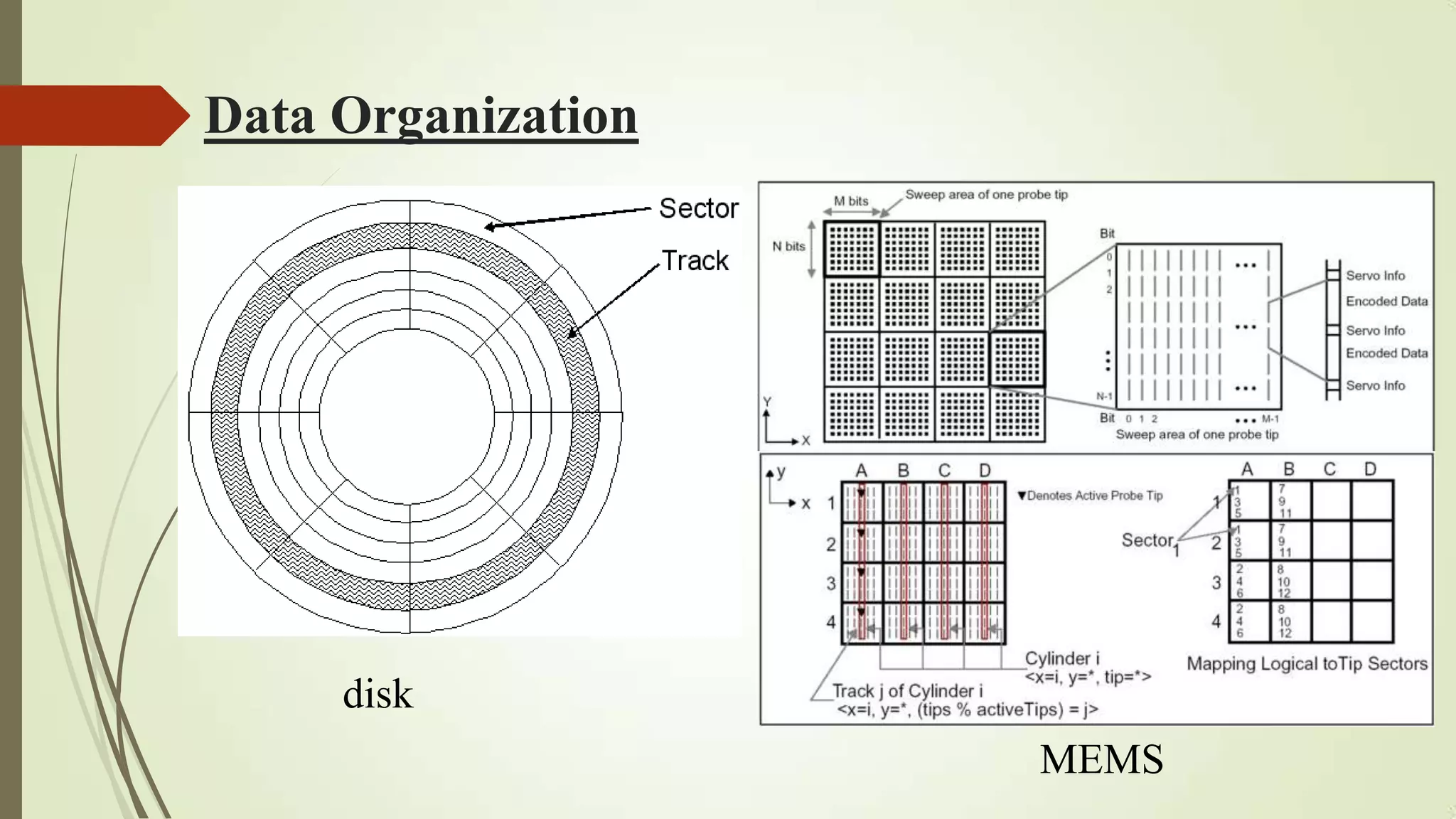
Data Organization


     disk
                    MEMS
Media Surface Movement

Media surface that rotate requires ball bearings
Very small ball bearing may have “striction” problem that prevent
 accurate positioning
   -Element would move by sticking and slipping
Best solution is to have media sled moving in X-Y directions
   -Sled moves in Y-direction for data access
   -Sled is suspended by spring
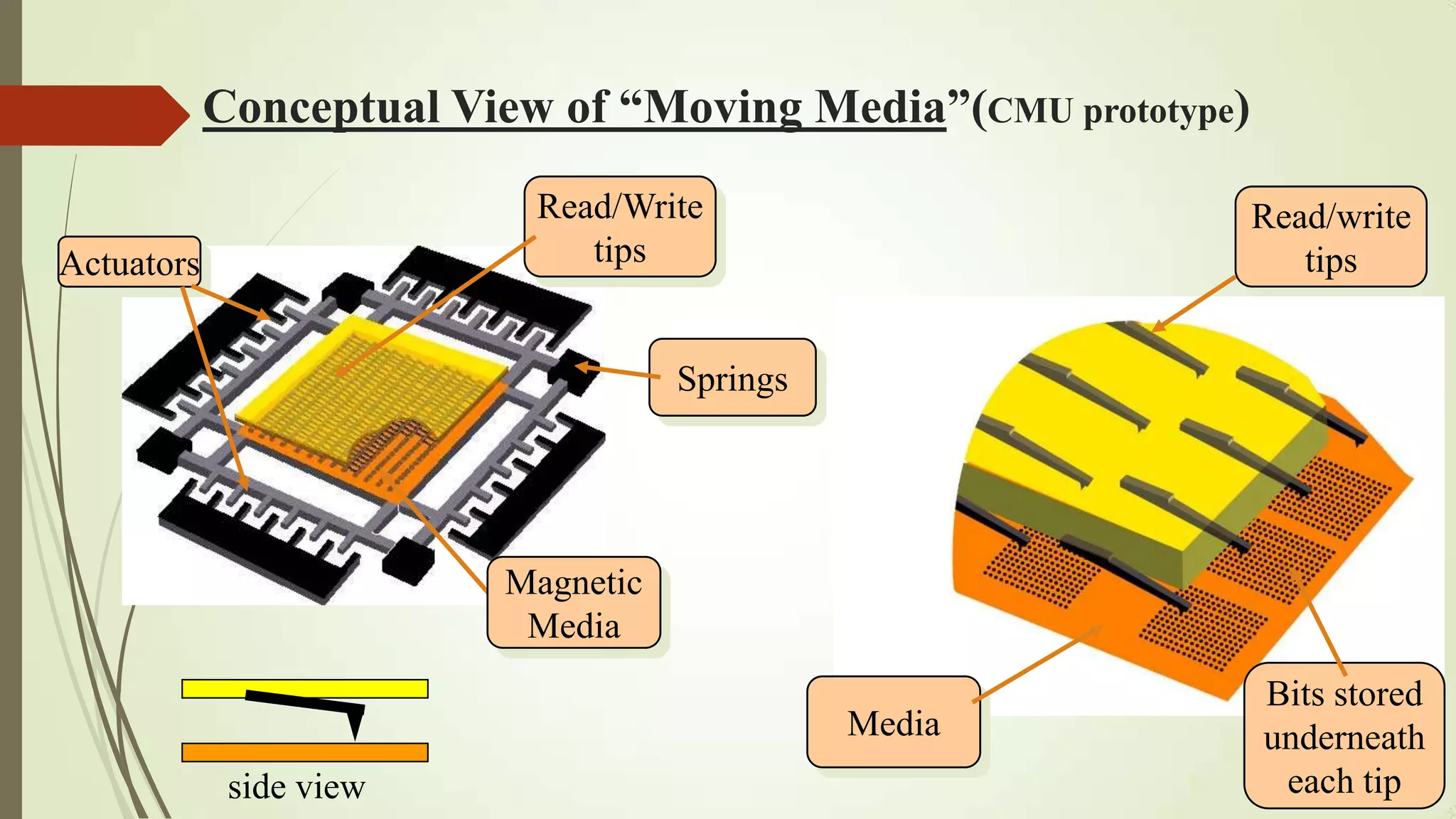
Conceptual View of “Moving Media”(CMU prototype)
                           Read/Write                          Read/write
Actuators                     tips                                tips


                                    Springs


                         Magnetic
                          Media
                                                               Bits stored
                                              Media            underneath
             side view                                          each tip
Operation
            (A)         (B)         (C)


 (D)              (E)         (F)
The Media Sled
Actuator pull sled in both dimensions
Size 8mm X 8mm X 500µm
Held over the probe tip array by a network of springs
Motion applied through electrostatic actuators
   -Motion limited to 10% or less of suspension/actuator length
   -Each probe tip can sweep 1% of the media sled
Include large number of probe tips for
   -Improving data throughput
   -Increasing system reliability
                                                                  Read write operation
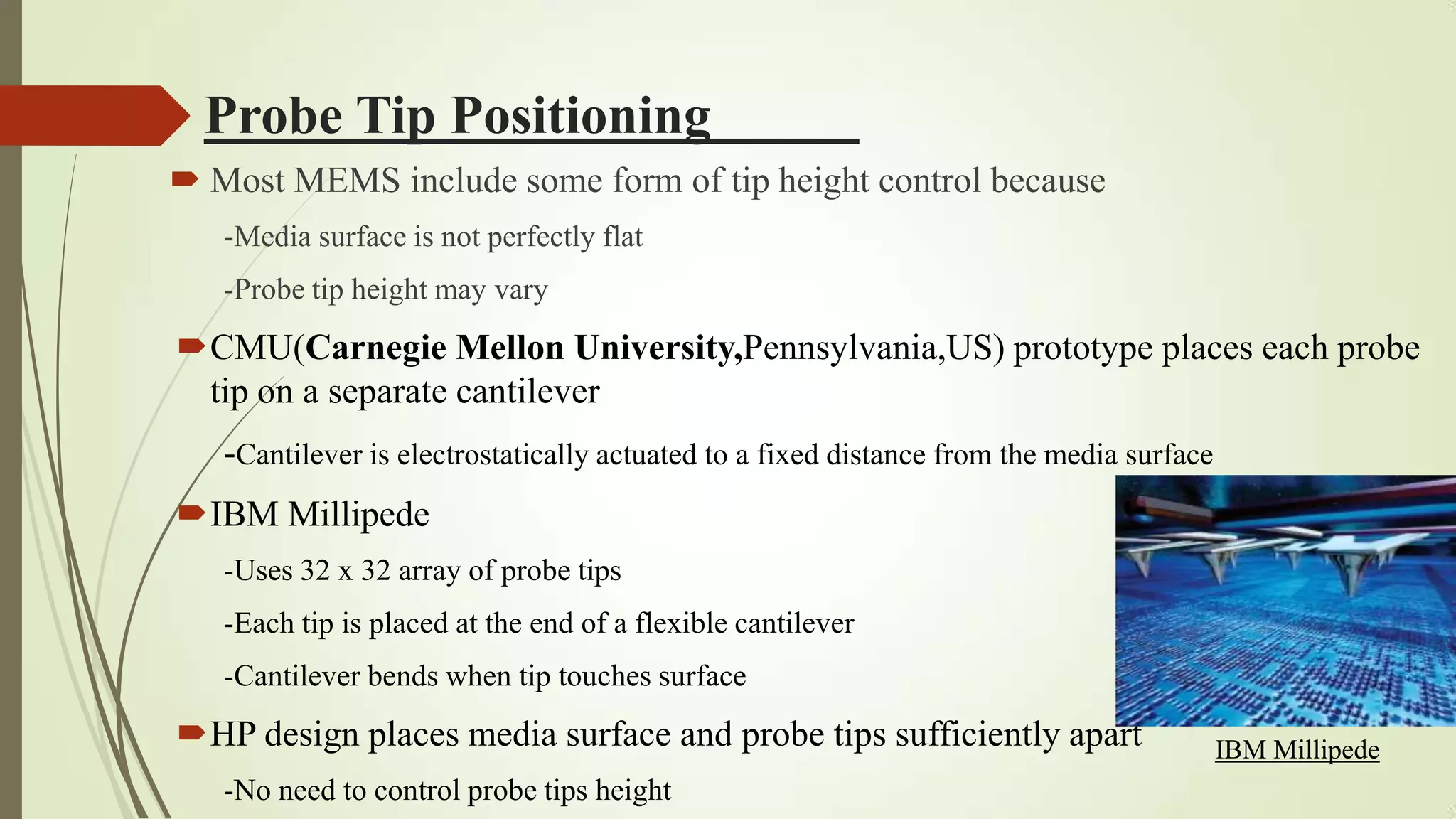
Probe Tip Positioning
 Most MEMS include some form of tip height control because
   -Media surface is not perfectly flat
   -Probe tip height may vary
CMU(Carnegie Mellon University,Pennsylvania,US) prototype places each probe
 tip on a separate cantilever
   -Cantilever is electrostatically actuated to a fixed distance from the media surface
IBM Millipede
   -Uses 32 x 32 array of probe tips
   -Each tip is placed at the end of a flexible cantilever
   -Cantilever bends when tip touches surface
HP design places media surface and probe tips sufficiently apart                         IBM Millipede
   -No need to control probe tips height
Probe Tip Fabrication
Major challenge is fabricating read/write probe tips in a way that is
 compatible with the underlying CMOS circuitry
This includes
   -thermal compatibility
   -geometrical compatibility
   -chemical compatibility……..
Failure Management
MEMS devices will have internal failures
  -Tips will break during fabrication/assembly, use
  -Media can wear(erosion/sideways displacement)
Storing, Reading and Writing Bits
CMU prototype uses same magnetic recording technology as current
 disk drives
  -Minimum mark size around 80µm x 80µm
Other solutions include
  -Melting pits in a polymer (IBM Millipede)
     -Raises tip wear issues
Potential Application
Lighter and less shock sensitive than disk drives
   -Great for notebook PC’s,PDA’s and video camcorders
Lower cost than disk drives in 1 to 10 GB range
   -Will open many new applications
High areal densities
   -Great for storing huge amounts of data
Can combine computing and storage on a single chip
 E.g. Average service time around 0.52 ms
   -Disk drive service time is 10.1 ms
   -Key factor for service time is X-seek time
Thank You

Mems mass storage syatem

  • 1.
    MEMS BASED INTEGRATEDCIRCUIT MASS STORAGE SYSTEMS Presented by prashant singh (imi2011003)
  • 2.
    Highlights New secondary storagetechnology that could revolutionize computer architecture. -Faster than hard drives -Lower entry cost -Lower weight and volume -Lower power consumption Discuss physical description of device.
  • 3.
    Disk Drive limitations Disk-drivecapacities double every 18 months -better 60% per year growth rate of semiconductor memories Two major limitations of disk drives are….. -Access times decreases have been minimal -Minimum entry cost remains too high for many applications
  • 4.
    Problem Specification Requirement ofmass storage system that can break both barrier -Access times -Minimum entry cost New mass storage should also be significantly cheaper than non-volatile RAM -$100 now buys 1 GB of flash memory
  • 5.
    MEMS MEMS use -Same parallel wafer-fabrication process as semiconductor memories -Keeps the prices low -Same mechanical positioning of R/W heads as disk drives -Data can be stored using higher density thin film technology
  • 6.
    Main Advantages OfMEMS  Potential for dramatic decrease in -Entry cost(10x cheaper than RAM) -Access time -Volume -Mass -Power dissipation -Failure rate -Shock sensitivity  Integrate storage with computation -Complete system-on-chip integration -Processing unit -RAM -Non-volatile storage
  • 7.
    MEMS storage prototype Likea disk drive, it has -recording heads -a moving magnetic recording medium Major departures from disk drive architecture are -MEMS recording heads-probe tips-are fabricated in a parallel wafer level manufacturing process -Media surface does not rotate(Data latency decreases)
  • 8.
  • 9.
    Media Surface Movement Mediasurface that rotate requires ball bearings Very small ball bearing may have “striction” problem that prevent accurate positioning -Element would move by sticking and slipping Best solution is to have media sled moving in X-Y directions -Sled moves in Y-direction for data access -Sled is suspended by spring
  • 10.
    Conceptual View of“Moving Media”(CMU prototype) Read/Write Read/write Actuators tips tips Springs Magnetic Media Bits stored Media underneath side view each tip
  • 11.
    Operation (A) (B) (C) (D) (E) (F)
  • 12.
    The Media Sled Actuatorpull sled in both dimensions Size 8mm X 8mm X 500µm Held over the probe tip array by a network of springs Motion applied through electrostatic actuators -Motion limited to 10% or less of suspension/actuator length -Each probe tip can sweep 1% of the media sled Include large number of probe tips for -Improving data throughput -Increasing system reliability Read write operation
  • 13.
    Probe Tip Positioning Most MEMS include some form of tip height control because -Media surface is not perfectly flat -Probe tip height may vary CMU(Carnegie Mellon University,Pennsylvania,US) prototype places each probe tip on a separate cantilever -Cantilever is electrostatically actuated to a fixed distance from the media surface IBM Millipede -Uses 32 x 32 array of probe tips -Each tip is placed at the end of a flexible cantilever -Cantilever bends when tip touches surface HP design places media surface and probe tips sufficiently apart IBM Millipede -No need to control probe tips height
  • 14.
    Probe Tip Fabrication Majorchallenge is fabricating read/write probe tips in a way that is compatible with the underlying CMOS circuitry This includes -thermal compatibility -geometrical compatibility -chemical compatibility……..
  • 15.
    Failure Management MEMS deviceswill have internal failures -Tips will break during fabrication/assembly, use -Media can wear(erosion/sideways displacement)
  • 16.
    Storing, Reading andWriting Bits CMU prototype uses same magnetic recording technology as current disk drives -Minimum mark size around 80µm x 80µm Other solutions include -Melting pits in a polymer (IBM Millipede) -Raises tip wear issues
  • 17.
    Potential Application Lighter andless shock sensitive than disk drives -Great for notebook PC’s,PDA’s and video camcorders Lower cost than disk drives in 1 to 10 GB range -Will open many new applications High areal densities -Great for storing huge amounts of data Can combine computing and storage on a single chip  E.g. Average service time around 0.52 ms -Disk drive service time is 10.1 ms -Key factor for service time is X-seek time
  • 18.

Editor's Notes

  • #14 CMU solution is most complex of three-must control individual heights of 6,400 probe tips,required by recording technology