Delocalizationof electrons
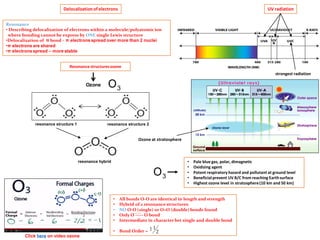
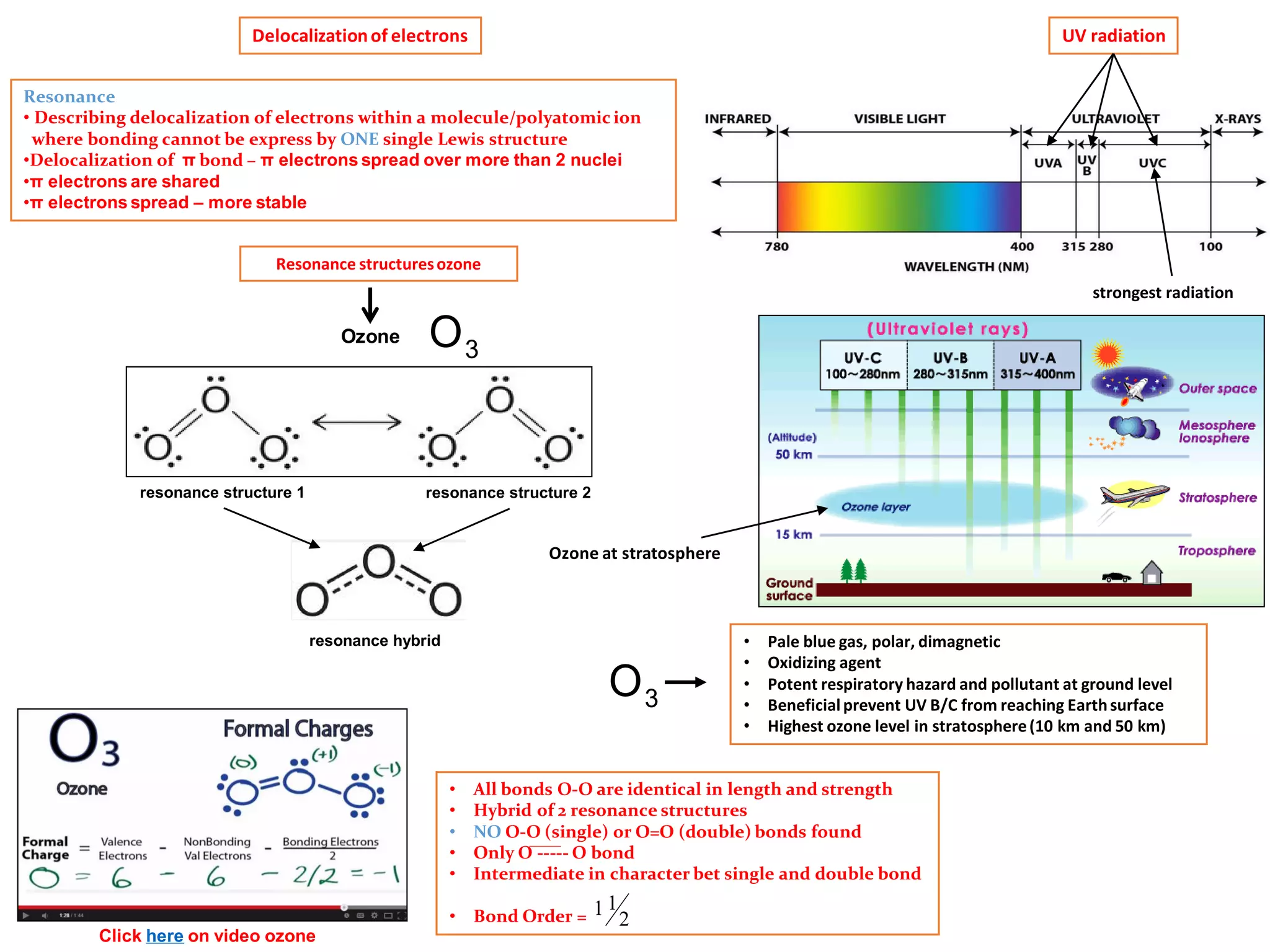
Resonance structuresozone
resonance structure 1 resonance structure 2
resonance hybrid
• All bonds O-O are identical in length and strength
• Hybrid of 2 resonance structures
• NO O-O (single) or O=O (double) bonds found
• Only O ----- O bond
• Intermediate in character bet single and double bond
• Bond Order = 2
11
Ozone
3O
Click here on video ozone
Resonance
• Describing delocalization of electrons within a molecule/polyatomic ion
where bonding cannot be express by ONE single Lewis structure
•Delocalization of π bond – π electrons spread over more than 2 nuclei
•π electrons are shared
•π electrons spread – more stable
• Pale blue gas, polar, dimagnetic
• Oxidizing agent
• Potent respiratory hazard and pollutant at ground level
• Beneficialprevent UV B/C from reaching Earthsurface
• Highest ozone level in stratosphere(10 km and 50 km)
UV radiation
Ozone at stratosphere
strongest radiation
3O
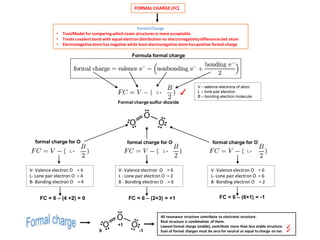
FORMAL CHARGE (FC)
Formal Charge
• Tool/Model for comparing which Lewis structures is more acceptable
• Treats covalent bond with equal electron distribution no electronegativitydifferencesbet atom
• Electronegativeatom has negative while least electronegative atom has positive formal charge
Formula formal charge
V - valence electrons of atom
L – lone pair electron
B – bonding electron molecule
✓
Formal charge sulfur dioxide
formal charge for O
V- Valence electron O = 6
L- Lone pair electron O = 4
B- Bonding electron O = 4
L +
FC = 6 – (4 +2) = 0
formal charge for O
V- Valence electron O = 6
L- Lone pair electron O = 6
B- Bonding electron O = 2
FC = 6 – (6+1) = -1
formal charge for O
V- Valence electron O = 6
L - Lone pair electron O = 2
B - Bonding electron O = 6
FC = 6 – (2+3) = +1
All resonance structure contribute to electronic structure.
Real structure is combination of them.
Lowest formal charge (stable), contribute more than less stable structure.
Sum of formal charges must be zero for neutral or equal to charge on ion. ✓0
+1
-1
✓
L + L + L +
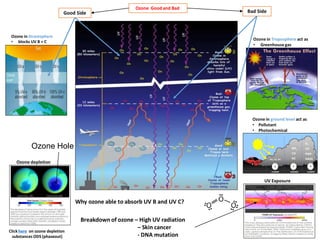
Ozone Goodand Bad
Good Side Bad Side
Ozone in Strastophere
• blocks UV B + C
Ozone in Troposphere act as
• Greenhouse gas
Ozone in ground level act as
• Pollutant
• Photochemical
Click here on ozone depletion
substances ODS (phaseout)
Why ozone able to absorb UV B and UV C?
Breakdown of ozone – High UV radiation
– Skin cancer
- DNA mutation
Ozone depletion
UV Exposure
Ozone Hole
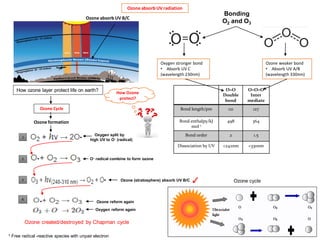
Ozone absorb UV radiation
Ozone absorb UV B/C
Ozone formation
O=O
Double
bond
O=O=O
Inter
mediate
Bond length/pm 121 127
Bond enthalpy/kJ
mol-1
498 364
Bond order 2 1.5
Dissociation by UV <242nm <330nm
Ozone weaker bond
• Absorb UV A/B
(wavelength 330nm)
Bonding
O2 and O3
Oxygen stronger bond
• Absorb UV C
(wavelength 230nm)
* Free radical -reactive species with unpair electron
How ozone layer protect life on earth?
Ozone Cycle
How Ozone
protect?
Oxygen split by
high UV to O· (radical)
O· radical combine to form ozone
1
2
3 Ozone (stratosphere) absorb UV B/C
4
Ozone reform again
✓ Ozone cycle
Ozone created/destroyed by Chapman cycle
Oxygen reform again
.
.
.
.
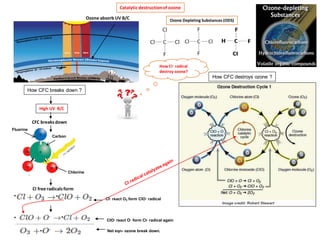
Ozone absorb UV B/C
CFC breaks down
How CFC breaks down ?
High UV B/C
How CI· radical
destroy ozone?
✓
Catalytic destructionof ozone
Ozone Depleting Substances (ODS)
How CFC destroys ozone ?
CI free radicalsform
CI· react O3 form CIO· radical
CIO· react O· form CI· radical again
Net eqn- ozone break down.
Carbon
Fluorine
Chlorine
. .
. .
.
+
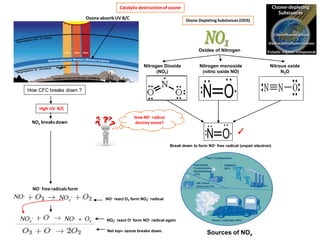
Ozone absorb UV B/C
NOx breaksdown
How CFC breaks down ?
High UV B/C
How NO· radical
destroy ozone?
✓
Catalytic destructionof ozone
Ozone Depleting Substances (ODS)
NO· free radicalsform
NO· react O3 form NO2· radical
NO2· react O· form NO· radical again
Net eqn- ozone breaks down.
Oxides of Nitrogen
Nitrogen Dioxide
(NO2)
Nitrogen monoxide
(nitric oxide NO)
Nitrous oxide
N2O
Break down to form NO· free radical (unpair electron)
NO· NO2·
NO2· NO· + O2
Sources of NOx
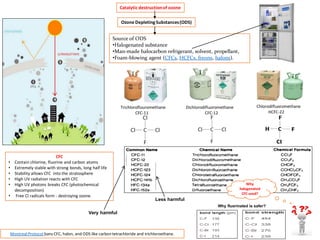
Catalytic destructionof ozone
Ozone DepletingSubstances(ODS)
Source of ODS
•Halogenated substance
•Man-made halocarbon refrigerant, solvent, propellant,
•Foam-blowing agent (CFCs, HCFCs, freons, halons).
Montreal Protocol bans CFC, halon, and ODS like carbon tetrachloride and trichloroethane.
CFC
• Contain chlorine, fluorine and carbon atoms
• Extremely stable with strong bonds, long half life
• Stability allows CFC into the stratosphere
• High UV radiation reacts with CFC
• High UV photons breaks CFC (photochemical
decomposition)
• Free Cl radicals form - destroying ozone.
Trichloroflouromethane
CFC-11
Dichlorodifluoromethane
CFC-12
Chlorodifluoromethane
HCFC-22
Why
halogenated
CFC used?
Less harmful
Very harmful
Why fluorinated is safer?
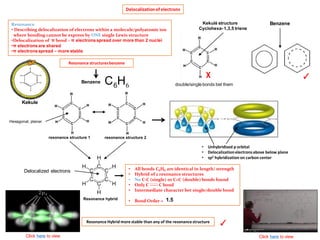
Delocalizationof electrons
Resonance
• Describing delocalization of electrons within a molecule/polyatomic ion
where bonding cannot be express by ONE single Lewis structure
•Delocalization of π bond – π electrons spread over more than 2 nuclei
•π electrons are shared
•π electrons spread – more stable
Resonance structuresbenzene
Benzene
6HC6
resonance structure 1 resonance structure 2
Resonance hybrid
• All bonds C6H6 are identical in length/ strength
• Hybrid of 2 resonance structures
• No C-C (single) or C=C (double) bonds found
• Only C ----- C bond
• Intermediate character bet single/double bond
• Bond Order =
• Unhybridised p orbital
• Delocalizationelectronsabove below plane
• sp2 hybridization on carbon center
1.5
Click here to view
Delocalized electrons
Kekulé structure
Cyclohexa- 1,3,5 triene
χ ✓
double/single bonds bet them
Benzene
Hexagonal, planar
Resonance Hybrid more stable than any of the resonancestructure
✓
Click here to view
Kekule
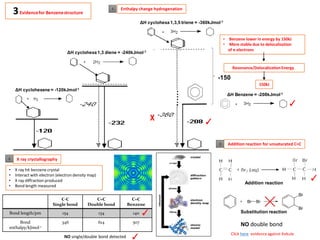
Resonance/DelocalizationEnergy
ΔH cyclohexene = -120kJmol-1
ΔH cyclohexa 1,3 diene = -240kJmol-1
ΔH cyclohexa 1,3,5 triene = -360kJmol-1
ΔH Benzene = -208kJmol-1
Enthalpy change hydrogenation
✓
✓
χ
……
• Benzene lower in energy by 150kJ
• More stable due to delocalization
of π electrons
150kJ
-150
C-C
Single bond
C=C
Double bond
C=C
Benzene
Bond length/pm 154 134 140
Bond
enthalpy/kJmol-1
346 614 507
3Evidencefor Benzenestructure
1
2
Click here evidenceagainst Kekule
• X ray hit benzene crystal
• Interact with electron (electron density map)
• X ray diffraction produced
• Bond length measured
X ray crystallography
NO single/double bond detected ✓
✓
3 Addition reaction for unsaturated C=C
✓Addition reaction
Substitution reaction
NO double bond

IB Chemistry on ozone and resonance

  • 1.
    Delocalizationof electrons Resonance structuresozone resonancestructure 1 resonance structure 2 resonance hybrid • All bonds O-O are identical in length and strength • Hybrid of 2 resonance structures • NO O-O (single) or O=O (double) bonds found • Only O ----- O bond • Intermediate in character bet single and double bond • Bond Order = 2 11 Ozone 3O Click here on video ozone Resonance • Describing delocalization of electrons within a molecule/polyatomic ion where bonding cannot be express by ONE single Lewis structure •Delocalization of π bond – π electrons spread over more than 2 nuclei •π electrons are shared •π electrons spread – more stable • Pale blue gas, polar, dimagnetic • Oxidizing agent • Potent respiratory hazard and pollutant at ground level • Beneficialprevent UV B/C from reaching Earthsurface • Highest ozone level in stratosphere(10 km and 50 km) UV radiation Ozone at stratosphere strongest radiation 3O
  • 2.
    FORMAL CHARGE (FC) FormalCharge • Tool/Model for comparing which Lewis structures is more acceptable • Treats covalent bond with equal electron distribution no electronegativitydifferencesbet atom • Electronegativeatom has negative while least electronegative atom has positive formal charge Formula formal charge V - valence electrons of atom L – lone pair electron B – bonding electron molecule ✓ Formal charge sulfur dioxide formal charge for O V- Valence electron O = 6 L- Lone pair electron O = 4 B- Bonding electron O = 4 L + FC = 6 – (4 +2) = 0 formal charge for O V- Valence electron O = 6 L- Lone pair electron O = 6 B- Bonding electron O = 2 FC = 6 – (6+1) = -1 formal charge for O V- Valence electron O = 6 L - Lone pair electron O = 2 B - Bonding electron O = 6 FC = 6 – (2+3) = +1 All resonance structure contribute to electronic structure. Real structure is combination of them. Lowest formal charge (stable), contribute more than less stable structure. Sum of formal charges must be zero for neutral or equal to charge on ion. ✓0 +1 -1 ✓ L + L + L +
  • 3.
    Ozone Goodand Bad GoodSide Bad Side Ozone in Strastophere • blocks UV B + C Ozone in Troposphere act as • Greenhouse gas Ozone in ground level act as • Pollutant • Photochemical Click here on ozone depletion substances ODS (phaseout) Why ozone able to absorb UV B and UV C? Breakdown of ozone – High UV radiation – Skin cancer - DNA mutation Ozone depletion UV Exposure Ozone Hole
  • 4.
    Ozone absorb UVradiation Ozone absorb UV B/C Ozone formation O=O Double bond O=O=O Inter mediate Bond length/pm 121 127 Bond enthalpy/kJ mol-1 498 364 Bond order 2 1.5 Dissociation by UV <242nm <330nm Ozone weaker bond • Absorb UV A/B (wavelength 330nm) Bonding O2 and O3 Oxygen stronger bond • Absorb UV C (wavelength 230nm) * Free radical -reactive species with unpair electron How ozone layer protect life on earth? Ozone Cycle How Ozone protect? Oxygen split by high UV to O· (radical) O· radical combine to form ozone 1 2 3 Ozone (stratosphere) absorb UV B/C 4 Ozone reform again ✓ Ozone cycle Ozone created/destroyed by Chapman cycle Oxygen reform again . . . .
  • 5.
    Ozone absorb UVB/C CFC breaks down How CFC breaks down ? High UV B/C How CI· radical destroy ozone? ✓ Catalytic destructionof ozone Ozone Depleting Substances (ODS) How CFC destroys ozone ? CI free radicalsform CI· react O3 form CIO· radical CIO· react O· form CI· radical again Net eqn- ozone break down. Carbon Fluorine Chlorine . . . . .
  • 6.
    + Ozone absorb UVB/C NOx breaksdown How CFC breaks down ? High UV B/C How NO· radical destroy ozone? ✓ Catalytic destructionof ozone Ozone Depleting Substances (ODS) NO· free radicalsform NO· react O3 form NO2· radical NO2· react O· form NO· radical again Net eqn- ozone breaks down. Oxides of Nitrogen Nitrogen Dioxide (NO2) Nitrogen monoxide (nitric oxide NO) Nitrous oxide N2O Break down to form NO· free radical (unpair electron) NO· NO2· NO2· NO· + O2 Sources of NOx
  • 7.
    Catalytic destructionof ozone OzoneDepletingSubstances(ODS) Source of ODS •Halogenated substance •Man-made halocarbon refrigerant, solvent, propellant, •Foam-blowing agent (CFCs, HCFCs, freons, halons). Montreal Protocol bans CFC, halon, and ODS like carbon tetrachloride and trichloroethane. CFC • Contain chlorine, fluorine and carbon atoms • Extremely stable with strong bonds, long half life • Stability allows CFC into the stratosphere • High UV radiation reacts with CFC • High UV photons breaks CFC (photochemical decomposition) • Free Cl radicals form - destroying ozone. Trichloroflouromethane CFC-11 Dichlorodifluoromethane CFC-12 Chlorodifluoromethane HCFC-22 Why halogenated CFC used? Less harmful Very harmful Why fluorinated is safer?
  • 8.
    Delocalizationof electrons Resonance • Describingdelocalization of electrons within a molecule/polyatomic ion where bonding cannot be express by ONE single Lewis structure •Delocalization of π bond – π electrons spread over more than 2 nuclei •π electrons are shared •π electrons spread – more stable Resonance structuresbenzene Benzene 6HC6 resonance structure 1 resonance structure 2 Resonance hybrid • All bonds C6H6 are identical in length/ strength • Hybrid of 2 resonance structures • No C-C (single) or C=C (double) bonds found • Only C ----- C bond • Intermediate character bet single/double bond • Bond Order = • Unhybridised p orbital • Delocalizationelectronsabove below plane • sp2 hybridization on carbon center 1.5 Click here to view Delocalized electrons Kekulé structure Cyclohexa- 1,3,5 triene χ ✓ double/single bonds bet them Benzene Hexagonal, planar Resonance Hybrid more stable than any of the resonancestructure ✓ Click here to view Kekule
  • 9.
    Resonance/DelocalizationEnergy ΔH cyclohexene =-120kJmol-1 ΔH cyclohexa 1,3 diene = -240kJmol-1 ΔH cyclohexa 1,3,5 triene = -360kJmol-1 ΔH Benzene = -208kJmol-1 Enthalpy change hydrogenation ✓ ✓ χ …… • Benzene lower in energy by 150kJ • More stable due to delocalization of π electrons 150kJ -150 C-C Single bond C=C Double bond C=C Benzene Bond length/pm 154 134 140 Bond enthalpy/kJmol-1 346 614 507 3Evidencefor Benzenestructure 1 2 Click here evidenceagainst Kekule • X ray hit benzene crystal • Interact with electron (electron density map) • X ray diffraction produced • Bond length measured X ray crystallography NO single/double bond detected ✓ ✓ 3 Addition reaction for unsaturated C=C ✓Addition reaction Substitution reaction NO double bond