Methods Of Preparetion
 It is the simplest boron hydride. It is prepared by treating
  boron Trifluoride with LiAlH4 in diethyl ether
  4BF3 + 3LiAlH4                 2B2H6 +3LiF + 3ALF3

 In a laboratory the diborane is prepared by the oxidation of
 sodium borobhydride with iodine
 2NaBH4 + I2                B2H6 +2NaI +H2

 In industry it is prepared by the reaction of BF3 with
 sodium hydride
 2 BF3 + 6 NaH         450 K        B2H6 + 6 NaF
PRORPERTIES
1)   Diborane is a colorless, highly toxic gas. It has boiling
     point ok 180 K

1)   Diborane catches fire spontaneously when it is exposed
     to atmospheric air
     it burns with oxygen. The reaction is exothermic
     releasing a lager amount of energy
     B2H6 + 3O2                B2O3 + 3H2O
     ΔH= - 1976 K J mol-1

3) it is readily hydrolyzed by water to form boric acid
    B2H6 + 6H2O                   2B(OH)3 + 6H2
4) With Lewis bases, diborane first undergoes cleavage
   (breaking) to form borane (BH3) which then reacts to
   form adducts
   B2H6 + 2NMe                 2BH3 . NMe
   B2H6 + 2CO                  2BH3 . CO

5) with ammonia an addition product B2H6.NH3formulated
    as [ BH2(NH3)2]+ [BH4]- is formed which then
    decomposes on heating at 473K to give a volatile
    compound called borazole (Borazine)
     3 B2H6 + 6NH3        [ BH2(NH3)2]+ [BH4]- 473K
       2B3N3H6 + 12H2
        ( borazole)
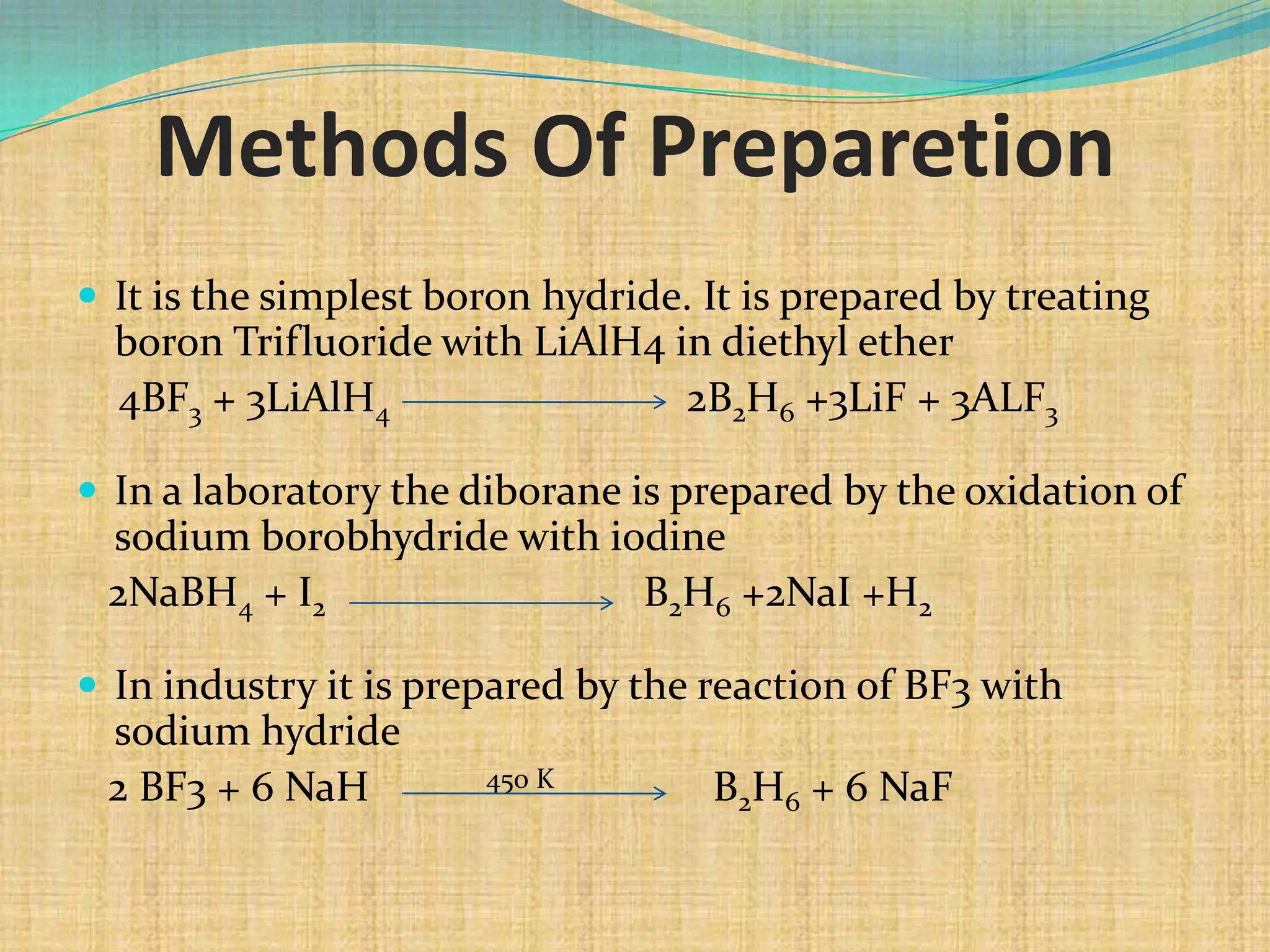
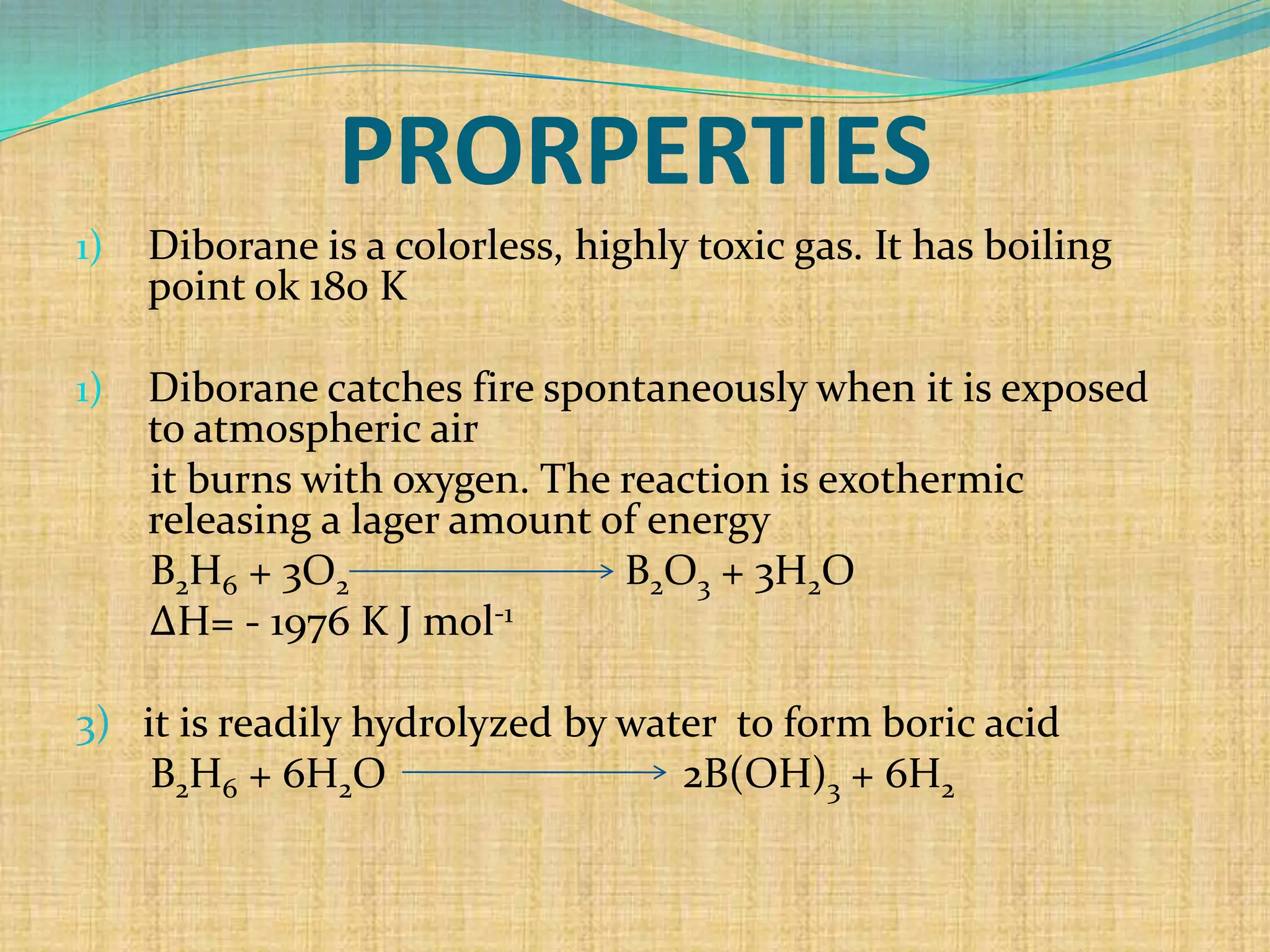
BORAZOLE (BORAZINE)
 This compound is called inorganic benzene in view of
 its ring structure with alternate NH and BH groups.
 Borazole contains 3 double bonds and has 6 electron
 system which is similar to benzene
6)Many metal hydrides react with diborane to form
  tetrahydridoborate which contain [BH4]- tetrahedral
  ion.
 2MH + B2H6       2M+ [BH4]-
 Where (M=Li or Na), for ex:


 2LiH + B2H6         2Li+ [BH4]-
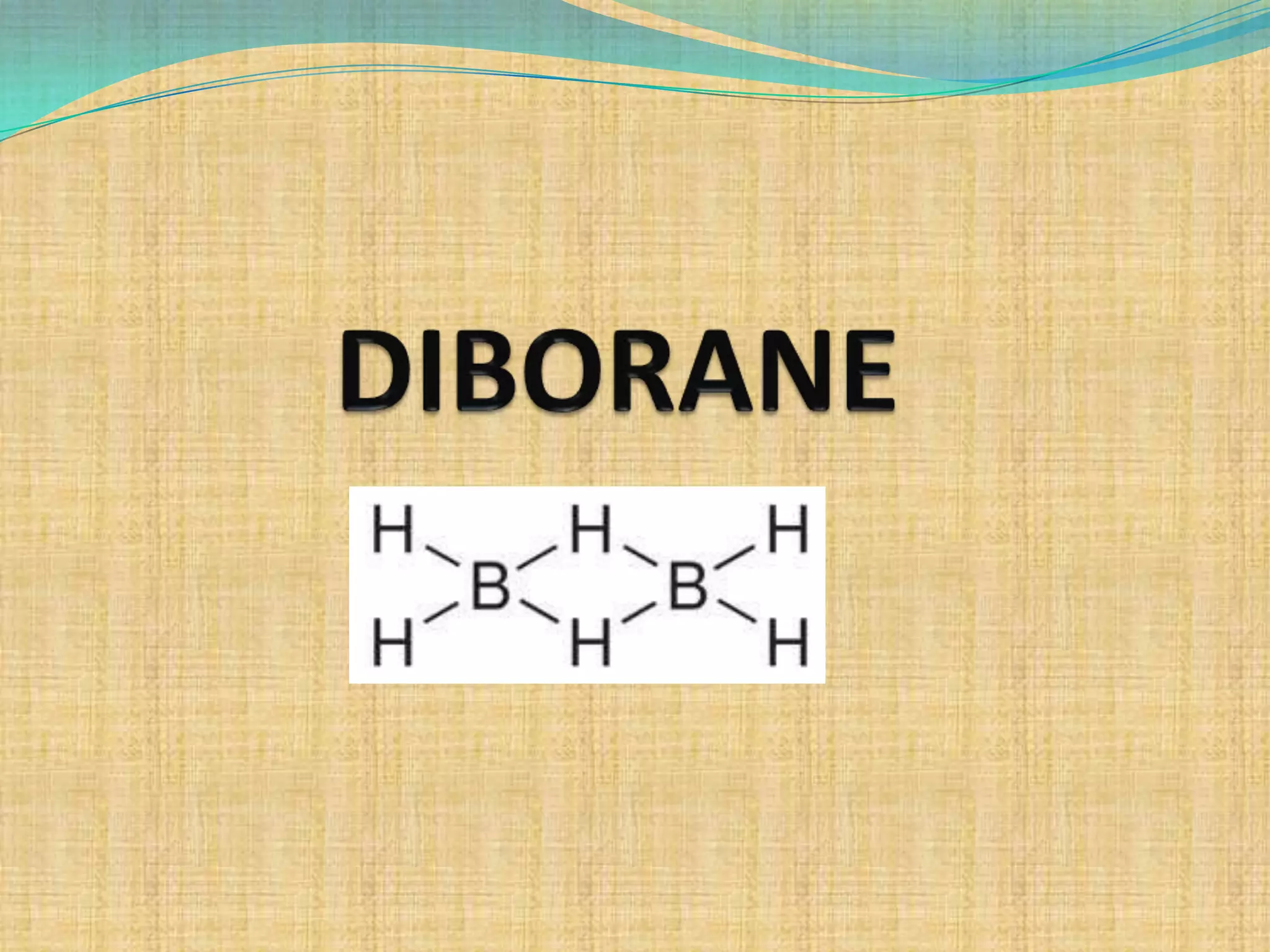
STRUCTURE OF DIBORANE
 X-ray diffraction has shown the following structure of
 diborane


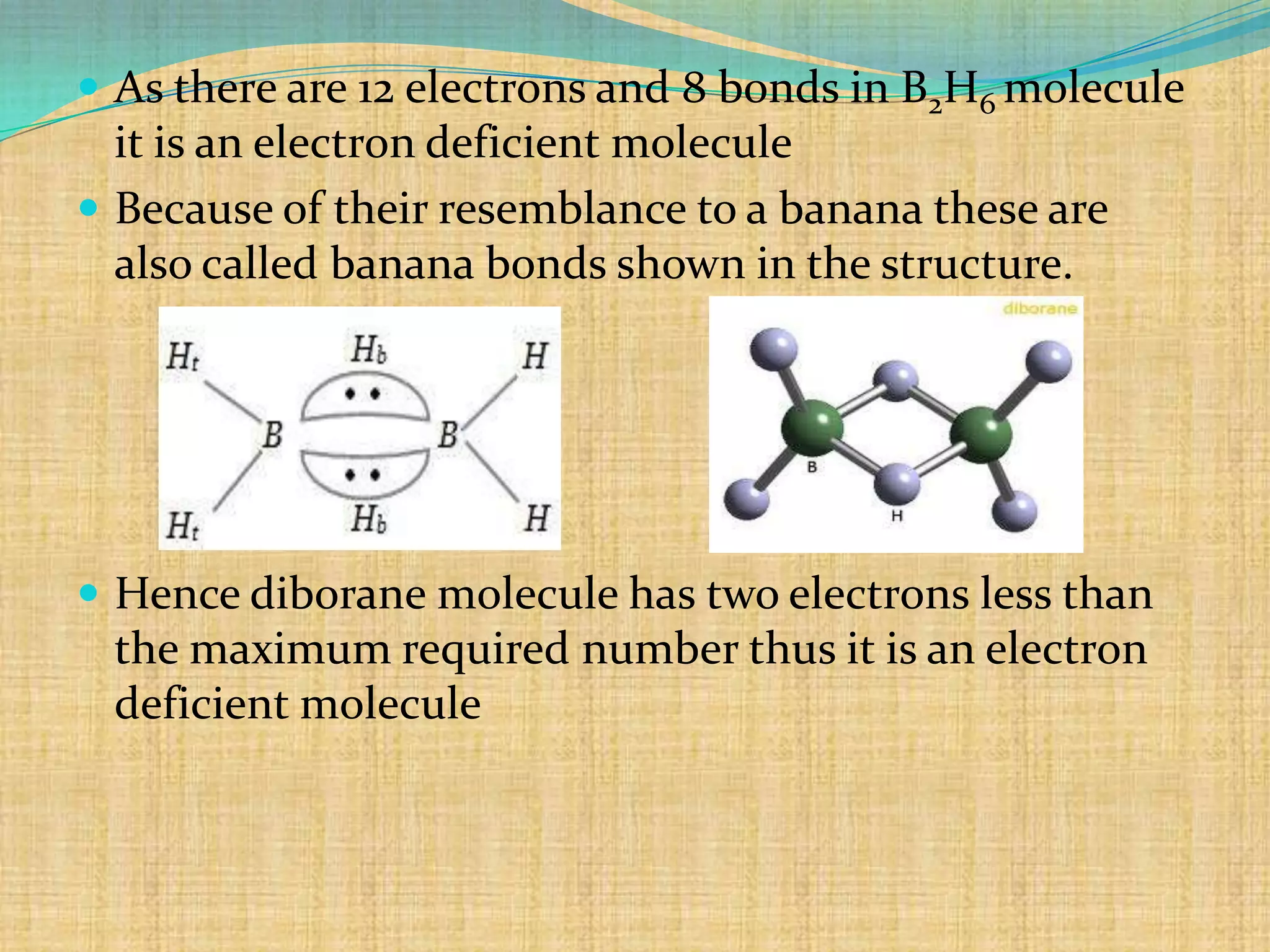
 Here B atoms undergo sp3 hybridization. There are
 four terminals B-Ht normal covalent bonds which are
 quite strong and two bridge B……Hb…..B which are
 different from normal covalent bonds and are quite
 weak

 The four Ht molecules and b atoms lie in the same
 plane while one Hb lies above and one below the plane
 As there are 12 electrons and 8 bonds in B2H6 molecule
  it is an electron deficient molecule
 Because of their resemblance to a banana these are
  also called banana bonds shown in the structure.


 Hence diborane molecule has two electrons less than
 the maximum required number thus it is an electron
 deficient molecule
USES OF DIBORANE
 Diborane has been suggested as a rocket
 propellant and experimentally fired but not used in
 any in service rocket as a rubbervulcaniser as
 a catalyst for hydrocarbon polymerization as a
 flame-speed accelerator, and as a doping agent for the
 production of semiconductors. It is also an
 intermediate in the production of highly
 pure boron for semiconductor production. It is also
 used to coat the walls of tokomaks to reduce the
 amount of heavy metal impurities in the plasma.
The End

Diborane

  • 2.
    Methods Of Preparetion It is the simplest boron hydride. It is prepared by treating boron Trifluoride with LiAlH4 in diethyl ether 4BF3 + 3LiAlH4 2B2H6 +3LiF + 3ALF3  In a laboratory the diborane is prepared by the oxidation of sodium borobhydride with iodine 2NaBH4 + I2 B2H6 +2NaI +H2  In industry it is prepared by the reaction of BF3 with sodium hydride 2 BF3 + 6 NaH 450 K B2H6 + 6 NaF
  • 3.
    PRORPERTIES 1) Diborane is a colorless, highly toxic gas. It has boiling point ok 180 K 1) Diborane catches fire spontaneously when it is exposed to atmospheric air it burns with oxygen. The reaction is exothermic releasing a lager amount of energy B2H6 + 3O2 B2O3 + 3H2O ΔH= - 1976 K J mol-1 3) it is readily hydrolyzed by water to form boric acid B2H6 + 6H2O 2B(OH)3 + 6H2
  • 4.
    4) With Lewisbases, diborane first undergoes cleavage (breaking) to form borane (BH3) which then reacts to form adducts B2H6 + 2NMe 2BH3 . NMe B2H6 + 2CO 2BH3 . CO 5) with ammonia an addition product B2H6.NH3formulated as [ BH2(NH3)2]+ [BH4]- is formed which then decomposes on heating at 473K to give a volatile compound called borazole (Borazine) 3 B2H6 + 6NH3 [ BH2(NH3)2]+ [BH4]- 473K 2B3N3H6 + 12H2 ( borazole)
  • 5.
    BORAZOLE (BORAZINE)  Thiscompound is called inorganic benzene in view of its ring structure with alternate NH and BH groups. Borazole contains 3 double bonds and has 6 electron system which is similar to benzene
  • 6.
    6)Many metal hydridesreact with diborane to form tetrahydridoborate which contain [BH4]- tetrahedral ion.  2MH + B2H6 2M+ [BH4]-  Where (M=Li or Na), for ex:  2LiH + B2H6 2Li+ [BH4]-
  • 7.
    STRUCTURE OF DIBORANE X-ray diffraction has shown the following structure of diborane  Here B atoms undergo sp3 hybridization. There are four terminals B-Ht normal covalent bonds which are quite strong and two bridge B……Hb…..B which are different from normal covalent bonds and are quite weak  The four Ht molecules and b atoms lie in the same plane while one Hb lies above and one below the plane
  • 8.
     As thereare 12 electrons and 8 bonds in B2H6 molecule it is an electron deficient molecule  Because of their resemblance to a banana these are also called banana bonds shown in the structure.  Hence diborane molecule has two electrons less than the maximum required number thus it is an electron deficient molecule
  • 9.
    USES OF DIBORANE Diborane has been suggested as a rocket propellant and experimentally fired but not used in any in service rocket as a rubbervulcaniser as a catalyst for hydrocarbon polymerization as a flame-speed accelerator, and as a doping agent for the production of semiconductors. It is also an intermediate in the production of highly pure boron for semiconductor production. It is also used to coat the walls of tokomaks to reduce the amount of heavy metal impurities in the plasma.
  • 10.