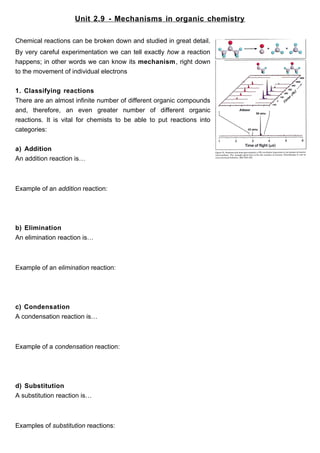
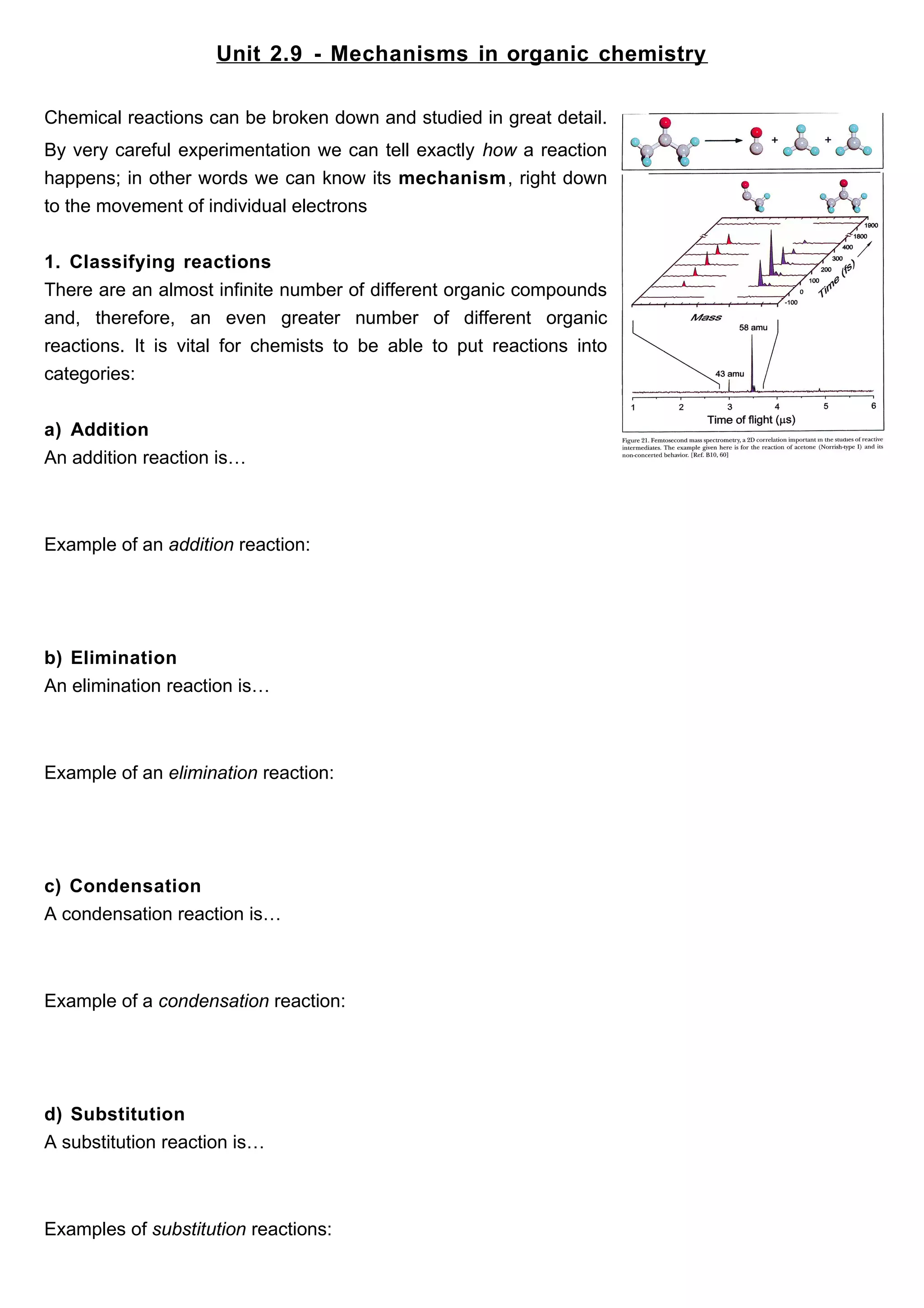
Unit 2.9 - Mechanisms in organic chemistry

Chemical reactions can be broken down and studied in great detail.
By very careful experimentation we can tell exactly how a reaction
happens; in other words we can know its mechanism, right down
to the movement of individual electrons


1. Classifying reactions
There are an almost infinite number of different organic compounds
and, therefore, an even greater number of different organic
reactions. It is vital for chemists to be able to put reactions into
categories:


a) Addition
An addition reaction is…


Example of an addition reaction:


b) Elimination
An elimination reaction is…


Example of an elimination reaction:


c) Condensation
A condensation reaction is…


Example of a condensation reaction:


d) Substitution
A substitution reaction is…


Examples of substitution reactions:
e) Oxidation and reduction
Oxidation is…


Oxidation levels in organic chemistry
             Alcohol                        Aldehyde / ketone                      Carboxylic acid


  [O]


Examples of oxidation reactions:


f) Polymerisation
Polymerisation is…


Examples of polymerisation reactions:


2. Classifying reagents
Reagents are, simply put, the chemicals involved in making chemical reactions happen. Just like the
reactions themselves there are literally millions of different organic reagents. It is helpful to be able to
put them into categories:
a) Nucleo philes
   •    Are attracted to partially _______________ atoms (look for polar bonds)
   •    Are electron ‘rich’ with a _____________ charge or _______ pair of electrons
   •    Can donate a pair of electrons to form a new ______________ bond
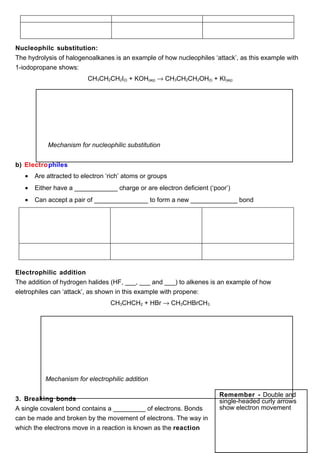
Nucleophilc substitution:
The hydrolysis of halogenoalkanes is an example of how nucleophiles ‘attack’, as this example with
1-iodopropane shows:
                          CH3CH2CH2I(l) + KOH(aq) → CH3CH2CH2OH(l) + KI(aq)


           Mechanism for nucleophilic substitution


b) Electrophiles
   •   Are attracted to electron ‘rich’ atoms or groups
   •   Either have a ____________ charge or are electron deficient (‘poor’)
   •   Can accept a pair of _______________ to form a new _____________ bond


Electrophilic addition
The addition of hydrogen halides (HF, ___, ___ and ___) to alkenes is an example of how
eletrophiles can ‘attack’, as shown in this example with propene:
                                  CH3CHCH2 + HBr → CH3CHBrCH3


          Mechanism for electrophilic addition

                                                                       Remember - Double and
3. Breaking bonds                                                      single-headed curly arrows
A single covalent bond contains a _________ of electrons. Bonds        show electron movement
can be made and broken by the movement of electrons. The way in
which the electrons move in a reaction is known as the reaction
_____________ . Bonds can break in two different ways:


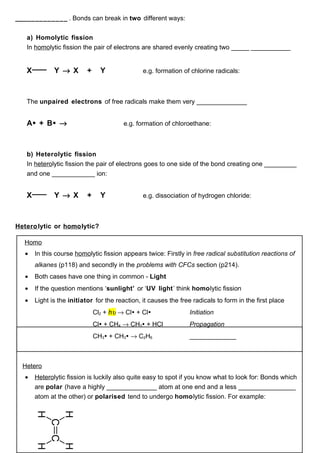
   a) Homolytic fission
   In homolytic fission the pair of electrons are shared evenly creating two _____ ___________


   X          Y → X       +     Y               e.g. formation of chlorine radicals:


   The unpaired electrons of free radicals make them very ______________


   A + B →                            e.g. formation of chloroethane:


   b) Heterolytic fission
   In heterolytic fission the pair of electrons goes to one side of the bond creating one _________
   and one ____________ ion:


   X          Y → X       +     Y               e.g. dissociation of hydrogen chloride:


Hetero lytic or homolytic?

  Homo
   •   In this course homolytic fission appears twice: Firstly in free radical substitution reactions of
       alkanes (p118) and secondly in the problems with CFCs section (p214).
   •   Both cases have one thing in common - Light
   •   If the question mentions ‘sunlight’ or ‘UV light’ think homolytic fission
   •   Light is the initiator for the reaction, it causes the free radicals to form in the first place
                              Cl2 + hυ → Cl + Cl               Initiation
                              Cl + CH4 → CH3 + HCl             Propagation
                              CH3 + CH3 → C2H6                 _____________


  Hetero
   •   Heterolytic fission is luckily also quite easy to spot if you know what to look for: Bonds which
       are polar (have a highly ______________ atom at one end and a less ________________
       atom at the other) or polarised tend to undergo homolytic fission. For example:
4. The ozone layer - Free radical chemistry
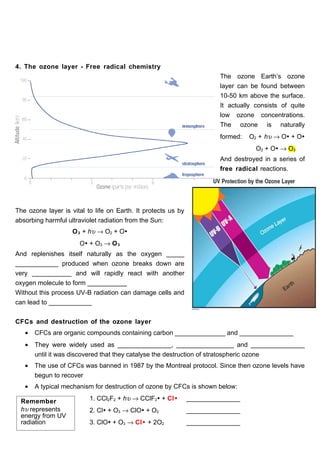
                                                                        The ozone Earth’s ozone
                                                                        layer can be found between
                                                                        10-50 km above the surface.
                                                                        It actually consists of quite
                                                                        low ozone concentrations.
                                                                        The ozone is naturally
                                                                        formed:   O2 + hυ → O + O
                                                                                    O2 + O → O3
                                                                        And destroyed in a series of
                                                                        free radical reactions.


The ozone layer is vital to life on Earth. It protects us by
absorbing harmful ultraviolet radiation from the Sun:
                    O 3 + hυ → O2 + O
                      O + O3 → O 3
And replenishes itself naturally as the oxygen _____
____________ produced when ozone breaks down are
very ___________ and will rapidly react with another
oxygen molecule to form ___________
Without this process UV-B radiation can damage cells and
can lead to ____________


CFCs and destruction of the ozone layer
   •   CFCs are organic compounds containing carbon ______________ and _______________
   •   They were widely used as _______________, ________________ and _______________
       until it was discovered that they catalyse the destruction of stratospheric ozone
   •   The use of CFCs was banned in 1987 by the Montreal protocol. Since then ozone levels have
       begun to recover
   •   A typical mechanism for destruction of ozone by CFCs is shown below:

 Remember                 1. CCl2F2 + hυ → CClF2 + Cl        _______________
 hυ represents            2. Cl + O3 → ClO + O2              _______________
 energy from UV
 radiation                3. ClO + O3 → Cl + 2O2             _______________
NB The chlorine radical is not removed in this process - one molecule of CFC can lead to the
     destruction of thousands of molecules of ozone


The mechanism for part 1 involves the ________________ fission of the C-Cl bond and is shown
below:


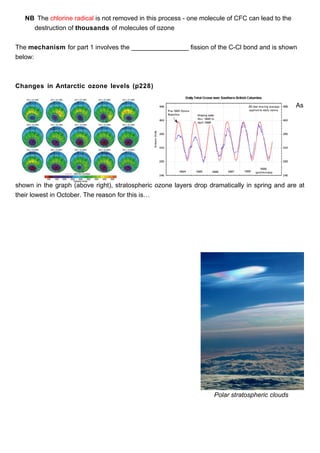
Changes in Antarctic ozone levels (p228)


                                                                                                  As


shown in the graph (above right), stratospheric ozone layers drop dramatically in spring and are at
their lowest in October. The reason for this is…


                                                                    Polar stratospheric clouds

Unit 2 9 Mechanisms Notes

  • 1.
    Unit 2.9 -Mechanisms in organic chemistry Chemical reactions can be broken down and studied in great detail. By very careful experimentation we can tell exactly how a reaction happens; in other words we can know its mechanism, right down to the movement of individual electrons 1. Classifying reactions There are an almost infinite number of different organic compounds and, therefore, an even greater number of different organic reactions. It is vital for chemists to be able to put reactions into categories: a) Addition An addition reaction is… Example of an addition reaction: b) Elimination An elimination reaction is… Example of an elimination reaction: c) Condensation A condensation reaction is… Example of a condensation reaction: d) Substitution A substitution reaction is… Examples of substitution reactions:
  • 2.
    e) Oxidation andreduction Oxidation is… Oxidation levels in organic chemistry Alcohol Aldehyde / ketone Carboxylic acid [O] Examples of oxidation reactions: f) Polymerisation Polymerisation is… Examples of polymerisation reactions: 2. Classifying reagents Reagents are, simply put, the chemicals involved in making chemical reactions happen. Just like the reactions themselves there are literally millions of different organic reagents. It is helpful to be able to put them into categories: a) Nucleo philes • Are attracted to partially _______________ atoms (look for polar bonds) • Are electron ‘rich’ with a _____________ charge or _______ pair of electrons • Can donate a pair of electrons to form a new ______________ bond
  • 3.
    Nucleophilc substitution: The hydrolysisof halogenoalkanes is an example of how nucleophiles ‘attack’, as this example with 1-iodopropane shows: CH3CH2CH2I(l) + KOH(aq) → CH3CH2CH2OH(l) + KI(aq) Mechanism for nucleophilic substitution b) Electrophiles • Are attracted to electron ‘rich’ atoms or groups • Either have a ____________ charge or are electron deficient (‘poor’) • Can accept a pair of _______________ to form a new _____________ bond Electrophilic addition The addition of hydrogen halides (HF, ___, ___ and ___) to alkenes is an example of how eletrophiles can ‘attack’, as shown in this example with propene: CH3CHCH2 + HBr → CH3CHBrCH3 Mechanism for electrophilic addition Remember - Double and 3. Breaking bonds single-headed curly arrows A single covalent bond contains a _________ of electrons. Bonds show electron movement can be made and broken by the movement of electrons. The way in which the electrons move in a reaction is known as the reaction
  • 4.
    _____________ . Bondscan break in two different ways: a) Homolytic fission In homolytic fission the pair of electrons are shared evenly creating two _____ ___________ X Y → X + Y e.g. formation of chlorine radicals: The unpaired electrons of free radicals make them very ______________ A + B → e.g. formation of chloroethane: b) Heterolytic fission In heterolytic fission the pair of electrons goes to one side of the bond creating one _________ and one ____________ ion: X Y → X + Y e.g. dissociation of hydrogen chloride: Hetero lytic or homolytic? Homo • In this course homolytic fission appears twice: Firstly in free radical substitution reactions of alkanes (p118) and secondly in the problems with CFCs section (p214). • Both cases have one thing in common - Light • If the question mentions ‘sunlight’ or ‘UV light’ think homolytic fission • Light is the initiator for the reaction, it causes the free radicals to form in the first place Cl2 + hυ → Cl + Cl Initiation Cl + CH4 → CH3 + HCl Propagation CH3 + CH3 → C2H6 _____________ Hetero • Heterolytic fission is luckily also quite easy to spot if you know what to look for: Bonds which are polar (have a highly ______________ atom at one end and a less ________________ atom at the other) or polarised tend to undergo homolytic fission. For example:
  • 5.
    4. The ozonelayer - Free radical chemistry The ozone Earth’s ozone layer can be found between 10-50 km above the surface. It actually consists of quite low ozone concentrations. The ozone is naturally formed: O2 + hυ → O + O O2 + O → O3 And destroyed in a series of free radical reactions. The ozone layer is vital to life on Earth. It protects us by absorbing harmful ultraviolet radiation from the Sun: O 3 + hυ → O2 + O O + O3 → O 3 And replenishes itself naturally as the oxygen _____ ____________ produced when ozone breaks down are very ___________ and will rapidly react with another oxygen molecule to form ___________ Without this process UV-B radiation can damage cells and can lead to ____________ CFCs and destruction of the ozone layer • CFCs are organic compounds containing carbon ______________ and _______________ • They were widely used as _______________, ________________ and _______________ until it was discovered that they catalyse the destruction of stratospheric ozone • The use of CFCs was banned in 1987 by the Montreal protocol. Since then ozone levels have begun to recover • A typical mechanism for destruction of ozone by CFCs is shown below: Remember 1. CCl2F2 + hυ → CClF2 + Cl _______________ hυ represents 2. Cl + O3 → ClO + O2 _______________ energy from UV radiation 3. ClO + O3 → Cl + 2O2 _______________
  • 6.
    NB The chlorineradical is not removed in this process - one molecule of CFC can lead to the destruction of thousands of molecules of ozone The mechanism for part 1 involves the ________________ fission of the C-Cl bond and is shown below: Changes in Antarctic ozone levels (p228) As shown in the graph (above right), stratospheric ozone layers drop dramatically in spring and are at their lowest in October. The reason for this is… Polar stratospheric clouds