INTRODUCITON TO ANALYTICAL
CHEMISTRY
Deokate U.A.
Copyright © by U. A. Deokate, all rights reserved.
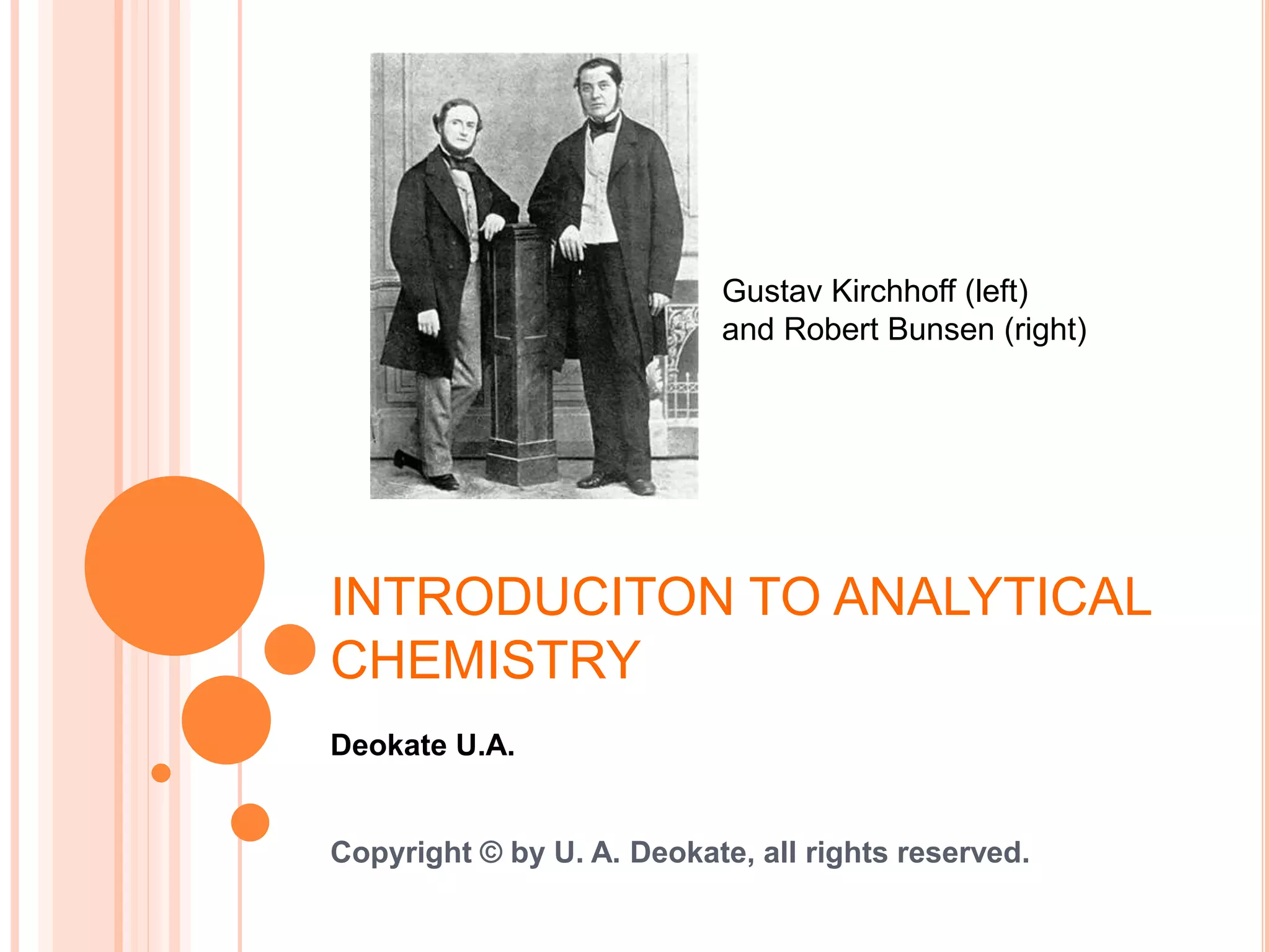
Gustav Kirchhoff (left)
and Robert Bunsen (right)
ANALYTICAL CHEMISTRY
Definition:
“The Science & art of determining composition of
material in terms of element or compound content”
Concerned with Chemical Characterization of mater
Involves Qualitative and Quantitative determination
9/9/2018
2
DeokateU.A.
INTRODUCTION
• Qualitative Analysis (identification)
provides information about the identity
of species or functional groups in the
sample (an analyte can be identified).
• Quantitative Analysis (Quantify)
provides numerical information of
analyte (quantitate the exact amount
or concentration).
9/9/2018
3
DeokateU.A.
ANALYTICAL METHODS
•Classical Methods: Wet chemical
methods such as precipitation,
extraction, distillation, boiling or melting
points, gravimetric and titrimetric
measurements.
•Instrumental Methods: Analytical
measurements (conductivity, electrode
potential, light absorption or emission,
mass-to-charge ratio, fluorescence
etc.) are made using instrumentation.
9/9/2018
4
DeokateU.A.
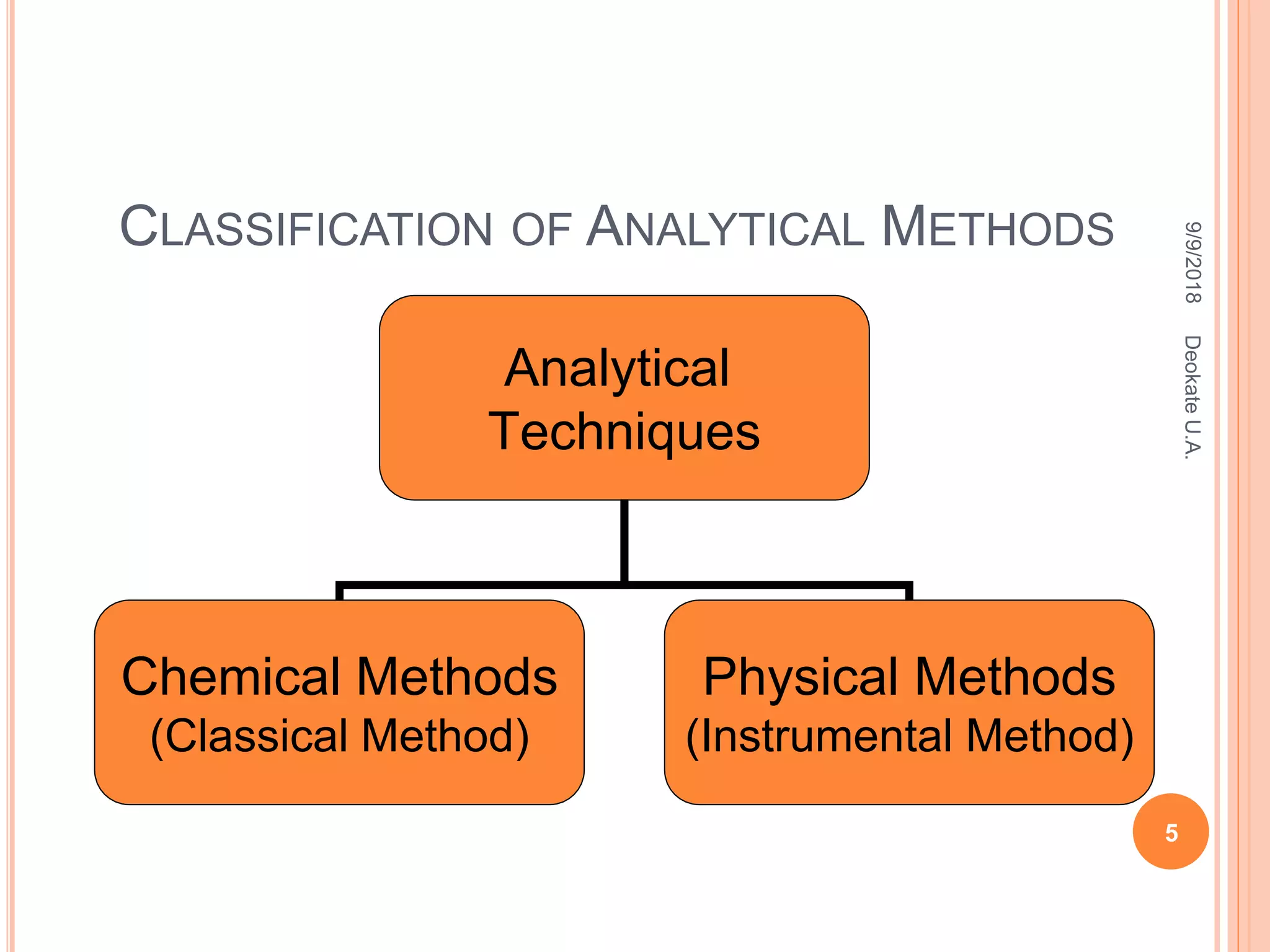
CLASSIFICATION OF ANALYTICAL METHODS
Analytical
Techniques
Chemical Methods
(Classical Method)
Physical Methods
(Instrumental Method)
9/9/2018DeokateU.A.
5
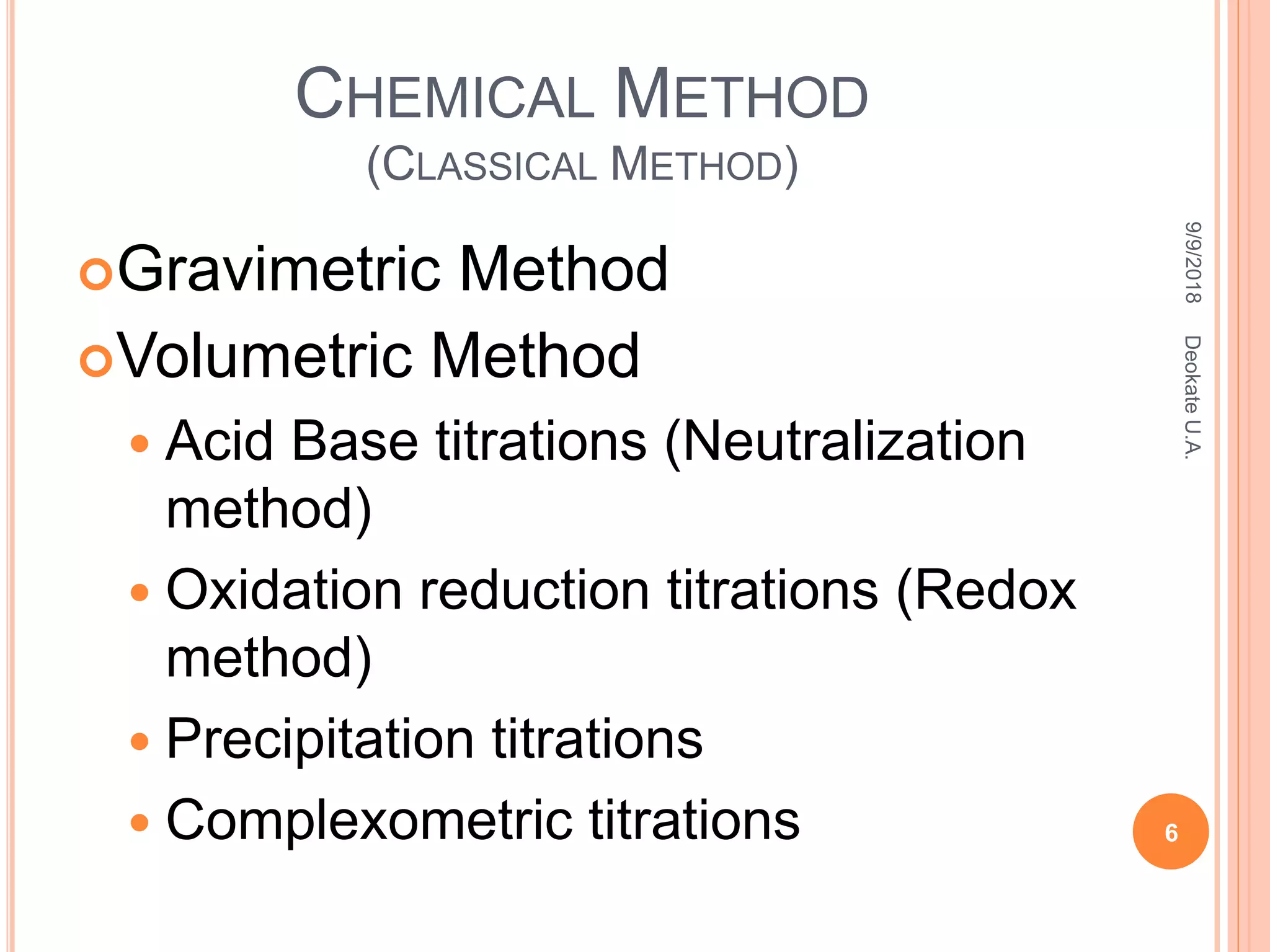
CHEMICAL METHOD
(CLASSICAL METHOD)
Gravimetric Method
Volumetric Method
 Acid Base titrations (Neutralization
method)
 Oxidation reduction titrations (Redox
method)
 Precipitation titrations
 Complexometric titrations
9/9/2018
6
DeokateU.A.
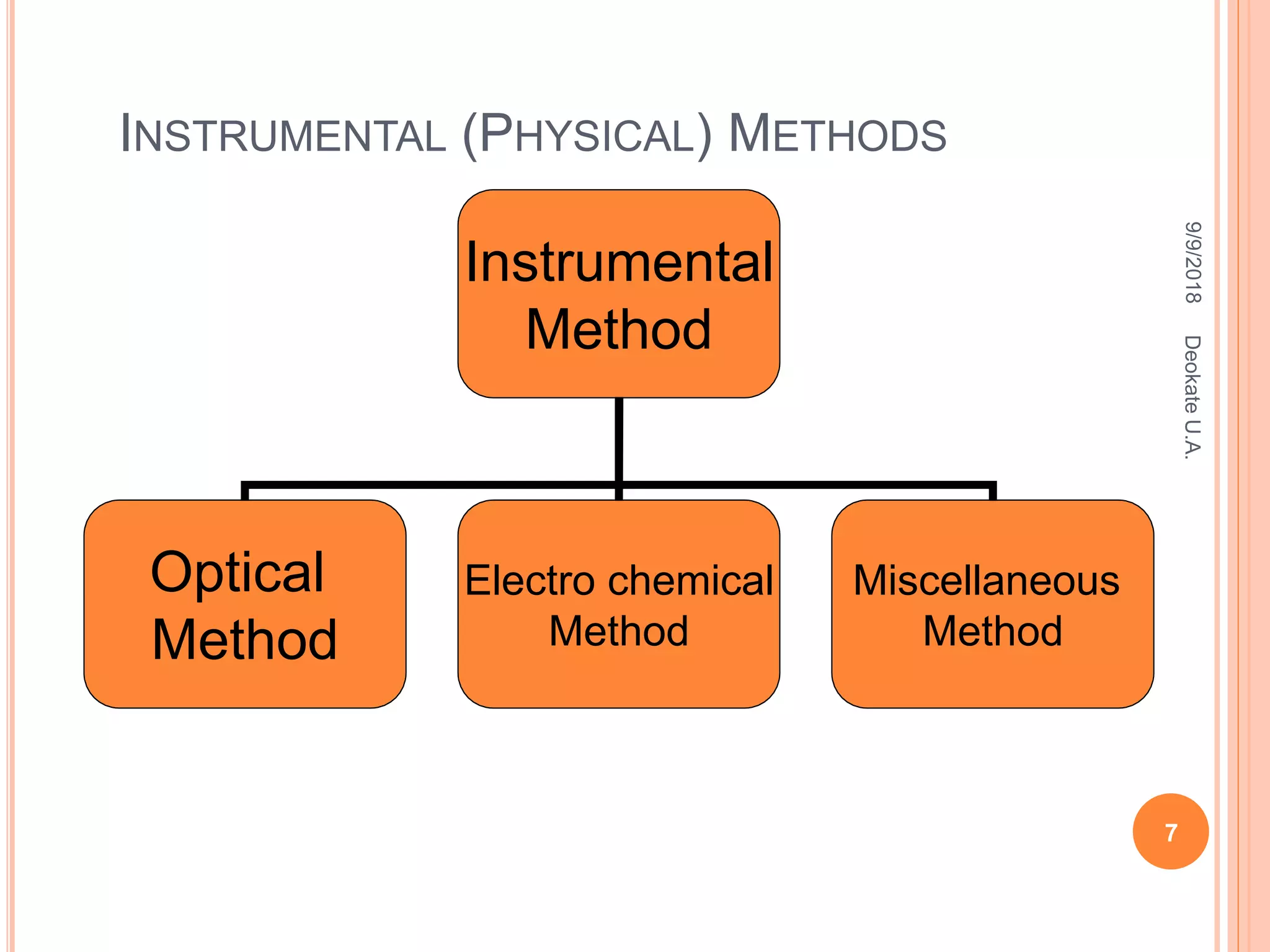
INSTRUMENTAL (PHYSICAL) METHODS
Instrumental
Method
Optical
Method
Electro chemical
Method
Miscellaneous
Method
9/9/2018DeokateU.A.
7
OPTICAL METHODS
Optical Methods
(Interaction of EMR)
Absorption
of EMR
UV- Visible
IR
NMR
X- Ray
Spectroscopy
Emissions
of EMR
Fluorescence
Phosphoresces
Flame Photometry
Scattering
Or Refraction
of EMR
Nepholometry
Terbidometry
Raman Spectroscopy
Refrectometry
Rotation
of EMR
Polarimetery
9/9/2018DeokateU.A.
8
ELECTRO CHEMICAL METHODS
pH metry & Potentiometry
Conductometry
Voltametry
Polarography
Amparometery
Coulombmetry
9/9/2018
9
DeokateU.A.
MISCELLANEOUS METHODS
 Thermometric Analysis
 DSC
 Thermo Gravimetric Analysis
9/9/2018
10
DeokateU.A.
The sample size dictates what measurement techniques can be used.
©Gary Christian, Analytical Chemistry, 6th Ed. (Wiley)
9/9/2018
11
DeokateU.A.
1. Clinical analysis - blood, urine, feces, cellular fluids, etc.,
for use in diagnosis.
2. Pharmaceutical analysis - establish the physical
properties, toxicity, metabolites, quality control, etc.
3. Environmental analysis - pollutants, soil and water
analysis, pesticides.
4. Forensic analysis - analysis related to criminology; DNA
finger printing, finger print detection; blood analysis.
5. Industrial quality control - required by most companies to
control product quality.
6. Bioanalytical chemistry and analysis - detection and/or
analysis of biological components (i.e., proteins, DNA,
RNA, carbohydrates, metabolites, etc.).
Several different areas of analytical chemistry:
9/9/2018
12
DeokateU.A.
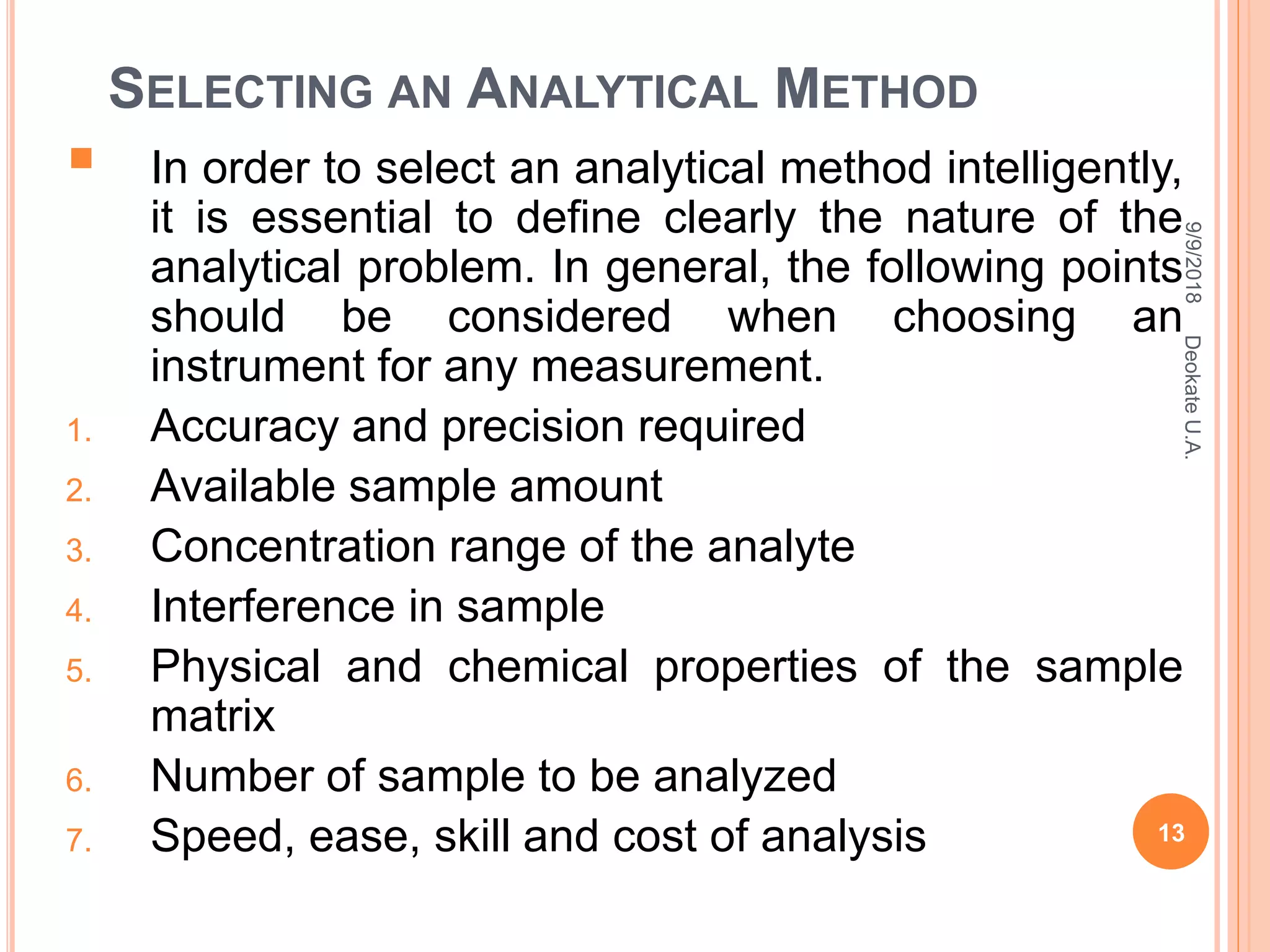
SELECTING AN ANALYTICAL METHOD
 In order to select an analytical method intelligently,
it is essential to define clearly the nature of the
analytical problem. In general, the following points
should be considered when choosing an
instrument for any measurement.
1. Accuracy and precision required
2. Available sample amount
3. Concentration range of the analyte
4. Interference in sample
5. Physical and chemical properties of the sample
matrix
6. Number of sample to be analyzed
7. Speed, ease, skill and cost of analysis
9/9/2018
13
DeokateU.A.
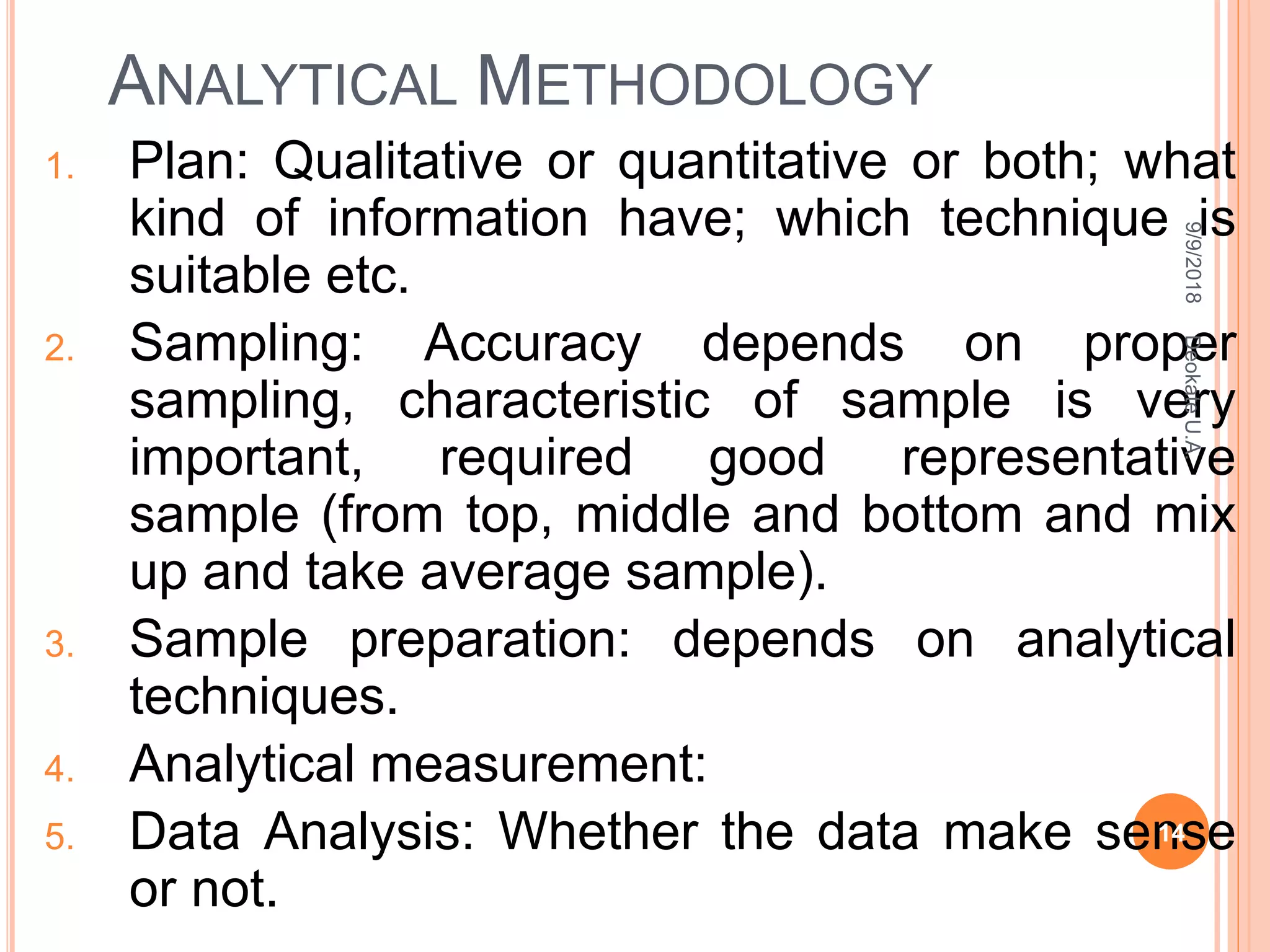
ANALYTICAL METHODOLOGY
1. Plan: Qualitative or quantitative or both; what
kind of information have; which technique is
suitable etc.
2. Sampling: Accuracy depends on proper
sampling, characteristic of sample is very
important, required good representative
sample (from top, middle and bottom and mix
up and take average sample).
3. Sample preparation: depends on analytical
techniques.
4. Analytical measurement:
5. Data Analysis: Whether the data make sense
or not.
9/9/2018
14
DeokateU.A.
Fig. 1.1. Steps in an analysis
An analysis involves several
steps and operations which
depend on:
•the particular problem
• your expertise
• the apparatus or
equipment available.
The analyst should be
involved in every step.
©Gary Christian,
Analytical Chemistry,
6th Ed. (Wiley)
9/9/2018
15
DeokateU.A.
APPLICATION OF ANALYTICAL CHEMISTRY
 Analytical chemistry has applications including in
forensics, bioanalysis, clinical analysis,
environmental analysis, and materials analysis.
 To determine complexity of matter
 To determine the composition of species

9/9/2018
16
DeokateU.A.
IMPORTANCE OF ANALYTICAL
CHEMISTRY IN PHARMACY:
 To determine self-life of compound. Self-life is the time period till which a
compound will be fit for use. For medicines, it is the time required for 90% of
drug ingredient to stay active after the date of manufacture. Hence we
notice expiry date clearly marked on all the medicine packages. So in
pharmacy we notice some medicines stored in refrigerator and some in dark
places to maintain the self-life.
 To determine adulterants: During manufacture of drug, there are many
chemical intermediates and reagents used. So there are many chances that
impurities like heavy metals, dirt etc. can also be present in final
preparation. Analytical chemistry is used to see if the formulation is within
limits of contamination. If the contamination is more, then it is unfit for
consumption.
 Drug dissolution studies: When a medical formulation is made in the form
of a tablet, ointment, capsule etc. It is tested for its ability to release the
medicine from within when put in a suitable medium. The dissolution studies
are done to see if the medicine is released completely from the tablet. Also
the time taken for release. Both these factors are essential because when a
tablet is swallowed, it stays in the stomach only for an hour. So if it has to
release the medicine, it has to do it within one hour. Also a medicine shows
its effects at suitable dose and not sub-doses. So the tablet has to release
the entire content within the said time. Hence dissolution studies are done
by using analytical chemistry to test the release of drug from a formulation
9/9/2018
17
DeokateU.A.
APPLICATION IN AGRICULTURE:
 Soil testing: This is done to study the inorganic
and organic minerals in the soil. This tells how far the
soil is suitable for growth of particular crop. It also gives
an idea of microbial environment, fertility and pesticide
residues in the soil.
 Water testing: Not all water is suitable for growth of
crops. Some of the water is very hard that it deposits
lime on the fertile soil making it unfit for further
cultivation. By analytical chemistry one can analyze the
water for its constituents and make suitable changes to
it.
 Harvested crop testing. Once the crop is harvested, it
is tested for its quality in terms of the pesticide residues,
any contaminants etc. If the material has high amount of
pesticide or other waste, it is rejected for human use.
9/9/2018
18
DeokateU.A.
IMPORTANCE OF ANALYTICAL
CHEMISTRY IN ENVIRONMENT:
 Similarly, in environment studies, it is widely used
for study of air condition (pollution), water and soil
contents in a particular locale.
 Industrial effluents for pollutants
 In geographical studies to determine the
composition of numerous rocks and soil sample
9/9/2018
19
DeokateU.A.
IN MEDICAL TECHNOLOGY & RESEARCH:
 Simple tests like serum cholesterol, urine ketones,
blood glucose level rely on analytical chemistry.
 For example, the blood glucose is estimated by
many methods. But one of the common one is to
convert the glucose into a colored substance in a
beaker andanalyze it by titration with a reacting
mixture.
 Similarly serum cholesterol is centrifuged and then
a coloring substance is added. The superficial layer
having cholesterol is (which is already colored) is
taken into a cuvette and quantified
by spectrophotometry.
9/9/2018
20
DeokateU.A.

1 introduciton to analytical chemistry1

  • 1.
    INTRODUCITON TO ANALYTICAL CHEMISTRY DeokateU.A. Copyright © by U. A. Deokate, all rights reserved. Gustav Kirchhoff (left) and Robert Bunsen (right)
  • 2.
    ANALYTICAL CHEMISTRY Definition: “The Science& art of determining composition of material in terms of element or compound content” Concerned with Chemical Characterization of mater Involves Qualitative and Quantitative determination 9/9/2018 2 DeokateU.A.
  • 3.
    INTRODUCTION • Qualitative Analysis(identification) provides information about the identity of species or functional groups in the sample (an analyte can be identified). • Quantitative Analysis (Quantify) provides numerical information of analyte (quantitate the exact amount or concentration). 9/9/2018 3 DeokateU.A.
  • 4.
    ANALYTICAL METHODS •Classical Methods:Wet chemical methods such as precipitation, extraction, distillation, boiling or melting points, gravimetric and titrimetric measurements. •Instrumental Methods: Analytical measurements (conductivity, electrode potential, light absorption or emission, mass-to-charge ratio, fluorescence etc.) are made using instrumentation. 9/9/2018 4 DeokateU.A.
  • 5.
    CLASSIFICATION OF ANALYTICALMETHODS Analytical Techniques Chemical Methods (Classical Method) Physical Methods (Instrumental Method) 9/9/2018DeokateU.A. 5
  • 6.
    CHEMICAL METHOD (CLASSICAL METHOD) GravimetricMethod Volumetric Method  Acid Base titrations (Neutralization method)  Oxidation reduction titrations (Redox method)  Precipitation titrations  Complexometric titrations 9/9/2018 6 DeokateU.A.
  • 7.
    INSTRUMENTAL (PHYSICAL) METHODS Instrumental Method Optical Method Electrochemical Method Miscellaneous Method 9/9/2018DeokateU.A. 7
  • 8.
    OPTICAL METHODS Optical Methods (Interactionof EMR) Absorption of EMR UV- Visible IR NMR X- Ray Spectroscopy Emissions of EMR Fluorescence Phosphoresces Flame Photometry Scattering Or Refraction of EMR Nepholometry Terbidometry Raman Spectroscopy Refrectometry Rotation of EMR Polarimetery 9/9/2018DeokateU.A. 8
  • 9.
    ELECTRO CHEMICAL METHODS pHmetry & Potentiometry Conductometry Voltametry Polarography Amparometery Coulombmetry 9/9/2018 9 DeokateU.A.
  • 10.
    MISCELLANEOUS METHODS  ThermometricAnalysis  DSC  Thermo Gravimetric Analysis 9/9/2018 10 DeokateU.A.
  • 11.
    The sample sizedictates what measurement techniques can be used. ©Gary Christian, Analytical Chemistry, 6th Ed. (Wiley) 9/9/2018 11 DeokateU.A.
  • 12.
    1. Clinical analysis- blood, urine, feces, cellular fluids, etc., for use in diagnosis. 2. Pharmaceutical analysis - establish the physical properties, toxicity, metabolites, quality control, etc. 3. Environmental analysis - pollutants, soil and water analysis, pesticides. 4. Forensic analysis - analysis related to criminology; DNA finger printing, finger print detection; blood analysis. 5. Industrial quality control - required by most companies to control product quality. 6. Bioanalytical chemistry and analysis - detection and/or analysis of biological components (i.e., proteins, DNA, RNA, carbohydrates, metabolites, etc.). Several different areas of analytical chemistry: 9/9/2018 12 DeokateU.A.
  • 13.
    SELECTING AN ANALYTICALMETHOD  In order to select an analytical method intelligently, it is essential to define clearly the nature of the analytical problem. In general, the following points should be considered when choosing an instrument for any measurement. 1. Accuracy and precision required 2. Available sample amount 3. Concentration range of the analyte 4. Interference in sample 5. Physical and chemical properties of the sample matrix 6. Number of sample to be analyzed 7. Speed, ease, skill and cost of analysis 9/9/2018 13 DeokateU.A.
  • 14.
    ANALYTICAL METHODOLOGY 1. Plan:Qualitative or quantitative or both; what kind of information have; which technique is suitable etc. 2. Sampling: Accuracy depends on proper sampling, characteristic of sample is very important, required good representative sample (from top, middle and bottom and mix up and take average sample). 3. Sample preparation: depends on analytical techniques. 4. Analytical measurement: 5. Data Analysis: Whether the data make sense or not. 9/9/2018 14 DeokateU.A.
  • 15.
    Fig. 1.1. Stepsin an analysis An analysis involves several steps and operations which depend on: •the particular problem • your expertise • the apparatus or equipment available. The analyst should be involved in every step. ©Gary Christian, Analytical Chemistry, 6th Ed. (Wiley) 9/9/2018 15 DeokateU.A.
  • 16.
    APPLICATION OF ANALYTICALCHEMISTRY  Analytical chemistry has applications including in forensics, bioanalysis, clinical analysis, environmental analysis, and materials analysis.  To determine complexity of matter  To determine the composition of species  9/9/2018 16 DeokateU.A.
  • 17.
    IMPORTANCE OF ANALYTICAL CHEMISTRYIN PHARMACY:  To determine self-life of compound. Self-life is the time period till which a compound will be fit for use. For medicines, it is the time required for 90% of drug ingredient to stay active after the date of manufacture. Hence we notice expiry date clearly marked on all the medicine packages. So in pharmacy we notice some medicines stored in refrigerator and some in dark places to maintain the self-life.  To determine adulterants: During manufacture of drug, there are many chemical intermediates and reagents used. So there are many chances that impurities like heavy metals, dirt etc. can also be present in final preparation. Analytical chemistry is used to see if the formulation is within limits of contamination. If the contamination is more, then it is unfit for consumption.  Drug dissolution studies: When a medical formulation is made in the form of a tablet, ointment, capsule etc. It is tested for its ability to release the medicine from within when put in a suitable medium. The dissolution studies are done to see if the medicine is released completely from the tablet. Also the time taken for release. Both these factors are essential because when a tablet is swallowed, it stays in the stomach only for an hour. So if it has to release the medicine, it has to do it within one hour. Also a medicine shows its effects at suitable dose and not sub-doses. So the tablet has to release the entire content within the said time. Hence dissolution studies are done by using analytical chemistry to test the release of drug from a formulation 9/9/2018 17 DeokateU.A.
  • 18.
    APPLICATION IN AGRICULTURE: Soil testing: This is done to study the inorganic and organic minerals in the soil. This tells how far the soil is suitable for growth of particular crop. It also gives an idea of microbial environment, fertility and pesticide residues in the soil.  Water testing: Not all water is suitable for growth of crops. Some of the water is very hard that it deposits lime on the fertile soil making it unfit for further cultivation. By analytical chemistry one can analyze the water for its constituents and make suitable changes to it.  Harvested crop testing. Once the crop is harvested, it is tested for its quality in terms of the pesticide residues, any contaminants etc. If the material has high amount of pesticide or other waste, it is rejected for human use. 9/9/2018 18 DeokateU.A.
  • 19.
    IMPORTANCE OF ANALYTICAL CHEMISTRYIN ENVIRONMENT:  Similarly, in environment studies, it is widely used for study of air condition (pollution), water and soil contents in a particular locale.  Industrial effluents for pollutants  In geographical studies to determine the composition of numerous rocks and soil sample 9/9/2018 19 DeokateU.A.
  • 20.
    IN MEDICAL TECHNOLOGY& RESEARCH:  Simple tests like serum cholesterol, urine ketones, blood glucose level rely on analytical chemistry.  For example, the blood glucose is estimated by many methods. But one of the common one is to convert the glucose into a colored substance in a beaker andanalyze it by titration with a reacting mixture.  Similarly serum cholesterol is centrifuged and then a coloring substance is added. The superficial layer having cholesterol is (which is already colored) is taken into a cuvette and quantified by spectrophotometry. 9/9/2018 20 DeokateU.A.