Case Scenario: 1
• D/O sayeda , Term (38wks), AGA(3000gm) delivery by
NVD not crying after drying ,suction and
stimulation.Then start positive pressure ventilation- bag
mask ventilation but chest not inflate..?
What is the problem ?
Case Scenario: 2
• D/O Tahmina, inborn, got admitted in NICU at 15 min of
her age due to prematurity (30weeks), LBW(1270g) and
respiratory distress soon after birth.
• On arrival baby was normothermic, euglycemic, reflex &
activities were good, but having respiratory distress in
the form of tachypnea, nasal flaring, chest retraction
and grunting. DOWNE’s Score – 05.Baby put on CPAP but
sign of respiratory distress not disappear.
What may be the problems ?
Case Scenario: 3
• D/O Mukta, Preterm (32wks) VLBW(1300gm) with symmetrical
IUGR with suspected EONS
• At Postnatal age 48 hours, baby developed repeated apnea with
supplemental O2. So, baby was put on CPAP.
• At 103 hours of age, despite of high setup on CPAP, baby
developed repeated apnea and desaturation with poor
respiratory drive,so baby put on MV .Intially MV working well
then baby developed hypoxia and B/L air entry in lungs was
absent.
What problem was
there?
Mechanical ventilation in neonates
Basics of neonatal ventilation
Different Modes of neonatal mechanical ventilation
Initiation of neonatal MV
Pulmonary graphics
Disease specific ventilation
Complications , VAP
• High frequency ventilation
• Weaning strategy
• Troubleshooting of positive pressure ventilation
4
Troubleshooting of positive
pressure ventilation
Outline
• Introduction
• Devices of positive pressure ventilation(PPV)
• Troubleshooting and its possible
Management
• Take home message
Introduction
Positive pressure ventilation is a form of respiratory therapy
that involves the delivery of air or a mixture of oxygen combined
with other gases by positive pressure into the lungs.
Introduction cont.
• Positive-pressure ventilation can be provided through
1. a face mask or
2.an endotracheal tube
either with a mechanical ventilator or with one of the three
commonly used manual resuscitators:
1.the self-inflating bag,
2.the flow-inflating (“anesthesia”)bag, and
3. T-piece resuscitator.
Assisted Ventilation of the Neonate 6th edition
Commonly used PPV in our NICU
• Self inflating bag(Bag mask ventilation)
Management of birth asphyxia
Approximately 10% of newborns require some assistance to
begin breathing at birth; about 1%
needs extensive resuscitative measures to survive.
• Initial steps: Put the baby on mother’s abdomen
• Dry thoroughly ( if amniotic fluid is clear)
• Remove the wet cloth
• Keep warm: Management protocol of newborn, NICU, BSMMU, January 2016
• Assess Crying/Breathing while drying:
• Breathing Well: Crying or breathing quietly & regularly
• Not breathing well: Not breathing at all or gasping
• Bag musk ventilation (BMV):
• If the baby is not breathing well after suction & stimulation
• Cut the umbilical cord to separate from mother
• Shift the baby to the area for ventilation
• Start PPV within one minute of birth
If chest does not rise with BMV
• Troubleshooting of BMV---
Troubleshooting of BMV---
• Clear airway (if necessary)
• Selection of appropriate size masks
Troubleshooting of BMV---
• Position yourself at the bedside
• Position the baby’s head
• Applying and sealing mask on the face
Troubleshooting of BMV---
• After starting BMV
Take ventilation corrective measures for effective ventilation at any time if
chest does not
rise with squeezing:
 Repositioning
Check the mouth, oropharynx, and nose for secretions; suction the mouth
and nose (if necessary)
Reapplying mask with mouth open and ensuring better seal
Providing harder squeeze (Lock pop-off valve if necessary)
Other problems of BMV
• Over-ventilating and hyperventilating. Giving too much volume
or going too fast could push air into the stomach, resulting in
gastric insufflation. This could lead to vomiting and subsequent
airway obstruction or aspiration.
Other problems of BMV
• Barotrauma — Pulmonary barotrauma is a well-known
complication of positive pressure ventilation.
• Consequences include
1. pneumothorax,
2.subcutaneous emphysema,
3.pneumomediastinum.
Smaller facemasks for positive pressure ventilation in preterm
infants: A randomised trial
Eoin O’Currain , Joyce E. O’Shea d, Lorraine McGrory e, Louise S. Owena, Omar Kamlin , Jennifer
A. Dawson, Peter G. Davis , Marta Thio
R E S U S C I T A T I O N 1 3 4 ( 2 0 1 9 ) 9 1 – 9 8
Received 5 September 2018; Received in revised form 18 October 2018; Accepted 10 December
2018
Conclusions: Using a smaller mask to administer PPV to preterm
infants did not reduce facemask leak. Facemask leak and
physiological instability are high in preterm infants receiving PPV,
in particular in those ≤26 weeks’ gestation. Factors other than
size may need to be improved when designing facemasks for this
population and future research should investigate the influence of
mask malleability, shape rim and hold on the quality of facemask
ventilation.
Airway Obstruction During Mask Ventilation of
Very Low Birth Weight Infants During Neonatal Resuscitation
Neil N. Finer, MD, Wade Rich, BSHS, RRT, Casey Wang, MD, Tina Leone,
Md
Pediatrics 2009;123:865–869
• CONCLUSIONS
Airway obstruction, as detected by the use of a colorimetric
carbon dioxide detector, occurs in the majority of
the VLBW infants who require ventilation with a face
mask during resuscitation after delivery. The use of this
simple device can alert the resuscitation team to this situation and
facilitate
maneuvers that can re-establish a patent airway.
NEXT PART…
Most widely used CPAP is Bubble CPAP
Indications: Presence of good respiratory drive is pre requisite of CPAP
support.
- Respiratory disorder (RDS, MAS, Pneumonia, PPHN)
- Apnea of prematurity
- Disorder causing excessive lung fluid
(TTN, PDA, CCF,Hydrops fetalis ect.)
- Laryngo/tracheo/bronchomalacia
- After extubation
CPAP Failure
• Presence of retraction/grunt despite giving optimum
CPAP
• Recurrent or severe apnea (significant apnea means 3
apnea/ hour or that requiring bag & mask ventilation)
• Significant bradycardia
• PO2 < 50 in FiO2 >0.60
• PCO2 > 60 or PH < 7.25
Troubleshooting in CPAP
SPO2-low
Chest retraction-+++
B/L air entry poor
Bubbling absent in machine
???
leak
Action should be taken
• Replace the circuit
Troubleshooting in CPAP
SPO2-low
Chest retraction-+++
B/L air entry poor
Bubbling present in machine
???
obstruction
Action should be taken
Cause:
Most commonly by mucous secretion
Action: proper suction ensure
Troubleshooting in CPAP
SPO2-Normal
Chest retraction-+++
B/L air entry good
Bubbling present in machine
???
Metabolic acidosis
Action should be taken
Common causes: Action
1. Hypoxia Due to any cause mx accordingly
2. Hypothermia Maintain temperature
2. Hypoglycemia Maintain glycemic control by feed or IVF
4. Infection By appropriate antibiotics
Troubleshooting in CPAP
SPO2-low
Chest retraction-+/nil
B/L air entry good
Bubbling present in machine
???
PPHN/CHD
Troubleshooting in CPAP
SPO2-low
Chest retraction-+++
B/L air entry poor
Bubbling present in machine
???
Lung disease
• Bubble CPAP versus Ventilator CPAP in Preterm Neonates
with Early Onset Respiratory Distress—A Randomized Controlled Trial
by Amit Tagare, Sandeep Kadam, Umesh Vaidya,Anand Pandit, and Sanjay Patole
Division of Neonatology, Department of Pediatrics, KEM Hospital, Pune 411011, India
Centre for Neonatal Research and Education, King Edward Memorial Hospital for Women,
University of Western Australia, Perth, Western Australia
Correspondence: Sandeep Kadam, Division of Neonatology, Department of Pediatrics KEM
Hospital,
Rasta Peth, Pune 41101
JOURNAL OF TROPICAL PEDIATRICS, VOL. 59, NO. 2, 2013
• Conclusion: BCPAP has higher success rate than VCPAP for managing preterm neonates
with early
onset respiratory distress, with comparable safety.
• Common problem we faced during MV handling
Troubleshooting in MV
Acute deterioration: Consider “DOPE” and large IVH
Acute deterioration
Displaced tube
Obstructed
tube
Pneumothorax
Equipment
failure
34
Acute deterioration of ventilated newborn
Tube displaced
Air entry in stomach
Abdominal distension
Check Baby
Check Ventilator
Disconnect from ventilator
and Start bag- ET tube
ventilation
Unequal
sound
Change ET Tube
No air entry
Tube in oropharynx
Complete
tube block
Tube dislodged
No air entry
↓ Breath sound
↓ Air entry
No chest movement
Pneumo
thorax
Acute deterioration of ventilated newborn
Poor saturation
PDA , Sepsis , PPHN , IVH
Worsening lung disease
Partial tube block
Faulty O2 supply
With same pressure
Improving saturation
Normal breath sound
Adequate chest movement Check Baby
Check Ventilator
Disconnect from ventilator
and Start bag- ET tube
ventilation
More pressure
Pulmonary Graphics
Graphical representation of Pressure, Flow and Volume.
Waveforms:
Pressure waveforms
Flow waveforms
Volume waveforms
Loops:
Pressure-Volume loop
Flow-Volume loop
Ventilatory Waveform
Pressure Limit waveforms
Volume Limit waveform
Abnormal Waveforms
Abnormal wave form
Air Leak
Abnormal wave form
Abnormal wave form
Abnormal wave form
Accidental Extubation
Abnormal wave form
Ventilatory Loops
Loops in mechanical ventilator
Normal Pressure-Volume Loops
Pressure volume loops
lung complance change
Abnormal pressure-volume Loops
Normal Flow-Volume Loop
Abnormal Flow-Volume Loops
Resistance pattern/Airway obstruction
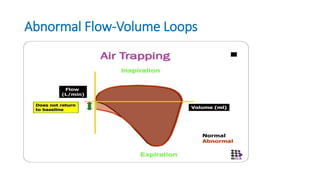
Abnormal Flow-Volume Loops
abnormal flow
Abnormal Flow-Volume Loops
Secretion/Water in the inspiratory or expiratory limb
Problem Possible Cause Suggested Action
Low VT alarm
-not volume
reaching target
Recurrent alarms Decreased compliance:
• Atelectasis Evaluate breath sounds
• Pneumothorax/PIE Evaluate chest rise
• ETT obstructed on tracheal wall or carina Reposition patient and/or ETT
• Abdominal distention Assess overall condition
Assisted Ventilation of the Neonate 6th edition
Problem Possible Cause Suggested Action
Low VT alarm
-not volume
reaching target
Recurrent alarms Increased resistance :
• Airway secretions Evaluate brearh sounds
• Partial kinking of ETT Examine ETT, circuit
• Bronchospasm Listen to patient, examine flow waveform
Assisted Ventilation of the Neonate 6th edition
Problem Possible Cause Suggested Action
Low VT alarm
-not volume
reaching target
Recurrent alarms
• Large ETT leak Check for ETT leak on the ventilator display.
Assisted Ventilation of the Neonate 6th edition
Problem Possible Cause Suggested Action
• Ventilator is not
generating any PIP
• Tubing disconnection Check for leak, disconnection
• VT is too low for the infant’s physiologic need Reevaluate VT setting.
Assisted Ventilation of the Neonate 6th edition
problem Possible Cause Suggested Action
• Persistently low
PaCO2
• Metabolic acidosis Consider pH, not just PaCO2; the respiratory
control center responds to
pH and respiratory compensation for a base
deficit is normal.
• Agitation Ensure optimal positioning, comfort.
Provide sedation if necessary.
Assisted Ventilation of the Neonate 6th edition
problem Possible Cause Suggested Action
• Tachypnea,
• increased WOB
• VT set too low Insufficient support leads to
tachypnea and retractions.
Reassess appropriateness of VT setting.
• Agitation as above
Assisted Ventilation of the Neonate 6th edition
Troubleshooting of ABG
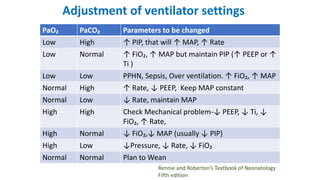
Adjustment of ventilator settings
PaO₂ PaCO₂ Parameters to be changed
Low High ↑ PIP, that will ↑ MAP, ↑ Rate
Low Normal ↑ FiO₂, ↑ MAP but maintain PIP (↑ PEEP or ↑
Ti )
Low Low PPHN, Sepsis, Over ventilation. ↑ FiO₂, ↑ MAP
Normal High ↑ Rate, ↓ PEEP, Keep MAP constant
Normal Low ↓ Rate, maintain MAP
High High Check Mechanical problem-↓ PEEP, ↓ Ti, ↓
FiO₂, ↑ Rate,
High Normal ↓ FiO₂,↓ MAP (usually ↓ PIP)
High Low ↓Pressure, ↓ Rate, ↓ FiO₂
Normal Normal Plan to Wean
Rennie and Roberton’s Textbook of Neonatology
Fifth edition
Indications of HFV
1.When conventional ventilation fails
– reduced compliance,RDS/ARDS,meconium aspiration ,BPD
,pneumonia,atelectasis, lung hypoplasia
Other: PPHN
2.Primary mode of ventilation in extreme prematurity.
3.Air leak syndromes (pneumothorax, PIE)
4.Congenital diaphragmatic hernia.
Assisted ventiltion of the neonate, Goldsmith 6th edition
Dragger manuals – high frequency ventilation basics and
practical application
 MAP: 2-5mbar above MAP of CMV
 Frequency: 10 Hz
 Amplitude: 50- 100% watch thorax
vibrations
 Volume: about 2 to 2.5 ml/kg
 Fi02:100%
Start HFV
Troubleshooting and adjustment during HFOV
Hypoxia Hyperoxia Hypercapnia Hypocapnia
Increase Fi02 Decrease Fi02 Increase Amplitude Decrease
Ampiltude
Increase MAP (1-2
cm H20)
Decrease MAP(1-2
cm H20)
Decrease
Frequency (1-2 cm
H20) if MAP max
Increase
Frequency(1-2 cm
H20) if MAP max
Common problems in PPV and its possible management
Ventilator-induced lung injury (VILI)
Ventilator-induced lung injury (VILI) results from
injury to the blood-gas barrier caused by mechanical
ventilation.
Common VILI are:
Barotrauma
Volutrauma
Atelectrauma
Biotrauma
73
Barotrauma
Slutsky, Chest, 1999
Abnormal wave form
Air Leak
Abnormal pressure-volume Loops
Management
Acute decompression with needle thoracostomy
followed by water seal drainage.
Prevention
Optimizing ventilator settings by using low tidal volume and
low plateau pressures provides a mortality benefit.
In view of the deleterious effects of alveolar overdistention,
limiting plateau pressures to less than 30 cm H2O while
balancing other ventilator settings .
The average tidal volume used for mechanical ventilation has
decreased over time. It is clearly not> 6 mL/kg.
78
Volutrauma
Pulmonary volutrauma:
Volutrauma is essentially damage to the lung caused
by over distention by a mechanical ventilator set for
an excessively high tidal volume .
This may result in increased epithelial and
microvascular permeability, thus, allowing fluid
filtration into the alveoli (pulmonary edema).
 Volutrauma is separate from pulmonary barotrauma
because the mechanism of injury is excessive volume
(volutrauma), instead of pressure (barotrauma).
79
Volutrauma
Abnormal pressure-volume Loops
Mx of volutrauma
Minimizing volutrauma has mainly been associated with reducing
tidal volume during mechanical ventilation.
Atelectrauma:
 The repetitive opening and collapse of alveoli plays a
pivotal role in VILI, which was known as atelectrauma.
Atelectrauma
83
Management
Minimizing Atelectrauma: is based on two principles
First, already collapsed alveoli/ saccules need to be reopened or
recruited by applying sufficient inflation pressure.
Second, after recruitment, sufficient(end-expiratory) airway pressure
should be applied to stabilize the lung volume and prevent
subsequent collapse during expiration.
Biotrauma:
 MV-induced inflammatory response may contribute
to the development of multiple system organ
dysfunction including respiratory failure in ventilated
patients.
 MV is able to trigger the release of numerous
proinflammatory mediators that may induce lung
injury and impair pulmonary function.
 High VT ventilation increases interleukin (IL)-1β, IL-6,
IL-8, tumor-necrosis factor (TNF)-α etc.
Biotrauma
85
Biotrauma
• This biological form of trauma is known as biotrauma.
Troubleshooting of positive pressure ventilation is common
We should 1st think simple ways and search it‫׳‬s solution
For our patient safety never overlook any alarm or troubleshooting of
PPV
Take home messages
87

ventilation in neonates

  • 1.
    Case Scenario: 1 •D/O sayeda , Term (38wks), AGA(3000gm) delivery by NVD not crying after drying ,suction and stimulation.Then start positive pressure ventilation- bag mask ventilation but chest not inflate..? What is the problem ?
  • 2.
    Case Scenario: 2 •D/O Tahmina, inborn, got admitted in NICU at 15 min of her age due to prematurity (30weeks), LBW(1270g) and respiratory distress soon after birth. • On arrival baby was normothermic, euglycemic, reflex & activities were good, but having respiratory distress in the form of tachypnea, nasal flaring, chest retraction and grunting. DOWNE’s Score – 05.Baby put on CPAP but sign of respiratory distress not disappear. What may be the problems ?
  • 3.
    Case Scenario: 3 •D/O Mukta, Preterm (32wks) VLBW(1300gm) with symmetrical IUGR with suspected EONS • At Postnatal age 48 hours, baby developed repeated apnea with supplemental O2. So, baby was put on CPAP. • At 103 hours of age, despite of high setup on CPAP, baby developed repeated apnea and desaturation with poor respiratory drive,so baby put on MV .Intially MV working well then baby developed hypoxia and B/L air entry in lungs was absent. What problem was there?
  • 4.
    Mechanical ventilation inneonates Basics of neonatal ventilation Different Modes of neonatal mechanical ventilation Initiation of neonatal MV Pulmonary graphics Disease specific ventilation Complications , VAP • High frequency ventilation • Weaning strategy • Troubleshooting of positive pressure ventilation 4
  • 5.
  • 6.
    Outline • Introduction • Devicesof positive pressure ventilation(PPV) • Troubleshooting and its possible Management • Take home message
  • 7.
    Introduction Positive pressure ventilationis a form of respiratory therapy that involves the delivery of air or a mixture of oxygen combined with other gases by positive pressure into the lungs.
  • 8.
    Introduction cont. • Positive-pressureventilation can be provided through 1. a face mask or 2.an endotracheal tube either with a mechanical ventilator or with one of the three commonly used manual resuscitators: 1.the self-inflating bag, 2.the flow-inflating (“anesthesia”)bag, and 3. T-piece resuscitator. Assisted Ventilation of the Neonate 6th edition
  • 9.
    Assisted Ventilation ofthe Neonate 6th edition
  • 10.
    Assisted Ventilation ofthe Neonate 6th edition
  • 11.
    Commonly used PPVin our NICU • Self inflating bag(Bag mask ventilation) Management of birth asphyxia Approximately 10% of newborns require some assistance to begin breathing at birth; about 1% needs extensive resuscitative measures to survive. • Initial steps: Put the baby on mother’s abdomen • Dry thoroughly ( if amniotic fluid is clear) • Remove the wet cloth • Keep warm: Management protocol of newborn, NICU, BSMMU, January 2016
  • 12.
    • Assess Crying/Breathingwhile drying: • Breathing Well: Crying or breathing quietly & regularly • Not breathing well: Not breathing at all or gasping • Bag musk ventilation (BMV): • If the baby is not breathing well after suction & stimulation • Cut the umbilical cord to separate from mother • Shift the baby to the area for ventilation • Start PPV within one minute of birth
  • 13.
    If chest doesnot rise with BMV • Troubleshooting of BMV---
  • 14.
    Troubleshooting of BMV--- •Clear airway (if necessary) • Selection of appropriate size masks
  • 15.
    Troubleshooting of BMV--- •Position yourself at the bedside • Position the baby’s head • Applying and sealing mask on the face
  • 16.
    Troubleshooting of BMV--- •After starting BMV Take ventilation corrective measures for effective ventilation at any time if chest does not rise with squeezing:  Repositioning Check the mouth, oropharynx, and nose for secretions; suction the mouth and nose (if necessary) Reapplying mask with mouth open and ensuring better seal Providing harder squeeze (Lock pop-off valve if necessary)
  • 17.
    Other problems ofBMV • Over-ventilating and hyperventilating. Giving too much volume or going too fast could push air into the stomach, resulting in gastric insufflation. This could lead to vomiting and subsequent airway obstruction or aspiration.
  • 18.
    Other problems ofBMV • Barotrauma — Pulmonary barotrauma is a well-known complication of positive pressure ventilation. • Consequences include 1. pneumothorax, 2.subcutaneous emphysema, 3.pneumomediastinum.
  • 19.
    Smaller facemasks forpositive pressure ventilation in preterm infants: A randomised trial Eoin O’Currain , Joyce E. O’Shea d, Lorraine McGrory e, Louise S. Owena, Omar Kamlin , Jennifer A. Dawson, Peter G. Davis , Marta Thio R E S U S C I T A T I O N 1 3 4 ( 2 0 1 9 ) 9 1 – 9 8 Received 5 September 2018; Received in revised form 18 October 2018; Accepted 10 December 2018 Conclusions: Using a smaller mask to administer PPV to preterm infants did not reduce facemask leak. Facemask leak and physiological instability are high in preterm infants receiving PPV, in particular in those ≤26 weeks’ gestation. Factors other than size may need to be improved when designing facemasks for this population and future research should investigate the influence of mask malleability, shape rim and hold on the quality of facemask ventilation.
  • 20.
    Airway Obstruction DuringMask Ventilation of Very Low Birth Weight Infants During Neonatal Resuscitation Neil N. Finer, MD, Wade Rich, BSHS, RRT, Casey Wang, MD, Tina Leone, Md Pediatrics 2009;123:865–869 • CONCLUSIONS Airway obstruction, as detected by the use of a colorimetric carbon dioxide detector, occurs in the majority of the VLBW infants who require ventilation with a face mask during resuscitation after delivery. The use of this simple device can alert the resuscitation team to this situation and facilitate maneuvers that can re-establish a patent airway.
  • 21.
  • 22.
    Most widely usedCPAP is Bubble CPAP Indications: Presence of good respiratory drive is pre requisite of CPAP support. - Respiratory disorder (RDS, MAS, Pneumonia, PPHN) - Apnea of prematurity - Disorder causing excessive lung fluid (TTN, PDA, CCF,Hydrops fetalis ect.) - Laryngo/tracheo/bronchomalacia - After extubation
  • 23.
    CPAP Failure • Presenceof retraction/grunt despite giving optimum CPAP • Recurrent or severe apnea (significant apnea means 3 apnea/ hour or that requiring bag & mask ventilation) • Significant bradycardia • PO2 < 50 in FiO2 >0.60 • PCO2 > 60 or PH < 7.25
  • 24.
    Troubleshooting in CPAP SPO2-low Chestretraction-+++ B/L air entry poor Bubbling absent in machine ??? leak
  • 25.
    Action should betaken • Replace the circuit
  • 26.
    Troubleshooting in CPAP SPO2-low Chestretraction-+++ B/L air entry poor Bubbling present in machine ??? obstruction
  • 27.
    Action should betaken Cause: Most commonly by mucous secretion Action: proper suction ensure
  • 28.
    Troubleshooting in CPAP SPO2-Normal Chestretraction-+++ B/L air entry good Bubbling present in machine ??? Metabolic acidosis
  • 29.
    Action should betaken Common causes: Action 1. Hypoxia Due to any cause mx accordingly 2. Hypothermia Maintain temperature 2. Hypoglycemia Maintain glycemic control by feed or IVF 4. Infection By appropriate antibiotics
  • 30.
    Troubleshooting in CPAP SPO2-low Chestretraction-+/nil B/L air entry good Bubbling present in machine ??? PPHN/CHD
  • 31.
    Troubleshooting in CPAP SPO2-low Chestretraction-+++ B/L air entry poor Bubbling present in machine ??? Lung disease
  • 32.
    • Bubble CPAPversus Ventilator CPAP in Preterm Neonates with Early Onset Respiratory Distress—A Randomized Controlled Trial by Amit Tagare, Sandeep Kadam, Umesh Vaidya,Anand Pandit, and Sanjay Patole Division of Neonatology, Department of Pediatrics, KEM Hospital, Pune 411011, India Centre for Neonatal Research and Education, King Edward Memorial Hospital for Women, University of Western Australia, Perth, Western Australia Correspondence: Sandeep Kadam, Division of Neonatology, Department of Pediatrics KEM Hospital, Rasta Peth, Pune 41101 JOURNAL OF TROPICAL PEDIATRICS, VOL. 59, NO. 2, 2013 • Conclusion: BCPAP has higher success rate than VCPAP for managing preterm neonates with early onset respiratory distress, with comparable safety.
  • 33.
    • Common problemwe faced during MV handling
  • 34.
    Troubleshooting in MV Acutedeterioration: Consider “DOPE” and large IVH Acute deterioration Displaced tube Obstructed tube Pneumothorax Equipment failure 34
  • 35.
    Acute deterioration ofventilated newborn Tube displaced Air entry in stomach Abdominal distension Check Baby Check Ventilator Disconnect from ventilator and Start bag- ET tube ventilation Unequal sound Change ET Tube No air entry Tube in oropharynx Complete tube block Tube dislodged No air entry ↓ Breath sound ↓ Air entry No chest movement Pneumo thorax
  • 36.
    Acute deterioration ofventilated newborn Poor saturation PDA , Sepsis , PPHN , IVH Worsening lung disease Partial tube block Faulty O2 supply With same pressure Improving saturation Normal breath sound Adequate chest movement Check Baby Check Ventilator Disconnect from ventilator and Start bag- ET tube ventilation More pressure
  • 37.
    Pulmonary Graphics Graphical representationof Pressure, Flow and Volume. Waveforms: Pressure waveforms Flow waveforms Volume waveforms Loops: Pressure-Volume loop Flow-Volume loop
  • 38.
  • 39.
  • 40.
  • 41.
  • 42.
  • 43.
  • 44.
  • 45.
  • 46.
  • 47.
  • 48.
  • 49.
  • 50.
  • 51.
  • 52.
  • 53.
  • 54.
  • 55.
  • 56.
  • 57.
    Abnormal Flow-Volume Loops Resistancepattern/Airway obstruction
  • 58.
  • 59.
  • 60.
    Abnormal Flow-Volume Loops Secretion/Waterin the inspiratory or expiratory limb
  • 61.
    Problem Possible CauseSuggested Action Low VT alarm -not volume reaching target Recurrent alarms Decreased compliance: • Atelectasis Evaluate breath sounds • Pneumothorax/PIE Evaluate chest rise • ETT obstructed on tracheal wall or carina Reposition patient and/or ETT • Abdominal distention Assess overall condition Assisted Ventilation of the Neonate 6th edition
  • 62.
    Problem Possible CauseSuggested Action Low VT alarm -not volume reaching target Recurrent alarms Increased resistance : • Airway secretions Evaluate brearh sounds • Partial kinking of ETT Examine ETT, circuit • Bronchospasm Listen to patient, examine flow waveform Assisted Ventilation of the Neonate 6th edition
  • 63.
    Problem Possible CauseSuggested Action Low VT alarm -not volume reaching target Recurrent alarms • Large ETT leak Check for ETT leak on the ventilator display. Assisted Ventilation of the Neonate 6th edition
  • 64.
    Problem Possible CauseSuggested Action • Ventilator is not generating any PIP • Tubing disconnection Check for leak, disconnection • VT is too low for the infant’s physiologic need Reevaluate VT setting. Assisted Ventilation of the Neonate 6th edition
  • 65.
    problem Possible CauseSuggested Action • Persistently low PaCO2 • Metabolic acidosis Consider pH, not just PaCO2; the respiratory control center responds to pH and respiratory compensation for a base deficit is normal. • Agitation Ensure optimal positioning, comfort. Provide sedation if necessary. Assisted Ventilation of the Neonate 6th edition
  • 66.
    problem Possible CauseSuggested Action • Tachypnea, • increased WOB • VT set too low Insufficient support leads to tachypnea and retractions. Reassess appropriateness of VT setting. • Agitation as above Assisted Ventilation of the Neonate 6th edition
  • 67.
  • 68.
    Adjustment of ventilatorsettings PaO₂ PaCO₂ Parameters to be changed Low High ↑ PIP, that will ↑ MAP, ↑ Rate Low Normal ↑ FiO₂, ↑ MAP but maintain PIP (↑ PEEP or ↑ Ti ) Low Low PPHN, Sepsis, Over ventilation. ↑ FiO₂, ↑ MAP Normal High ↑ Rate, ↓ PEEP, Keep MAP constant Normal Low ↓ Rate, maintain MAP High High Check Mechanical problem-↓ PEEP, ↓ Ti, ↓ FiO₂, ↑ Rate, High Normal ↓ FiO₂,↓ MAP (usually ↓ PIP) High Low ↓Pressure, ↓ Rate, ↓ FiO₂ Normal Normal Plan to Wean Rennie and Roberton’s Textbook of Neonatology Fifth edition
  • 69.
    Indications of HFV 1.Whenconventional ventilation fails – reduced compliance,RDS/ARDS,meconium aspiration ,BPD ,pneumonia,atelectasis, lung hypoplasia Other: PPHN 2.Primary mode of ventilation in extreme prematurity. 3.Air leak syndromes (pneumothorax, PIE) 4.Congenital diaphragmatic hernia. Assisted ventiltion of the neonate, Goldsmith 6th edition Dragger manuals – high frequency ventilation basics and practical application
  • 70.
     MAP: 2-5mbarabove MAP of CMV  Frequency: 10 Hz  Amplitude: 50- 100% watch thorax vibrations  Volume: about 2 to 2.5 ml/kg  Fi02:100% Start HFV
  • 71.
    Troubleshooting and adjustmentduring HFOV Hypoxia Hyperoxia Hypercapnia Hypocapnia Increase Fi02 Decrease Fi02 Increase Amplitude Decrease Ampiltude Increase MAP (1-2 cm H20) Decrease MAP(1-2 cm H20) Decrease Frequency (1-2 cm H20) if MAP max Increase Frequency(1-2 cm H20) if MAP max
  • 72.
    Common problems inPPV and its possible management
  • 73.
    Ventilator-induced lung injury(VILI) Ventilator-induced lung injury (VILI) results from injury to the blood-gas barrier caused by mechanical ventilation. Common VILI are: Barotrauma Volutrauma Atelectrauma Biotrauma 73
  • 74.
  • 75.
  • 76.
  • 78.
    Management Acute decompression withneedle thoracostomy followed by water seal drainage. Prevention Optimizing ventilator settings by using low tidal volume and low plateau pressures provides a mortality benefit. In view of the deleterious effects of alveolar overdistention, limiting plateau pressures to less than 30 cm H2O while balancing other ventilator settings . The average tidal volume used for mechanical ventilation has decreased over time. It is clearly not> 6 mL/kg. 78
  • 79.
    Volutrauma Pulmonary volutrauma: Volutrauma isessentially damage to the lung caused by over distention by a mechanical ventilator set for an excessively high tidal volume . This may result in increased epithelial and microvascular permeability, thus, allowing fluid filtration into the alveoli (pulmonary edema).  Volutrauma is separate from pulmonary barotrauma because the mechanism of injury is excessive volume (volutrauma), instead of pressure (barotrauma). 79
  • 80.
  • 81.
  • 82.
    Mx of volutrauma Minimizingvolutrauma has mainly been associated with reducing tidal volume during mechanical ventilation.
  • 83.
    Atelectrauma:  The repetitiveopening and collapse of alveoli plays a pivotal role in VILI, which was known as atelectrauma. Atelectrauma 83
  • 84.
    Management Minimizing Atelectrauma: isbased on two principles First, already collapsed alveoli/ saccules need to be reopened or recruited by applying sufficient inflation pressure. Second, after recruitment, sufficient(end-expiratory) airway pressure should be applied to stabilize the lung volume and prevent subsequent collapse during expiration.
  • 85.
    Biotrauma:  MV-induced inflammatoryresponse may contribute to the development of multiple system organ dysfunction including respiratory failure in ventilated patients.  MV is able to trigger the release of numerous proinflammatory mediators that may induce lung injury and impair pulmonary function.  High VT ventilation increases interleukin (IL)-1β, IL-6, IL-8, tumor-necrosis factor (TNF)-α etc. Biotrauma 85
  • 86.
    Biotrauma • This biologicalform of trauma is known as biotrauma.
  • 87.
    Troubleshooting of positivepressure ventilation is common We should 1st think simple ways and search it‫׳‬s solution For our patient safety never overlook any alarm or troubleshooting of PPV Take home messages 87