Overview of Database Concepts
Chapter Objectives
• Identify the purpose of a database
management system (DBMS)
• Distinguish a field from a record and a
column from a row
• Identify the basic components of an Entity-
Relationship Model
• Define the three types of relationships that
can exist between entities
Chapter Objectives
• Identify the problem associated with many-
to-many relationships and the appropriate
solutions
• Explain the purpose of normalization
• Describe the role of a primary key
• Identify partial dependency and transitive
dependency in the normalization process
Chapter Objectives
• Explain the purpose of a foreign key
• Determine how to link data in different
tables through the use of a common field
• Explain the purpose of a structured query
language (SQL)
Database Terminology
• Database – logical structure to store
data
• Database Management System
(DBMS) – software used to create
and interact with the database
Database Components
• Character
• Field
• Record
• File
Database Components -
Character
• Basic unit of data
• Can be a letter, number, or special symbol
Database Components - Field
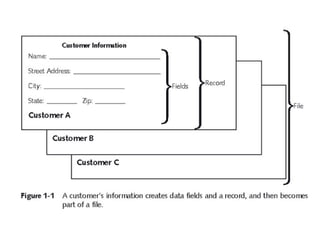
• A group of related characters
• Represents an attribute or characteristic of
an entity
• Corresponds to a column in the physical
database
Database Components - Record
• A collection of fields for one specific entity
• Corresponds to a row in the physical
database
Database Components - File
• A group of records about the same type of
entity
Components Example
Review of Database Design
• Systems Development Life Cycle (SDLC)
• Entity-Relationship Model (E-R Model)
• Normalization
Systems Development Life Cycle
(SDLC)
• Systems investigation – understanding the
problem
• Systems analysis – understanding the
solution
• Systems design – creating the logical and
physical components
Systems Development Life Cycle
(SDLC)
• Systems implementation – placing
completed system into operation
• Systems maintenance and review –
evaluating the implemented system
Entity-Relationship Model
(E-R Model)
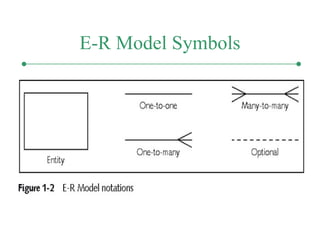
• Used to depict the relationship that exists
among entities
E-R Model Symbols
Relationships
• The following relationships can be
included in an E-R Model:
– One-to-one
– One-to-many
– Many-to-many
One-to-one Relationship
• Each occurrence of data in one entity is
represented by only one occurrence of data
in the other entity
• Example: Each individual has just one
Social Security Number (SSN) and each
SSN is assigned to just one person
One-to-many Relationship
• Each occurrence of data in one entity can be
represented by many occurrences of the
data in the other entity
• Example: A class has only one instructor,
but each instructor can teach many classes
Many-to-many Relationship
• Data can have multiple occurrences in both
entities
• Example: A student can take many classes
and each class is composed of many
students
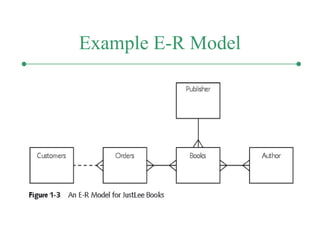
Example E-R Model
Normalization
• Determines required tables and columns for
each table
• Multi-step process allows designer to take
the raw data to be collected about an entity
• Used to reduce or control data redundancy
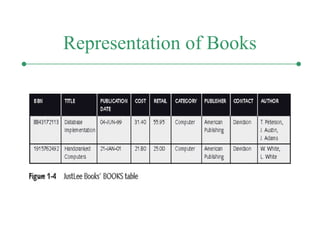
Attributes of Books
• isbn : a value string used to identify any book.
• Title: Book’s title
• Publication Date: A value of DATE type.
• Cost: Publisher’ price
• Retail: Sale’s price.
• Category: Computer, Fiction Science, etc.
• Publisher: Publisher’ house.
• Contact: Sale representative.
Representation of Books
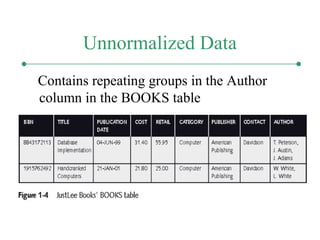
Unnormalized Data
Contains repeating groups in the Author
column in the BOOKS table
First-Normal Form (1NF)
• Primary key is identified. A Primary key is
a field that serves to uniquely identify each
record.
• Repeating groups are eliminated (each entry
a separated record).
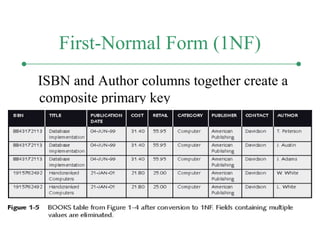
First-Normal Form (1NF)
ISBN and Author columns together create a
composite primary key
Composite Primary Key
• More than one column is required to
uniquely identify a row
• When a primary key consists of more or
one field, another problem may occurs---
partial dependency - a column/ns is/are
only dependent on a portion of the primary
key
The fields describing the book depend of
the book itself not upon who wrote.
Second-Normal Form (2NF)
• Partial dependency must be eliminated
– Break the composite primary key into
two parts, each part representing a
separate table (for example, Author)
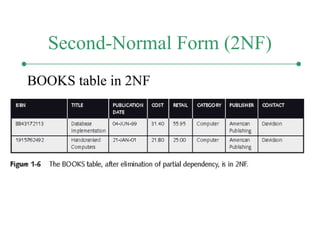
Second-Normal Form (2NF)
BOOKS table in 2NF
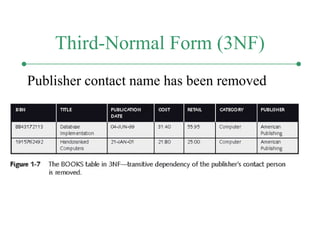
Third-Normal Form (3NF)
Publisher contact name has been removed
Summary of Normalization Steps
• 1NF: eliminate repeating groups, identify
primary key
• 2NF: table is in 1NF and partial
dependencies eliminated
• 3NF: table is in 2NF and transitive
dependencies eliminated
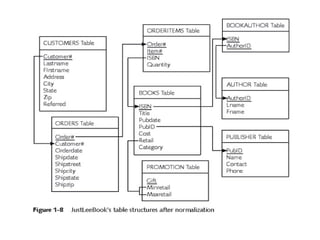
Linking Tables
• Once tables are normalized, make certain
tables are linked
• Tables are linked through a common field
• A common field is usually a primary key in
one table and a foreign key in the other
table
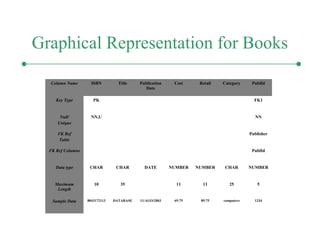
Graphical Representation for Books
Column Name ISBN Title Publication
Date
Cost Retail Category PublId
Key Type PK FK1
Null/
Unique
NN,U NN
FK Ref
Table
Publisher
FK Ref Columns PublId
Data type CHAR CHAR DATE NUMBER NUMBER CHAR NUMBER
Maximum
Length
10 35 11 11 25 5
Sample Data 8843172113 DATABASE 11/AGO/2003 69.75 89.75 computers 1234
Lab # 1
• Find the graphical representations of tables
considered in the Pet Shop.
Specialization
• Top-down design process; we designate subgroupings
within an entity set that are distinctive from other
entities in the set.
• These subgroupings become lower-level entity sets
that have attributes or participate in relationships that
do not apply to the higher-level entity set.
• Depicted by a triangle component labeled ISA (E.g.
customer “is a” person).
• Attribute inheritance – a lower-level entity set
inherits all the attributes and relationship participation
of the higher-level entity set to which it is linked.
Generalization
• A bottom-up design process – combine a
number of entity sets that share the same
features into a higher-level entity set.
• Specialization and generalization are simple
inversions of each other; they are represented
in an E-R diagram in the same way.
• The terms specialization and generalization are
used interchangeably.
UML
• UML: Unified Modeling Language
• UML has many components to graphically
model different aspects of an entire software
system
• UML Class Diagrams correspond to E-R
Diagram, but several differences.
Structured Query Language
(SQL)
• Data sublanguage
• Used to:
– Create or modify tables
– Add data to tables
– Edit data in tables
– Retrieve data from tables

overview of database concept

  • 1.
  • 2.
    Chapter Objectives • Identifythe purpose of a database management system (DBMS) • Distinguish a field from a record and a column from a row • Identify the basic components of an Entity- Relationship Model • Define the three types of relationships that can exist between entities
  • 3.
    Chapter Objectives • Identifythe problem associated with many- to-many relationships and the appropriate solutions • Explain the purpose of normalization • Describe the role of a primary key • Identify partial dependency and transitive dependency in the normalization process
  • 4.
    Chapter Objectives • Explainthe purpose of a foreign key • Determine how to link data in different tables through the use of a common field • Explain the purpose of a structured query language (SQL)
  • 5.
    Database Terminology • Database– logical structure to store data • Database Management System (DBMS) – software used to create and interact with the database
  • 6.
    Database Components • Character •Field • Record • File
  • 7.
    Database Components - Character •Basic unit of data • Can be a letter, number, or special symbol
  • 8.
    Database Components -Field • A group of related characters • Represents an attribute or characteristic of an entity • Corresponds to a column in the physical database
  • 9.
    Database Components -Record • A collection of fields for one specific entity • Corresponds to a row in the physical database
  • 10.
    Database Components -File • A group of records about the same type of entity
  • 11.
  • 12.
    Review of DatabaseDesign • Systems Development Life Cycle (SDLC) • Entity-Relationship Model (E-R Model) • Normalization
  • 13.
    Systems Development LifeCycle (SDLC) • Systems investigation – understanding the problem • Systems analysis – understanding the solution • Systems design – creating the logical and physical components
  • 14.
    Systems Development LifeCycle (SDLC) • Systems implementation – placing completed system into operation • Systems maintenance and review – evaluating the implemented system
  • 15.
    Entity-Relationship Model (E-R Model) •Used to depict the relationship that exists among entities
  • 16.
  • 17.
    Relationships • The followingrelationships can be included in an E-R Model: – One-to-one – One-to-many – Many-to-many
  • 18.
    One-to-one Relationship • Eachoccurrence of data in one entity is represented by only one occurrence of data in the other entity • Example: Each individual has just one Social Security Number (SSN) and each SSN is assigned to just one person
  • 19.
    One-to-many Relationship • Eachoccurrence of data in one entity can be represented by many occurrences of the data in the other entity • Example: A class has only one instructor, but each instructor can teach many classes
  • 20.
    Many-to-many Relationship • Datacan have multiple occurrences in both entities • Example: A student can take many classes and each class is composed of many students
  • 21.
  • 22.
    Normalization • Determines requiredtables and columns for each table • Multi-step process allows designer to take the raw data to be collected about an entity • Used to reduce or control data redundancy
  • 23.
    Attributes of Books •isbn : a value string used to identify any book. • Title: Book’s title • Publication Date: A value of DATE type. • Cost: Publisher’ price • Retail: Sale’s price. • Category: Computer, Fiction Science, etc. • Publisher: Publisher’ house. • Contact: Sale representative.
  • 24.
  • 25.
    Unnormalized Data Contains repeatinggroups in the Author column in the BOOKS table
  • 26.
    First-Normal Form (1NF) •Primary key is identified. A Primary key is a field that serves to uniquely identify each record. • Repeating groups are eliminated (each entry a separated record).
  • 27.
    First-Normal Form (1NF) ISBNand Author columns together create a composite primary key
  • 28.
    Composite Primary Key •More than one column is required to uniquely identify a row • When a primary key consists of more or one field, another problem may occurs--- partial dependency - a column/ns is/are only dependent on a portion of the primary key The fields describing the book depend of the book itself not upon who wrote.
  • 29.
    Second-Normal Form (2NF) •Partial dependency must be eliminated – Break the composite primary key into two parts, each part representing a separate table (for example, Author)
  • 30.
  • 31.
    Third-Normal Form (3NF) Publishercontact name has been removed
  • 32.
    Summary of NormalizationSteps • 1NF: eliminate repeating groups, identify primary key • 2NF: table is in 1NF and partial dependencies eliminated • 3NF: table is in 2NF and transitive dependencies eliminated
  • 33.
    Linking Tables • Oncetables are normalized, make certain tables are linked • Tables are linked through a common field • A common field is usually a primary key in one table and a foreign key in the other table
  • 35.
    Graphical Representation forBooks Column Name ISBN Title Publication Date Cost Retail Category PublId Key Type PK FK1 Null/ Unique NN,U NN FK Ref Table Publisher FK Ref Columns PublId Data type CHAR CHAR DATE NUMBER NUMBER CHAR NUMBER Maximum Length 10 35 11 11 25 5 Sample Data 8843172113 DATABASE 11/AGO/2003 69.75 89.75 computers 1234
  • 36.
    Lab # 1 •Find the graphical representations of tables considered in the Pet Shop.
  • 37.
    Specialization • Top-down designprocess; we designate subgroupings within an entity set that are distinctive from other entities in the set. • These subgroupings become lower-level entity sets that have attributes or participate in relationships that do not apply to the higher-level entity set. • Depicted by a triangle component labeled ISA (E.g. customer “is a” person). • Attribute inheritance – a lower-level entity set inherits all the attributes and relationship participation of the higher-level entity set to which it is linked.
  • 38.
    Generalization • A bottom-updesign process – combine a number of entity sets that share the same features into a higher-level entity set. • Specialization and generalization are simple inversions of each other; they are represented in an E-R diagram in the same way. • The terms specialization and generalization are used interchangeably.
  • 39.
    UML • UML: UnifiedModeling Language • UML has many components to graphically model different aspects of an entire software system • UML Class Diagrams correspond to E-R Diagram, but several differences.
  • 40.
    Structured Query Language (SQL) •Data sublanguage • Used to: – Create or modify tables – Add data to tables – Edit data in tables – Retrieve data from tables