





1
Slide:1
2
Slide:2
Mail: mdshowrovahmed@gmail.com
3
Slide:3
4
There are four structural types of database
management systems:
 Hierarchical databases.
 Network databases.
 Relational databases.
 Object-oriented databases.
Slide:4
5
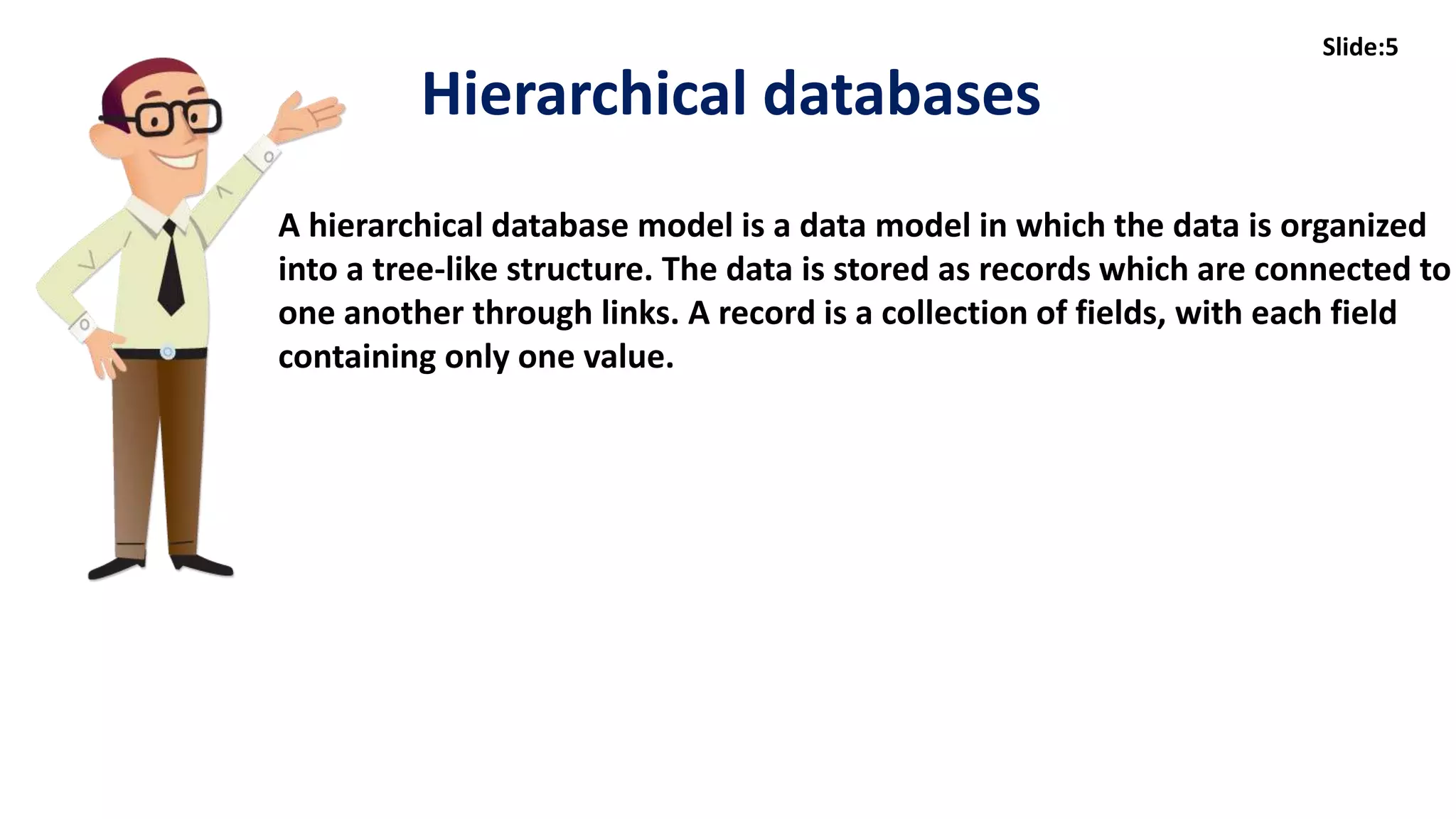
A hierarchical database model is a data model in which the data is organized
into a tree-like structure. The data is stored as records which are connected to
one another through links. A record is a collection of fields, with each field
containing only one value.
Hierarchical databases
Slide:5
6
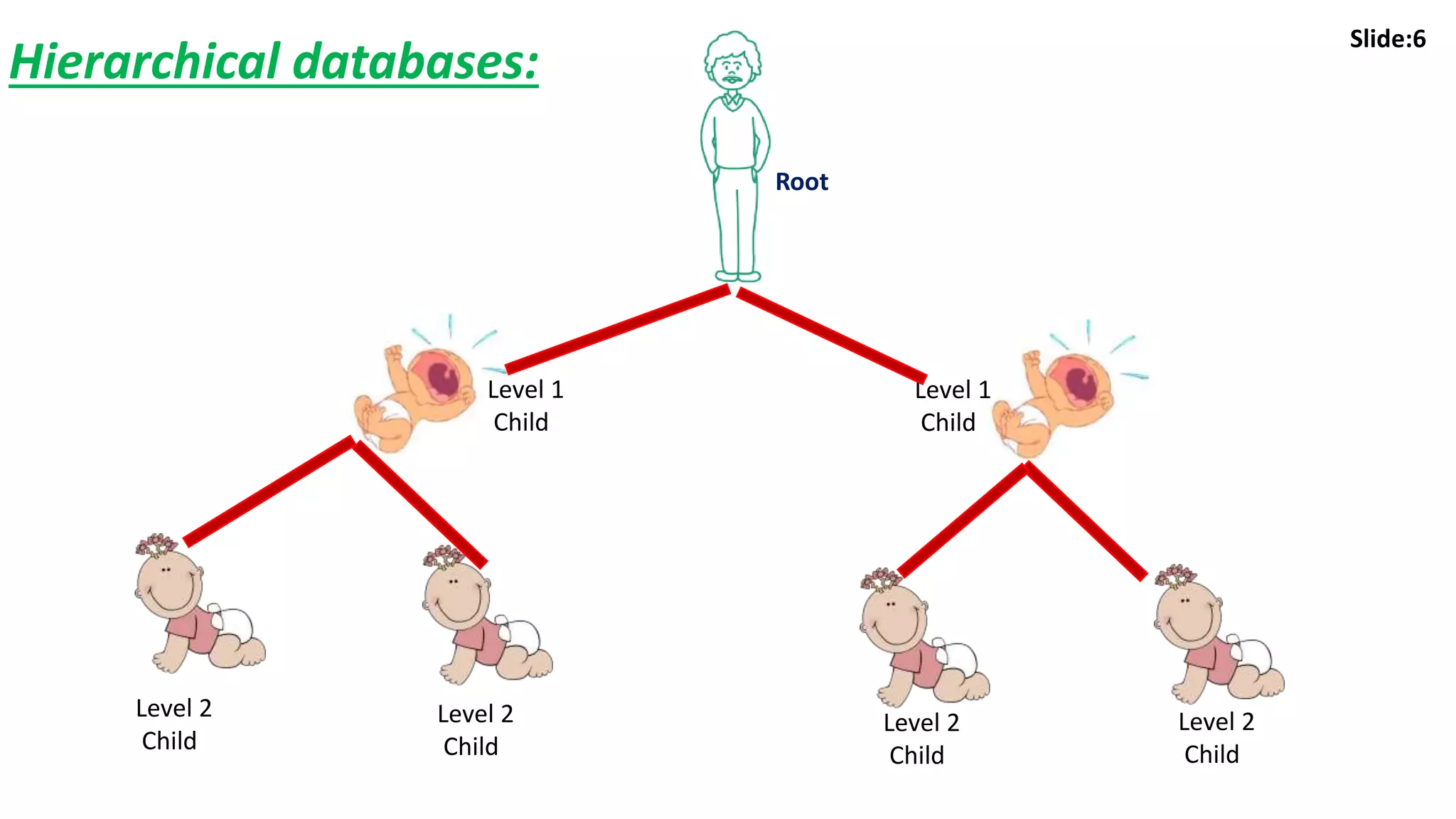
Root
Level 1
Child
Level 1
Child
Level 2
Child
Level 2
Child
Level 2
Child
Level 2
Child
Hierarchical databases:
Slide:6
7
Advantages of Hierarchical Organisational Structure:
Everything in Hierarchical Organisational Structure is going to be organized and stabilized
and there is less likely to get authority and obligation disordered. All the employees know
exactly what position they are in and also know what job they have to do. Fixed rules of
intra-organization procedures and structures is set and usually written in language, which
leaves no discretion for interpretation. Most importantly, under this organisational
structure, goals are clearly defined turning out to be suitable for all type of businesses. Also
the objective will be clear so task can be done in time.
Slide:7
8
Disadvantages of Hierarchical Organisational Structure:
However it barely allows flexibility, long term-planning, and creativity, ending with stiffness and
dictatorship in management. Some leaders may be overburdened while some coordinates stay
idle; some departments may pay too much attention to local target and interests but ignore
overall objective and interests; schedule of the whole project might be affected extremely when
some leaders are out of work. Moreover, this hierarchical organisational structure leaves little
communication between employees causing a lack of team spirit. So workers may be jealousy
when one gets promoted. They may not agree on the changes within the company and unwisely
express that. This way, moral of organization is going to get bad.
Slide:8
9
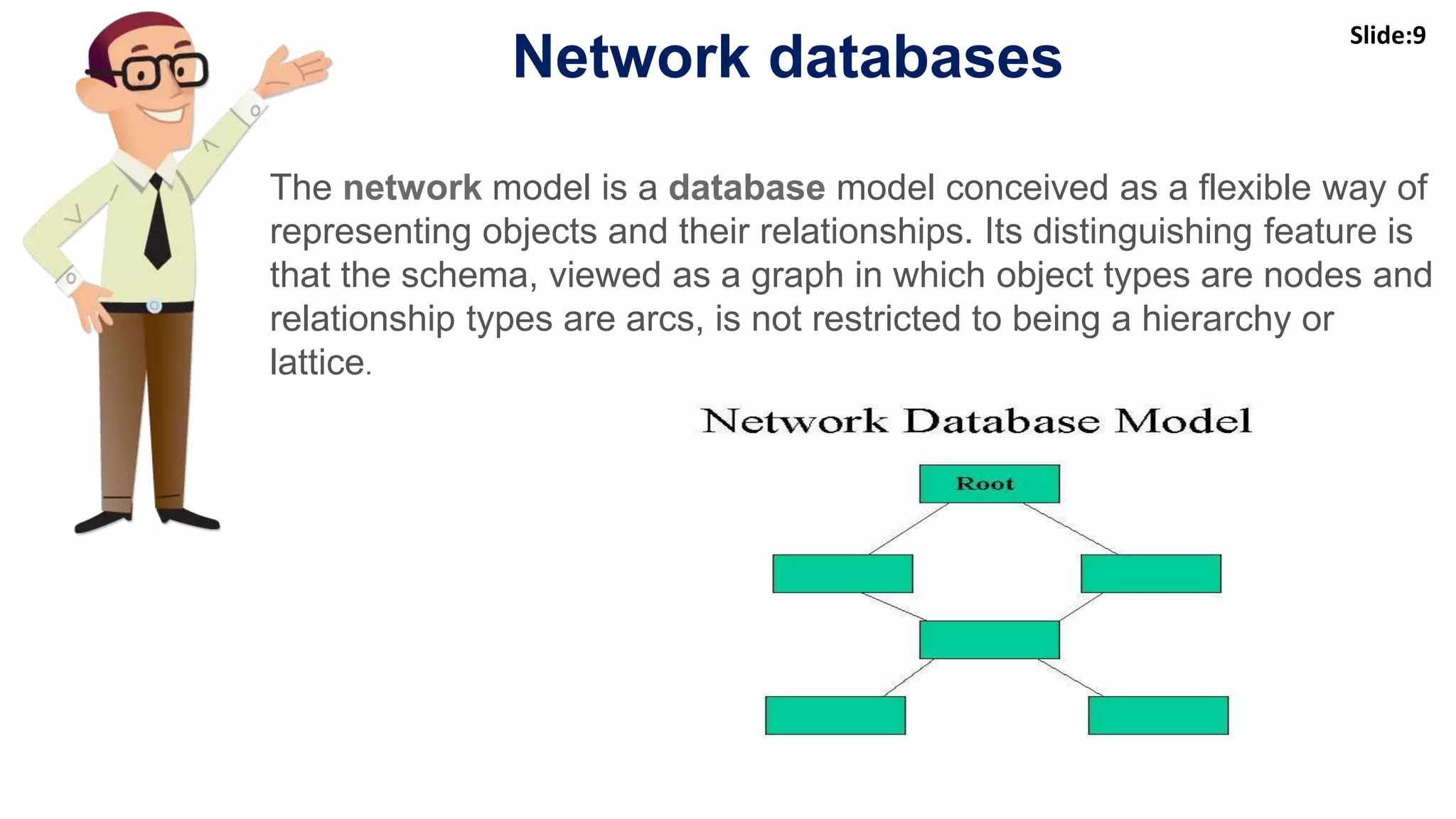
The network model is a database model conceived as a flexible way of
representing objects and their relationships. Its distinguishing feature is
that the schema, viewed as a graph in which object types are nodes and
relationship types are arcs, is not restricted to being a hierarchy or
lattice.
Network databases
Slide:9
10
Advantages of using Network databases:
 Simplicity:The network model is conceptually simple and easy to design
 Ability to handle more relationship types
Ease of data access
 Data Integrity
Data Independence
Slide:10
11
System complexity:
In a network model, data are accessed one record at a time. This males it
essential for thedatabase designers, administrators, and programmers to be
familiar with the internal datastructures to gain access to the data. Therefore, a
user friendly database management systemcannot be created using the network
model
Lack of Structural independence:
Making structural modifications to the database is very difficult in the network
database modelas the data access method is navigational. Any changes made to
the database structure require theapplication programs to be modified before
they can access data. Though the network modelachieves data independence, it
still fails to achieve structural independence
Disdvantages of using Network databases Slide:11
12
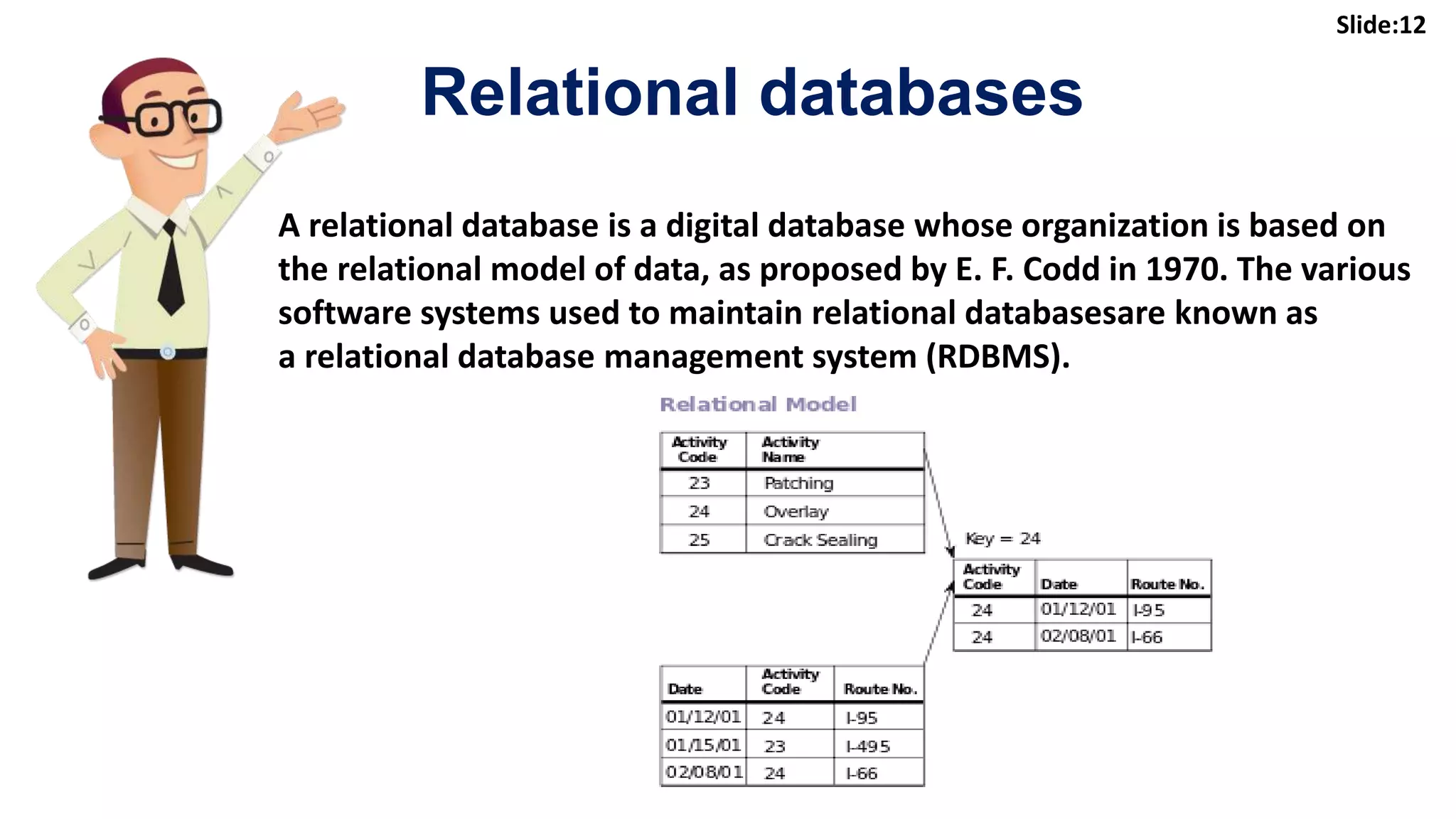
A relational database is a digital database whose organization is based on
the relational model of data, as proposed by E. F. Codd in 1970. The various
software systems used to maintain relational databasesare known as
a relational database management system (RDBMS).
Relational databases
Slide:12
13
Advantages of using relational databases:
 Ease of use
Flexibility
Precision
Security
Data Independence
Data Manipulation Language
Slide:13
14
Disadvantages of using relational databases:
 Performance: A major constraint and therefore disadvantage in the use of relational
database system is machine performance
Physical Storage Consumption: It is, therefore common in relational databases to tune the
databases and in such a case the physical data layout would be chosen so as to give good performance in the
most frequently run operations. It therefore would naturally result in the fact that the lays frequently run
operations would tend to become even more shared.
 Slow extraction of meaning from data: if the data is naturally organized in a
hierarchical manner and stored as such, the hierarchical approach may give quick meaning
for that data.
Slide:14
15
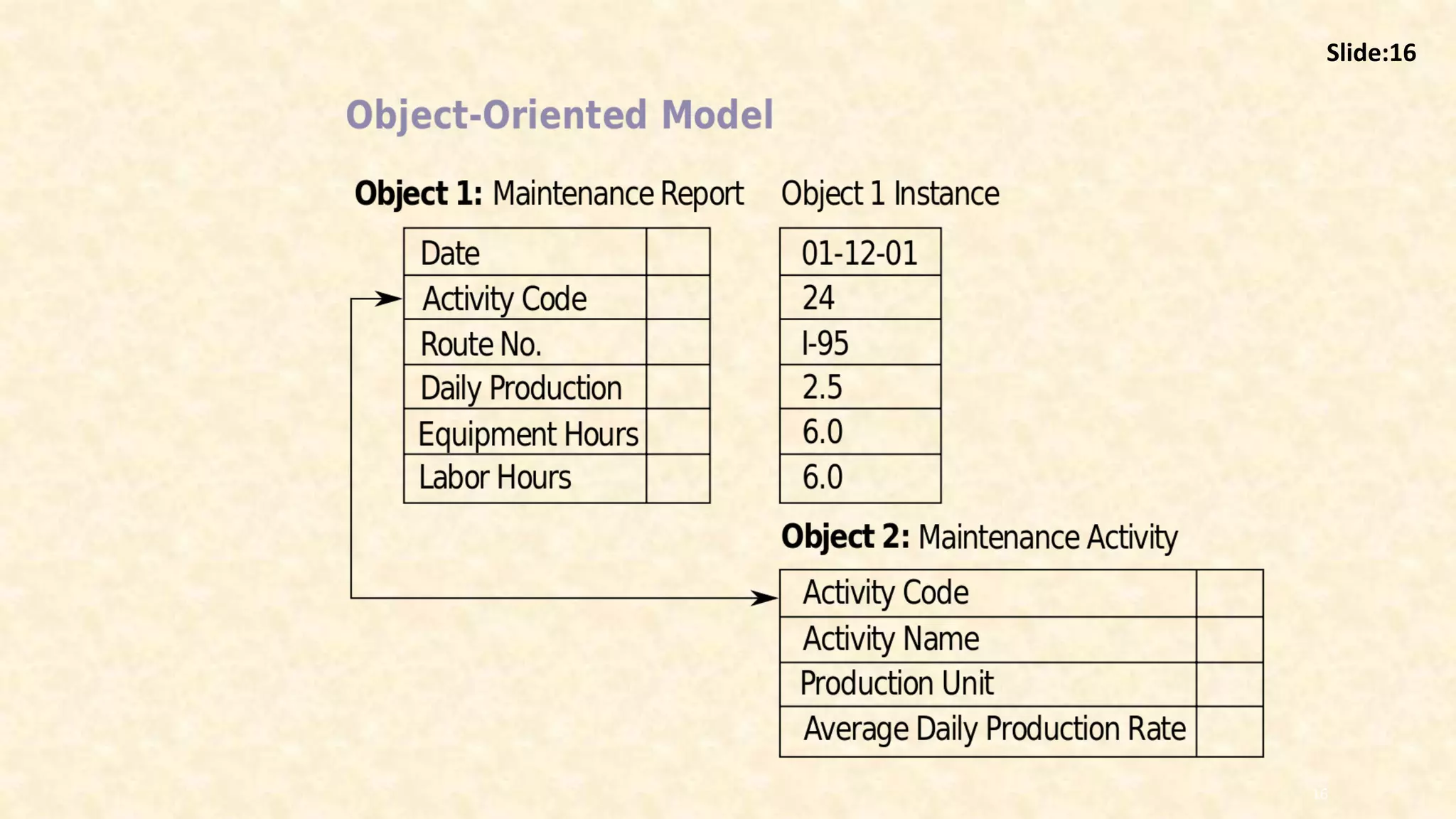
An object database (also object-oriented databasemanagement system,
OODBMS) is a databasemanagement system in which information is
represented in the form of objects as used in object-
oriented programming. Object databases are different from
relational databases which are table-oriented.
Object-oriented databases
Slide:15
16
Slide:16
17
Slide:17

Types of databases

  • 1.
  • 2.
  • 3.
  • 4.
    4 There are fourstructural types of database management systems:  Hierarchical databases.  Network databases.  Relational databases.  Object-oriented databases. Slide:4
  • 5.
    5 A hierarchical databasemodel is a data model in which the data is organized into a tree-like structure. The data is stored as records which are connected to one another through links. A record is a collection of fields, with each field containing only one value. Hierarchical databases Slide:5
  • 6.
    6 Root Level 1 Child Level 1 Child Level2 Child Level 2 Child Level 2 Child Level 2 Child Hierarchical databases: Slide:6
  • 7.
    7 Advantages of HierarchicalOrganisational Structure: Everything in Hierarchical Organisational Structure is going to be organized and stabilized and there is less likely to get authority and obligation disordered. All the employees know exactly what position they are in and also know what job they have to do. Fixed rules of intra-organization procedures and structures is set and usually written in language, which leaves no discretion for interpretation. Most importantly, under this organisational structure, goals are clearly defined turning out to be suitable for all type of businesses. Also the objective will be clear so task can be done in time. Slide:7
  • 8.
    8 Disadvantages of HierarchicalOrganisational Structure: However it barely allows flexibility, long term-planning, and creativity, ending with stiffness and dictatorship in management. Some leaders may be overburdened while some coordinates stay idle; some departments may pay too much attention to local target and interests but ignore overall objective and interests; schedule of the whole project might be affected extremely when some leaders are out of work. Moreover, this hierarchical organisational structure leaves little communication between employees causing a lack of team spirit. So workers may be jealousy when one gets promoted. They may not agree on the changes within the company and unwisely express that. This way, moral of organization is going to get bad. Slide:8
  • 9.
    9 The network modelis a database model conceived as a flexible way of representing objects and their relationships. Its distinguishing feature is that the schema, viewed as a graph in which object types are nodes and relationship types are arcs, is not restricted to being a hierarchy or lattice. Network databases Slide:9
  • 10.
    10 Advantages of usingNetwork databases:  Simplicity:The network model is conceptually simple and easy to design  Ability to handle more relationship types Ease of data access  Data Integrity Data Independence Slide:10
  • 11.
    11 System complexity: In anetwork model, data are accessed one record at a time. This males it essential for thedatabase designers, administrators, and programmers to be familiar with the internal datastructures to gain access to the data. Therefore, a user friendly database management systemcannot be created using the network model Lack of Structural independence: Making structural modifications to the database is very difficult in the network database modelas the data access method is navigational. Any changes made to the database structure require theapplication programs to be modified before they can access data. Though the network modelachieves data independence, it still fails to achieve structural independence Disdvantages of using Network databases Slide:11
  • 12.
    12 A relational databaseis a digital database whose organization is based on the relational model of data, as proposed by E. F. Codd in 1970. The various software systems used to maintain relational databasesare known as a relational database management system (RDBMS). Relational databases Slide:12
  • 13.
    13 Advantages of usingrelational databases:  Ease of use Flexibility Precision Security Data Independence Data Manipulation Language Slide:13
  • 14.
    14 Disadvantages of usingrelational databases:  Performance: A major constraint and therefore disadvantage in the use of relational database system is machine performance Physical Storage Consumption: It is, therefore common in relational databases to tune the databases and in such a case the physical data layout would be chosen so as to give good performance in the most frequently run operations. It therefore would naturally result in the fact that the lays frequently run operations would tend to become even more shared.  Slow extraction of meaning from data: if the data is naturally organized in a hierarchical manner and stored as such, the hierarchical approach may give quick meaning for that data. Slide:14
  • 15.
    15 An object database(also object-oriented databasemanagement system, OODBMS) is a databasemanagement system in which information is represented in the form of objects as used in object- oriented programming. Object databases are different from relational databases which are table-oriented. Object-oriented databases Slide:15
  • 16.
  • 17.