The Relational Database Model
Course:-MCA-II
Subject:-Database Management System
Unit:-2
Outline
 Data Models, Schemas, and Instances
 Three-Schema Architecture
 Database language and Interfaces
 The database system environment
 Centralized and client/server architecture
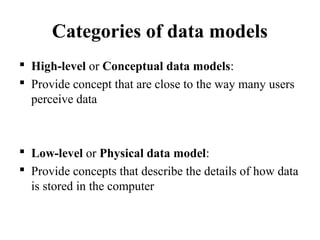
Categories of data models
 High-level or Conceptual data models:
 Provide concept that are close to the way many users
perceive data
 Low-level or Physical data model:
 Provide concepts that describe the details of how data
is stored in the computer
Conceptual data models
• It uses concepts such as entities, attributes and
relationships.
• Entity represents a real-world object or concept, such
as employee or project
• Attribute represents some property of interest that
further describes an entity, such as employee’s name
or salary
• Relation among two or more entities represents an
association among two or more entitles
Example of a Relation[1]
Schemas and Database State
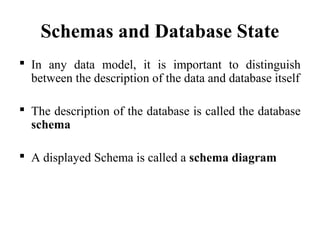
 In any data model, it is important to distinguish
between the description of the data and database itself
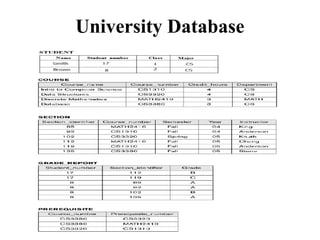
 The description of the database is called the database
schema
 A displayed Schema is called a schema diagram
University Database
Example of a Database Schema[2]
Schemas and Database State
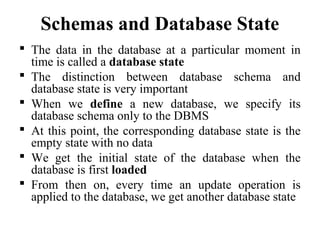
 The data in the database at a particular moment in
time is called a database state
 The distinction between database schema and
database state is very important
 When we define a new database, we specify its
database schema only to the DBMS
 At this point, the corresponding database state is the
empty state with no data
 We get the initial state of the database when the
database is first loaded
 From then on, every time an update operation is
applied to the database, we get another database state
Schemas and Database State
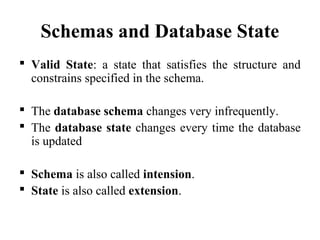
 Valid State: a state that satisfies the structure and
constrains specified in the schema.
 The database schema changes very infrequently.
 The database state changes every time the database
is updated
 Schema is also called intension.
 State is also called extension.
Outline
 Data Models, Schemas, and Instances
 Three-Schema Architecture
 Database language and Interfaces
 The database system environment
 Centralized and client/server architecture
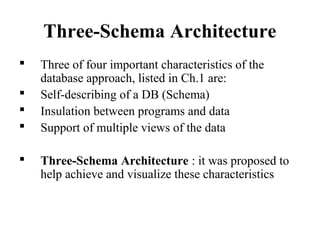
Three-Schema Architecture
 Three of four important characteristics of the
database approach, listed in Ch.1 are:
 Self-describing of a DB (Schema)
 Insulation between programs and data
 Support of multiple views of the data
 Three-Schema Architecture : it was proposed to
help achieve and visualize these characteristics
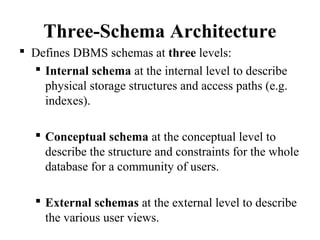
Three-Schema Architecture
 Defines DBMS schemas at three levels:
 Internal schema at the internal level to describe
physical storage structures and access paths (e.g.
indexes).
 Conceptual schema at the conceptual level to
describe the structure and constraints for the whole
database for a community of users.
 External schemas at the external level to describe
the various user views.
The Three-schema architecture[3]
Outline
 Data Models, Schemas, and Instances
 Three-Schema Architecture
 Database language and Interfaces
 The database system environment
 Centralized and client/server architecture
DBMS Languages
 The first step to create a database through DBMS is
to specify conceptual and internal schemas for the
database
 Data Definition Language (DDL): is used by
database designers to define schemas
 Data Manipulation Language (DML)
 View Definition Language (VDL): is to specify user
views
 In current DBMS, the preceding types of languages
are usually not considered distinct languages
DBMS Programming Language
Interfaces
 Programmer interfaces for embedding DML in a
programming languages:
Embedded Approach: e.g. embedded SQL (for C, C+
+, etc.), SQLJ (for Java)
Procedure Call Approach: e.g. JDBC for Java,
ODBC for other programming languages
Database Programming Language Approach: e.g.
ORACLE has PL/SQL, a programming language based
on SQL; language incorporates SQL and its data types
as integral components
User-Friendly DBMS Interfaces
• Menu-based, popular for browsing on the web
(URSA)
• Forms-based, designed for naïve users
• Graphics-based
• Natural language: requests in written English
• Combinations of the above
Outline
 Data Models, Schemas, and Instances
 Three-Schema Architecture
 Database language and Interfaces
 The database system environment
 Centralized and client/server architecture
DBMS Component Modules
 A DBMS is a complex software system
 The figure showed in next slide is divide into two
halves.
 The top half refers to the various users of the database
system
 The lower half shows the internals of the DBMS
responsible for storage of data and processing of
transactions
Typical DBMS Component Modules[4]
Outline
 Data Models, Schemas, and Instances
 Three-Schema Architecture
 Database language and Interfaces
 The database system environment
 Centralized and client/server architecture
Centralized DBMS Architecture
 A centralized DBMS in which all the DBMS
functionality, application program execution, and
user interface processing were carried out on a single
machine
Basic Client/Server Architectures
 The client/server architecture was developed to deal
with computer environment in which a large number
of PCs, workstation, file server…
 A client in this framework is typically a user machine
that provides user interface capabilities and local
processing
 A server is a system containing both hardware and
software that can provide services to the client
machines.
Logical two-tier client server
architecture[5]
Two-tier Architecture
 This is called two-tire architectures because the
software components are distributed over two
systems: client and server
 The emergence of the Web changed the roles of
client and server, leading to the three-tier
architecture
Three-tier architecture
 The intermediate layer or middle layer is
sometimes called the application server or Web
server
 Three-tier Architecture Can Enhance Security:
 Database server only accessible via middle tier
 Clients cannot directly access database server
Three-tier client-server
architecture[6]
Three-tier architecture
 The presentation layer displays information to the
user
 The business logic layer handles intermediate rules
and constrains before data is passed up to the user or
down to the DBMS
 If the bottom layer is split into two layers (a web
server and a database server), then it is a 4-tire
architecture (possible to the n-tier)
REFERENCES
1. http://mytechnicalarticles.files.wordpress.com/2010/07/database-
system-concepts-and-architecture.pdf
2. http://cse.hcmut.edu.vn/~c503002/Files/DANGTranTri/slides/02.pdf
3. http://mytechnicalarticles.files.wordpress.com/2010/07/database-
system-concepts-and-architecture_ppt.pdf
4. Database System Concepts: Abraham Silberschatz, Henry F. Korth &
S., Sudarshan, TATA Mcgraw Hill.
5. Database Systems Concepts, design and Applications 2/e, Singh S. K,
PearsonEducation
6. SQL- PL/SQL, Ivan bayross, BPB Publications.
 
Image References
1.http://www.k9safesearch.com/search.jsp?q=relation+
+images+in+database+management+system&v=w
2.http://stackoverflow.com/questions/7991112/database-normalization-
for-school-management-system
3.http://www.expertsmind.com/questions/draw-and-explain-the-three-
level-architecture-of-database-30163918.aspx
4.http://www.expertsmind.com/questions/draw-and-DBMS Component
Modules-of-database-30163918.aspx
5.http://www.studytonight.com/dbms/architecture-of-database.php
6.http://www.studytonight.com/dbms/architecture-of-database.php

Mca ii-dbms- u-ii-the relational database model

  • 1.
    The Relational DatabaseModel Course:-MCA-II Subject:-Database Management System Unit:-2
  • 2.
    Outline  Data Models,Schemas, and Instances  Three-Schema Architecture  Database language and Interfaces  The database system environment  Centralized and client/server architecture
  • 3.
    Categories of datamodels  High-level or Conceptual data models:  Provide concept that are close to the way many users perceive data  Low-level or Physical data model:  Provide concepts that describe the details of how data is stored in the computer
  • 4.
    Conceptual data models •It uses concepts such as entities, attributes and relationships. • Entity represents a real-world object or concept, such as employee or project • Attribute represents some property of interest that further describes an entity, such as employee’s name or salary • Relation among two or more entities represents an association among two or more entitles
  • 5.
    Example of aRelation[1]
  • 6.
    Schemas and DatabaseState  In any data model, it is important to distinguish between the description of the data and database itself  The description of the database is called the database schema  A displayed Schema is called a schema diagram
  • 7.
  • 8.
    Example of aDatabase Schema[2]
  • 9.
    Schemas and DatabaseState  The data in the database at a particular moment in time is called a database state  The distinction between database schema and database state is very important  When we define a new database, we specify its database schema only to the DBMS  At this point, the corresponding database state is the empty state with no data  We get the initial state of the database when the database is first loaded  From then on, every time an update operation is applied to the database, we get another database state
  • 10.
    Schemas and DatabaseState  Valid State: a state that satisfies the structure and constrains specified in the schema.  The database schema changes very infrequently.  The database state changes every time the database is updated  Schema is also called intension.  State is also called extension.
  • 11.
    Outline  Data Models,Schemas, and Instances  Three-Schema Architecture  Database language and Interfaces  The database system environment  Centralized and client/server architecture
  • 12.
    Three-Schema Architecture  Threeof four important characteristics of the database approach, listed in Ch.1 are:  Self-describing of a DB (Schema)  Insulation between programs and data  Support of multiple views of the data  Three-Schema Architecture : it was proposed to help achieve and visualize these characteristics
  • 13.
    Three-Schema Architecture  DefinesDBMS schemas at three levels:  Internal schema at the internal level to describe physical storage structures and access paths (e.g. indexes).  Conceptual schema at the conceptual level to describe the structure and constraints for the whole database for a community of users.  External schemas at the external level to describe the various user views.
  • 14.
  • 15.
    Outline  Data Models,Schemas, and Instances  Three-Schema Architecture  Database language and Interfaces  The database system environment  Centralized and client/server architecture
  • 16.
    DBMS Languages  Thefirst step to create a database through DBMS is to specify conceptual and internal schemas for the database  Data Definition Language (DDL): is used by database designers to define schemas  Data Manipulation Language (DML)  View Definition Language (VDL): is to specify user views  In current DBMS, the preceding types of languages are usually not considered distinct languages
  • 17.
    DBMS Programming Language Interfaces Programmer interfaces for embedding DML in a programming languages: Embedded Approach: e.g. embedded SQL (for C, C+ +, etc.), SQLJ (for Java) Procedure Call Approach: e.g. JDBC for Java, ODBC for other programming languages Database Programming Language Approach: e.g. ORACLE has PL/SQL, a programming language based on SQL; language incorporates SQL and its data types as integral components
  • 18.
    User-Friendly DBMS Interfaces •Menu-based, popular for browsing on the web (URSA) • Forms-based, designed for naïve users • Graphics-based • Natural language: requests in written English • Combinations of the above
  • 19.
    Outline  Data Models,Schemas, and Instances  Three-Schema Architecture  Database language and Interfaces  The database system environment  Centralized and client/server architecture
  • 20.
    DBMS Component Modules A DBMS is a complex software system  The figure showed in next slide is divide into two halves.  The top half refers to the various users of the database system  The lower half shows the internals of the DBMS responsible for storage of data and processing of transactions
  • 21.
  • 22.
    Outline  Data Models,Schemas, and Instances  Three-Schema Architecture  Database language and Interfaces  The database system environment  Centralized and client/server architecture
  • 23.
    Centralized DBMS Architecture A centralized DBMS in which all the DBMS functionality, application program execution, and user interface processing were carried out on a single machine
  • 24.
    Basic Client/Server Architectures The client/server architecture was developed to deal with computer environment in which a large number of PCs, workstation, file server…  A client in this framework is typically a user machine that provides user interface capabilities and local processing  A server is a system containing both hardware and software that can provide services to the client machines.
  • 25.
    Logical two-tier clientserver architecture[5]
  • 26.
    Two-tier Architecture  Thisis called two-tire architectures because the software components are distributed over two systems: client and server  The emergence of the Web changed the roles of client and server, leading to the three-tier architecture
  • 27.
    Three-tier architecture  Theintermediate layer or middle layer is sometimes called the application server or Web server  Three-tier Architecture Can Enhance Security:  Database server only accessible via middle tier  Clients cannot directly access database server
  • 28.
  • 29.
    Three-tier architecture  Thepresentation layer displays information to the user  The business logic layer handles intermediate rules and constrains before data is passed up to the user or down to the DBMS  If the bottom layer is split into two layers (a web server and a database server), then it is a 4-tire architecture (possible to the n-tier)
  • 30.
    REFERENCES 1. http://mytechnicalarticles.files.wordpress.com/2010/07/database- system-concepts-and-architecture.pdf 2. http://cse.hcmut.edu.vn/~c503002/Files/DANGTranTri/slides/02.pdf 3.http://mytechnicalarticles.files.wordpress.com/2010/07/database- system-concepts-and-architecture_ppt.pdf 4. Database System Concepts: Abraham Silberschatz, Henry F. Korth & S., Sudarshan, TATA Mcgraw Hill. 5. Database Systems Concepts, design and Applications 2/e, Singh S. K, PearsonEducation 6. SQL- PL/SQL, Ivan bayross, BPB Publications.  
  • 31.