www.lib.ku.edu/instruction


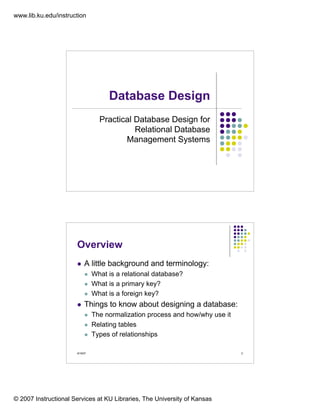
                                     Database Design
                                  Practical Database Design for
                                            Relational Database
                                         Management Systems


                      Overview
                           A little background and terminology:
                                What is a relational database?
                                What is a primary key?
                                What is a foreign key?
                           Things to know about designing a database:
                                The normalization process and how/why use it
                                Relating tables
                                Types of relationships

                      9/19/07                                                  2


© 2007 Instructional Services at KU Libraries, The University of Kansas
www.lib.ku.edu/instruction


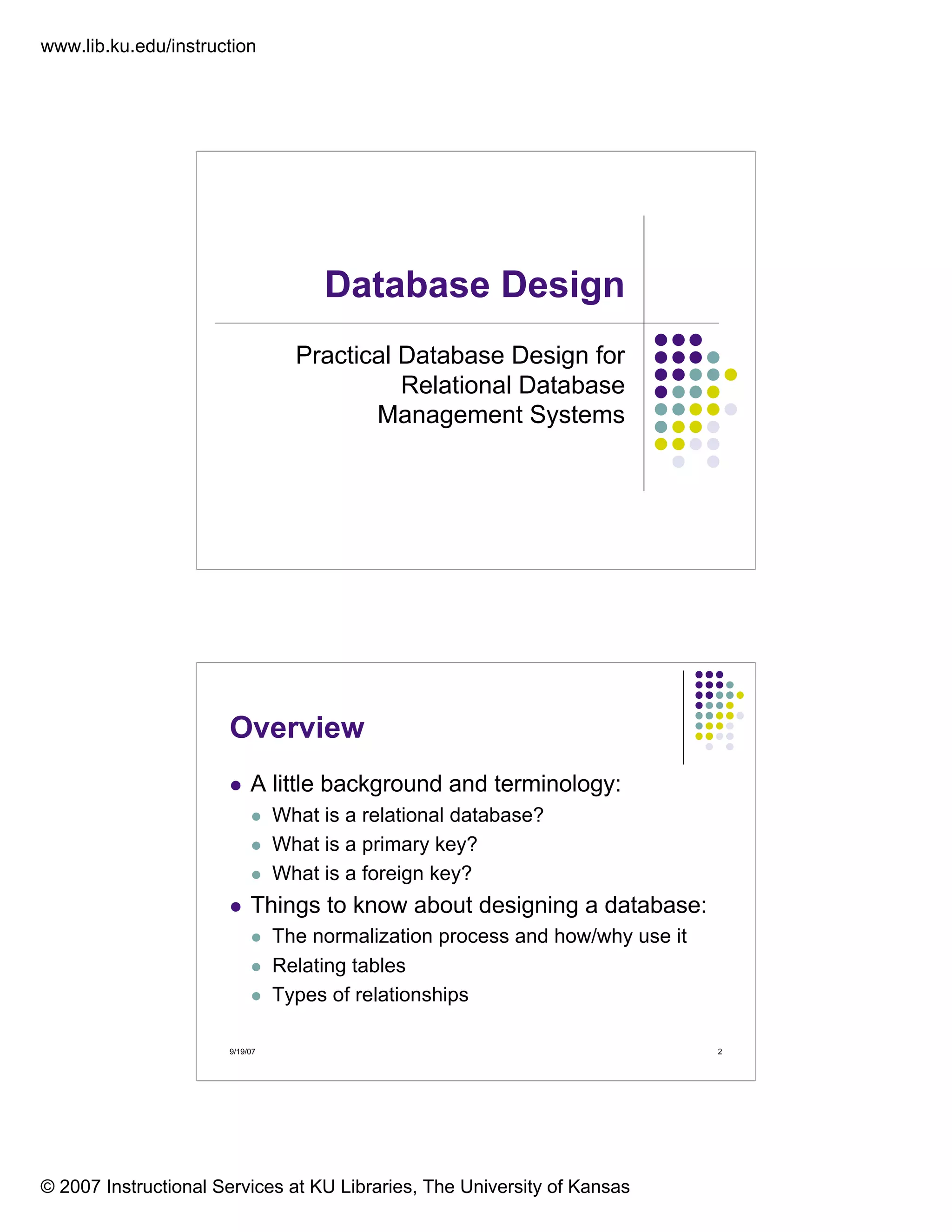
                      Relational Database Management
                      System

                           Collection of information organized in tables
                                Tables are also “relations”
                           Tables are constructed and associated to each other
                           through shared fields–“common” fields
                                Fields are also “columns” or “attributes”
                           A set of attributes comprises a record
                                Records are also “rows” or “tuples”
                           Tables are related through common fields
                           designated as primary and foreign keys
                           Allow us to find, update, and delete data quickly,
                           and help to ensure accuracy
                      9/19/07                                                     3


                      Primary and Foreign Key
                      Fields
                           Primary Key
                                Primary key fields must be unique and cannot
                                contain a null value.
                                Each table should have a primary key field.
                                Concatenated keys: using more than one field as
                                a primary key field.
                           Foreign Key: Fields in a table that refer to
                           the primary key in another table
                                The data in this field must exactly match data
                                contained in the primary key field.
                      9/19/07                                                     4


© 2007 Instructional Services at KU Libraries, The University of Kansas
www.lib.ku.edu/instruction


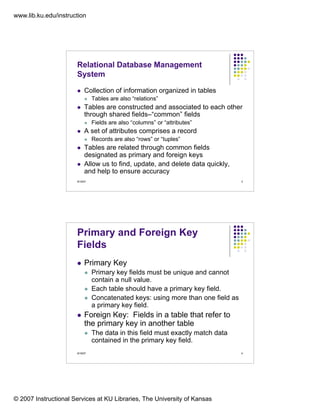
                      What is Normalization?
                           The process by which we efficiently organize data to achieve
                           these goals:
                                Eliminating redundancy
                                Ensuring data is stored in the correct table
                                Eliminating need for restructuring database when data is added.
                           Five levels of normal form
                                In order to achieve one level of normal form, each previous level
                                must be met


                                        Third normal form is sufficient for
                                        most typical database applications.

                      9/19/07                                                                       5


                      First Normal Form (1NF)
                           There are no repeating or duplicate fields.
                           Each cell contains only a single value.
                           Each record is unique.
                                Identified by primary key


                      9/19/07                                                                       6


© 2007 Instructional Services at KU Libraries, The University of Kansas
www.lib.ku.edu/instruction


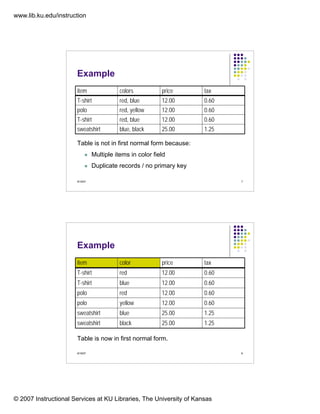
                      Example
                      item                 colors          price     tax
                      T-shirt              red, blue       12.00     0.60
                      polo                 red, yellow     12.00     0.60
                      T-shirt              red, blue       12.00     0.60
                      sweatshirt           blue, black     25.00     1.25

                      Table is not in first normal form because:
                                Multiple items in color field
                                Duplicate records / no primary key

                      9/19/07                                               7


                      Example
                      item                 color           price     tax
                      T-shirt              red             12.00     0.60
                      T-shirt              blue            12.00     0.60
                      polo                 red             12.00     0.60
                      polo                 yellow          12.00     0.60
                      sweatshirt           blue            25.00     1.25
                      sweatshirt           black           25.00     1.25

                      Table is now in first normal form.

                      9/19/07                                               8


© 2007 Instructional Services at KU Libraries, The University of Kansas
www.lib.ku.edu/instruction


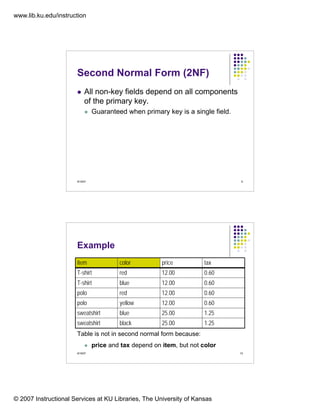
                      Second Normal Form (2NF)
                           All non-key fields depend on all components
                           of the primary key.
                                Guaranteed when primary key is a single field.


                      9/19/07                                                    9


                      Example
                      item               color          price         tax
                      T-shirt            red            12.00         0.60
                      T-shirt            blue           12.00         0.60
                      polo               red            12.00         0.60
                      polo               yellow         12.00         0.60
                      sweatshirt         blue           25.00         1.25
                      sweatshirt         black          25.00         1.25
                      Table is not in second normal form because:
                                price and tax depend on item, but not color
                      9/19/07                                                    10


© 2007 Instructional Services at KU Libraries, The University of Kansas
www.lib.ku.edu/instruction


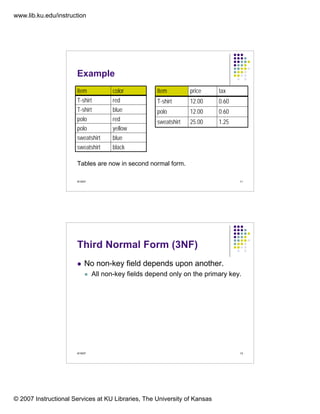
                      Example
                      item             color         item         price   tax
                      T-shirt          red           T-shirt      12.00   0.60
                      T-shirt          blue          polo         12.00   0.60
                      polo             red           sweatshirt   25.00   1.25
                      polo             yellow
                      sweatshirt       blue
                      sweatshirt       black

                      Tables are now in second normal form.

                      9/19/07                                                    11


                      Third Normal Form (3NF)
                           No non-key field depends upon another.
                                All non-key fields depend only on the primary key.


                      9/19/07                                                    12


© 2007 Instructional Services at KU Libraries, The University of Kansas
www.lib.ku.edu/instruction


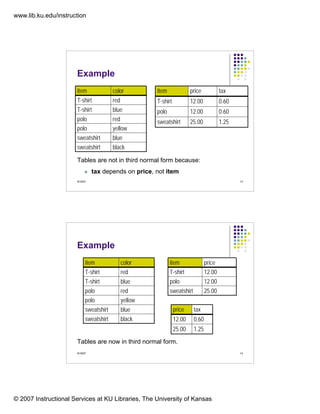
                      Example
                      item               color        item              price            tax
                      T-shirt            red          T-shirt           12.00            0.60
                      T-shirt            blue         polo              12.00            0.60
                      polo               red          sweatshirt        25.00            1.25
                      polo               yellow
                      sweatshirt         blue
                      sweatshirt         black

                      Tables are not in third normal form because:
                                tax depends on price, not item
                      9/19/07                                                                   13


                      Example
                            item            color            item                price
                            T-shirt         red              T-shirt             12.00
                            T-shirt         blue             polo                12.00
                            polo            red              sweatshirt          25.00
                            polo            yellow
                            sweatshirt      blue                price     tax
                            sweatshirt      black               12.00     0.60
                                                                25.00     1.25

                      Tables are now in third normal form.
                      9/19/07                                                                   14


© 2007 Instructional Services at KU Libraries, The University of Kansas
www.lib.ku.edu/instruction


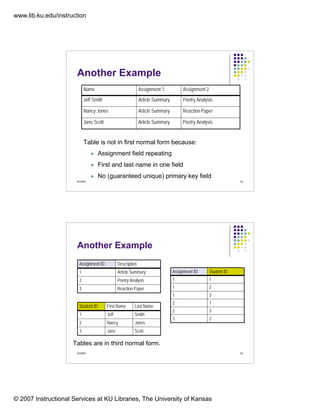
                      Another Example
                           Name                              Assignment 1           Assignment 2
                           Jeff Smith                        Article Summary        Poetry Analysis

                           Nancy Jones                       Article Summary        Reaction Paper

                           Jane Scott                        Article Summary        Poetry Analysis


                           Table is not in first normal form because:
                                    Assignment field repeating
                                    First and last name in one field
                                    No (guaranteed unique) primary key field
                      9/19/07                                                                                   15


                      Another Example
                       Assignment ID           Description
                       1                       Article Summary                 Assignment ID       Student ID
                       2                       Poetry Analysis                 1                   1
                       3                       Reaction Paper                  1                   2
                                                                               1                   3
                                                                               2                   1
                       Student ID       First Name      Last Name
                                                                               2                   3
                       1                Jeff            Smith
                                                                               3                   2
                       2                Nancy           Jones
                       3                Jane            Scott

                     Tables are in third normal form.
                      9/19/07                                                                                   16


© 2007 Instructional Services at KU Libraries, The University of Kansas
www.lib.ku.edu/instruction


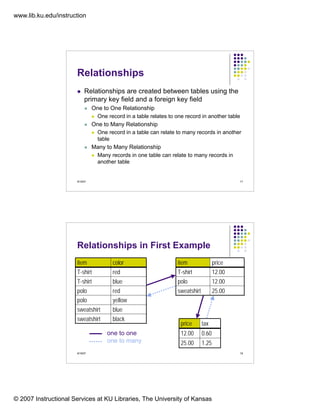
                      Relationships
                           Relationships are created between tables using the
                           primary key field and a foreign key field
                                One to One Relationship
                                 One record in a table relates to one record in another table
                                One to Many Relationship
                                 One record in a table can relate to many records in another
                                 table
                                Many to Many Relationship
                                 Many records in one table can relate to many records in
                                 another table


                      9/19/07                                                                  17


                      Relationships in First Example
                      item              color                      item                price
                      T-shirt           red                        T-shirt             12.00
                      T-shirt           blue                       polo                12.00
                      polo              red                        sweatshirt          25.00
                      polo              yellow
                      sweatshirt        blue
                      sweatshirt        black
                                                                    price       tax
                                      one to one                    12.00       0.60
                                      one to many                   25.00       1.25
                      9/19/07                                                                  18


© 2007 Instructional Services at KU Libraries, The University of Kansas
www.lib.ku.edu/instruction


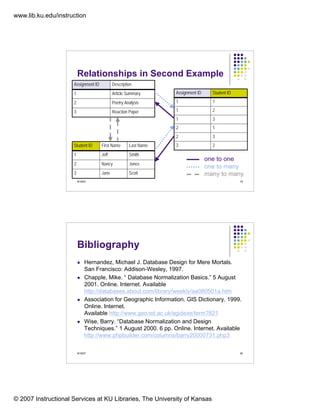
                         Relationships in Second Example
                     Assignment ID          Description
                     1                      Article Summary      Assignment ID     Student ID

                     2                      Poetry Analysis      1                 1

                     3                      Reaction Paper       1                 2
                                                                 1                 3
                                                                 2                 1
                                                                 2                 3
                     Student ID      First Name      Last Name   3                 2
                     1               Jeff            Smith
                                                                                 one to one
                     2               Nancy           Jones
                                                                                 one to many
                     3               Jane            Scott                       many to many
                         9/19/07                                                                19


                         Bibliography
                              Hernandez, Michael J. Database Design for Mere Mortals.
                              San Francisco: Addison-Wesley, 1997.
                              Chapple, Mike. “ Database Normalization Basics.” 5 August
                              2001. Online. Internet. Available
                              http://databases.about.com/library/weekly/aa080501a.htm
                              Association for Geographic Information. GIS Dictionary. 1999.
                              Online. Internet.
                              Available http://www.geo.ed.ac.uk/agidexe/term?821
                              Wise, Barry. “Database Normalization and Design
                              Techniques.” 1 August 2000. 6 pp. Online. Internet. Available
                              http://www.phpbuilder.com/columns/barry20000731.php3

                         9/19/07                                                                20


© 2007 Instructional Services at KU Libraries, The University of Kansas
www.lib.ku.edu/instruction


                      Further Reading
                           Harrington, Jan L. Relational Database Design Clearly
                           Explained. San Diego: Academic Express, 1998.
                           Chapple, Mike. “Choosing a Database Product.” 6 May 2001.
                           Online. Internet. Available
                           http://databases.about.com/library/weekly/aa050601a.htm
                           Gilmore, W.J. “Introduction to Database Normalization.” 27
                           November 2000. Online. Internet. Available
                           http://www.devshed.com/Server_Side/MySQL/Normal/Normal
                           1/page1.html


                      9/19/07                                                       21


© 2007 Instructional Services at KU Libraries, The University of Kansas

Database design & Normalization (1NF, 2NF, 3NF)

  • 1.
    www.lib.ku.edu/instruction Database Design Practical Database Design for Relational Database Management Systems Overview A little background and terminology: What is a relational database? What is a primary key? What is a foreign key? Things to know about designing a database: The normalization process and how/why use it Relating tables Types of relationships 9/19/07 2 © 2007 Instructional Services at KU Libraries, The University of Kansas
  • 2.
    www.lib.ku.edu/instruction Relational Database Management System Collection of information organized in tables Tables are also “relations” Tables are constructed and associated to each other through shared fields–“common” fields Fields are also “columns” or “attributes” A set of attributes comprises a record Records are also “rows” or “tuples” Tables are related through common fields designated as primary and foreign keys Allow us to find, update, and delete data quickly, and help to ensure accuracy 9/19/07 3 Primary and Foreign Key Fields Primary Key Primary key fields must be unique and cannot contain a null value. Each table should have a primary key field. Concatenated keys: using more than one field as a primary key field. Foreign Key: Fields in a table that refer to the primary key in another table The data in this field must exactly match data contained in the primary key field. 9/19/07 4 © 2007 Instructional Services at KU Libraries, The University of Kansas
  • 3.
    www.lib.ku.edu/instruction What is Normalization? The process by which we efficiently organize data to achieve these goals: Eliminating redundancy Ensuring data is stored in the correct table Eliminating need for restructuring database when data is added. Five levels of normal form In order to achieve one level of normal form, each previous level must be met Third normal form is sufficient for most typical database applications. 9/19/07 5 First Normal Form (1NF) There are no repeating or duplicate fields. Each cell contains only a single value. Each record is unique. Identified by primary key 9/19/07 6 © 2007 Instructional Services at KU Libraries, The University of Kansas
  • 4.
    www.lib.ku.edu/instruction Example item colors price tax T-shirt red, blue 12.00 0.60 polo red, yellow 12.00 0.60 T-shirt red, blue 12.00 0.60 sweatshirt blue, black 25.00 1.25 Table is not in first normal form because: Multiple items in color field Duplicate records / no primary key 9/19/07 7 Example item color price tax T-shirt red 12.00 0.60 T-shirt blue 12.00 0.60 polo red 12.00 0.60 polo yellow 12.00 0.60 sweatshirt blue 25.00 1.25 sweatshirt black 25.00 1.25 Table is now in first normal form. 9/19/07 8 © 2007 Instructional Services at KU Libraries, The University of Kansas
  • 5.
    www.lib.ku.edu/instruction Second Normal Form (2NF) All non-key fields depend on all components of the primary key. Guaranteed when primary key is a single field. 9/19/07 9 Example item color price tax T-shirt red 12.00 0.60 T-shirt blue 12.00 0.60 polo red 12.00 0.60 polo yellow 12.00 0.60 sweatshirt blue 25.00 1.25 sweatshirt black 25.00 1.25 Table is not in second normal form because: price and tax depend on item, but not color 9/19/07 10 © 2007 Instructional Services at KU Libraries, The University of Kansas
  • 6.
    www.lib.ku.edu/instruction Example item color item price tax T-shirt red T-shirt 12.00 0.60 T-shirt blue polo 12.00 0.60 polo red sweatshirt 25.00 1.25 polo yellow sweatshirt blue sweatshirt black Tables are now in second normal form. 9/19/07 11 Third Normal Form (3NF) No non-key field depends upon another. All non-key fields depend only on the primary key. 9/19/07 12 © 2007 Instructional Services at KU Libraries, The University of Kansas
  • 7.
    www.lib.ku.edu/instruction Example item color item price tax T-shirt red T-shirt 12.00 0.60 T-shirt blue polo 12.00 0.60 polo red sweatshirt 25.00 1.25 polo yellow sweatshirt blue sweatshirt black Tables are not in third normal form because: tax depends on price, not item 9/19/07 13 Example item color item price T-shirt red T-shirt 12.00 T-shirt blue polo 12.00 polo red sweatshirt 25.00 polo yellow sweatshirt blue price tax sweatshirt black 12.00 0.60 25.00 1.25 Tables are now in third normal form. 9/19/07 14 © 2007 Instructional Services at KU Libraries, The University of Kansas
  • 8.
    www.lib.ku.edu/instruction Another Example Name Assignment 1 Assignment 2 Jeff Smith Article Summary Poetry Analysis Nancy Jones Article Summary Reaction Paper Jane Scott Article Summary Poetry Analysis Table is not in first normal form because: Assignment field repeating First and last name in one field No (guaranteed unique) primary key field 9/19/07 15 Another Example Assignment ID Description 1 Article Summary Assignment ID Student ID 2 Poetry Analysis 1 1 3 Reaction Paper 1 2 1 3 2 1 Student ID First Name Last Name 2 3 1 Jeff Smith 3 2 2 Nancy Jones 3 Jane Scott Tables are in third normal form. 9/19/07 16 © 2007 Instructional Services at KU Libraries, The University of Kansas
  • 9.
    www.lib.ku.edu/instruction Relationships Relationships are created between tables using the primary key field and a foreign key field One to One Relationship One record in a table relates to one record in another table One to Many Relationship One record in a table can relate to many records in another table Many to Many Relationship Many records in one table can relate to many records in another table 9/19/07 17 Relationships in First Example item color item price T-shirt red T-shirt 12.00 T-shirt blue polo 12.00 polo red sweatshirt 25.00 polo yellow sweatshirt blue sweatshirt black price tax one to one 12.00 0.60 one to many 25.00 1.25 9/19/07 18 © 2007 Instructional Services at KU Libraries, The University of Kansas
  • 10.
    www.lib.ku.edu/instruction Relationships in Second Example Assignment ID Description 1 Article Summary Assignment ID Student ID 2 Poetry Analysis 1 1 3 Reaction Paper 1 2 1 3 2 1 2 3 Student ID First Name Last Name 3 2 1 Jeff Smith one to one 2 Nancy Jones one to many 3 Jane Scott many to many 9/19/07 19 Bibliography Hernandez, Michael J. Database Design for Mere Mortals. San Francisco: Addison-Wesley, 1997. Chapple, Mike. “ Database Normalization Basics.” 5 August 2001. Online. Internet. Available http://databases.about.com/library/weekly/aa080501a.htm Association for Geographic Information. GIS Dictionary. 1999. Online. Internet. Available http://www.geo.ed.ac.uk/agidexe/term?821 Wise, Barry. “Database Normalization and Design Techniques.” 1 August 2000. 6 pp. Online. Internet. Available http://www.phpbuilder.com/columns/barry20000731.php3 9/19/07 20 © 2007 Instructional Services at KU Libraries, The University of Kansas
  • 11.
    www.lib.ku.edu/instruction Further Reading Harrington, Jan L. Relational Database Design Clearly Explained. San Diego: Academic Express, 1998. Chapple, Mike. “Choosing a Database Product.” 6 May 2001. Online. Internet. Available http://databases.about.com/library/weekly/aa050601a.htm Gilmore, W.J. “Introduction to Database Normalization.” 27 November 2000. Online. Internet. Available http://www.devshed.com/Server_Side/MySQL/Normal/Normal 1/page1.html 9/19/07 21 © 2007 Instructional Services at KU Libraries, The University of Kansas