LEARNING THEORIES
RELATED TO EDUCATIONAL
TECHNOLOGY
Presented by: Osorio, Christine S.
Bsed-Physics3
Instructor: Sir James Paglinawan PhD.
School: Central Mindanao University
What is
learning?
How do
we learn?
Technology
Utilization
What is Learning?
It is a process of
acquiring, remembering,
and applying skills,
knowledge, attitudes and
other modes of response.
It involves relatively
permanent change in
behavior or knowledge as a
result of an experience or
practice.
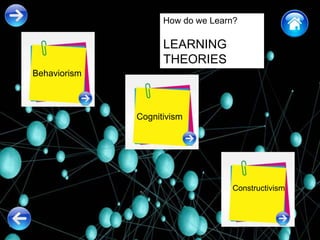
How do we Learn?
LEARNING
THEORIES
Behaviorism
Cognitivism
Constructivism
Behaviorism
Theory of animal and human learning that
focuses on objectively observable behaviors
and discount mental abilities.
1. Classical Conditioning
2. Behavioral Operant Conditioning
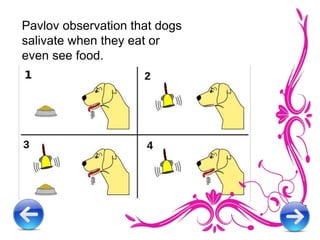
Pavlov observation that dogs
salivate when they eat or
even see food.
The following are relevant
educational technology which
can be used:
•Observation of learners
•Selecting stimulus
•Can help elicit the outcomes
•Can be used in behavioral
approaches
•Technology to promote
motivation, classroom
management, and special
education
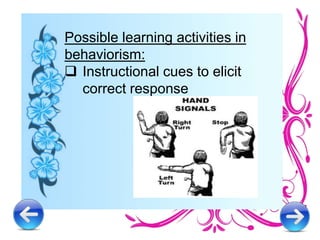
Possible learning activities in
behaviorism:
 Instructional cues to elicit
correct response
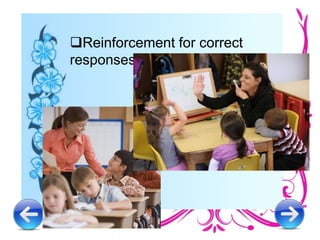
Reinforcement for correct
responses.
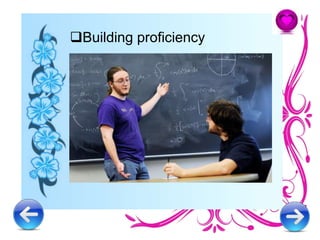
Building proficiency
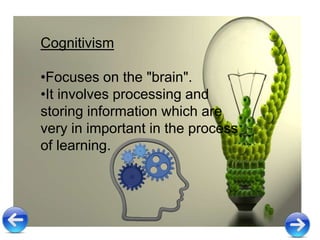
Cognitivism
•Focuses on the "brain".
•It involves processing and
storing information which are
very in important in the process
of learning.
Relevance of Cognitivism to
Educational Technology
•Conduct task analysis and
learner analysis.
•Creates tests
•Create learning materials
according to any of the
Instructional Design Models.
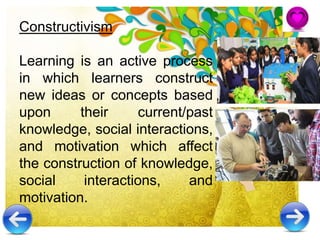
Constructivism
Learning is an active process
in which learners construct
new ideas or concepts based
upon their current/past
knowledge, social interactions,
and motivation which affect
the construction of knowledge,
social interactions, and
motivation.
TECHNOLOGY
UTILIZATION
1 2
3 4
Principles of Effective Instruction
As educators, it is important to consider
how to engage learners in their.
•Assess prior knowledge
•Consider individual differences
•State the objective
•Develop metacognitive skills
•Provide social interaction
Principles of Effective Instruction
•Incorporate realistic contexts
•Engage students in relevant practice
•Offer frequent, timely, and
constructive feedback
Principles of Effective Technology
Utilization
•Teachers are expected to be competent in the
use of technology in their teaching.
•As a teacher, you will be expected to enhance
students abilities to engage in the use of
technology to support their learning.
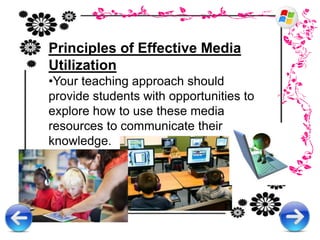
Principles of Effective Media
Utilization
•Your teaching approach should
provide students with opportunities to
explore how to use these media
resources to communicate their
knowledge.
Principles of Effective Text utilization
•Text is everywhere in students learning.
Designing good text-based materials involves
a few basic elements:
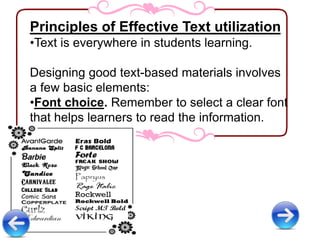
•Font choice. Remember to select a clear font
that helps learners to read the information.
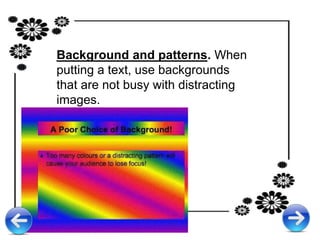
Background and patterns. When
putting a text, use backgrounds
that are not busy with distracting
images.
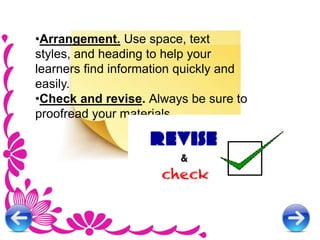
•Arrangement. Use space, text
styles, and heading to help your
learners find information quickly and
easily.
•Check and revise. Always be sure to
proofread your materials.
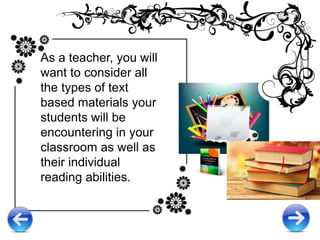
As a teacher, you will
want to consider all
the types of text
based materials your
students will be
encountering in your
classroom as well as
their individual
reading abilities.
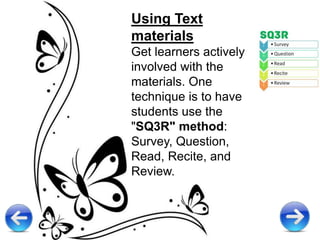
Using Text
materials
Get learners actively
involved with the
materials. One
technique is to have
students use the
"SQ3R" method:
Survey, Question,
Read, Recite, and
Review.
Chapter 5: Learning theories related to educationa Technology

Chapter 5: Learning theories related to educationa Technology

  • 1.
    LEARNING THEORIES RELATED TOEDUCATIONAL TECHNOLOGY Presented by: Osorio, Christine S. Bsed-Physics3 Instructor: Sir James Paglinawan PhD. School: Central Mindanao University
  • 2.
    What is learning? How do welearn? Technology Utilization
  • 3.
    What is Learning? Itis a process of acquiring, remembering, and applying skills, knowledge, attitudes and other modes of response. It involves relatively permanent change in behavior or knowledge as a result of an experience or practice.
  • 4.
    How do weLearn? LEARNING THEORIES Behaviorism Cognitivism Constructivism
  • 5.
    Behaviorism Theory of animaland human learning that focuses on objectively observable behaviors and discount mental abilities. 1. Classical Conditioning 2. Behavioral Operant Conditioning
  • 6.
    Pavlov observation thatdogs salivate when they eat or even see food.
  • 8.
    The following arerelevant educational technology which can be used: •Observation of learners •Selecting stimulus •Can help elicit the outcomes
  • 9.
    •Can be usedin behavioral approaches •Technology to promote motivation, classroom management, and special education
  • 10.
    Possible learning activitiesin behaviorism:  Instructional cues to elicit correct response
  • 11.
  • 12.
  • 13.
    Cognitivism •Focuses on the"brain". •It involves processing and storing information which are very in important in the process of learning.
  • 14.
    Relevance of Cognitivismto Educational Technology •Conduct task analysis and learner analysis. •Creates tests •Create learning materials according to any of the Instructional Design Models.
  • 15.
    Constructivism Learning is anactive process in which learners construct new ideas or concepts based upon their current/past knowledge, social interactions, and motivation which affect the construction of knowledge, social interactions, and motivation.
  • 16.
  • 17.
    Principles of EffectiveInstruction As educators, it is important to consider how to engage learners in their. •Assess prior knowledge •Consider individual differences •State the objective •Develop metacognitive skills •Provide social interaction
  • 18.
    Principles of EffectiveInstruction •Incorporate realistic contexts •Engage students in relevant practice •Offer frequent, timely, and constructive feedback
  • 19.
    Principles of EffectiveTechnology Utilization •Teachers are expected to be competent in the use of technology in their teaching. •As a teacher, you will be expected to enhance students abilities to engage in the use of technology to support their learning.
  • 20.
    Principles of EffectiveMedia Utilization •Your teaching approach should provide students with opportunities to explore how to use these media resources to communicate their knowledge.
  • 21.
    Principles of EffectiveText utilization •Text is everywhere in students learning. Designing good text-based materials involves a few basic elements: •Font choice. Remember to select a clear font that helps learners to read the information.
  • 22.
    Background and patterns.When putting a text, use backgrounds that are not busy with distracting images.
  • 23.
    •Arrangement. Use space,text styles, and heading to help your learners find information quickly and easily. •Check and revise. Always be sure to proofread your materials.
  • 24.
    As a teacher,you will want to consider all the types of text based materials your students will be encountering in your classroom as well as their individual reading abilities.
  • 25.
    Using Text materials Get learnersactively involved with the materials. One technique is to have students use the "SQ3R" method: Survey, Question, Read, Recite, and Review.