Relational
Databab
Chapter 4
Reporters:
Montejo, Lyn
Decendario, Jemalyn
Padulla, Daniela
Demetillo, Mary Gold
Database and Files
File Systems
 Store data over long periods of time
 Store large amounts of data
Drawbacks of using file systems :
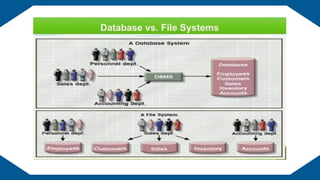
"Islands of data" in scattered file systems
Duplication
Inconsistency
Rigidity
EDUCATION BACKGROUND
Data
 Known facts that can be recorded and have an implicit
meaning.
Database
 A collection of very large, related data.
Database Management System (DBMS)
 serves as the interface between the database and the
various application programs.
 it is a system software that allows users to efficiently
define, create, maintain, and share databases.
EDUCATION BACKGROUND
Advantages of database over file system
 Efficiency
 Minimal Data Redundancy
 Data Integration
 Data Sharing
 Better Controls
 Reduce Maintenance
EDUCATION BACKGROUND
There are some basic principles about how data are
stored in computer systems :
 An entity is anything about which the organization wishes
to store data. At a college or university, one entity would
be the student.
 Information about the attributes of an entity (e.g., the
student's ID number and birth date) are stored in fields.
 All the fields containing data about one entity (e.g., one
student) form a record.
 A set of all related records forms a file (e.g., the student
file).
 A set of interrelated, centrally coordinated files forms a
database.
EDUCATION BACKGROUND
Database System
 The combination of the database, the DBMS, and the
application programs that access the database
Data Administrator
 person responsible for the database or the design,
implementation, repair and security of a firm's database.
Data Warehouse
 collecting and managing data from varied sources to
provide meaningful business insights.
EDUCATION BACKGROUND
Database technology
 provides many benefits to organizations, including data
integration, data sharing, reporting flexibility, minimal data
redundancy and inconsistencies, data independence, central
management of data, and cross-functional analysis.
EDUCATION BACKGROUND
DATABASE SYSTEMS
A set of interrelated, centrally coordinated files forms a database.
Database systems were developed to address the problems associated
with the proliferation of master files.
A schema describes the logical structure of a database.
There are three levels of schema
DATABASE SYSTEMS
Conceptual level
 The organization-wide view of the entire database the big picture.
Lists all data elements and the relationships between them.
External level
 A set of individual user views of portions of the database,8 how each
user sees the portion of the system with which he interacts. These
individual views are referred to as subschema.
DATABASE SYSTEMS
Internal level
 A low-level view of the database. It describes how the data are
stored and accessed, including record layouts, definitions,
addresses, and indexes
A database management system (DBMS) serves as the interface
between the database and the various application programs.
A key component of a DBMS is the data dictionary. The data dictionary
contains information about the structure of the database.
DATABASE SYSTEMS
DBMS Languages Every DBMS must provide a means of performing
the three basic functions of creating a database, changing a database,
and querying a database.
The set of commands used to create the database is known as data
definition language (DDL). DDL is used to build the data dictionary,
initialize or create the database, describe the logical views for each
individual user or programmer, and specify any limitations or
constraints on security imposed on database records or fields.
DATABASE SYSTEMS
The set of commands used to change the database is known as data
manipulation language (DML). DML is used for maintaining the data,
including updating data, inserting data, and deleting portions of the
database
The set of commands used to query the database is known as data
query language (DQL)
Many DBMS packages also include a report writer, a language that
simplifies the creation of reports
RELATIONAL DATABASES
 A DBMS is characterized by the type of logical data model on which it is
based. A data model is an abstract representation of the contents of a
database.
 Most new DBMSs are called relational databases because they use the
relational model, which represents everything in the database as being
stored in the form of tables (aka, relations). This model only describes
how the data appear in the conceptual- and external-level schema.
The data are physically stored according to the description in the
internal-level schema.
 Each row in a relation is called a tuple (rhymes with “couple”). Each row
contains data about a specific occurrence of the type of entity in the
table.
 Each column in a table contains information about a specific attribute
of the entity.
RELATIONAL DATABASES
 A primary key is the attribute or combination of attributes that
uniquely identifies a specific row in a table. In some tables, two or
more attributes may be joined to form the primary key.
 A foreign key is an attribute in one table that is a primary key in
another table. Foreign keys are used to link tables together.
 Other non-key attributes in a table store important information about
the entity.
 One possible alternate approach to the relational model would be to
store all data in one uniform table.
RELATIONAL DATABASES
 A primary key is the attribute or combination of attributes that
uniquely identifies a specific row in a table. In some tables, two or
more attributes may be joined to form the primary key.
 A foreign key is an attribute in one table that is a primary key in
another table. Foreign keys are used to link tables together.
 Other non-key attributes in a table store important information about
the entity.
 One possible alternate approach to the relational model would be to
store all data in one uniform table.
RELATIONAL DATABASES
Update anomaly
 a number of problems arise. Suppose Alice Simpson changes her
phone number. You need to make the change in three places. If you
fail to change it in all three places or change it incorrectly in one place,
then the records for Alice will be inconsistent.
Insert anomaly
 If you need to add a new student but he hasn’t signed up for any
courses yet, you cannot create a complete record. The same is true if
there is a new class to add, but there are no students enrolled in it yet.
RELATIONAL DATABASES
Update anomaly
 a number of problems arise. Suppose Alice Simpson changes her
phone number. You need to make the change in three places. If you
fail to change it in all three places or change it incorrectly in one place,
then the records for Alice will be inconsistent.
Insert anomaly
 If you need to add a new student but he hasn’t signed up for any
courses yet, you cannot create a complete record. The same is true if
there is a new class to add, but there are no students enrolled in it yet.
RELATIONAL DATABASES
Delete anomaly
If Ned withdraws from all his classes and you eliminate all three of his
rows from the table, then you will no longer have a record of Ned. If Ned
is planning to take classes next semester, then you probably didn’t really
want to delete all records of him.
RELATIONAL DATABASES
Another alternate approach would be to store each student in one row of
the table and create multiple columns to accommodate each class that
he is taking. This approach is also fraught with problems:
 How many classes should you allow for in building the table?
 There would be a great deal of wasted space for all the students taking
fewer than the maximum possible number of classes.
 f you wanted a list of every student taking a particular class, you would
have to search multiple attributes.
The solution to the preceding problems is to use a set of tables in a
relational database. Each entity is stored in a separate table, and
separate tables or foreign keys are used to link the entities together.
FOLLOWERS
Requirements of relation database
 Every column in a row must be single-valued.
 The primary key cannot be null (entity integrity rule).
 A foreign key must either be null or correspond to the
value of a primary key in another table (referential
integrity rule).
 All non-key attributes in a table should describe a
characteristic of the object identified by the primary
FOLLOWERS
Benefits of Meeting Basic Requirements
 Produces a well-structured (normalized) database with
consistent data and minimized redundancy.
 Attributes appear multiple times only when functioning
as foreign keys.
 Easier to add new data to the system without insert
anomalies.
 Space is used more efficiently.
FOLLOWERS
Deletion Anomaly Avoidance
 Deleting a class for a student doesn't eliminate the
student or class record from their respective tables.
FOLLOWERS
Two Basic Ways to Design Relational Databases
Normalization
 Starts with one large table and follows rules to
decompose it into normalized tables.
Objective
 Produce tables in third-normal form( 3NF) to avoid
update, insert, and delete anomalies.
FOLLOWERS
 Semantic Data Modeling: Uses knowledge about
business processes and information needs.
 Facilitates efficient design of transaction processing
databases.
 Advantages:
(1) Utilizes business process knowledge,
(2)A graphical model represents organization policies and
facilitates communication.
FOLLOWERS
Creating Relational Database Queries
 Databases store data for people and organizations.
 Query databases and tables to retrieve data.
 Example: Microsoft Access queries.
FOLLOWERS
Impact of Database Systems on Accounting
 May lead to the abandonment of double-entry
accounting.
 Alter the nature of external reporting.
 Enhance decision-making with powerful querying
capabilities.
 Integrate financial and operational data.
 Accountants must become knowledgeable about
databases to develop AIS and ensure data reliability.
THANK YOU

Accounting Information System Related Data.pptx

  • 1.
    Relational Databab Chapter 4 Reporters: Montejo, Lyn Decendario,Jemalyn Padulla, Daniela Demetillo, Mary Gold
  • 2.
    Database and Files FileSystems  Store data over long periods of time  Store large amounts of data Drawbacks of using file systems : "Islands of data" in scattered file systems Duplication Inconsistency Rigidity
  • 3.
    EDUCATION BACKGROUND Data  Knownfacts that can be recorded and have an implicit meaning. Database  A collection of very large, related data. Database Management System (DBMS)  serves as the interface between the database and the various application programs.  it is a system software that allows users to efficiently define, create, maintain, and share databases.
  • 4.
    EDUCATION BACKGROUND Advantages ofdatabase over file system  Efficiency  Minimal Data Redundancy  Data Integration  Data Sharing  Better Controls  Reduce Maintenance
  • 5.
    EDUCATION BACKGROUND There aresome basic principles about how data are stored in computer systems :  An entity is anything about which the organization wishes to store data. At a college or university, one entity would be the student.  Information about the attributes of an entity (e.g., the student's ID number and birth date) are stored in fields.  All the fields containing data about one entity (e.g., one student) form a record.  A set of all related records forms a file (e.g., the student file).  A set of interrelated, centrally coordinated files forms a database.
  • 6.
    EDUCATION BACKGROUND Database System The combination of the database, the DBMS, and the application programs that access the database Data Administrator  person responsible for the database or the design, implementation, repair and security of a firm's database. Data Warehouse  collecting and managing data from varied sources to provide meaningful business insights.
  • 7.
    EDUCATION BACKGROUND Database technology provides many benefits to organizations, including data integration, data sharing, reporting flexibility, minimal data redundancy and inconsistencies, data independence, central management of data, and cross-functional analysis.
  • 8.
  • 9.
    DATABASE SYSTEMS A setof interrelated, centrally coordinated files forms a database. Database systems were developed to address the problems associated with the proliferation of master files. A schema describes the logical structure of a database. There are three levels of schema
  • 10.
    DATABASE SYSTEMS Conceptual level The organization-wide view of the entire database the big picture. Lists all data elements and the relationships between them. External level  A set of individual user views of portions of the database,8 how each user sees the portion of the system with which he interacts. These individual views are referred to as subschema.
  • 11.
    DATABASE SYSTEMS Internal level A low-level view of the database. It describes how the data are stored and accessed, including record layouts, definitions, addresses, and indexes A database management system (DBMS) serves as the interface between the database and the various application programs. A key component of a DBMS is the data dictionary. The data dictionary contains information about the structure of the database.
  • 12.
    DATABASE SYSTEMS DBMS LanguagesEvery DBMS must provide a means of performing the three basic functions of creating a database, changing a database, and querying a database. The set of commands used to create the database is known as data definition language (DDL). DDL is used to build the data dictionary, initialize or create the database, describe the logical views for each individual user or programmer, and specify any limitations or constraints on security imposed on database records or fields.
  • 13.
    DATABASE SYSTEMS The setof commands used to change the database is known as data manipulation language (DML). DML is used for maintaining the data, including updating data, inserting data, and deleting portions of the database The set of commands used to query the database is known as data query language (DQL) Many DBMS packages also include a report writer, a language that simplifies the creation of reports
  • 14.
    RELATIONAL DATABASES  ADBMS is characterized by the type of logical data model on which it is based. A data model is an abstract representation of the contents of a database.  Most new DBMSs are called relational databases because they use the relational model, which represents everything in the database as being stored in the form of tables (aka, relations). This model only describes how the data appear in the conceptual- and external-level schema. The data are physically stored according to the description in the internal-level schema.  Each row in a relation is called a tuple (rhymes with “couple”). Each row contains data about a specific occurrence of the type of entity in the table.  Each column in a table contains information about a specific attribute of the entity.
  • 15.
    RELATIONAL DATABASES  Aprimary key is the attribute or combination of attributes that uniquely identifies a specific row in a table. In some tables, two or more attributes may be joined to form the primary key.  A foreign key is an attribute in one table that is a primary key in another table. Foreign keys are used to link tables together.  Other non-key attributes in a table store important information about the entity.  One possible alternate approach to the relational model would be to store all data in one uniform table.
  • 16.
    RELATIONAL DATABASES  Aprimary key is the attribute or combination of attributes that uniquely identifies a specific row in a table. In some tables, two or more attributes may be joined to form the primary key.  A foreign key is an attribute in one table that is a primary key in another table. Foreign keys are used to link tables together.  Other non-key attributes in a table store important information about the entity.  One possible alternate approach to the relational model would be to store all data in one uniform table.
  • 17.
    RELATIONAL DATABASES Update anomaly a number of problems arise. Suppose Alice Simpson changes her phone number. You need to make the change in three places. If you fail to change it in all three places or change it incorrectly in one place, then the records for Alice will be inconsistent. Insert anomaly  If you need to add a new student but he hasn’t signed up for any courses yet, you cannot create a complete record. The same is true if there is a new class to add, but there are no students enrolled in it yet.
  • 18.
    RELATIONAL DATABASES Update anomaly a number of problems arise. Suppose Alice Simpson changes her phone number. You need to make the change in three places. If you fail to change it in all three places or change it incorrectly in one place, then the records for Alice will be inconsistent. Insert anomaly  If you need to add a new student but he hasn’t signed up for any courses yet, you cannot create a complete record. The same is true if there is a new class to add, but there are no students enrolled in it yet.
  • 19.
    RELATIONAL DATABASES Delete anomaly IfNed withdraws from all his classes and you eliminate all three of his rows from the table, then you will no longer have a record of Ned. If Ned is planning to take classes next semester, then you probably didn’t really want to delete all records of him.
  • 20.
    RELATIONAL DATABASES Another alternateapproach would be to store each student in one row of the table and create multiple columns to accommodate each class that he is taking. This approach is also fraught with problems:  How many classes should you allow for in building the table?  There would be a great deal of wasted space for all the students taking fewer than the maximum possible number of classes.  f you wanted a list of every student taking a particular class, you would have to search multiple attributes. The solution to the preceding problems is to use a set of tables in a relational database. Each entity is stored in a separate table, and separate tables or foreign keys are used to link the entities together.
  • 21.
    FOLLOWERS Requirements of relationdatabase  Every column in a row must be single-valued.  The primary key cannot be null (entity integrity rule).  A foreign key must either be null or correspond to the value of a primary key in another table (referential integrity rule).  All non-key attributes in a table should describe a characteristic of the object identified by the primary
  • 22.
    FOLLOWERS Benefits of MeetingBasic Requirements  Produces a well-structured (normalized) database with consistent data and minimized redundancy.  Attributes appear multiple times only when functioning as foreign keys.  Easier to add new data to the system without insert anomalies.  Space is used more efficiently.
  • 23.
    FOLLOWERS Deletion Anomaly Avoidance Deleting a class for a student doesn't eliminate the student or class record from their respective tables.
  • 24.
    FOLLOWERS Two Basic Waysto Design Relational Databases Normalization  Starts with one large table and follows rules to decompose it into normalized tables. Objective  Produce tables in third-normal form( 3NF) to avoid update, insert, and delete anomalies.
  • 25.
    FOLLOWERS  Semantic DataModeling: Uses knowledge about business processes and information needs.  Facilitates efficient design of transaction processing databases.  Advantages: (1) Utilizes business process knowledge, (2)A graphical model represents organization policies and facilitates communication.
  • 26.
    FOLLOWERS Creating Relational DatabaseQueries  Databases store data for people and organizations.  Query databases and tables to retrieve data.  Example: Microsoft Access queries.
  • 27.
    FOLLOWERS Impact of DatabaseSystems on Accounting  May lead to the abandonment of double-entry accounting.  Alter the nature of external reporting.  Enhance decision-making with powerful querying capabilities.  Integrate financial and operational data.  Accountants must become knowledgeable about databases to develop AIS and ensure data reliability.
  • 28.