


PURANDARE’S CERVICOPEXY
Dr. Niranjan Chavan
MD, FCPS, DGO, DFP, MICOG, DICOG, FICOG
Professor and Unit Chief, L.T.M.M.C & L.T.M.G.H
Chairperson, FOGSI Oncology and TT Committee (2012-2014)
Treasurer, MOGS (2017- 2018)
Chair and Convener, FOGSI Cell- Violence against Doctors (2015-2016)
Chief Editor, AFG Times (2015-2017)
Editorial Board, European Journal of Gynecologic Oncology
Editor of FOGSI FOCUS, MOGS, AFG & IAGE Newsletters
Member, Managing Committee, IAGE (2013-2017)
Member , Oncology Committee, AOFOG (2013 -2015)
Recipient of 6 National & International Awards
Author of 15 Research Papers and 19 Scientific Chapters
Course Co-Ordinator, of 11 batches, of MUHS recognized Certificate Course of
Basic Infertility Management Including Endoscopy (BIMIE) at LTMGH
HISTORY
Dr B. N. Purandare was an illustrious
son of an illustrious father. He graduated
from The Seth G S Medical College and
KEM Hospital with flying colours. He
went on to London and Edinburgh to
train in surgery and gynecology after
medical education in India, and became
Fellow, Royal College of surgeons.
HISTORY
• A premier vaginal surgeon with excellent skills, he
devised the ABDOMINAL CERVICOPEXY
operation for prolapse which revolutionized the
conservative surgeries for prolapsed and the
surgery is named after him.
• It is widely performed even today.
• His special interests included performing Vaginal
hysterectomy, Vaginal sterilization, Schauta’s
operation, Abdominal cervicopexy, and Tubal
recanalisation, where he has left his mark on these
surgeries.
INTRODUCTION
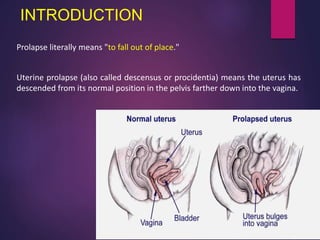
Prolapse literally means "to fall out of place."
Uterine prolapse (also called descensus or procidentia) means the uterus has
descended from its normal position in the pelvis farther down into the vagina.
EPIDEMIOLOGY
• The global prevalence of genital prolapse is 2 to 20 %
under 45 years of age.
• In India, more than 1 million of women suffer from
genital prolapse and majority of them falls under the
reproductive age group.
• It is estimated that about half of the women loss their
pelvic floor support and result in some degree of
prolapse and among them only 10- 20 % seek
treatment for the problem.
• 11% life time risk of surgery for prolapse.
• Incidence of Nulliparous Prolapse 2-5%.
Bang RA, Bang AT, Baitule M, Choudhary Y, Sarmukaddam S, Tale O. High prevalence of
gynaecological diseases in rural Indian women. Lancet 14;1(8629):85-8.
EPIDEMIOLOGY
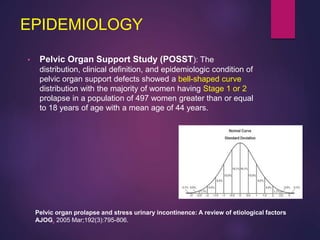
• Pelvic Organ Support Study (POSST): The
distribution, clinical definition, and epidemiologic condition of
pelvic organ support defects showed a bell-shaped curve
distribution with the majority of women having Stage 1 or 2
prolapse in a population of 497 women greater than or equal
to 18 years of age with a mean age of 44 years.
Pelvic organ prolapse and stress urinary incontinence: A review of etiological factors
AJOG. 2005 Mar;192(3):795-806.
ETIOLOGY
• Stretching and tearing of the endopelvic fascia and the levator
muscles and perineal bodyduring difficult childbirth.
• Multiparous women
• Genital atrophy
• Hypoestrogenism
• Pelvic tumors
• Sacral nerve disorders
• Diabetic neuropathy
• Medical conditions associated with increases in intra-abdominal
pressure (eg, obesity, chronic pulmonary disease, smoking,
constipation)
• Certain rare abnormalities in connective tissue (collagen), such as
Marfan disease
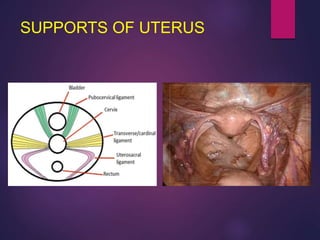
SUPPORTS OF UTERUS
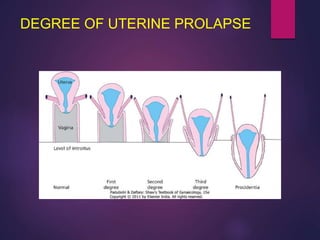
DEGREE OF UTERINE PROLAPSE
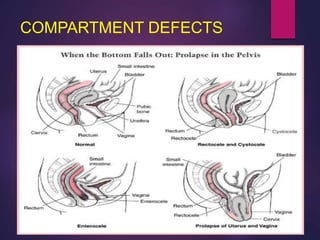
COMPARTMENT DEFECTS
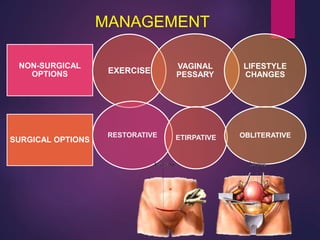
MANAGEMENT
NON-SURGICAL
OPTIONS
SURGICAL OPTIONS
EXERCISE
VAGINAL
PESSARY
LIFESTYLE
CHANGES
RESTORATIVE ETIRPATIVE OBLITERATIVE
AIM OF RESTORATIVE SURGERIES
Restorative surgeries play a definitive role:
• To relieve the symptoms
• To restore the anatomy to normal
• To restore the functions to normal
• To prevent recurrence in future
• To maintain child bearing potential
• To maintain menstrual function
RESTORATIVE SURGERIES
• COLPORRHAPHY ( ANTERIOR/ POSTERIOR)
• FOTHERGILL’S REPAIR (MANCHESTER OPERATION)
• SHIRODKAR’S PROCEDURE
• ABDOMINAL SLING OPERATION
• A) ABDOMINOCERVICOPEXY
PURANDARE’S CERVICOPEXY
• B) SHIRODKAR’S ABDOMINAL SLING OPERATION
• C) KHANNA’S ABDOMINAL SLING OPERATION
D) VIRKUD’S COMPOSITE SLING
E)OTHERS [ SOONAWALA/ VIVEK JOSHI’S ]
• LAPAROSCOPIC SLING SURGERY
PRINCIPLE OF PURANDARE’S
CERVICOPEXY
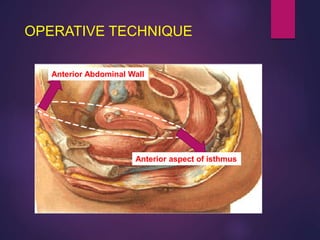
The objective of this operation is to buttress the
weakened supports ( Mackenrodt’s and Uterosacral
ligaments) of the uterus by providing a substitute in the
form of Mersiline tape , used as slings to support the
uterus and anchor it to the anterior abdominal wall.
INDICATIONS
CONTRAINDICATIONS
• Pregnancy
• Poor abdominal wall tone
• Suspected malignancy of lower genital tract
• Nulliparous prolapse
• Second and third degree prolapse with no or minimal
cystocele and/or rectocele and no supravaginal elongation
of cervix.
• Woman desirous of child bearing.
PREOPERATIVE REQUISITES
• Good abdominal muscle tone
• Exfoliative cytology of the cervix to rule out cervical
neoplasia
• At least 6 weeks since last delivery or abortion if any
OPERATIVE POSITION : Supine
Anterior Abdominal Wall
Anterior aspect of isthmus
OPERATIVE TECHNIQUE
STEPS
Opening of the abdominal wall through
a low transverse supra pubic incision
deepened down up to the rectus
sheath
Two musculofascial slings are elevated
from the midline outwards and laterally
up to the lateral border of the rectus
abdominus muscle on either side
The peritoneum is opened in the mid
line , and the uterus brought up into
view.Uterus held with Uterus holding
forceps
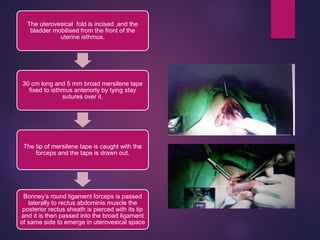
The uterovesical fold is incised ,and the
bladder mobilised from the front of the
uterine isthmus.
30 cm long and 5 mm broad mersilene tape
fixed to isthmus anteriorly by tying stay
sutures over it.
The tip of mersilene tape is caught with the
forceps and the tape is drawn out.
Bonney’s round ligament forceps is passed
laterally to rectus abdominis muscle the
posterior rectus sheath is pierced with its tip
and it is then passed into the broad ligament
of same side to emerge in uterovesical space
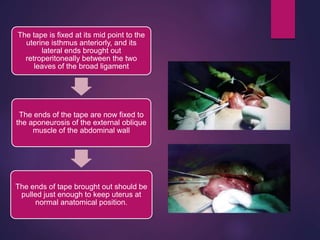
The tape is fixed at its mid point to the
uterine isthmus anteriorly, and its
lateral ends brought out
retroperitoneally between the two
leaves of the broad ligament
The ends of the tape are now fixed to
the aponeurosis of the external oblique
muscle of the abdominal wall
The ends of tape brought out should be
pulled just enough to keep uterus at
normal anatomical position.
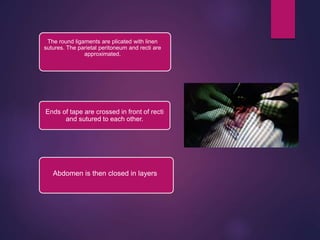
The round ligaments are plicated with linen
sutures. The parietal peritoneum and recti are
approximated.
Ends of tape are crossed in front of recti
and sutured to each other.
Abdomen is then closed in layers
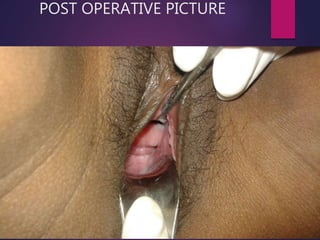
POST OPERATIVE PICTURE
POST-OPERATIVE CARE
• Parental fluids until bowel sounds return.
• Early oral fluids are now advocated.
• Antibiotics, sedatives, metronidazole for 24 hours IV.
• Indwelling catheter for 48 hours.
• Early ambulation
• DVT prophylaxis
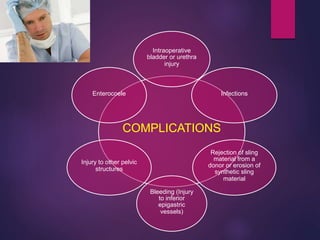
COMPLICATIONS
Intraoperative
bladder or urethra
injury
Infections
Rejection of sling
material from a
donor or erosion of
synthetic sling
material
Bleeding (Injury
to inferior
epigastric
vessels)
Injury to other pelvic
structures
Enterocoele
ADVANTAGES
• Technically easy to perform
• Provides dynamic support to uterus
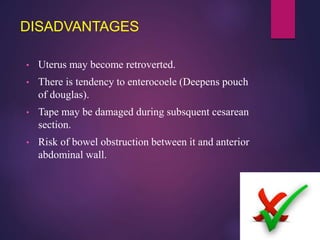
DISADVANTAGES
• Uterus may become retroverted.
• There is tendency to enterocoele (Deepens pouch
of douglas).
• Tape may be damaged during subsquent cesarean
section.
• Risk of bowel obstruction between it and anterior
abdominal wall.
STUDIES
Anterior abdominal wall cervicopexy for treatment of stage
III and stage IV uterine prolapse :2010
Among 37 patients, AWC was performed in 21 women with stage III and
16 women with stage IV uterine prolapse. Overcorrection was observed
in 3 women. Postoperatively, 2 women experienced febrile morbidity and
5 had urinary retention. Thirteen women complained of urinary
frequency, but all reported improvement at 3-month follow up. Among 24
women who became pregnant, 14 delivered vaginally, 5 delivered by
cesarean, and 5 had an ongoing pregnancy. Four recurrences occurred:
2 stage II and 2 stage III prolapses. Three of these women had
delivered by cesarean, while the fourth recurrence occurred after the
patient's third vaginal birth. AWC is a simple and effective procedure to
treat stage II and stage III uterine prolapse. However, some surgical
modifications and more studies are required to ascertain its validity.
International journal of gynaecology and obstetrics: the official organ of the International Federation of
Gynaecology and Obstetrics 2010
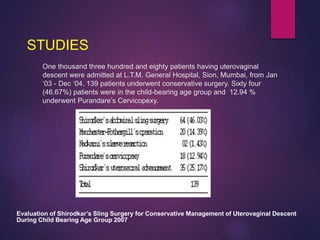
One thousand three hundred and eighty patients having uterovaginal
descent were admitted at L.T.M. General Hospital, Sion, Mumbai, from Jan
‘03 - Dec ‘04. 139 patients underwent conservative surgery. Sixty four
(46.67%) patients were in the child-bearing age group and 12.94 %
underwent Purandare’s Cervicopexy.
STUDIES
Evaluation of Shirodkar’s Sling Surgery for Conservative Management of Uterovaginal Descent
During Child Bearing Age Group 2007
STUDIES
POP being the most common indication for benign
gynecological surgery could be due to higher number of
unsupervised home conducted vaginal births with tendency for
premature bearing down during labor in rural and tribal
populations. Majority of the surgeries were done abdominally.
Younger women in third decade of life were mostly offered
conservative approach of Fothergill's operation and Purandare's
cervicopexy. A total of 287 (31%) women had pelvic organ
prolapse (POP); VH was done in 267, Fothergill's repair in 14
and Purandare's cervicopexy in 6.
Gynecological diseases in rural India: A critical appraisal of indications and route of surgery
along with histopathology correlation of 922 women undergoing major gynecological surgeryJ
Midlife Health. 2014 Apr-Jun
Purandares cervicopexy

Purandares cervicopexy

  • 1.
  • 2.
    Dr. Niranjan Chavan MD,FCPS, DGO, DFP, MICOG, DICOG, FICOG Professor and Unit Chief, L.T.M.M.C & L.T.M.G.H Chairperson, FOGSI Oncology and TT Committee (2012-2014) Treasurer, MOGS (2017- 2018) Chair and Convener, FOGSI Cell- Violence against Doctors (2015-2016) Chief Editor, AFG Times (2015-2017) Editorial Board, European Journal of Gynecologic Oncology Editor of FOGSI FOCUS, MOGS, AFG & IAGE Newsletters Member, Managing Committee, IAGE (2013-2017) Member , Oncology Committee, AOFOG (2013 -2015) Recipient of 6 National & International Awards Author of 15 Research Papers and 19 Scientific Chapters Course Co-Ordinator, of 11 batches, of MUHS recognized Certificate Course of Basic Infertility Management Including Endoscopy (BIMIE) at LTMGH
  • 3.
    HISTORY Dr B. N.Purandare was an illustrious son of an illustrious father. He graduated from The Seth G S Medical College and KEM Hospital with flying colours. He went on to London and Edinburgh to train in surgery and gynecology after medical education in India, and became Fellow, Royal College of surgeons.
  • 4.
    HISTORY • A premiervaginal surgeon with excellent skills, he devised the ABDOMINAL CERVICOPEXY operation for prolapse which revolutionized the conservative surgeries for prolapsed and the surgery is named after him. • It is widely performed even today. • His special interests included performing Vaginal hysterectomy, Vaginal sterilization, Schauta’s operation, Abdominal cervicopexy, and Tubal recanalisation, where he has left his mark on these surgeries.
  • 5.
    INTRODUCTION Prolapse literally means"to fall out of place." Uterine prolapse (also called descensus or procidentia) means the uterus has descended from its normal position in the pelvis farther down into the vagina.
  • 6.
    EPIDEMIOLOGY • The globalprevalence of genital prolapse is 2 to 20 % under 45 years of age. • In India, more than 1 million of women suffer from genital prolapse and majority of them falls under the reproductive age group. • It is estimated that about half of the women loss their pelvic floor support and result in some degree of prolapse and among them only 10- 20 % seek treatment for the problem. • 11% life time risk of surgery for prolapse. • Incidence of Nulliparous Prolapse 2-5%. Bang RA, Bang AT, Baitule M, Choudhary Y, Sarmukaddam S, Tale O. High prevalence of gynaecological diseases in rural Indian women. Lancet 14;1(8629):85-8.
  • 7.
    EPIDEMIOLOGY • Pelvic OrganSupport Study (POSST): The distribution, clinical definition, and epidemiologic condition of pelvic organ support defects showed a bell-shaped curve distribution with the majority of women having Stage 1 or 2 prolapse in a population of 497 women greater than or equal to 18 years of age with a mean age of 44 years. Pelvic organ prolapse and stress urinary incontinence: A review of etiological factors AJOG. 2005 Mar;192(3):795-806.
  • 8.
    ETIOLOGY • Stretching andtearing of the endopelvic fascia and the levator muscles and perineal bodyduring difficult childbirth. • Multiparous women • Genital atrophy • Hypoestrogenism • Pelvic tumors • Sacral nerve disorders • Diabetic neuropathy • Medical conditions associated with increases in intra-abdominal pressure (eg, obesity, chronic pulmonary disease, smoking, constipation) • Certain rare abnormalities in connective tissue (collagen), such as Marfan disease
  • 9.
  • 10.
  • 11.
  • 12.
  • 13.
    AIM OF RESTORATIVESURGERIES Restorative surgeries play a definitive role: • To relieve the symptoms • To restore the anatomy to normal • To restore the functions to normal • To prevent recurrence in future • To maintain child bearing potential • To maintain menstrual function
  • 14.
    RESTORATIVE SURGERIES • COLPORRHAPHY( ANTERIOR/ POSTERIOR) • FOTHERGILL’S REPAIR (MANCHESTER OPERATION) • SHIRODKAR’S PROCEDURE • ABDOMINAL SLING OPERATION • A) ABDOMINOCERVICOPEXY PURANDARE’S CERVICOPEXY • B) SHIRODKAR’S ABDOMINAL SLING OPERATION • C) KHANNA’S ABDOMINAL SLING OPERATION D) VIRKUD’S COMPOSITE SLING E)OTHERS [ SOONAWALA/ VIVEK JOSHI’S ] • LAPAROSCOPIC SLING SURGERY
  • 15.
    PRINCIPLE OF PURANDARE’S CERVICOPEXY Theobjective of this operation is to buttress the weakened supports ( Mackenrodt’s and Uterosacral ligaments) of the uterus by providing a substitute in the form of Mersiline tape , used as slings to support the uterus and anchor it to the anterior abdominal wall.
  • 16.
    INDICATIONS CONTRAINDICATIONS • Pregnancy • Poorabdominal wall tone • Suspected malignancy of lower genital tract • Nulliparous prolapse • Second and third degree prolapse with no or minimal cystocele and/or rectocele and no supravaginal elongation of cervix. • Woman desirous of child bearing.
  • 17.
    PREOPERATIVE REQUISITES • Goodabdominal muscle tone • Exfoliative cytology of the cervix to rule out cervical neoplasia • At least 6 weeks since last delivery or abortion if any OPERATIVE POSITION : Supine
  • 18.
    Anterior Abdominal Wall Anterioraspect of isthmus OPERATIVE TECHNIQUE
  • 19.
    STEPS Opening of theabdominal wall through a low transverse supra pubic incision deepened down up to the rectus sheath Two musculofascial slings are elevated from the midline outwards and laterally up to the lateral border of the rectus abdominus muscle on either side The peritoneum is opened in the mid line , and the uterus brought up into view.Uterus held with Uterus holding forceps
  • 20.
    The uterovesical foldis incised ,and the bladder mobilised from the front of the uterine isthmus. 30 cm long and 5 mm broad mersilene tape fixed to isthmus anteriorly by tying stay sutures over it. The tip of mersilene tape is caught with the forceps and the tape is drawn out. Bonney’s round ligament forceps is passed laterally to rectus abdominis muscle the posterior rectus sheath is pierced with its tip and it is then passed into the broad ligament of same side to emerge in uterovesical space
  • 21.
    The tape isfixed at its mid point to the uterine isthmus anteriorly, and its lateral ends brought out retroperitoneally between the two leaves of the broad ligament The ends of the tape are now fixed to the aponeurosis of the external oblique muscle of the abdominal wall The ends of tape brought out should be pulled just enough to keep uterus at normal anatomical position.
  • 22.
    The round ligamentsare plicated with linen sutures. The parietal peritoneum and recti are approximated. Ends of tape are crossed in front of recti and sutured to each other. Abdomen is then closed in layers
  • 23.
  • 24.
    POST-OPERATIVE CARE • Parentalfluids until bowel sounds return. • Early oral fluids are now advocated. • Antibiotics, sedatives, metronidazole for 24 hours IV. • Indwelling catheter for 48 hours. • Early ambulation • DVT prophylaxis
  • 25.
    COMPLICATIONS Intraoperative bladder or urethra injury Infections Rejectionof sling material from a donor or erosion of synthetic sling material Bleeding (Injury to inferior epigastric vessels) Injury to other pelvic structures Enterocoele
  • 26.
    ADVANTAGES • Technically easyto perform • Provides dynamic support to uterus
  • 27.
    DISADVANTAGES • Uterus maybecome retroverted. • There is tendency to enterocoele (Deepens pouch of douglas). • Tape may be damaged during subsquent cesarean section. • Risk of bowel obstruction between it and anterior abdominal wall.
  • 28.
    STUDIES Anterior abdominal wallcervicopexy for treatment of stage III and stage IV uterine prolapse :2010 Among 37 patients, AWC was performed in 21 women with stage III and 16 women with stage IV uterine prolapse. Overcorrection was observed in 3 women. Postoperatively, 2 women experienced febrile morbidity and 5 had urinary retention. Thirteen women complained of urinary frequency, but all reported improvement at 3-month follow up. Among 24 women who became pregnant, 14 delivered vaginally, 5 delivered by cesarean, and 5 had an ongoing pregnancy. Four recurrences occurred: 2 stage II and 2 stage III prolapses. Three of these women had delivered by cesarean, while the fourth recurrence occurred after the patient's third vaginal birth. AWC is a simple and effective procedure to treat stage II and stage III uterine prolapse. However, some surgical modifications and more studies are required to ascertain its validity. International journal of gynaecology and obstetrics: the official organ of the International Federation of Gynaecology and Obstetrics 2010
  • 29.
    One thousand threehundred and eighty patients having uterovaginal descent were admitted at L.T.M. General Hospital, Sion, Mumbai, from Jan ‘03 - Dec ‘04. 139 patients underwent conservative surgery. Sixty four (46.67%) patients were in the child-bearing age group and 12.94 % underwent Purandare’s Cervicopexy. STUDIES Evaluation of Shirodkar’s Sling Surgery for Conservative Management of Uterovaginal Descent During Child Bearing Age Group 2007
  • 30.
    STUDIES POP being themost common indication for benign gynecological surgery could be due to higher number of unsupervised home conducted vaginal births with tendency for premature bearing down during labor in rural and tribal populations. Majority of the surgeries were done abdominally. Younger women in third decade of life were mostly offered conservative approach of Fothergill's operation and Purandare's cervicopexy. A total of 287 (31%) women had pelvic organ prolapse (POP); VH was done in 267, Fothergill's repair in 14 and Purandare's cervicopexy in 6. Gynecological diseases in rural India: A critical appraisal of indications and route of surgery along with histopathology correlation of 922 women undergoing major gynecological surgeryJ Midlife Health. 2014 Apr-Jun