Presenter: Dr Avinash Kumar
Moderator: Dr Harish Chellani
Dr soumya tiwari
Definition
 When the external genitalia do not have the typical anatomic
appearance of normal male or female genitalia
 Most cases present in newborn period
 Social and medical emergency
When to suspect
 Micropenis: Stretched penile length<2.5cm in a term newborn
 Asymmetry of labioscrotal folds
 B/L cryptorchidism
 U/L cryptorchidism with hypospadias
 B/L testes with perineoscrotal or penoscrotal hypospadias
 Female external genitalia with clitoromegaly or inguinal hernia
 Overtly abnormal genitals like cloacal exstrophy
Disorder of Sexual Differentiation(DSD)
 Also known as disorder of sexual determination (Nelson)
 Preferred over older terminology such as ambiguous genitalia,
pseudohermaphroditism and intersex
 Atypical development of genetic, gonadal and phenotypic sex
 Includes disorders grouped under 4 major headings
 46,XX virilized female
 46,XY undervirilized male
 Gonadal differentiation and chromosomal disorders
 Syndromes associated with ambiguous genitalia
Types
46,XX virilized female
 Congenital adrenal hyperplasia
 21-hydroxylase deficiency,
 11-hydroxylase deficiency
 3 beta hydroxysteroid
dehydrogenase deficiency
 Aromatase deficiency(fetal and
maternal)
 Virilizing maternal conditions
 CAH
 Adrenal/ovarian tumors
 Drugs-progestin,androgen
46,XY undervirilized male
 Androgen insensitivity
 5 alfa reductase deficiency
 Testosterone biosynthesis defects
 Leydig cell hypoplasia
 Persistent mullerian duct
syndrome
Types
Gonadal differentiation and
chromosomsl disorders
 46,XY gonadal dysgenesis
 True hermaphorditism
Syndromes with ambigous
genitalia
 Turner
 Camptomelic dysplasia
 Denys-Drash syndrome
 Frasier syndrome
 WAGR syndrome
 Robinow syndrome
Incidence
 The exact data on the incidence and prevalence of
conditions causing ambiguous genitalia are limited
 Congenital adrenal hyperplasia accounts for most of the
cases
 Incidence of CAH 1 in 15000, AIS 1 in 20,000 (Avery’s
disease of newborn 9th ed)
Incidence-India
Etiology and clinical profile of ambiguous genitalia studied (n=109)
1) Genetic females with virilisation or FPH –27.5 %(n=30)
 Congenital adrenal hyperplasia (CAH) was the underlying cause in all cases of
FPH
Salt wasting form - 23/30
Simple virilising form – 7/30
2) Genetic males undervirilised or MPH –52.3 %(n=57)
Androgen insensitivity syndrome - 28% (16/57)
5- alpha reductase deficiency - 23%(13/57) .
3) Disorder of gonadal differentiation- 10.1%(n=11)
Gonadal dysgenesis – 9/11
True hermaphrodite – 2/11
4) Syndromic form of ambiguous genitalia- 1.8% (n=2)
Rajesh R. Joshi, Sudha Rao, Meena Desai. Etiology and clinical profile of ambiguous
genitalia-an overview of 10 years experience. Indian Pediatrics, 2006;43:974-979.
Embryology
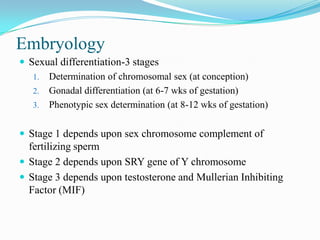
 Sexual differentiation-3 stages
1. Determination of chromosomal sex (at conception)
2. Gonadal differentiation (at 6-7 wks of gestation)
3. Phenotypic sex determination (at 8-12 wks of gestation)
 Stage 1 depends upon sex chromosome complement of
fertilizing sperm
 Stage 2 depends upon SRY gene of Y chromosome
 Stage 3 depends upon testosterone and Mullerian Inhibiting
Factor (MIF)
 Gonad develops from
 Somatic cells (arise from mesonrphric cells and coelomic
epithelium)- sertoli cells/granulosa cells
 Germ cells (arise from yolk sac and migrate to genital ridge)-
Leydig cell/theca cell
Embryology
 Testicular development is guided by TDF which is encoded
by the SRY gene on the short arm of the Y chromosome.
 Under the influence of the TDF ,germ cells in the genital ridge
differentiate into Sertoli cells which secrete MIS (causes
regression of the mullerian ducts) and Leydig cells which
produce testosterone (promotes maturation of spermatogonia
and regulates male phenotype).
Embryology
Wolffian duct develops into the following:
 Epididymis
 Vas deferens
 Ejaculatory duct and seminal vesicles
Embryology
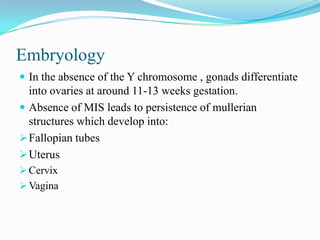
 In the absence of the Y chromosome , gonads differentiate
into ovaries at around 11-13 weeks gestation.
 Absence of MIS leads to persistence of mullerian
structures which develop into:
Fallopian tubes
Uterus
 Cervix
 Vagina
Embryology
 Undifferentiated external genitalia includes the following:
 Urogenital tubercle
 Urogenital swelling
 Urogenital folds
Embryology
 In males DHT leads to development of these three structures
into :
 Glans penis
 Scrotum
 Penile shaft
 In absence of DHT, these structures develop into
 Clitoris
 Labia majora
 Labia minora
Embryology
 True hermaphroditism have both testicular and ovarian tissue
in the gonads.
 In patients with pure gonadal dysgenesis,both gonads are
streak gonads.
 Patients with mixed gonadal dysgenesis have a testis on one
side and a streak gonad on the other
Hormone Biosynthesis Pathway
History
 Maternal drug ingestion esp. in 1st trimester (virilization in a
gonadal female)
 H/O virilization in mother may suggest androgen producing
tumour (arrhenoblastoma)
 Past h/o early death of infants may suggest a previously missed
androgenital deficiency
 Family h/o affected sibling or family member (CAH, testicular
feminization)
External genitalia Examination
 Note the size and degree
of differentiation of the
phallus, since variations
may represent
clitoromegaly or
hypospadias
 Note the position of the
urethral meatus -
hypospadiasis CAH with ambiguous genitalia
External genitalia Examination
 Labioscrotal folds may be
separated or folds may be
fused at the midline,
giving an appearance of a
scrotum
 Labioscrotal folds with
increased pigmentation
suggest the possibility of
increased corticotropin
levels as part of
adrenogenital syndrome
Micropenis with hypospadiasis, bifid
scrotum
Ambiguous genitalia in CAH
Investigations
 Serum electrolytes
 Blood sugar
 Hormonal study
 Karyotyping
 Ultrasonography
 Genitogaphy,
 Sinogram
 CT
 MRI
 Exploratory laprotomy/ Laproscopy
Algorithm for evaluation of 46,XX DSD
Ambiguous genitalia
46 XX Karyotype
Uterus present
17 Hydroxy progesterone
IncreasedNormal Normal
Ovotestis on USG
Biopsy:
Ovarian folicles &
testicular tubules
CAH
Matrnal virilization/
Exogenous androgen exposure
Hermaphroditism
(Bisexual gonads)
Maternal virilizing disorders:
Medications: Progestins
Tumors (adrenal/ovarian)
Luteomas of pregnancy
Aromatase deficiency
Algorithm for evaluation of 46,XY DSD
Ambiguous genitalia
Karyotype 46 XY
Uterus present
Gonadal biopsy:
•True hermaphordite
•Persistent mullerian duct
syndrome
No uterus
hCG stimulation test
N/ T & DHT:
AIS(Ar mutation
analysis)/
Idiopathic
Normal T & DHT
: 5 alpha reductase
deficiency
T and DHT:
LH/FSH :partial gonadal dysgenesis,
leydig cell hypoplasia
Precursor steroids : T-biosynthesis
defect
lvisUSG Pelvis
Ultrasonography
 Identify müllerian structures- uterus, ovaries, fallopian tubes
and upper half of vagina
 Allows visualization of a neonate's adrenal glands - enlarged in
infants with congenital adrenal hyperplasia (CAH) - have a
cribriform appearance.
 Normal ultrasonographic findings of the adrenal glands do not
exclude a diagnosis of CAH.
Genitography
 Helps to determine ductal anatomy.
 In a neonate with ambiguous genitalia, a catheter can be
inserted into the urethra - Contrast is injected to outline the
internal ductal anatomy.
 Findings - normal urethral anatomy, a müllerian remnant in a
male, a common urogenital sinus, or normal female internal
genitalia
 CT and MRI - may help identify internal anatomy
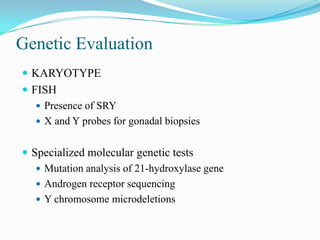
Genetic Evaluation
 KARYOTYPE
 FISH
 Presence of SRY
 X and Y probes for gonadal biopsies
 Specialized molecular genetic tests
 Mutation analysis of 21-hydroxylase gene
 Androgen receptor sequencing
 Y chromosome microdeletions
Endocrinal Evaluation
Hypothalamic/pituitary/gonadal Axis:
• Gonadotropins: LH, FSH
• Gonadal response: Testosterone, DHT, estrogen
Adrenal function:
• Electrolytes, 17-OH-P
• DHEAS
• Cortisol
Response to challenges:
• GnRH stimulation
• HCG stimulation
hCG stimulation test
 Evaluation of gonadal axis in children
 Dynamic & reliable test for leydig cell evaluation in boys
 Assess testosterone secretion by testes
 500 IU of hCG given i/m daily for 3 days
 Serum testosterone, DHT, DHEA, androsteedione, LH & FSH
are measured at baseline and then 24 hr after 3rd day
 Collection of 24 hr urine before & after three doses of hCG
used in analysis of steroid profile to detect testosterone
biosynthesis defect
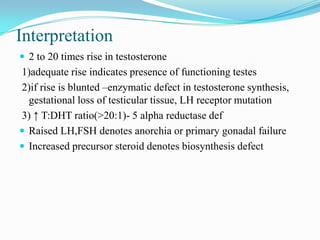
Interpretation
 2 to 20 times rise in testosterone
1)adequate rise indicates presence of functioning testes
2)if rise is blunted –enzymatic defect in testosterone synthesis,
gestational loss of testicular tissue, LH receptor mutation
3) ↑ T:DHT ratio(>20:1)- 5 alpha reductase def
 Raised LH,FSH denotes anorchia or primary gonadal failure
 Increased precursor steroid denotes biosynthesis defect
GnRH stimulation test
 Assess the pituitary function and degree of pubertal maturation
in DSD
 Evaluation of B/L cryptorchidism (along with hCG stimulation
test)
Method: Serum LH, FSH, estradiol, testosterone and SHBG
collected, followed by 2.5mcgm/kg GnRH iv is given, then
above samples collected at 30 and 60 min.
Interpretation
 In normal cases FSH&LH values rise at 30 min and later
decline at 60 min
 Initially there is predominant FSH response with progressive
increase in LH response with pubertal maturation
 In primary gonadal failure the basal gonadotropins are
elevated with exaggerated response to GnRH
MANAGEMENT
DSD Team Participants
 Pediatrician
 Medical Geneticist
 Pediatric Urologist
 Pediatric Endocrinologist
 Gynecologist
 Pediatric Psychologist
 Cytogeneticist
 Social Worker
General guidelines for gender
assignment
 Try to match the baby’s sex assignment to the chromosomal
and gonadal sex if possible
 Try to anticipate pubertal development
 Consider future function when planning surgeries
 Try to preserve fertility
 Respect the opinions of well-informed parents
Treatment
Treatment options include :
 Reconstructive surgery
 Hormone therapy
Reconstructive surgery
Goals
Cosmetic
 to make a boy’s or a girl’s genitalia look natural
 restoring sexual function
 May need repeated surgeries later in life
Reconstructive surgery
 For girls : sexual function of organs is often not compromised
despite any ambiguous appearance.
 Depending on severity options are :
 Uncovering vagina hidden under skin
 Removing excess masculine tissue around the
clitoris(clitoral reduction) – done once hormone replacement
therapy has begun
 Testis should be removed soon after birth if female sex of
rearing is decided
Reconstructive surgery
 For boys : surgery is complicated but often successful. It
includes :
 Lengthening of the incomplete penis
 Undescended testis that is to be retained is best brought
down into the scrotum at the time of initial gonadal biopsy
 Correction of chordee and urethroplasty in boys with
hypospadias is usually performed between 6 and 18 months
of age
Hormone therapy
 Depending on severity of condition, hormone therapy alone
may be enough to correct the initial hormonal imbalance.
 Ability of the gonads to produce appropriate hormones for sex
of rearing is a factor in sex assignment.
 Advantageous to retain a gonad appropriate to the assigned sex
if it is likely to function adequately.
Hormone therapy
Ovaries of true hermaphrodites may also produce
adequate levels of estrogen.
However, the testes of true hermaphrodites and mixed
gonadal dysgenesis may initially show good function that
declines during childhood
 Testosterone supplements may be necessary for the
establishment of puberty or in adult life.
Ovotesticular DSD
 Pts who are highly virilised have a good testicular function,
have no uterus and therefore are usually raised as males
 If uterus exists, virilisation is mild, testicular function is
minimal, and female sex is usually assigned
Prediction of fertility
 Ovaries are generally functional but testicular tissue is
generally dysgenetic
 XX patients with CAH have a reasonably high probability of
being fertile since they have a uterus and 2 normal ovaries
 Women with 46,XX ovotesticular DSD are occasionally fertile
 Pts with gonadal dysgenesis, partial AIS, 17-OHD are infertile
either because testis are abnormal or there is no uterus
 If child has no chance of fertility and genitalia are sufficiently
well developed to function as male, male sex of rearing is
advised
 Pts with ovotesticular DSD should be raised as female after
removing the testicular tissue and leaving the ovary in place
Congenital Adrenal Hyperplasia
 Incidence – 1 in 12000
 Most common cause of ambiguous genitalia in female newborn
 Autosomal recessive inheritance
 No sex prediliction
 21-hydroxylase deficiency - common cause of CAH
 Young women may present with symptoms of polycystic
ovarian syndrome
Presentation
Males -
 classic CAH-no signs of CAH at birth
 Hyperpigmentation and possible penile enlargement
Females –
 Virilisation at birth
 May present as salt-wasting disease
 Non-salt-wasting disease - present later with signs of
virilization
Management
 Medical –
Stablisation of general condition
Correction of electrolyte abnormalities
After stabilisation – replacement of glucocorticoid and / or
mineralocorticoids depending on the general condition
 Glucocorticoid replacement :
 Hydrocortisone – 10-15mg/m2/d
 Prednisolone – 2.5-6mg/m2/d
 Mineralocorticoid replacement :
 9 fluorohydrocortisone – 0.1-0.2mg/d
Management
 Surgical –
Females with severe virilisation – early recession of clitoris
followed by vaginoplasty
Mild virilisation – medical treatment is adequate
Antenatal management (CAH)
5 alpha reductase deficiency
 Autosomal recessive
 Clinical features - Normal male external genitalia, ambiguous
genitalia or normal female genitalia
Capable of producing viable sperm
Feminized or ambiguous genitalia - macroclitoris or
micropenis
Primary amenorrhoea and may experience virilization
Treatment
 Medical management –
Males – testosterone enanthenate 25 mg i.m. monthly X 3mths
may increase penile length
Females - estrogen replacement therapy should be initiated at a
bone age of 12 years or once an increase in gonadotropins is
observed
Dose is tailored to reach adult replacement levels over a 3-4
year range
Surgical treatment
 Females
Feminizing genitoplasty - gonadectomy, restructuring of the
labioscrotal folds into labia, and reduction or recession of the
phallus
 Males
Urethroplasty (Perineoscrotal hypospadias repair is typically a
multistage procedure.)
Repair of bifid scrotum
Chordee repair
Orchiopexy
Androgen insensitivity syndrome(AIS)
 Also known as Androgen receptor defects
 M/c form of male DSD
 Frequency 1/20,000 genetic males
 X linked recessive disorder
 Two types
complete AIS
Partial AIS(k/a Reifenstein syndrome)
Clinical presentation
 Extreme failure of virilization
 Genetic male invariably reared as female since birth
 Testes may be intra-abdominal/inguinal
 Normal breast (due to peripheral aromatization of testosterone)
 Primary amenorrhoea
 Absent pubic hair
Investigation
 Serum Gonadotropins
LH & FSH
 hCG stimulation test (Twofold or greater increase in
testosterone level in response to HCG suggests normal
functioning testicular tissue and helps rule out a defect in
testosterone biosynthesis)
Treatment
 Remove inguinal hernias
 Gonadectomy before or immediately after completion of
puberty (increased risk of gonadoblastoma)
 Estrogen replacement
 Vaginal reconstruction or vaginoplasty may be needed
 Supportive counseling for infertility
 Genetic counseling for family members
Conclusion
 The controversy revolves around the issues of gender
reassignment
 Physician and family may not correlate with the gender
preference by the patient in adulthood
 Adequate counseling and support for parents is vital.
 The most important sex organ is the brain, which may undergo
hormonal imprinting in utero.
Ambiguous genitalia

Ambiguous genitalia

  • 1.
    Presenter: Dr AvinashKumar Moderator: Dr Harish Chellani Dr soumya tiwari
  • 2.
    Definition  When theexternal genitalia do not have the typical anatomic appearance of normal male or female genitalia  Most cases present in newborn period  Social and medical emergency
  • 3.
    When to suspect Micropenis: Stretched penile length<2.5cm in a term newborn  Asymmetry of labioscrotal folds  B/L cryptorchidism  U/L cryptorchidism with hypospadias  B/L testes with perineoscrotal or penoscrotal hypospadias  Female external genitalia with clitoromegaly or inguinal hernia  Overtly abnormal genitals like cloacal exstrophy
  • 4.
    Disorder of SexualDifferentiation(DSD)  Also known as disorder of sexual determination (Nelson)  Preferred over older terminology such as ambiguous genitalia, pseudohermaphroditism and intersex  Atypical development of genetic, gonadal and phenotypic sex  Includes disorders grouped under 4 major headings  46,XX virilized female  46,XY undervirilized male  Gonadal differentiation and chromosomal disorders  Syndromes associated with ambiguous genitalia
  • 5.
    Types 46,XX virilized female Congenital adrenal hyperplasia  21-hydroxylase deficiency,  11-hydroxylase deficiency  3 beta hydroxysteroid dehydrogenase deficiency  Aromatase deficiency(fetal and maternal)  Virilizing maternal conditions  CAH  Adrenal/ovarian tumors  Drugs-progestin,androgen 46,XY undervirilized male  Androgen insensitivity  5 alfa reductase deficiency  Testosterone biosynthesis defects  Leydig cell hypoplasia  Persistent mullerian duct syndrome
  • 6.
    Types Gonadal differentiation and chromosomsldisorders  46,XY gonadal dysgenesis  True hermaphorditism Syndromes with ambigous genitalia  Turner  Camptomelic dysplasia  Denys-Drash syndrome  Frasier syndrome  WAGR syndrome  Robinow syndrome
  • 7.
    Incidence  The exactdata on the incidence and prevalence of conditions causing ambiguous genitalia are limited  Congenital adrenal hyperplasia accounts for most of the cases  Incidence of CAH 1 in 15000, AIS 1 in 20,000 (Avery’s disease of newborn 9th ed)
  • 8.
    Incidence-India Etiology and clinicalprofile of ambiguous genitalia studied (n=109) 1) Genetic females with virilisation or FPH –27.5 %(n=30)  Congenital adrenal hyperplasia (CAH) was the underlying cause in all cases of FPH Salt wasting form - 23/30 Simple virilising form – 7/30 2) Genetic males undervirilised or MPH –52.3 %(n=57) Androgen insensitivity syndrome - 28% (16/57) 5- alpha reductase deficiency - 23%(13/57) . 3) Disorder of gonadal differentiation- 10.1%(n=11) Gonadal dysgenesis – 9/11 True hermaphrodite – 2/11 4) Syndromic form of ambiguous genitalia- 1.8% (n=2) Rajesh R. Joshi, Sudha Rao, Meena Desai. Etiology and clinical profile of ambiguous genitalia-an overview of 10 years experience. Indian Pediatrics, 2006;43:974-979.
  • 9.
    Embryology  Sexual differentiation-3stages 1. Determination of chromosomal sex (at conception) 2. Gonadal differentiation (at 6-7 wks of gestation) 3. Phenotypic sex determination (at 8-12 wks of gestation)  Stage 1 depends upon sex chromosome complement of fertilizing sperm  Stage 2 depends upon SRY gene of Y chromosome  Stage 3 depends upon testosterone and Mullerian Inhibiting Factor (MIF)
  • 10.
     Gonad developsfrom  Somatic cells (arise from mesonrphric cells and coelomic epithelium)- sertoli cells/granulosa cells  Germ cells (arise from yolk sac and migrate to genital ridge)- Leydig cell/theca cell
  • 11.
    Embryology  Testicular developmentis guided by TDF which is encoded by the SRY gene on the short arm of the Y chromosome.  Under the influence of the TDF ,germ cells in the genital ridge differentiate into Sertoli cells which secrete MIS (causes regression of the mullerian ducts) and Leydig cells which produce testosterone (promotes maturation of spermatogonia and regulates male phenotype).
  • 12.
    Embryology Wolffian duct developsinto the following:  Epididymis  Vas deferens  Ejaculatory duct and seminal vesicles
  • 13.
    Embryology  In theabsence of the Y chromosome , gonads differentiate into ovaries at around 11-13 weeks gestation.  Absence of MIS leads to persistence of mullerian structures which develop into: Fallopian tubes Uterus  Cervix  Vagina
  • 15.
    Embryology  Undifferentiated externalgenitalia includes the following:  Urogenital tubercle  Urogenital swelling  Urogenital folds
  • 16.
    Embryology  In malesDHT leads to development of these three structures into :  Glans penis  Scrotum  Penile shaft  In absence of DHT, these structures develop into  Clitoris  Labia majora  Labia minora
  • 17.
    Embryology  True hermaphroditismhave both testicular and ovarian tissue in the gonads.  In patients with pure gonadal dysgenesis,both gonads are streak gonads.  Patients with mixed gonadal dysgenesis have a testis on one side and a streak gonad on the other
  • 18.
  • 20.
    History  Maternal drugingestion esp. in 1st trimester (virilization in a gonadal female)  H/O virilization in mother may suggest androgen producing tumour (arrhenoblastoma)  Past h/o early death of infants may suggest a previously missed androgenital deficiency  Family h/o affected sibling or family member (CAH, testicular feminization)
  • 21.
    External genitalia Examination Note the size and degree of differentiation of the phallus, since variations may represent clitoromegaly or hypospadias  Note the position of the urethral meatus - hypospadiasis CAH with ambiguous genitalia
  • 22.
    External genitalia Examination Labioscrotal folds may be separated or folds may be fused at the midline, giving an appearance of a scrotum  Labioscrotal folds with increased pigmentation suggest the possibility of increased corticotropin levels as part of adrenogenital syndrome Micropenis with hypospadiasis, bifid scrotum Ambiguous genitalia in CAH
  • 23.
    Investigations  Serum electrolytes Blood sugar  Hormonal study  Karyotyping  Ultrasonography  Genitogaphy,  Sinogram  CT  MRI  Exploratory laprotomy/ Laproscopy
  • 25.
    Algorithm for evaluationof 46,XX DSD Ambiguous genitalia 46 XX Karyotype Uterus present 17 Hydroxy progesterone IncreasedNormal Normal Ovotestis on USG Biopsy: Ovarian folicles & testicular tubules CAH Matrnal virilization/ Exogenous androgen exposure Hermaphroditism (Bisexual gonads) Maternal virilizing disorders: Medications: Progestins Tumors (adrenal/ovarian) Luteomas of pregnancy Aromatase deficiency
  • 26.
    Algorithm for evaluationof 46,XY DSD Ambiguous genitalia Karyotype 46 XY Uterus present Gonadal biopsy: •True hermaphordite •Persistent mullerian duct syndrome No uterus hCG stimulation test N/ T & DHT: AIS(Ar mutation analysis)/ Idiopathic Normal T & DHT : 5 alpha reductase deficiency T and DHT: LH/FSH :partial gonadal dysgenesis, leydig cell hypoplasia Precursor steroids : T-biosynthesis defect lvisUSG Pelvis
  • 27.
    Ultrasonography  Identify müllerianstructures- uterus, ovaries, fallopian tubes and upper half of vagina  Allows visualization of a neonate's adrenal glands - enlarged in infants with congenital adrenal hyperplasia (CAH) - have a cribriform appearance.  Normal ultrasonographic findings of the adrenal glands do not exclude a diagnosis of CAH.
  • 28.
    Genitography  Helps todetermine ductal anatomy.  In a neonate with ambiguous genitalia, a catheter can be inserted into the urethra - Contrast is injected to outline the internal ductal anatomy.  Findings - normal urethral anatomy, a müllerian remnant in a male, a common urogenital sinus, or normal female internal genitalia  CT and MRI - may help identify internal anatomy
  • 29.
    Genetic Evaluation  KARYOTYPE FISH  Presence of SRY  X and Y probes for gonadal biopsies  Specialized molecular genetic tests  Mutation analysis of 21-hydroxylase gene  Androgen receptor sequencing  Y chromosome microdeletions
  • 30.
    Endocrinal Evaluation Hypothalamic/pituitary/gonadal Axis: •Gonadotropins: LH, FSH • Gonadal response: Testosterone, DHT, estrogen Adrenal function: • Electrolytes, 17-OH-P • DHEAS • Cortisol Response to challenges: • GnRH stimulation • HCG stimulation
  • 31.
    hCG stimulation test Evaluation of gonadal axis in children  Dynamic & reliable test for leydig cell evaluation in boys  Assess testosterone secretion by testes  500 IU of hCG given i/m daily for 3 days  Serum testosterone, DHT, DHEA, androsteedione, LH & FSH are measured at baseline and then 24 hr after 3rd day  Collection of 24 hr urine before & after three doses of hCG used in analysis of steroid profile to detect testosterone biosynthesis defect
  • 32.
    Interpretation  2 to20 times rise in testosterone 1)adequate rise indicates presence of functioning testes 2)if rise is blunted –enzymatic defect in testosterone synthesis, gestational loss of testicular tissue, LH receptor mutation 3) ↑ T:DHT ratio(>20:1)- 5 alpha reductase def  Raised LH,FSH denotes anorchia or primary gonadal failure  Increased precursor steroid denotes biosynthesis defect
  • 33.
    GnRH stimulation test Assess the pituitary function and degree of pubertal maturation in DSD  Evaluation of B/L cryptorchidism (along with hCG stimulation test) Method: Serum LH, FSH, estradiol, testosterone and SHBG collected, followed by 2.5mcgm/kg GnRH iv is given, then above samples collected at 30 and 60 min.
  • 34.
    Interpretation  In normalcases FSH&LH values rise at 30 min and later decline at 60 min  Initially there is predominant FSH response with progressive increase in LH response with pubertal maturation  In primary gonadal failure the basal gonadotropins are elevated with exaggerated response to GnRH
  • 35.
  • 36.
    DSD Team Participants Pediatrician  Medical Geneticist  Pediatric Urologist  Pediatric Endocrinologist  Gynecologist  Pediatric Psychologist  Cytogeneticist  Social Worker
  • 37.
    General guidelines forgender assignment  Try to match the baby’s sex assignment to the chromosomal and gonadal sex if possible  Try to anticipate pubertal development  Consider future function when planning surgeries  Try to preserve fertility  Respect the opinions of well-informed parents
  • 38.
    Treatment Treatment options include:  Reconstructive surgery  Hormone therapy
  • 39.
    Reconstructive surgery Goals Cosmetic  tomake a boy’s or a girl’s genitalia look natural  restoring sexual function  May need repeated surgeries later in life
  • 40.
    Reconstructive surgery  Forgirls : sexual function of organs is often not compromised despite any ambiguous appearance.  Depending on severity options are :  Uncovering vagina hidden under skin  Removing excess masculine tissue around the clitoris(clitoral reduction) – done once hormone replacement therapy has begun  Testis should be removed soon after birth if female sex of rearing is decided
  • 41.
    Reconstructive surgery  Forboys : surgery is complicated but often successful. It includes :  Lengthening of the incomplete penis  Undescended testis that is to be retained is best brought down into the scrotum at the time of initial gonadal biopsy  Correction of chordee and urethroplasty in boys with hypospadias is usually performed between 6 and 18 months of age
  • 42.
    Hormone therapy  Dependingon severity of condition, hormone therapy alone may be enough to correct the initial hormonal imbalance.  Ability of the gonads to produce appropriate hormones for sex of rearing is a factor in sex assignment.  Advantageous to retain a gonad appropriate to the assigned sex if it is likely to function adequately.
  • 43.
    Hormone therapy Ovaries oftrue hermaphrodites may also produce adequate levels of estrogen. However, the testes of true hermaphrodites and mixed gonadal dysgenesis may initially show good function that declines during childhood  Testosterone supplements may be necessary for the establishment of puberty or in adult life.
  • 44.
    Ovotesticular DSD  Ptswho are highly virilised have a good testicular function, have no uterus and therefore are usually raised as males  If uterus exists, virilisation is mild, testicular function is minimal, and female sex is usually assigned
  • 45.
    Prediction of fertility Ovaries are generally functional but testicular tissue is generally dysgenetic  XX patients with CAH have a reasonably high probability of being fertile since they have a uterus and 2 normal ovaries  Women with 46,XX ovotesticular DSD are occasionally fertile
  • 46.
     Pts withgonadal dysgenesis, partial AIS, 17-OHD are infertile either because testis are abnormal or there is no uterus  If child has no chance of fertility and genitalia are sufficiently well developed to function as male, male sex of rearing is advised  Pts with ovotesticular DSD should be raised as female after removing the testicular tissue and leaving the ovary in place
  • 48.
    Congenital Adrenal Hyperplasia Incidence – 1 in 12000  Most common cause of ambiguous genitalia in female newborn  Autosomal recessive inheritance  No sex prediliction  21-hydroxylase deficiency - common cause of CAH  Young women may present with symptoms of polycystic ovarian syndrome
  • 49.
    Presentation Males -  classicCAH-no signs of CAH at birth  Hyperpigmentation and possible penile enlargement Females –  Virilisation at birth  May present as salt-wasting disease  Non-salt-wasting disease - present later with signs of virilization
  • 50.
    Management  Medical – Stablisationof general condition Correction of electrolyte abnormalities After stabilisation – replacement of glucocorticoid and / or mineralocorticoids depending on the general condition  Glucocorticoid replacement :  Hydrocortisone – 10-15mg/m2/d  Prednisolone – 2.5-6mg/m2/d  Mineralocorticoid replacement :  9 fluorohydrocortisone – 0.1-0.2mg/d
  • 51.
    Management  Surgical – Femaleswith severe virilisation – early recession of clitoris followed by vaginoplasty Mild virilisation – medical treatment is adequate
  • 52.
  • 53.
    5 alpha reductasedeficiency  Autosomal recessive  Clinical features - Normal male external genitalia, ambiguous genitalia or normal female genitalia Capable of producing viable sperm Feminized or ambiguous genitalia - macroclitoris or micropenis Primary amenorrhoea and may experience virilization
  • 54.
    Treatment  Medical management– Males – testosterone enanthenate 25 mg i.m. monthly X 3mths may increase penile length Females - estrogen replacement therapy should be initiated at a bone age of 12 years or once an increase in gonadotropins is observed Dose is tailored to reach adult replacement levels over a 3-4 year range
  • 55.
    Surgical treatment  Females Feminizinggenitoplasty - gonadectomy, restructuring of the labioscrotal folds into labia, and reduction or recession of the phallus  Males Urethroplasty (Perineoscrotal hypospadias repair is typically a multistage procedure.) Repair of bifid scrotum Chordee repair Orchiopexy
  • 56.
    Androgen insensitivity syndrome(AIS) Also known as Androgen receptor defects  M/c form of male DSD  Frequency 1/20,000 genetic males  X linked recessive disorder  Two types complete AIS Partial AIS(k/a Reifenstein syndrome)
  • 57.
    Clinical presentation  Extremefailure of virilization  Genetic male invariably reared as female since birth  Testes may be intra-abdominal/inguinal  Normal breast (due to peripheral aromatization of testosterone)  Primary amenorrhoea  Absent pubic hair
  • 58.
    Investigation  Serum Gonadotropins LH& FSH  hCG stimulation test (Twofold or greater increase in testosterone level in response to HCG suggests normal functioning testicular tissue and helps rule out a defect in testosterone biosynthesis)
  • 59.
    Treatment  Remove inguinalhernias  Gonadectomy before or immediately after completion of puberty (increased risk of gonadoblastoma)  Estrogen replacement  Vaginal reconstruction or vaginoplasty may be needed  Supportive counseling for infertility  Genetic counseling for family members
  • 60.
    Conclusion  The controversyrevolves around the issues of gender reassignment  Physician and family may not correlate with the gender preference by the patient in adulthood  Adequate counseling and support for parents is vital.  The most important sex organ is the brain, which may undergo hormonal imprinting in utero.