Evidence Based Practical Tips 
For 
Office Hysteroscopy 
Dr. Shashwat Jani. 
M.S. ( Gynec ). 
Diploma in Advance Endoscopy ( France ) . 
Assistant Prof., Smt. N.H.L. Mun. Medical College, 
Ahmedabad, Gujarat. 
Mobile : +91 99099 44160. 
E- mail : drshashwatjani@gmail.com
Greetings From Ahmedabad . . . 
27-Nov-14 Dr Shashwat Jani. 9909944160 2
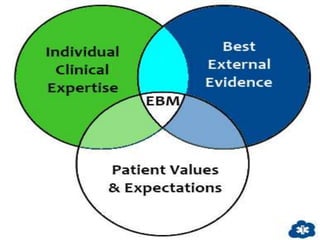
What is E.B.M. ...??? 
 Evidence Based Medicine…?  
 Experience Based Medicine…?  
 Eminence Based Medicine....?  
 
27-Nov-14 Dr Shashwat Jani. 9909944160 3
27-Nov-14 Dr Shashwat Jani. 9909944160 4
Sources 
Cochrane library . 
Royal College of Obstetricians &Gynecologists 
(RCOG) Guidelines. 
Journal of Evidence Based Obstetrics & Gynecology. 
National Guideline Clearinghouse . ( U.S. Govt. ). 
New Zealand Guidelines Group 
PubMed. 
 Italian Society of Gynecological Endoscopy. 
International Society Of Gynecology Endoscopy. 
American Association Of Gynecology Laparoscopist. 
27-Nov-14 Dr Shashwat Jani. 9909944160 5
What is Office Hysteroscopy .??? 
“ Diagnostic hysteroscopy and some 
operative hysteroscopic procedures 
should be conducted outside of the 
formal operating theatre setting in an 
appropriately equipped and staffed 
ambulatory situations & yet guarantying 
patient’s safety & privacy. “ 
27-Nov-14 Dr Shashwat Jani. 9909944160 6
 No Anesthesia nor Analgesia. 
 No drugs ( Atropine only ). 
 No speculum nor Tenaculum. 
 Operative procedures. 
27-Nov-14 Dr Shashwat Jani. 9909944160 7
Prof Bettocchi 
 A pioneer in the field of office hysteroscopy, 
Prof Bettocchi, in 2004 reported on 4863 
operative hysteroscopic procedures where a 
vaginoscopic technique was used without analgesia or 
anesthesia. 
 As technology has further advanced and 
hysteroscopes have reduced in size, office procedures 
have become even more feasible. 
 There have also been improvements in energy 
sources such as bipolar (as opposed to monopolar) 
that have decreased complications related to the 
operative distension media, this has made operative 
hysteroscopy more acceptable. 
27-Nov-14 Dr Shashwat Jani. 9909944160 8
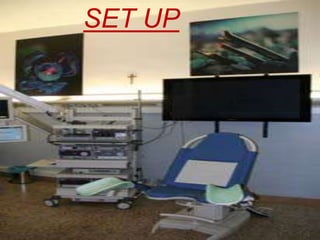
SET UP 
Set Up 
27-Nov-14 Dr Shashwat Jani. 9909944160 9
Hysteroscopy Instrumentation 
 Lockable cabinet 
 Telescope 
 Sheath system 
 Hysteroscope 
- Diagnostic 
- Operative 
Resectoscope 
 Distention systems 
Fluid delivery system 
 Light source and cable 
 Video cameras and monitors
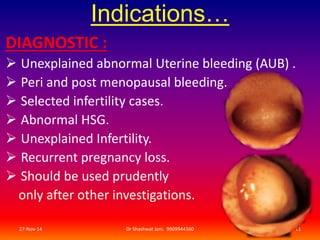
Indications… 
DIAGNOSTIC : 
 Unexplained abnormal Uterine bleeding (AUB) . 
 Peri and post menopausal bleeding. 
 Selected infertility cases. 
 Abnormal HSG. 
 Unexplained Infertility. 
 Recurrent pregnancy loss. 
 Should be used prudently 
only after other investigations. 
27-Nov-14 Dr Shashwat Jani. 9909944160 11
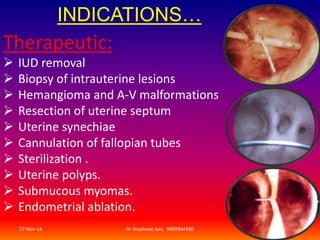
INDICATIONS… 
Therapeutic: 
 IUD removal 
 Biopsy of intrauterine lesions 
 Hemangioma and A-V malformations 
 Resection of uterine septum 
 Uterine synechiae 
 Cannulation of fallopian tubes 
 Sterilization . 
 Uterine polyps. 
 Submucous myomas. 
 Endometrial ablation. 
27-Nov-14 Dr Shashwat Jani. 9909944160 12
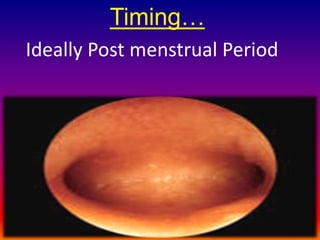
Timing… 
Ideally Post menstrual Period 
27-Nov-14 Dr Shashwat Jani. 9909944160 13
Anesthesia… 
3 mm Flexible/Rigid 
• Usually not needed 
5.5 mm Rigid w/o Dilatation 
• Parous usually not needed 
• Tenaculum site local 
• 1% Lidocaine 
5.5 mm Rigid with Dilatation 
• Tenaculum site local 
• Paracervical block 
27-Nov-14 Dr Shashwat Jani. 9909944160 14
Analgesia… 
 Routine use of Opiates NOT recommended. 
 Women without contraindications should 
be advised to consider taking standard doses 
of NSAIDs around 1 hour before their 
scheduled outpatient hysteroscopy 
appointment with the aim of reducing pain in 
the immediate postoperative period. 
27-Nov-14 Dr Shashwat Jani. 9909944160 15
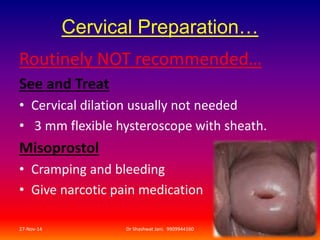
Cervical Preparation… 
Routinely NOT recommended… 
See and Treat 
• Cervical dilation usually not needed 
• 3 mm flexible hysteroscope with sheath. 
Misoprostol 
• Cramping and bleeding 
• Give narcotic pain medication 
27-Nov-14 Dr Shashwat Jani. 9909944160 16
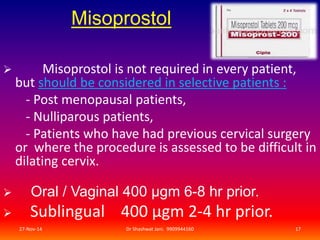
Misoprostol 
 Misoprostol is not required in every patient, 
but should be considered in selective patients : 
- Post menopausal patients, 
- Nulliparous patients, 
- Patients who have had previous cervical surgery 
or where the procedure is assessed to be difficult in 
dilating cervix. 
 Oral / Vaginal 400 μgm 6-8 hr prior. 
 Sublingual 400 μgm 2-4 hr prior. 
27-Nov-14 Dr Shashwat Jani. 9909944160 17
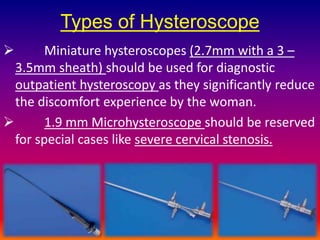
Types of Hysteroscope 
 Miniature hysteroscopes (2.7mm with a 3 – 
3.5mm sheath) should be used for diagnostic 
outpatient hysteroscopy as they significantly reduce 
the discomfort experience by the woman. 
 1.9 mm Microhysteroscope should be reserved 
for special cases like severe cervical stenosis. 
27-Nov-14 Dr Shashwat Jani. 9909944160 18
 There is insufficient evidence to recommend 
0° or fore-oblique optical lenses (i.e. 12°, 25° or 30° 
off-set lenses) for routine outpatient hysteroscopy. 
Now ,,, 
Types Of Hysteroscopes? 
27-Nov-14 Dr Shashwat Jani. 9909944160 19
 Flexible hysteroscopes are associated with 
less pain during outpatient hysteroscopy compared 
with rigid hysteroscopes. 
 However, Rigid hysteroscopes may provide 
better images, fewer failed procedures, quicker 
examination time and reduced cost. 
 Thus, there is insufficient evidence to 
recommend preferential use of rigid or flexible 
hysteroscopes for diagnostic outpatient procedures. 
Choice of hysteroscope should be left to the 
discretion of the Operator…!!! 
 
27-Nov-14 Dr Shashwat Jani. 9909944160 20
Distension Media 
OR 
 For routine outpatient hysteroscopy, the 
choice of distension medium between Carbon 
dioxide and Normal Saline should be left to the 
discretion of the operator as neither is superior in 
reducing pain, although uterine distension with 
normal saline appears to reduce the incidence of 
vasovagal episodes. 
27-Nov-14 Dr Shashwat Jani. 9909944160 21
 Uterine distension with Normal saline 
allows improved image quality and allows 
outpatient diagnostic hysteroscopy to be 
completed more quickly compared with 
carbon dioxide. 
 Operative outpatient hysteroscopy, using 
bipolar electrosurgery, requires the use of 
normal saline to act as both the distension 
and conducting medium. 
27-Nov-14 Dr Shashwat Jani. 9909944160 22
Local Anesthesia & Cervical Dilatation 
 Miniaturization of hysteroscopes and increasing use 
of the vaginoscopic technique may diminish any advantage 
of Intracervical or paracervical anesthesia. 
 Routine administration of intracervical or paracervical 
local anaesthetic should be used where : 
 larger diameter hysteroscopes are being employed 
(outer diameter greater than 5mm) & 
 where the need for cervical dilatation is anticipated 
(e.g. cervical stenosis). 
 Routine administration of intracervical or paracervical 
local anesthetic is Not indicated to reduce the incidence of 
vasovagal reactions. 
27-Nov-14 Dr Shashwat Jani. 9909944160 23
Conscious Sedation 
 Conscious sedation should not be routinely 
used in outpatient hysteroscopic procedures as it 
confers No advantage in terms of pain control and 
the woman’s satisfaction over local anaesthesia. 
 Life-threatening complications can result from 
the use of conscious sedation. 
 Appropriate monitoring and staff skills are 
mandatory if procedures are to be undertaken using 
conscious sedation. 
27-Nov-14 Dr Shashwat Jani. 9909944160 24
Antibiotics 
 Routine use of Antibiotic is 
NOT recommended after Diagnostic 
Office Hysteroscopy. 
 But should be given in Operative 
Hysteroscopy. 
27-Nov-14 Dr Shashwat Jani. 9909944160 25
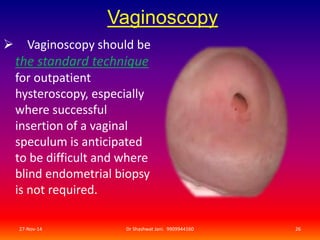
Vaginoscopy 
 Vaginoscopy should be 
the standard technique 
for outpatient 
hysteroscopy, especially 
where successful 
insertion of a vaginal 
speculum is anticipated 
to be difficult and where 
blind endometrial biopsy 
is not required. 
27-Nov-14 Dr Shashwat Jani. 9909944160 26
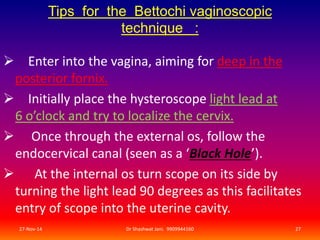
Tips for the Bettochi vaginoscopic 
technique : 
 Enter into the vagina, aiming for deep in the 
posterior fornix. 
 Initially place the hysteroscope light lead at 
6 o’clock and try to localize the cervix. 
 Once through the external os, follow the 
endocervical canal (seen as a ‘Black Hole’). 
 At the internal os turn scope on its side by 
turning the light lead 90 degrees as this facilitates 
entry of scope into the uterine cavity. 
27-Nov-14 Dr Shashwat Jani. 9909944160 27
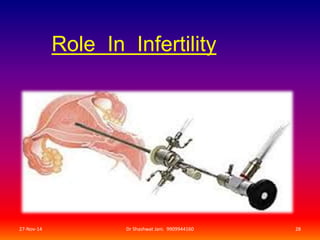
Role In Infertility 
27-Nov-14 Dr Shashwat Jani. 9909944160 28
As a Screening test… 
 Given the low invasiveness and the safety of 
office hysteroscopy and the desire for the infertile 
couple to shorten as much as possible the 
diagnostic period which is often a source of anxiety 
and uncertainty, it is reasonable to recommend the 
evaluation of uterine cavity by office hysteroscopy 
in the diagnostic work up of infertile couples. 
(LEVEL OF EVIDENCE VI, 
STRENGH OF THE RECOMMENDATION B). 
27-Nov-14 Dr Shashwat Jani. 9909944160 29
Prior to IVF…. 
 Hysteroscopy should be recommended for 
women with repeated implantation failure. 
(LEVEL OF EVIDENCE I , 
STRENGH OF THE RECOMMENDATION A). 
 However, a “screening” office hysteroscopy 
should be performed before including patients in an 
IVF program in order to minimize any negative 
intrauterine influence on IVF outcome. 
(LEVEL OF EVIDENCE VI, 
STRENGH OF THE RECOMMENDATION B). 
27-Nov-14 Dr Shashwat Jani. 9909944160 30
H/o of Recurrent Miscarriage… 
 Diagnosis and treatment by hysteroscopy of 
uterine malformations and intrauterine 
adhesions in such patients may improve live birth 
rate and therefore, their treatment could be 
recommended. 
(LEVEL OF EVIDENCE V, 
STRENGH OF THE RECOMMENDATION B). 
27-Nov-14 Dr Shashwat Jani. 9909944160 31
Role In AUB… 
 Hysteroscopy should be always performed in 
women presenting with AUB, in whom other tests 
(Sonohysterography and/or Transvaginal 
ultrasound) have already reported OR have been 
unable to rule out endouterine pathologies. 
( LEVEL OF EVIDENCE III , 
STRENGHT OF THE RECOMMENDATION B ). 
27-Nov-14 Dr Shashwat Jani. 9909944160 32
Post menopausal Bleeding… 
 It is reasonable to recommend evaluation of 
endometrial cavity by hysteroscopy in cases of 
repeated AUB in such women. 
(LEVEL OF EVIDENCE VI, 
STRENGH OF THE RECOMMENDATION B). 
27-Nov-14 Dr Shashwat Jani. 9909944160 33
Role in Biopsy… 
 Target-eye biopsy is more accurate than 
blind biopsy, and therefore hysteroscopy with 
multiple target biopsies should be used in 
place of blind techniques in the diagnostic 
work-up for atypical lesions. 
( LEVEL OF EVIDENCE II, 
STRENGH OF THE RECOMMENDATION B). 
27-Nov-14 Dr Shashwat Jani. 9909944160 34
 The possible risk of the spreading of 
neoplastic cells to the abdominal cavity should 
not limit the use of hysteroscopy in favour of 
blind techniques. 
(LEVEL OF EVIDENCE II, 
STRENGH OF THE RECOMMENDATION A ) . 
27-Nov-14 Dr Shashwat Jani. 9909944160 35
TIPS 
For 
Managing & Minimizing 
Operative Complications 
27-Nov-14 Dr Shashwat Jani. 9909944160 36
“ Ignoring contraindications to 
hysteroscopic surgery increases 
the risk of complications and is 
the single greatest factor leading 
to patient injury and physician 
liability. “ 
27-Nov-14 Dr Shashwat Jani. 9909944160 37
Contraindications 
 Acute pelvic inflammatory disease 
 Pregnancy 
 Genital tract malignancies 
 Lack of informed consent 
 Inability to dilate the cervix 
 Inability to distend the uterus to obtain visualization 
 Poor surgical candidates who may not tolerate fluid 
overload because of renal disease, or radiofrequency 
current when a cardiac pacemaker is present. 
 Unfamiliarity with equipment, instruments or 
technique 
 Lack of appropriate equipment or staff familiar with 
the equipment. 
27-Nov-14 Dr Shashwat Jani. 9909944160 38
A False Passage… 
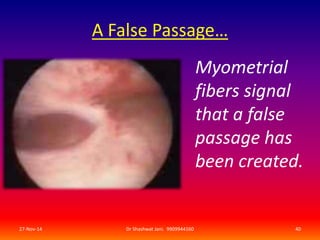
 If muscle fibers are visible and the tubal ostea are 
not, assume the passage is false. 
 Slowly remove the hysteroscope and identify the 
true cavity for confirmation. 
Discontinue the procedure—even if no perforation 
is detected—to prevent distention fluid from being 
absorbed into the circulation through the injury. 
Adequate distention is not possible at this time. 
Delay repeat hysteroscopy for 2 to 3 months. 
27-Nov-14 Dr Shashwat Jani. 9909944160 39
A False Passage… 
Myometrial 
fibers signal 
that a false 
passage has 
been created. 
27-Nov-14 Dr Shashwat Jani. 9909944160 40
To Avoid Creating A False Passage… 
 Dilate the cervix with slow, steady pressure and stop as 
soon as the internal os opens; do not attempt to push the 
dilator to the uterine fundus. 
 Often the external os opens, but the internal os cannot be 
dilated the extra 1 to 2 mm necessary to accommodate the 
27- French resectoscope. 
Rather than exert more force and risk perforation or 
laceration, simply turn on the resectoscope’s inflow with the 
outflow shut off, and let the fluid pressure dilate the cervix. 
 Always insert the hysteroscope or resectoscope under 
direct vision rather than use an obturator. 
 Keep the “dark circle” in the center of the field and slowly 
advance the hysteroscope toward it until the cavity is 
reached. 
27-Nov-14 Dr Shashwat Jani. 9909944160 41
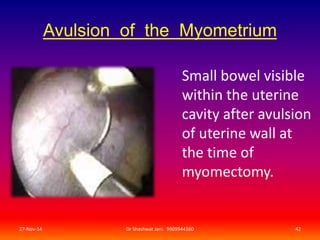
Avulsion of the Myometrium 
Small bowel visible 
within the uterine 
cavity after avulsion 
of uterine wall at 
the time of 
myomectomy. 
27-Nov-14 Dr Shashwat Jani. 9909944160 42
To Prevent Myometrial Avulsion… 
 Keep the myoma grasper away from the fundus 
when removing myoma segments, and avoid 
excessive traction on what may be a thin segment 
of myometrium. 
 Injuries can occur when the grasper perforates 
the uterus and bowel is inadvertently grasped. 
 Large injuries require laparoscopic repair. 
 Perforation is more likely in repeat procedures. 
27-Nov-14 Dr Shashwat Jani. 9909944160 43
Perforation… 
 In the AAGL survey, the incidence of perforation 
was 14 per 1,000. 
 It was even higher during transection of lateral 
and fundal adhesions: 2 to 3 per 100. 
 Although perforation is more common with 
thermal energy sources, it may occur mechanically 
when scissors are used to transect a uterine 
septum, synechiae, or polyps. 
27-Nov-14 Dr Shashwat Jani. 9909944160 44
Perforation… 
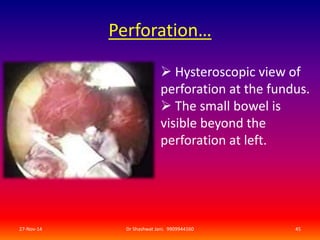
 Hysteroscopic view of 
perforation at the fundus. 
 The small bowel is 
visible beyond the 
perforation at left. 
27-Nov-14 Dr Shashwat Jani. 9909944160 45
When perforation occurs… 
 During the use of thermal energy, laparoscopy is 
necessary to assess the organs overlying the site. 
 During setup for laparoscopy, bring the hysteroscope 
near the area of perforation to inspect the bowel beyond the 
uterus. 
 Since the pelvis fills quickly with distention fluid, the 
hysteroscope can even be placed through the perforation to 
yield an excellent view of the undersurfaces of the bowel 
immediately adjacent to the injured area. 
Disconnect the electrosurgical cord before doing this..!!! 
 
27-Nov-14 Dr Shashwat Jani. 9909944160 46
Intra operative bleeding… 
 Bleeding is unlikely unless vessels are 
lacerated or injured in the cervical canal or 
lower uterine segment during dilation or deep 
ablation or vaporization. 
 Bleeding is more common when 
endomyometrial resection is performed with 
the wire loop electrode or during ablation or 
vaporization of fibroids. 
27-Nov-14 Dr Shashwat Jani. 9909944160 47
To achieve hemostasis 
1 ) Insert a Foley catheter with a 30-cc balloon into 
the uterine cavity, inject 15 to 20 mL (or more for a 
larger cavity) of fluid into the balloon, and observe 
the patient. 
2 ) Pack the uterus. 
1/2-inch–gauge packing that has been soaked in a 
dilute vasopressin solution. 
(20 U [1 mL] in 60 mL Normal Saline). 
27-Nov-14 Dr Shashwat Jani. 9909944160 48
Benefits of Vasopressin : 
Before balloon tamponade or Packing the uterus, 
Inject very dilute vasopressin : 
(4 U [0.2 mL] in 60 mL normal saline) 
directly into the cervix 2 cm deep, 
at the 4 and 8 o’clock positions. 
27-Nov-14 Dr Shashwat Jani. 9909944160 49
Electrosurgical & Gaseous Complications 
 Most electrosurgical complications involve 
activation of an electrode at the time of 
perforation, or current diversion to the outer 
sheath. 
27-Nov-14 Dr Shashwat Jani. 9909944160 50
To Avoid… 
 Avoid perforating the uterus by applying current 
only when the electrode is moving toward the 
operator, not the fundus. 
 To avoid return-pad injuries : 
Keep the patient’s thigh completely dry; 
ensure that the pad is flat against the skin at 
application, with no bubbles or creases; and use 
only return electrode monitor (REM) dispersive 
pads. 
27-Nov-14 Dr Shashwat Jani. 9909944160 51
Gas Embolism : 
 Carbon dioxide is a soluble gas, so these 
emboli generally resolve rapidly. 
 In contrast, room air emboli are more 
likely to be fatal. 
27-Nov-14 Dr Shashwat Jani. 9909944160 52
To reduce risk of gas embolism : 
 Avoid Trendelenburg positioning 
 Remove last dilator just before inserting the 
resectoscope 
 Limit repeated removal - reinsertion of the 
resectoscope 
 Vaporizing myomas eliminates the need to 
remove fibroid chips 
 Intracervical injection of vasopressin may 
block gas from entering circulation. 
27-Nov-14 Dr Shashwat Jani. 9909944160 53
Distension Media : 
 Continuously record inflow and outflow using the 
electronic monitor with the deficit alarm set to 500 mL. 
 Keep distention fluid at room temperature and monitor 
the patient’s core temperature continuously. 
 Significant fluid intravasation will lower the patient’s 
temperature, and this may be the first sign of fluid overload. 
 Perform operative hysteroscopy under spinal or epidural 
anesthesia so the anesthesiologist can continually assess the 
patient’s sensorium. 
 Confusion and irritability are early signs of dilutional 
hyponatremia. 
27-Nov-14 Dr Shashwat Jani. 9909944160 54
Safety First… 
 Hysteroscopy is a technologically dependent 
surgery and before starting surgery every 
surgeon should have reasonably good 
knowledge of Hysteroscopic procedures. 
 Please put a board in your Hospital : 
“ Your Safety Is Our First Priority. “ 
drshashwatjani@gmail.com 55
27-Nov-14 Dr Shashwat Jani. 9909944160 56
27-Nov-14 Dr Shashwat Jani. 9909944160 57
Thank you 
27-Nov-14 Dr Shashwat Jani. 9909944160 58

EVIDENCE BASED PRACTICAL TIPS FOR OFFICE HYSTEROSCOPY BY DR SHASHWAT JANI

  • 1.
    Evidence Based PracticalTips For Office Hysteroscopy Dr. Shashwat Jani. M.S. ( Gynec ). Diploma in Advance Endoscopy ( France ) . Assistant Prof., Smt. N.H.L. Mun. Medical College, Ahmedabad, Gujarat. Mobile : +91 99099 44160. E- mail : drshashwatjani@gmail.com
  • 2.
    Greetings From Ahmedabad. . . 27-Nov-14 Dr Shashwat Jani. 9909944160 2
  • 3.
    What is E.B.M....???  Evidence Based Medicine…?   Experience Based Medicine…?   Eminence Based Medicine....?   27-Nov-14 Dr Shashwat Jani. 9909944160 3
  • 4.
    27-Nov-14 Dr ShashwatJani. 9909944160 4
  • 5.
    Sources Cochrane library. Royal College of Obstetricians &Gynecologists (RCOG) Guidelines. Journal of Evidence Based Obstetrics & Gynecology. National Guideline Clearinghouse . ( U.S. Govt. ). New Zealand Guidelines Group PubMed.  Italian Society of Gynecological Endoscopy. International Society Of Gynecology Endoscopy. American Association Of Gynecology Laparoscopist. 27-Nov-14 Dr Shashwat Jani. 9909944160 5
  • 6.
    What is OfficeHysteroscopy .??? “ Diagnostic hysteroscopy and some operative hysteroscopic procedures should be conducted outside of the formal operating theatre setting in an appropriately equipped and staffed ambulatory situations & yet guarantying patient’s safety & privacy. “ 27-Nov-14 Dr Shashwat Jani. 9909944160 6
  • 7.
     No Anesthesianor Analgesia.  No drugs ( Atropine only ).  No speculum nor Tenaculum.  Operative procedures. 27-Nov-14 Dr Shashwat Jani. 9909944160 7
  • 8.
    Prof Bettocchi A pioneer in the field of office hysteroscopy, Prof Bettocchi, in 2004 reported on 4863 operative hysteroscopic procedures where a vaginoscopic technique was used without analgesia or anesthesia.  As technology has further advanced and hysteroscopes have reduced in size, office procedures have become even more feasible.  There have also been improvements in energy sources such as bipolar (as opposed to monopolar) that have decreased complications related to the operative distension media, this has made operative hysteroscopy more acceptable. 27-Nov-14 Dr Shashwat Jani. 9909944160 8
  • 9.
    SET UP SetUp 27-Nov-14 Dr Shashwat Jani. 9909944160 9
  • 10.
    Hysteroscopy Instrumentation Lockable cabinet  Telescope  Sheath system  Hysteroscope - Diagnostic - Operative Resectoscope  Distention systems Fluid delivery system  Light source and cable  Video cameras and monitors
  • 11.
    Indications… DIAGNOSTIC :  Unexplained abnormal Uterine bleeding (AUB) .  Peri and post menopausal bleeding.  Selected infertility cases.  Abnormal HSG.  Unexplained Infertility.  Recurrent pregnancy loss.  Should be used prudently only after other investigations. 27-Nov-14 Dr Shashwat Jani. 9909944160 11
  • 12.
    INDICATIONS… Therapeutic: IUD removal  Biopsy of intrauterine lesions  Hemangioma and A-V malformations  Resection of uterine septum  Uterine synechiae  Cannulation of fallopian tubes  Sterilization .  Uterine polyps.  Submucous myomas.  Endometrial ablation. 27-Nov-14 Dr Shashwat Jani. 9909944160 12
  • 13.
    Timing… Ideally Postmenstrual Period 27-Nov-14 Dr Shashwat Jani. 9909944160 13
  • 14.
    Anesthesia… 3 mmFlexible/Rigid • Usually not needed 5.5 mm Rigid w/o Dilatation • Parous usually not needed • Tenaculum site local • 1% Lidocaine 5.5 mm Rigid with Dilatation • Tenaculum site local • Paracervical block 27-Nov-14 Dr Shashwat Jani. 9909944160 14
  • 15.
    Analgesia…  Routineuse of Opiates NOT recommended.  Women without contraindications should be advised to consider taking standard doses of NSAIDs around 1 hour before their scheduled outpatient hysteroscopy appointment with the aim of reducing pain in the immediate postoperative period. 27-Nov-14 Dr Shashwat Jani. 9909944160 15
  • 16.
    Cervical Preparation… RoutinelyNOT recommended… See and Treat • Cervical dilation usually not needed • 3 mm flexible hysteroscope with sheath. Misoprostol • Cramping and bleeding • Give narcotic pain medication 27-Nov-14 Dr Shashwat Jani. 9909944160 16
  • 17.
    Misoprostol  Misoprostolis not required in every patient, but should be considered in selective patients : - Post menopausal patients, - Nulliparous patients, - Patients who have had previous cervical surgery or where the procedure is assessed to be difficult in dilating cervix.  Oral / Vaginal 400 μgm 6-8 hr prior.  Sublingual 400 μgm 2-4 hr prior. 27-Nov-14 Dr Shashwat Jani. 9909944160 17
  • 18.
    Types of Hysteroscope  Miniature hysteroscopes (2.7mm with a 3 – 3.5mm sheath) should be used for diagnostic outpatient hysteroscopy as they significantly reduce the discomfort experience by the woman.  1.9 mm Microhysteroscope should be reserved for special cases like severe cervical stenosis. 27-Nov-14 Dr Shashwat Jani. 9909944160 18
  • 19.
     There isinsufficient evidence to recommend 0° or fore-oblique optical lenses (i.e. 12°, 25° or 30° off-set lenses) for routine outpatient hysteroscopy. Now ,,, Types Of Hysteroscopes? 27-Nov-14 Dr Shashwat Jani. 9909944160 19
  • 20.
     Flexible hysteroscopesare associated with less pain during outpatient hysteroscopy compared with rigid hysteroscopes.  However, Rigid hysteroscopes may provide better images, fewer failed procedures, quicker examination time and reduced cost.  Thus, there is insufficient evidence to recommend preferential use of rigid or flexible hysteroscopes for diagnostic outpatient procedures. Choice of hysteroscope should be left to the discretion of the Operator…!!!  27-Nov-14 Dr Shashwat Jani. 9909944160 20
  • 21.
    Distension Media OR  For routine outpatient hysteroscopy, the choice of distension medium between Carbon dioxide and Normal Saline should be left to the discretion of the operator as neither is superior in reducing pain, although uterine distension with normal saline appears to reduce the incidence of vasovagal episodes. 27-Nov-14 Dr Shashwat Jani. 9909944160 21
  • 22.
     Uterine distensionwith Normal saline allows improved image quality and allows outpatient diagnostic hysteroscopy to be completed more quickly compared with carbon dioxide.  Operative outpatient hysteroscopy, using bipolar electrosurgery, requires the use of normal saline to act as both the distension and conducting medium. 27-Nov-14 Dr Shashwat Jani. 9909944160 22
  • 23.
    Local Anesthesia &Cervical Dilatation  Miniaturization of hysteroscopes and increasing use of the vaginoscopic technique may diminish any advantage of Intracervical or paracervical anesthesia.  Routine administration of intracervical or paracervical local anaesthetic should be used where :  larger diameter hysteroscopes are being employed (outer diameter greater than 5mm) &  where the need for cervical dilatation is anticipated (e.g. cervical stenosis).  Routine administration of intracervical or paracervical local anesthetic is Not indicated to reduce the incidence of vasovagal reactions. 27-Nov-14 Dr Shashwat Jani. 9909944160 23
  • 24.
    Conscious Sedation Conscious sedation should not be routinely used in outpatient hysteroscopic procedures as it confers No advantage in terms of pain control and the woman’s satisfaction over local anaesthesia.  Life-threatening complications can result from the use of conscious sedation.  Appropriate monitoring and staff skills are mandatory if procedures are to be undertaken using conscious sedation. 27-Nov-14 Dr Shashwat Jani. 9909944160 24
  • 25.
    Antibiotics  Routineuse of Antibiotic is NOT recommended after Diagnostic Office Hysteroscopy.  But should be given in Operative Hysteroscopy. 27-Nov-14 Dr Shashwat Jani. 9909944160 25
  • 26.
    Vaginoscopy  Vaginoscopyshould be the standard technique for outpatient hysteroscopy, especially where successful insertion of a vaginal speculum is anticipated to be difficult and where blind endometrial biopsy is not required. 27-Nov-14 Dr Shashwat Jani. 9909944160 26
  • 27.
    Tips for theBettochi vaginoscopic technique :  Enter into the vagina, aiming for deep in the posterior fornix.  Initially place the hysteroscope light lead at 6 o’clock and try to localize the cervix.  Once through the external os, follow the endocervical canal (seen as a ‘Black Hole’).  At the internal os turn scope on its side by turning the light lead 90 degrees as this facilitates entry of scope into the uterine cavity. 27-Nov-14 Dr Shashwat Jani. 9909944160 27
  • 28.
    Role In Infertility 27-Nov-14 Dr Shashwat Jani. 9909944160 28
  • 29.
    As a Screeningtest…  Given the low invasiveness and the safety of office hysteroscopy and the desire for the infertile couple to shorten as much as possible the diagnostic period which is often a source of anxiety and uncertainty, it is reasonable to recommend the evaluation of uterine cavity by office hysteroscopy in the diagnostic work up of infertile couples. (LEVEL OF EVIDENCE VI, STRENGH OF THE RECOMMENDATION B). 27-Nov-14 Dr Shashwat Jani. 9909944160 29
  • 30.
    Prior to IVF….  Hysteroscopy should be recommended for women with repeated implantation failure. (LEVEL OF EVIDENCE I , STRENGH OF THE RECOMMENDATION A).  However, a “screening” office hysteroscopy should be performed before including patients in an IVF program in order to minimize any negative intrauterine influence on IVF outcome. (LEVEL OF EVIDENCE VI, STRENGH OF THE RECOMMENDATION B). 27-Nov-14 Dr Shashwat Jani. 9909944160 30
  • 31.
    H/o of RecurrentMiscarriage…  Diagnosis and treatment by hysteroscopy of uterine malformations and intrauterine adhesions in such patients may improve live birth rate and therefore, their treatment could be recommended. (LEVEL OF EVIDENCE V, STRENGH OF THE RECOMMENDATION B). 27-Nov-14 Dr Shashwat Jani. 9909944160 31
  • 32.
    Role In AUB…  Hysteroscopy should be always performed in women presenting with AUB, in whom other tests (Sonohysterography and/or Transvaginal ultrasound) have already reported OR have been unable to rule out endouterine pathologies. ( LEVEL OF EVIDENCE III , STRENGHT OF THE RECOMMENDATION B ). 27-Nov-14 Dr Shashwat Jani. 9909944160 32
  • 33.
    Post menopausal Bleeding…  It is reasonable to recommend evaluation of endometrial cavity by hysteroscopy in cases of repeated AUB in such women. (LEVEL OF EVIDENCE VI, STRENGH OF THE RECOMMENDATION B). 27-Nov-14 Dr Shashwat Jani. 9909944160 33
  • 34.
    Role in Biopsy…  Target-eye biopsy is more accurate than blind biopsy, and therefore hysteroscopy with multiple target biopsies should be used in place of blind techniques in the diagnostic work-up for atypical lesions. ( LEVEL OF EVIDENCE II, STRENGH OF THE RECOMMENDATION B). 27-Nov-14 Dr Shashwat Jani. 9909944160 34
  • 35.
     The possiblerisk of the spreading of neoplastic cells to the abdominal cavity should not limit the use of hysteroscopy in favour of blind techniques. (LEVEL OF EVIDENCE II, STRENGH OF THE RECOMMENDATION A ) . 27-Nov-14 Dr Shashwat Jani. 9909944160 35
  • 36.
    TIPS For Managing& Minimizing Operative Complications 27-Nov-14 Dr Shashwat Jani. 9909944160 36
  • 37.
    “ Ignoring contraindicationsto hysteroscopic surgery increases the risk of complications and is the single greatest factor leading to patient injury and physician liability. “ 27-Nov-14 Dr Shashwat Jani. 9909944160 37
  • 38.
    Contraindications  Acutepelvic inflammatory disease  Pregnancy  Genital tract malignancies  Lack of informed consent  Inability to dilate the cervix  Inability to distend the uterus to obtain visualization  Poor surgical candidates who may not tolerate fluid overload because of renal disease, or radiofrequency current when a cardiac pacemaker is present.  Unfamiliarity with equipment, instruments or technique  Lack of appropriate equipment or staff familiar with the equipment. 27-Nov-14 Dr Shashwat Jani. 9909944160 38
  • 39.
    A False Passage…  If muscle fibers are visible and the tubal ostea are not, assume the passage is false.  Slowly remove the hysteroscope and identify the true cavity for confirmation. Discontinue the procedure—even if no perforation is detected—to prevent distention fluid from being absorbed into the circulation through the injury. Adequate distention is not possible at this time. Delay repeat hysteroscopy for 2 to 3 months. 27-Nov-14 Dr Shashwat Jani. 9909944160 39
  • 40.
    A False Passage… Myometrial fibers signal that a false passage has been created. 27-Nov-14 Dr Shashwat Jani. 9909944160 40
  • 41.
    To Avoid CreatingA False Passage…  Dilate the cervix with slow, steady pressure and stop as soon as the internal os opens; do not attempt to push the dilator to the uterine fundus.  Often the external os opens, but the internal os cannot be dilated the extra 1 to 2 mm necessary to accommodate the 27- French resectoscope. Rather than exert more force and risk perforation or laceration, simply turn on the resectoscope’s inflow with the outflow shut off, and let the fluid pressure dilate the cervix.  Always insert the hysteroscope or resectoscope under direct vision rather than use an obturator.  Keep the “dark circle” in the center of the field and slowly advance the hysteroscope toward it until the cavity is reached. 27-Nov-14 Dr Shashwat Jani. 9909944160 41
  • 42.
    Avulsion of theMyometrium Small bowel visible within the uterine cavity after avulsion of uterine wall at the time of myomectomy. 27-Nov-14 Dr Shashwat Jani. 9909944160 42
  • 43.
    To Prevent MyometrialAvulsion…  Keep the myoma grasper away from the fundus when removing myoma segments, and avoid excessive traction on what may be a thin segment of myometrium.  Injuries can occur when the grasper perforates the uterus and bowel is inadvertently grasped.  Large injuries require laparoscopic repair.  Perforation is more likely in repeat procedures. 27-Nov-14 Dr Shashwat Jani. 9909944160 43
  • 44.
    Perforation…  Inthe AAGL survey, the incidence of perforation was 14 per 1,000.  It was even higher during transection of lateral and fundal adhesions: 2 to 3 per 100.  Although perforation is more common with thermal energy sources, it may occur mechanically when scissors are used to transect a uterine septum, synechiae, or polyps. 27-Nov-14 Dr Shashwat Jani. 9909944160 44
  • 45.
    Perforation…  Hysteroscopicview of perforation at the fundus.  The small bowel is visible beyond the perforation at left. 27-Nov-14 Dr Shashwat Jani. 9909944160 45
  • 46.
    When perforation occurs…  During the use of thermal energy, laparoscopy is necessary to assess the organs overlying the site.  During setup for laparoscopy, bring the hysteroscope near the area of perforation to inspect the bowel beyond the uterus.  Since the pelvis fills quickly with distention fluid, the hysteroscope can even be placed through the perforation to yield an excellent view of the undersurfaces of the bowel immediately adjacent to the injured area. Disconnect the electrosurgical cord before doing this..!!!  27-Nov-14 Dr Shashwat Jani. 9909944160 46
  • 47.
    Intra operative bleeding…  Bleeding is unlikely unless vessels are lacerated or injured in the cervical canal or lower uterine segment during dilation or deep ablation or vaporization.  Bleeding is more common when endomyometrial resection is performed with the wire loop electrode or during ablation or vaporization of fibroids. 27-Nov-14 Dr Shashwat Jani. 9909944160 47
  • 48.
    To achieve hemostasis 1 ) Insert a Foley catheter with a 30-cc balloon into the uterine cavity, inject 15 to 20 mL (or more for a larger cavity) of fluid into the balloon, and observe the patient. 2 ) Pack the uterus. 1/2-inch–gauge packing that has been soaked in a dilute vasopressin solution. (20 U [1 mL] in 60 mL Normal Saline). 27-Nov-14 Dr Shashwat Jani. 9909944160 48
  • 49.
    Benefits of Vasopressin: Before balloon tamponade or Packing the uterus, Inject very dilute vasopressin : (4 U [0.2 mL] in 60 mL normal saline) directly into the cervix 2 cm deep, at the 4 and 8 o’clock positions. 27-Nov-14 Dr Shashwat Jani. 9909944160 49
  • 50.
    Electrosurgical & GaseousComplications  Most electrosurgical complications involve activation of an electrode at the time of perforation, or current diversion to the outer sheath. 27-Nov-14 Dr Shashwat Jani. 9909944160 50
  • 51.
    To Avoid… Avoid perforating the uterus by applying current only when the electrode is moving toward the operator, not the fundus.  To avoid return-pad injuries : Keep the patient’s thigh completely dry; ensure that the pad is flat against the skin at application, with no bubbles or creases; and use only return electrode monitor (REM) dispersive pads. 27-Nov-14 Dr Shashwat Jani. 9909944160 51
  • 52.
    Gas Embolism :  Carbon dioxide is a soluble gas, so these emboli generally resolve rapidly.  In contrast, room air emboli are more likely to be fatal. 27-Nov-14 Dr Shashwat Jani. 9909944160 52
  • 53.
    To reduce riskof gas embolism :  Avoid Trendelenburg positioning  Remove last dilator just before inserting the resectoscope  Limit repeated removal - reinsertion of the resectoscope  Vaporizing myomas eliminates the need to remove fibroid chips  Intracervical injection of vasopressin may block gas from entering circulation. 27-Nov-14 Dr Shashwat Jani. 9909944160 53
  • 54.
    Distension Media :  Continuously record inflow and outflow using the electronic monitor with the deficit alarm set to 500 mL.  Keep distention fluid at room temperature and monitor the patient’s core temperature continuously.  Significant fluid intravasation will lower the patient’s temperature, and this may be the first sign of fluid overload.  Perform operative hysteroscopy under spinal or epidural anesthesia so the anesthesiologist can continually assess the patient’s sensorium.  Confusion and irritability are early signs of dilutional hyponatremia. 27-Nov-14 Dr Shashwat Jani. 9909944160 54
  • 55.
    Safety First… Hysteroscopy is a technologically dependent surgery and before starting surgery every surgeon should have reasonably good knowledge of Hysteroscopic procedures.  Please put a board in your Hospital : “ Your Safety Is Our First Priority. “ drshashwatjani@gmail.com 55
  • 56.
    27-Nov-14 Dr ShashwatJani. 9909944160 56
  • 57.
    27-Nov-14 Dr ShashwatJani. 9909944160 57
  • 58.
    Thank you 27-Nov-14Dr Shashwat Jani. 9909944160 58