INTERSEXUALITY Dr. Jehad Yousef FICS, FRCOG Alhayat ART Center Amman – Jordan
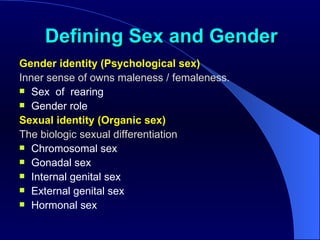
Defining Sex and Gender Gender identity (Psychological sex) Inner sense of owns maleness / femaleness.   Sex  of  rearing Gender role Sexual identity (Organic sex) The biologic sexual differentiation Chromosomal sex Gonadal sex Internal genital sex External genital sex Hormonal sex
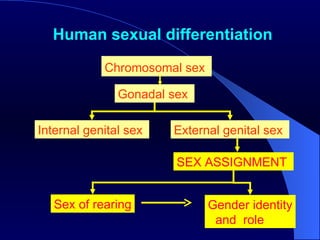
Human sexual differentiation Chromosomal sex   Gonadal sex   External genital sex  Internal genital sex  SEX ASSIGNMENT  Gender identity and  role  Sex of rearing
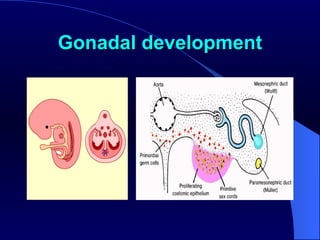
Gonadal development
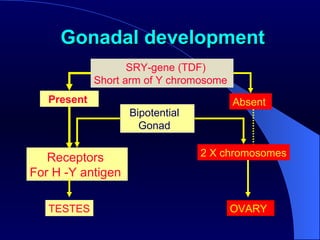
Gonadal development SRY-gene (TDF) Short arm of Y chromosome  Bipotential  Gonad  2 X chromosomes Receptors  For H -Y antigen  OVARY TESTES Present  Absent
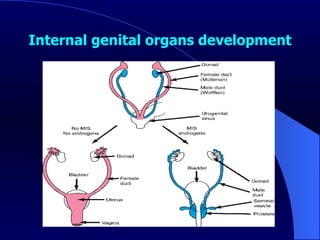
Internal genital organs development
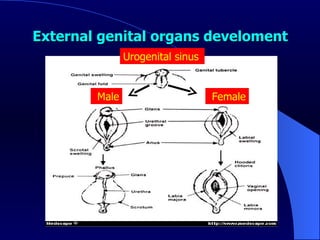
External genital organs develoment   Female  Male  Urogenital sinus
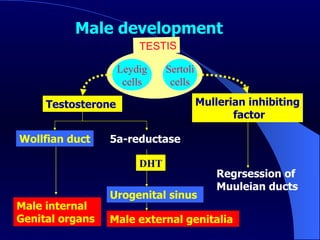
Leydig cells Sertoli cells Testosterone  Mullerian inhibiting factor Wollfian duct 5a-reductase  Urogenital sinus  Regrsession of  Muuleian ducts  Male external genitalia  Male internal  Genital organs  DHT TESTIS  Male development
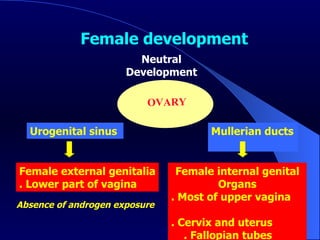
Urogenital sinus  Female external genitalia . Lower part of vagina OVARY  Mullerian ducts  Female internal genital Organs . Most of upper vagina  . Cervix and uterus  . Fallopian tubes  Neutral  Development  Absence of androgen exposure  Female development
Summary of Normal Sex Differentiation genetic sex is determined at fertilization.  testes develop in XY fetus, ovaries develop in XX fetus.  XY fetus produces MIS and androgens and XX fetus does not.  XY fetus develops Wolffian ducts and XX fetus develops Mullerian ducts.  XY fetus masculinizes the female genitalia to make it male and the XX fetus retains female genitalia.
INTERSEX An individual in whom there is discordance between chromosomal, gonadal, internal genital, and phenotypic sex or the sex of rearing. INTERSEXUALITY: Discordance between any tow of the organic sex criteria  TRANSSEXUALITY: Discordance between oganic sex and psychological sex components
CLASSIFICATION OF INTERSEXUALITY 1. Virilization of genitically female foetus  Female pseudohemaphroditism 2. Incomplete musculinization of genitically male foetus   Male pseudohermaphroditism (XY-FEMALE)  3. The presence of both ovarian and testicular tissue in the same individual True hermaphroditism 4. Chromosomal abnormality Mixed gonadal dysgenesis ( 45,X0 / 46,XY)
How many children are born with intersex conditions? A conservative estimate is that 1 in 2000 children born will be affected by an intersex condition. 98 % of affected babies are due to congenital adrenal hyperplasia
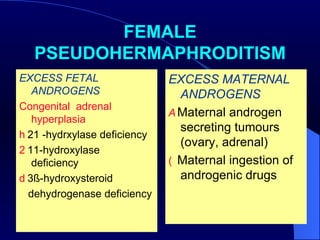
FEMALE PSEUDOHERMAPHRODITISM EXCESS FETAL  ANDROGENS Congenital  adrenal  hyperplasia     21 -hydrxylase deficiency    11-hydroxylase  deficiency    3ß-hydroxysteroid dehydrogenase deficiency EXCESS MATERNAL ANDROGENS    Maternal androgen secreting tumours (ovary, adrenal)    Maternal ingestion of androgenic drugs
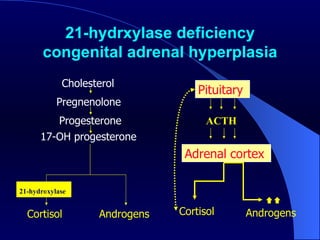
21-hydrxylase deficiency congenital adrenal hyperplasia Pituitary  ACTH  Adrenal cortex   Androgens  Cortisol  Cholesterol  Pregnenolone  Progesterone  17-OH progesterone  21-hydroxylase   Androgens  Cortisol
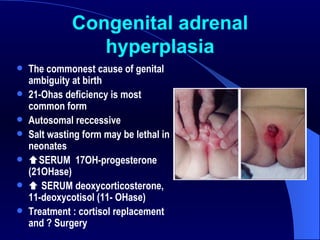
Congenital adrenal hyperplasia The commonest cause of genital ambiguity at birth 21-Ohas deficiency is most common form Autosomal reccessive Salt wasting form may be lethal in neonates  SERUM  17OH-progesterone  (21OHase)    SERUM deoxycorticosterone, 11-deoxycotisol (11- OHase) Treatment : cortisol replacement and ? Surgery
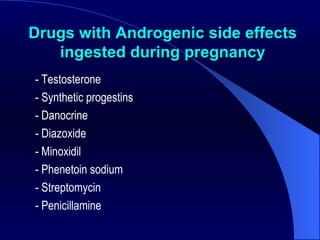
Drugs with Androgenic side effects ingested during pregnancy -   Testosterone - Synthetic progestins - Danocrine - Diazoxide - Minoxidil  - Phenetoin sodium  - Streptomycin  - Penicillamine
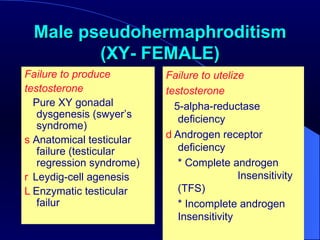
Male pseudohermaphroditism (XY- FEMALE) Failure to produce  testosterone      Pure XY gonadal dysgenesis (swyer’s syndrome)    Anatomical testicular failure (testicular regression syndrome)    Leydig-cell agenesis    Enzymatic testicular failur  Failure to utelize  testosterone      5-alpha-reductase deficiency    Androgen receptor deficiency * Complete androgen  Insensitivity (TFS) * Incomplete androgen Insensitivity
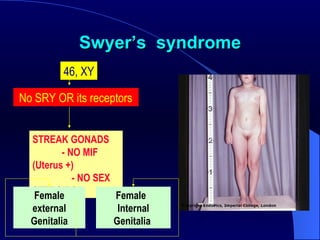
Swyer ’s   syndrome 46, XY No SRY OR its receptors   STREAK GONADS  - NO MIF (Uterus +)  - NO SEX STEROIDS Female  Internal Genitalia  Female external Genitalia
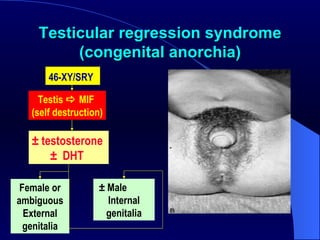
Testicular regression syndrome (congenital anorchia) 46-XY/SRY   Testis    MIF  (self destruction) ± testosterone  ±  DHT   ± Male  Internal genitalia Female or ambiguous External genitalia
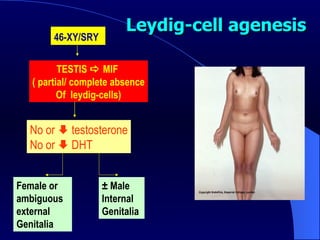
Leydig-cell agenesis 46-XY/SRY   TESTIS    MIF  ( partial/ complete absence Of  leydig-cells) No or    testosterone No or    DHT  ± Male  Internal Genitalia  Female or ambiguous external Genitalia
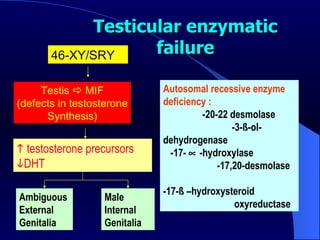
Testicular enzymatic failure 46-XY/SRY  Testis    MIF (defects in testosterone Synthesis)    testosterone precursors   DHT Male  Internal Genitalia  Ambiguous  External Genitalia   Autosomal recessive enzyme deficiency :  -20-22 desmolase  -3- ß -ol-dehydrogenase  -17-    -hydroxylase  -17,20-desmolase  -17- ß  –hydroxysteroid  oxyreductase
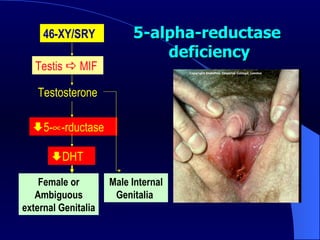
5-alpha-reductase  deficiency 46-XY/SRY  Testis    MIF  Testosterone   5-  -rductase Male Internal Genitalia   Female or Ambiguous external Genitalia    DHT
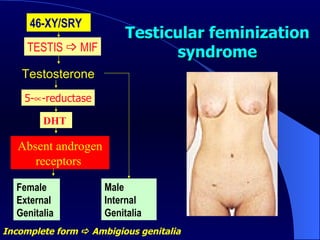
Testicular feminization syndrome 46-XY/SRY  TESTIS    MIF Testosterone  5-  -reductase DHT  Absent androgen receptors  Male Internal Genitalia   Female External Genitalia   Incomplete form    Ambigious genitalia
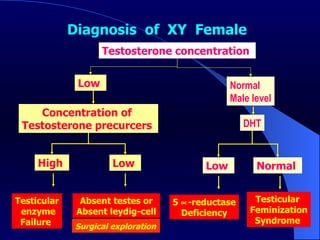
Diagnosis  of  XY  Female   Testosterone concentration  Normal Male level DHT Normal  Low  Testicular  Feminization Syndrome  5   -reductase Deficiency Low  Concentration of  Testosterone precurcers   Low  High  Absent testes or Absent leydig-cell   Testicular enzyme Failure  Surgical exploration
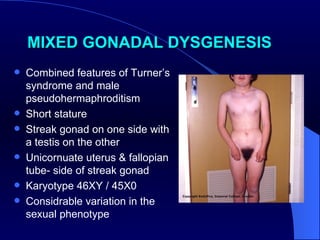
MIXED GONADAL DYSGENESIS Combined features of Turner ’s syndrome and male pseudohermaphroditism  Short stature Streak gonad on one side with a testis on the other Unicornuate uterus & fallopian tube- side of streak gonad  Karyotype 46XY / 45X0 Considrable variation in the sexual phenotype
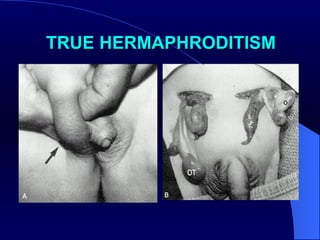
TRUE HERMAPHRODITISM •  Gonads : - ovary one side and testis on the other or - bilateral ovotestis •  Karyotype : 46,XX most common(57%); XY(13%) and XX/XY(30%) •  Internal genitalia : Both mullerian and wolffian derivates •  Phenotype is variable •  Gonadal biopsy is required for confirming diagnosis
TRUE HERMAPHRODITISM
DYSEMBROGENESIS genital ambiguity with associated anomalies Can occur in both genitic males and genitic females Most common genital malformation : - Penoscrotal transposition - Agenesis of phallus in a genitic male Coexistence of other caudal or urologic abnormalities should strongly suggest dysembryogenisis
CLINICAL PRESENTATION OF INTERSEXUALITY AT BIRTH Ambiguous genitalia DURING CHILDHOOD Heterosexual features  AT ADOLESSCENCE Delayed or Heterosexual Puberty
AMBIGUOUS  GENITALIA  AT BIRTH The external genital organs look unusual, making it impossible to identify the sex of the newborn  from its outward appearance. Any one of the following : A small, hypospadiac phallus and unilaterally undescended gonad. An enlarged phallus with bilaterally impalpable gonads. An enlarged phallus and a vagina in the same infant.
MANAGEMENT OF NEWBORN WITH AMBIGUOUS GENITALIA GENERAL GIUDELINES Medical and social emergency Avoid immediate declaration of sex Proper counselling of the parents Team management; obstetrician, neonatologist, pediatric endocrinolgist, genetist and paediatric surgeon.
MANAGEMENT OF NEWBORN WITH AMBIGUOUS GENITALIA DIAGNOSIS History : pregnancy; family  Detailed examination : abdomen; pelvis; external genitalia; urethral and anal openings. Federman ’s rule: a palpable gonad below the inguinal ligament is testes until proven otherwise
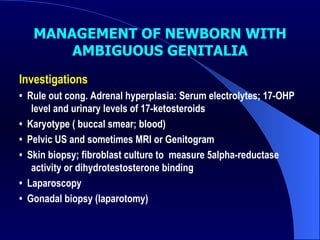
MANAGEMENT OF NEWBORN WITH AMBIGUOUS GENITALIA Investigations  •  Rule out cong. Adrenal hyperplasia: Serum electrolytes; 17-OHP level and urinary levels of 17-ketosteroids  •  Karyotype ( buccal smear; blood) •   Pelvic US and sometimes MRI or Genitogram  •  Skin biopsy; fibroblast culture to  measure 5alpha-reductase activity or dihydrotestosterone binding •  Laparoscopy •  Gonadal biopsy (laparotomy)
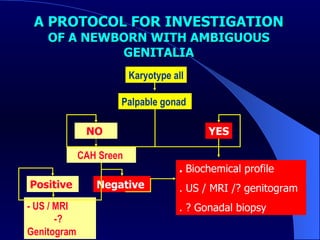
A PROTOCOL FOR INVESTIGATION  OF A NEWBORN WITH AMBIGUOUS GENITALIA Karyotype all Palpable gonad  YES NO  CAH Sreen  Positive  - US / MRI  -? Genitogram  Negative  .  Biochemical profile . US / MRI /? genitogram . ? Gonadal biopsy
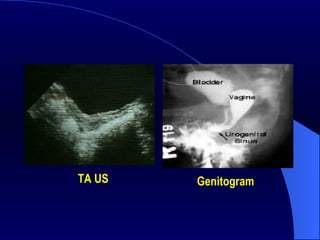
Genitogram  TA US
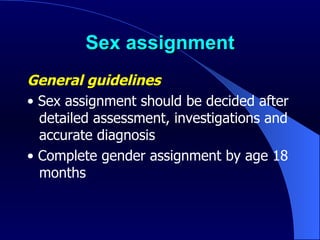
Sex assignment General guidelines   •   Sex assignment should be decided after detailed assessment, investigations and accurate diagnosis •  Complete gender assignment by age 18 months
Sex assignment •  Male gender assignment : - stretched phallus > 2 cm - erectile tissue - lack of severe hypospadias •  Female gender assignment : - inadequate phallus - cervix and uterus present In difficult cases;  sex assignment should be to the sex which can be surgically made to be adequate for coitus
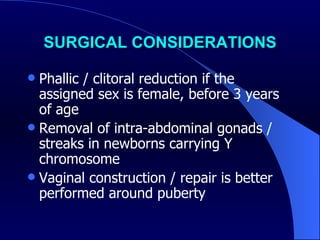
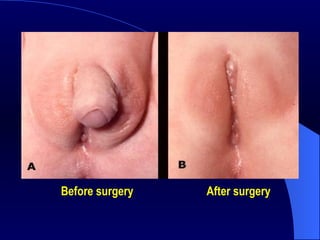
SURGICAL CONSIDERATIONS Phallic / clitoral reduction if the assigned sex is female, before 3 years of age  Removal of intra-abdominal gonads / streaks in newborns carrying Y chromosome Vaginal construction / repair is better performed around puberty
Before surgery   After surgery
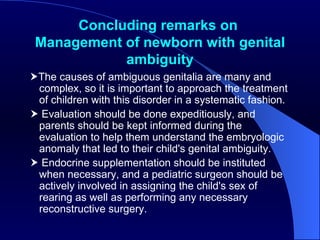
Concluding remarks on  Management of newborn with  genital ambiguity  The causes of ambiguous genitalia are many and complex, so it is important to approach the treatment of children with this disorder in a systematic fashion.    Evaluation should be done expeditiously, and parents should be kept informed during the evaluation to help them understand the embryologic anomaly that led to their child's genital ambiguity.    Endocrine supplementation should be instituted when necessary, and a pediatric surgeon should be actively involved in assigning the child's sex of rearing as well as performing any necessary reconstructive surgery.
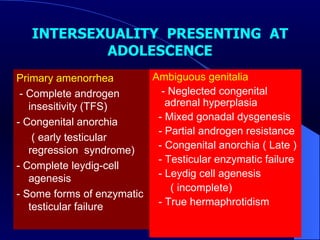
INTERSEXUALITY  PRESENTING  AT ADOLESCENCE Primary amenorrhea  - Complete androgen insesitivity (TFS) - Congenital anorchia  ( early testicular  regression  syndrome) - Complete leydig-cell agenesis  - Some forms of enzymatic testicular failure Ambiguous genitalia - Neglected congenital adrenal hyperplasia - Mixed gonadal dysgenesis - Partial androgen resistance - Congenital anorchia ( Late ) - Testicular enzymatic failure  - Leydig cell agenesis ( incomplete)  - True hermaphrotidism
MANAGEMENT OF INTERSEXUALITY  PRESENTING  AT ADOLESCENCE Cortisol replacement therapy and ? Corrective surgery in CAH Corrective surgery in drug induced cliteromegally In almost all other instances (XY- FEMALE), whatever the diagnosis is to  Maintain the gender role as female In some cases of  enzymatic testicular defects or 5    -reductase deficiency : Some May seek to change the gender role
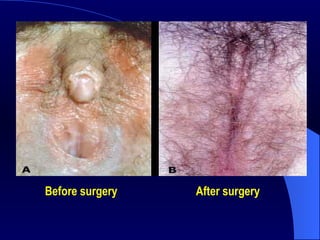
INTERSEXUALITY  PRESENTING  AT ADOLESCENCE   Surgical aspects of manegement   Clitoral reduction Removal of gonads in the presence of Y chromosome Vaginal repair and construction
Before surgery   After surgery
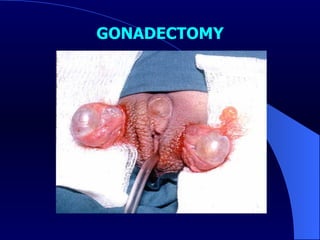
GONADECTOMY
VAGINAL CREATION
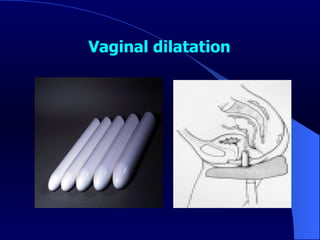
Vaginal dilatation
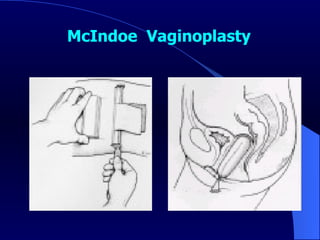
McIndoe  Vaginoplasty
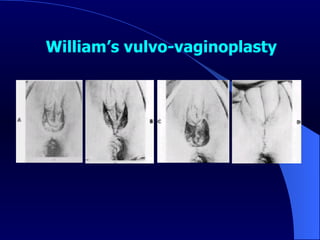
William’s vulvo-vaginoplasty
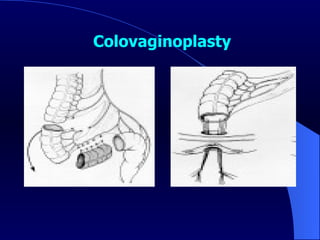
Colovaginoplasty
Transsexualism Transsexualism occurs when a person strongly believes that he or she  belong to the opposite sex. This is typically a lifelong feeling and results in varied degrees of physical/external changes These patients should be referred to the psychiatrist
Concluding remarks  Management of adolescent  with  intersex By following an approach that is based on a few embryological; physiological and anatomical  principles-and with a minimum of tests- the clinician can arrive at a prompt and accurate diagnosis in patients with intersexuality If such a patient is managed correctly, she or he may live a happy, well adjusted life and may even be fertile If the patient is managed incorrectly, she or he may be doomed to live as a sexual freak in loneliness and frustration Gynecologists, endocrinologists, plastic surgeons, urologists and psychiatrists should be actively involved in the management of these patients
Thank You For Your Attention Dr. J.Yousef  FICS,FRCOG e-mail : ramoamman@yahoo.co.uk

Intersexuality

  • 1.
    INTERSEXUALITY Dr. JehadYousef FICS, FRCOG Alhayat ART Center Amman – Jordan
  • 2.
    Defining Sex andGender Gender identity (Psychological sex) Inner sense of owns maleness / femaleness. Sex of rearing Gender role Sexual identity (Organic sex) The biologic sexual differentiation Chromosomal sex Gonadal sex Internal genital sex External genital sex Hormonal sex
  • 3.
    Human sexual differentiationChromosomal sex Gonadal sex External genital sex Internal genital sex SEX ASSIGNMENT Gender identity and role Sex of rearing
  • 4.
  • 5.
    Gonadal development SRY-gene(TDF) Short arm of Y chromosome Bipotential Gonad 2 X chromosomes Receptors For H -Y antigen OVARY TESTES Present Absent
  • 6.
  • 7.
    External genital organsdeveloment Female Male Urogenital sinus
  • 8.
    Leydig cells Sertolicells Testosterone Mullerian inhibiting factor Wollfian duct 5a-reductase Urogenital sinus Regrsession of Muuleian ducts Male external genitalia Male internal Genital organs DHT TESTIS Male development
  • 9.
    Urogenital sinus Female external genitalia . Lower part of vagina OVARY Mullerian ducts Female internal genital Organs . Most of upper vagina . Cervix and uterus . Fallopian tubes Neutral Development Absence of androgen exposure Female development
  • 10.
    Summary of NormalSex Differentiation genetic sex is determined at fertilization. testes develop in XY fetus, ovaries develop in XX fetus. XY fetus produces MIS and androgens and XX fetus does not. XY fetus develops Wolffian ducts and XX fetus develops Mullerian ducts. XY fetus masculinizes the female genitalia to make it male and the XX fetus retains female genitalia.
  • 11.
    INTERSEX An individualin whom there is discordance between chromosomal, gonadal, internal genital, and phenotypic sex or the sex of rearing. INTERSEXUALITY: Discordance between any tow of the organic sex criteria TRANSSEXUALITY: Discordance between oganic sex and psychological sex components
  • 12.
    CLASSIFICATION OF INTERSEXUALITY1. Virilization of genitically female foetus Female pseudohemaphroditism 2. Incomplete musculinization of genitically male foetus Male pseudohermaphroditism (XY-FEMALE) 3. The presence of both ovarian and testicular tissue in the same individual True hermaphroditism 4. Chromosomal abnormality Mixed gonadal dysgenesis ( 45,X0 / 46,XY)
  • 13.
    How many childrenare born with intersex conditions? A conservative estimate is that 1 in 2000 children born will be affected by an intersex condition. 98 % of affected babies are due to congenital adrenal hyperplasia
  • 14.
    FEMALE PSEUDOHERMAPHRODITISM EXCESSFETAL ANDROGENS Congenital adrenal hyperplasia  21 -hydrxylase deficiency  11-hydroxylase deficiency  3ß-hydroxysteroid dehydrogenase deficiency EXCESS MATERNAL ANDROGENS  Maternal androgen secreting tumours (ovary, adrenal)  Maternal ingestion of androgenic drugs
  • 15.
    21-hydrxylase deficiency congenitaladrenal hyperplasia Pituitary ACTH Adrenal cortex  Androgens Cortisol Cholesterol Pregnenolone Progesterone 17-OH progesterone 21-hydroxylase Androgens Cortisol
  • 16.
    Congenital adrenal hyperplasiaThe commonest cause of genital ambiguity at birth 21-Ohas deficiency is most common form Autosomal reccessive Salt wasting form may be lethal in neonates  SERUM 17OH-progesterone (21OHase)  SERUM deoxycorticosterone, 11-deoxycotisol (11- OHase) Treatment : cortisol replacement and ? Surgery
  • 17.
    Drugs with Androgenicside effects ingested during pregnancy - Testosterone - Synthetic progestins - Danocrine - Diazoxide - Minoxidil - Phenetoin sodium - Streptomycin - Penicillamine
  • 18.
    Male pseudohermaphroditism (XY-FEMALE) Failure to produce testosterone  Pure XY gonadal dysgenesis (swyer’s syndrome)  Anatomical testicular failure (testicular regression syndrome)  Leydig-cell agenesis  Enzymatic testicular failur Failure to utelize testosterone  5-alpha-reductase deficiency  Androgen receptor deficiency * Complete androgen Insensitivity (TFS) * Incomplete androgen Insensitivity
  • 19.
    Swyer ’s syndrome 46, XY No SRY OR its receptors STREAK GONADS - NO MIF (Uterus +) - NO SEX STEROIDS Female Internal Genitalia Female external Genitalia
  • 20.
    Testicular regression syndrome(congenital anorchia) 46-XY/SRY Testis  MIF (self destruction) ± testosterone ± DHT ± Male Internal genitalia Female or ambiguous External genitalia
  • 21.
    Leydig-cell agenesis 46-XY/SRY TESTIS  MIF ( partial/ complete absence Of leydig-cells) No or  testosterone No or  DHT ± Male Internal Genitalia Female or ambiguous external Genitalia
  • 22.
    Testicular enzymatic failure46-XY/SRY Testis  MIF (defects in testosterone Synthesis)  testosterone precursors  DHT Male Internal Genitalia Ambiguous External Genitalia Autosomal recessive enzyme deficiency : -20-22 desmolase -3- ß -ol-dehydrogenase -17-  -hydroxylase -17,20-desmolase -17- ß –hydroxysteroid oxyreductase
  • 23.
    5-alpha-reductase deficiency46-XY/SRY Testis  MIF Testosterone  5-  -rductase Male Internal Genitalia Female or Ambiguous external Genitalia  DHT
  • 24.
    Testicular feminization syndrome46-XY/SRY TESTIS  MIF Testosterone 5-  -reductase DHT Absent androgen receptors Male Internal Genitalia Female External Genitalia Incomplete form  Ambigious genitalia
  • 25.
    Diagnosis of XY Female Testosterone concentration Normal Male level DHT Normal Low Testicular Feminization Syndrome 5  -reductase Deficiency Low Concentration of Testosterone precurcers Low High Absent testes or Absent leydig-cell Testicular enzyme Failure Surgical exploration
  • 26.
    MIXED GONADAL DYSGENESISCombined features of Turner ’s syndrome and male pseudohermaphroditism Short stature Streak gonad on one side with a testis on the other Unicornuate uterus & fallopian tube- side of streak gonad Karyotype 46XY / 45X0 Considrable variation in the sexual phenotype
  • 27.
    TRUE HERMAPHRODITISM • Gonads : - ovary one side and testis on the other or - bilateral ovotestis • Karyotype : 46,XX most common(57%); XY(13%) and XX/XY(30%) • Internal genitalia : Both mullerian and wolffian derivates • Phenotype is variable • Gonadal biopsy is required for confirming diagnosis
  • 28.
  • 29.
    DYSEMBROGENESIS genital ambiguitywith associated anomalies Can occur in both genitic males and genitic females Most common genital malformation : - Penoscrotal transposition - Agenesis of phallus in a genitic male Coexistence of other caudal or urologic abnormalities should strongly suggest dysembryogenisis
  • 30.
    CLINICAL PRESENTATION OFINTERSEXUALITY AT BIRTH Ambiguous genitalia DURING CHILDHOOD Heterosexual features AT ADOLESSCENCE Delayed or Heterosexual Puberty
  • 31.
    AMBIGUOUS GENITALIA AT BIRTH The external genital organs look unusual, making it impossible to identify the sex of the newborn from its outward appearance. Any one of the following : A small, hypospadiac phallus and unilaterally undescended gonad. An enlarged phallus with bilaterally impalpable gonads. An enlarged phallus and a vagina in the same infant.
  • 32.
    MANAGEMENT OF NEWBORNWITH AMBIGUOUS GENITALIA GENERAL GIUDELINES Medical and social emergency Avoid immediate declaration of sex Proper counselling of the parents Team management; obstetrician, neonatologist, pediatric endocrinolgist, genetist and paediatric surgeon.
  • 33.
    MANAGEMENT OF NEWBORNWITH AMBIGUOUS GENITALIA DIAGNOSIS History : pregnancy; family Detailed examination : abdomen; pelvis; external genitalia; urethral and anal openings. Federman ’s rule: a palpable gonad below the inguinal ligament is testes until proven otherwise
  • 34.
    MANAGEMENT OF NEWBORNWITH AMBIGUOUS GENITALIA Investigations • Rule out cong. Adrenal hyperplasia: Serum electrolytes; 17-OHP level and urinary levels of 17-ketosteroids • Karyotype ( buccal smear; blood) • Pelvic US and sometimes MRI or Genitogram • Skin biopsy; fibroblast culture to measure 5alpha-reductase activity or dihydrotestosterone binding • Laparoscopy • Gonadal biopsy (laparotomy)
  • 35.
    A PROTOCOL FORINVESTIGATION OF A NEWBORN WITH AMBIGUOUS GENITALIA Karyotype all Palpable gonad YES NO CAH Sreen Positive - US / MRI -? Genitogram Negative . Biochemical profile . US / MRI /? genitogram . ? Gonadal biopsy
  • 36.
  • 37.
    Sex assignment Generalguidelines • Sex assignment should be decided after detailed assessment, investigations and accurate diagnosis • Complete gender assignment by age 18 months
  • 38.
    Sex assignment • Male gender assignment : - stretched phallus > 2 cm - erectile tissue - lack of severe hypospadias • Female gender assignment : - inadequate phallus - cervix and uterus present In difficult cases; sex assignment should be to the sex which can be surgically made to be adequate for coitus
  • 39.
    SURGICAL CONSIDERATIONS Phallic/ clitoral reduction if the assigned sex is female, before 3 years of age Removal of intra-abdominal gonads / streaks in newborns carrying Y chromosome Vaginal construction / repair is better performed around puberty
  • 40.
    Before surgery After surgery
  • 41.
    Concluding remarks on Management of newborn with genital ambiguity  The causes of ambiguous genitalia are many and complex, so it is important to approach the treatment of children with this disorder in a systematic fashion.  Evaluation should be done expeditiously, and parents should be kept informed during the evaluation to help them understand the embryologic anomaly that led to their child's genital ambiguity.  Endocrine supplementation should be instituted when necessary, and a pediatric surgeon should be actively involved in assigning the child's sex of rearing as well as performing any necessary reconstructive surgery.
  • 42.
    INTERSEXUALITY PRESENTING AT ADOLESCENCE Primary amenorrhea - Complete androgen insesitivity (TFS) - Congenital anorchia ( early testicular regression syndrome) - Complete leydig-cell agenesis - Some forms of enzymatic testicular failure Ambiguous genitalia - Neglected congenital adrenal hyperplasia - Mixed gonadal dysgenesis - Partial androgen resistance - Congenital anorchia ( Late ) - Testicular enzymatic failure - Leydig cell agenesis ( incomplete) - True hermaphrotidism
  • 43.
    MANAGEMENT OF INTERSEXUALITY PRESENTING AT ADOLESCENCE Cortisol replacement therapy and ? Corrective surgery in CAH Corrective surgery in drug induced cliteromegally In almost all other instances (XY- FEMALE), whatever the diagnosis is to Maintain the gender role as female In some cases of enzymatic testicular defects or 5  -reductase deficiency : Some May seek to change the gender role
  • 44.
    INTERSEXUALITY PRESENTING AT ADOLESCENCE Surgical aspects of manegement Clitoral reduction Removal of gonads in the presence of Y chromosome Vaginal repair and construction
  • 45.
    Before surgery After surgery
  • 46.
  • 47.
  • 48.
  • 49.
  • 50.
  • 51.
  • 52.
    Transsexualism Transsexualism occurswhen a person strongly believes that he or she belong to the opposite sex. This is typically a lifelong feeling and results in varied degrees of physical/external changes These patients should be referred to the psychiatrist
  • 53.
    Concluding remarks Management of adolescent with intersex By following an approach that is based on a few embryological; physiological and anatomical principles-and with a minimum of tests- the clinician can arrive at a prompt and accurate diagnosis in patients with intersexuality If such a patient is managed correctly, she or he may live a happy, well adjusted life and may even be fertile If the patient is managed incorrectly, she or he may be doomed to live as a sexual freak in loneliness and frustration Gynecologists, endocrinologists, plastic surgeons, urologists and psychiatrists should be actively involved in the management of these patients
  • 54.
    Thank You ForYour Attention Dr. J.Yousef FICS,FRCOG e-mail : ramoamman@yahoo.co.uk