

Presented by:
RITEKSHA PATEL
M.PHARMACY
LIST OF CONTENT
1. INTRODUCTION
2. PRINCIPLE OF OSMOSIS
3. BASIC COMPONENT OF OSMOTIC SYSTEM
4. CLASSIFICATION OF OSMOTIC PUMP
5. FACTOR AFFECTING RELEASE OF MEDICAMENT FROM
OSMOTIC DDS
6. EVALUATION
7. MARKETED PRODUCT
8. CURRENT ISSUES
9. ADVANTAGES
10. DISADVANTAGES
2
1. Introduction
1. Osmotic drug delivery uses the osmotic pressure for
controlled delivery of drugs by using osmogens.
2. Osmosis : It refers to the process of movement of solvent
from lower concentration of solute towards higher
concentration of solute across the semipermeable
membrane.
3. Osmotic pressure: The pressure exerted by the flow of
water through a semipermeable membrane separating
two solutions with different concentrations of solute.
4. These systems can be used for both route of
administration i.e. oral and parenterals.
3
2.Principle of osmosis
Abbe Nollet first reported osmotic effect in 1748, but
Pfeffer in 1877 had been the pioneer of quantitative
measurement of osmotic effect. Van’t Hoff
established the analogy between the Pfeffer results
and the ideal gas laws by the expression
π = n2RT
Where n2 represents the molar concentration of sugar
(or other solute) in the solution, R depicts the gas
constant, and T the temperatue.
4
3. Basic component of osmotic DDS
1. Drug : itself may act as osmogen otherwise osmogenic salt
can be added in formulation
2. Semipermeable membrane:
criteria: Sufficient wet strength and water permeability
Should be biocompatible and rigid
Should be sufficient thick to withstand the pressure
within the device
Any polymer that is permeable to water but
impermeable to solute can be used as a coating
material in osmotic devices
Ex. Cellulose Acetate, Cellulose Triacetate and Ethyl
Cellulose
5
3. Hydrophilic and hydrophobic polymers :( CMC, HEC, HPMC )
4. Wicking agent : ( SLS, PVP, bentonite )
5. Solubilizing agent :(PVP, CD, PEG )
6. Osmogens:( NACL, KCL)
7. Surfactants : (poly oxyethylenated caster oil)
8. Coating solvent : ( acetone and methanol 80:20,acetone and
water 90:10 )
9. Plasticizer : ( phthalates, benzoates, TEC )
10. Flux regulator : ( poly propylene, poly butylene )
11. Pore forming agent:( Calcium nitrate , potassium sulphate)
6
4. Classification of osmotic DDS
1. Implantable Osmotic Drug Delivery System
2. Oral Osmotic Drug Delivery System
7
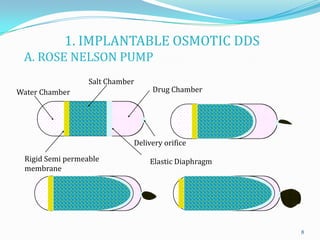
1. IMPLANTABLE OSMOTIC DDS
A. ROSE NELSON PUMP
Drug Chamber
Elastic Diaphragm
Salt Chamber
Rigid Semi permeable
membrane
Water Chamber
Delivery orifice
8
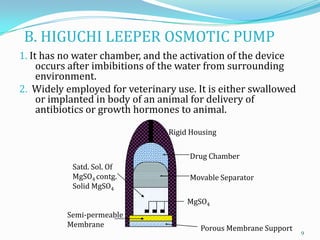
B. HIGUCHI LEEPER OSMOTIC PUMP
1. It has no water chamber, and the activation of the device
occurs after imbibitions of the water from surrounding
environment.
2. Widely employed for veterinary use. It is either swallowed
or implanted in body of an animal for delivery of
antibiotics or growth hormones to animal.
Porous Membrane Support
MgSO4
Movable Separator
Drug Chamber
Rigid Housing
Satd. Sol. Of
MgSO4 contg.
Solid MgSO4
Semi-permeable
Membrane
9
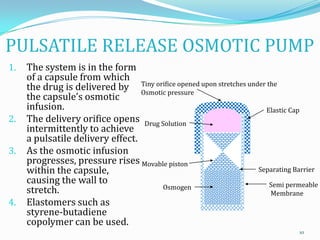
PULSATILE RELEASE OSMOTIC PUMP
1. The system is in the form
of a capsule from which
the drug is delivered by
the capsule’s osmotic
infusion.
2. The delivery orifice opens
intermittently to achieve
a pulsatile delivery effect.
3. As the osmotic infusion
progresses, pressure rises
within the capsule,
causing the wall to
stretch.
4. Elastomers such as
styrene-butadiene
copolymer can be used.
Osmogen Semi permeable
Membrane
Separating Barrier
Elastic Cap
Movable piston
Drug Solution
Tiny orifice opened upon stretches under the
Osmotic pressure
10
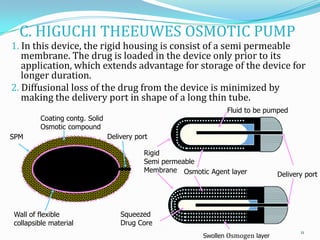
C. HIGUCHI THEEUWES OSMOTIC PUMP
1. In this device, the rigid housing is consist of a semi permeable
membrane. The drug is loaded in the device only prior to its
application, which extends advantage for storage of the device for
longer duration.
2. Diffusional loss of the drug from the device is minimized by
making the delivery port in shape of a long thin tube.
Wall of flexible
collapsible material
SPM
Coating contg. Solid
Osmotic compound
Delivery port
Osmotic Agent layer
Rigid
Semi permeable
Membrane
Fluid to be pumped
Delivery port
Swollen Osmogen layer
Squeezed
Drug Core
11
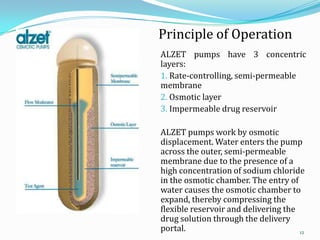
Principle of Operation
ALZET pumps have 3 concentric
layers:
1. Rate-controlling, semi-permeable
membrane
2. Osmotic layer
3. Impermeable drug reservoir
ALZET pumps work by osmotic
displacement. Water enters the pump
across the outer, semi-permeable
membrane due to the presence of a
high concentration of sodium chloride
in the osmotic chamber. The entry of
water causes the osmotic chamber to
expand, thereby compressing the
flexible reservoir and delivering the
drug solution through the delivery
portal. 12
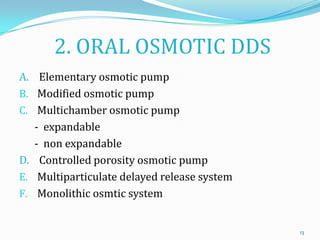
2. ORAL OSMOTIC DDS
A. Elementary osmotic pump
B. Modified osmotic pump
C. Multichamber osmotic pump
- expandable
- non expandable
D. Controlled porosity osmotic pump
E. Multiparticulate delayed release system
F. Monolithic osmtic system
13
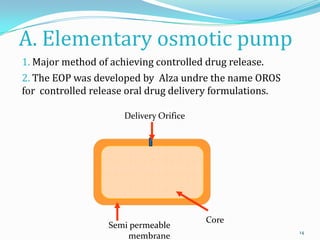
A. Elementary osmotic pump
Semi permeable
membrane
Core
Delivery Orifice
1. Major method of achieving controlled drug release.
2. The EOP was developed by Alza undre the name OROS
for controlled release oral drug delivery formulations.
14
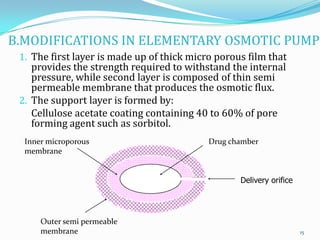
B.MODIFICATIONS IN ELEMENTARY OSMOTIC PUMP
1. The first layer is made up of thick micro porous film that
provides the strength required to withstand the internal
pressure, while second layer is composed of thin semi
permeable membrane that produces the osmotic flux.
2. The support layer is formed by:
Cellulose acetate coating containing 40 to 60% of pore
forming agent such as sorbitol.
Delivery orifice
Drug chamberInner microporous
membrane
Outer semi permeable
membrane 15
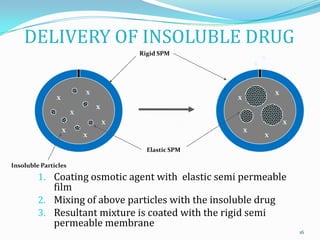
DELIVERY OF INSOLUBLE DRUG
1. Coating osmotic agent with elastic semi permeable
film
2. Mixing of above particles with the insoluble drug
3. Resultant mixture is coated with the rigid semi
permeable membrane
x
x
x
x
x
x
x
x
x
x
x
x
x
x
Elastic SPM
Rigid SPM
Insoluble Particles
16
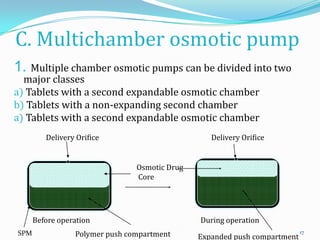
C. Multichamber osmotic pump
1. Multiple chamber osmotic pumps can be divided into two
major classes
a) Tablets with a second expandable osmotic chamber
b) Tablets with a non-expanding second chamber
a) Tablets with a second expandable osmotic chamber
Osmotic Drug
Core
SPM
Delivery Orifice Delivery Orifice
Polymer push compartment Expanded push compartment
Before operation During operation
17
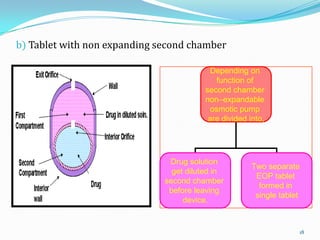
b) Tablet with non expanding second chamber
Depending on
function of
second chamber
non–expandable
osmotic pump
are divided into,
Drug solution
get diluted in
second chamber
before leaving
device.
Two separate
EOP tablet
formed in
single tablet
18
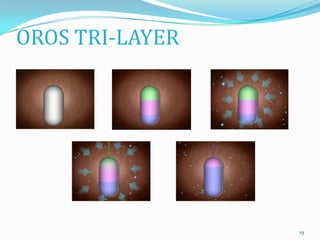
OROS TRI-LAYER
19
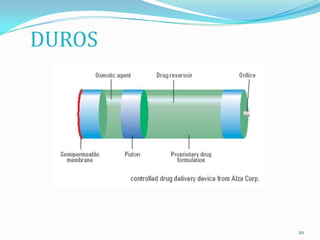
DUROS
20
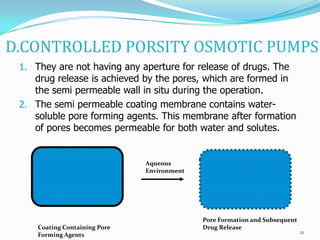
D.CONTROLLED PORSITY OSMOTIC PUMPS
1. They are not having any aperture for release of drugs. The
drug release is achieved by the pores, which are formed in
the semi permeable wall in situ during the operation.
2. The semi permeable coating membrane contains water-
soluble pore forming agents. This membrane after formation
of pores becomes permeable for both water and solutes.
Coating Containing Pore
Forming Agents
Pore Formation and Subsequent
Drug Release
Aqueous
Environment
21
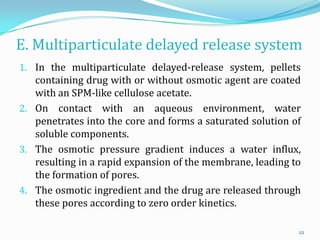
E. Multiparticulate delayed release system
1. In the multiparticulate delayed-release system, pellets
containing drug with or without osmotic agent are coated
with an SPM-like cellulose acetate.
2. On contact with an aqueous environment, water
penetrates into the core and forms a saturated solution of
soluble components.
3. The osmotic pressure gradient induces a water influx,
resulting in a rapid expansion of the membrane, leading to
the formation of pores.
4. The osmotic ingredient and the drug are released through
these pores according to zero order kinetics.
22
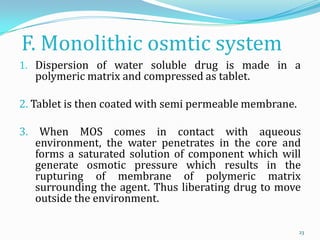
F. Monolithic osmtic system
1. Dispersion of water soluble drug is made in a
polymeric matrix and compressed as tablet.
2. Tablet is then coated with semi permeable membrane.
3. When MOS comes in contact with aqueous
environment, the water penetrates in the core and
forms a saturated solution of component which will
generate osmotic pressure which results in the
rupturing of membrane of polymeric matrix
surrounding the agent. Thus liberating drug to move
outside the environment.
23
5. Factors affecting release of medicament
from Osmotic DDS
A. Solubility
B. Osmotic pressure
C. Delivery orifice
D. Membrane
A. Solubility
1. Solubility of drug is one of the most important factors
since kinetic of osmotic release is directly related to the
drug solubility.
2. Both highly soluble and poorly soluble drugs are not good
candidates for osmotic drug delivery.
24
B. Osmotic pressure
1. The next release-controlling factor that must be optimized
is the osmotic pressure gradient between inside the
compartment and the external environment.
2. The release rate of a drug from an osmotic system is
directly proportional to the osmotic pressure of the core
formulation
C. Delivery orifice
1. To achieve an optimal zero order delivery profile,the
orifice must be smaller .
2. The typical orifice size in osmotic pumps ranges from
600µ to 1 mm.
25
D. Membrane
1. Type and nature of polymer
 polymer that is permeable to water but impermeable to
solute can be selected
 Ex. cellulose esters such as cellulose acetate, cellulose
diacetate, cellulose triacetate, cellulose propionate,
cellulose acetate butyrate
2. Membrane thickness
 release rate from osmotic systems is inversely proportional
to membrane thickness
3. Wet strength
4. Water permeability
26
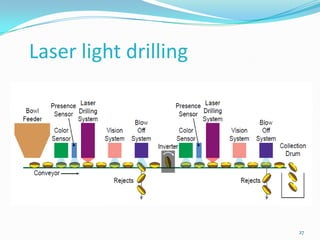
Laser light drilling
27
6.EVALUATION
1. IN VITRO EVALUATION
2. IN VIVO EVALUATION
28
7.MARKETED PRODUCTS
1. Products Incorporating ALZA's OROS® Technology
A. Cardura® XL (doxazosin mesylate) sold in Germany for
the treatment of hypertension.
B. Covera-HS® (verapamil) a Controlled Release system
for the management of hypertension and angina pectoris.
C. Sudafed® (pseudoephedrine) for 24-hour relief of cold
and other respiratory allergies.
D. Procardia XL® (nifedipine) extended-release tablet for
the treatment of angina and hypertension.
2.Products Incorporating ALZA's DUROS® Implant
Technology
A. Viadur® (leuprolide acetate implant) delivers
leuprolide continuously for 12 months.
29
8. CURRENT ISSUES
1. Microporous bilayer osmotic tablet for colon-specific
delivery .
2. Development and evaluation of push-pull based osmotic
delivery system for pramipexole
 offer significant patient benefits by providing enhanced
efficacy and reduced side effects and may also reduce the
number of daily doses compared to conventional therapies.
3. A controlled porosity osmotic pump system with biphasic
release of theophylline
 The developed system was composed of a tablet-in-tablet
(TNT) core and a controlled porosity coating membrane
 osmotic agent: sodium phosphate, sodium chloride .
30
9. Advantages
1. Zero order release
2. High release rate
3. High degree of IVIVC
4. Production scale up is easy
5. Increase efficacy of drug
6. Controlled drug delivery
7. Reduce dosing frequency
31
10. Disadvantages
1. Expensive
2. Chance of toxicity due to dose dumping
3. Release of drug depends on :
- size of drug port
- surface area
- thickness and composition of membrane
32
33
34

OSMOTIC DRUG DELIVERY SYSTEM

  • 1.
  • 2.
    LIST OF CONTENT 1.INTRODUCTION 2. PRINCIPLE OF OSMOSIS 3. BASIC COMPONENT OF OSMOTIC SYSTEM 4. CLASSIFICATION OF OSMOTIC PUMP 5. FACTOR AFFECTING RELEASE OF MEDICAMENT FROM OSMOTIC DDS 6. EVALUATION 7. MARKETED PRODUCT 8. CURRENT ISSUES 9. ADVANTAGES 10. DISADVANTAGES 2
  • 3.
    1. Introduction 1. Osmoticdrug delivery uses the osmotic pressure for controlled delivery of drugs by using osmogens. 2. Osmosis : It refers to the process of movement of solvent from lower concentration of solute towards higher concentration of solute across the semipermeable membrane. 3. Osmotic pressure: The pressure exerted by the flow of water through a semipermeable membrane separating two solutions with different concentrations of solute. 4. These systems can be used for both route of administration i.e. oral and parenterals. 3
  • 4.
    2.Principle of osmosis AbbeNollet first reported osmotic effect in 1748, but Pfeffer in 1877 had been the pioneer of quantitative measurement of osmotic effect. Van’t Hoff established the analogy between the Pfeffer results and the ideal gas laws by the expression π = n2RT Where n2 represents the molar concentration of sugar (or other solute) in the solution, R depicts the gas constant, and T the temperatue. 4
  • 5.
    3. Basic componentof osmotic DDS 1. Drug : itself may act as osmogen otherwise osmogenic salt can be added in formulation 2. Semipermeable membrane: criteria: Sufficient wet strength and water permeability Should be biocompatible and rigid Should be sufficient thick to withstand the pressure within the device Any polymer that is permeable to water but impermeable to solute can be used as a coating material in osmotic devices Ex. Cellulose Acetate, Cellulose Triacetate and Ethyl Cellulose 5
  • 6.
    3. Hydrophilic andhydrophobic polymers :( CMC, HEC, HPMC ) 4. Wicking agent : ( SLS, PVP, bentonite ) 5. Solubilizing agent :(PVP, CD, PEG ) 6. Osmogens:( NACL, KCL) 7. Surfactants : (poly oxyethylenated caster oil) 8. Coating solvent : ( acetone and methanol 80:20,acetone and water 90:10 ) 9. Plasticizer : ( phthalates, benzoates, TEC ) 10. Flux regulator : ( poly propylene, poly butylene ) 11. Pore forming agent:( Calcium nitrate , potassium sulphate) 6
  • 7.
    4. Classification ofosmotic DDS 1. Implantable Osmotic Drug Delivery System 2. Oral Osmotic Drug Delivery System 7
  • 8.
    1. IMPLANTABLE OSMOTICDDS A. ROSE NELSON PUMP Drug Chamber Elastic Diaphragm Salt Chamber Rigid Semi permeable membrane Water Chamber Delivery orifice 8
  • 9.
    B. HIGUCHI LEEPEROSMOTIC PUMP 1. It has no water chamber, and the activation of the device occurs after imbibitions of the water from surrounding environment. 2. Widely employed for veterinary use. It is either swallowed or implanted in body of an animal for delivery of antibiotics or growth hormones to animal. Porous Membrane Support MgSO4 Movable Separator Drug Chamber Rigid Housing Satd. Sol. Of MgSO4 contg. Solid MgSO4 Semi-permeable Membrane 9
  • 10.
    PULSATILE RELEASE OSMOTICPUMP 1. The system is in the form of a capsule from which the drug is delivered by the capsule’s osmotic infusion. 2. The delivery orifice opens intermittently to achieve a pulsatile delivery effect. 3. As the osmotic infusion progresses, pressure rises within the capsule, causing the wall to stretch. 4. Elastomers such as styrene-butadiene copolymer can be used. Osmogen Semi permeable Membrane Separating Barrier Elastic Cap Movable piston Drug Solution Tiny orifice opened upon stretches under the Osmotic pressure 10
  • 11.
    C. HIGUCHI THEEUWESOSMOTIC PUMP 1. In this device, the rigid housing is consist of a semi permeable membrane. The drug is loaded in the device only prior to its application, which extends advantage for storage of the device for longer duration. 2. Diffusional loss of the drug from the device is minimized by making the delivery port in shape of a long thin tube. Wall of flexible collapsible material SPM Coating contg. Solid Osmotic compound Delivery port Osmotic Agent layer Rigid Semi permeable Membrane Fluid to be pumped Delivery port Swollen Osmogen layer Squeezed Drug Core 11
  • 12.
    Principle of Operation ALZETpumps have 3 concentric layers: 1. Rate-controlling, semi-permeable membrane 2. Osmotic layer 3. Impermeable drug reservoir ALZET pumps work by osmotic displacement. Water enters the pump across the outer, semi-permeable membrane due to the presence of a high concentration of sodium chloride in the osmotic chamber. The entry of water causes the osmotic chamber to expand, thereby compressing the flexible reservoir and delivering the drug solution through the delivery portal. 12
  • 13.
    2. ORAL OSMOTICDDS A. Elementary osmotic pump B. Modified osmotic pump C. Multichamber osmotic pump - expandable - non expandable D. Controlled porosity osmotic pump E. Multiparticulate delayed release system F. Monolithic osmtic system 13
  • 14.
    A. Elementary osmoticpump Semi permeable membrane Core Delivery Orifice 1. Major method of achieving controlled drug release. 2. The EOP was developed by Alza undre the name OROS for controlled release oral drug delivery formulations. 14
  • 15.
    B.MODIFICATIONS IN ELEMENTARYOSMOTIC PUMP 1. The first layer is made up of thick micro porous film that provides the strength required to withstand the internal pressure, while second layer is composed of thin semi permeable membrane that produces the osmotic flux. 2. The support layer is formed by: Cellulose acetate coating containing 40 to 60% of pore forming agent such as sorbitol. Delivery orifice Drug chamberInner microporous membrane Outer semi permeable membrane 15
  • 16.
    DELIVERY OF INSOLUBLEDRUG 1. Coating osmotic agent with elastic semi permeable film 2. Mixing of above particles with the insoluble drug 3. Resultant mixture is coated with the rigid semi permeable membrane x x x x x x x x x x x x x x Elastic SPM Rigid SPM Insoluble Particles 16
  • 17.
    C. Multichamber osmoticpump 1. Multiple chamber osmotic pumps can be divided into two major classes a) Tablets with a second expandable osmotic chamber b) Tablets with a non-expanding second chamber a) Tablets with a second expandable osmotic chamber Osmotic Drug Core SPM Delivery Orifice Delivery Orifice Polymer push compartment Expanded push compartment Before operation During operation 17
  • 18.
    b) Tablet withnon expanding second chamber Depending on function of second chamber non–expandable osmotic pump are divided into, Drug solution get diluted in second chamber before leaving device. Two separate EOP tablet formed in single tablet 18
  • 19.
  • 20.
  • 21.
    D.CONTROLLED PORSITY OSMOTICPUMPS 1. They are not having any aperture for release of drugs. The drug release is achieved by the pores, which are formed in the semi permeable wall in situ during the operation. 2. The semi permeable coating membrane contains water- soluble pore forming agents. This membrane after formation of pores becomes permeable for both water and solutes. Coating Containing Pore Forming Agents Pore Formation and Subsequent Drug Release Aqueous Environment 21
  • 22.
    E. Multiparticulate delayedrelease system 1. In the multiparticulate delayed-release system, pellets containing drug with or without osmotic agent are coated with an SPM-like cellulose acetate. 2. On contact with an aqueous environment, water penetrates into the core and forms a saturated solution of soluble components. 3. The osmotic pressure gradient induces a water influx, resulting in a rapid expansion of the membrane, leading to the formation of pores. 4. The osmotic ingredient and the drug are released through these pores according to zero order kinetics. 22
  • 23.
    F. Monolithic osmticsystem 1. Dispersion of water soluble drug is made in a polymeric matrix and compressed as tablet. 2. Tablet is then coated with semi permeable membrane. 3. When MOS comes in contact with aqueous environment, the water penetrates in the core and forms a saturated solution of component which will generate osmotic pressure which results in the rupturing of membrane of polymeric matrix surrounding the agent. Thus liberating drug to move outside the environment. 23
  • 24.
    5. Factors affectingrelease of medicament from Osmotic DDS A. Solubility B. Osmotic pressure C. Delivery orifice D. Membrane A. Solubility 1. Solubility of drug is one of the most important factors since kinetic of osmotic release is directly related to the drug solubility. 2. Both highly soluble and poorly soluble drugs are not good candidates for osmotic drug delivery. 24
  • 25.
    B. Osmotic pressure 1.The next release-controlling factor that must be optimized is the osmotic pressure gradient between inside the compartment and the external environment. 2. The release rate of a drug from an osmotic system is directly proportional to the osmotic pressure of the core formulation C. Delivery orifice 1. To achieve an optimal zero order delivery profile,the orifice must be smaller . 2. The typical orifice size in osmotic pumps ranges from 600µ to 1 mm. 25
  • 26.
    D. Membrane 1. Typeand nature of polymer  polymer that is permeable to water but impermeable to solute can be selected  Ex. cellulose esters such as cellulose acetate, cellulose diacetate, cellulose triacetate, cellulose propionate, cellulose acetate butyrate 2. Membrane thickness  release rate from osmotic systems is inversely proportional to membrane thickness 3. Wet strength 4. Water permeability 26
  • 27.
  • 28.
    6.EVALUATION 1. IN VITROEVALUATION 2. IN VIVO EVALUATION 28
  • 29.
    7.MARKETED PRODUCTS 1. ProductsIncorporating ALZA's OROS® Technology A. Cardura® XL (doxazosin mesylate) sold in Germany for the treatment of hypertension. B. Covera-HS® (verapamil) a Controlled Release system for the management of hypertension and angina pectoris. C. Sudafed® (pseudoephedrine) for 24-hour relief of cold and other respiratory allergies. D. Procardia XL® (nifedipine) extended-release tablet for the treatment of angina and hypertension. 2.Products Incorporating ALZA's DUROS® Implant Technology A. Viadur® (leuprolide acetate implant) delivers leuprolide continuously for 12 months. 29
  • 30.
    8. CURRENT ISSUES 1.Microporous bilayer osmotic tablet for colon-specific delivery . 2. Development and evaluation of push-pull based osmotic delivery system for pramipexole  offer significant patient benefits by providing enhanced efficacy and reduced side effects and may also reduce the number of daily doses compared to conventional therapies. 3. A controlled porosity osmotic pump system with biphasic release of theophylline  The developed system was composed of a tablet-in-tablet (TNT) core and a controlled porosity coating membrane  osmotic agent: sodium phosphate, sodium chloride . 30
  • 31.
    9. Advantages 1. Zeroorder release 2. High release rate 3. High degree of IVIVC 4. Production scale up is easy 5. Increase efficacy of drug 6. Controlled drug delivery 7. Reduce dosing frequency 31
  • 32.
    10. Disadvantages 1. Expensive 2.Chance of toxicity due to dose dumping 3. Release of drug depends on : - size of drug port - surface area - thickness and composition of membrane 32
  • 33.
  • 34.

Editor's Notes

  • #15 The EOP was developed by Alza undre the name OROS for controlled release oral drug delivery formulations