
COLON SPECIFIC DRUG
DELIVERY SYSTEM
1
Contents
 Introduction
 Advantages & limitations
 Anatomy of physiology of colon
 Factors related to colonic drug delivery
 Drug absorption in the colon
 Role of absorption enhancers
 Approaches to colon specific drug delivery
2
Introduction
 Colonic delivery refers to targeted delivery of drugs
into the lower GI tract, which occurs primarily in the
large intestine i.e. colon.
Most of the conventional drug delivery for treating
colon disorders are failing as the drugs do not reach
the site of action in appropriate concentrations.
 Colonic drug delivery has gained importance not
just for delivery of drugs for the treatment of local
diseases associated with colon but also for systemic
delivery of proteins, therapeutic peptides etc.
3
Advantages of C.S.D.D.S
Targeted drug delivery
Require small drug dose
Reduce dosing frequency
Less incidence of side effect
Reduce gastric irritation
Improve patient compliance
It has low hostile environment, less peptidase activity
so peptides, oral vaccines, insulin, growth hormones,
can be given through this route.
4
Multiple manufacturing steps.
Microflora affects activity of drug via metabolic degradation of
the drug.
Bioavailability of drug may be low due to potentially binding of
drug in a nonspecific way to dietary residues, intestinal
secretions, mucus or faecal matter.
Non availability of an appropriate dissolution testing method to
evaluate the dosage form in-vitro.
Drug should be in solution form before absorption and there for
rate limiting step for poor soluble drugs.
Limitations
5
Anatomy & physiology of colon
The GI tract is divided into stomach, small intestine & large
intestine.
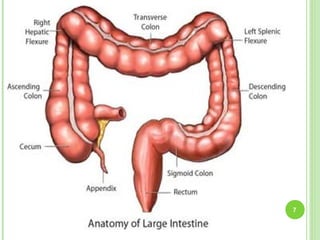
The colon itself is made up of the caecum, ascending colon,
hepatic flexure, transverse colon, splenic flexure, descending
colon, sigmoid colon.
It is about 1.5 m long.
Although it varies in diameter from approx 9 cm in caecum
& 2 cm in sigmoid colon.
The wall of colon is composed of 4 layers: serosa,
muscularis externa, sub mucosa & mucosa.
Serosa consists of areolar tissue, muscularis externa
composed of an inner circular layer of fibers, sub mucosa is
layer of connective tissue, mucosa is divided into epithelium
lamina propria & muscularis mucosae
6
7
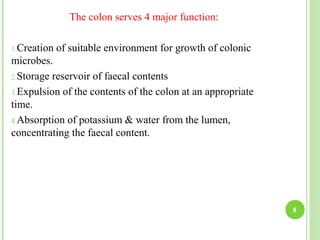
The colon serves 4 major function:
1.Creation of suitable environment for growth of colonic
microbes.
2.Storage reservoir of faecal contents
3.Expulsion of the contents of the colon at an appropriate
time.
4.Absorption of potassium & water from the lumen,
concentrating the faecal content.
8
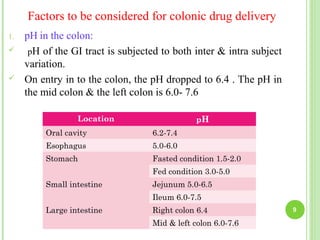
Factors to be considered for colonic drug delivery
1. pH in the colon:
 pH of the GI tract is subjected to both inter & intra subject
variation.
 On entry in to the colon, the pH dropped to 6.4 . The pH in
the mid colon & the left colon is 6.0- 7.6
9
Location pH
Oral cavity 6.2-7.4
Esophagus 5.0-6.0
Stomach Fasted condition 1.5-2.0
Fed condition 3.0-5.0
Small intestine Jejunum 5.0-6.5
Ileum 6.0-7.5
Large intestine Right colon 6.4
Mid & left colon 6.0-7.6
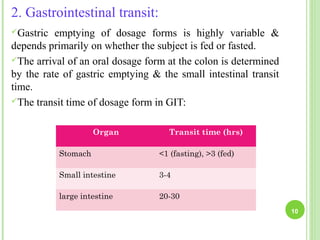
2. Gastrointestinal transit:
Gastric emptying of dosage forms is highly variable &
depends primarily on whether the subject is fed or fasted.
The arrival of an oral dosage form at the colon is determined
by the rate of gastric emptying & the small intestinal transit
time.
The transit time of dosage form in GIT:
10
Organ Transit time (hrs)
Stomach <1 (fasting), >3 (fed)
Small intestine 3-4
large intestine 20-30
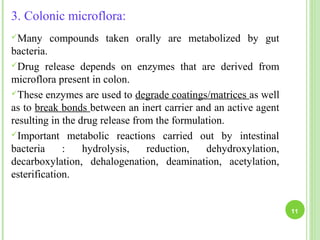
3. Colonic microflora:
Many compounds taken orally are metabolized by gut
bacteria.
Drug release depends on enzymes that are derived from
microflora present in colon.
These enzymes are used to degrade coatings/matrices as well
as to break bonds between an inert carrier and an active agent
resulting in the drug release from the formulation.
Important metabolic reactions carried out by intestinal
bacteria : hydrolysis, reduction, dehydroxylation,
decarboxylation, dehalogenation, deamination, acetylation,
esterification.
11
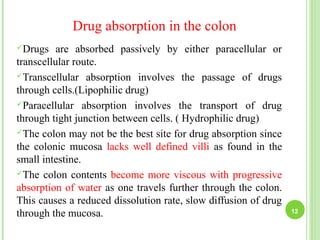
Drug absorption in the colon
Drugs are absorbed passively by either paracellular or
transcellular route.
Transcellular absorption involves the passage of drugs
through cells.(Lipophilic drug)
Paracellular absorption involves the transport of drug
through tight junction between cells. ( Hydrophilic drug)
The colon may not be the best site for drug absorption since
the colonic mucosa lacks well defined villi as found in the
small intestine.
The colon contents become more viscous with progressive
absorption of water as one travels further through the colon.
This causes a reduced dissolution rate, slow diffusion of drug
through the mucosa. 12
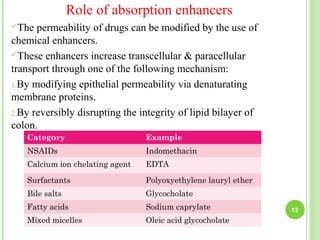
Role of absorption enhancers
The permeability of drugs can be modified by the use of
chemical enhancers.
These enhancers increase transcellular & paracellular
transport through one of the following mechanism:
1.By modifying epithelial permeability via denaturating
membrane proteins.
2.By reversibly disrupting the integrity of lipid bilayer of
colon.
13
Category Example
NSAIDs Indomethacin
Calcium ion chelating agent EDTA
Surfactants Polyoxyethylene lauryl ether
Bile salts Glycocholate
Fatty acids Sodium caprylate
Mixed micelles Oleic acid glycocholate
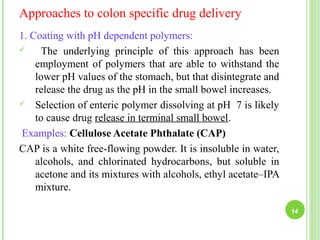
Approaches to colon specific drug delivery
1. Coating with pH dependent polymers:
 The underlying principle of this approach has been
employment of polymers that are able to withstand the
lower pH values of the stomach, but that disintegrate and
release the drug as the pH in the small bowel increases.
 Selection of enteric polymer dissolving at pH 7 is likely
to cause drug release in terminal small bowel.
Examples: Cellulose Acetate Phthalate (CAP)
CAP is a white free-flowing powder. It is insoluble in water,
alcohols, and chlorinated hydrocarbons, but soluble in
acetone and its mixtures with alcohols, ethyl acetate–IPA
mixture.
14
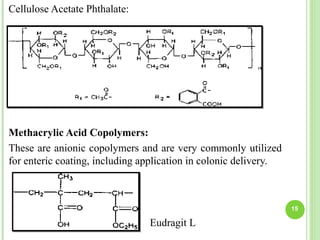
Cellulose Acetate Phthalate:
Methacrylic Acid Copolymers:
These are anionic copolymers and are very commonly utilized
for enteric coating, including application in colonic delivery.
Eudragit L
15
Shellac:
Shellac is a material of natural origin used for enteric
coatings. It is a purified resinous secretion of the insect
Laccifer lacca.
Hydroxypropyl Methylcellulose Phthalate (HPMCP):
HPMCP is a white powder or granular material. It is a more
flexible polymer than CAP. Commercially, the available
forms are HPMCP-50 and HPMCP-55.
16
2. Time release dosage forms:
Nonbiodegradable polymers are used.
They are generally nonspecific with respect to pH-solubility
characteristics and the employment of these polymers as carrier
matrices for colonic delivery often utilizes a time-dependent
mechanism.
This provides an initial lag phase of low or no release during
transit through the upper gastrointestinal tract.
17
Available Technologies:
Colon targeted delivery system:
This system, first described by Shah & co-workers, uses lag
time to achieve colon delivery.
System consist of 3 main parts: An outer enteric coat, inner
semipermeable polymer membrane, and a central core having
swelling excipients and an active component.
The outer enteric coating prevents drug release until the
tablet reaches the small intestine.
In the small intestine, the enteric coating dissolves allowing
gastrointestinal fluids to diffuse through the semipermeable
membrane into the core.
The core swells until after a period of 4–6 h, when it bursts,
and releases the active component in the colon. 18
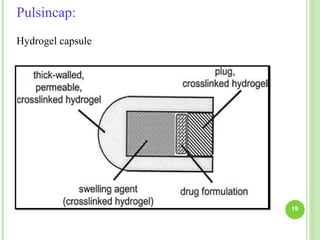
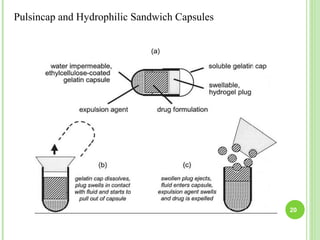
Pulsincap:
Hydrogel capsule
19
Pulsincap and Hydrophilic Sandwich Capsules
20
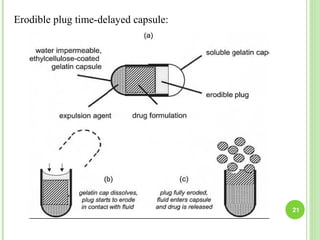
Erodible plug time-delayed capsule:
21
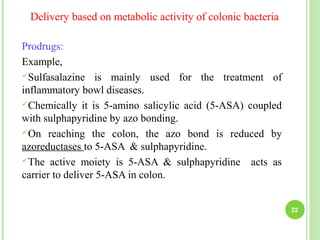
Delivery based on metabolic activity of colonic bacteria
Prodrugs:
Example,
Sulfasalazine is mainly used for the treatment of
inflammatory bowl diseases.
Chemically it is 5-amino salicylic acid (5-ASA) coupled
with sulphapyridine by azo bonding.
On reaching the colon, the azo bond is reduced by
azoreductases to 5-ASA & sulphapyridine.
The active moiety is 5-ASA & sulphapyridine acts as
carrier to deliver 5-ASA in colon.
22
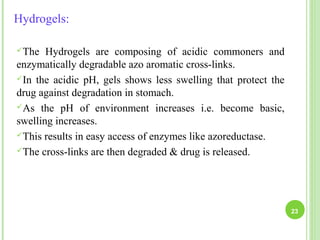
Hydrogels:
The Hydrogels are composing of acidic commoners and
enzymatically degradable azo aromatic cross-links.
In the acidic pH, gels shows less swelling that protect the
drug against degradation in stomach.
As the pH of environment increases i.e. become basic,
swelling increases.
This results in easy access of enzymes like azoreductase.
The cross-links are then degraded & drug is released.
23
Polysaccharides as carriers:
The colonic microflora secretes a number of enzymes that
are capable of hydrolytic cleavage of glycosidic bonds.
These include β-d-glucosidase, β-dgalactosidase, amylase,
pectinase, xylanase, α-d-xylosidase, and dextranases.
Natural polysaccharides like pectin & inulin are not
digested in stomach & small intestine but are degraded in
colon by resident bacteria.
The bacteria converts polysaccharides to gases such as
methane, carbon dioxide, hydrogen & to short chain fatty
acids.
These polysaccharides thus have the potential as non-toxic
carriers for colon specific drug delivery. 24
25

A

  • 1.
  • 2.
    Contents  Introduction  Advantages& limitations  Anatomy of physiology of colon  Factors related to colonic drug delivery  Drug absorption in the colon  Role of absorption enhancers  Approaches to colon specific drug delivery 2
  • 3.
    Introduction  Colonic deliveryrefers to targeted delivery of drugs into the lower GI tract, which occurs primarily in the large intestine i.e. colon. Most of the conventional drug delivery for treating colon disorders are failing as the drugs do not reach the site of action in appropriate concentrations.  Colonic drug delivery has gained importance not just for delivery of drugs for the treatment of local diseases associated with colon but also for systemic delivery of proteins, therapeutic peptides etc. 3
  • 4.
    Advantages of C.S.D.D.S Targeteddrug delivery Require small drug dose Reduce dosing frequency Less incidence of side effect Reduce gastric irritation Improve patient compliance It has low hostile environment, less peptidase activity so peptides, oral vaccines, insulin, growth hormones, can be given through this route. 4
  • 5.
    Multiple manufacturing steps. Microfloraaffects activity of drug via metabolic degradation of the drug. Bioavailability of drug may be low due to potentially binding of drug in a nonspecific way to dietary residues, intestinal secretions, mucus or faecal matter. Non availability of an appropriate dissolution testing method to evaluate the dosage form in-vitro. Drug should be in solution form before absorption and there for rate limiting step for poor soluble drugs. Limitations 5
  • 6.
    Anatomy & physiologyof colon The GI tract is divided into stomach, small intestine & large intestine. The colon itself is made up of the caecum, ascending colon, hepatic flexure, transverse colon, splenic flexure, descending colon, sigmoid colon. It is about 1.5 m long. Although it varies in diameter from approx 9 cm in caecum & 2 cm in sigmoid colon. The wall of colon is composed of 4 layers: serosa, muscularis externa, sub mucosa & mucosa. Serosa consists of areolar tissue, muscularis externa composed of an inner circular layer of fibers, sub mucosa is layer of connective tissue, mucosa is divided into epithelium lamina propria & muscularis mucosae 6
  • 7.
  • 8.
    The colon serves4 major function: 1.Creation of suitable environment for growth of colonic microbes. 2.Storage reservoir of faecal contents 3.Expulsion of the contents of the colon at an appropriate time. 4.Absorption of potassium & water from the lumen, concentrating the faecal content. 8
  • 9.
    Factors to beconsidered for colonic drug delivery 1. pH in the colon:  pH of the GI tract is subjected to both inter & intra subject variation.  On entry in to the colon, the pH dropped to 6.4 . The pH in the mid colon & the left colon is 6.0- 7.6 9 Location pH Oral cavity 6.2-7.4 Esophagus 5.0-6.0 Stomach Fasted condition 1.5-2.0 Fed condition 3.0-5.0 Small intestine Jejunum 5.0-6.5 Ileum 6.0-7.5 Large intestine Right colon 6.4 Mid & left colon 6.0-7.6
  • 10.
    2. Gastrointestinal transit: Gastricemptying of dosage forms is highly variable & depends primarily on whether the subject is fed or fasted. The arrival of an oral dosage form at the colon is determined by the rate of gastric emptying & the small intestinal transit time. The transit time of dosage form in GIT: 10 Organ Transit time (hrs) Stomach <1 (fasting), >3 (fed) Small intestine 3-4 large intestine 20-30
  • 11.
    3. Colonic microflora: Manycompounds taken orally are metabolized by gut bacteria. Drug release depends on enzymes that are derived from microflora present in colon. These enzymes are used to degrade coatings/matrices as well as to break bonds between an inert carrier and an active agent resulting in the drug release from the formulation. Important metabolic reactions carried out by intestinal bacteria : hydrolysis, reduction, dehydroxylation, decarboxylation, dehalogenation, deamination, acetylation, esterification. 11
  • 12.
    Drug absorption inthe colon Drugs are absorbed passively by either paracellular or transcellular route. Transcellular absorption involves the passage of drugs through cells.(Lipophilic drug) Paracellular absorption involves the transport of drug through tight junction between cells. ( Hydrophilic drug) The colon may not be the best site for drug absorption since the colonic mucosa lacks well defined villi as found in the small intestine. The colon contents become more viscous with progressive absorption of water as one travels further through the colon. This causes a reduced dissolution rate, slow diffusion of drug through the mucosa. 12
  • 13.
    Role of absorptionenhancers The permeability of drugs can be modified by the use of chemical enhancers. These enhancers increase transcellular & paracellular transport through one of the following mechanism: 1.By modifying epithelial permeability via denaturating membrane proteins. 2.By reversibly disrupting the integrity of lipid bilayer of colon. 13 Category Example NSAIDs Indomethacin Calcium ion chelating agent EDTA Surfactants Polyoxyethylene lauryl ether Bile salts Glycocholate Fatty acids Sodium caprylate Mixed micelles Oleic acid glycocholate
  • 14.
    Approaches to colonspecific drug delivery 1. Coating with pH dependent polymers:  The underlying principle of this approach has been employment of polymers that are able to withstand the lower pH values of the stomach, but that disintegrate and release the drug as the pH in the small bowel increases.  Selection of enteric polymer dissolving at pH 7 is likely to cause drug release in terminal small bowel. Examples: Cellulose Acetate Phthalate (CAP) CAP is a white free-flowing powder. It is insoluble in water, alcohols, and chlorinated hydrocarbons, but soluble in acetone and its mixtures with alcohols, ethyl acetate–IPA mixture. 14
  • 15.
    Cellulose Acetate Phthalate: MethacrylicAcid Copolymers: These are anionic copolymers and are very commonly utilized for enteric coating, including application in colonic delivery. Eudragit L 15
  • 16.
    Shellac: Shellac is amaterial of natural origin used for enteric coatings. It is a purified resinous secretion of the insect Laccifer lacca. Hydroxypropyl Methylcellulose Phthalate (HPMCP): HPMCP is a white powder or granular material. It is a more flexible polymer than CAP. Commercially, the available forms are HPMCP-50 and HPMCP-55. 16
  • 17.
    2. Time releasedosage forms: Nonbiodegradable polymers are used. They are generally nonspecific with respect to pH-solubility characteristics and the employment of these polymers as carrier matrices for colonic delivery often utilizes a time-dependent mechanism. This provides an initial lag phase of low or no release during transit through the upper gastrointestinal tract. 17
  • 18.
    Available Technologies: Colon targeteddelivery system: This system, first described by Shah & co-workers, uses lag time to achieve colon delivery. System consist of 3 main parts: An outer enteric coat, inner semipermeable polymer membrane, and a central core having swelling excipients and an active component. The outer enteric coating prevents drug release until the tablet reaches the small intestine. In the small intestine, the enteric coating dissolves allowing gastrointestinal fluids to diffuse through the semipermeable membrane into the core. The core swells until after a period of 4–6 h, when it bursts, and releases the active component in the colon. 18
  • 19.
  • 20.
    Pulsincap and HydrophilicSandwich Capsules 20
  • 21.
  • 22.
    Delivery based onmetabolic activity of colonic bacteria Prodrugs: Example, Sulfasalazine is mainly used for the treatment of inflammatory bowl diseases. Chemically it is 5-amino salicylic acid (5-ASA) coupled with sulphapyridine by azo bonding. On reaching the colon, the azo bond is reduced by azoreductases to 5-ASA & sulphapyridine. The active moiety is 5-ASA & sulphapyridine acts as carrier to deliver 5-ASA in colon. 22
  • 23.
    Hydrogels: The Hydrogels arecomposing of acidic commoners and enzymatically degradable azo aromatic cross-links. In the acidic pH, gels shows less swelling that protect the drug against degradation in stomach. As the pH of environment increases i.e. become basic, swelling increases. This results in easy access of enzymes like azoreductase. The cross-links are then degraded & drug is released. 23
  • 24.
    Polysaccharides as carriers: Thecolonic microflora secretes a number of enzymes that are capable of hydrolytic cleavage of glycosidic bonds. These include β-d-glucosidase, β-dgalactosidase, amylase, pectinase, xylanase, α-d-xylosidase, and dextranases. Natural polysaccharides like pectin & inulin are not digested in stomach & small intestine but are degraded in colon by resident bacteria. The bacteria converts polysaccharides to gases such as methane, carbon dioxide, hydrogen & to short chain fatty acids. These polysaccharides thus have the potential as non-toxic carriers for colon specific drug delivery. 24
  • 25.