Approaches to the development of Implantable drug delivery system(Parenteral drug delivery system)Prepared by: Paresh K Bharodiya09PCT07Guided by: Dr. Ajay B. SolankiDepartment of pharmaceuticsA.R College & G.H Patel Institute of Pharmacy12/05/2010
List of contents	Effect of physicochemical properties on parenteral absorptionIntroductionApproaches to design implantable drug delivery systems(a) Controlled drug delivery by diffusion processPolymer membrane permeation- controlled drug deliveryMatrix diffusion-controlled drug deliveryMicroreservior partition-controlled drug delivery systemMembrane matrix hybrid-type drug delivery system(b) Controlled drug delivery by activation processOsmotic pressureVapor pressureMagneticallyHydrationHydrolysis(c) Controlled drug delivery by feed back regulated mechanismBioerosionBioresponceREFRENCES
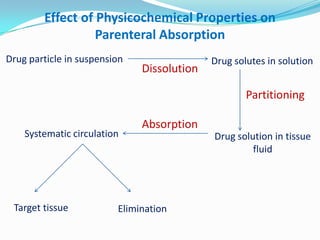
Effect of Physicochemical Properties on Parenteral AbsorptionDrug particle in suspensionDrug solutes in solutionDissolution  Partitioning Absorption Systematic circulationDrug solution in tissue fluidTarget tissueElimination
Rate of dissolution of solid in formulation vehicleParticle size and crystal habitpH of the formulationpKa of drugLipophillicity of the drugTissue fluid/vehicle partition coefficientSolubility of drug at biological fluid at injection sitePresence of other ingredients in the formulation and their interaction with the drug molecule
Implantable drug delivery systeman introduction Implantable drug delivery systems are placed completely under the skin — usually in a convenient but inconspicuous location. The patient is aware of only a small bump under the skin.designed to transmit drugs and fluids into the bloodstream without the repeated insertion of needles.well suited to the drug delivery requirements of insulin, steroids, chemotherapeutics, antibiotics, analgesics, total parenteral nutrition, and heparinThere is little chance of infection or interference with daily activities Because the device is completely subcutaneous, with no opening in the skin
Approaches to the development of Implantable drug delivery systemIn 1861 Lafarge pioneered the concept of IDDS for long term continuous administration of crystalline hormone in the form of solid steroid pelletBut the release profile was not constant and can not be readily  controlled in terms of precision of the release rate and duration of action  While it is possible to surgically implant and remove drug-concentrative devices or polymeric matrices, the requirement for such intervention could have a significant negative impact on the acceptabilityTwo approaches to this problem seem possibleUse of implanted electrically driven pumpsUse of erodible implants
Number of approaches have been developed to achive controlled administration of drugs via implantation(1)  Controlled drug delivery by diffusion processDiffusion of the drug out of the device or solvent into the polymer ultimately contributes to the drug-release processRelease of the drug from the device is preprogrammed at a specific rate profileThis is accomplished by a system design which controls molecular diffusion of drug in or and/or across  barrier medium surrounding the systemThis systems can be further sub classified in to number of classes
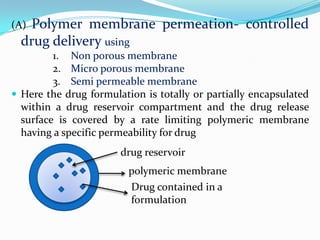
(A)Polymer membrane permeation- controlled drug delivery usingNon porous membraneMicro porous membraneSemi permeable membraneHere the drug formulation is totally or partially encapsulated within a drug reservoir compartment and the drug release surface is covered by a rate limiting polymeric membrane having a specific permeability for drugdrug reservoirpolymeric membraneDrug contained in a formulation
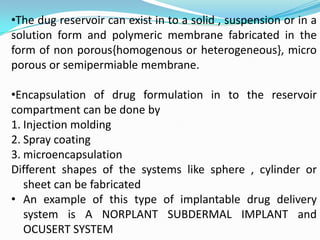
The dug reservoir can exist in to a solid , suspension or in a solution form and polymeric membrane fabricated in the form of non porous{homogenous or heterogeneous}, micro porous or semipermiable membrane.
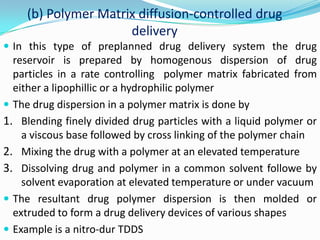
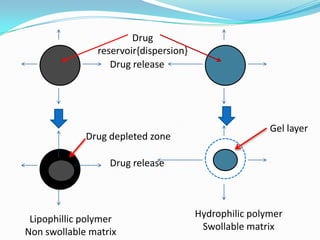
Encapsulation of drug formulation in to the reservoir compartment can be done byInjection moldingSpray coating microencapsulation  Different shapes of the systems like sphere , cylinder or sheet can be fabricatedAn example of this type of implantable drug delivery system is A NORPLANT SUBDERMAL IMPLANT and OCUSERT SYSTEM(b) Polymer Matrix diffusion-controlled drug deliveryIn this type of preplanned drug delivery system the drug reservoir is prepared by homogenous dispersion of drug particles in a rate controlling  polymer matrix fabricated from  either a lipophillic or a hydrophilic polymerThe drug dispersion in a polymer matrix is done by Blending finely divided drug particles with a liquid polymer or a viscous base followed by cross linking of the polymer chainMixing the drug with a polymer at an elevated temperature Dissolving drug and polymer in a common solvent followe by solvent evaporation at elevated temperature or under vacuumThe resultant drug polymer dispersion is then molded or extruded to form a drug delivery devices of various shapesExample is a nitro-dur TDDS
Drug reservoir{dispersion}Drug releaseGel layerDrug depleted zone Drug releaseHydrophilic polymerSwollable matrixLipophillic polymer Non swollable matrix
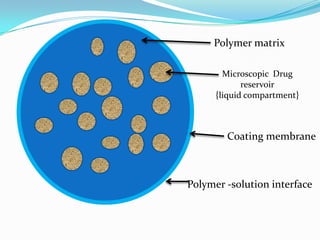
(C) Microreservior partition-controlled drug delivery systemIn this type drug reservoir is fabricated by micro dispersion of aqueous suspension of a drug using a high energy dispersion technique in to a biocompatible polymer such as silicone elastomer to form a homogenous dispersion of many discrete , unreachable microscopic drug reservoirDepending on the physicochemical properties of the drug and the desired rate of drug release , the device can be further coated with polymer to modify mechanism and rate of release  example is the transdermal nitro disc system
Polymer matrixMicroscopic  Drug reservoir{liquid compartment}Coating membranePolymer -solution interface
(d) Membrane matrix hybrid-type drug delivery systemThis device is a hybrid of Polymer Matrix diffusion-controlled drug delivery and Polymer membrane permeation- controlled drug delivery system aim is to take advantage of controlled release kinetic offered by Polymer membrane permeation- controlled drug delivery system and to avoid risk of dose dumping from reservoir compartment of this type of drug delivery system Drug reservoir is formed by dispersion of drug in to a polymer matrix which is further coated by a semi permeable polymeric membrane Example is a norplant II sub dermal system
(II) Controlled drug delivery by activation processIn this type release of the drug is activated by some physical , chemical, or biological process and/or by the energy supplied externally and the rate of release is than regulated by the processes applied or input of energyBased on the processed applied these activation modulated drug delivery system can be classified in to Osmotic pressure activatedVapor  pressure activatedMagnetically activatedHydrolytic-activatedHydration activated
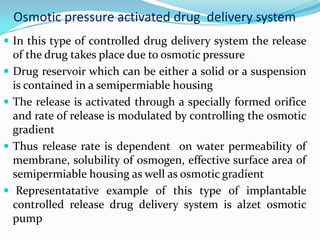
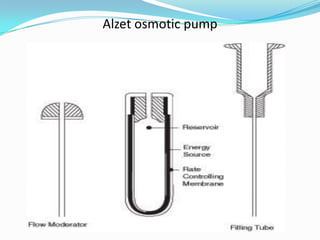
Osmotic pressure activated drug  delivery system In this type of controlled drug delivery system the release of the drug takes place due to osmotic pressure Drug reservoir which can be either a solid or a suspension is contained in a semipermiable housing The release is activated through a specially formed orifice and rate of release is modulated by controlling the osmotic gradientThus release rate is dependent  on water permeability of membrane, solubility of osmogen, effective surface area of semipermiable housing as well as osmotic gradient Representatative example of this type of implantable controlled release drug delivery system is alzet osmotic pump
Alzet osmotic pump
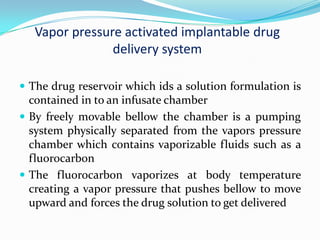
Vapor pressure activated implantable drug  delivery system The drug reservoir which ids a solution formulation is contained in to an infusate chamberBy freely movable bellow the chamber is a pumping system physically separated from the vapors pressure chamber which contains vaporizable fluids such as a fluorocarbon The fluorocarbon vaporizes at body temperature creating a vapor pressure that pushes bellow to move upward and forces the drug solution to get delivered
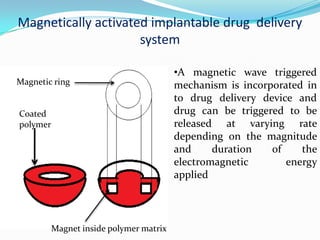
Magnetically activated implantable drug  delivery system A magnetic wave triggered mechanism is incorporated in to drug delivery device and drug can be triggered to be released at varying rate depending on the magnitude and duration of the electromagnetic energy appliedMagnetic ringCoated polymer Magnet inside polymer matrix
Hydration activated drug delivery system This system depends on the hydration induced swelling process by tissue fluid at implantable site to activate drug release In this system drug reservoir is dispersed in to swollable polymer matrix fabricated from hydrophilic polymer that become swollen upon hydration Drug is released from microscopic water filled pore channels in to the polymer matrix and Release rate of drug is controlled by swelling of the polymer matrix
Hydrolysis activated drug delivery system Release of drug is activated by hydrolysis of a bioerodable polymer by the cell fluid at the implantation siteBiodegradable polymer likeCo(lactic-glycolic)polymer Poly(orthoester)Poly(anhydride) are used in fabrication of this type of implantable drug delivery system This system is made by dispersing loading dose of a drug with a biodegradable polymer , which is then molded in to pellet or a bead shaped implantExample is a LHRH{goserelin} releasing biodegradable sub dermal implant
(c) Controlled drug delivery by feed back regulated mechanismusing this group of controlled drug delivery system the release of a drug is  activated by some biochemical molecule in the body and its concentration at the implantable site via feedback mechanismAnd the rate of controlled release of drug is regulated by the concentration of biochemical substance detected by a sensor in the feedback mechanism
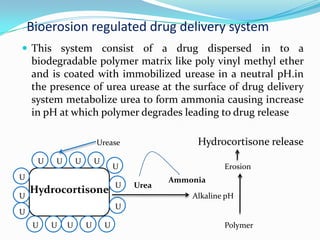
Bioerosion regulated drug delivery system This system consist of a drug dispersed in to a biodegradable polymer matrix like poly vinyl methyl ether and is coated with immobilized urease in a neutral pH.in the presence of urea urease at the surface of drug delivery system metabolize urea to form ammonia causing increase in pH at which polymer degrades leading to drug releaseHydrocortisone release Urease UUUUUUUUUUUUUUUErosion Ammonia Urea Hydrocortisone Alkaline pHPolymer
Bioresponce activated drug delivery system Drug reservoir is contained in a device enclosed by a bioresponsive polymer membrane whose permeability is controlled by conc. of a biochemical agent contained where the system is locatedExample is a glucose triggered insulin delivery system in which insulin reservoir is capsulated within hydrogel membrane having amineNR2 groups In alkaline pH NR2 is neutral and membrane is unsellable and impermeable to insulin As glucose, triggering agent penetrates in to membrane it is oxidized to glucuronic acid by enzyme glucose oxidise contained in a membrane NR2 groups are protonated and hydro gel membrane becomes swollable and permeable for insulin.Amt of release is dependant on the concentration of glucose entering in to membrane
REFRENCESNOVEL DRUG DELIVERY SYSTEM, Yie. W Chien, second edition, marceldekker inc, page 381DRUG DELIVERY SYSTEMS, Vasant V. RanadeMannfred A. Hollinger  Second Edition,

Implantable Drug Delivery System

  • 1.
    Approaches tothe development of Implantable drug delivery system(Parenteral drug delivery system)Prepared by: Paresh K Bharodiya09PCT07Guided by: Dr. Ajay B. SolankiDepartment of pharmaceuticsA.R College & G.H Patel Institute of Pharmacy12/05/2010
  • 2.
    List of contents Effectof physicochemical properties on parenteral absorptionIntroductionApproaches to design implantable drug delivery systems(a) Controlled drug delivery by diffusion processPolymer membrane permeation- controlled drug deliveryMatrix diffusion-controlled drug deliveryMicroreservior partition-controlled drug delivery systemMembrane matrix hybrid-type drug delivery system(b) Controlled drug delivery by activation processOsmotic pressureVapor pressureMagneticallyHydrationHydrolysis(c) Controlled drug delivery by feed back regulated mechanismBioerosionBioresponceREFRENCES
  • 3.
    Effect of PhysicochemicalProperties on Parenteral AbsorptionDrug particle in suspensionDrug solutes in solutionDissolution Partitioning Absorption Systematic circulationDrug solution in tissue fluidTarget tissueElimination
  • 4.
    Rate of dissolutionof solid in formulation vehicleParticle size and crystal habitpH of the formulationpKa of drugLipophillicity of the drugTissue fluid/vehicle partition coefficientSolubility of drug at biological fluid at injection sitePresence of other ingredients in the formulation and their interaction with the drug molecule
  • 5.
    Implantable drug deliverysysteman introduction Implantable drug delivery systems are placed completely under the skin — usually in a convenient but inconspicuous location. The patient is aware of only a small bump under the skin.designed to transmit drugs and fluids into the bloodstream without the repeated insertion of needles.well suited to the drug delivery requirements of insulin, steroids, chemotherapeutics, antibiotics, analgesics, total parenteral nutrition, and heparinThere is little chance of infection or interference with daily activities Because the device is completely subcutaneous, with no opening in the skin
  • 6.
    Approaches to thedevelopment of Implantable drug delivery systemIn 1861 Lafarge pioneered the concept of IDDS for long term continuous administration of crystalline hormone in the form of solid steroid pelletBut the release profile was not constant and can not be readily controlled in terms of precision of the release rate and duration of action While it is possible to surgically implant and remove drug-concentrative devices or polymeric matrices, the requirement for such intervention could have a significant negative impact on the acceptabilityTwo approaches to this problem seem possibleUse of implanted electrically driven pumpsUse of erodible implants
  • 7.
    Number of approacheshave been developed to achive controlled administration of drugs via implantation(1) Controlled drug delivery by diffusion processDiffusion of the drug out of the device or solvent into the polymer ultimately contributes to the drug-release processRelease of the drug from the device is preprogrammed at a specific rate profileThis is accomplished by a system design which controls molecular diffusion of drug in or and/or across barrier medium surrounding the systemThis systems can be further sub classified in to number of classes
  • 8.
    (A)Polymer membrane permeation-controlled drug delivery usingNon porous membraneMicro porous membraneSemi permeable membraneHere the drug formulation is totally or partially encapsulated within a drug reservoir compartment and the drug release surface is covered by a rate limiting polymeric membrane having a specific permeability for drugdrug reservoirpolymeric membraneDrug contained in a formulation
  • 9.
    The dug reservoircan exist in to a solid , suspension or in a solution form and polymeric membrane fabricated in the form of non porous{homogenous or heterogeneous}, micro porous or semipermiable membrane.
  • 10.
    Encapsulation of drugformulation in to the reservoir compartment can be done byInjection moldingSpray coating microencapsulation Different shapes of the systems like sphere , cylinder or sheet can be fabricatedAn example of this type of implantable drug delivery system is A NORPLANT SUBDERMAL IMPLANT and OCUSERT SYSTEM(b) Polymer Matrix diffusion-controlled drug deliveryIn this type of preplanned drug delivery system the drug reservoir is prepared by homogenous dispersion of drug particles in a rate controlling polymer matrix fabricated from either a lipophillic or a hydrophilic polymerThe drug dispersion in a polymer matrix is done by Blending finely divided drug particles with a liquid polymer or a viscous base followed by cross linking of the polymer chainMixing the drug with a polymer at an elevated temperature Dissolving drug and polymer in a common solvent followe by solvent evaporation at elevated temperature or under vacuumThe resultant drug polymer dispersion is then molded or extruded to form a drug delivery devices of various shapesExample is a nitro-dur TDDS
  • 11.
    Drug reservoir{dispersion}Drug releaseGellayerDrug depleted zone Drug releaseHydrophilic polymerSwollable matrixLipophillic polymer Non swollable matrix
  • 12.
    (C) Microreservior partition-controlleddrug delivery systemIn this type drug reservoir is fabricated by micro dispersion of aqueous suspension of a drug using a high energy dispersion technique in to a biocompatible polymer such as silicone elastomer to form a homogenous dispersion of many discrete , unreachable microscopic drug reservoirDepending on the physicochemical properties of the drug and the desired rate of drug release , the device can be further coated with polymer to modify mechanism and rate of release example is the transdermal nitro disc system
  • 13.
    Polymer matrixMicroscopic Drug reservoir{liquid compartment}Coating membranePolymer -solution interface
  • 14.
    (d) Membrane matrixhybrid-type drug delivery systemThis device is a hybrid of Polymer Matrix diffusion-controlled drug delivery and Polymer membrane permeation- controlled drug delivery system aim is to take advantage of controlled release kinetic offered by Polymer membrane permeation- controlled drug delivery system and to avoid risk of dose dumping from reservoir compartment of this type of drug delivery system Drug reservoir is formed by dispersion of drug in to a polymer matrix which is further coated by a semi permeable polymeric membrane Example is a norplant II sub dermal system
  • 15.
    (II) Controlled drugdelivery by activation processIn this type release of the drug is activated by some physical , chemical, or biological process and/or by the energy supplied externally and the rate of release is than regulated by the processes applied or input of energyBased on the processed applied these activation modulated drug delivery system can be classified in to Osmotic pressure activatedVapor pressure activatedMagnetically activatedHydrolytic-activatedHydration activated
  • 16.
    Osmotic pressure activateddrug delivery system In this type of controlled drug delivery system the release of the drug takes place due to osmotic pressure Drug reservoir which can be either a solid or a suspension is contained in a semipermiable housing The release is activated through a specially formed orifice and rate of release is modulated by controlling the osmotic gradientThus release rate is dependent on water permeability of membrane, solubility of osmogen, effective surface area of semipermiable housing as well as osmotic gradient Representatative example of this type of implantable controlled release drug delivery system is alzet osmotic pump
  • 17.
  • 18.
    Vapor pressure activatedimplantable drug delivery system The drug reservoir which ids a solution formulation is contained in to an infusate chamberBy freely movable bellow the chamber is a pumping system physically separated from the vapors pressure chamber which contains vaporizable fluids such as a fluorocarbon The fluorocarbon vaporizes at body temperature creating a vapor pressure that pushes bellow to move upward and forces the drug solution to get delivered
  • 19.
    Magnetically activated implantabledrug delivery system A magnetic wave triggered mechanism is incorporated in to drug delivery device and drug can be triggered to be released at varying rate depending on the magnitude and duration of the electromagnetic energy appliedMagnetic ringCoated polymer Magnet inside polymer matrix
  • 20.
    Hydration activated drugdelivery system This system depends on the hydration induced swelling process by tissue fluid at implantable site to activate drug release In this system drug reservoir is dispersed in to swollable polymer matrix fabricated from hydrophilic polymer that become swollen upon hydration Drug is released from microscopic water filled pore channels in to the polymer matrix and Release rate of drug is controlled by swelling of the polymer matrix
  • 21.
    Hydrolysis activated drugdelivery system Release of drug is activated by hydrolysis of a bioerodable polymer by the cell fluid at the implantation siteBiodegradable polymer likeCo(lactic-glycolic)polymer Poly(orthoester)Poly(anhydride) are used in fabrication of this type of implantable drug delivery system This system is made by dispersing loading dose of a drug with a biodegradable polymer , which is then molded in to pellet or a bead shaped implantExample is a LHRH{goserelin} releasing biodegradable sub dermal implant
  • 22.
    (c) Controlled drugdelivery by feed back regulated mechanismusing this group of controlled drug delivery system the release of a drug is activated by some biochemical molecule in the body and its concentration at the implantable site via feedback mechanismAnd the rate of controlled release of drug is regulated by the concentration of biochemical substance detected by a sensor in the feedback mechanism
  • 23.
    Bioerosion regulated drugdelivery system This system consist of a drug dispersed in to a biodegradable polymer matrix like poly vinyl methyl ether and is coated with immobilized urease in a neutral pH.in the presence of urea urease at the surface of drug delivery system metabolize urea to form ammonia causing increase in pH at which polymer degrades leading to drug releaseHydrocortisone release Urease UUUUUUUUUUUUUUUErosion Ammonia Urea Hydrocortisone Alkaline pHPolymer
  • 24.
    Bioresponce activated drugdelivery system Drug reservoir is contained in a device enclosed by a bioresponsive polymer membrane whose permeability is controlled by conc. of a biochemical agent contained where the system is locatedExample is a glucose triggered insulin delivery system in which insulin reservoir is capsulated within hydrogel membrane having amineNR2 groups In alkaline pH NR2 is neutral and membrane is unsellable and impermeable to insulin As glucose, triggering agent penetrates in to membrane it is oxidized to glucuronic acid by enzyme glucose oxidise contained in a membrane NR2 groups are protonated and hydro gel membrane becomes swollable and permeable for insulin.Amt of release is dependant on the concentration of glucose entering in to membrane
  • 25.
    REFRENCESNOVEL DRUG DELIVERYSYSTEM, Yie. W Chien, second edition, marceldekker inc, page 381DRUG DELIVERY SYSTEMS, Vasant V. RanadeMannfred A. Hollinger Second Edition,