OSMOTIC DRUG
DELIVERY SYSTEM
(ALZET PUMP)
Presented by: Bhaskar Pratap
M.PHARM. (IP)
LIST OF CONTENT
1. INTRODUCTION
2. PRINCIPLE OF OSMOSIS
3. BASIC COMPONENT OF OSMOTIC SYSTEM
4. CLASSIFICATION OF OSMOTIC PUMP
5. FACTOR AFFECTING RELEASE OF MEDICAMENT
FROM OSMOTIC DDS
6. EVALUATION
7. ADVANTAGES
8. DISADVANTAGES
1. Osmotic drug delivery uses the osmotic pressure for
controlled delivery of drugs by using osmogens.
2. Osmosis : It refers to the process of movement of solvent
from lower concentration of solute towards higher
concentration of solute across the semipermeable
membrane.
3. Osmotic pressure: The pressure exerted by the flow of water
through a semipermeable membrane separating two
solutions with different concentrations of solute.
4. These systems can be used for both route of administration
i.e. oral and parenterals.
Introduction
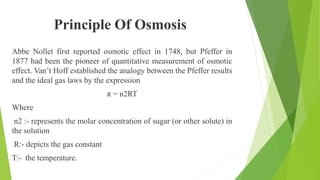
Abbe Nollet first reported osmotic effect in 1748, but Pfeffer in
1877 had been the pioneer of quantitative measurement of osmotic
effect. Van’t Hoff established the analogy between the Pfeffer results
and the ideal gas laws by the expression
π = n2RT
Where
n2 :- represents the molar concentration of sugar (or other solute) in
the solution
R:- depicts the gas constant
T:- the temperature.
Principle Of Osmosis
1. Drug : itself may act as osmogen otherwise osmogenic salt
can be added in formulation
2. Semipermeable membrane: criteria: Sufficient wet strength
and water permeability
Should be biocompatible and rigid
Should be sufficient thick to withstand the pressure within the
Any polymer that is permeable to water but impermeable to
solute can be used as a coating material in osmotic devices
Ex. Cellulose Acetate, Cellulose Triacetate and Ethyl
Cellulose
Basic Component Of Osmotic DDS Device
3. Hydrophilic and hydrophobic polymers :( CMC, HEC, HPMC )
4. Wicking agent : ( SLS, PVP, bentonite )
5. Solubilizing agent :(PVP, CD, PEG )
6. Osmogens:( NACL, KCL)
7. Surfactants : (poly oxyethylenated caster oil)
8. Coating solvent : ( acetone and methanol 80:20,acetone and water
90:10 )
9. Plasticizer : ( phthalates, benzoates, TEC )
10. Flux regulator : ( poly propylene, poly butylene )
11. Pore forming agent:( Calcium nitrate , potassium sulphate)
1. Implantable Osmotic Drug Delivery System
2. Oral Osmotic Drug Delivery System
Classification Of Osmotic DDS
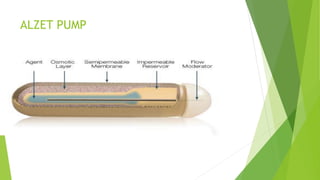
ALZET OSMOTIC PUMP
 Design: Empty reservoir within the core of the pump is filled with the drug
or hormone solution to be delivered and is surrounded by salt chamber with
Impermeable layer between them
 It is an implantable osmotic pumps for laboratory animal
 The pump are used to deliver homogenous solution or suspension
continuously at a controlled rate for extended time
 Mechanism: water enters into the salt chamber through semi permeable
membrane and causes compression of flexible reservoir and delivery of drug
solution
ALZET PUMP
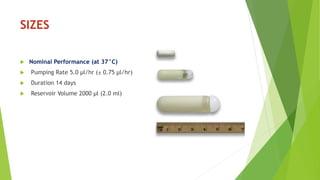
SIZES
 Nominal Performance (at 37°C)
 Pumping Rate 5.0 µl/hr (± 0.75 µl/hr)
 Duration 14 days
 Reservoir Volume 2000 µl (2.0 ml)
A. Solubility
B. Osmotic pressure
C. Delivery orifice
D. Membrane
A.Solubility
1. Solubility of drug is one of the most important factors since kinetic
of osmotic release is directly related to the drug solubility.
2. Both highly soluble and poorly soluble drugs are not good
candidates for osmotic drug delivery.
Factors Affecting Release Of Medicament From
Osmotic DDS
B. Osmotic pressure
1. The next release-controlling factor that must be optimized is the
osmotic pressure gradient between inside the compartment and the
external environment.
2. The release rate of a drug from an osmotic system is directly
proportional to the osmotic pressure of the core formulation
C. Delivery orifice
1. To achieve an optimal zero order delivery profile, the orifice must be
smaller .
2. The typical orifice size in osmotic pumps ranges from 600µ to 1
mm.
D. Membrane
1. Type and nature of polymer
- polymer that is permeable to water but impermeable to solute can be
selected
Ex. cellulose esters such as cellulose acetate, cellulose diacetate, cellulose
triacetate, cellulose propionate, cellulose acetate butyrate
2. Membrane thickness
- release rate from osmotic systems is inversely proportional membrane
thickness
3. Wet strength
4. Water permeability
EVALUATION
1.Invitro Evaluation -in vitro release of drugs from oral
osmotic systems is by
• conventional USP paddle
• basket type apparatus. The dissolution medium is
- distilled water
- gastric fluid (for first 2-4 h)
- intestinal fluids (for subsequent hours)
2.In Vivo Evaluation Of Oral Osmotic Systems
• in dogs(preferred)
• Monkey
1. Zero order release
2. High release rate
3. High degree of IVIVC
4. Production scale up is easy
5. Increase efficacy of drug
6. Controlled drug delivery
7. Reduce dosing frequency
Advantages
1. Expensive
2. Chance of toxicity due to dose dumping
3. Release of drug depends on :
- size of drug port
- surface area
- thickness and composition of membrane
Disadvantages
Thank You

Alzet osmotic pump

  • 1.
    OSMOTIC DRUG DELIVERY SYSTEM (ALZETPUMP) Presented by: Bhaskar Pratap M.PHARM. (IP)
  • 2.
    LIST OF CONTENT 1.INTRODUCTION 2. PRINCIPLE OF OSMOSIS 3. BASIC COMPONENT OF OSMOTIC SYSTEM 4. CLASSIFICATION OF OSMOTIC PUMP 5. FACTOR AFFECTING RELEASE OF MEDICAMENT FROM OSMOTIC DDS 6. EVALUATION 7. ADVANTAGES 8. DISADVANTAGES
  • 3.
    1. Osmotic drugdelivery uses the osmotic pressure for controlled delivery of drugs by using osmogens. 2. Osmosis : It refers to the process of movement of solvent from lower concentration of solute towards higher concentration of solute across the semipermeable membrane. 3. Osmotic pressure: The pressure exerted by the flow of water through a semipermeable membrane separating two solutions with different concentrations of solute. 4. These systems can be used for both route of administration i.e. oral and parenterals. Introduction
  • 4.
    Abbe Nollet firstreported osmotic effect in 1748, but Pfeffer in 1877 had been the pioneer of quantitative measurement of osmotic effect. Van’t Hoff established the analogy between the Pfeffer results and the ideal gas laws by the expression π = n2RT Where n2 :- represents the molar concentration of sugar (or other solute) in the solution R:- depicts the gas constant T:- the temperature. Principle Of Osmosis
  • 5.
    1. Drug :itself may act as osmogen otherwise osmogenic salt can be added in formulation 2. Semipermeable membrane: criteria: Sufficient wet strength and water permeability Should be biocompatible and rigid Should be sufficient thick to withstand the pressure within the Any polymer that is permeable to water but impermeable to solute can be used as a coating material in osmotic devices Ex. Cellulose Acetate, Cellulose Triacetate and Ethyl Cellulose Basic Component Of Osmotic DDS Device
  • 6.
    3. Hydrophilic andhydrophobic polymers :( CMC, HEC, HPMC ) 4. Wicking agent : ( SLS, PVP, bentonite ) 5. Solubilizing agent :(PVP, CD, PEG ) 6. Osmogens:( NACL, KCL) 7. Surfactants : (poly oxyethylenated caster oil) 8. Coating solvent : ( acetone and methanol 80:20,acetone and water 90:10 ) 9. Plasticizer : ( phthalates, benzoates, TEC ) 10. Flux regulator : ( poly propylene, poly butylene ) 11. Pore forming agent:( Calcium nitrate , potassium sulphate)
  • 7.
    1. Implantable OsmoticDrug Delivery System 2. Oral Osmotic Drug Delivery System Classification Of Osmotic DDS
  • 8.
    ALZET OSMOTIC PUMP Design: Empty reservoir within the core of the pump is filled with the drug or hormone solution to be delivered and is surrounded by salt chamber with Impermeable layer between them  It is an implantable osmotic pumps for laboratory animal  The pump are used to deliver homogenous solution or suspension continuously at a controlled rate for extended time  Mechanism: water enters into the salt chamber through semi permeable membrane and causes compression of flexible reservoir and delivery of drug solution
  • 9.
  • 10.
    SIZES  Nominal Performance(at 37°C)  Pumping Rate 5.0 µl/hr (± 0.75 µl/hr)  Duration 14 days  Reservoir Volume 2000 µl (2.0 ml)
  • 11.
    A. Solubility B. Osmoticpressure C. Delivery orifice D. Membrane A.Solubility 1. Solubility of drug is one of the most important factors since kinetic of osmotic release is directly related to the drug solubility. 2. Both highly soluble and poorly soluble drugs are not good candidates for osmotic drug delivery. Factors Affecting Release Of Medicament From Osmotic DDS
  • 12.
    B. Osmotic pressure 1.The next release-controlling factor that must be optimized is the osmotic pressure gradient between inside the compartment and the external environment. 2. The release rate of a drug from an osmotic system is directly proportional to the osmotic pressure of the core formulation C. Delivery orifice 1. To achieve an optimal zero order delivery profile, the orifice must be smaller . 2. The typical orifice size in osmotic pumps ranges from 600µ to 1 mm.
  • 13.
    D. Membrane 1. Typeand nature of polymer - polymer that is permeable to water but impermeable to solute can be selected Ex. cellulose esters such as cellulose acetate, cellulose diacetate, cellulose triacetate, cellulose propionate, cellulose acetate butyrate 2. Membrane thickness - release rate from osmotic systems is inversely proportional membrane thickness 3. Wet strength 4. Water permeability
  • 14.
    EVALUATION 1.Invitro Evaluation -invitro release of drugs from oral osmotic systems is by • conventional USP paddle • basket type apparatus. The dissolution medium is - distilled water - gastric fluid (for first 2-4 h) - intestinal fluids (for subsequent hours) 2.In Vivo Evaluation Of Oral Osmotic Systems • in dogs(preferred) • Monkey
  • 15.
    1. Zero orderrelease 2. High release rate 3. High degree of IVIVC 4. Production scale up is easy 5. Increase efficacy of drug 6. Controlled drug delivery 7. Reduce dosing frequency Advantages
  • 16.
    1. Expensive 2. Chanceof toxicity due to dose dumping 3. Release of drug depends on : - size of drug port - surface area - thickness and composition of membrane Disadvantages
  • 17.