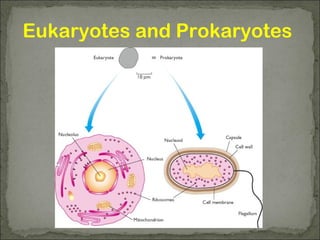
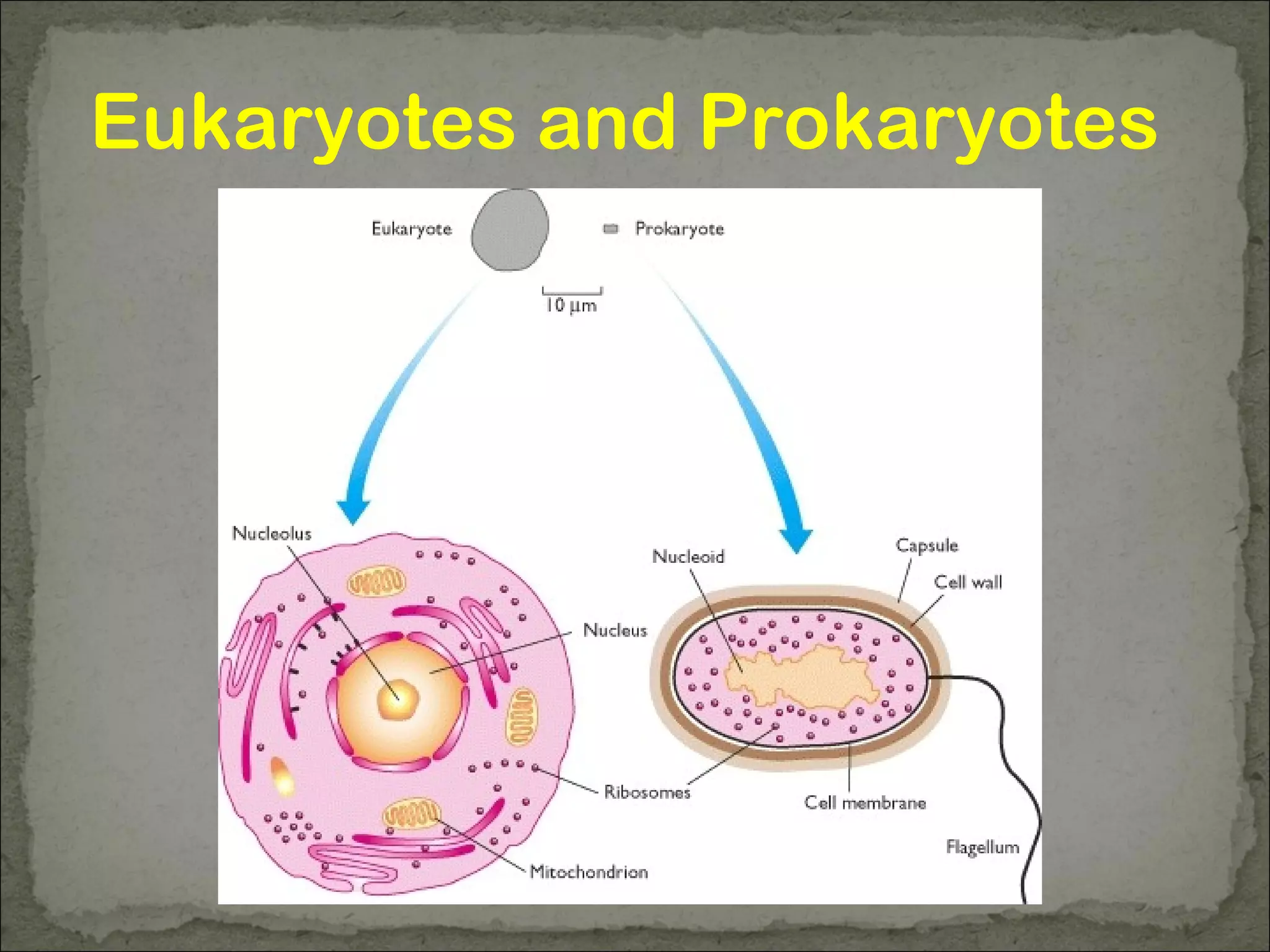
Eukaryotes and Prokaryotes
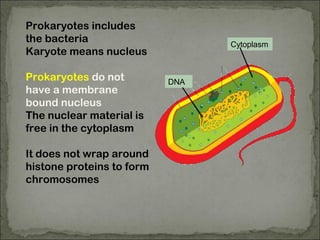
Prokaryotes includes
the bacteria
Karyote means nucleus
Prokaryotes do not
have a membrane
bound nucleus
The nuclear material is
free in the cytoplasm
It does not wrap around
histone proteins to form
chromosomes
DNA
Cytoplasm
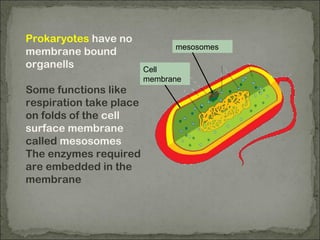
Prokaryotes have no
membrane bound
organells
Some functions like
respiration take place
on folds of the cell
surface membrane
called mesosomes
The enzymes required
are embedded in the
membrane
Cell
membrane
mesosomes
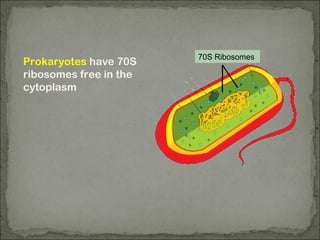
Prokaryotes have 70S
ribosomes free in the
cytoplasm
70S Ribosomes
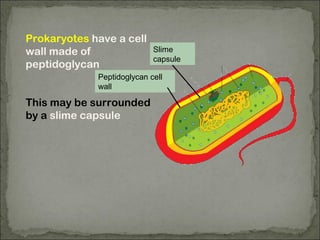
Prokaryotes have a cell
wall made of
peptidoglycan
This may be surrounded
by a slime capsule
Peptidoglycan cell
wall
Slime
capsule
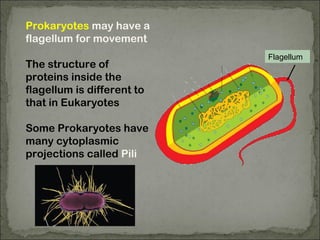
Prokaryotes may have a
flagellum for movement
The structure of
proteins inside the
flagellum is different to
that in Eukaryotes
Some Prokaryotes have
many cytoplasmic
projections called Pili
Flagellum
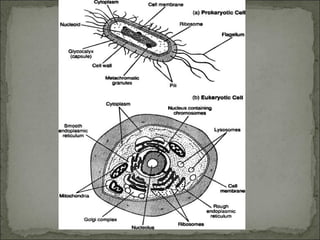
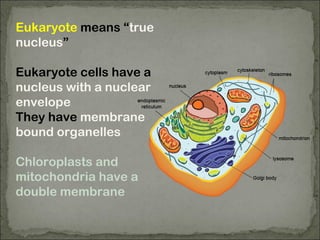
Eukaryote means “true
nucleus”
Eukaryote cells have a
nucleus with a nuclear
envelope
They have membrane
bound organelles
Chloroplasts and
mitochondria have a
double membrane
The Endosymbiont Theory
• Chloroplasts and Mitochondria are the
same size as Prokaryotes (0.5 - 10µm)
• They contain 70S ribosomes and
circular DNA like prokaryotes
• They have a double membrane
The endosymbiont theory suggests these
organelles were once free living prokaryote
organisms that were engulfed by another
cell and enclosed in a vacuole
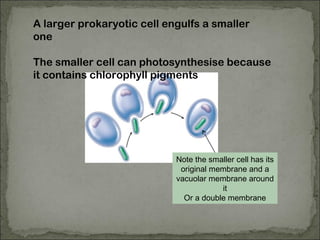
A larger prokaryotic cell engulfs a smaller
one
The smaller cell can photosynthesise because
it contains chlorophyll pigments
Note the smaller cell has its
original membrane and a
vacuolar membrane around
it
Or a double membrane
Instead of digesting the contents of the vacuole
a symbiotic relationship was established
Symbiotic relationships are those in which both
parties benefit from the relationship
The larger cell receives glucose
The smaller cell is sheltered and receives other
nutrients and raw materials

Prokaryotes and Eukaryotes

  • 1.
  • 2.
    Prokaryotes includes the bacteria Karyotemeans nucleus Prokaryotes do not have a membrane bound nucleus The nuclear material is free in the cytoplasm It does not wrap around histone proteins to form chromosomes DNA Cytoplasm
  • 3.
    Prokaryotes have no membranebound organells Some functions like respiration take place on folds of the cell surface membrane called mesosomes The enzymes required are embedded in the membrane Cell membrane mesosomes
  • 4.
    Prokaryotes have 70S ribosomesfree in the cytoplasm 70S Ribosomes
  • 5.
    Prokaryotes have acell wall made of peptidoglycan This may be surrounded by a slime capsule Peptidoglycan cell wall Slime capsule
  • 6.
    Prokaryotes may havea flagellum for movement The structure of proteins inside the flagellum is different to that in Eukaryotes Some Prokaryotes have many cytoplasmic projections called Pili Flagellum
  • 8.
    Eukaryote means “true nucleus” Eukaryotecells have a nucleus with a nuclear envelope They have membrane bound organelles Chloroplasts and mitochondria have a double membrane
  • 9.
    The Endosymbiont Theory •Chloroplasts and Mitochondria are the same size as Prokaryotes (0.5 - 10µm) • They contain 70S ribosomes and circular DNA like prokaryotes • They have a double membrane The endosymbiont theory suggests these organelles were once free living prokaryote organisms that were engulfed by another cell and enclosed in a vacuole
  • 10.
    A larger prokaryoticcell engulfs a smaller one The smaller cell can photosynthesise because it contains chlorophyll pigments Note the smaller cell has its original membrane and a vacuolar membrane around it Or a double membrane
  • 11.
    Instead of digestingthe contents of the vacuole a symbiotic relationship was established Symbiotic relationships are those in which both parties benefit from the relationship The larger cell receives glucose The smaller cell is sheltered and receives other nutrients and raw materials