AIM
To isolate microorganisms from the
sample
To get pure culture of microorganisms
PRINCIPLE
 Pour plate is a rapid quantitative isolation method
 This method is used to isolate bacteria, fungus, and
actinomycetes
 Original sample is diluted several times to thin out the population
sufficiently
 The most diluted sample is mixed with warm agar and poured
into petriplates
 After the agar solidifies and forms individual colony
 The total number of colonies equals to the number of viable
microorganisms
 Colonies were transferred on fresh media for identification
MATERIALS REQUIRED
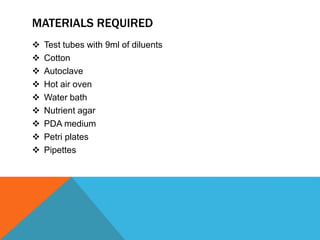
 Test tubes with 9ml of diluents
 Cotton
 Autoclave
 Hot air oven
 Water bath
 Nutrient agar
 PDA medium
 Petri plates
 Pipettes
PROCEDURE
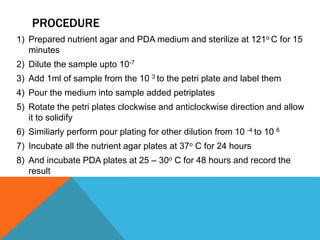
1) Prepared nutrient agar and PDA medium and sterilize at 121o C for 15
minutes
2) Dilute the sample upto 10-7
3) Add 1ml of sample from the 10 3 to the petri plate and label them
4) Pour the medium into sample added petriplates
5) Rotate the petri plates clockwise and anticlockwise direction and allow
it to solidify
6) Similiarly perform pour plating for other dilution from 10 -4 to 10 6
7) Incubate all the nutrient agar plates at 37o C for 24 hours
8) And incubate PDA plates at 25 – 30o C for 48 hours and record the
result
ADVANTAGES & DISADAVANTAGES
ADVANTAGES DISADVANTAGES
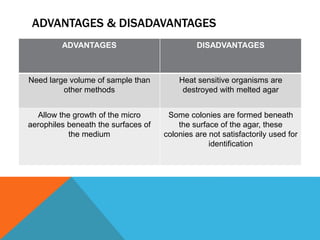
Need large volume of sample than
other methods
Heat sensitive organisms are
destroyed with melted agar
Allow the growth of the micro
aerophiles beneath the surfaces of
the medium
Some colonies are formed beneath
the surface of the agar, these
colonies are not satisfactorily used for
identification
RESULT
Individual colonies are noted
Calculated the number of bacteria
present in the sample

POUR PLATE TECHNIQUE.pptx

  • 2.
    AIM To isolate microorganismsfrom the sample To get pure culture of microorganisms
  • 3.
    PRINCIPLE  Pour plateis a rapid quantitative isolation method  This method is used to isolate bacteria, fungus, and actinomycetes  Original sample is diluted several times to thin out the population sufficiently  The most diluted sample is mixed with warm agar and poured into petriplates  After the agar solidifies and forms individual colony  The total number of colonies equals to the number of viable microorganisms  Colonies were transferred on fresh media for identification
  • 4.
    MATERIALS REQUIRED  Testtubes with 9ml of diluents  Cotton  Autoclave  Hot air oven  Water bath  Nutrient agar  PDA medium  Petri plates  Pipettes
  • 5.
    PROCEDURE 1) Prepared nutrientagar and PDA medium and sterilize at 121o C for 15 minutes 2) Dilute the sample upto 10-7 3) Add 1ml of sample from the 10 3 to the petri plate and label them 4) Pour the medium into sample added petriplates 5) Rotate the petri plates clockwise and anticlockwise direction and allow it to solidify 6) Similiarly perform pour plating for other dilution from 10 -4 to 10 6 7) Incubate all the nutrient agar plates at 37o C for 24 hours 8) And incubate PDA plates at 25 – 30o C for 48 hours and record the result
  • 6.
    ADVANTAGES & DISADAVANTAGES ADVANTAGESDISADVANTAGES Need large volume of sample than other methods Heat sensitive organisms are destroyed with melted agar Allow the growth of the micro aerophiles beneath the surfaces of the medium Some colonies are formed beneath the surface of the agar, these colonies are not satisfactorily used for identification
  • 7.
    RESULT Individual colonies arenoted Calculated the number of bacteria present in the sample