Prepared by Ruhid Hasan
ID: 031161009
University of Development
Alternative
WHAT IS
TRANSPORT SYSTEM?
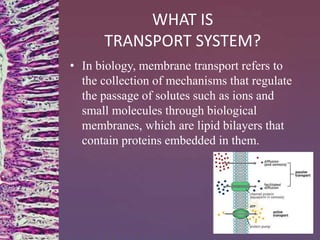
• In biology, membrane transport refers to
the collection of mechanisms that regulate
the passage of solutes such as ions and
small molecules through biological
membranes, which are lipid bilayers that
contain proteins embedded in them.
CLASSIFICATION
OF
TRANSPORT SYSTEM
• Passive Transport
• Active Transport
• Carrier-Madiated Transport
• Vesicular Transport
• Pore Transport
• Ion-pair formation Transport
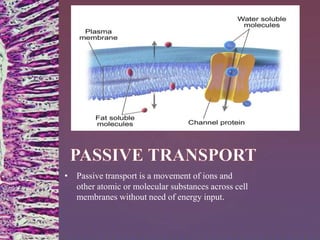
• Passive transport is a movement of ions and
other atomic or molecular substances across cell
membranes without need of energy input.
DIFFUSION
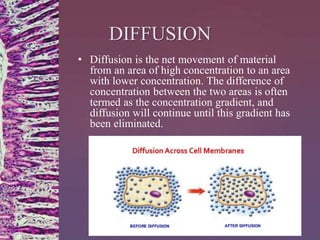
• Diffusion is the net movement of material
from an area of high concentration to an area
with lower concentration. The difference of
concentration between the two areas is often
termed as the concentration gradient, and
diffusion will continue until this gradient has
been eliminated.
FACILITATED DIFFUSION
• Facilitated diffusion, also called
carrier-mediated osmosis, is the
movement of molecules across the cell
membrane via special transport
proteins that are embheir plasma
membrane by actively taking up or
excluding ions.
FILTRATION
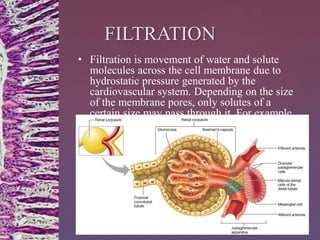
• Filtration is movement of water and solute
molecules across the cell membrane due to
hydrostatic pressure generated by the
cardiovascular system. Depending on the size
of the membrane pores, only solutes of a
certain size may pass through it. For example,
the membrane pores of the Bowman's capsule
in the kidneys
OSMOSIS
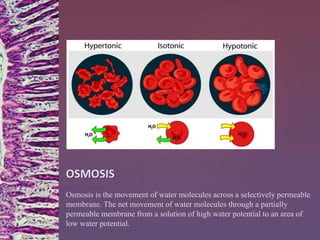
Osmosis is the movement of water molecules across a selectively permeable
membrane. The net movement of water molecules through a partially
permeable membrane from a solution of high water potential to an area of
low water potential.
TYPE OF OSMOSIS TRANSPORT
equilibrium -all molecules occupy the same amount of space
Hypertonic -concentration outside the cell is
higher than inside. Water will move out of the cell
to create equilibrium.
Hypotonic -concentration of solutes outside the cell is lower than the
concentration inside. Water will move into the cell to create
equilibrium.
Isotonic Solution - Solute and water concentrations equal on
both sides of membrane. Water will move both ways randomly to
maintain equilibrium.
Do you have any query or Questions?
Then you Can contact me
Name: Ruhid Hasan
ID: 031161009
Batch: 48th
Semester: 7th
FOR BEING PATIENTS

PASSIVE TRANSPORT SYSTEM

  • 1.
    Prepared by RuhidHasan ID: 031161009 University of Development Alternative
  • 2.
    WHAT IS TRANSPORT SYSTEM? •In biology, membrane transport refers to the collection of mechanisms that regulate the passage of solutes such as ions and small molecules through biological membranes, which are lipid bilayers that contain proteins embedded in them.
  • 3.
    CLASSIFICATION OF TRANSPORT SYSTEM • PassiveTransport • Active Transport • Carrier-Madiated Transport • Vesicular Transport • Pore Transport • Ion-pair formation Transport
  • 4.
    • Passive transportis a movement of ions and other atomic or molecular substances across cell membranes without need of energy input.
  • 5.
    DIFFUSION • Diffusion isthe net movement of material from an area of high concentration to an area with lower concentration. The difference of concentration between the two areas is often termed as the concentration gradient, and diffusion will continue until this gradient has been eliminated.
  • 6.
    FACILITATED DIFFUSION • Facilitateddiffusion, also called carrier-mediated osmosis, is the movement of molecules across the cell membrane via special transport proteins that are embheir plasma membrane by actively taking up or excluding ions.
  • 7.
    FILTRATION • Filtration ismovement of water and solute molecules across the cell membrane due to hydrostatic pressure generated by the cardiovascular system. Depending on the size of the membrane pores, only solutes of a certain size may pass through it. For example, the membrane pores of the Bowman's capsule in the kidneys
  • 8.
    OSMOSIS Osmosis is themovement of water molecules across a selectively permeable membrane. The net movement of water molecules through a partially permeable membrane from a solution of high water potential to an area of low water potential.
  • 9.
    TYPE OF OSMOSISTRANSPORT equilibrium -all molecules occupy the same amount of space Hypertonic -concentration outside the cell is higher than inside. Water will move out of the cell to create equilibrium. Hypotonic -concentration of solutes outside the cell is lower than the concentration inside. Water will move into the cell to create equilibrium. Isotonic Solution - Solute and water concentrations equal on both sides of membrane. Water will move both ways randomly to maintain equilibrium.
  • 10.
    Do you haveany query or Questions? Then you Can contact me Name: Ruhid Hasan ID: 031161009 Batch: 48th Semester: 7th
  • 11.