ORTHOSTATIC HYPOTENSION
Defined as a fall in systolic blood pressure of atleast
20 mm Hg or diastolic blood pressure of at least 10
mm Hg within 3 min of standing when compared
with BP from sitting/supine position.
What is Tilt Test
• The tilt test assess someone response to
orthostatic stress (standing upright).
• This test is valuable diagnostic test for
evaluating patient with syncope.
Indications
• Definite indications:-
- Unexplained recurrent syncope or a single episode
in the absence of organic heart disease either A/W
injury or in setting that pose a high risk of injury.
- Unexplained recurrent syncope or a single episode
in the presence of organic heart disease after
cardiac cause of syncope have been excluded.
- A case in which cause of syncope has been
determined but the predisposition to
neurocardiogenic syncope may alter the treatment
used.
• Possible indications:-
- Differentiation of convulsive syncope from epilepsy.
- Assessment of recurrent, unexplained falls.
- Evaluation of recurrent, unexplained near-syncope
and light-headedness.
- Evaluation of recurrent syncope in the setting of
autonomic failure or peripheral neuropathies.
- Evaluation of postexertion syncope when an episode
can not be produced by exercise test.
Method
Preparation:-
-Do not eat or drink at least 2 hours before the test
-For morning test do not eat or drink after midnight
Part 1:-
• This part shows body response to change in position
• Patient is asked to lie on his back on a table
• Straps at waist and knees help to stay in position
• Intravenous line is put in one arm
• Electrodes are attached to the chest and are
connected to the ECG machine to track heart beats.
• A cuff is placed on one arm to measure blood
pressure.
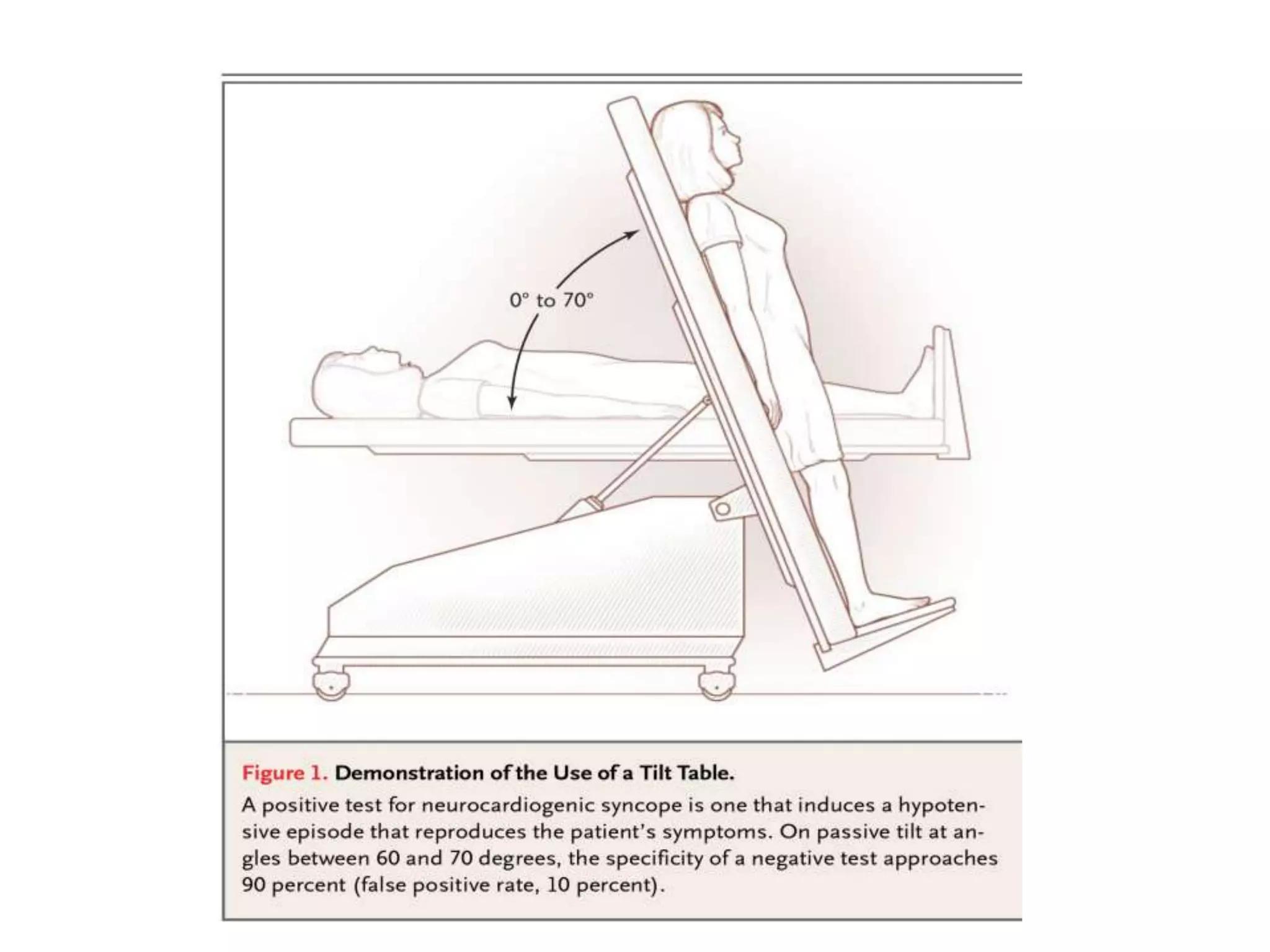
• The table is tilted such that head is slightly higher (30
degree) than rest of the body
• The BP and heart rate are checked at this level.
• After about 5 minute table is tilted more so that
patient lies at a 60 degree angle or higher.
• Continous recording of BP and heart rate done up to
45 minutes
• The patient is asked to stay still and quite during this
time and can tell if feel uncomfortable.
• If BP falls during this time the test has to be stopped
and table should be lowered.
• If BP does not drops after the time is up, lower the
table start the second part of the test.
Part 2:-
• The second part of the test shows body response to
a provocative agents such as isoproterenol or
nitroglycerin spray.
• After giving a provocative agent table is tilted upward
to 60 degree angle
• If BP drops the table is lowered to flat position and
stop medicine and test will ends.
• If BP does not drop then table is kept at 60 degree angle
for 15 minutes then test will be over.
• During the study BP, heart rate, oxygen saturation and
cardiac rhythm are recorded and monitored.
• The patient is also observed for signs and symptoms that
would necessitate early termination of the study.
Tilt Test End
The tilt test should be stopped and the patient is laid
flat immediately when:-
• Systolic blood pressure falls below 80 mmHg - or is
falling rapidly
• Heart rate falls below 50 /min - or is falling rapidly
• Heart rate rises above 170 /min
• Acute arrhythmia
• Hyperventilation leading to an end-tidal CO2 of less
than 20 mmHg if not able to bring it under control
• Patient distress or discomfort
Interpretation
• Responses to tilt testing :-
- A ‘positive’ tilt test is when the patient’s syncopal or
pre-syncopal symptoms are reproduced and
accompanied by hypotension, bradycardia (relative
or otherwise) or both.
- Heart rate and blood pressure changes in isolation
should not prompt a diagnosis of neurally mediated
or OH syncope.
There are several different possible positive
responses to a tilt test. The same patient may
have different responses at different times:
• Vasodepressor - the blood pressure falls but the
heart rate does not fall by more than 10% from its
peak.
.
• Cardio-inhibitory type A or ‘cardio-inhibition
without asystole’ - the heart rate falls to less than 40
/min for more than 10 seconds but asystole of more
than 3 seconds does not occur.
• Cardio-inhibitory type B or ‘cardio-inhibition with
asystole’ - there is asystole of more than 3 seconds
• Mixed - a mixture of a vasodepressor response and
cardio-inhibitory type A response.
• Excessive heart rate rise - a heart rate that rises
both at the onset of upright position and throughout
its duration before syncope (greater than 130 /min).
This is known as POTS (postural orthostatic
tachycardia syndrome)
Thank you..

ORTHOSTATIC HYPOTENSION

  • 1.
    ORTHOSTATIC HYPOTENSION Defined asa fall in systolic blood pressure of atleast 20 mm Hg or diastolic blood pressure of at least 10 mm Hg within 3 min of standing when compared with BP from sitting/supine position.
  • 2.
    What is TiltTest • The tilt test assess someone response to orthostatic stress (standing upright). • This test is valuable diagnostic test for evaluating patient with syncope.
  • 3.
    Indications • Definite indications:- -Unexplained recurrent syncope or a single episode in the absence of organic heart disease either A/W injury or in setting that pose a high risk of injury. - Unexplained recurrent syncope or a single episode in the presence of organic heart disease after cardiac cause of syncope have been excluded.
  • 4.
    - A casein which cause of syncope has been determined but the predisposition to neurocardiogenic syncope may alter the treatment used.
  • 5.
    • Possible indications:- -Differentiation of convulsive syncope from epilepsy. - Assessment of recurrent, unexplained falls. - Evaluation of recurrent, unexplained near-syncope and light-headedness.
  • 6.
    - Evaluation ofrecurrent syncope in the setting of autonomic failure or peripheral neuropathies. - Evaluation of postexertion syncope when an episode can not be produced by exercise test.
  • 7.
    Method Preparation:- -Do not eator drink at least 2 hours before the test -For morning test do not eat or drink after midnight Part 1:- • This part shows body response to change in position • Patient is asked to lie on his back on a table • Straps at waist and knees help to stay in position • Intravenous line is put in one arm
  • 8.
    • Electrodes areattached to the chest and are connected to the ECG machine to track heart beats. • A cuff is placed on one arm to measure blood pressure. • The table is tilted such that head is slightly higher (30 degree) than rest of the body • The BP and heart rate are checked at this level. • After about 5 minute table is tilted more so that patient lies at a 60 degree angle or higher. • Continous recording of BP and heart rate done up to 45 minutes
  • 10.
    • The patientis asked to stay still and quite during this time and can tell if feel uncomfortable. • If BP falls during this time the test has to be stopped and table should be lowered. • If BP does not drops after the time is up, lower the table start the second part of the test.
  • 11.
    Part 2:- • Thesecond part of the test shows body response to a provocative agents such as isoproterenol or nitroglycerin spray. • After giving a provocative agent table is tilted upward to 60 degree angle • If BP drops the table is lowered to flat position and stop medicine and test will ends.
  • 12.
    • If BPdoes not drop then table is kept at 60 degree angle for 15 minutes then test will be over. • During the study BP, heart rate, oxygen saturation and cardiac rhythm are recorded and monitored. • The patient is also observed for signs and symptoms that would necessitate early termination of the study.
  • 14.
    Tilt Test End Thetilt test should be stopped and the patient is laid flat immediately when:- • Systolic blood pressure falls below 80 mmHg - or is falling rapidly • Heart rate falls below 50 /min - or is falling rapidly • Heart rate rises above 170 /min • Acute arrhythmia • Hyperventilation leading to an end-tidal CO2 of less than 20 mmHg if not able to bring it under control • Patient distress or discomfort
  • 15.
    Interpretation • Responses totilt testing :- - A ‘positive’ tilt test is when the patient’s syncopal or pre-syncopal symptoms are reproduced and accompanied by hypotension, bradycardia (relative or otherwise) or both. - Heart rate and blood pressure changes in isolation should not prompt a diagnosis of neurally mediated or OH syncope.
  • 16.
    There are severaldifferent possible positive responses to a tilt test. The same patient may have different responses at different times: • Vasodepressor - the blood pressure falls but the heart rate does not fall by more than 10% from its peak. .
  • 17.
    • Cardio-inhibitory typeA or ‘cardio-inhibition without asystole’ - the heart rate falls to less than 40 /min for more than 10 seconds but asystole of more than 3 seconds does not occur. • Cardio-inhibitory type B or ‘cardio-inhibition with asystole’ - there is asystole of more than 3 seconds
  • 18.
    • Mixed -a mixture of a vasodepressor response and cardio-inhibitory type A response. • Excessive heart rate rise - a heart rate that rises both at the onset of upright position and throughout its duration before syncope (greater than 130 /min). This is known as POTS (postural orthostatic tachycardia syndrome)
  • 19.