Approach to syncope
Dr. Gagan V
SR – Cardiology
• Syncope (Greek:synkope) literally means a
“cessation”, “cutting short” or “pause”
• Syncope is a transient loss of consciousness
due to transient global cerebral hypoperfusion
characterized by rapid onset, short duration,
and spontaneous recovery.
• Cessation of blood flow leads to loss of
conciousness within 10 minutes
• Important clinical problem
• Disabling, may cause injuries
• Upto 25% of victims of sudden cardiac death
in age 15 to 35 years presented initially with
syncope/presyncope
• first episode of syncope between 10 and 30
years with a peak at 15 years of age
• Second peak ≥ 65
• Prognosis of syncope
– Structural heart disease/arrhythmias – increased
risk of sudden cardiac death
– Orthostatic hypotension – twofold increased risk
of mortality because of associated comorbidities
– Neurally mediated syncope – excellent prognosis
Causes of real/apparent loss of
conciousness
• Syncope
• Neurologic
– Epilepsy
– Vertebrobasilar TIA
• Metabolic
syndromes/Coma
– Hyperventilation with
hypocapnia
– Hypoglycemia
– Hypoxemia
– Drug/alcohol intoxication
– Coma
• Psychogenic syncope
– Anxiety/panic disorders
– Somatization disorders
• Syncope is characterized by
– Loss of conciousness
– Transient
– Rapid
– Short duration
– And rapid recovery
Causes of Syncope
• Vascular
• Cardiac
• Syncope of Unknown origin
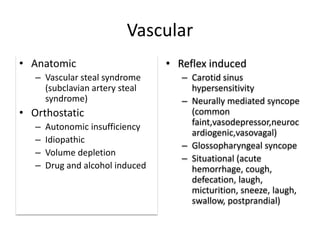
Vascular
• Anatomic
– Vascular steal syndrome
(subclavian artery steal
syndrome)
• Orthostatic
– Autonomic insufficiency
– Idiopathic
– Volume depletion
– Drug and alcohol induced
• Reflex induced
– Carotid sinus
hypersensitivity
– Neurally mediated syncope
(common
faint,vasodepressor,neuroc
ardiogenic,vasovagal)
– Glossopharyngeal syncope
– Situational (acute
hemorrhage, cough,
defecation, laugh,
micturition, sneeze, laugh,
swallow, postprandial)
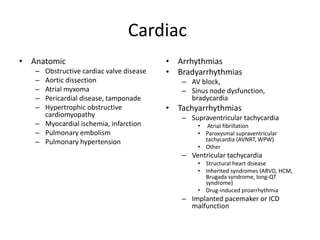
Cardiac
• Anatomic
– Obstructive cardiac valve disease
– Aortic dissection
– Atrial myxoma
– Pericardial disease, tamponade
– Hypertrophic obstructive
cardiomyopathy
– Myocardial ischemia, infarction
– Pulmonary embolism
– Pulmonary hypertension
• Arrhythmias
• Bradyarrhythmias
– AV block,
– Sinus node dysfunction,
bradycardia
• Tachyarrhythmias
– Supraventricular tachycardia
• Atrial fibrillation
• Paroxysmal supraventricular
tachycardia (AVNRT, WPW)
• Other
– Ventricular tachycardia
• Structural heart disease
• Inherited syndromes (ARVD, HCM,
Brugada syndrome, long-QT
syndrome)
• Drug-induced proarrhythmia
– Implanted pacemaker or ICD
malfunction
Vascular causes
• Reflex mediated and orthostatic hypotension
• Most common
• One third of all syncopal episodes
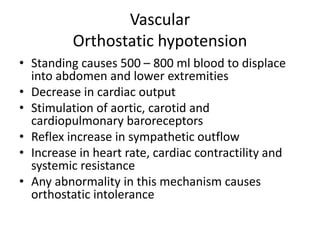
Vascular
Orthostatic hypotension
• Standing causes 500 – 800 ml blood to displace
into abdomen and lower extremities
• Decrease in cardiac output
• Stimulation of aortic, carotid and
cardiopulmonary baroreceptors
• Reflex increase in sympathetic outflow
• Increase in heart rate, cardiac contractility and
systemic resistance
• Any abnormality in this mechanism causes
orthostatic intolerance
• Syncope, presyncope, tremulousness, palpitation,
fatigue, diaphoresis, blurred/tunnel vision
• Orthostatic hypotension defined as drop of 20/10 mm
Hg within 3 minutes of standing
• Asymptomatic/symptomatic
• Usually worse in morning, after food, after exercise
• After food occurs due to redistribution in gut esp in
elderly
• Upto 20 mm Hg drop in SBP after food can be seen in
elderly upto one third
• Initial orthostatic hypotension
– Decrease of > 40 mm Hg immediately after
standing with rapid return to normal (<30 sec)
• Delayed progressive orthostatic hypotension
– Slow progressive decrease in SBP on standing
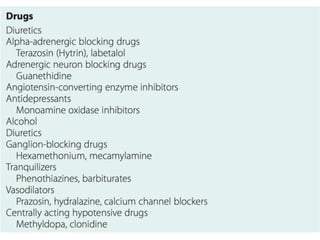
• Drugs most common cause of orthostatic
hypotension, either by volume depletion or
vasodilation
• Elderly are susceptible
– Reduced baroreceptor sensitivity
– Decreased cerebral blood flow
– Renal sodium wasting
– Impaired thirst mechanism
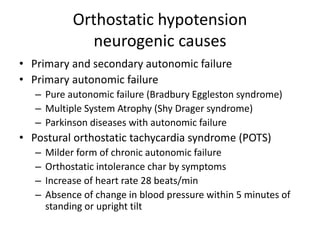
Orthostatic hypotension
neurogenic causes
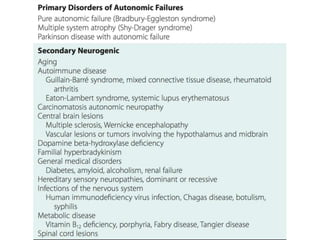
• Primary and secondary autonomic failure
• Primary autonomic failure
– Pure autonomic failure (Bradbury Eggleston syndrome)
– Multiple System Atrophy (Shy Drager syndrome)
– Parkinson diseases with autonomic failure
• Postural orthostatic tachycardia syndrome (POTS)
– Milder form of chronic autonomic failure
– Orthostatic intolerance char by symptoms
– Increase of heart rate 28 beats/min
– Absence of change in blood pressure within 5 minutes of
standing or upright tilt
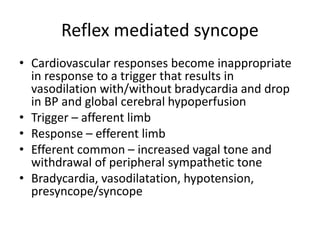
Reflex mediated syncope
• Cardiovascular responses become inappropriate
in response to a trigger that results in
vasodilation with/without bradycardia and drop
in BP and global cerebral hypoperfusion
• Trigger – afferent limb
• Response – efferent limb
• Efferent common – increased vagal tone and
withdrawal of peripheral sympathetic tone
• Bradycardia, vasodilatation, hypotension,
presyncope/syncope
• Vasodepressor type response
– Hypotension due to peripheral vasodilation
predominates
• Cardioinhibitory response
– Bradycardia/asystole predominates
• Mixed
– Both vasodilation and bradycardia
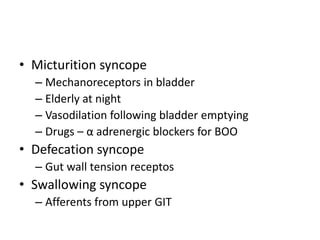
• Micturition syncope
– Mechanoreceptors in bladder
– Elderly at night
– Vasodilation following bladder emptying
– Drugs – α adrenergic blockers for BOO
• Defecation syncope
– Gut wall tension receptos
• Swallowing syncope
– Afferents from upper GIT
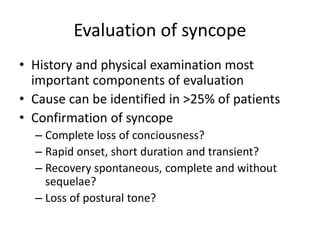
Evaluation of syncope
• History and physical examination most
important components of evaluation
• Cause can be identified in >25% of patients
• Confirmation of syncope
– Complete loss of conciousness?
– Rapid onset, short duration and transient?
– Recovery spontaneous, complete and without
sequelae?
– Loss of postural tone?
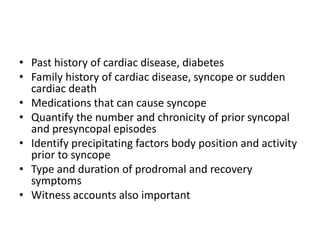
• Past history of cardiac disease, diabetes
• Family history of cardiac disease, syncope or sudden
cardiac death
• Medications that can cause syncope
• Quantify the number and chronicity of prior syncopal
and presyncopal episodes
• Identify precipitating factors body position and activity
prior to syncope
• Type and duration of prodromal and recovery
symptoms
• Witness accounts also important
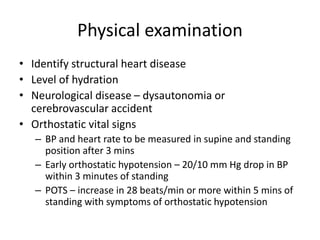
Physical examination
• Identify structural heart disease
• Level of hydration
• Neurological disease – dysautonomia or
cerebrovascular accident
• Orthostatic vital signs
– BP and heart rate to be measured in supine and standing
position after 3 mins
– Early orthostatic hypotension – 20/10 mm Hg drop in BP
within 3 minutes of standing
– POTS – increase in 28 beats/min or more within 5 mins of
standing with symptoms of orthostatic hypotension
• Carotid sinus massage
– To identify carotid sinus hypersensitivity in patients more than
40 years of age
– To avoid in patients with history of TIA, CVA within 3 months,
carotid bruit unless significant stenosis ruled out by doppler
– Apply gentle pressure over carotid bifurcation ie just below
angle of jaw
– Pressure applied for 5 to 10 sec in both supine and upright
position
– Carotid sinus hypersensitivity defined as sinus pause more than
3 seconds in duration or fall in SBP of 50 mm Hg or more
– Response can be cardioinhibitory (asystole) or vasodepressive
(fall in SBP)
– Complications are neurologic
Tests
Tilt-Table testing
• 20 min horizontal pre tilt stabilization phase
• Upright tilt testing at angle between 60 to 80 degrees
for 30 to 45 minutes
• Sensitivity can be increased with decreased specificity
by
– Longer tilt duration
– Steeper tilt angles
– Provocative agents like isoprenaline and Nitroglycerine
– Isoprenaline – 1 – 3 μg/min to increase heart rate 25%
– Nitroglycerine 300 to 400 μg spray sublingually after 20
min unmedicated phase in upright position
• Positive response implies susceptibility to neurally mediated
syncope
• Indication – confirmation of neurogenic syncope when initial
evaluation is insufficient to confirm same
• Not recommended when diagnosis can be confirmed otherwise
• Reflex hypotension or bradycardia without syncope is less specific
for neurally mediated syncope
• In patients with structural heart disease other causes to be ruled
out before confirming neurally mediated syncope
• Psychogenic pseudosyncope - loss of conciousness with no change
in vital signs
• No value in assessing treatment of neurally mediated syncope

Approach to syncope

  • 1.
    Approach to syncope Dr.Gagan V SR – Cardiology
  • 2.
    • Syncope (Greek:synkope)literally means a “cessation”, “cutting short” or “pause” • Syncope is a transient loss of consciousness due to transient global cerebral hypoperfusion characterized by rapid onset, short duration, and spontaneous recovery. • Cessation of blood flow leads to loss of conciousness within 10 minutes
  • 3.
    • Important clinicalproblem • Disabling, may cause injuries • Upto 25% of victims of sudden cardiac death in age 15 to 35 years presented initially with syncope/presyncope • first episode of syncope between 10 and 30 years with a peak at 15 years of age • Second peak ≥ 65
  • 4.
    • Prognosis ofsyncope – Structural heart disease/arrhythmias – increased risk of sudden cardiac death – Orthostatic hypotension – twofold increased risk of mortality because of associated comorbidities – Neurally mediated syncope – excellent prognosis
  • 5.
    Causes of real/apparentloss of conciousness • Syncope • Neurologic – Epilepsy – Vertebrobasilar TIA • Metabolic syndromes/Coma – Hyperventilation with hypocapnia – Hypoglycemia – Hypoxemia – Drug/alcohol intoxication – Coma • Psychogenic syncope – Anxiety/panic disorders – Somatization disorders
  • 6.
    • Syncope ischaracterized by – Loss of conciousness – Transient – Rapid – Short duration – And rapid recovery
  • 7.
    Causes of Syncope •Vascular • Cardiac • Syncope of Unknown origin
  • 8.
    Vascular • Anatomic – Vascularsteal syndrome (subclavian artery steal syndrome) • Orthostatic – Autonomic insufficiency – Idiopathic – Volume depletion – Drug and alcohol induced • Reflex induced – Carotid sinus hypersensitivity – Neurally mediated syncope (common faint,vasodepressor,neuroc ardiogenic,vasovagal) – Glossopharyngeal syncope – Situational (acute hemorrhage, cough, defecation, laugh, micturition, sneeze, laugh, swallow, postprandial)
  • 9.
    Cardiac • Anatomic – Obstructivecardiac valve disease – Aortic dissection – Atrial myxoma – Pericardial disease, tamponade – Hypertrophic obstructive cardiomyopathy – Myocardial ischemia, infarction – Pulmonary embolism – Pulmonary hypertension • Arrhythmias • Bradyarrhythmias – AV block, – Sinus node dysfunction, bradycardia • Tachyarrhythmias – Supraventricular tachycardia • Atrial fibrillation • Paroxysmal supraventricular tachycardia (AVNRT, WPW) • Other – Ventricular tachycardia • Structural heart disease • Inherited syndromes (ARVD, HCM, Brugada syndrome, long-QT syndrome) • Drug-induced proarrhythmia – Implanted pacemaker or ICD malfunction
  • 10.
    Vascular causes • Reflexmediated and orthostatic hypotension • Most common • One third of all syncopal episodes
  • 11.
    Vascular Orthostatic hypotension • Standingcauses 500 – 800 ml blood to displace into abdomen and lower extremities • Decrease in cardiac output • Stimulation of aortic, carotid and cardiopulmonary baroreceptors • Reflex increase in sympathetic outflow • Increase in heart rate, cardiac contractility and systemic resistance • Any abnormality in this mechanism causes orthostatic intolerance
  • 12.
    • Syncope, presyncope,tremulousness, palpitation, fatigue, diaphoresis, blurred/tunnel vision • Orthostatic hypotension defined as drop of 20/10 mm Hg within 3 minutes of standing • Asymptomatic/symptomatic • Usually worse in morning, after food, after exercise • After food occurs due to redistribution in gut esp in elderly • Upto 20 mm Hg drop in SBP after food can be seen in elderly upto one third
  • 13.
    • Initial orthostatichypotension – Decrease of > 40 mm Hg immediately after standing with rapid return to normal (<30 sec) • Delayed progressive orthostatic hypotension – Slow progressive decrease in SBP on standing
  • 14.
    • Drugs mostcommon cause of orthostatic hypotension, either by volume depletion or vasodilation • Elderly are susceptible – Reduced baroreceptor sensitivity – Decreased cerebral blood flow – Renal sodium wasting – Impaired thirst mechanism
  • 16.
    Orthostatic hypotension neurogenic causes •Primary and secondary autonomic failure • Primary autonomic failure – Pure autonomic failure (Bradbury Eggleston syndrome) – Multiple System Atrophy (Shy Drager syndrome) – Parkinson diseases with autonomic failure • Postural orthostatic tachycardia syndrome (POTS) – Milder form of chronic autonomic failure – Orthostatic intolerance char by symptoms – Increase of heart rate 28 beats/min – Absence of change in blood pressure within 5 minutes of standing or upright tilt
  • 17.
    Reflex mediated syncope •Cardiovascular responses become inappropriate in response to a trigger that results in vasodilation with/without bradycardia and drop in BP and global cerebral hypoperfusion • Trigger – afferent limb • Response – efferent limb • Efferent common – increased vagal tone and withdrawal of peripheral sympathetic tone • Bradycardia, vasodilatation, hypotension, presyncope/syncope
  • 18.
    • Vasodepressor typeresponse – Hypotension due to peripheral vasodilation predominates • Cardioinhibitory response – Bradycardia/asystole predominates • Mixed – Both vasodilation and bradycardia
  • 19.
    • Micturition syncope –Mechanoreceptors in bladder – Elderly at night – Vasodilation following bladder emptying – Drugs – α adrenergic blockers for BOO • Defecation syncope – Gut wall tension receptos • Swallowing syncope – Afferents from upper GIT
  • 21.
    Evaluation of syncope •History and physical examination most important components of evaluation • Cause can be identified in >25% of patients • Confirmation of syncope – Complete loss of conciousness? – Rapid onset, short duration and transient? – Recovery spontaneous, complete and without sequelae? – Loss of postural tone?
  • 22.
    • Past historyof cardiac disease, diabetes • Family history of cardiac disease, syncope or sudden cardiac death • Medications that can cause syncope • Quantify the number and chronicity of prior syncopal and presyncopal episodes • Identify precipitating factors body position and activity prior to syncope • Type and duration of prodromal and recovery symptoms • Witness accounts also important
  • 24.
    Physical examination • Identifystructural heart disease • Level of hydration • Neurological disease – dysautonomia or cerebrovascular accident • Orthostatic vital signs – BP and heart rate to be measured in supine and standing position after 3 mins – Early orthostatic hypotension – 20/10 mm Hg drop in BP within 3 minutes of standing – POTS – increase in 28 beats/min or more within 5 mins of standing with symptoms of orthostatic hypotension
  • 25.
    • Carotid sinusmassage – To identify carotid sinus hypersensitivity in patients more than 40 years of age – To avoid in patients with history of TIA, CVA within 3 months, carotid bruit unless significant stenosis ruled out by doppler – Apply gentle pressure over carotid bifurcation ie just below angle of jaw – Pressure applied for 5 to 10 sec in both supine and upright position – Carotid sinus hypersensitivity defined as sinus pause more than 3 seconds in duration or fall in SBP of 50 mm Hg or more – Response can be cardioinhibitory (asystole) or vasodepressive (fall in SBP) – Complications are neurologic
  • 26.
    Tests Tilt-Table testing • 20min horizontal pre tilt stabilization phase • Upright tilt testing at angle between 60 to 80 degrees for 30 to 45 minutes • Sensitivity can be increased with decreased specificity by – Longer tilt duration – Steeper tilt angles – Provocative agents like isoprenaline and Nitroglycerine – Isoprenaline – 1 – 3 μg/min to increase heart rate 25% – Nitroglycerine 300 to 400 μg spray sublingually after 20 min unmedicated phase in upright position
  • 27.
    • Positive responseimplies susceptibility to neurally mediated syncope • Indication – confirmation of neurogenic syncope when initial evaluation is insufficient to confirm same • Not recommended when diagnosis can be confirmed otherwise • Reflex hypotension or bradycardia without syncope is less specific for neurally mediated syncope • In patients with structural heart disease other causes to be ruled out before confirming neurally mediated syncope • Psychogenic pseudosyncope - loss of conciousness with no change in vital signs • No value in assessing treatment of neurally mediated syncope