Holter Monitoring
and Tilt Table Testing
Presented by Anisa Shoukat
HOLTER MONITORING
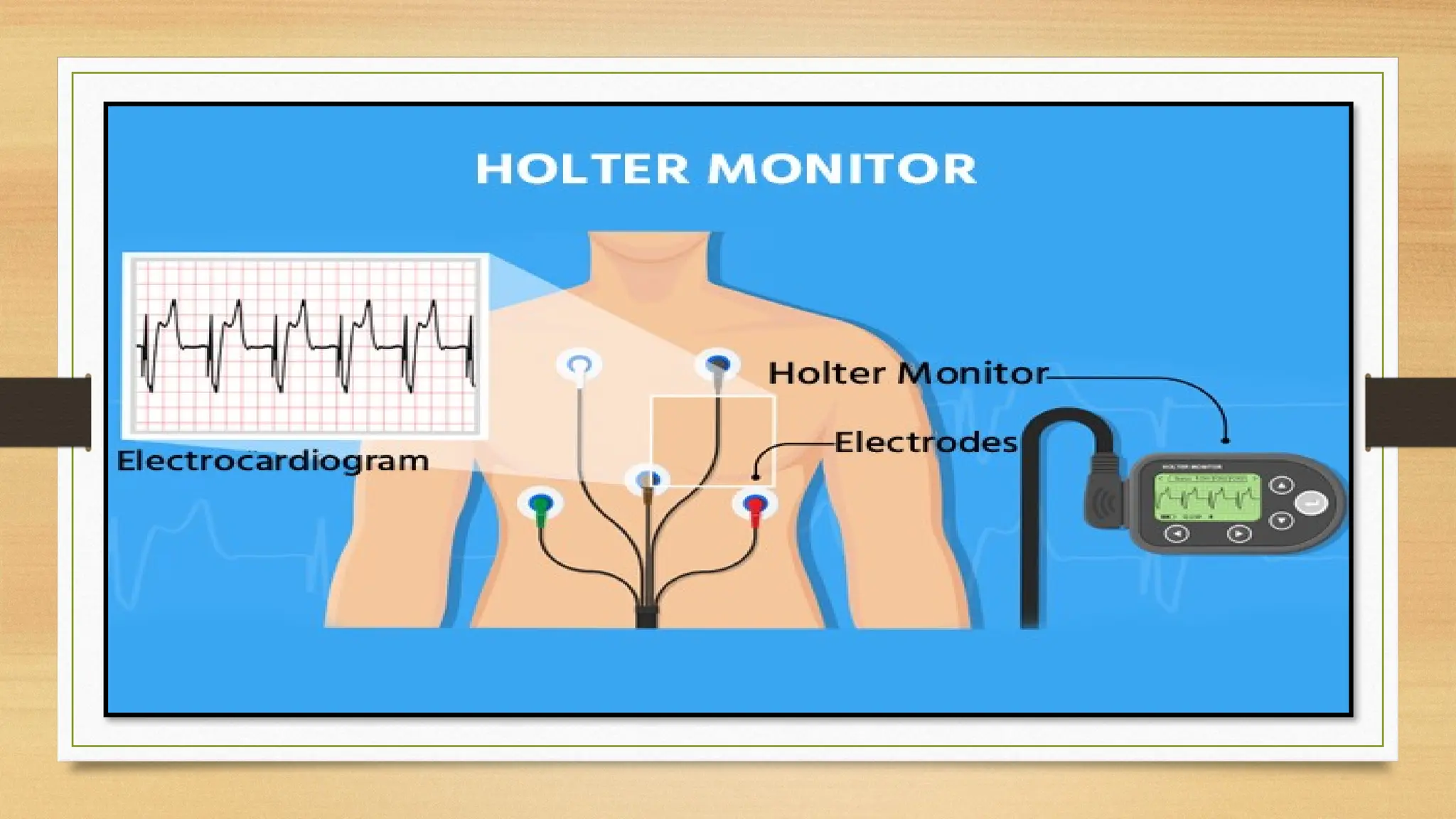
A Holter monitor is a wearable device and type of ambulatory ECG that records your heart’s
rhythm and rate activity
This monitor is:
• Small
• Battery operated.
• Equipped with wires and electrodes (small patches) that stick to your skin.
A Holter monitor records your heart’s electrical activity for 24 or 48 hours. While you wear it, you
continue to do your regular daily activities. The Holter monitor is named for Dr. Norman J.
Holter, who created it in the 1950s.
What conditions can a Holter monitor find?
• Arrhythmia (heart rhythm abnormalities).
• Heart palpitations.
• Unexplained dizziness.
Your provider can also use a cardiac monitor to determine how well your:
• Pacemaker is working.
What’s the difference between Holter and event monitoring?
• A Holter monitor records your heart continuously for 24 or 48 hours.
• An event monitor is not continuous. It only records your heart’s activity
when you feel symptoms and activate the monitor.
What should I expect when wearing the Holter monitor?
1. Attach the electrodes: The technician attaches the electrodes to your chest. The electrodes are small, round,
sticky patches. They might need to shave your chest to make sure the electrodes stay attached.
2. Place the monitor: The technician helps you put on the monitor and connect it to the electrodes. They
explain how to take care of the monitor.
3. Store the monitor: You can carry the heart monitor in a pocket or bag. Or you can wear it on a strap, like a
purse. You can also wear it on your waist.
4. Go about your day: You can do most of your usual activities while you wear the monitor.
5. Keep an activity and symptom diary: Your technician explains how to keep track of your activities and
symptoms. Write down symptoms such as shortness of breath, skipped or uneven heartbeats and chest pain.
Jot down when the symptoms happened and what you were doing. Your provider will compare changes in
your EKG with your symptoms and activities.
Are there activities I should avoid while wearing the Holter monitor?
• Bathe, shower or swim.
• Have an X-ray.
• Go near a high-voltage area or metal detector.
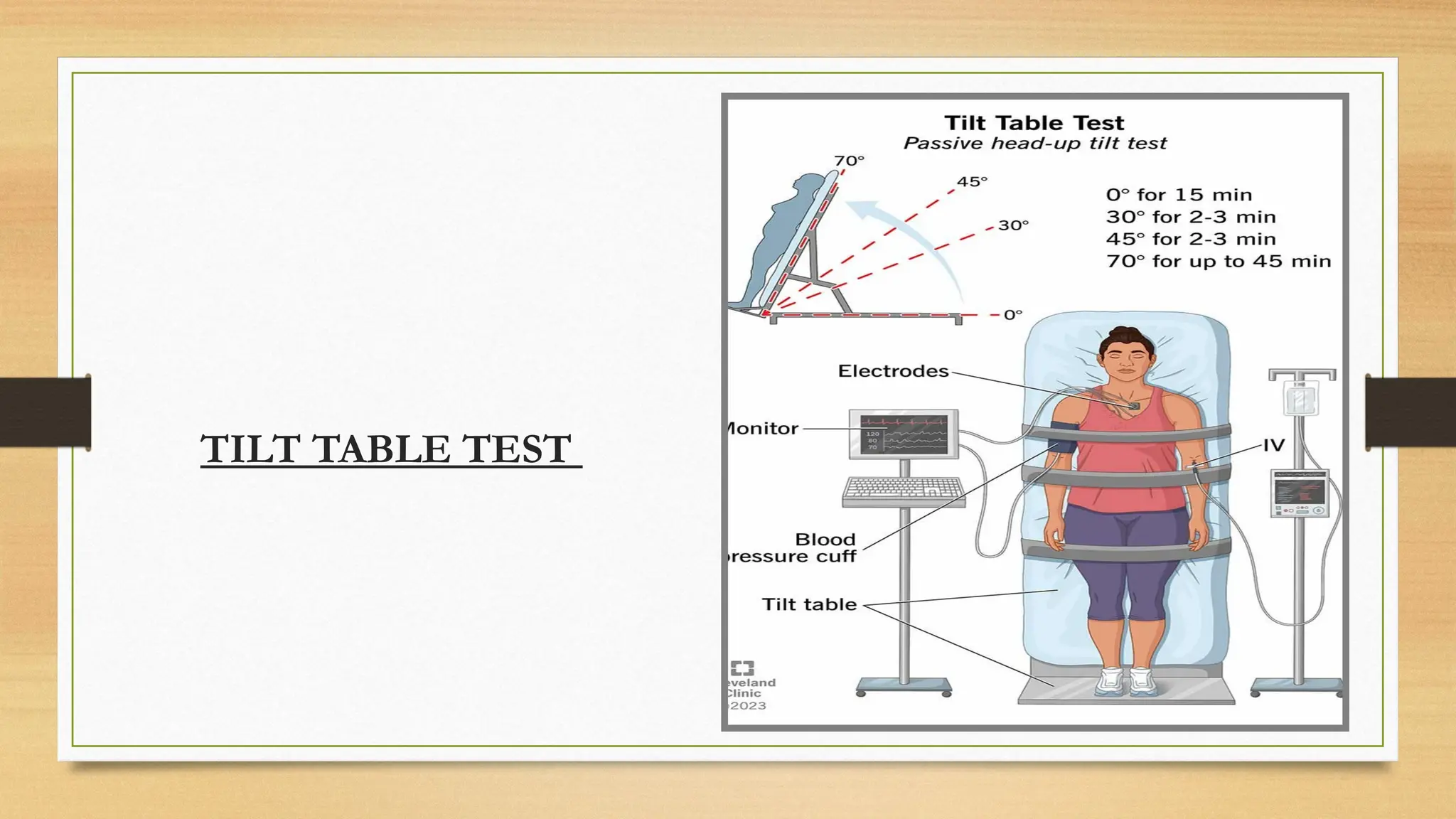
TILT TABLE TEST
Terms to know
• Vasovagal syncope occurs when you faint because your body overreacts to
certain triggers, such as the sight of blood or extreme emotional distress. It
may also be called neurocardiogenic syncope
• Orthostatic hypotension also called postural hypotension is a form of low
blood pressure that happens when standing after sitting or lying down.
Orthostatic hypotension can cause dizziness or lightheadedness and possibly
fainting. Orthostatic hypotension can be mild. Episodes might be brief
Terms to know
• Orthostatic syncope refers to a transient or passing loss of consciousness
resulting from a reduction in cerebral blood flow and is usually associated
with a loss in postural tone but with spontaneous recovery. Syncope can
occur without symptoms or can be preceded by symptoms like dizziness,
diaphoresis, nausea or blurred vision
What is a tilt table test?
• The tilt table test also called a “passive head-up tilt test” or “head-upright tilt
test” is a test healthcare providers use for people who faint.
• It records your blood pressure, heart rhythm and heart rate on a beat-by-beat
basis when the table you’re on tilts at different angles.
• The table always stays head-up.
INDICATIONS
• Recurrent syncope of unknown origin
• Syncope of unknown origin with traumatic injury
• Even one syncopal event of unknown origin
• Suspicion of pseudo syncope or psychogenic syncope
• Jerking movements during the loss of consciousness to differentiate them
from epilepsy
• A fall, which may mask syncope.
CONTRAINDICATIONS
• significant coronary artery stenosis
• hypertrophic cardiomyopathy with outflow tract narrowing
• severe anemia
• known origin of the syncopal event, lack of syncopal events
• falls, pre-syncopal events in medical history
• an unstable condition.
What conditions cause a positive tilt table test?
• Unusually slow heartbeat (bradycardia).
• Unusually fast heartbeat (tachycardia).
• Low blood sugar (hypoglycemia).
• Low blood pressure (hypotension).
• Postural orthostatic tachycardia syndrome (POTS).
Procedure
First part of test
• During a tilt table test, you’ll rest for 15 minutes.
• Then, as you lie still, a provider will record your blood pressure and EKG.
A provider who controls the motorized table will tilt it:
• To 30 degrees for 2 to 3 minutes.
• To 45 degrees for 2 to 3 minutes.
• To 70 degrees for up to 45 minutes.
• You’ll always be upright during the test.
For the most accurate test results, follow these
directions:
• Stay as still and quiet as possible during the test.
• Don’t move your legs while you’re in the
standing position.
• Try not to talk unless you need to.
• Tell a provider about symptoms you have
during your tilt table test.
Second part of test
• If your blood pressure doesn’t fall during the
first part of the test, a provider may give you
medicine to see if your body reacts to it. The
medicine makes your heart beat faster. You
may get the medicine through your IV or as a
pill or spray in your mouth.
• After you receive the medicine, a provider will
tilt the table to 60 degrees for up to 15
minutes. If your blood pressure goes down
during this time, it’s the end of the test. Either
way, you’re done in 15 minutes with the second
part of the test.
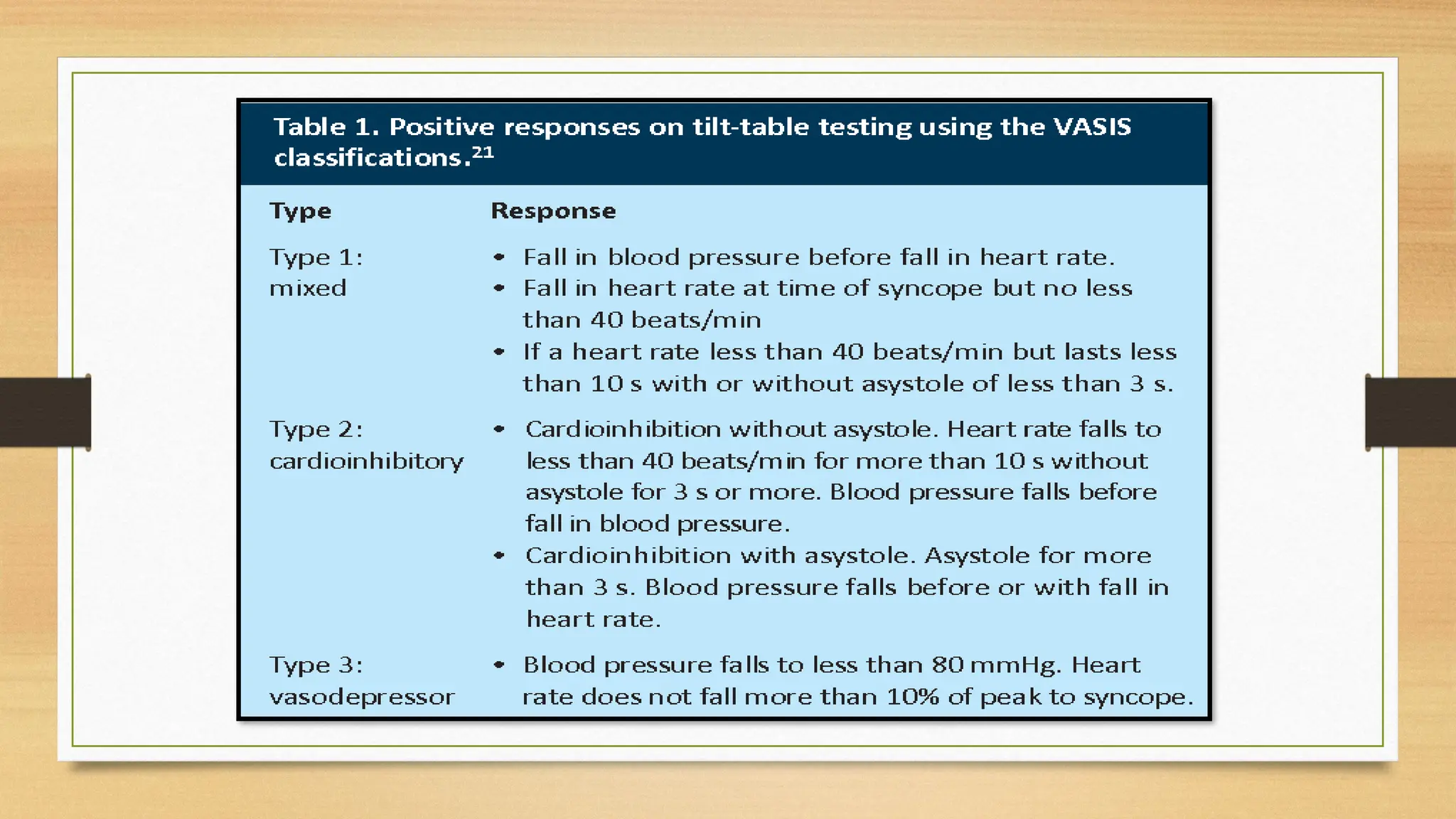
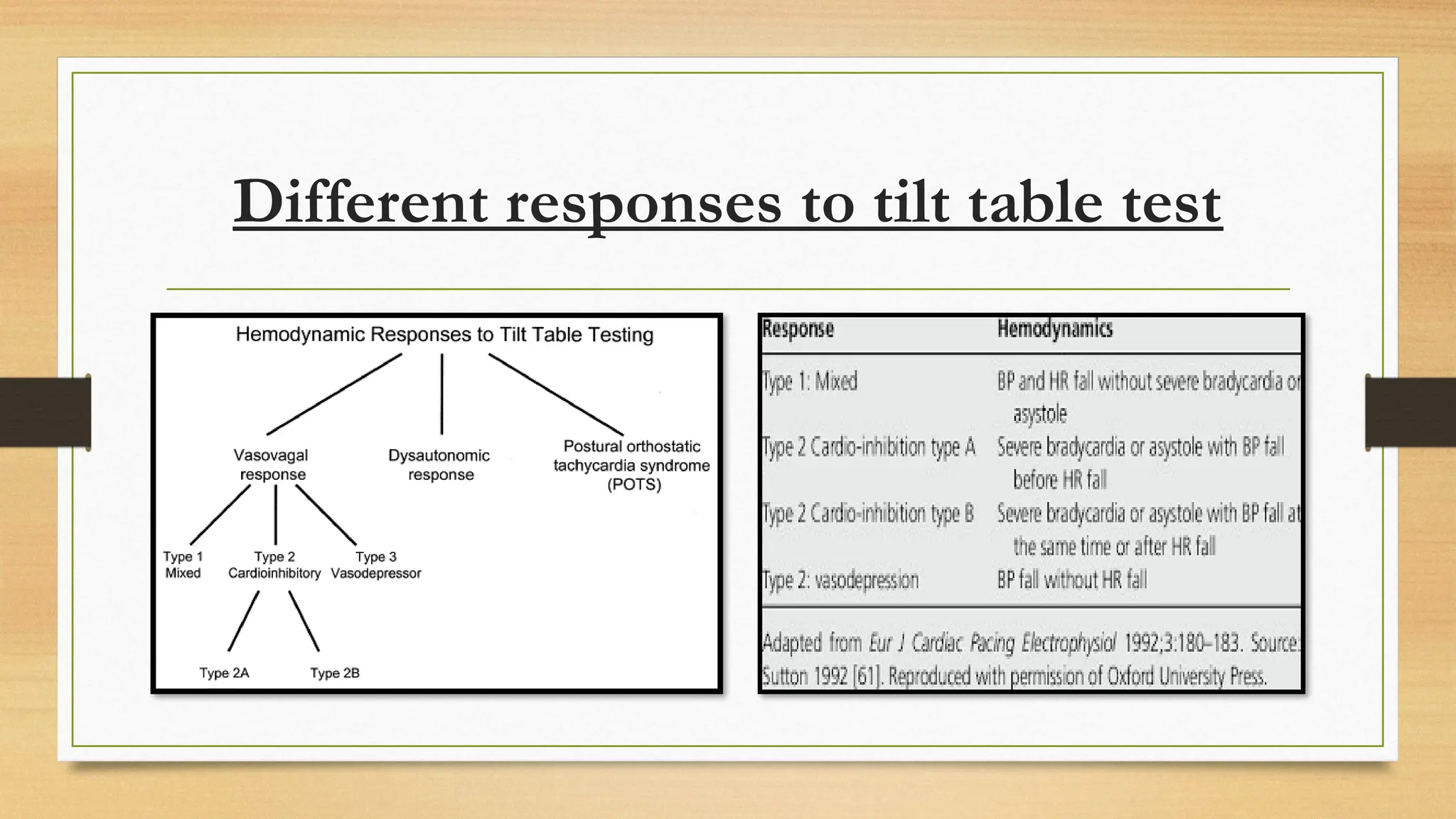
Different responses to tilt table test
Holter Monitoring and Tilt Table Testing.pptx

Holter Monitoring and Tilt Table Testing.pptx

  • 1.
    Holter Monitoring and TiltTable Testing Presented by Anisa Shoukat
  • 3.
    HOLTER MONITORING A Holtermonitor is a wearable device and type of ambulatory ECG that records your heart’s rhythm and rate activity This monitor is: • Small • Battery operated. • Equipped with wires and electrodes (small patches) that stick to your skin. A Holter monitor records your heart’s electrical activity for 24 or 48 hours. While you wear it, you continue to do your regular daily activities. The Holter monitor is named for Dr. Norman J. Holter, who created it in the 1950s.
  • 4.
    What conditions cana Holter monitor find? • Arrhythmia (heart rhythm abnormalities). • Heart palpitations. • Unexplained dizziness. Your provider can also use a cardiac monitor to determine how well your: • Pacemaker is working.
  • 5.
    What’s the differencebetween Holter and event monitoring? • A Holter monitor records your heart continuously for 24 or 48 hours. • An event monitor is not continuous. It only records your heart’s activity when you feel symptoms and activate the monitor.
  • 6.
    What should Iexpect when wearing the Holter monitor? 1. Attach the electrodes: The technician attaches the electrodes to your chest. The electrodes are small, round, sticky patches. They might need to shave your chest to make sure the electrodes stay attached. 2. Place the monitor: The technician helps you put on the monitor and connect it to the electrodes. They explain how to take care of the monitor. 3. Store the monitor: You can carry the heart monitor in a pocket or bag. Or you can wear it on a strap, like a purse. You can also wear it on your waist. 4. Go about your day: You can do most of your usual activities while you wear the monitor. 5. Keep an activity and symptom diary: Your technician explains how to keep track of your activities and symptoms. Write down symptoms such as shortness of breath, skipped or uneven heartbeats and chest pain. Jot down when the symptoms happened and what you were doing. Your provider will compare changes in your EKG with your symptoms and activities.
  • 7.
    Are there activitiesI should avoid while wearing the Holter monitor? • Bathe, shower or swim. • Have an X-ray. • Go near a high-voltage area or metal detector.
  • 8.
  • 9.
    Terms to know •Vasovagal syncope occurs when you faint because your body overreacts to certain triggers, such as the sight of blood or extreme emotional distress. It may also be called neurocardiogenic syncope • Orthostatic hypotension also called postural hypotension is a form of low blood pressure that happens when standing after sitting or lying down. Orthostatic hypotension can cause dizziness or lightheadedness and possibly fainting. Orthostatic hypotension can be mild. Episodes might be brief
  • 10.
    Terms to know •Orthostatic syncope refers to a transient or passing loss of consciousness resulting from a reduction in cerebral blood flow and is usually associated with a loss in postural tone but with spontaneous recovery. Syncope can occur without symptoms or can be preceded by symptoms like dizziness, diaphoresis, nausea or blurred vision
  • 11.
    What is atilt table test? • The tilt table test also called a “passive head-up tilt test” or “head-upright tilt test” is a test healthcare providers use for people who faint. • It records your blood pressure, heart rhythm and heart rate on a beat-by-beat basis when the table you’re on tilts at different angles. • The table always stays head-up.
  • 12.
    INDICATIONS • Recurrent syncopeof unknown origin • Syncope of unknown origin with traumatic injury • Even one syncopal event of unknown origin • Suspicion of pseudo syncope or psychogenic syncope • Jerking movements during the loss of consciousness to differentiate them from epilepsy • A fall, which may mask syncope.
  • 13.
    CONTRAINDICATIONS • significant coronaryartery stenosis • hypertrophic cardiomyopathy with outflow tract narrowing • severe anemia • known origin of the syncopal event, lack of syncopal events • falls, pre-syncopal events in medical history • an unstable condition.
  • 14.
    What conditions causea positive tilt table test? • Unusually slow heartbeat (bradycardia). • Unusually fast heartbeat (tachycardia). • Low blood sugar (hypoglycemia). • Low blood pressure (hypotension). • Postural orthostatic tachycardia syndrome (POTS).
  • 15.
    Procedure First part oftest • During a tilt table test, you’ll rest for 15 minutes. • Then, as you lie still, a provider will record your blood pressure and EKG. A provider who controls the motorized table will tilt it: • To 30 degrees for 2 to 3 minutes. • To 45 degrees for 2 to 3 minutes. • To 70 degrees for up to 45 minutes.
  • 16.
    • You’ll alwaysbe upright during the test. For the most accurate test results, follow these directions: • Stay as still and quiet as possible during the test. • Don’t move your legs while you’re in the standing position. • Try not to talk unless you need to. • Tell a provider about symptoms you have during your tilt table test. Second part of test • If your blood pressure doesn’t fall during the first part of the test, a provider may give you medicine to see if your body reacts to it. The medicine makes your heart beat faster. You may get the medicine through your IV or as a pill or spray in your mouth. • After you receive the medicine, a provider will tilt the table to 60 degrees for up to 15 minutes. If your blood pressure goes down during this time, it’s the end of the test. Either way, you’re done in 15 minutes with the second part of the test.
  • 18.
    Different responses totilt table test