
Dr Uday Prashant MD, DM
SYNCOPE
 Syncope is “characterized by sudden, brief loss of consciousness

and postural tone followed by spontaneous recovery”.

 Morichetti et al, have shown that syncope is a common presenting

problem in health care settings, accounting for 3% to 5% of
emergency room visits and 1% to 3% of hospital admissions1

 Despite major advances in our understanding of the mechanisms

and underlying causes of syncope, its etiology often remains a
diagnostic dilemma.

 Commonly used approach though adequate in majority leads to

misdiagnosis and waste of resources
- Routinely prescribed tests are 24 Hour HOLTER, EEG, CT Scan
etc which are quite useless in majority.
 Syncope is a sudden and brief loss of consciousness

associated with a loss of postural tone, from which
recovery is spontaneous.
 Usually the loss of consciousness is for 20 -30 seconds
and the underlying mechanism is a transient global
cerebral hypoperfusion.
 Syncope is a transient symptom and not a disease
 In the present evidence based clinical practice,

experience with the technology on evaluation of
syncope is not sufficiently well developed to formulate
guidelines by the formal American College Cardiology
(ACC)/American Heart Association (AHA).
 Only Expert Consensus documents are available and
these form the best attempt of the ACC to inform and
guide clinical practice in areas where rigorous evidence
is not yet available.
Indian Literature
 Medline search has revealed only two studies on

evaluation of syncope in Indian population.
1) One study, described orthostatic tolerance of normal
Indians comparing those with abnormal
cardiovascular status4.
2) And another study described the utility of Head-uptilt-testing (HUTT) in pediatric patients suspected of
neurocardiogenic syncope5.
 HUTT has important role in initial evaluation of those

with unexplained syncope especially when vasovagal
syncope is suspected.
 It has the advantage of being a provocative test and
provides hemodynamic as well as cardiac rhythm data
during symptoms.
 Besides pulse and blood pressure monitoring, heart
rate variability analysis was done during tilt table to
find early predictors of positive test.
 To evaluate patients presenting with syncope by

history, examination and Electrocardiogram.
 In patients with unexplained syncope perform tilt

table test and arrhythmia monitoring for 24 hours.
 To analyze the utility value of these tests in reaching a

diagnosis in patients with unexplained syncope.
Inclusion criteria
 Age between 13 yrs & 60 yrs.

 Patients with unexplained syncope
UNEXPLAINED SYNCOPE
 In patients who present with primary complaint of

syncope, after initial clinical evaluation and baseline ECG if no diagnosis of cause of syncope is made, or no etiology
of syncope is suggested, then they are worked up for
‘unexplained syncope’.
 In patients with a suggested etiology for syncope, after
specific targeted testing and no diagnosis was reached then
they were worked up as unexplained syncope2,3.
 Patients clinically suspected of neurocardiogenic syncope
were classified as having unexplained syncope as there is
no diagnostic test for neurocardiogenic syncope other than
tilt table testing.
EXCLUSION CRITERIA
 Patients with loss of consciousness greater than 5min or

required external intervention for their recovery.
 Patients with orthostatic hypotension.
 Patients taking medications that can lead to arrhythmias

or orthostasis.
 Patients with contraindications to tilt table testing: - those

with LVOT obstruction , stenotic valvular disease and
significant stenotic cerebrovascular disease.
 If during the initial evaluation any cause other than

vasovagal syncope was diagnosed or suggested, then they
were excluded from further study.
 If targeted specific tests for suggested etiologies were
inconclusive in establishing the diagnosis of syncope then
they were also included in the study.
 In them further tests were performed.
 Specific clinical details sought included the presence of
prodromal symptoms, number of episodes, circumstances
surrounding each episode, any precipitating factors and
eyewitness observations of the actual episode
 Lamper T et al have done videometric analysis of 56

syncopal episodes in patients prone to syncopal
attacks and found that the onset of syncope was rapid,
with subsequent recovery spontaneous and usually
complete.
 Most of the subjects had no premonitory symptoms,
90 percent had myoclonic jerks and average syncope
duration was 12 seconds (range5-22 seconds).
 Complete loss of consciousness in vasovagal syncope is
usually no longer than 20 seconds in duration.
 Hoffnagels et al have found that if syncope duration is

longer than few minutes (>5 minutes) other causes of
loss of consciousness become important and history
plays important role in differentiating neurological
causes of loss of consciousness12
Likelehood Ratios
Positive likelihood ratio = Sensitivity/ (1-Specificity
Negative likelihood ratio = (1-Sensitivity) / Specificity
Positive predictive value (PPV) = (True positive) / (True +
False positives)
Likelihood ratios and positive predictive values of important
clinical correlates were calculated using UBC Bayesian
calculator.
All patients underwent a 70-degree, head-up tilt for a
maximum duration of 45 minutes
 Patients were given a 15 minutes rest in supine position

before starting the test in order to familiarize with the
surroundings.
 The patients were instructed to relax and breathe
quietly during the test.
 A manually operated tilt table with a footboard was
used during the test.
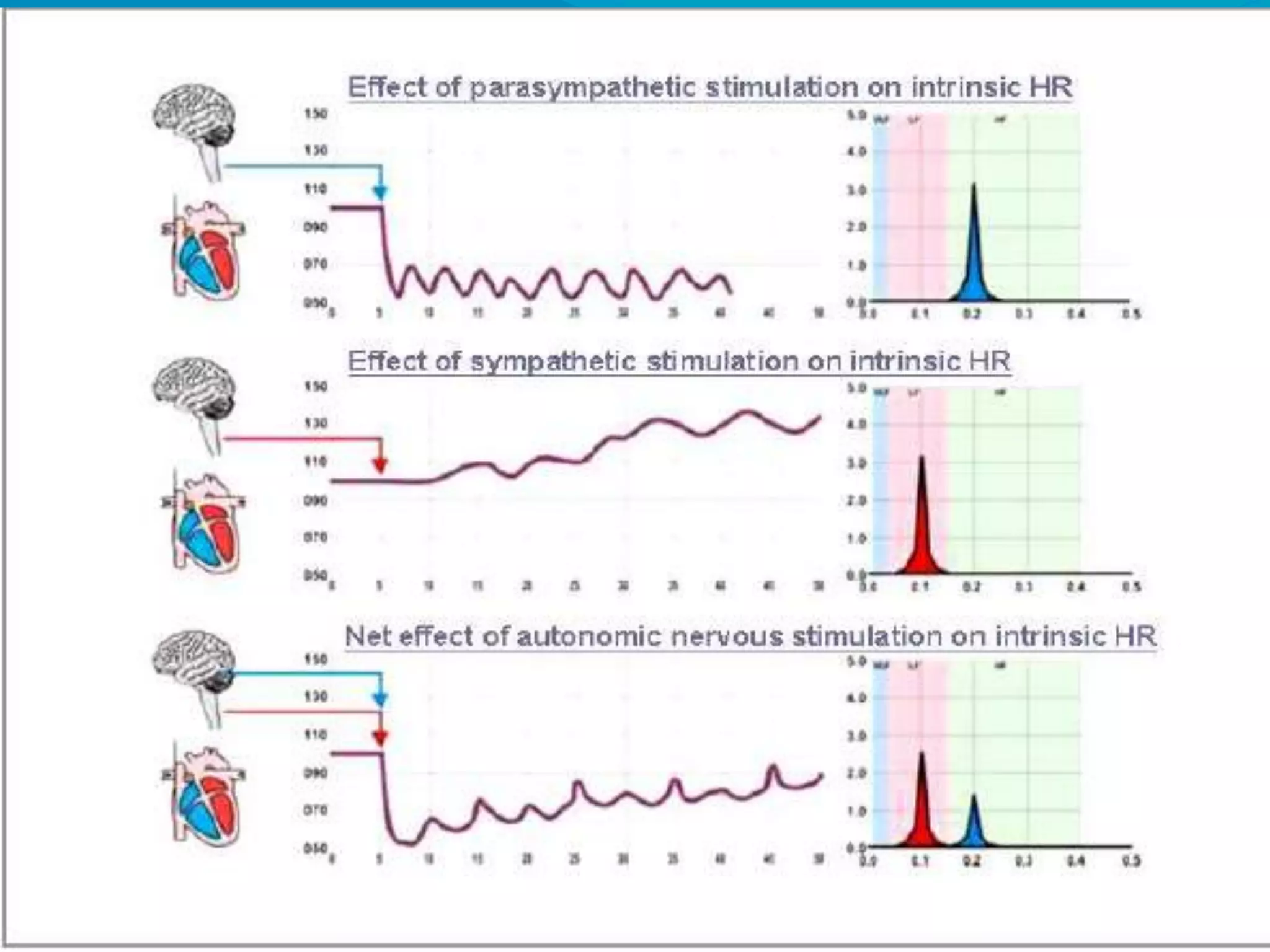
SA-3000P is an apparatus that analyze the “Heart Rate Variability” which give
significant information on Autonomic Nervous System (ANS)’s regulating function and
balance status. The change (variation) of heart rate during short term (5 minutes) is
analyzed with the method of time domain and frequency domain to provide the degree
of balance and activity of autonomic nervous system.
 HRV can be assessed in two ways, either as a Time







Domain Analysis or in the
frequency domain as a Power Spectral Density
(PSD) analysis. In either method, the
time intervals between each successive normal QRS
complex are first determined. All
abnormal beats not generated by sinus node
depolarizations are eliminated from the
HRV analysis.
 the main advantages of power spectral
 density(PSD) analysis over the time domain measures

is that it supplies information on
 how the power is distributed (the variance) as a
function of frequency, thereby
 providing a means to quantify autonomic balance at
any given time.
 TIME DOMAIN ANALYSIS: In the time domain analysis the coefficient of

variations of RR intervals was calculated using formula
 CVRRRI = SDNN/ mean RR, where SDNN represents the standard deviation of all
NN intervals (i.e. normal-to-normal RR intervals) resulting from sinus node
depolarizations after exclusion of noise, artifacts and ectopics9.
 FREQUENCY DOMAIN ANALYSIS: The RR interval series (300 seconds) was
resampled at 4 Hz after editing out noise, artifacts and ectopics and analyzed by fast

Fourier transformation. RR interval variations occurring in the frequency range 40400 mHz were chosen for analysis and a power spectrum was obtained by squaring
the magnitude of fast Fourier transform in this frequency range.
 Low frequency spectral power (LF) and high frequency spectral power (HF) were
obtained by integrating the power spectrum from 40mHz –150 mHz and 150- 400
mHz respectively.
 The LF/HF ratio was derived as the ratio of low frequency and high frequency
spectral powers expressed in dimensionless units.
 The LF and HF spectral powers in normalized units (nu) were calculated thus: LF
nu = LF / (LF + HF) and HF nu = HF / (LF + HF) 10.

 HRV data: - In order to find out the early predictors of a positive test, patients were
classified into two groups, i.e., those with a positive test (n=16) and those with
negative test (n=38). BP, HR and HRV indices at rest and during first 5 minutes of
head-up tilt in both the groups were compared.
 i) The incidence of positive tilt table tests and positive

Holter recordings which correlated to clinical
development of syncope were tabulated .
 ii) Different types of tilt table test responses (mixed,

cardioinhibitry or pure vasodepressor were studied)
Causes for Syncope







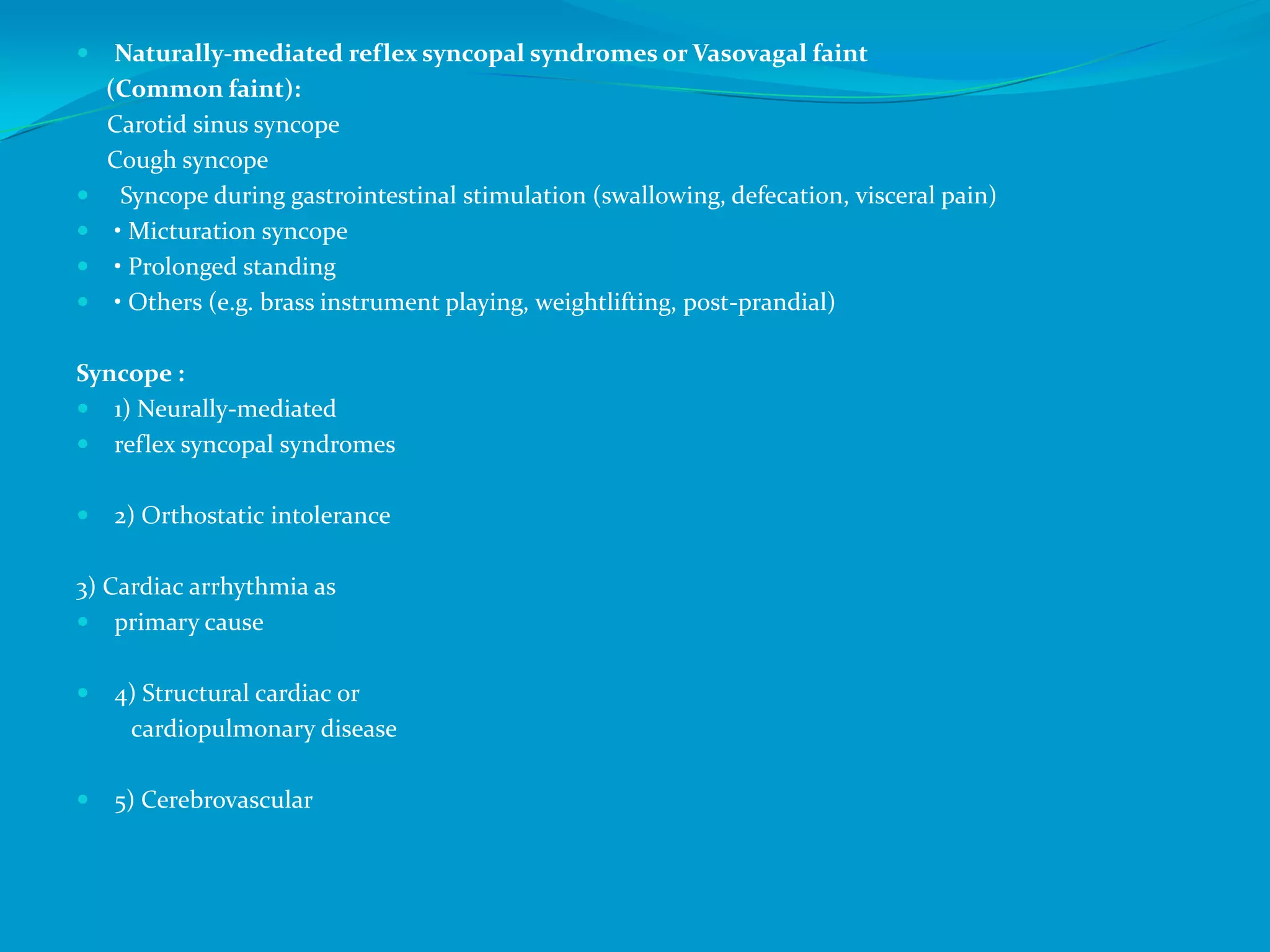
Naturally-mediated reflex syncopal syndromes or Vasovagal faint
(Common faint):
Carotid sinus syncope
Cough syncope
Syncope during gastrointestinal stimulation (swallowing, defecation, visceral pain)
• Micturation syncope
• Prolonged standing
• Others (e.g. brass instrument playing, weightlifting, post-prandial)

Syncope :
 1) Neurally-mediated
 reflex syncopal syndromes


2) Orthostatic intolerance

3) Cardiac arrhythmia as
 primary cause


4) Structural cardiac or
cardiopulmonary disease



5) Cerebrovascular




























Non-syncopal attacks :
1) With impairment or loss of
consciousness
2) Without loss of consciousness
14
2) Orthostatic (Autonomic failure):
• Primary autonomic failure syndromes (e.g. pure autonomic failure, multiple system
atrophy, Parkinsons disease with autonomic failure)
• Secondary autonomic failure syndromes (e.g diabetic neuropathy, amyloid neuropathy)
• Drugs and alcohol
• Volume depletion
• Hemorrhage, diarrhea, Addison`s disease
3) Cardiac arrhythmias as primary cause:
• Sinus node dysfunction (including bradycardia/tachycardia syndrome)
• Atrioventricular conduction system disease
• Paroxysmal supraventricular and ventricular tachycardias
• Inherited syndromes (e.g. long QT syndrome, Brugada syndrome)
• Implanted device (pacemaker, ICD malfunction) or drug-induced proarrhythmias
4) Structural cardiac or cardiopulmonary disease:
• Acute myocardial infarction/ischaemia
• Obstructive cardiomyopathy
• Atrial myxoma
• Acute aortic dissection
• Pericardial disease/tamponade
• Pulmonary embolus/pulmonary hypertension
5) Cerebrovascular:
• Vascular steal syndromes

Utility value of tilt table testing in evaluation

  • 1.
  • 2.
    SYNCOPE  Syncope is“characterized by sudden, brief loss of consciousness and postural tone followed by spontaneous recovery”.  Morichetti et al, have shown that syncope is a common presenting problem in health care settings, accounting for 3% to 5% of emergency room visits and 1% to 3% of hospital admissions1  Despite major advances in our understanding of the mechanisms and underlying causes of syncope, its etiology often remains a diagnostic dilemma.  Commonly used approach though adequate in majority leads to misdiagnosis and waste of resources - Routinely prescribed tests are 24 Hour HOLTER, EEG, CT Scan etc which are quite useless in majority.
  • 3.
     Syncope isa sudden and brief loss of consciousness associated with a loss of postural tone, from which recovery is spontaneous.  Usually the loss of consciousness is for 20 -30 seconds and the underlying mechanism is a transient global cerebral hypoperfusion.  Syncope is a transient symptom and not a disease
  • 4.
     In thepresent evidence based clinical practice, experience with the technology on evaluation of syncope is not sufficiently well developed to formulate guidelines by the formal American College Cardiology (ACC)/American Heart Association (AHA).  Only Expert Consensus documents are available and these form the best attempt of the ACC to inform and guide clinical practice in areas where rigorous evidence is not yet available.
  • 5.
    Indian Literature  Medlinesearch has revealed only two studies on evaluation of syncope in Indian population. 1) One study, described orthostatic tolerance of normal Indians comparing those with abnormal cardiovascular status4. 2) And another study described the utility of Head-uptilt-testing (HUTT) in pediatric patients suspected of neurocardiogenic syncope5.
  • 6.
     HUTT hasimportant role in initial evaluation of those with unexplained syncope especially when vasovagal syncope is suspected.  It has the advantage of being a provocative test and provides hemodynamic as well as cardiac rhythm data during symptoms.  Besides pulse and blood pressure monitoring, heart rate variability analysis was done during tilt table to find early predictors of positive test.
  • 7.
     To evaluatepatients presenting with syncope by history, examination and Electrocardiogram.  In patients with unexplained syncope perform tilt table test and arrhythmia monitoring for 24 hours.  To analyze the utility value of these tests in reaching a diagnosis in patients with unexplained syncope.
  • 8.
    Inclusion criteria  Agebetween 13 yrs & 60 yrs.  Patients with unexplained syncope
  • 9.
    UNEXPLAINED SYNCOPE  Inpatients who present with primary complaint of syncope, after initial clinical evaluation and baseline ECG if no diagnosis of cause of syncope is made, or no etiology of syncope is suggested, then they are worked up for ‘unexplained syncope’.  In patients with a suggested etiology for syncope, after specific targeted testing and no diagnosis was reached then they were worked up as unexplained syncope2,3.  Patients clinically suspected of neurocardiogenic syncope were classified as having unexplained syncope as there is no diagnostic test for neurocardiogenic syncope other than tilt table testing.
  • 10.
    EXCLUSION CRITERIA  Patientswith loss of consciousness greater than 5min or required external intervention for their recovery.  Patients with orthostatic hypotension.  Patients taking medications that can lead to arrhythmias or orthostasis.  Patients with contraindications to tilt table testing: - those with LVOT obstruction , stenotic valvular disease and significant stenotic cerebrovascular disease.
  • 11.
     If duringthe initial evaluation any cause other than vasovagal syncope was diagnosed or suggested, then they were excluded from further study.  If targeted specific tests for suggested etiologies were inconclusive in establishing the diagnosis of syncope then they were also included in the study.  In them further tests were performed.  Specific clinical details sought included the presence of prodromal symptoms, number of episodes, circumstances surrounding each episode, any precipitating factors and eyewitness observations of the actual episode
  • 12.
     Lamper Tet al have done videometric analysis of 56 syncopal episodes in patients prone to syncopal attacks and found that the onset of syncope was rapid, with subsequent recovery spontaneous and usually complete.  Most of the subjects had no premonitory symptoms, 90 percent had myoclonic jerks and average syncope duration was 12 seconds (range5-22 seconds).  Complete loss of consciousness in vasovagal syncope is usually no longer than 20 seconds in duration.
  • 13.
     Hoffnagels etal have found that if syncope duration is longer than few minutes (>5 minutes) other causes of loss of consciousness become important and history plays important role in differentiating neurological causes of loss of consciousness12
  • 14.
    Likelehood Ratios Positive likelihoodratio = Sensitivity/ (1-Specificity Negative likelihood ratio = (1-Sensitivity) / Specificity Positive predictive value (PPV) = (True positive) / (True + False positives) Likelihood ratios and positive predictive values of important clinical correlates were calculated using UBC Bayesian calculator. All patients underwent a 70-degree, head-up tilt for a maximum duration of 45 minutes
  • 15.
     Patients weregiven a 15 minutes rest in supine position before starting the test in order to familiarize with the surroundings.  The patients were instructed to relax and breathe quietly during the test.  A manually operated tilt table with a footboard was used during the test.
  • 16.
    SA-3000P is anapparatus that analyze the “Heart Rate Variability” which give significant information on Autonomic Nervous System (ANS)’s regulating function and balance status. The change (variation) of heart rate during short term (5 minutes) is analyzed with the method of time domain and frequency domain to provide the degree of balance and activity of autonomic nervous system.
  • 19.
     HRV canbe assessed in two ways, either as a Time     Domain Analysis or in the frequency domain as a Power Spectral Density (PSD) analysis. In either method, the time intervals between each successive normal QRS complex are first determined. All abnormal beats not generated by sinus node depolarizations are eliminated from the HRV analysis.
  • 21.
     the mainadvantages of power spectral  density(PSD) analysis over the time domain measures is that it supplies information on  how the power is distributed (the variance) as a function of frequency, thereby  providing a means to quantify autonomic balance at any given time.
  • 22.
     TIME DOMAINANALYSIS: In the time domain analysis the coefficient of variations of RR intervals was calculated using formula  CVRRRI = SDNN/ mean RR, where SDNN represents the standard deviation of all NN intervals (i.e. normal-to-normal RR intervals) resulting from sinus node depolarizations after exclusion of noise, artifacts and ectopics9.  FREQUENCY DOMAIN ANALYSIS: The RR interval series (300 seconds) was resampled at 4 Hz after editing out noise, artifacts and ectopics and analyzed by fast Fourier transformation. RR interval variations occurring in the frequency range 40400 mHz were chosen for analysis and a power spectrum was obtained by squaring the magnitude of fast Fourier transform in this frequency range.  Low frequency spectral power (LF) and high frequency spectral power (HF) were obtained by integrating the power spectrum from 40mHz –150 mHz and 150- 400 mHz respectively.  The LF/HF ratio was derived as the ratio of low frequency and high frequency spectral powers expressed in dimensionless units.  The LF and HF spectral powers in normalized units (nu) were calculated thus: LF nu = LF / (LF + HF) and HF nu = HF / (LF + HF) 10.  HRV data: - In order to find out the early predictors of a positive test, patients were classified into two groups, i.e., those with a positive test (n=16) and those with negative test (n=38). BP, HR and HRV indices at rest and during first 5 minutes of head-up tilt in both the groups were compared.
  • 23.
     i) Theincidence of positive tilt table tests and positive Holter recordings which correlated to clinical development of syncope were tabulated .  ii) Different types of tilt table test responses (mixed, cardioinhibitry or pure vasodepressor were studied)
  • 24.
  • 25.
         Naturally-mediated reflex syncopalsyndromes or Vasovagal faint (Common faint): Carotid sinus syncope Cough syncope Syncope during gastrointestinal stimulation (swallowing, defecation, visceral pain) • Micturation syncope • Prolonged standing • Others (e.g. brass instrument playing, weightlifting, post-prandial) Syncope :  1) Neurally-mediated  reflex syncopal syndromes  2) Orthostatic intolerance 3) Cardiac arrhythmia as  primary cause  4) Structural cardiac or cardiopulmonary disease  5) Cerebrovascular
  • 26.
                               Non-syncopal attacks : 1)With impairment or loss of consciousness 2) Without loss of consciousness 14 2) Orthostatic (Autonomic failure): • Primary autonomic failure syndromes (e.g. pure autonomic failure, multiple system atrophy, Parkinsons disease with autonomic failure) • Secondary autonomic failure syndromes (e.g diabetic neuropathy, amyloid neuropathy) • Drugs and alcohol • Volume depletion • Hemorrhage, diarrhea, Addison`s disease 3) Cardiac arrhythmias as primary cause: • Sinus node dysfunction (including bradycardia/tachycardia syndrome) • Atrioventricular conduction system disease • Paroxysmal supraventricular and ventricular tachycardias • Inherited syndromes (e.g. long QT syndrome, Brugada syndrome) • Implanted device (pacemaker, ICD malfunction) or drug-induced proarrhythmias 4) Structural cardiac or cardiopulmonary disease: • Acute myocardial infarction/ischaemia • Obstructive cardiomyopathy • Atrial myxoma • Acute aortic dissection • Pericardial disease/tamponade • Pulmonary embolus/pulmonary hypertension 5) Cerebrovascular: • Vascular steal syndromes