IMAGING IN
ORTHOPAEDICS
Dr. BIPUL BORTHAKUR
PROFESSOR
DEPT. OF ORTHOPAEDICS, SMCH
INTRODUCTION
• The availability of diagnostic images to physical therapists
greatly depends on the practise setting
• The results from imaging studies should be used in conjuction
with other clinical findings
• In general , imaging tests have a high sensitivity ( few false
negatives ) , but low specificity ( high false positive rate )
IMAGING TECHNIQUES
• Plain film Radiography
• X – rays with contrast media
• Plain tomography
• Computed tomography ( CT )
• Magnetic resonance imaging ( MRI )
• Diagnostic Ultrasound
• Radionuclide imaging
• Single – photon emission computed tomography
( SPECT )
• Positron emission tomography ( PET )
• Bone mineral densitometry ( BMD )
PLAIN FILM RADIOGRAPHY
• First order & Most useful method of diagnostic imaging
• Provides information on size , shape , tissue density & bone
architecture
• Overview - Radiographic image
Radiographic interpretation
Diagnostic associations
Limitations
RADIOGRAPHIC IMAGE
• X- Rays - part of elecromagnetic spectrum - ability to penetrate
body tissues of varying densities
• Exposure to xray particles causes the film to darken , while on
areas of absorption , appear lighter on x-ray film
• Denser the tissue - lighter it appears on the film
• Structures in order of deceasing density
METAL > BONE > SOFT TISSUE > WATER ( BODY FLUID ) > FAT > AIR
BONE - Cancellous bone is less dense than cortical bone &
appear lighter than cortical bone
RADIOGRAPHIC INTERPRETATION
• Convenient sequence of examination is
Patient
Soft tissues
Bones
Joints
PATIENT - AGE - important criteria
< 10 yrs – ewing’s sarcoma
10 – 20 yrs - osteosarcoma
> 50 yrs – metastatic deposit
• SOFT TISSUES
1) GENERALIZED CHANGE - Muscle planes
Bulging - joint effusion ( hip ) / rheumatoid arthritis (
interphalangeal joint )
Displaced - tumours
Obliterated – infection
2) LOCALIZED CHANGE - in case of mass , soft tissue calcification ,
ossification , gas , radioopaque foreign body
• BONES
Shape
Generalized change – bone density ( osteopenia/osteosclerosis)
abnormal trabeculations ( Paget’s disease )
sclerotic /lytic lesions ( diffuse metastatic infiltration)
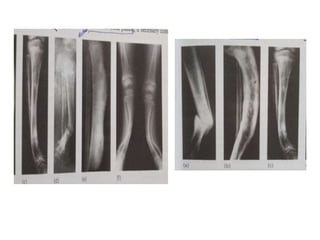
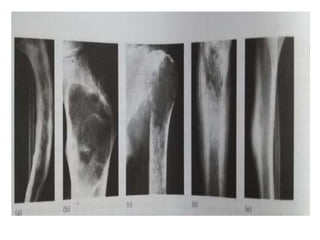
Localized change - BENIGN TUMOURS – well defined , sclerotic
margin, smooth periosteal reaction
MALIGNANT TUMOUR - Ill defined areas , permeative
bone destruction & speculated periosteal reactions
JOINTS
JOINT SPACE -
appears wider in children > adults
chondrocalcinosis ( lines of increased within radiographic
articular space )
SHAPE - narrowing / asymmetry of joint space
1) infection
2) inflammatory arthropathies
3) osteoarthritis
EROSIONS - Periarticular erosions - Rheumatoid arthritis , psoriasis
juxta articular erosions - Gout
DIAGNOSTIC ASSOCIATIONS
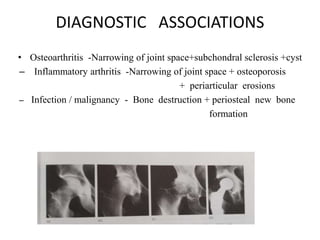
• Osteoarthritis -Narrowing of joint space+subchondral sclerosis +cyst
– Inflammatory arthritis -Narrowing of joint space + osteoporosis
+ periarticular erosions
– Infection / malignancy - Bone destruction + periosteal new bone
formation
• LIMITATIONS OF PLAIN RADIOGRAPHY
1) Exposure to ionizing radiation - radiation induced cancer
2) Provides poor soft tissue contrast
X RAYS WITH CONTRAST MEDIA
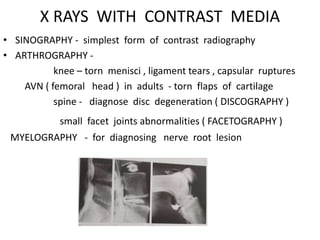
• SINOGRAPHY - simplest form of contrast radiography
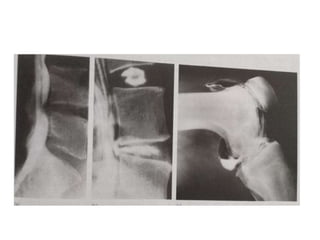
• ARTHROGRAPHY -
knee – torn menisci , ligament tears , capsular ruptures
AVN ( femoral head ) in adults - torn flaps of cartilage
spine - diagnose disc degeneration ( DISCOGRAPHY )
small facet joints abnormalities ( FACETOGRAPHY )
MYELOGRAPHY - for diagnosing nerve root lesion
PLAIN TOMOGRAPHY
• Provides image ‘ focussed ‘ on a selected plane
• Useful in diagnosing segmental bone necrosis & depressed
fractures in cancellous bone
• Conventional tomography has been supplanted by CT & MRI
COMPUTED TOMOGRAPHY ( CT )
• CT SCAN produces sectional images through selected tissue
planes - but with greater resolution
• As compared to conventional tomography , computed tomography
produces trans – axial images ( transverse anatomical sections )
• In new multislice CT scanners , 3D surface rendered
reconstructions & volume rendered reconstructions - help in
demonstrating anatomical contours
CLINICAL APPLICATIONS OF CT SCAN
• Since it provides excellent contrast resolution and spatial localization
it’s ideal for evaluating
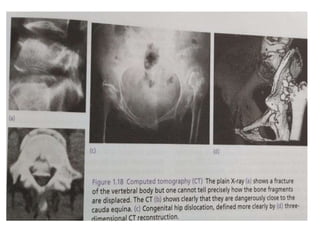
Acute trauma to the head , spine , chest , abdomen & pelvis
• Better than MRI - fine bone detail & soft tissue calcification
• Invaluable tool in pre operative planning in secondary fracture
management
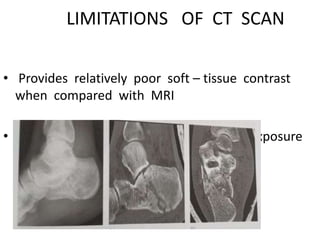
• Routinely used for vertebrae , acetabulum , tibial plataeu , ankle & foot
injuries - complex ( intraarticular fractures ) & fracture dislocations
• Assessment of bone tumours ( size & spread )
• Can be employed for guiding soft tissues & bone biopsy
LIMITATIONS OF CT SCAN
• Provides relatively poor soft – tissue contrast
when compared with MRI
• Major diadvantage is - high radiation exposure
MAGNETIC RESONANCE IMAGING (
MRI )
• Provides superb soft tissue contrast , distinguishing
different soft tissues eg. Ligaments , tendons ,
muscle & hyaline cartilage
• Utilizes Non – Ionizing radiation
• Contraindicated in patients with pacemakers &
possible metallic foreign body
MRI PHYSICS
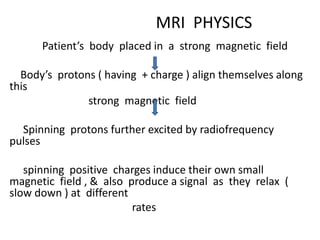
Patient’s body placed in a strong magnetic field
Body’s protons ( having + charge ) align themselves along
this
strong magnetic field
Spinning protons further excited by radiofrequency
pulses
spinning positive charges induce their own small
magnetic field , & also produce a signal as they relax (
slow down ) at different
rates
• Proton density map is recorded from these signals and
plotted in x, y , z coordinates
• T1 weighted ( T1W) images - high spatial resolution & good
anatomical looking pictures
• T2 weighted ( T2W ) images - physiological characterstics of
tissue
• Proton density ( PD) images - balanced / intermediate – are
combination of T1 & T2 images
• Fat suppression sequences - assessing soft – tissues & bone
marrow
oedema
CONTRAST ENHANCED – MRI
• Enhancement by intravenous contrast – active blood supply &
leaky cell membrane
• INDIRECT ARTHROGRAPHY
Gadolinium compounds – Intravenous – secreted through joint
synovium - into joint effusion
No additional distension of the joint
• DIRECT ARTHROGRAPHY
Dilute gadolinium ( 1:2000 concentration ) solution directly
punctured into joints under image guidance
Distention of joint capsule occurs
CLINICAL APPILICATIONS OF MRI
• Ideal for non – invasive imaging of the musculoskeletal system - excellent
anatomical detail , soft tissue contrast & multiplanar capability
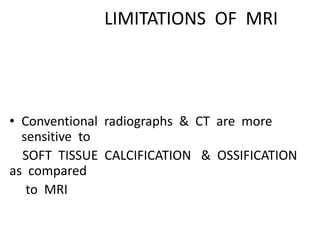
• MRI of hip , knee , ankle , shoulder & wrist is common - can detect early
changes of bone marrow oedema & osteonecrosis
• MRI Knee - for meniscal tears & cruciate ligament injuries
• Fat suppresion sequences – extent of perilesional oedema & IV contrast –
active part of the tumour ( it distinguish vascular from avascular tissues
• Direct MRI arthrography - distent joint capsule
diagnose labral tears in shoulder & hip
ankle – assess integrity of the capsular ligaments
LIMITATIONS OF MRI
• Conventional radiographs & CT are more
sensitive to
SOFT TISSUE CALCIFICATION & OSSIFICATION
as compared
to MRI
DIAGNOSTIC ULTRASOUND
High frequency sound waves by TRANSDUCER
penetrate into soft tissues
some waves are reflected back - registered as electric signals
and display images on a screen
• Image produce , depend upon reflective surface & soft tissue interface
• Different tissues display varying echogenicity
Fluid –filled cyst - echo free
fat - highly echogenic
semi solid organs – varying degree of echogenicity
• REAL TIME display gives dynamic image – more useful than static image
CLINICAL APPLICATIONS
• Identify hidden cystic lesions – haematomas ,
abcesses , popliteal cysts & arterial aneurysms
• Detect intra- articular fluid , synovial effusions
& monitor ‘ irritable hip ‘
• Use to detect tendinitis & partial or complete
tears
• For guiding needle placement in diagnostic &
therapeutic joint & soft – tissue injections
DOPPLER ULTRASOUND
• Blood flow detected – principle of change in
sound frequency – material moving – towards or
away from USG transducer
• Abnormal increased blood flow – areas of
inflammation / aggressive tumours
• Different flow rates – different colour
RADIONUCLIDE IMAGING
• Photon emission by radionuclide taken by
specific tissues – recorded by gamma camera -
reflects physiological activity of that tissue
• Radiopharmaceutical used – 2 components
chemical compound – metaboloic uptake
in target tissue
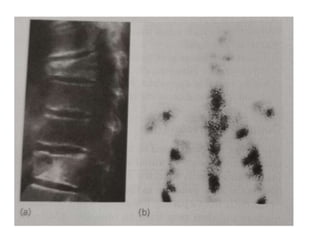
ISOTOPE BONE SCAN
• Bone imaging - technetium – 99 m – ideal isotope
short half life – 6 hrs
rapidly excreted in urine
• Technetium – labelled hydroxymethylene
diphosphonate ( 99mTc-HDP) given intravenously
& recorded at 2 stages
1) Early perfusion phase - isotope in blood stream
– reflecting local
• 4 types of abnormality seen
1) Increased activity in perfusion phase -
inflammation , fracture , high
vascular tumour , regional
sympathetic dystrophy
2) Decreased activity in perfusion phase – local
vascular insufficiency
3) Increased activity in the delayed bone phase –
fracture , implant
CLINICAL APPLICATIONS
• Diagnosis of stress fracture /undisplaced
fracture
• Detection of a small bone abcess or osteoid
osteoma
• Investigation of loosening or infection around
prostheses
ADVANTAGE & DISADVANTAGE
• ADVANTAGE
whole body can be imaged for multiple sites
of pathology ( occult metastasis , multifocal
infection )
provides physiological activity of examined
tissues
OTHER RADIONUCLIDE
COMPOUNDS
• GALLIUM - 67
concentrates in inflammatory cells – identify
hidden infection
• INDIUM – 111 – LABELLED LEUCOCYTES
distinguish sites of active infection from
chronic inflammation
SINGLE – PHOTON EMISSION
COMPUTED
TOMOGRAPHY ( SPECT )
• SPECT - bone scan – images are recorded &
displayed in all 3 orthogonal planes ( coronal ,
sagittal & axial plane )
spatial localization of pathology
POSITRON EMISSION TOMOGRAPHY (
PET )• Positron – emitting isotopes - short half life –
produced by cyclotron
• M/C used – 18 – fluro – 2 – deoxy – D – glucose (
18 – FDG )
measures rate of consumption of
glucose
• Malignant tumours metabolize glucose faster
than benign tumours
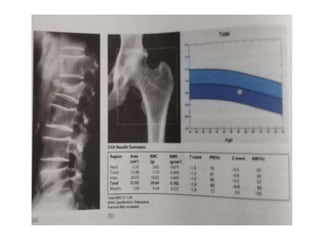
BONE MINERAL DENSITOMETRY
• Bone mineral density measurement – widely used in
oseoporosis & increased risk of osteoporotic fractures
• Various techniques developed
RADIOGRAPHIC ABSORPTIOMETRY ( RA )
QUANTITATIVE COMPUTED TOMOGRAPHY ( QCT )
QUANTITATIVE ULTRASONOMETRY ( QUS )
DUAL ENERGY X- RAY ABSORPTIOMETRY ( DEXA ) – M/C
accepted
• RA - conventional radiographic equipment – bone density in
phalanges
• QCT – trabecular bone density in vertebral bodies
• QUS - measures bone mineral density in peripheral skeleton
( wrist & calcaneum )
• DEXA - columnated low – dose X ray beams to distinguish bone density from
soft tissue
• Advantage of DXA – develop huge international database – express bone mineral
density in comparison to age & sex matched population. (Z-score) and peak adult
bone mass (T score)
• According to WHO, T score <-1- osteopenia & T-score <-2.5 – osteoporosis.
THANK YOU

Imaging in orthopaedics

  • 1.
    IMAGING IN ORTHOPAEDICS Dr. BIPULBORTHAKUR PROFESSOR DEPT. OF ORTHOPAEDICS, SMCH
  • 2.
    INTRODUCTION • The availabilityof diagnostic images to physical therapists greatly depends on the practise setting • The results from imaging studies should be used in conjuction with other clinical findings • In general , imaging tests have a high sensitivity ( few false negatives ) , but low specificity ( high false positive rate )
  • 3.
    IMAGING TECHNIQUES • Plainfilm Radiography • X – rays with contrast media • Plain tomography • Computed tomography ( CT ) • Magnetic resonance imaging ( MRI ) • Diagnostic Ultrasound • Radionuclide imaging • Single – photon emission computed tomography ( SPECT ) • Positron emission tomography ( PET ) • Bone mineral densitometry ( BMD )
  • 4.
    PLAIN FILM RADIOGRAPHY •First order & Most useful method of diagnostic imaging • Provides information on size , shape , tissue density & bone architecture • Overview - Radiographic image Radiographic interpretation Diagnostic associations Limitations
  • 5.
    RADIOGRAPHIC IMAGE • X-Rays - part of elecromagnetic spectrum - ability to penetrate body tissues of varying densities • Exposure to xray particles causes the film to darken , while on areas of absorption , appear lighter on x-ray film • Denser the tissue - lighter it appears on the film • Structures in order of deceasing density METAL > BONE > SOFT TISSUE > WATER ( BODY FLUID ) > FAT > AIR BONE - Cancellous bone is less dense than cortical bone & appear lighter than cortical bone
  • 6.
    RADIOGRAPHIC INTERPRETATION • Convenientsequence of examination is Patient Soft tissues Bones Joints PATIENT - AGE - important criteria < 10 yrs – ewing’s sarcoma 10 – 20 yrs - osteosarcoma > 50 yrs – metastatic deposit
  • 7.
    • SOFT TISSUES 1)GENERALIZED CHANGE - Muscle planes Bulging - joint effusion ( hip ) / rheumatoid arthritis ( interphalangeal joint ) Displaced - tumours Obliterated – infection 2) LOCALIZED CHANGE - in case of mass , soft tissue calcification , ossification , gas , radioopaque foreign body
  • 8.
    • BONES Shape Generalized change– bone density ( osteopenia/osteosclerosis) abnormal trabeculations ( Paget’s disease ) sclerotic /lytic lesions ( diffuse metastatic infiltration) Localized change - BENIGN TUMOURS – well defined , sclerotic margin, smooth periosteal reaction MALIGNANT TUMOUR - Ill defined areas , permeative bone destruction & speculated periosteal reactions
  • 11.
    JOINTS JOINT SPACE - appearswider in children > adults chondrocalcinosis ( lines of increased within radiographic articular space ) SHAPE - narrowing / asymmetry of joint space 1) infection 2) inflammatory arthropathies 3) osteoarthritis EROSIONS - Periarticular erosions - Rheumatoid arthritis , psoriasis juxta articular erosions - Gout
  • 12.
    DIAGNOSTIC ASSOCIATIONS • Osteoarthritis-Narrowing of joint space+subchondral sclerosis +cyst – Inflammatory arthritis -Narrowing of joint space + osteoporosis + periarticular erosions – Infection / malignancy - Bone destruction + periosteal new bone formation
  • 13.
    • LIMITATIONS OFPLAIN RADIOGRAPHY 1) Exposure to ionizing radiation - radiation induced cancer 2) Provides poor soft tissue contrast
  • 14.
    X RAYS WITHCONTRAST MEDIA • SINOGRAPHY - simplest form of contrast radiography • ARTHROGRAPHY - knee – torn menisci , ligament tears , capsular ruptures AVN ( femoral head ) in adults - torn flaps of cartilage spine - diagnose disc degeneration ( DISCOGRAPHY ) small facet joints abnormalities ( FACETOGRAPHY ) MYELOGRAPHY - for diagnosing nerve root lesion
  • 16.
    PLAIN TOMOGRAPHY • Providesimage ‘ focussed ‘ on a selected plane • Useful in diagnosing segmental bone necrosis & depressed fractures in cancellous bone • Conventional tomography has been supplanted by CT & MRI
  • 17.
    COMPUTED TOMOGRAPHY (CT ) • CT SCAN produces sectional images through selected tissue planes - but with greater resolution • As compared to conventional tomography , computed tomography produces trans – axial images ( transverse anatomical sections ) • In new multislice CT scanners , 3D surface rendered reconstructions & volume rendered reconstructions - help in demonstrating anatomical contours
  • 18.
    CLINICAL APPLICATIONS OFCT SCAN • Since it provides excellent contrast resolution and spatial localization it’s ideal for evaluating Acute trauma to the head , spine , chest , abdomen & pelvis • Better than MRI - fine bone detail & soft tissue calcification • Invaluable tool in pre operative planning in secondary fracture management • Routinely used for vertebrae , acetabulum , tibial plataeu , ankle & foot injuries - complex ( intraarticular fractures ) & fracture dislocations • Assessment of bone tumours ( size & spread ) • Can be employed for guiding soft tissues & bone biopsy
  • 20.
    LIMITATIONS OF CTSCAN • Provides relatively poor soft – tissue contrast when compared with MRI • Major diadvantage is - high radiation exposure
  • 21.
    MAGNETIC RESONANCE IMAGING( MRI ) • Provides superb soft tissue contrast , distinguishing different soft tissues eg. Ligaments , tendons , muscle & hyaline cartilage • Utilizes Non – Ionizing radiation • Contraindicated in patients with pacemakers & possible metallic foreign body
  • 22.
    MRI PHYSICS Patient’s bodyplaced in a strong magnetic field Body’s protons ( having + charge ) align themselves along this strong magnetic field Spinning protons further excited by radiofrequency pulses spinning positive charges induce their own small magnetic field , & also produce a signal as they relax ( slow down ) at different rates
  • 23.
    • Proton densitymap is recorded from these signals and plotted in x, y , z coordinates • T1 weighted ( T1W) images - high spatial resolution & good anatomical looking pictures • T2 weighted ( T2W ) images - physiological characterstics of tissue • Proton density ( PD) images - balanced / intermediate – are combination of T1 & T2 images • Fat suppression sequences - assessing soft – tissues & bone marrow oedema
  • 24.
    CONTRAST ENHANCED –MRI • Enhancement by intravenous contrast – active blood supply & leaky cell membrane • INDIRECT ARTHROGRAPHY Gadolinium compounds – Intravenous – secreted through joint synovium - into joint effusion No additional distension of the joint • DIRECT ARTHROGRAPHY Dilute gadolinium ( 1:2000 concentration ) solution directly punctured into joints under image guidance Distention of joint capsule occurs
  • 25.
    CLINICAL APPILICATIONS OFMRI • Ideal for non – invasive imaging of the musculoskeletal system - excellent anatomical detail , soft tissue contrast & multiplanar capability • MRI of hip , knee , ankle , shoulder & wrist is common - can detect early changes of bone marrow oedema & osteonecrosis • MRI Knee - for meniscal tears & cruciate ligament injuries • Fat suppresion sequences – extent of perilesional oedema & IV contrast – active part of the tumour ( it distinguish vascular from avascular tissues • Direct MRI arthrography - distent joint capsule diagnose labral tears in shoulder & hip ankle – assess integrity of the capsular ligaments
  • 27.
    LIMITATIONS OF MRI •Conventional radiographs & CT are more sensitive to SOFT TISSUE CALCIFICATION & OSSIFICATION as compared to MRI
  • 28.
    DIAGNOSTIC ULTRASOUND High frequencysound waves by TRANSDUCER penetrate into soft tissues some waves are reflected back - registered as electric signals and display images on a screen • Image produce , depend upon reflective surface & soft tissue interface • Different tissues display varying echogenicity Fluid –filled cyst - echo free fat - highly echogenic semi solid organs – varying degree of echogenicity • REAL TIME display gives dynamic image – more useful than static image
  • 29.
    CLINICAL APPLICATIONS • Identifyhidden cystic lesions – haematomas , abcesses , popliteal cysts & arterial aneurysms • Detect intra- articular fluid , synovial effusions & monitor ‘ irritable hip ‘ • Use to detect tendinitis & partial or complete tears • For guiding needle placement in diagnostic & therapeutic joint & soft – tissue injections
  • 30.
    DOPPLER ULTRASOUND • Bloodflow detected – principle of change in sound frequency – material moving – towards or away from USG transducer • Abnormal increased blood flow – areas of inflammation / aggressive tumours • Different flow rates – different colour
  • 31.
    RADIONUCLIDE IMAGING • Photonemission by radionuclide taken by specific tissues – recorded by gamma camera - reflects physiological activity of that tissue • Radiopharmaceutical used – 2 components chemical compound – metaboloic uptake in target tissue
  • 32.
    ISOTOPE BONE SCAN •Bone imaging - technetium – 99 m – ideal isotope short half life – 6 hrs rapidly excreted in urine • Technetium – labelled hydroxymethylene diphosphonate ( 99mTc-HDP) given intravenously & recorded at 2 stages 1) Early perfusion phase - isotope in blood stream – reflecting local
  • 34.
    • 4 typesof abnormality seen 1) Increased activity in perfusion phase - inflammation , fracture , high vascular tumour , regional sympathetic dystrophy 2) Decreased activity in perfusion phase – local vascular insufficiency 3) Increased activity in the delayed bone phase – fracture , implant
  • 35.
    CLINICAL APPLICATIONS • Diagnosisof stress fracture /undisplaced fracture • Detection of a small bone abcess or osteoid osteoma • Investigation of loosening or infection around prostheses
  • 36.
    ADVANTAGE & DISADVANTAGE •ADVANTAGE whole body can be imaged for multiple sites of pathology ( occult metastasis , multifocal infection ) provides physiological activity of examined tissues
  • 37.
    OTHER RADIONUCLIDE COMPOUNDS • GALLIUM- 67 concentrates in inflammatory cells – identify hidden infection • INDIUM – 111 – LABELLED LEUCOCYTES distinguish sites of active infection from chronic inflammation
  • 38.
    SINGLE – PHOTONEMISSION COMPUTED TOMOGRAPHY ( SPECT ) • SPECT - bone scan – images are recorded & displayed in all 3 orthogonal planes ( coronal , sagittal & axial plane ) spatial localization of pathology
  • 39.
    POSITRON EMISSION TOMOGRAPHY( PET )• Positron – emitting isotopes - short half life – produced by cyclotron • M/C used – 18 – fluro – 2 – deoxy – D – glucose ( 18 – FDG ) measures rate of consumption of glucose • Malignant tumours metabolize glucose faster than benign tumours
  • 40.
    BONE MINERAL DENSITOMETRY •Bone mineral density measurement – widely used in oseoporosis & increased risk of osteoporotic fractures • Various techniques developed RADIOGRAPHIC ABSORPTIOMETRY ( RA ) QUANTITATIVE COMPUTED TOMOGRAPHY ( QCT ) QUANTITATIVE ULTRASONOMETRY ( QUS ) DUAL ENERGY X- RAY ABSORPTIOMETRY ( DEXA ) – M/C accepted
  • 41.
    • RA -conventional radiographic equipment – bone density in phalanges • QCT – trabecular bone density in vertebral bodies • QUS - measures bone mineral density in peripheral skeleton ( wrist & calcaneum ) • DEXA - columnated low – dose X ray beams to distinguish bone density from soft tissue • Advantage of DXA – develop huge international database – express bone mineral density in comparison to age & sex matched population. (Z-score) and peak adult bone mass (T score) • According to WHO, T score <-1- osteopenia & T-score <-2.5 – osteoporosis.
  • 43.