ROLE OF RADIOLOGY IN
ORTHOPAEDICS
PRESENTER:PUTHOTA ROOPA SAI
MODERATOR: Dr. VAMSI KRISHNA SIR
CHAIRPERSON: Dr. A.SRINIVASA RAO SIR
DEPARTMENT OF ORTHOPAEDICS
Imaging Techniques in Orthopaedics
• Conventional Radiography
• Flouroscopy
• Digital radiography
• Computed tomography
• Magnetic resonance imaging
• Scintigraphy
• PET scan
• Ultrasound
• Scanogram
• DEXA
• Arthrography,Tenography,Bursography
• Angiography
• Myelography
CONVENTIONAL RADIOGRAPHY
• The first x-ray was invented by Wilhelm Conrad
Roentgen on 22 Dec 1895 when he produced the
first human x-ray of his wife Bertha’s hand.
CONVENTIONAL RADIOGRAPHY:
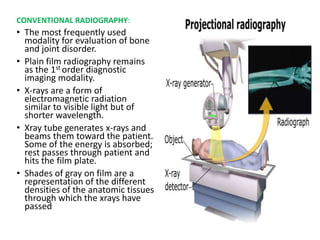
• The most frequently used
modality for evaluation of bone
and joint disorder.
• Plain film radiography remains
as the 1st order diagnostic
imaging modality.
• X-rays are a form of
electromagnetic radiation
similar to visible light but of
shorter wavelength.
• Xray tube generates x-rays and
beams them toward the patient.
Some of the energy is absorbed;
rest passes through patient and
hits the film plate.
• Shades of gray on film are a
representation of the different
densities of the anatomic tissues
through which the xrays have
passed
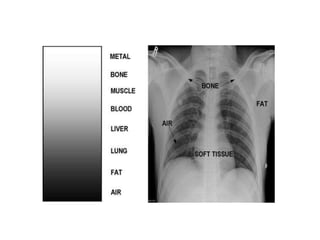
• Tissues with greater density will absorb more of the xray so less of the
beam reaches the film plate. The resultant image is therefore lighter.
Tissues with less density will allow more x ray to reach the film so it will
be darker. This is called radiodensity and is determined by: thickness
and composition of structure.
• Air: black eg: trachea, lungs, stomach, digestive tract.
• Fat: gray black eg: subcutaneously along muscle sheaths ; around
viscera.
• Water: gray eg: muscles, nerves, tendons, ligaments, vessels
(all of these structures have the same density and therefore are hard
to distinguish on plain x rays.)
• Bone: gray/white. (Calcium with higher atomic number absorbs higher
proportions of x-rays resulting in less crystal formation in the film –
Radioopaque appearance of bone
• Contrast medium: white outline.
• Heavy metals: white solid.
ABC’S Approach
• A
◦ Adequacy, Alignment
• B
◦ Bones
• C
◦ Cartilage
• S
◦ Soft Tissues
• ABCs approach applies to every x-ray image
• ADEQUACY
Adequate views:
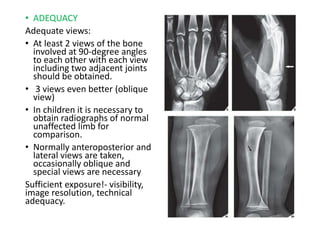
• At least 2 views of the bone
involved at 90-degree angles
to each other with each view
including two adjacent joints
should be obtained.
• 3 views even better (oblique
view)
• In children it is necessary to
obtain radiographs of normal
unaffected limb for
comparison.
• Normally anteroposterior and
lateral views are taken,
occasionally oblique and
special views are necessary
Sufficient exposure!- visibility,
image resolution, technical
adequacy.
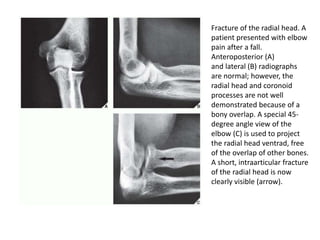
Fracture of the radial head. A
patient presented with elbow
pain after a fall.
Anteroposterior (A)
and lateral (B) radiographs
are normal; however, the
radial head and coronoid
processes are not well
demonstrated because of a
bony overlap. A special 45-
degree angle view of the
elbow (C) is used to project
the radial head ventrad, free
of the overlap of other bones.
A short, intraarticular fracture
of the radial head is now
clearly visible (arrow).
• ALINGMENT
• Assess the size of the
bones.
• Assess the number of
bones.
• Assess each bone for
normal shape and
contour; irregularities
can be from trauma,
congenital,
developmental or
pathological.
• Assess joint position:
trauma, inflammatory or
degenerative disease.
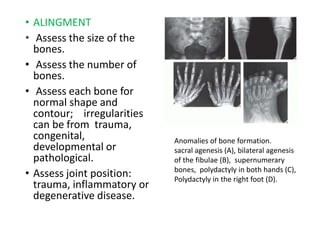
Anomalies of bone formation.
sacral agenesis (A), bilateral agenesis
of the fibulae (B), supernumerary
bones, polydactyly in both hands (C),
Polydactyly in the right foot (D).
• BONES
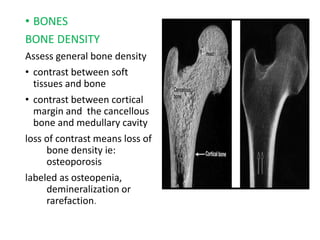
BONE DENSITY
Assess general bone density
• contrast between soft
tissues and bone
• contrast between cortical
margin and the cancellous
bone and medullary cavity
loss of contrast means loss of
bone density ie:
osteoporosis
labeled as osteopenia,
demineralization or
rarefaction.
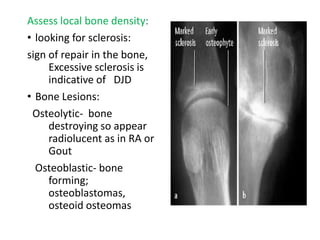
Assess local bone density:
• looking for sclerosis:
sign of repair in the bone,
Excessive sclerosis is
indicative of DJD
• Bone Lesions:
Osteolytic- bone
destroying so appear
radiolucent as in RA or
Gout
Osteoblastic- bone
forming;
osteoblastomas,
osteoid osteomas
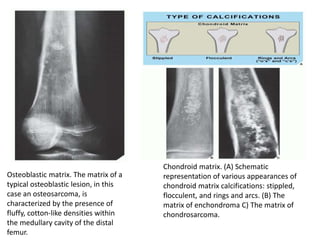
Osteoblastic matrix. The matrix of a
typical osteoblastic lesion, in this
case an osteosarcoma, is
characterized by the presence of
fluffy, cotton-like densities within
the medullary cavity of the distal
femur.
Chondroid matrix. (A) Schematic
representation of various appearances of
chondroid matrix calcifications: stippled,
flocculent, and rings and arcs. (B) The
matrix of enchondroma C) The matrix of
chondrosarcoma.
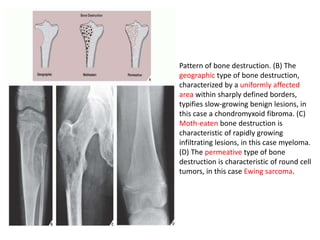
Pattern of bone destruction. (B) The
geographic type of bone destruction,
characterized by a uniformly affected
area within sharply defined borders,
typifies slow-growing benign lesions, in
this case a chondromyxoid fibroma. (C)
Moth-eaten bone destruction is
characteristic of rapidly growing
infiltrating lesions, in this case myeloma.
(D) The permeative type of bone
destruction is characteristic of round cell
tumors, in this case Ewing sarcoma.
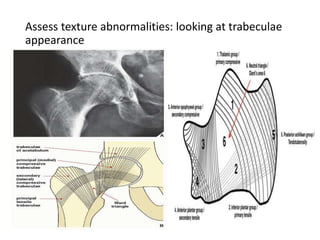
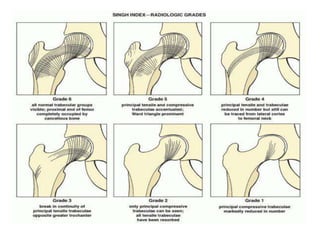
Assess texture abnormalities: looking at trabeculae
appearance
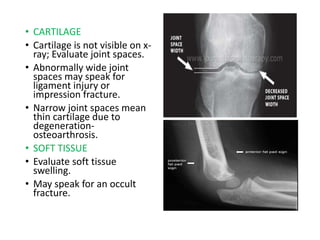
• CARTILAGE
• Cartilage is not visible on x-
ray; Evaluate joint spaces.
• Abnormally wide joint
spaces may speak for
ligament injury or
impression fracture.
• Narrow joint spaces mean
thin cartilage due to
degeneration-
osteoarthrosis.
• SOFT TISSUE
• Evaluate soft tissue
swelling.
• May speak for an occult
fracture.
• A ◦
evaluate adequacy: adequate views and image
quality.
evaluate alignment- long axes of bones.
• B ◦
Examine bones (whole)- look for cracks and
deformities.
• C ◦
Examine cartilage- joint space- width, asymmetry.
• S ◦
Evaluate soft tissues: swelling, joint effusion (relate
image to clinical exam)
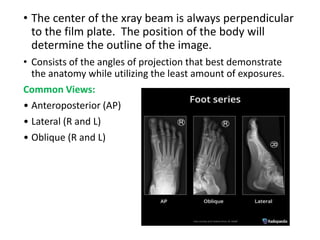
• The center of the xray beam is always perpendicular
to the film plate. The position of the body will
determine the outline of the image.
• Consists of the angles of projection that best demonstrate
the anatomy while utilizing the least amount of exposures.
Common Views:
• Anteroposterior (AP)
• Lateral (R and L)
• Oblique (R and L)
PLANES
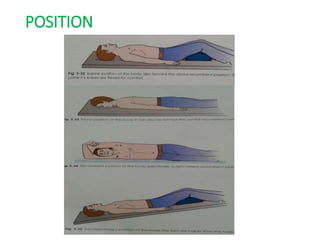
POSITION
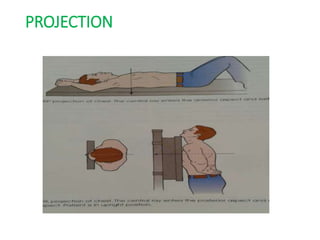
PROJECTION
SHOULDER
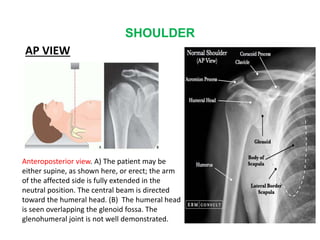
AP VIEW
Anteroposterior view. A) The patient may be
either supine, as shown here, or erect; the arm
of the affected side is fully extended in the
neutral position. The central beam is directed
toward the humeral head. (B) The humeral head
is seen overlapping the glenoid fossa. The
glenohumeral joint is not well demonstrated.
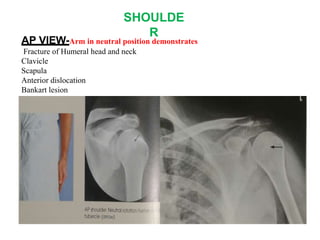
SHOULDE
R
AP VIEW-Arm in neutral position demonstrates
Fracture of Humeral head and neck
Clavicle
Scapula
Anterior dislocation
Bankart lesion
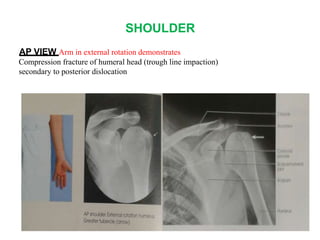
SHOULDER
AP VIEW Arm in external rotation demonstrates
Compression fracture of humeral head (trough line impaction)
secondary to posterior dislocation
SHOULDER
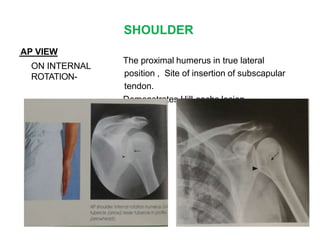
AP VIEW
ON INTERNAL
ROTATION-
The proximal humerus in true lateral
position , Site of insertion of subscapular
tendon.
Demonstrates Hill-sachs lesion
SHOULDER
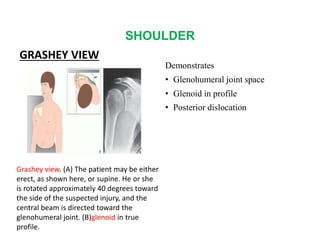
GRASHEY VIEW
Demonstrates
• Glenohumeral joint space
• Glenoid in profile
• Posterior dislocation
Grashey view. (A) The patient may be either
erect, as shown here, or supine. He or she
is rotated approximately 40 degrees toward
the side of the suspected injury, and the
central beam is directed toward the
glenohumeral joint. (B)glenoid in true
profile.
SHOULDER
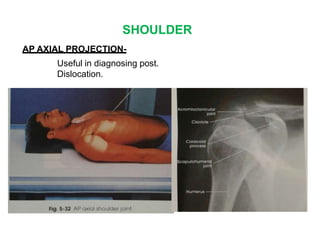
AP AXIAL PROJECTION-
Useful in diagnosing post.
Dislocation.
SHOULDER
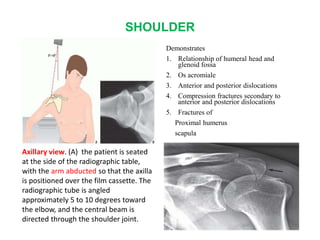
Demonstrates
1. Relationship of humeral head and
glenoid fossa
2. Os acromiale
3. Anterior and posterior dislocations
4. Compression fractures secondary to
anterior and posterior dislocations
5. Fractures of
Proximal humerus
scapula
Axillary view. (A) the patient is seated
at the side of the radiographic table,
with the arm abducted so that the axilla
is positioned over the film cassette. The
radiographic tube is angled
approximately 5 to 10 degrees toward
the elbow, and the central beam is
directed through the shoulder joint.
SHOULDER
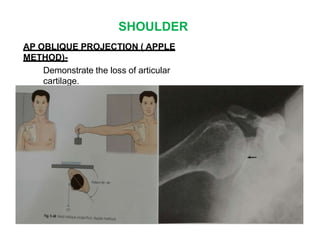
AP OBLIQUE PROJECTION ( APPLE
METHOD)-
Demonstrate the loss of articular
cartilage.
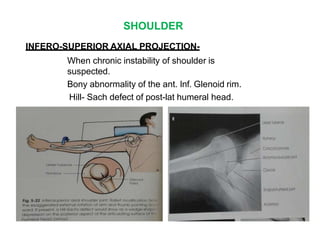
SHOULDER
INFERO-SUPERIOR AXIAL PROJECTION-
When chronic instability of shoulder is
suspected.
Bony abnormality of the ant. Inf. Glenoid rim.
Hill- Sach defect of post-lat humeral head.
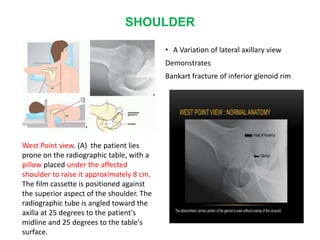
SHOULDER
• A Variation of lateral axillary view
Demonstrates
Bankart fracture of inferior glenoid rim
West Point view. (A) the patient lies
prone on the radiographic table, with a
pillow placed under the affected
shoulder to raise it approximately 8 cm.
The film cassette is positioned against
the superior aspect of the shoulder. The
radiographic tube is angled toward the
axilla at 25 degrees to the patient's
midline and 25 degrees to the table's
surface.
SHOULDER
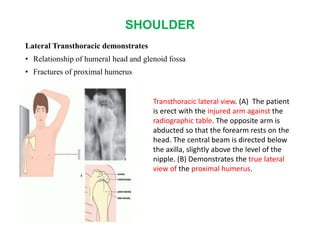
Lateral Transthoracic demonstrates
• Relationship of humeral head and glenoid fossa
• Fractures of proximal humerus
Transthoracic lateral view. (A) The patient
is erect with the injured arm against the
radiographic table. The opposite arm is
abducted so that the forearm rests on the
head. The central beam is directed below
the axilla, slightly above the level of the
nipple. (B) Demonstrates the true lateral
view of the proximal humerus.
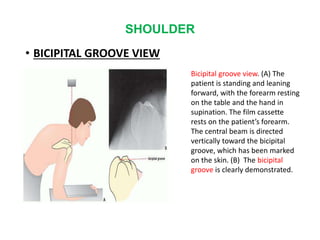
SHOULDER
• BICIPITAL GROOVE VIEW
Bicipital groove view. (A) The
patient is standing and leaning
forward, with the forearm resting
on the table and the hand in
supination. The film cassette
rests on the patient’s forearm.
The central beam is directed
vertically toward the bicipital
groove, which has been marked
on the skin. (B) The bicipital
groove is clearly demonstrated.
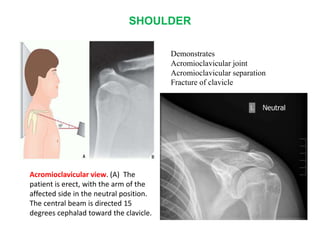
SHOULDER
Acromioclavicular view. (A) The
patient is erect, with the arm of the
affected side in the neutral position.
The central beam is directed 15
degrees cephalad toward the clavicle.
Demonstrates
Acromioclavicular joint
Acromioclavicular separation
Fracture of clavicle
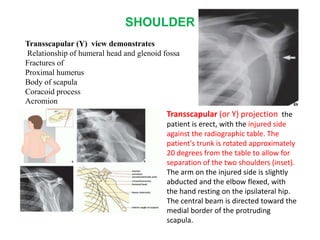
SHOULDER
Transscapular (or Y) projection the
patient is erect, with the injured side
against the radiographic table. The
patient's trunk is rotated approximately
20 degrees from the table to allow for
separation of the two shoulders (inset).
The arm on the injured side is slightly
abducted and the elbow flexed, with
the hand resting on the ipsilateral hip.
The central beam is directed toward the
medial border of the protruding
scapula.
Transscapular (Y) view demonstrates
Relationship of humeral head and glenoid fossa
Fractures of
Proximal humerus
Body of scapula
Coracoid process
Acromion
SHOULDER
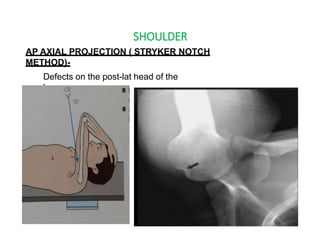
AP AXIAL PROJECTION ( STRYKER NOTCH
METHOD)-
Defects on the post-lat head of the
humerus.
SHOULDER
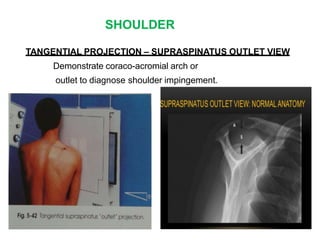
TANGENTIAL PROJECTION – SUPRASPINATUS OUTLET VIEW
Demonstrate coraco-acromial arch or
outlet to diagnose shoulder impingement.
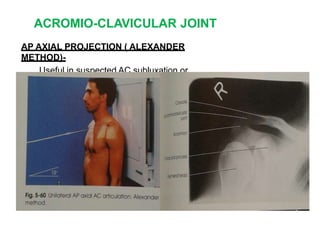
ACROMIO-CLAVICULAR JOINT
AP AXIAL PROJECTION ( ALEXANDER
METHOD)-
Useful in suspected AC subluxation or
dislocation.
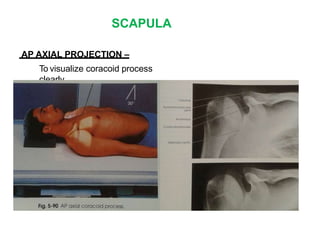
SCAPULA
AP AXIAL PROJECTION –
To visualize coracoid process
clearly.
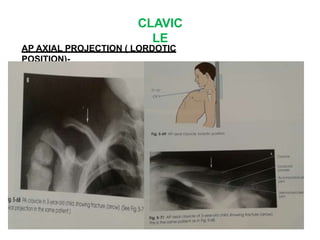
CLAVIC
LE
AP AXIAL PROJECTION ( LORDOTIC
POSITION)-
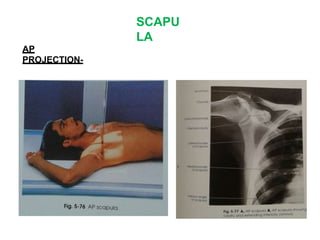
SCAPU
LA
AP
PROJECTION-
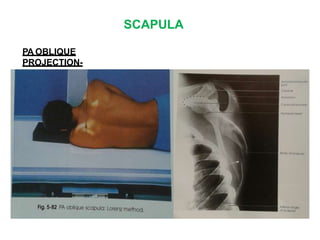
SCAPULA
PA OBLIQUE
PROJECTION-
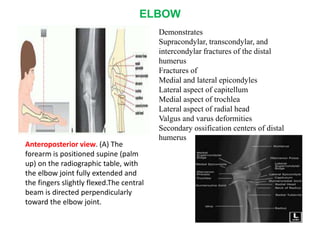
ELBOW
Anteroposterior view. (A) The
forearm is positioned supine (palm
up) on the radiographic table, with
the elbow joint fully extended and
the fingers slightly flexed.The central
beam is directed perpendicularly
toward the elbow joint.
Demonstrates
Supracondylar, transcondylar, and
intercondylar fractures of the distal
humerus
Fractures of
Medial and lateral epicondyles
Lateral aspect of capitellum
Medial aspect of trochlea
Lateral aspect of radial head
Valgus and varus deformities
Secondary ossification centers of distal
humerus
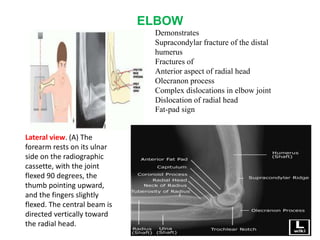
ELBOW
Lateral view. (A) The
forearm rests on its ulnar
side on the radiographic
cassette, with the joint
flexed 90 degrees, the
thumb pointing upward,
and the fingers slightly
flexed. The central beam is
directed vertically toward
the radial head.
Demonstrates
Supracondylar fracture of the distal
humerus
Fractures of
Anterior aspect of radial head
Olecranon process
Complex dislocations in elbow joint
Dislocation of radial head
Fat-pad sign
ELBOW
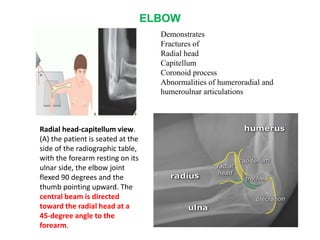
Radial head-capitellum view.
(A) the patient is seated at the
side of the radiographic table,
with the forearm resting on its
ulnar side, the elbow joint
flexed 90 degrees and the
thumb pointing upward. The
central beam is directed
toward the radial head at a
45-degree angle to the
forearm.
Demonstrates
Fractures of
Radial head
Capitellum
Coronoid process
Abnormalities of humeroradial and
humeroulnar articulations
ELBOW
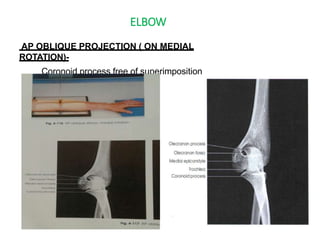
AP OBLIQUE PROJECTION ( ON MEDIAL
ROTATION)-
Coronoid process free of superimposition
ELBOW
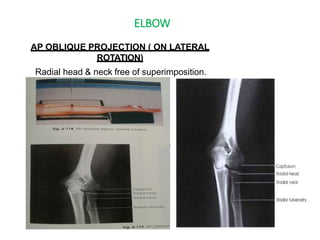
AP OBLIQUE PROJECTION ( ON LATERAL
ROTATION)
Radial head & neck free of superimposition.
ELBOW
AP PROJECTION ( ACUTE FLEXION)-
Demonstrate olecranon process
clearly
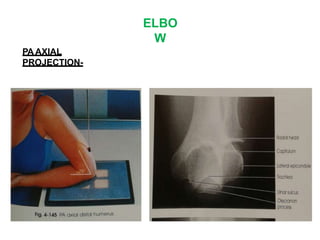
ELBO
W
PA AXIAL
PROJECTION-
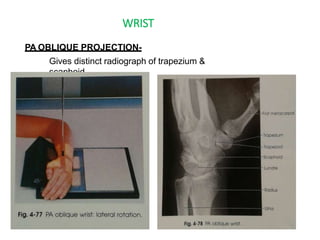
WRIST
PA OBLIQUE PROJECTION-
Gives distinct radiograph of trapezium &
scaphoid.
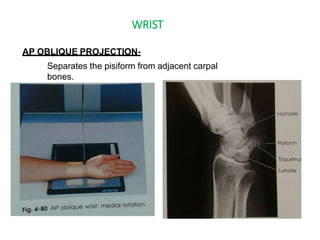
WRIST
AP OBLIQUE PROJECTION-
Separates the pisiform from adjacent carpal
bones.
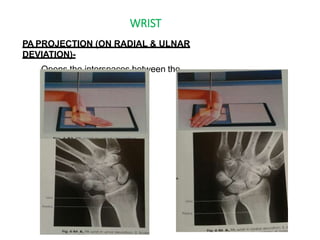
WRIST
PA PROJECTION (ON RADIAL & ULNAR
DEVIATION)-
Opens the interspaces between the
carpals.
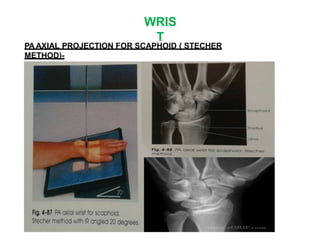
WRIS
T
PAAXIAL PROJECTION FOR SCAPHOID ( STECHER
METHOD)-
WRIST
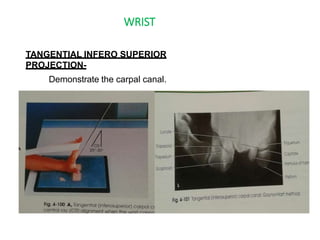
TANGENTIAL INFERO SUPERIOR
PROJECTION-
Demonstrate the carpal canal.
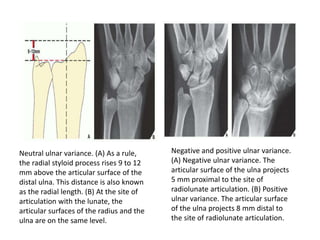
Neutral ulnar variance. (A) As a rule,
the radial styloid process rises 9 to 12
mm above the articular surface of the
distal ulna. This distance is also known
as the radial length. (B) At the site of
articulation with the lunate, the
articular surfaces of the radius and the
ulna are on the same level.
Negative and positive ulnar variance.
(A) Negative ulnar variance. The
articular surface of the ulna projects
5 mm proximal to the site of
radiolunate articulation. (B) Positive
ulnar variance. The articular surface
of the ulna projects 8 mm distal to
the site of radiolunate articulation.
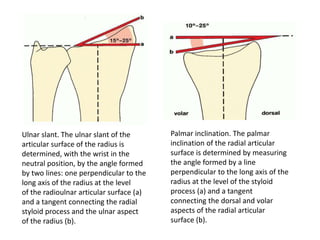
Ulnar slant. The ulnar slant of the
articular surface of the radius is
determined, with the wrist in the
neutral position, by the angle formed
by two lines: one perpendicular to the
long axis of the radius at the level
of the radioulnar articular surface (a)
and a tangent connecting the radial
styloid process and the ulnar aspect
of the radius (b).
Palmar inclination. The palmar
inclination of the radial articular
surface is determined by measuring
the angle formed by a line
perpendicular to the long axis of the
radius at the level of the styloid
process (a) and a tangent
connecting the dorsal and volar
aspects of the radial articular
surface (b).
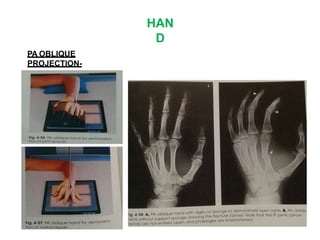
HAN
D
PA OBLIQUE
PROJECTION-
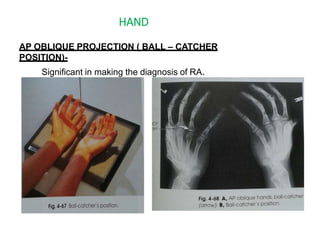
HAND
AP OBLIQUE PROJECTION ( BALL – CATCHER
POSITION)-
Significant in making the diagnosis of RA.
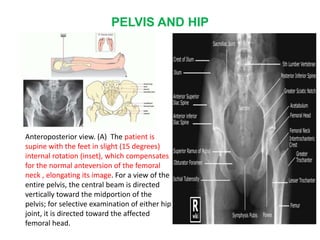
PELVIS AND HIP
Anteroposterior view. (A) The patient is
supine with the feet in slight (15 degrees)
internal rotation (inset), which compensates
for the normal anteversion of the femoral
neck , elongating its image. For a view of the
entire pelvis, the central beam is directed
vertically toward the midportion of the
pelvis; for selective examination of either hip
joint, it is directed toward the affected
femoral head.
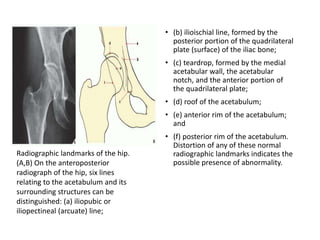
• (b) ilioischial line, formed by the
posterior portion of the quadrilateral
plate (surface) of the iliac bone;
• (c) teardrop, formed by the medial
acetabular wall, the acetabular
notch, and the anterior portion of
the quadrilateral plate;
• (d) roof of the acetabulum;
• (e) anterior rim of the acetabulum;
and
• (f) posterior rim of the acetabulum.
Distortion of any of these normal
radiographic landmarks indicates the
possible presence of abnormality.
Radiographic landmarks of the hip.
(A,B) On the anteroposterior
radiograph of the hip, six lines
relating to the acetabulum and its
surrounding structures can be
distinguished: (a) iliopubic or
iliopectineal (arcuate) line;
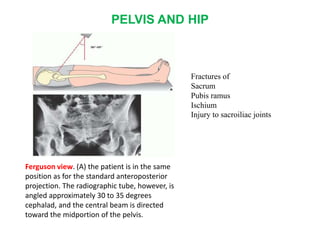
PELVIS AND HIP
Ferguson view. (A) the patient is in the same
position as for the standard anteroposterior
projection. The radiographic tube, however, is
angled approximately 30 to 35 degrees
cephalad, and the central beam is directed
toward the midportion of the pelvis.
Fractures of
Sacrum
Pubis ramus
Ischium
Injury to sacroiliac joints
PELVIS AND HIP
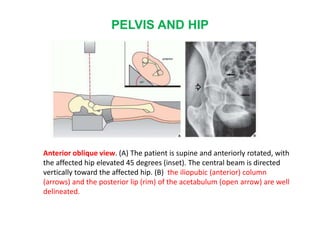
Anterior oblique view. (A) The patient is supine and anteriorly rotated, with
the affected hip elevated 45 degrees (inset). The central beam is directed
vertically toward the affected hip. (B) the iliopubic (anterior) column
(arrows) and the posterior lip (rim) of the acetabulum (open arrow) are well
delineated.
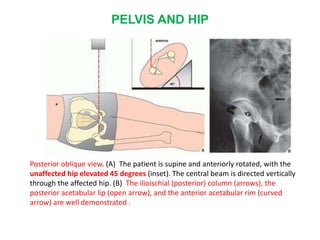
PELVIS AND HIP
Posterior oblique view. (A) The patient is supine and anteriorly rotated, with the
unaffected hip elevated 45 degrees (inset). The central beam is directed vertically
through the affected hip. (B) The ilioischial (posterior) column (arrows), the
posterior acetabular lip (open arrow), and the anterior acetabular rim (curved
arrow) are well demonstrated .
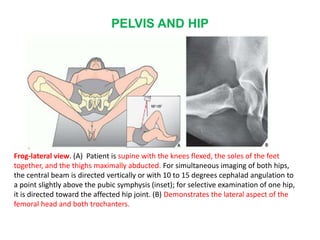
PELVIS AND HIP
Frog-lateral view. (A) Patient is supine with the knees flexed, the soles of the feet
together, and the thighs maximally abducted. For simultaneous imaging of both hips,
the central beam is directed vertically or with 10 to 15 degrees cephalad angulation to
a point slightly above the pubic symphysis (inset); for selective examination of one hip,
it is directed toward the affected hip joint. (B) Demonstrates the lateral aspect of the
femoral head and both trochanters.
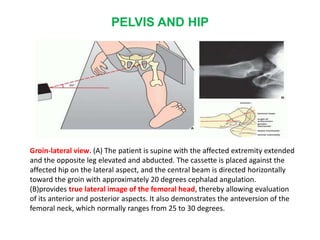
PELVIS AND HIP
Groin-lateral view. (A) The patient is supine with the affected extremity extended
and the opposite leg elevated and abducted. The cassette is placed against the
affected hip on the lateral aspect, and the central beam is directed horizontally
toward the groin with approximately 20 degrees cephalad angulation.
(B)provides true lateral image of the femoral head, thereby allowing evaluation
of its anterior and posterior aspects. It also demonstrates the anteversion of the
femoral neck, which normally ranges from 25 to 30 degrees.
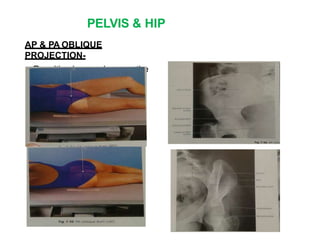
PELVIS & HIP
AP & PA OBLIQUE
PROJECTION-
Resulting image shows entire
ilium
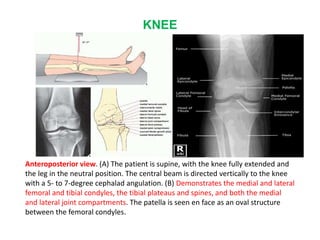
KNEE
Anteroposterior view. (A) The patient is supine, with the knee fully extended and
the leg in the neutral position. The central beam is directed vertically to the knee
with a 5- to 7-degree cephalad angulation. (B) Demonstrates the medial and lateral
femoral and tibial condyles, the tibial plateaus and spines, and both the medial
and lateral joint compartments. The patella is seen en face as an oval structure
between the femoral condyles.
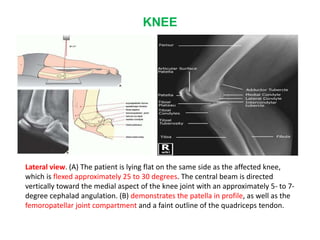
KNEE
Lateral view. (A) The patient is lying flat on the same side as the affected knee,
which is flexed approximately 25 to 30 degrees. The central beam is directed
vertically toward the medial aspect of the knee joint with an approximately 5- to 7-
degree cephalad angulation. (B) demonstrates the patella in profile, as well as the
femoropatellar joint compartment and a faint outline of the quadriceps tendon.
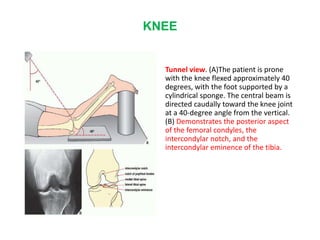
KNEE
Tunnel view. (A)The patient is prone
with the knee flexed approximately 40
degrees, with the foot supported by a
cylindrical sponge. The central beam is
directed caudally toward the knee joint
at a 40-degree angle from the vertical.
(B) Demonstrates the posterior aspect
of the femoral condyles, the
intercondylar notch, and the
intercondylar eminence of the tibia.
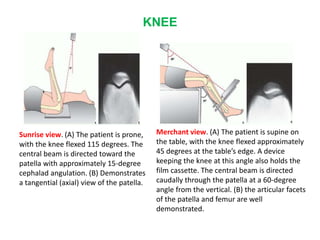
KNEE
Sunrise view. (A) The patient is prone,
with the knee flexed 115 degrees. The
central beam is directed toward the
patella with approximately 15-degree
cephalad angulation. (B) Demonstrates
a tangential (axial) view of the patella.
Merchant view. (A) The patient is supine on
the table, with the knee flexed approximately
45 degrees at the table’s edge. A device
keeping the knee at this angle also holds the
film cassette. The central beam is directed
caudally through the patella at a 60-degree
angle from the vertical. (B) the articular facets
of the patella and femur are well
demonstrated.
Skyline view
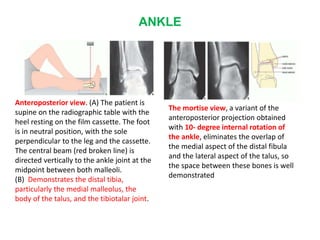
ANKLE
Anteroposterior view. (A) The patient is
supine on the radiographic table with the
heel resting on the film cassette. The foot
is in neutral position, with the sole
perpendicular to the leg and the cassette.
The central beam (red broken line) is
directed vertically to the ankle joint at the
midpoint between both malleoli.
(B) Demonstrates the distal tibia,
particularly the medial malleolus, the
body of the talus, and the tibiotalar joint.
The mortise view, a variant of the
anteroposterior projection obtained
with 10- degree internal rotation of
the ankle, eliminates the overlap of
the medial aspect of the distal fibula
and the lateral aspect of the talus, so
the space between these bones is well
demonstrated
ANKLE
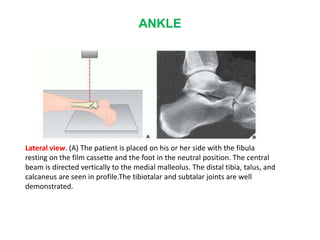
Lateral view. (A) The patient is placed on his or her side with the fibula
resting on the film cassette and the foot in the neutral position. The central
beam is directed vertically to the medial malleolus. The distal tibia, talus, and
calcaneus are seen in profile.The tibiotalar and subtalar joints are well
demonstrated.
ANKLE
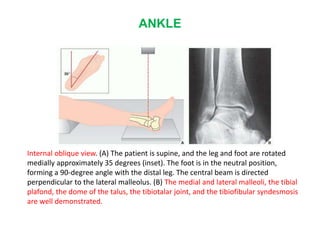
Internal oblique view. (A) The patient is supine, and the leg and foot are rotated
medially approximately 35 degrees (inset). The foot is in the neutral position,
forming a 90-degree angle with the distal leg. The central beam is directed
perpendicular to the lateral malleolus. (B) The medial and lateral malleoli, the tibial
plafond, the dome of the talus, the tibiotalar joint, and the tibiofibular syndesmosis
are well demonstrated.
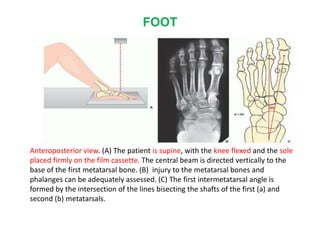
FOOT
Anteroposterior view. (A) The patient is supine, with the knee flexed and the sole
placed firmly on the film cassette. The central beam is directed vertically to the
base of the first metatarsal bone. (B) injury to the metatarsal bones and
phalanges can be adequately assessed. (C) The first intermetatarsal angle is
formed by the intersection of the lines bisecting the shafts of the first (a) and
second (b) metatarsals.
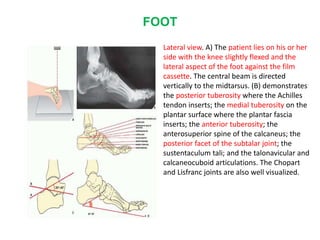
FOOT
Lateral view. A) The patient lies on his or her
side with the knee slightly flexed and the
lateral aspect of the foot against the film
cassette. The central beam is directed
vertically to the midtarsus. (B) demonstrates
the posterior tuberosity where the Achilles
tendon inserts; the medial tuberosity on the
plantar surface where the plantar fascia
inserts; the anterior tuberosity; the
anterosuperior spine of the calcaneus; the
posterior facet of the subtalar joint; the
sustentaculum tali; and the talonavicular and
calcaneocuboid articulations. The Chopart
and Lisfranc joints are also well visualized.
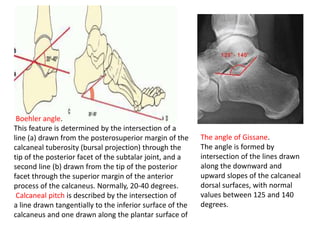
Boehler angle.
This feature is determined by the intersection of a
line (a) drawn from the posterosuperior margin of the
calcaneal tuberosity (bursal projection) through the
tip of the posterior facet of the subtalar joint, and a
second line (b) drawn from the tip of the posterior
facet through the superior margin of the anterior
process of the calcaneus. Normally, 20-40 degrees.
Calcaneal pitch is described by the intersection of
a line drawn tangentially to the inferior surface of the
calcaneus and one drawn along the plantar surface of
The angle of Gissane.
The angle is formed by
intersection of the lines drawn
along the downward and
upward slopes of the calcaneal
dorsal surfaces, with normal
values between 125 and 140
degrees.
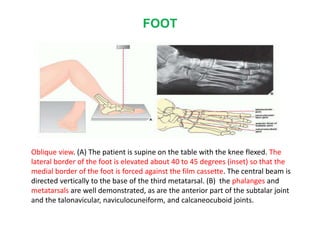
FOOT
Oblique view. (A) The patient is supine on the table with the knee flexed. The
lateral border of the foot is elevated about 40 to 45 degrees (inset) so that the
medial border of the foot is forced against the film cassette. The central beam is
directed vertically to the base of the third metatarsal. (B) the phalanges and
metatarsals are well demonstrated, as are the anterior part of the subtalar joint
and the talonavicular, naviculocuneiform, and calcaneocuboid joints.
FOOT
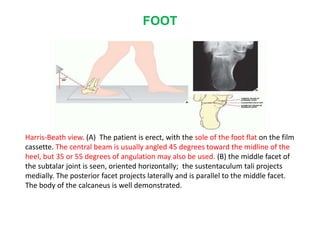
Harris-Beath view. (A) The patient is erect, with the sole of the foot flat on the film
cassette. The central beam is usually angled 45 degrees toward the midline of the
heel, but 35 or 55 degrees of angulation may also be used. (B) the middle facet of
the subtalar joint is seen, oriented horizontally; the sustentaculum tali projects
medially. The posterior facet projects laterally and is parallel to the middle facet.
The body of the calcaneus is well demonstrated.
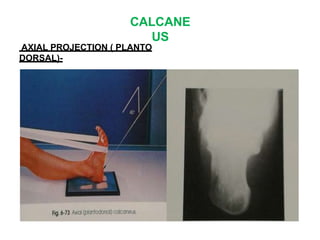
CALCANE
US
AXIAL PROJECTION ( PLANTO
DORSAL)-
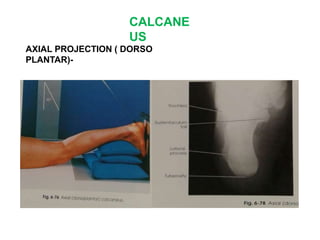
CALCANE
US
AXIAL PROJECTION ( DORSO
PLANTAR)-
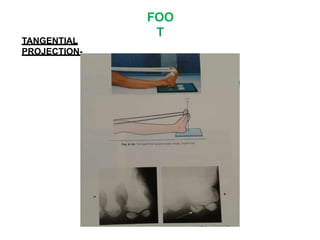
FOO
T
TANGENTIAL
PROJECTION-
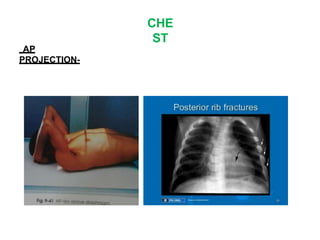
CHE
ST
AP
PROJECTION-
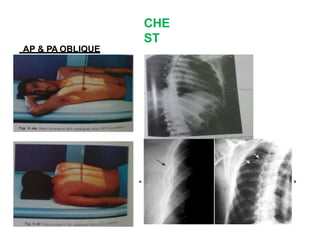
CHE
ST
AP & PA OBLIQUE
PROJECTION-
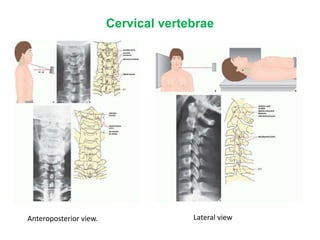
Cervical vertebrae
Lateral view
Anteroposterior view.
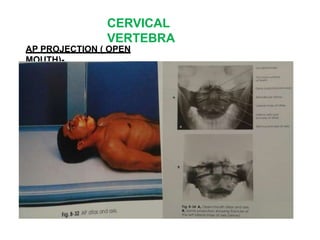
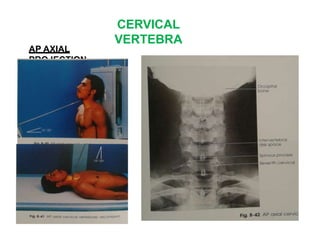
CERVICAL
VERTEBRA
AP PROJECTION ( OPEN
MOUTH)-
CERVICAL
VERTEBRA
AP AXIAL
PROJECTION-
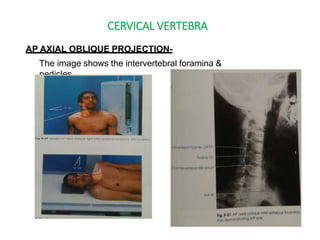
CERVICAL VERTEBRA
AP AXIAL OBLIQUE PROJECTION-
The image shows the intervertebral foramina &
pedicles.
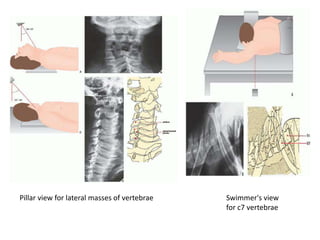
Pillar view for lateral masses of vertebrae Swimmer's view
for c7 vertebrae
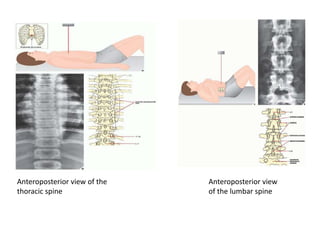
Anteroposterior view of the
thoracic spine
Anteroposterior view
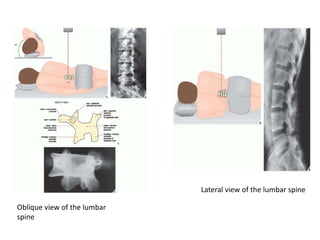
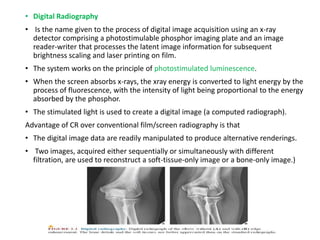
of the lumbar spine
Lateral view of the lumbar spine
Oblique view of the lumbar
spine
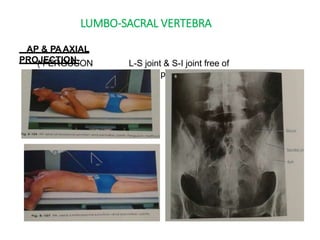
LUMBO-SACRAL VERTEBRA
AP & PAAXIAL
PROJECTION-
( FERGUSON
METHOD)-
L-S joint & S-I joint free of
superimposition.
Stress Views
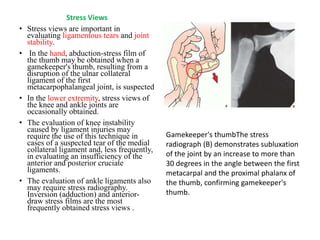
• Stress views are important in
evaluating ligamentous tears and joint
stability.
• In the hand, abduction-stress film of
the thumb may be obtained when a
gamekeeper's thumb, resulting from a
disruption of the ulnar collateral
ligament of the first
metacarpophalangeal joint, is suspected
• In the lower extremity, stress views of
the knee and ankle joints are
occasionally obtained.
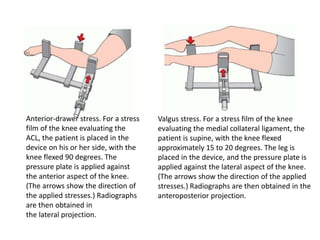
• The evaluation of knee instability
caused by ligament injuries may
require the use of this technique in
cases of a suspected tear of the medial
collateral ligament and, less frequently,
in evaluating an insufficiency of the
anterior and posterior cruciate
ligaments.
• The evaluation of ankle ligaments also
may require stress radiography.
Inversion (adduction) and anterior-
draw stress films are the most
frequently obtained stress views .
Gamekeeper's thumbThe stress
radiograph (B) demonstrates subluxation
of the joint by an increase to more than
30 degrees in the angle between the first
metacarpal and the proximal phalanx of
the thumb, confirming gamekeeper's
thumb.
Anterior-drawer stress. For a stress
film of the knee evaluating the
ACL, the patient is placed in the
device on his or her side, with the
knee flexed 90 degrees. The
pressure plate is applied against
the anterior aspect of the knee.
(The arrows show the direction of
the applied stresses.) Radiographs
are then obtained in
the lateral projection.
Valgus stress. For a stress film of the knee
evaluating the medial collateral ligament, the
patient is supine, with the knee flexed
approximately 15 to 20 degrees. The leg is
placed in the device, and the pressure plate is
applied against the lateral aspect of the knee.
(The arrows show the direction of the applied
stresses.) Radiographs are then obtained in the
anteroposterior projection.
Flouroscopy
• Fluoroscopy is a fundamental diagnostic tool for many radiologic
procedures,including arthrography, tenography, bursography,
arteriography, and percutaneous bone or soft-tissue biopsy.
• Fluoroscopy combined with videotaping is useful in evaluating the
kinematics of joints.
• Used in conjunction with
• Myelography - to observe the movement of the contrast column in the
subarachnoid space
• Arthrography - to check the proper placement of the needle and to
monitor the flow of the contrast agent
• Intraoperatively - to assess the reduction of a fracture or placement of
hardware
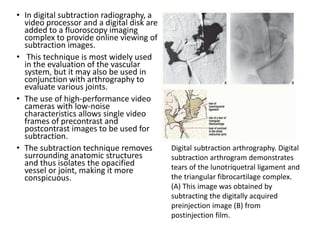
• Digital Radiography
• Is the name given to the process of digital image acquisition using an x-ray
detector comprising a photostimulable phosphor imaging plate and an image
reader-writer that processes the latent image information for subsequent
brightness scaling and laser printing on film.
• The system works on the principle of photostimulated luminescence.
• When the screen absorbs x-rays, the xray energy is converted to light energy by the
process of fluorescence, with the intensity of light being proportional to the energy
absorbed by the phosphor.
• The stimulated light is used to create a digital image (a computed radiograph).
Advantage of CR over conventional film/screen radiography is that
• The digital image data are readily manipulated to produce alternative renderings.
• Two images, acquired either sequentially or simultaneously with different
filtration, are used to reconstruct a soft-tissue-only image or a bone-only image.)
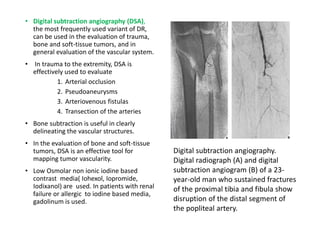
• In digital subtraction radiography, a
video processor and a digital disk are
added to a fluoroscopy imaging
complex to provide online viewing of
subtraction images.
• This technique is most widely used
in the evaluation of the vascular
system, but it may also be used in
conjunction with arthrography to
evaluate various joints.
• The use of high-performance video
cameras with low-noise
characteristics allows single video
frames of precontrast and
postcontrast images to be used for
subtraction.
• The subtraction technique removes
surrounding anatomic structures
and thus isolates the opacified
vessel or joint, making it more
conspicuous.
Digital subtraction arthrography. Digital
subtraction arthrogram demonstrates
tears of the lunotriquetral ligament and
the triangular fibrocartilage complex.
(A) This image was obtained by
subtracting the digitally acquired
preinjection image (B) from
postinjection film.
• Digital subtraction angiography (DSA),
the most frequently used variant of DR,
can be used in the evaluation of trauma,
bone and soft-tissue tumors, and in
general evaluation of the vascular system.
• In trauma to the extremity, DSA is
effectively used to evaluate
1. Arterial occlusion
2. Pseudoaneurysms
3. Arteriovenous fistulas
4. Transection of the arteries
• Bone subtraction is useful in clearly
delineating the vascular structures.
• In the evaluation of bone and soft-tissue
tumors, DSA is an effective tool for
mapping tumor vascularity.
• Low Osmolar non ionic iodine based
contrast media( Iohexol, Iopromide,
Iodixanol) are used. In patients with renal
failure or allergic to iodine based media,
gadolinum is used.
Digital subtraction angiography.
Digital radiograph (A) and digital
subtraction angiogram (B) of a 23-
year-old man who sustained fractures
of the proximal tibia and fibula show
disruption of the distal segment of
the popliteal artery.
Computed Tomography(CT)
• Essential components of CT
system include
• Circular scanning gantry
which houses x-ray tube and
image sensors
• Table for the patient
• An x-ray generator
• Computerized data
processing unit
• The x-ray tube is rotated
360 degrees around the
patient while the computer
collects the data and
formulates an axial image,
or “slice.” Each cross-
sectional slice represents a
thickness between 0.1 and
1.5 cm of body tissue.
• The tissues absorb the x-ray beam to various degrees depending on the
atomic number and density of the specific tissue.
• The remaining, unabsorbed (unattenuated) beam passes through the
tissues and is detected and processed by the computer.
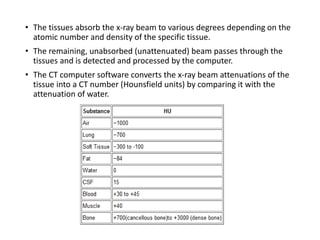
• The CT computer software converts the x-ray beam attenuations of the
tissue into a CT number (Hounsfield units) by comparing it with the
attenuation of water.
• Tissue
• H
Spiral ( Helical ) CT –
• Data gathering system using a continuous rotation of
the x-ray source and the detectors. It allows the rapid
acquisition of volumes of CT data and renders the
ability to reformat the images at any predetermined
intervals ranging from 0.5 to 10.0 mm.
• Acquires all data in 24 or 32 seconds, generating up to
92 sections compared to standard CT where 12 scans
can be done over 1 minute.
• This technology has markedly reduced scan times and
has eliminated interscan delay and hence interscan
motion. It also has decreased the motion artifacts,
improved the definition of scanned structures, and
markedly facilitated the ability to obtain three-
dimensional (3D) reconstructions.
MDCT
• Multichannel multidetector row CT
• Images can be generated with subsecond gantry rotation times
yielding high resolution volume data sets, and at the same time
minimizing the radiation dose to the patient.
fpVCT
• High-resolution flat-panel volume CT
• Uses digital flat-panel detectors and provides volumetric coverage
as well as ultra-high spatial resolution in two-dimensional (2D)
and 3D projections.
• Furthermore, it reduces metal and beam-hardening artifacts.
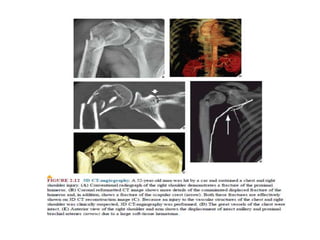
3D CT-angiography
• Used to determine the presence or absence of injury to the
vessels near the fractured bones
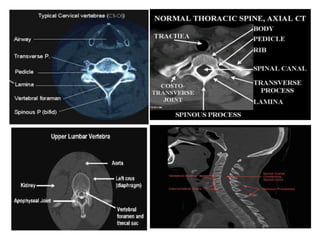
CT scan of spine
Bone structure
Facet arthritis
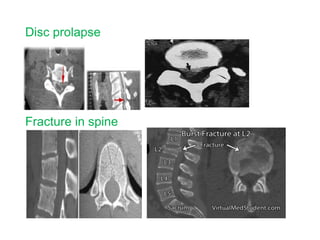
Disc prolapse
Trauma
spondylitis
Tumor
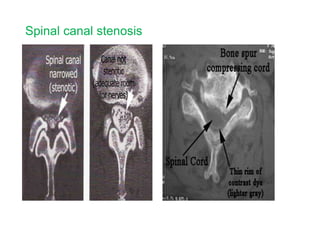
Spinal stenosis(central)
Spinal stenosis (lateral)
Spinal canal stenosis
Disc prolapse
Fracture in spine
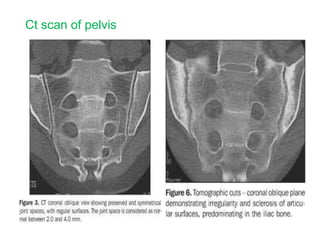
Ct scan of pelvis
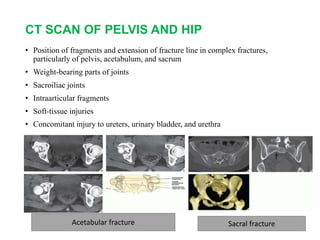
CT SCAN OF PELVIS AND HIP
• Position of fragments and extension of fracture line in complex fractures,
particularly of pelvis, acetabulum, and sacrum
• Weight-bearing parts of joints
• Sacroiliac joints
• Intraarticular fragments
• Soft-tissue injuries
• Concomitant injury to ureters, urinary bladder, and urethra
Acetabular fracture Sacral fracture
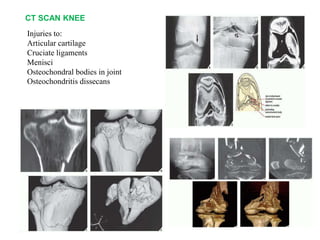
CT SCAN KNEE
Injuries to:
Articular cartilage
Cruciate ligaments
Menisci
Osteochondral bodies in joint
Osteochondritis dissecans
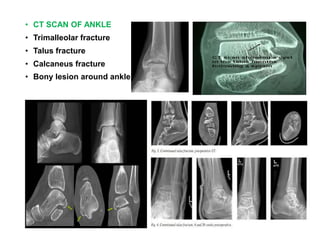
• CT SCAN OF ANKLEnd fracture
• Trimalleolar fracture
• Talus fracture
• Calcaneus fracture
• Bony lesion around ankle
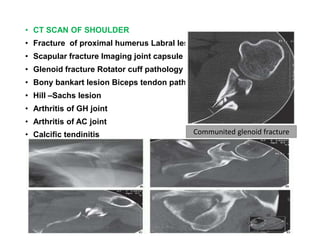
• CT SCAN OF SHOULDERArthrography
• Fracture of proximal humerus Labral lesion
• Scapular fracture Imaging joint capsule
• Glenoid fracture Rotator cuff pathology
• Bony bankart lesion Biceps tendon pathology
• Hill –Sachs lesion
• Arthritis of GH joint
• Arthritis of AC joint
• Calcific tendinitis Communited glenoid fracture
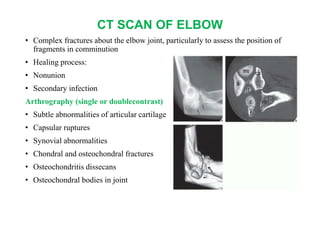
CT SCAN OF ELBOW
• Complex fractures about the elbow joint, particularly to assess the position of
fragments in comminution
• Healing process:
• Nonunion
• Secondary infection
Arthrography (single or doublecontrast)
• Subtle abnormalities of articular cartilage
• Capsular ruptures
• Synovial abnormalities
• Chondral and osteochondral fractures
• Osteochondritis dissecans
• Osteochondral bodies in joint
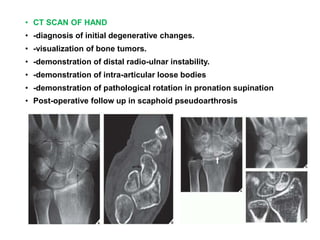
• CT SCAN OF HANDpal.
• -diagnosis of initial degenerative changes.
• -visualization of bone tumors.
• -demonstration of distal radio-ulnar instability.
• -demonstration of intra-articular loose bodies
• -demonstration of pathological rotation in pronation supination
• Post-operative follow up in scaphoid pseudoarthrosis
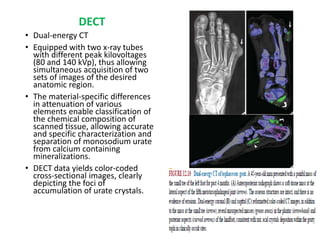
DECT
• Dual-energy CT
• Equipped with two x-ray tubes
with different peak kilovoltages
(80 and 140 kVp), thus allowing
simultaneous acquisition of two
sets of images of the desired
anatomic region.
• The material-specific differences
in attenuation of various
elements enable classification of
the chemical composition of
scanned tissue, allowing accurate
and specific characterization and
separation of monosodium urate
from calcium containing
mineralizations.
• DECT data yields color-coded
cross-sectional images, clearly
depicting the foci of
accumulation of urate crystals.
QCT :
• Quantitative CT
• Method for measuring the lumbar spine mineral content.
• Measurements are performed on a CT scanner using a mineral standard for
simultaneous calibration and computed radiograph for localization.
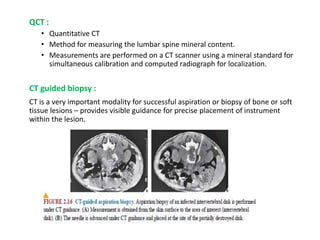
CT guided biopsy :
CT is a very important modality for successful aspiration or biopsy of bone or soft
tissue lesions – provides visible guidance for precise placement of instrument
within the lesion.
• Advantages :
1. Direct transaxial images can be obtained
2. Bone can be imaged in multiple planes- coronal,sagittal
and oblique using reformation technique
3. Helps in evaluating complex fractures of pelvis,hip and
knee.
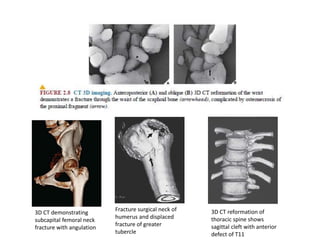
4. 3D reconstruction possible which helps in analyzing
regions with complex anatomy like
wrist,foot,ankle,pelvis.
3D CT demonstrating
subcapital femoral neck
fracture with angulation
Fracture surgical neck of
humerus and displaced
fracture of greater
tubercle
3D CT reformation of
thoracic spine shows
sagittal cleft with anterior
defect of T11
DISADVANTAGES :
• Lack of homogeneity in the composition of small volume of
tissue.
• Poor tissue characterization. Despite the ability of CT to
discriminate among some differences in density, a simple
analysis of attenuation values does not permit precise
histologic characterization.
• Motion artifacts degrade the image quality
• An area that contains metal (e.g., prosthesis or various rods
and screws) will produce significant artifacts.
• Finally, the radiation dose may occasionally be high,
particularly when contiguous and overlapping sections are
obtained during examination.
• Children – More sensitive to radiation and prone to develop
radiation induced neoplasm. Lens and thyroid are at risk.
• Inferior to MRI in imaging of bone marrow and soft tissue
details like marrow injury/ trabecular injury/ bone
contusion.
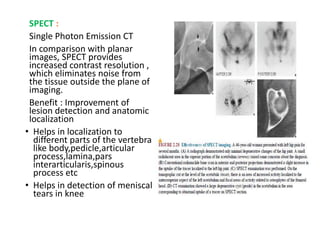
SPECT :
Single Photon Emission CT
In comparison with planar
images, SPECT provides
increased contrast resolution ,
which eliminates noise from
the tissue outside the plane of
imaging.
Benefit : Improvement of
lesion detection and anatomic
localization
• Helps in localization to
different parts of the vertebra
like body,pedicle,articular
process,lamina,pars
interarticularis,spinous
process etc
• Helps in detection of meniscal
tears in knee
MRI
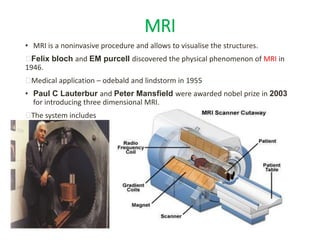
• MRI is a noninvasive procedure and allows to visualise the structures.
Felix bloch and EM purcell discovered the physical phenomenon of MRI in
1946.
Medical application – odebald and lindstorm in 1955
• Paul C Lauterbur and Peter Mansfield were awarded nobel prize in 2003
for introducing three dimensional MRI.
The system includes
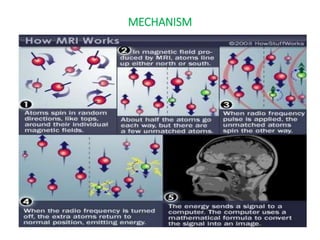
MECHANISM
• T1 and T2 weighed images
• The T1 relaxation time ( longitudinal relaxation time)
• - used to describe the return of protons back to equilibrium after application
and removal of the rf pulse.
• -- Provide good anatomic detail
• T2 relaxation time (transverse relaxation time)
• - used to describe the associated loss of coherence or phase between individual
protons immediately after the application of the rf pulse.
• - used for evaluation of pathologic processes.
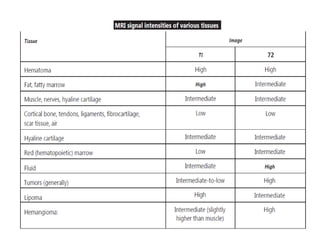
• T1 weighted images are : Sharp Well defined ,Anatomic imaging
Fat-bright; fluid-dark
T2 weighted imaging is traditionally known as “PATHOLOGICAL IMAGING”
They are sensitive for detecting edema.
On traditional spin echo T2 imaging
fat-dark; fluid-bright
• USES OF MRI IN ORTHOPAEDICS
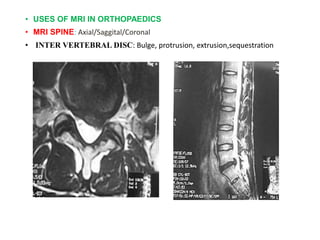
• MRI SPINE: Axial/Saggital/Coronal
• INTER VERTEBRAL DISC: Bulge, protrusion, extrusion,sequestration
• SPINAL TUMORS:
• Excellent delineation of vertebral body marrow allows detection of primary and
metastatic diseases on T1 weighed sequences.
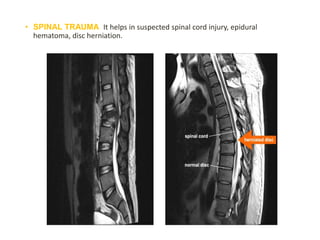
• SPINAL TRAUMA: It helps in suspected spinal cord injury, epidural
hematoma, disc herniation.
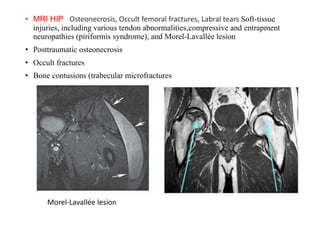
• MRI HIP : Osteonecrosis, Occult femoral fractures, Labral tears Soft-tissue
injuries, including various tendon abnormalities,compressive and entrapment
neuropathies (piriformis syndrome), and Morel-Lavallée lesion
• Posttraumatic osteonecrosis
• Occult fractures
• Bone contusions (trabecular microfractures
Morel-Lavallée lesion
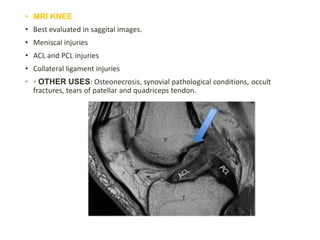
• MRI KNEE
• Best evaluated in saggital images.
• Meniscal injuries
• ACL and PCL injuries
• Collateral ligament injuries
• • OTHER USES: Osteonecrosis, synovial pathological conditions, occult
fractures, tears of patellar and quadriceps tendon.
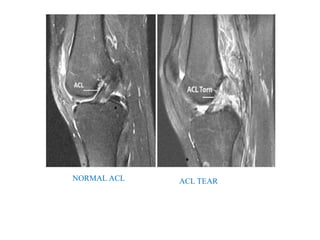
NORMAL ACL ACL TEAR
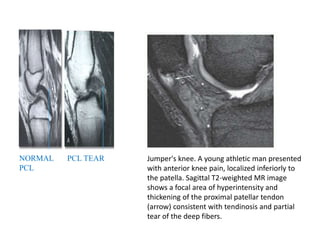
Jumper's knee. A young athletic man presented
with anterior knee pain, localized inferiorly to
the patella. Sagittal T2-weighted MR image
shows a focal area of hyperintensity and
thickening of the proximal patellar tendon
(arrow) consistent with tendinosis and partial
tear of the deep fibers.
NORMAL
PCL
PCL TEAR
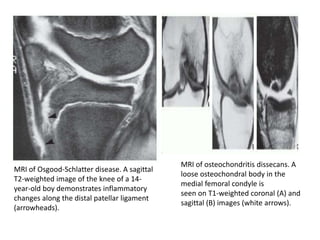
MRI of Osgood-Schlatter disease. A sagittal
T2-weighted image of the knee of a 14-
year-old boy demonstrates inflammatory
changes along the distal patellar ligament
(arrowheads).
MRI of osteochondritis dissecans. A
loose osteochondral body in the
medial femoral condyle is
seen on T1-weighted coronal (A) and
sagittal (B) images (white arrows).
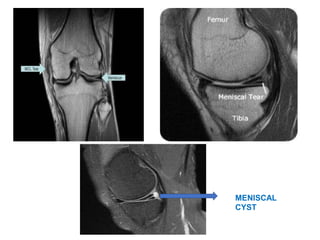
MENISCAL
CYST
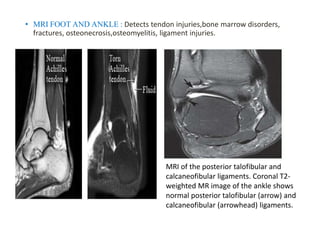
• MRI FOOT AND ANKLE : Detects tendon injuries,bone marrow disorders,
fractures, osteonecrosis,osteomyelitis, ligament injuries.
MRI of the posterior talofibular and
calcaneofibular ligaments. Coronal T2-
weighted MR image of the ankle shows
normal posterior talofibular (arrow) and
calcaneofibular (arrowhead) ligaments.
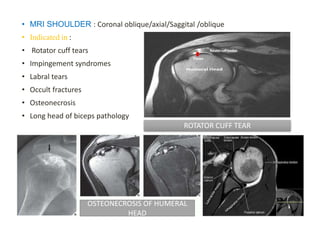
• MRI SHOULDER : Coronal oblique/axial/Saggital /oblique
• Indicated in :
• Rotator cuff tears
• Impingement syndromes
• Labral tears
• Occult fractures
• Osteonecrosis
• Long head of biceps pathology
ROTATOR CUFF TEAR
OSTEONECROSIS OF HUMERAL
HEAD
MRI OF ELBOW
Abnormalities of the ligaments,a tendons, muscles, and nerves
Capsular ruptures
Joint effusion
Synovial cysts
Hematomas
Subtle abnormalities of bones (e.g., bone contusion)
Osteochondritis dissecans
Epiphyseal fractures (in children)
MRI of osteochondritis dissecans of the capitellum
• MRI OF WRIST AND HAND : To detect carpal ligament disruption , avascular
necrosis of lunate
MRI of the tear of
the TFCC.
MRI of the ulnar
impaction
syndrome
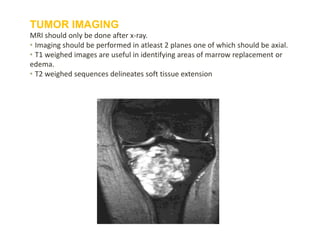
TUMOR IMAGING
MRI should only be done after x-ray.
• Imaging should be performed in atleast 2 planes one of which should be axial.
• T1 weighed images are useful in identifying areas of marrow replacement or
edema.
• T2 weighed sequences delineates soft tissue extension
• ADVANTAGES DISADVANTADVANTAGES DISADVANT
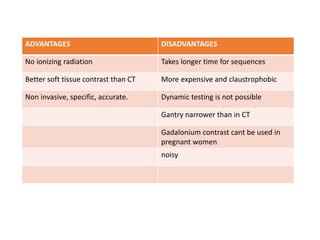
ADVANTAGES DISADVANTAGES
No ionizing radiation Takes longer time for sequences
Better soft tissue contrast than CT More expensive and claustrophobic
Non invasive, specific, accurate. Dynamic testing is not possible
Gantry narrower than in CT
Gadalonium contrast cant be used in
pregnant women
noisy
Contraindications
• Intra cerebral aneurysm clips.
• Internal hearing aids.
• Middle ear prosthesis.
• Cardiac pace makers.
• Implants.
• 1st trimester of pregnancy.
• Metallic orbital foreign bodies.
BONE SCAN
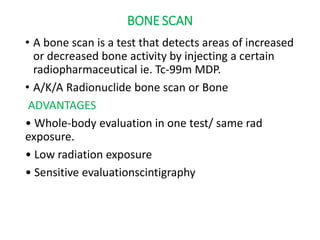
• A bone scan is a test that detects areas of increased
or decreased bone activity by injecting a certain
radiopharmaceutical ie. Tc-99m MDP.
• A/K/A Radionuclide bone scan or Bone
ADVANTAGES
• Whole-body evaluation in one test/ same rad
exposure.
• Low radiation exposure
• Sensitive evaluationscintigraphy
• DISADVANTAGES
• Needs radiopharms & gamma camera not widely
available
• Low specificity
• COST…
Radiopharmaceutical (“Tracer”)
• The most widely used is Tc-99m labeled
diphosphonates; Tc-99m Methylene diphosphonate
(Tc-99m MDP) ; Tc-99m Medronate.
Phosphonates concentrate in the mineral phase of
bone: nearly twothirds in hydroxyapatite crystals and
one third in calcium phosphate.
• PATHOPHYSIOLOGY
Two major factors control accumulation of phosphonates in bone
1) Blood flow ,
2) Extraction efficiency.
which in turn depend on capillary permeability, acid-base balance,
parathyroid hormone levels, etc.
• Maximum bone accumulation is reached 1 h after injection and the level
remains practically constant up to 72 h.
• Tc-99m MDP uptake depends on osteoblast and osteoclast activity
• Increased uptake - osteoblastic activity present
• Decreased uptake - pure lytic lesion , osteoclast activity
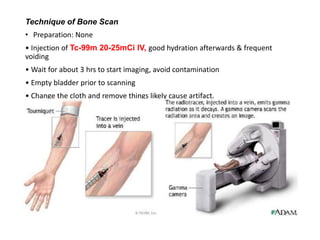
Technique of Bone Scan
• Preparation: None
• Injection of Tc-99m 20-25mCi IV, good hydration afterwards & frequent
voiding
• Wait for about 3 hrs to start imaging, avoid contamination
• Empty bladder prior to scanning
• Change the cloth and remove things likely cause artifact.
IMAGING ACQUISITION
• Can be performed as:
• – a) Limited bone scintigraphy or spot views (planar images of a selected
portion of the skeleton)
• – b) Whole-body bone scintigraphy (planar images of the entire skeleton in
anterior and posterior views)
• – c) SPECT (single photon emission computed tomography- image of a portion
of the skeleton)
• – d) Multiphase bone scintigraphy (immediate and delayed images to study
blood flow)
Clinical indications
• Oncological indications
• Primary tumours (e.g. Ewing’s sarcoma, osteosarcoma)
Staging, evaluation of response to therapy and follow up of primary bone tumors
• Secondary tumours (metastases)
• – Staging and follow-up of neoplastic diseases
• – Distribution of osteoblastic activity prior to radiometabolic therapy.
• Non-neoplastic diseases
• Whenever there is an increase in blood flow to a lesion or there is an alteration in
osteoblastic activity.
• – Stress and/or occult fractures.
• – Trauma
• – Musculoskeletal inflammation and infection
• – Bone viability (grafts, infarcts, osteonecrosis).
• – Metabolic bone disease.
• – Arthritis
• Complications of hardware/prosthetic joint replacement, loose or infected joint
prosthesis.
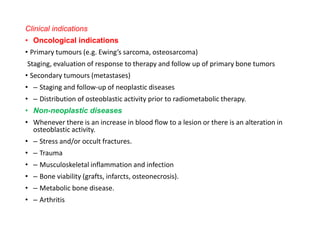
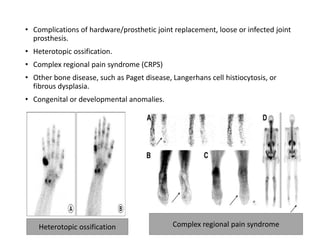
• Heterotopic ossification.
• Complex regional pain syndrome (CRPS)
• Other bone disease, such as Paget disease, Langerhans cell histiocytosis, or
fibrous dysplasia.
• Congenital or developmental anomalies.
Heterotopic ossification Complex regional pain syndrome
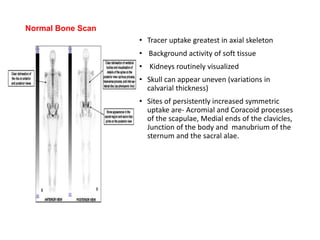
Normal Bone Scan
• Tracer uptake greatest in axial skeleton
• Background activity of soft tissue
• Kidneys routinely visualized
• Skull can appear uneven (variations in
calvarial thickness)
• Sites of persistently increased symmetric
uptake are- Acromial and Coracoid processes
of the scapulae, Medial ends of the clavicles,
Junction of the body and manubrium of the
sternum and the sacral alae.
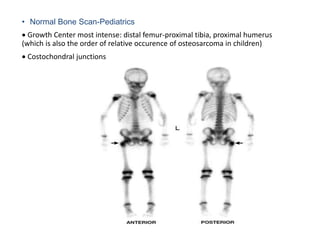
• Normal Bone Scan-Pediatrics
 Growth Center most intense: distal femur-proximal tibia, proximal humerus
(which is also the order of relative occurence of osteosarcoma in children)
 Costochondral junctions
METASTATIC BONE DISEASE
The presence of multiple, randomly distributed areas of increased
uptake of varying size, shape, and intensity is highly suggestive of
bone metastases.
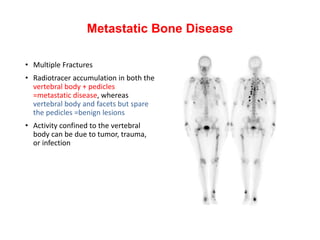
Metastatic Bone Disease
• Multiple Fractures
• Radiotracer accumulation in both the
vertebral body + pedicles
=metastatic disease, whereas
vertebral body and facets but spare
the pedicles =benign lesions
• Activity confined to the vertebral
body can be due to tumor, trauma,
or infection
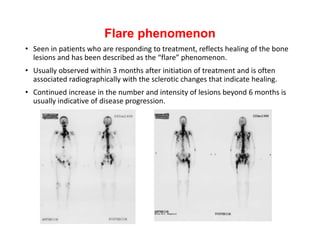
Flare phenomenon
• Seen in patients who are responding to treatment, reflects healing of the bone
lesions and has been described as the “flare” phenomenon.
• Usually observed within 3 months after initiation of treatment and is often
associated radiographically with the sclerotic changes that indicate healing.
• Continued increase in the number and intensity of lesions beyond 6 months is
usually indicative of disease progression.
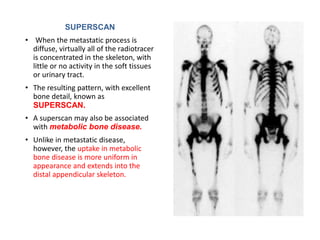
SUPERSCAN
• When the metastatic process is
diffuse, virtually all of the radiotracer
is concentrated in the skeleton, with
little or no activity in the soft tissues
or urinary tract.
• The resulting pattern, with excellent
bone detail, known as
SUPERSCAN.
• A superscan may also be associated
with metabolic bone disease.
• Unlike in metastatic disease,
however, the uptake in metabolic
bone disease is more uniform in
appearance and extends into the
distal appendicular skeleton.
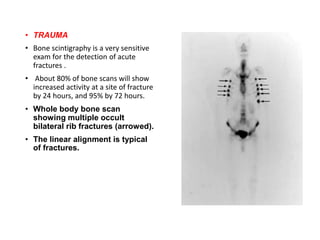
• TRAUMA
• Bone scintigraphy is a very sensitive
exam for the detection of acute
fractures .
• About 80% of bone scans will show
increased activity at a site of fracture
by 24 hours, and 95% by 72 hours.
• Whole body bone scan
showing multiple occult
bilateral rib fractures (arrowed).
• The linear alignment is typical
of fractures.
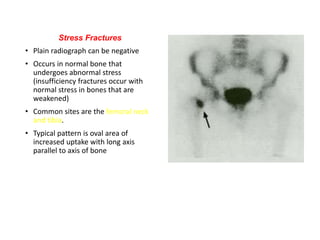
Stress Fractures
• Plain radiograph can be negative
• Occurs in normal bone that
undergoes abnormal stress
(insufficiency fractures occur with
normal stress in bones that are
weakened)
• Common sites are the femoral neck
and tibia.
• Typical pattern is oval area of
increased uptake with long axis
parallel to axis of bone
• 3 PHASE BONE SCAN
• 3 stages which follow IV injection of the tracer.
1) Flow phase
• 2 to 5-sec images are obtained for 60 seconds after injection
• Demonstrates perfusion and characterises the blood flow to a particular area
2) Blood pool phase
• The blood-pool image is obtained 5 min after injection
• Demonstrated the blood pool, not the blood flow
• Inflammation causes capillary dilatation and increased blood flow
• If the study is going to be a triphasic bone scan, a third phase is added.
3) Delayed phase
• The bone image is obtained 2 - 4 hours later
• Urinary excretion has decreased the amount of the radionuclide in soft tissue
DIFFERNTIATE OSTEOMYELITIS FROM CELLULITIS
OSTEOMYELITIS
• The classic appearance of osteomyelitis on three-phase bone scans consists of focal
hyperperfusion, focal hyperemia, and focally increased bone uptake
• Phase I + Phase II with negative Phase III Cellulitis
• All positive- OM.
SOME OTHER TRACERS
• GALLIUM-67
-Sensitive for detection of inflammatory process.
• - HOT in ABSCESS ( Vertebral OM)
• LYMPHOMA
• SARCOIDOSIS
INDIUM 111-
• Tagged with leucocytes.
• More sensitive than Ga67 scans.
• Used with Sulfur Colloid Scan – Delineate areas of normal bone activity
• IN 111 labelled Leucocyte- Highlight involved region.
• - SO INCONGURENCE OF BOTH IS HIGHLY SUGGESTIVE OF INFECTION
PAINFUL PROSTHESISLOSSENING OR INFECTION
• 3 PHASE BONE SCAN-
• Focally increased uptake- Loosening
• Diffuse , Uniformly distribution – Infection
• Not very specific
• Ga-67 SCAN-
• Differntiate between pure mechanical loosening and infection.
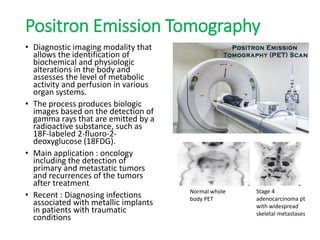
Positron Emission Tomography
• Diagnostic imaging modality that
allows the identification of
biochemical and physiologic
alterations in the body and
assesses the level of metabolic
activity and perfusion in various
organ systems.
• The process produces biologic
images based on the detection of
gamma rays that are emitted by a
radioactive substance, such as
18F-labeled 2-fluoro-2-
deoxyglucose (18FDG).
• Main application : oncology
including the detection of
primary and metastatic tumors
and recurrences of the tumors
after treatment
• Recent : Diagnosing infections
associated with metallic implants
in patients with traumatic
conditions
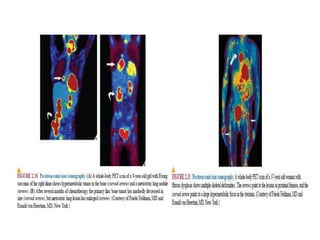
Normal whole
body PET
Stage 4
adenocarcinoma pt
with widespread
skeletal metastases
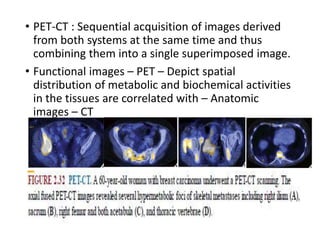
• PET-CT : Sequential acquisition of images derived
from both systems at the same time and thus
combining them into a single superimposed image.
• Functional images – PET – Depict spatial
distribution of metabolic and biochemical activities
in the tissues are correlated with – Anatomic
images – CT
PET-MRI
• Newest hybrid technology with capability of instantaneous fusion of
anatomic and functional data that allows an integrated scanning for
simultaneous PET and MRI.
• Limited clinical applications –
evaluation of the progress of treatment of some
inflammatory arthritides
Mapping of metastatic disease.
ULTRASOUND
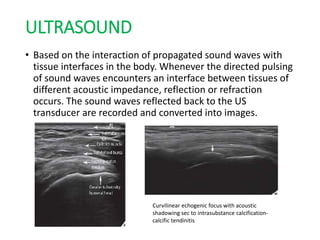
• Based on the interaction of propagated sound waves with
tissue interfaces in the body. Whenever the directed pulsing
of sound waves encounters an interface between tissues of
different acoustic impedance, reflection or refraction
occurs. The sound waves reflected back to the US
transducer are recorded and converted into images.
Curvilinear echogenic focus with acoustic
shadowing sec to intrasubstance calcification-
calcific tendinitis
ULTRASOUND IN ORTHOPAEDICS
CLINICAL APPLICATIONS-
1. Evaluation of rotator cuff
2. Injuries to various tendons(Tendoachilles)
3. Osgood-Schlatter disease
4. Soft tissue tumors occasionally
5. Imaging method of choice – evaluation of infant hip
6. 3D US for DDH( Newest development)
7. Recently used in rheumatic disorders
8. Differentiation of popliteal fossa masses(Aneurysm/Baker’s
cyst/Hypertrophied synovium)
Disdvantages :
Difficult to visualize deeper/bony structures
DOPLER ULTRASOUND is used in cases where there is
abnormal increase in blood flow as in the areas of inflamation &
aggressive tumours & other condition like DVT, Peripheral vascular
disease.
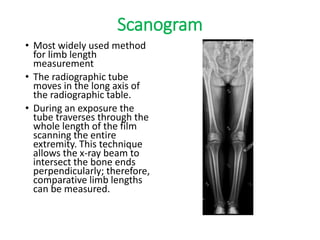
Scanogram
• Most widely used method
for limb length
measurement
• The radiographic tube
moves in the long axis of
the radiographic table.
• During an exposure the
tube traverses through the
whole length of the film
scanning the entire
extremity. This technique
allows the x-ray beam to
intersect the bone ends
perpendicularly; therefore,
comparative limb lengths
can be measured.
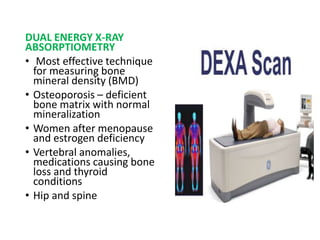
DUAL ENERGY X-RAY
ABSORPTIOMETRY
• Most effective technique
for measuring bone
mineral density (BMD)
• Osteoporosis – deficient
bone matrix with normal
mineralization
• Women after menopause
and estrogen deficiency
• Vertebral anomalies,
medications causing bone
loss and thyroid
conditions
• Hip and spine
• Photons produced from a low dose energy source
• 2 X-ray beams with 2 different energy peaks are
passed through the body, one peak gets absorbed
by the soft tissue and the other by the bone
• Generates a two dimensional image
• Soft tissue amount is subtracted from the total
area, giving the bone mineral density.
• These measurements are then compared with the
normal ranges matched for chronological age(T and
Z scores)
T score shows the amount of bone that is
compared with a young adult of the same gender
with peak bone mass. The T score is used to
estimate your risk of developing a fracture.
• A score above -1 is considered normal
• A score between -1 and -2.5 - Osteopenia(low bone
mass)
• A score below -2.5 is defined as osteoporosis.
Z score shows the amount of bone, compared with
other people in your age group and of the same
size and gender. Z score mainly diagnoses to the
risk of having a fracture.
T score shows the amount of bone that is
compared with a young adult of the same gender
with peak bone mass. The T score is used to
estimate your risk of developing a fracture.
• A score above -1 is considered normal
• A score between -1 and -2.5 - Osteopenia(low bone
mass)
• A score below -2.5 is defined as osteoporosis.
Z score shows the amount of bone, compared with
other people in your age group and of the same
size and gender. Z score mainly diagnoses to the
risk of having a fracture.
Advantages
• Quick and non invasive procedure
• No anaesthesia required
• Accurately measures the fracture risk
• Less radiation exposure
Arthrography
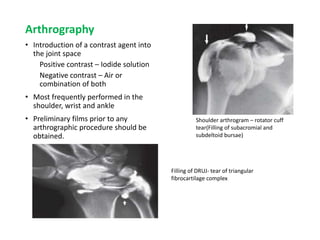
• Introduction of a contrast agent into
the joint space
Positive contrast – Iodide solution
Negative contrast – Air or
combination of both
• Most frequently performed in the
shoulder, wrist and ankle
• Preliminary films prior to any
arthrographic procedure should be
obtained.
Shoulder arthrogram – rotator cuff
tear(Filling of subacromial and
subdeltoid bursae)
Filling of DRUJ- tear of triangular
fibrocartilage complex
Tenography and
Bursography
• Contrast is injected into
tendon sheath to
evaluate intergrity –
Tenogram.
• Injection of contrast
into bursa – abandoned
• Occasionally used in
the subacromial-
subdeltoid bursae
complex to
demonstrate partial
tears of rotator cuff
Angiography
• Contrast material
injected directly into
selective branches of
the arterial and venous
circulation.
• Tumor evaluation – to
map out bone lesion,
demonstrate vascularity
of lesion , to assess
extent of disease.
• Helpful in planning for
limb salvage
procedures
Tranverse fracture of distal
femur resulted in
transsection of the
superficial femoral artery
Myelography
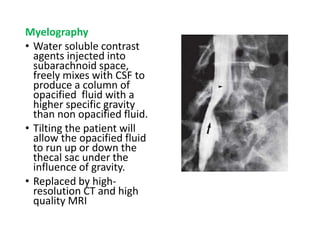
• Water soluble contrast
agents injected into
subarachnoid space,
freely mixes with CSF to
produce a column of
opacified fluid with a
higher specific gravity
than non opacified fluid.
• Tilting the patient will
allow the opacified fluid
to run up or down the
thecal sac under the
influence of gravity.
• Replaced by high-
resolution CT and high
quality MRI
Radiology in orthopaedics

Radiology in orthopaedics

  • 1.
    ROLE OF RADIOLOGYIN ORTHOPAEDICS PRESENTER:PUTHOTA ROOPA SAI MODERATOR: Dr. VAMSI KRISHNA SIR CHAIRPERSON: Dr. A.SRINIVASA RAO SIR DEPARTMENT OF ORTHOPAEDICS
  • 2.
    Imaging Techniques inOrthopaedics • Conventional Radiography • Flouroscopy • Digital radiography • Computed tomography • Magnetic resonance imaging • Scintigraphy • PET scan • Ultrasound • Scanogram • DEXA • Arthrography,Tenography,Bursography • Angiography • Myelography
  • 3.
    CONVENTIONAL RADIOGRAPHY • Thefirst x-ray was invented by Wilhelm Conrad Roentgen on 22 Dec 1895 when he produced the first human x-ray of his wife Bertha’s hand.
  • 4.
    CONVENTIONAL RADIOGRAPHY: • Themost frequently used modality for evaluation of bone and joint disorder. • Plain film radiography remains as the 1st order diagnostic imaging modality. • X-rays are a form of electromagnetic radiation similar to visible light but of shorter wavelength. • Xray tube generates x-rays and beams them toward the patient. Some of the energy is absorbed; rest passes through patient and hits the film plate. • Shades of gray on film are a representation of the different densities of the anatomic tissues through which the xrays have passed
  • 5.
    • Tissues withgreater density will absorb more of the xray so less of the beam reaches the film plate. The resultant image is therefore lighter. Tissues with less density will allow more x ray to reach the film so it will be darker. This is called radiodensity and is determined by: thickness and composition of structure. • Air: black eg: trachea, lungs, stomach, digestive tract. • Fat: gray black eg: subcutaneously along muscle sheaths ; around viscera. • Water: gray eg: muscles, nerves, tendons, ligaments, vessels (all of these structures have the same density and therefore are hard to distinguish on plain x rays.) • Bone: gray/white. (Calcium with higher atomic number absorbs higher proportions of x-rays resulting in less crystal formation in the film – Radioopaque appearance of bone • Contrast medium: white outline. • Heavy metals: white solid.
  • 7.
    ABC’S Approach • A ◦Adequacy, Alignment • B ◦ Bones • C ◦ Cartilage • S ◦ Soft Tissues • ABCs approach applies to every x-ray image
  • 8.
    • ADEQUACY Adequate views: •At least 2 views of the bone involved at 90-degree angles to each other with each view including two adjacent joints should be obtained. • 3 views even better (oblique view) • In children it is necessary to obtain radiographs of normal unaffected limb for comparison. • Normally anteroposterior and lateral views are taken, occasionally oblique and special views are necessary Sufficient exposure!- visibility, image resolution, technical adequacy.
  • 9.
    Fracture of theradial head. A patient presented with elbow pain after a fall. Anteroposterior (A) and lateral (B) radiographs are normal; however, the radial head and coronoid processes are not well demonstrated because of a bony overlap. A special 45- degree angle view of the elbow (C) is used to project the radial head ventrad, free of the overlap of other bones. A short, intraarticular fracture of the radial head is now clearly visible (arrow).
  • 10.
    • ALINGMENT • Assessthe size of the bones. • Assess the number of bones. • Assess each bone for normal shape and contour; irregularities can be from trauma, congenital, developmental or pathological. • Assess joint position: trauma, inflammatory or degenerative disease. Anomalies of bone formation. sacral agenesis (A), bilateral agenesis of the fibulae (B), supernumerary bones, polydactyly in both hands (C), Polydactyly in the right foot (D).
  • 12.
    • BONES BONE DENSITY Assessgeneral bone density • contrast between soft tissues and bone • contrast between cortical margin and the cancellous bone and medullary cavity loss of contrast means loss of bone density ie: osteoporosis labeled as osteopenia, demineralization or rarefaction.
  • 13.
    Assess local bonedensity: • looking for sclerosis: sign of repair in the bone, Excessive sclerosis is indicative of DJD • Bone Lesions: Osteolytic- bone destroying so appear radiolucent as in RA or Gout Osteoblastic- bone forming; osteoblastomas, osteoid osteomas
  • 14.
    Osteoblastic matrix. Thematrix of a typical osteoblastic lesion, in this case an osteosarcoma, is characterized by the presence of fluffy, cotton-like densities within the medullary cavity of the distal femur. Chondroid matrix. (A) Schematic representation of various appearances of chondroid matrix calcifications: stippled, flocculent, and rings and arcs. (B) The matrix of enchondroma C) The matrix of chondrosarcoma.
  • 15.
    Pattern of bonedestruction. (B) The geographic type of bone destruction, characterized by a uniformly affected area within sharply defined borders, typifies slow-growing benign lesions, in this case a chondromyxoid fibroma. (C) Moth-eaten bone destruction is characteristic of rapidly growing infiltrating lesions, in this case myeloma. (D) The permeative type of bone destruction is characteristic of round cell tumors, in this case Ewing sarcoma.
  • 16.
    Assess texture abnormalities:looking at trabeculae appearance
  • 18.
    • CARTILAGE • Cartilageis not visible on x- ray; Evaluate joint spaces. • Abnormally wide joint spaces may speak for ligament injury or impression fracture. • Narrow joint spaces mean thin cartilage due to degeneration- osteoarthrosis. • SOFT TISSUE • Evaluate soft tissue swelling. • May speak for an occult fracture.
  • 19.
    • A ◦ evaluateadequacy: adequate views and image quality. evaluate alignment- long axes of bones. • B ◦ Examine bones (whole)- look for cracks and deformities. • C ◦ Examine cartilage- joint space- width, asymmetry. • S ◦ Evaluate soft tissues: swelling, joint effusion (relate image to clinical exam)
  • 20.
    • The centerof the xray beam is always perpendicular to the film plate. The position of the body will determine the outline of the image. • Consists of the angles of projection that best demonstrate the anatomy while utilizing the least amount of exposures. Common Views: • Anteroposterior (AP) • Lateral (R and L) • Oblique (R and L)
  • 21.
  • 22.
  • 23.
  • 25.
    SHOULDER AP VIEW Anteroposterior view.A) The patient may be either supine, as shown here, or erect; the arm of the affected side is fully extended in the neutral position. The central beam is directed toward the humeral head. (B) The humeral head is seen overlapping the glenoid fossa. The glenohumeral joint is not well demonstrated.
  • 26.
    SHOULDE R AP VIEW-Arm inneutral position demonstrates Fracture of Humeral head and neck Clavicle Scapula Anterior dislocation Bankart lesion
  • 27.
    SHOULDER AP VIEW Armin external rotation demonstrates Compression fracture of humeral head (trough line impaction) secondary to posterior dislocation
  • 28.
    SHOULDER AP VIEW ON INTERNAL ROTATION- Theproximal humerus in true lateral position , Site of insertion of subscapular tendon. Demonstrates Hill-sachs lesion
  • 29.
    SHOULDER GRASHEY VIEW Demonstrates • Glenohumeraljoint space • Glenoid in profile • Posterior dislocation Grashey view. (A) The patient may be either erect, as shown here, or supine. He or she is rotated approximately 40 degrees toward the side of the suspected injury, and the central beam is directed toward the glenohumeral joint. (B)glenoid in true profile.
  • 30.
    SHOULDER AP AXIAL PROJECTION- Usefulin diagnosing post. Dislocation.
  • 31.
    SHOULDER Demonstrates 1. Relationship ofhumeral head and glenoid fossa 2. Os acromiale 3. Anterior and posterior dislocations 4. Compression fractures secondary to anterior and posterior dislocations 5. Fractures of Proximal humerus scapula Axillary view. (A) the patient is seated at the side of the radiographic table, with the arm abducted so that the axilla is positioned over the film cassette. The radiographic tube is angled approximately 5 to 10 degrees toward the elbow, and the central beam is directed through the shoulder joint.
  • 32.
    SHOULDER AP OBLIQUE PROJECTION( APPLE METHOD)- Demonstrate the loss of articular cartilage.
  • 33.
    SHOULDER INFERO-SUPERIOR AXIAL PROJECTION- Whenchronic instability of shoulder is suspected. Bony abnormality of the ant. Inf. Glenoid rim. Hill- Sach defect of post-lat humeral head.
  • 34.
    SHOULDER • A Variationof lateral axillary view Demonstrates Bankart fracture of inferior glenoid rim West Point view. (A) the patient lies prone on the radiographic table, with a pillow placed under the affected shoulder to raise it approximately 8 cm. The film cassette is positioned against the superior aspect of the shoulder. The radiographic tube is angled toward the axilla at 25 degrees to the patient's midline and 25 degrees to the table's surface.
  • 35.
    SHOULDER Lateral Transthoracic demonstrates •Relationship of humeral head and glenoid fossa • Fractures of proximal humerus Transthoracic lateral view. (A) The patient is erect with the injured arm against the radiographic table. The opposite arm is abducted so that the forearm rests on the head. The central beam is directed below the axilla, slightly above the level of the nipple. (B) Demonstrates the true lateral view of the proximal humerus.
  • 36.
    SHOULDER • BICIPITAL GROOVEVIEW Bicipital groove view. (A) The patient is standing and leaning forward, with the forearm resting on the table and the hand in supination. The film cassette rests on the patient’s forearm. The central beam is directed vertically toward the bicipital groove, which has been marked on the skin. (B) The bicipital groove is clearly demonstrated.
  • 37.
    SHOULDER Acromioclavicular view. (A)The patient is erect, with the arm of the affected side in the neutral position. The central beam is directed 15 degrees cephalad toward the clavicle. Demonstrates Acromioclavicular joint Acromioclavicular separation Fracture of clavicle
  • 38.
    SHOULDER Transscapular (or Y)projection the patient is erect, with the injured side against the radiographic table. The patient's trunk is rotated approximately 20 degrees from the table to allow for separation of the two shoulders (inset). The arm on the injured side is slightly abducted and the elbow flexed, with the hand resting on the ipsilateral hip. The central beam is directed toward the medial border of the protruding scapula. Transscapular (Y) view demonstrates Relationship of humeral head and glenoid fossa Fractures of Proximal humerus Body of scapula Coracoid process Acromion
  • 39.
    SHOULDER AP AXIAL PROJECTION( STRYKER NOTCH METHOD)- Defects on the post-lat head of the humerus.
  • 40.
    SHOULDER TANGENTIAL PROJECTION –SUPRASPINATUS OUTLET VIEW Demonstrate coraco-acromial arch or outlet to diagnose shoulder impingement.
  • 41.
    ACROMIO-CLAVICULAR JOINT AP AXIALPROJECTION ( ALEXANDER METHOD)- Useful in suspected AC subluxation or dislocation.
  • 42.
    SCAPULA AP AXIAL PROJECTION– To visualize coracoid process clearly.
  • 43.
    CLAVIC LE AP AXIAL PROJECTION( LORDOTIC POSITION)-
  • 44.
  • 45.
  • 46.
    ELBOW Anteroposterior view. (A)The forearm is positioned supine (palm up) on the radiographic table, with the elbow joint fully extended and the fingers slightly flexed.The central beam is directed perpendicularly toward the elbow joint. Demonstrates Supracondylar, transcondylar, and intercondylar fractures of the distal humerus Fractures of Medial and lateral epicondyles Lateral aspect of capitellum Medial aspect of trochlea Lateral aspect of radial head Valgus and varus deformities Secondary ossification centers of distal humerus
  • 47.
    ELBOW Lateral view. (A)The forearm rests on its ulnar side on the radiographic cassette, with the joint flexed 90 degrees, the thumb pointing upward, and the fingers slightly flexed. The central beam is directed vertically toward the radial head. Demonstrates Supracondylar fracture of the distal humerus Fractures of Anterior aspect of radial head Olecranon process Complex dislocations in elbow joint Dislocation of radial head Fat-pad sign
  • 48.
    ELBOW Radial head-capitellum view. (A)the patient is seated at the side of the radiographic table, with the forearm resting on its ulnar side, the elbow joint flexed 90 degrees and the thumb pointing upward. The central beam is directed toward the radial head at a 45-degree angle to the forearm. Demonstrates Fractures of Radial head Capitellum Coronoid process Abnormalities of humeroradial and humeroulnar articulations
  • 49.
    ELBOW AP OBLIQUE PROJECTION( ON MEDIAL ROTATION)- Coronoid process free of superimposition
  • 50.
    ELBOW AP OBLIQUE PROJECTION( ON LATERAL ROTATION) Radial head & neck free of superimposition.
  • 51.
    ELBOW AP PROJECTION (ACUTE FLEXION)- Demonstrate olecranon process clearly
  • 52.
  • 53.
    WRIST PA OBLIQUE PROJECTION- Givesdistinct radiograph of trapezium & scaphoid.
  • 54.
    WRIST AP OBLIQUE PROJECTION- Separatesthe pisiform from adjacent carpal bones.
  • 55.
    WRIST PA PROJECTION (ONRADIAL & ULNAR DEVIATION)- Opens the interspaces between the carpals.
  • 56.
    WRIS T PAAXIAL PROJECTION FORSCAPHOID ( STECHER METHOD)-
  • 57.
  • 58.
    Neutral ulnar variance.(A) As a rule, the radial styloid process rises 9 to 12 mm above the articular surface of the distal ulna. This distance is also known as the radial length. (B) At the site of articulation with the lunate, the articular surfaces of the radius and the ulna are on the same level. Negative and positive ulnar variance. (A) Negative ulnar variance. The articular surface of the ulna projects 5 mm proximal to the site of radiolunate articulation. (B) Positive ulnar variance. The articular surface of the ulna projects 8 mm distal to the site of radiolunate articulation.
  • 59.
    Ulnar slant. Theulnar slant of the articular surface of the radius is determined, with the wrist in the neutral position, by the angle formed by two lines: one perpendicular to the long axis of the radius at the level of the radioulnar articular surface (a) and a tangent connecting the radial styloid process and the ulnar aspect of the radius (b). Palmar inclination. The palmar inclination of the radial articular surface is determined by measuring the angle formed by a line perpendicular to the long axis of the radius at the level of the styloid process (a) and a tangent connecting the dorsal and volar aspects of the radial articular surface (b).
  • 60.
  • 61.
    HAND AP OBLIQUE PROJECTION( BALL – CATCHER POSITION)- Significant in making the diagnosis of RA.
  • 62.
    PELVIS AND HIP Anteroposteriorview. (A) The patient is supine with the feet in slight (15 degrees) internal rotation (inset), which compensates for the normal anteversion of the femoral neck , elongating its image. For a view of the entire pelvis, the central beam is directed vertically toward the midportion of the pelvis; for selective examination of either hip joint, it is directed toward the affected femoral head.
  • 63.
    • (b) ilioischialline, formed by the posterior portion of the quadrilateral plate (surface) of the iliac bone; • (c) teardrop, formed by the medial acetabular wall, the acetabular notch, and the anterior portion of the quadrilateral plate; • (d) roof of the acetabulum; • (e) anterior rim of the acetabulum; and • (f) posterior rim of the acetabulum. Distortion of any of these normal radiographic landmarks indicates the possible presence of abnormality. Radiographic landmarks of the hip. (A,B) On the anteroposterior radiograph of the hip, six lines relating to the acetabulum and its surrounding structures can be distinguished: (a) iliopubic or iliopectineal (arcuate) line;
  • 64.
    PELVIS AND HIP Fergusonview. (A) the patient is in the same position as for the standard anteroposterior projection. The radiographic tube, however, is angled approximately 30 to 35 degrees cephalad, and the central beam is directed toward the midportion of the pelvis. Fractures of Sacrum Pubis ramus Ischium Injury to sacroiliac joints
  • 65.
    PELVIS AND HIP Anterioroblique view. (A) The patient is supine and anteriorly rotated, with the affected hip elevated 45 degrees (inset). The central beam is directed vertically toward the affected hip. (B) the iliopubic (anterior) column (arrows) and the posterior lip (rim) of the acetabulum (open arrow) are well delineated.
  • 66.
    PELVIS AND HIP Posterioroblique view. (A) The patient is supine and anteriorly rotated, with the unaffected hip elevated 45 degrees (inset). The central beam is directed vertically through the affected hip. (B) The ilioischial (posterior) column (arrows), the posterior acetabular lip (open arrow), and the anterior acetabular rim (curved arrow) are well demonstrated .
  • 67.
    PELVIS AND HIP Frog-lateralview. (A) Patient is supine with the knees flexed, the soles of the feet together, and the thighs maximally abducted. For simultaneous imaging of both hips, the central beam is directed vertically or with 10 to 15 degrees cephalad angulation to a point slightly above the pubic symphysis (inset); for selective examination of one hip, it is directed toward the affected hip joint. (B) Demonstrates the lateral aspect of the femoral head and both trochanters.
  • 68.
    PELVIS AND HIP Groin-lateralview. (A) The patient is supine with the affected extremity extended and the opposite leg elevated and abducted. The cassette is placed against the affected hip on the lateral aspect, and the central beam is directed horizontally toward the groin with approximately 20 degrees cephalad angulation. (B)provides true lateral image of the femoral head, thereby allowing evaluation of its anterior and posterior aspects. It also demonstrates the anteversion of the femoral neck, which normally ranges from 25 to 30 degrees.
  • 69.
    PELVIS & HIP AP& PA OBLIQUE PROJECTION- Resulting image shows entire ilium
  • 70.
    KNEE Anteroposterior view. (A)The patient is supine, with the knee fully extended and the leg in the neutral position. The central beam is directed vertically to the knee with a 5- to 7-degree cephalad angulation. (B) Demonstrates the medial and lateral femoral and tibial condyles, the tibial plateaus and spines, and both the medial and lateral joint compartments. The patella is seen en face as an oval structure between the femoral condyles.
  • 71.
    KNEE Lateral view. (A)The patient is lying flat on the same side as the affected knee, which is flexed approximately 25 to 30 degrees. The central beam is directed vertically toward the medial aspect of the knee joint with an approximately 5- to 7- degree cephalad angulation. (B) demonstrates the patella in profile, as well as the femoropatellar joint compartment and a faint outline of the quadriceps tendon.
  • 72.
    KNEE Tunnel view. (A)Thepatient is prone with the knee flexed approximately 40 degrees, with the foot supported by a cylindrical sponge. The central beam is directed caudally toward the knee joint at a 40-degree angle from the vertical. (B) Demonstrates the posterior aspect of the femoral condyles, the intercondylar notch, and the intercondylar eminence of the tibia.
  • 73.
    KNEE Sunrise view. (A)The patient is prone, with the knee flexed 115 degrees. The central beam is directed toward the patella with approximately 15-degree cephalad angulation. (B) Demonstrates a tangential (axial) view of the patella. Merchant view. (A) The patient is supine on the table, with the knee flexed approximately 45 degrees at the table’s edge. A device keeping the knee at this angle also holds the film cassette. The central beam is directed caudally through the patella at a 60-degree angle from the vertical. (B) the articular facets of the patella and femur are well demonstrated.
  • 74.
  • 75.
    ANKLE Anteroposterior view. (A)The patient is supine on the radiographic table with the heel resting on the film cassette. The foot is in neutral position, with the sole perpendicular to the leg and the cassette. The central beam (red broken line) is directed vertically to the ankle joint at the midpoint between both malleoli. (B) Demonstrates the distal tibia, particularly the medial malleolus, the body of the talus, and the tibiotalar joint. The mortise view, a variant of the anteroposterior projection obtained with 10- degree internal rotation of the ankle, eliminates the overlap of the medial aspect of the distal fibula and the lateral aspect of the talus, so the space between these bones is well demonstrated
  • 76.
    ANKLE Lateral view. (A)The patient is placed on his or her side with the fibula resting on the film cassette and the foot in the neutral position. The central beam is directed vertically to the medial malleolus. The distal tibia, talus, and calcaneus are seen in profile.The tibiotalar and subtalar joints are well demonstrated.
  • 77.
    ANKLE Internal oblique view.(A) The patient is supine, and the leg and foot are rotated medially approximately 35 degrees (inset). The foot is in the neutral position, forming a 90-degree angle with the distal leg. The central beam is directed perpendicular to the lateral malleolus. (B) The medial and lateral malleoli, the tibial plafond, the dome of the talus, the tibiotalar joint, and the tibiofibular syndesmosis are well demonstrated.
  • 78.
    FOOT Anteroposterior view. (A)The patient is supine, with the knee flexed and the sole placed firmly on the film cassette. The central beam is directed vertically to the base of the first metatarsal bone. (B) injury to the metatarsal bones and phalanges can be adequately assessed. (C) The first intermetatarsal angle is formed by the intersection of the lines bisecting the shafts of the first (a) and second (b) metatarsals.
  • 79.
    FOOT Lateral view. A)The patient lies on his or her side with the knee slightly flexed and the lateral aspect of the foot against the film cassette. The central beam is directed vertically to the midtarsus. (B) demonstrates the posterior tuberosity where the Achilles tendon inserts; the medial tuberosity on the plantar surface where the plantar fascia inserts; the anterior tuberosity; the anterosuperior spine of the calcaneus; the posterior facet of the subtalar joint; the sustentaculum tali; and the talonavicular and calcaneocuboid articulations. The Chopart and Lisfranc joints are also well visualized.
  • 80.
    Boehler angle. This featureis determined by the intersection of a line (a) drawn from the posterosuperior margin of the calcaneal tuberosity (bursal projection) through the tip of the posterior facet of the subtalar joint, and a second line (b) drawn from the tip of the posterior facet through the superior margin of the anterior process of the calcaneus. Normally, 20-40 degrees. Calcaneal pitch is described by the intersection of a line drawn tangentially to the inferior surface of the calcaneus and one drawn along the plantar surface of The angle of Gissane. The angle is formed by intersection of the lines drawn along the downward and upward slopes of the calcaneal dorsal surfaces, with normal values between 125 and 140 degrees.
  • 81.
    FOOT Oblique view. (A)The patient is supine on the table with the knee flexed. The lateral border of the foot is elevated about 40 to 45 degrees (inset) so that the medial border of the foot is forced against the film cassette. The central beam is directed vertically to the base of the third metatarsal. (B) the phalanges and metatarsals are well demonstrated, as are the anterior part of the subtalar joint and the talonavicular, naviculocuneiform, and calcaneocuboid joints.
  • 82.
    FOOT Harris-Beath view. (A)The patient is erect, with the sole of the foot flat on the film cassette. The central beam is usually angled 45 degrees toward the midline of the heel, but 35 or 55 degrees of angulation may also be used. (B) the middle facet of the subtalar joint is seen, oriented horizontally; the sustentaculum tali projects medially. The posterior facet projects laterally and is parallel to the middle facet. The body of the calcaneus is well demonstrated.
  • 83.
  • 84.
  • 85.
  • 86.
  • 87.
    CHE ST AP & PAOBLIQUE PROJECTION-
  • 88.
  • 89.
  • 90.
  • 91.
    CERVICAL VERTEBRA AP AXIALOBLIQUE PROJECTION- The image shows the intervertebral foramina & pedicles.
  • 92.
    Pillar view forlateral masses of vertebrae Swimmer's view for c7 vertebrae
  • 93.
    Anteroposterior view ofthe thoracic spine Anteroposterior view of the lumbar spine
  • 94.
    Lateral view ofthe lumbar spine Oblique view of the lumbar spine
  • 95.
    LUMBO-SACRAL VERTEBRA AP &PAAXIAL PROJECTION- ( FERGUSON METHOD)- L-S joint & S-I joint free of superimposition.
  • 96.
    Stress Views • Stressviews are important in evaluating ligamentous tears and joint stability. • In the hand, abduction-stress film of the thumb may be obtained when a gamekeeper's thumb, resulting from a disruption of the ulnar collateral ligament of the first metacarpophalangeal joint, is suspected • In the lower extremity, stress views of the knee and ankle joints are occasionally obtained. • The evaluation of knee instability caused by ligament injuries may require the use of this technique in cases of a suspected tear of the medial collateral ligament and, less frequently, in evaluating an insufficiency of the anterior and posterior cruciate ligaments. • The evaluation of ankle ligaments also may require stress radiography. Inversion (adduction) and anterior- draw stress films are the most frequently obtained stress views . Gamekeeper's thumbThe stress radiograph (B) demonstrates subluxation of the joint by an increase to more than 30 degrees in the angle between the first metacarpal and the proximal phalanx of the thumb, confirming gamekeeper's thumb.
  • 97.
    Anterior-drawer stress. Fora stress film of the knee evaluating the ACL, the patient is placed in the device on his or her side, with the knee flexed 90 degrees. The pressure plate is applied against the anterior aspect of the knee. (The arrows show the direction of the applied stresses.) Radiographs are then obtained in the lateral projection. Valgus stress. For a stress film of the knee evaluating the medial collateral ligament, the patient is supine, with the knee flexed approximately 15 to 20 degrees. The leg is placed in the device, and the pressure plate is applied against the lateral aspect of the knee. (The arrows show the direction of the applied stresses.) Radiographs are then obtained in the anteroposterior projection.
  • 98.
    Flouroscopy • Fluoroscopy isa fundamental diagnostic tool for many radiologic procedures,including arthrography, tenography, bursography, arteriography, and percutaneous bone or soft-tissue biopsy. • Fluoroscopy combined with videotaping is useful in evaluating the kinematics of joints. • Used in conjunction with • Myelography - to observe the movement of the contrast column in the subarachnoid space • Arthrography - to check the proper placement of the needle and to monitor the flow of the contrast agent • Intraoperatively - to assess the reduction of a fracture or placement of hardware
  • 99.
    • Digital Radiography •Is the name given to the process of digital image acquisition using an x-ray detector comprising a photostimulable phosphor imaging plate and an image reader-writer that processes the latent image information for subsequent brightness scaling and laser printing on film. • The system works on the principle of photostimulated luminescence. • When the screen absorbs x-rays, the xray energy is converted to light energy by the process of fluorescence, with the intensity of light being proportional to the energy absorbed by the phosphor. • The stimulated light is used to create a digital image (a computed radiograph). Advantage of CR over conventional film/screen radiography is that • The digital image data are readily manipulated to produce alternative renderings. • Two images, acquired either sequentially or simultaneously with different filtration, are used to reconstruct a soft-tissue-only image or a bone-only image.)
  • 100.
    • In digitalsubtraction radiography, a video processor and a digital disk are added to a fluoroscopy imaging complex to provide online viewing of subtraction images. • This technique is most widely used in the evaluation of the vascular system, but it may also be used in conjunction with arthrography to evaluate various joints. • The use of high-performance video cameras with low-noise characteristics allows single video frames of precontrast and postcontrast images to be used for subtraction. • The subtraction technique removes surrounding anatomic structures and thus isolates the opacified vessel or joint, making it more conspicuous. Digital subtraction arthrography. Digital subtraction arthrogram demonstrates tears of the lunotriquetral ligament and the triangular fibrocartilage complex. (A) This image was obtained by subtracting the digitally acquired preinjection image (B) from postinjection film.
  • 101.
    • Digital subtractionangiography (DSA), the most frequently used variant of DR, can be used in the evaluation of trauma, bone and soft-tissue tumors, and in general evaluation of the vascular system. • In trauma to the extremity, DSA is effectively used to evaluate 1. Arterial occlusion 2. Pseudoaneurysms 3. Arteriovenous fistulas 4. Transection of the arteries • Bone subtraction is useful in clearly delineating the vascular structures. • In the evaluation of bone and soft-tissue tumors, DSA is an effective tool for mapping tumor vascularity. • Low Osmolar non ionic iodine based contrast media( Iohexol, Iopromide, Iodixanol) are used. In patients with renal failure or allergic to iodine based media, gadolinum is used. Digital subtraction angiography. Digital radiograph (A) and digital subtraction angiogram (B) of a 23- year-old man who sustained fractures of the proximal tibia and fibula show disruption of the distal segment of the popliteal artery.
  • 102.
    Computed Tomography(CT) • Essentialcomponents of CT system include • Circular scanning gantry which houses x-ray tube and image sensors • Table for the patient • An x-ray generator • Computerized data processing unit • The x-ray tube is rotated 360 degrees around the patient while the computer collects the data and formulates an axial image, or “slice.” Each cross- sectional slice represents a thickness between 0.1 and 1.5 cm of body tissue.
  • 103.
    • The tissuesabsorb the x-ray beam to various degrees depending on the atomic number and density of the specific tissue. • The remaining, unabsorbed (unattenuated) beam passes through the tissues and is detected and processed by the computer. • The CT computer software converts the x-ray beam attenuations of the tissue into a CT number (Hounsfield units) by comparing it with the attenuation of water. • Tissue • H
  • 104.
    Spiral ( Helical) CT – • Data gathering system using a continuous rotation of the x-ray source and the detectors. It allows the rapid acquisition of volumes of CT data and renders the ability to reformat the images at any predetermined intervals ranging from 0.5 to 10.0 mm. • Acquires all data in 24 or 32 seconds, generating up to 92 sections compared to standard CT where 12 scans can be done over 1 minute. • This technology has markedly reduced scan times and has eliminated interscan delay and hence interscan motion. It also has decreased the motion artifacts, improved the definition of scanned structures, and markedly facilitated the ability to obtain three- dimensional (3D) reconstructions.
  • 105.
    MDCT • Multichannel multidetectorrow CT • Images can be generated with subsecond gantry rotation times yielding high resolution volume data sets, and at the same time minimizing the radiation dose to the patient. fpVCT • High-resolution flat-panel volume CT • Uses digital flat-panel detectors and provides volumetric coverage as well as ultra-high spatial resolution in two-dimensional (2D) and 3D projections. • Furthermore, it reduces metal and beam-hardening artifacts. 3D CT-angiography • Used to determine the presence or absence of injury to the vessels near the fractured bones
  • 106.
    CT scan ofspine Bone structure Facet arthritis Disc prolapse Trauma spondylitis Tumor Spinal stenosis(central) Spinal stenosis (lateral)
  • 108.
  • 109.
  • 110.
    Ct scan ofpelvis
  • 111.
    CT SCAN OFPELVIS AND HIP • Position of fragments and extension of fracture line in complex fractures, particularly of pelvis, acetabulum, and sacrum • Weight-bearing parts of joints • Sacroiliac joints • Intraarticular fragments • Soft-tissue injuries • Concomitant injury to ureters, urinary bladder, and urethra Acetabular fracture Sacral fracture
  • 112.
    CT SCAN KNEE Injuriesto: Articular cartilage Cruciate ligaments Menisci Osteochondral bodies in joint Osteochondritis dissecans
  • 113.
    • CT SCANOF ANKLEnd fracture • Trimalleolar fracture • Talus fracture • Calcaneus fracture • Bony lesion around ankle
  • 114.
    • CT SCANOF SHOULDERArthrography • Fracture of proximal humerus Labral lesion • Scapular fracture Imaging joint capsule • Glenoid fracture Rotator cuff pathology • Bony bankart lesion Biceps tendon pathology • Hill –Sachs lesion • Arthritis of GH joint • Arthritis of AC joint • Calcific tendinitis Communited glenoid fracture
  • 115.
    CT SCAN OFELBOW • Complex fractures about the elbow joint, particularly to assess the position of fragments in comminution • Healing process: • Nonunion • Secondary infection Arthrography (single or doublecontrast) • Subtle abnormalities of articular cartilage • Capsular ruptures • Synovial abnormalities • Chondral and osteochondral fractures • Osteochondritis dissecans • Osteochondral bodies in joint
  • 116.
    • CT SCANOF HANDpal. • -diagnosis of initial degenerative changes. • -visualization of bone tumors. • -demonstration of distal radio-ulnar instability. • -demonstration of intra-articular loose bodies • -demonstration of pathological rotation in pronation supination • Post-operative follow up in scaphoid pseudoarthrosis
  • 119.
    DECT • Dual-energy CT •Equipped with two x-ray tubes with different peak kilovoltages (80 and 140 kVp), thus allowing simultaneous acquisition of two sets of images of the desired anatomic region. • The material-specific differences in attenuation of various elements enable classification of the chemical composition of scanned tissue, allowing accurate and specific characterization and separation of monosodium urate from calcium containing mineralizations. • DECT data yields color-coded cross-sectional images, clearly depicting the foci of accumulation of urate crystals.
  • 120.
    QCT : • QuantitativeCT • Method for measuring the lumbar spine mineral content. • Measurements are performed on a CT scanner using a mineral standard for simultaneous calibration and computed radiograph for localization. CT guided biopsy : CT is a very important modality for successful aspiration or biopsy of bone or soft tissue lesions – provides visible guidance for precise placement of instrument within the lesion.
  • 121.
    • Advantages : 1.Direct transaxial images can be obtained 2. Bone can be imaged in multiple planes- coronal,sagittal and oblique using reformation technique 3. Helps in evaluating complex fractures of pelvis,hip and knee. 4. 3D reconstruction possible which helps in analyzing regions with complex anatomy like wrist,foot,ankle,pelvis.
  • 122.
    3D CT demonstrating subcapitalfemoral neck fracture with angulation Fracture surgical neck of humerus and displaced fracture of greater tubercle 3D CT reformation of thoracic spine shows sagittal cleft with anterior defect of T11
  • 123.
    DISADVANTAGES : • Lackof homogeneity in the composition of small volume of tissue. • Poor tissue characterization. Despite the ability of CT to discriminate among some differences in density, a simple analysis of attenuation values does not permit precise histologic characterization. • Motion artifacts degrade the image quality • An area that contains metal (e.g., prosthesis or various rods and screws) will produce significant artifacts. • Finally, the radiation dose may occasionally be high, particularly when contiguous and overlapping sections are obtained during examination. • Children – More sensitive to radiation and prone to develop radiation induced neoplasm. Lens and thyroid are at risk. • Inferior to MRI in imaging of bone marrow and soft tissue details like marrow injury/ trabecular injury/ bone contusion.
  • 124.
    SPECT : Single PhotonEmission CT In comparison with planar images, SPECT provides increased contrast resolution , which eliminates noise from the tissue outside the plane of imaging. Benefit : Improvement of lesion detection and anatomic localization • Helps in localization to different parts of the vertebra like body,pedicle,articular process,lamina,pars interarticularis,spinous process etc • Helps in detection of meniscal tears in knee
  • 125.
    MRI • MRI isa noninvasive procedure and allows to visualise the structures. Felix bloch and EM purcell discovered the physical phenomenon of MRI in 1946. Medical application – odebald and lindstorm in 1955 • Paul C Lauterbur and Peter Mansfield were awarded nobel prize in 2003 for introducing three dimensional MRI. The system includes
  • 126.
  • 127.
    • T1 andT2 weighed images • The T1 relaxation time ( longitudinal relaxation time) • - used to describe the return of protons back to equilibrium after application and removal of the rf pulse. • -- Provide good anatomic detail • T2 relaxation time (transverse relaxation time) • - used to describe the associated loss of coherence or phase between individual protons immediately after the application of the rf pulse. • - used for evaluation of pathologic processes. • T1 weighted images are : Sharp Well defined ,Anatomic imaging Fat-bright; fluid-dark T2 weighted imaging is traditionally known as “PATHOLOGICAL IMAGING” They are sensitive for detecting edema. On traditional spin echo T2 imaging fat-dark; fluid-bright
  • 129.
    • USES OFMRI IN ORTHOPAEDICS • MRI SPINE: Axial/Saggital/Coronal • INTER VERTEBRAL DISC: Bulge, protrusion, extrusion,sequestration
  • 130.
    • SPINAL TUMORS: •Excellent delineation of vertebral body marrow allows detection of primary and metastatic diseases on T1 weighed sequences.
  • 131.
    • SPINAL TRAUMA:It helps in suspected spinal cord injury, epidural hematoma, disc herniation.
  • 132.
    • MRI HIP: Osteonecrosis, Occult femoral fractures, Labral tears Soft-tissue injuries, including various tendon abnormalities,compressive and entrapment neuropathies (piriformis syndrome), and Morel-Lavallée lesion • Posttraumatic osteonecrosis • Occult fractures • Bone contusions (trabecular microfractures Morel-Lavallée lesion
  • 133.
    • MRI KNEE •Best evaluated in saggital images. • Meniscal injuries • ACL and PCL injuries • Collateral ligament injuries • • OTHER USES: Osteonecrosis, synovial pathological conditions, occult fractures, tears of patellar and quadriceps tendon.
  • 134.
  • 135.
    Jumper's knee. Ayoung athletic man presented with anterior knee pain, localized inferiorly to the patella. Sagittal T2-weighted MR image shows a focal area of hyperintensity and thickening of the proximal patellar tendon (arrow) consistent with tendinosis and partial tear of the deep fibers. NORMAL PCL PCL TEAR
  • 136.
    MRI of Osgood-Schlatterdisease. A sagittal T2-weighted image of the knee of a 14- year-old boy demonstrates inflammatory changes along the distal patellar ligament (arrowheads). MRI of osteochondritis dissecans. A loose osteochondral body in the medial femoral condyle is seen on T1-weighted coronal (A) and sagittal (B) images (white arrows).
  • 137.
  • 138.
    • MRI FOOTAND ANKLE : Detects tendon injuries,bone marrow disorders, fractures, osteonecrosis,osteomyelitis, ligament injuries. MRI of the posterior talofibular and calcaneofibular ligaments. Coronal T2- weighted MR image of the ankle shows normal posterior talofibular (arrow) and calcaneofibular (arrowhead) ligaments.
  • 139.
    • MRI SHOULDER: Coronal oblique/axial/Saggital /oblique • Indicated in : • Rotator cuff tears • Impingement syndromes • Labral tears • Occult fractures • Osteonecrosis • Long head of biceps pathology ROTATOR CUFF TEAR OSTEONECROSIS OF HUMERAL HEAD
  • 140.
    MRI OF ELBOW Abnormalitiesof the ligaments,a tendons, muscles, and nerves Capsular ruptures Joint effusion Synovial cysts Hematomas Subtle abnormalities of bones (e.g., bone contusion) Osteochondritis dissecans Epiphyseal fractures (in children) MRI of osteochondritis dissecans of the capitellum
  • 141.
    • MRI OFWRIST AND HAND : To detect carpal ligament disruption , avascular necrosis of lunate MRI of the tear of the TFCC. MRI of the ulnar impaction syndrome
  • 142.
    TUMOR IMAGING MRI shouldonly be done after x-ray. • Imaging should be performed in atleast 2 planes one of which should be axial. • T1 weighed images are useful in identifying areas of marrow replacement or edema. • T2 weighed sequences delineates soft tissue extension
  • 143.
    • ADVANTAGES DISADVANTADVANTAGESDISADVANT ADVANTAGES DISADVANTAGES No ionizing radiation Takes longer time for sequences Better soft tissue contrast than CT More expensive and claustrophobic Non invasive, specific, accurate. Dynamic testing is not possible Gantry narrower than in CT Gadalonium contrast cant be used in pregnant women noisy
  • 144.
    Contraindications • Intra cerebralaneurysm clips. • Internal hearing aids. • Middle ear prosthesis. • Cardiac pace makers. • Implants. • 1st trimester of pregnancy. • Metallic orbital foreign bodies.
  • 145.
    BONE SCAN • Abone scan is a test that detects areas of increased or decreased bone activity by injecting a certain radiopharmaceutical ie. Tc-99m MDP. • A/K/A Radionuclide bone scan or Bone ADVANTAGES • Whole-body evaluation in one test/ same rad exposure. • Low radiation exposure • Sensitive evaluationscintigraphy
  • 146.
    • DISADVANTAGES • Needsradiopharms & gamma camera not widely available • Low specificity • COST… Radiopharmaceutical (“Tracer”) • The most widely used is Tc-99m labeled diphosphonates; Tc-99m Methylene diphosphonate (Tc-99m MDP) ; Tc-99m Medronate. Phosphonates concentrate in the mineral phase of bone: nearly twothirds in hydroxyapatite crystals and one third in calcium phosphate.
  • 147.
    • PATHOPHYSIOLOGY Two majorfactors control accumulation of phosphonates in bone 1) Blood flow , 2) Extraction efficiency. which in turn depend on capillary permeability, acid-base balance, parathyroid hormone levels, etc. • Maximum bone accumulation is reached 1 h after injection and the level remains practically constant up to 72 h. • Tc-99m MDP uptake depends on osteoblast and osteoclast activity • Increased uptake - osteoblastic activity present • Decreased uptake - pure lytic lesion , osteoclast activity
  • 148.
    Technique of BoneScan • Preparation: None • Injection of Tc-99m 20-25mCi IV, good hydration afterwards & frequent voiding • Wait for about 3 hrs to start imaging, avoid contamination • Empty bladder prior to scanning • Change the cloth and remove things likely cause artifact.
  • 149.
    IMAGING ACQUISITION • Canbe performed as: • – a) Limited bone scintigraphy or spot views (planar images of a selected portion of the skeleton) • – b) Whole-body bone scintigraphy (planar images of the entire skeleton in anterior and posterior views) • – c) SPECT (single photon emission computed tomography- image of a portion of the skeleton) • – d) Multiphase bone scintigraphy (immediate and delayed images to study blood flow)
  • 150.
    Clinical indications • Oncologicalindications • Primary tumours (e.g. Ewing’s sarcoma, osteosarcoma) Staging, evaluation of response to therapy and follow up of primary bone tumors • Secondary tumours (metastases) • – Staging and follow-up of neoplastic diseases • – Distribution of osteoblastic activity prior to radiometabolic therapy. • Non-neoplastic diseases • Whenever there is an increase in blood flow to a lesion or there is an alteration in osteoblastic activity. • – Stress and/or occult fractures. • – Trauma • – Musculoskeletal inflammation and infection • – Bone viability (grafts, infarcts, osteonecrosis). • – Metabolic bone disease. • – Arthritis
  • 151.
    • Complications ofhardware/prosthetic joint replacement, loose or infected joint prosthesis. • Heterotopic ossification. • Complex regional pain syndrome (CRPS) • Other bone disease, such as Paget disease, Langerhans cell histiocytosis, or fibrous dysplasia. • Congenital or developmental anomalies. Heterotopic ossification Complex regional pain syndrome
  • 152.
    Normal Bone Scan •Tracer uptake greatest in axial skeleton • Background activity of soft tissue • Kidneys routinely visualized • Skull can appear uneven (variations in calvarial thickness) • Sites of persistently increased symmetric uptake are- Acromial and Coracoid processes of the scapulae, Medial ends of the clavicles, Junction of the body and manubrium of the sternum and the sacral alae.
  • 153.
    • Normal BoneScan-Pediatrics  Growth Center most intense: distal femur-proximal tibia, proximal humerus (which is also the order of relative occurence of osteosarcoma in children)  Costochondral junctions
  • 154.
    METASTATIC BONE DISEASE Thepresence of multiple, randomly distributed areas of increased uptake of varying size, shape, and intensity is highly suggestive of bone metastases.
  • 155.
    Metastatic Bone Disease •Multiple Fractures • Radiotracer accumulation in both the vertebral body + pedicles =metastatic disease, whereas vertebral body and facets but spare the pedicles =benign lesions • Activity confined to the vertebral body can be due to tumor, trauma, or infection
  • 156.
    Flare phenomenon • Seenin patients who are responding to treatment, reflects healing of the bone lesions and has been described as the “flare” phenomenon. • Usually observed within 3 months after initiation of treatment and is often associated radiographically with the sclerotic changes that indicate healing. • Continued increase in the number and intensity of lesions beyond 6 months is usually indicative of disease progression.
  • 157.
    SUPERSCAN • When themetastatic process is diffuse, virtually all of the radiotracer is concentrated in the skeleton, with little or no activity in the soft tissues or urinary tract. • The resulting pattern, with excellent bone detail, known as SUPERSCAN. • A superscan may also be associated with metabolic bone disease. • Unlike in metastatic disease, however, the uptake in metabolic bone disease is more uniform in appearance and extends into the distal appendicular skeleton.
  • 158.
    • TRAUMA • Bonescintigraphy is a very sensitive exam for the detection of acute fractures . • About 80% of bone scans will show increased activity at a site of fracture by 24 hours, and 95% by 72 hours. • Whole body bone scan showing multiple occult bilateral rib fractures (arrowed). • The linear alignment is typical of fractures.
  • 159.
    Stress Fractures • Plainradiograph can be negative • Occurs in normal bone that undergoes abnormal stress (insufficiency fractures occur with normal stress in bones that are weakened) • Common sites are the femoral neck and tibia. • Typical pattern is oval area of increased uptake with long axis parallel to axis of bone
  • 160.
    • 3 PHASEBONE SCAN • 3 stages which follow IV injection of the tracer. 1) Flow phase • 2 to 5-sec images are obtained for 60 seconds after injection • Demonstrates perfusion and characterises the blood flow to a particular area 2) Blood pool phase • The blood-pool image is obtained 5 min after injection • Demonstrated the blood pool, not the blood flow • Inflammation causes capillary dilatation and increased blood flow • If the study is going to be a triphasic bone scan, a third phase is added. 3) Delayed phase • The bone image is obtained 2 - 4 hours later • Urinary excretion has decreased the amount of the radionuclide in soft tissue DIFFERNTIATE OSTEOMYELITIS FROM CELLULITIS
  • 161.
    OSTEOMYELITIS • The classicappearance of osteomyelitis on three-phase bone scans consists of focal hyperperfusion, focal hyperemia, and focally increased bone uptake • Phase I + Phase II with negative Phase III Cellulitis • All positive- OM. SOME OTHER TRACERS • GALLIUM-67 -Sensitive for detection of inflammatory process. • - HOT in ABSCESS ( Vertebral OM) • LYMPHOMA • SARCOIDOSIS
  • 162.
    INDIUM 111- • Taggedwith leucocytes. • More sensitive than Ga67 scans. • Used with Sulfur Colloid Scan – Delineate areas of normal bone activity • IN 111 labelled Leucocyte- Highlight involved region. • - SO INCONGURENCE OF BOTH IS HIGHLY SUGGESTIVE OF INFECTION PAINFUL PROSTHESISLOSSENING OR INFECTION • 3 PHASE BONE SCAN- • Focally increased uptake- Loosening • Diffuse , Uniformly distribution – Infection • Not very specific • Ga-67 SCAN- • Differntiate between pure mechanical loosening and infection.
  • 163.
    Positron Emission Tomography •Diagnostic imaging modality that allows the identification of biochemical and physiologic alterations in the body and assesses the level of metabolic activity and perfusion in various organ systems. • The process produces biologic images based on the detection of gamma rays that are emitted by a radioactive substance, such as 18F-labeled 2-fluoro-2- deoxyglucose (18FDG). • Main application : oncology including the detection of primary and metastatic tumors and recurrences of the tumors after treatment • Recent : Diagnosing infections associated with metallic implants in patients with traumatic conditions Normal whole body PET Stage 4 adenocarcinoma pt with widespread skeletal metastases
  • 165.
    • PET-CT :Sequential acquisition of images derived from both systems at the same time and thus combining them into a single superimposed image. • Functional images – PET – Depict spatial distribution of metabolic and biochemical activities in the tissues are correlated with – Anatomic images – CT
  • 166.
    PET-MRI • Newest hybridtechnology with capability of instantaneous fusion of anatomic and functional data that allows an integrated scanning for simultaneous PET and MRI. • Limited clinical applications – evaluation of the progress of treatment of some inflammatory arthritides Mapping of metastatic disease.
  • 167.
    ULTRASOUND • Based onthe interaction of propagated sound waves with tissue interfaces in the body. Whenever the directed pulsing of sound waves encounters an interface between tissues of different acoustic impedance, reflection or refraction occurs. The sound waves reflected back to the US transducer are recorded and converted into images. Curvilinear echogenic focus with acoustic shadowing sec to intrasubstance calcification- calcific tendinitis
  • 168.
    ULTRASOUND IN ORTHOPAEDICS CLINICALAPPLICATIONS- 1. Evaluation of rotator cuff 2. Injuries to various tendons(Tendoachilles) 3. Osgood-Schlatter disease 4. Soft tissue tumors occasionally 5. Imaging method of choice – evaluation of infant hip 6. 3D US for DDH( Newest development) 7. Recently used in rheumatic disorders 8. Differentiation of popliteal fossa masses(Aneurysm/Baker’s cyst/Hypertrophied synovium) Disdvantages : Difficult to visualize deeper/bony structures DOPLER ULTRASOUND is used in cases where there is abnormal increase in blood flow as in the areas of inflamation & aggressive tumours & other condition like DVT, Peripheral vascular disease.
  • 169.
    Scanogram • Most widelyused method for limb length measurement • The radiographic tube moves in the long axis of the radiographic table. • During an exposure the tube traverses through the whole length of the film scanning the entire extremity. This technique allows the x-ray beam to intersect the bone ends perpendicularly; therefore, comparative limb lengths can be measured.
  • 170.
    DUAL ENERGY X-RAY ABSORPTIOMETRY •Most effective technique for measuring bone mineral density (BMD) • Osteoporosis – deficient bone matrix with normal mineralization • Women after menopause and estrogen deficiency • Vertebral anomalies, medications causing bone loss and thyroid conditions • Hip and spine
  • 171.
    • Photons producedfrom a low dose energy source • 2 X-ray beams with 2 different energy peaks are passed through the body, one peak gets absorbed by the soft tissue and the other by the bone • Generates a two dimensional image • Soft tissue amount is subtracted from the total area, giving the bone mineral density. • These measurements are then compared with the normal ranges matched for chronological age(T and Z scores)
  • 172.
    T score showsthe amount of bone that is compared with a young adult of the same gender with peak bone mass. The T score is used to estimate your risk of developing a fracture. • A score above -1 is considered normal • A score between -1 and -2.5 - Osteopenia(low bone mass) • A score below -2.5 is defined as osteoporosis. Z score shows the amount of bone, compared with other people in your age group and of the same size and gender. Z score mainly diagnoses to the risk of having a fracture. T score shows the amount of bone that is compared with a young adult of the same gender with peak bone mass. The T score is used to estimate your risk of developing a fracture. • A score above -1 is considered normal • A score between -1 and -2.5 - Osteopenia(low bone mass) • A score below -2.5 is defined as osteoporosis. Z score shows the amount of bone, compared with other people in your age group and of the same size and gender. Z score mainly diagnoses to the risk of having a fracture.
  • 173.
    Advantages • Quick andnon invasive procedure • No anaesthesia required • Accurately measures the fracture risk • Less radiation exposure
  • 174.
    Arthrography • Introduction ofa contrast agent into the joint space Positive contrast – Iodide solution Negative contrast – Air or combination of both • Most frequently performed in the shoulder, wrist and ankle • Preliminary films prior to any arthrographic procedure should be obtained. Shoulder arthrogram – rotator cuff tear(Filling of subacromial and subdeltoid bursae) Filling of DRUJ- tear of triangular fibrocartilage complex
  • 175.
    Tenography and Bursography • Contrastis injected into tendon sheath to evaluate intergrity – Tenogram. • Injection of contrast into bursa – abandoned • Occasionally used in the subacromial- subdeltoid bursae complex to demonstrate partial tears of rotator cuff
  • 176.
    Angiography • Contrast material injecteddirectly into selective branches of the arterial and venous circulation. • Tumor evaluation – to map out bone lesion, demonstrate vascularity of lesion , to assess extent of disease. • Helpful in planning for limb salvage procedures Tranverse fracture of distal femur resulted in transsection of the superficial femoral artery
  • 177.
    Myelography • Water solublecontrast agents injected into subarachnoid space, freely mixes with CSF to produce a column of opacified fluid with a higher specific gravity than non opacified fluid. • Tilting the patient will allow the opacified fluid to run up or down the thecal sac under the influence of gravity. • Replaced by high- resolution CT and high quality MRI