Spodylolysthes
is
Introduction
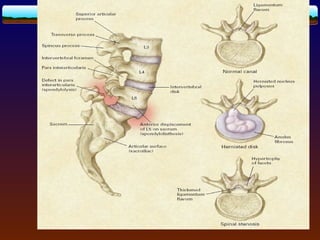
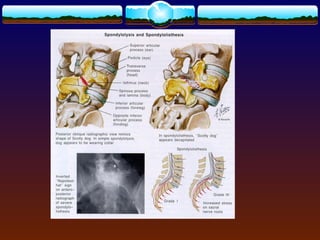
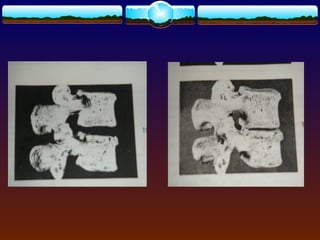
 Spondylolisthesis is a common cause for lower-
back pain, radiculopathy, and neurogenic
claudication among the adult population.
 Definition: ant. slipping of the spine.
 Site
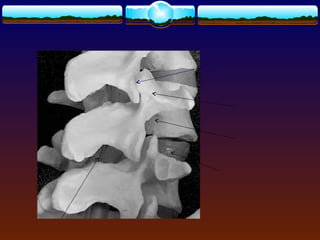
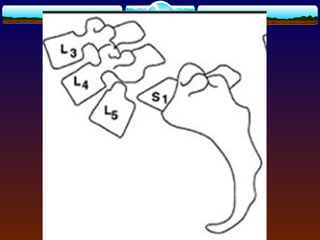
 Normal locking mechanism
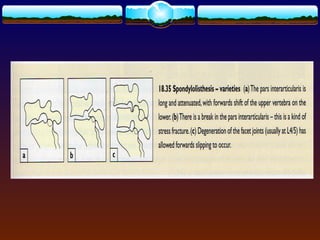
Classification (Wiltse et al 1976)
 congenital,dysplastic
 isthmic,* 5%,7year,gymnastic,wt,lifters,
 degenerative,*L4-L5
 pathologic,
 iatrogenic,
 traumatic.
Epidemiology
 level L4-L5.&L5-S1
 F:M = 6:1
 Black : White = 6:1
pathology
Clinical Presentation
 Hx acording to age of presentation
 lower-back pain,
 neurogenic claudication,
 Vesicorectal disorder,
 radiculopathy is present, the L5 nerve root
most often is affected.L4 second most
common

Physical Examination
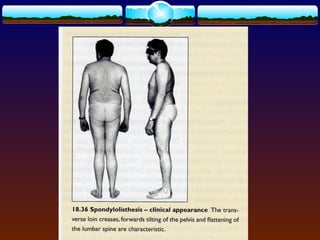
 loss of lumbar lordosis,flat
buttock,sacrum,scoliosis
 Transverse loin crese
 Hip flexion contractures
 Muscle atrophy
 Fell- step-off at the listhetic level.
 range of motion (ROM) usually is normal and
occasionally hypermobility may exist.
 Hamstring tightness
 Neurological examination
Imaging Studies
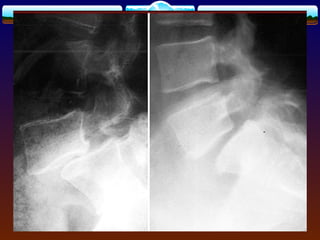
 lumbar AP, lateral, and oblique views.
 lateral flexion and extension,MRI
 Meyerding’s system for grading:
Grade 1 is 25%,
Grade 2 is 50%,
Grade 3 is 75%,
Grade 4 is 100% displacement ,
GradeV --spondyloptosis
Risk factors for progression
 Clinical ,gender,age,symptome,gaite
 Radilogical,angle,typ sarcum,l5
Prognosis
Dysplastic
Lytic
Degenerative
Non-operative treatment
 1-day to 2-day period rest-
 short course of anti-inflammatory
medications
 Physiotherapy
 Spinal support
 Modification of activity
 Psychological support
 Epidural injection
Surgical treatment
------Surgical goals
 pain reduction,
 improvement of neurologic symptoms,
 improvement in the quality of life.
If attainment of these goals is unlikely,
conservative treatment should be continued.
Indications
 indications :
--progressive neurologic deficit
--cauda equina syndrome.
--slip >50% and progressive
- persistent radiculopathy
-persistent and unremitting lower-back
-pain for more than 6 months,
-disabling symptom-affect work,sport
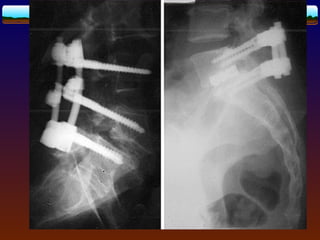
Decompression Alone
Laminectomy and Posterior Spinal Fusion (without
Interpedicled Instrumentation(
Decompression with Anterior and Posterior
Spinal Fusion
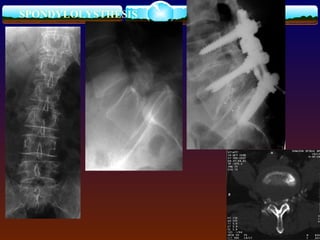
SPONDYLOLYSTHESIS
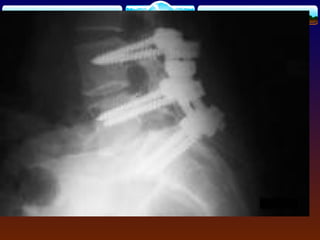
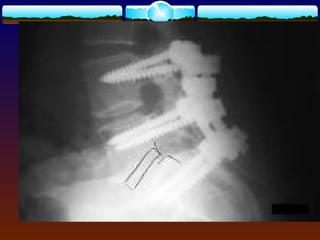
Post traumatic
spondylolethesis
Spinal stenosis
Lumbar Spinal Stenosis
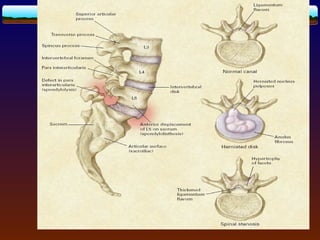
 Normal canal
 “Narrowing of osteoligamentous vertebral canal
and/or the intervertebral foramina causing
compression of the thecal sac and/or the caudal
nerve roots”
 Classification
 ----congenital
 -----aquired
Lumbar Spinal Stenosis
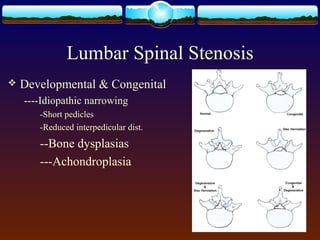
 Developmental & Congenital
----Idiopathic narrowing
-Short pedicles
-Reduced interpedicular dist.
--Bone dysplasias
---Achondroplasia
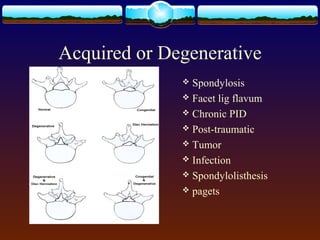
Acquired or Degenerative
 Spondylosis
 Facet lig flavum
 Chronic PID
 Post-traumatic
 Tumor
 Infection
 Spondylolisthesis
 pagets
Pathoanatomy
 Adult degenerative lumbar spinal stenosis (ie
Acquired stenosis)
 Facet hypertrophy
 Vertebral osteophytes
 thickened ligamentum flavum
 Disc protrusions
 Overall decreased volume of spinal canal
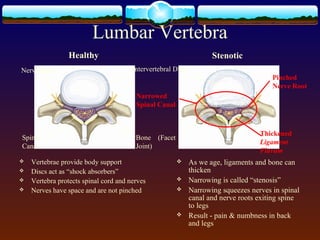
Stenotic
 Vertebrae provide body support
 Discs act as “shock absorbers”
 Vertebra protects spinal cord and nerves
 Nerves have space and are not pinched
 As we age, ligaments and bone can
thicken
 Narrowing is called “stenosis”
 Narrowing squeezes nerves in spinal
canal and nerve roots exiting spine
to legs
 Result - pain & numbness in back
and legs
Nerve Root
Spinal
Canal
Lumbar Vertebra
Bone (Facet
Joint)
Healthy
Intervertebral Disc
Thickened
Ligament
Flavum
Pinched
Nerve Root
Narrowed
Spinal Canal
Clinical Presentation
 Hx-age- ach-heaviness,n,symptoms
 neurogenic claudication with intermittent pain
radiating to the thighs or legs.
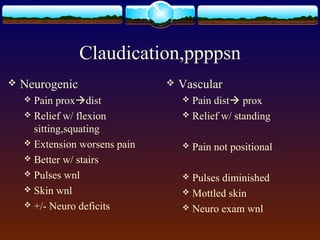
Claudication,ppppsn
 Neurogenic
 Pain proxdist
 Relief w/ flexion
sitting,squating
 Extension worsens pain
 Better w/ stairs
 Pulses wnl
 Skin wnl
 +/- Neuro deficits
 Vascular
 Pain dist prox
 Relief w/ standing
 Pain not positional
 Pulses diminished
 Mottled skin
 Neuro exam wnl
EMG-NCS
 Differentiation between neuropathy and
radiculopathy
Evaluation
 AP & Lat radiographs 20-16
 Flex/ext films to reval stability
 CT 16-11
 MRI
 Lumbar myelography + CT
 Evaluation of extent of neural element compression
Treatment
 Non-Operative
 NSAIDs
 Physical therapy
Stretching, strengthening,
 heat, electrical stimulation,Activity modification
 Bracing- especially w/ spondylolisthesis
 Steroid injection-
Non-Operative Treatment
 Good for non-progressive minimally debilitating
conditions
 Pt getting better  non op
 Pt getting worse  Surgery
Surgery?
 Indications
 Worsening neuro sx, bowel bladder dysfunction, cauda
equina syn, debilitating pain
 Best candidate
 Predominantly leg pain
 Clinical exam ∝ Imaging studies
 Mild to moderate neuro deficit
 No back pain (excluding spondylolisthesis)
Operative Treatment
 Laminectomy
Bilateral laminectomies for all affected levels
 If discectomy performed, consider arthrodesis
 Hemilaminectomy
 Pts w/ unilateral symp
 Better preserves post op stability
 Difficulty in accessing
Contralateral side
Neural foramen
 Risk for dural tear
Operative Treatment
 Laminoplasty
 Hinging open the lamina on one side, interpositioning
the resected spinous process
 Increased size of spinal canal
 X-Stop
 Device designed to selectively impart relative flexion at
one symptomatic motion segment of the spine
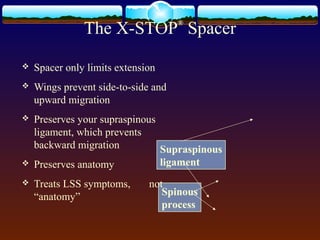
The X-STOP®
Spacer
Supraspinous
ligament
Spinous
process
 Spacer only limits extension
 Wings prevent side-to-side and
upward migration
 Preserves your supraspinous
ligament, which prevents
backward migration
 Preserves anatomy
 Treats LSS symptoms, not
“anatomy”
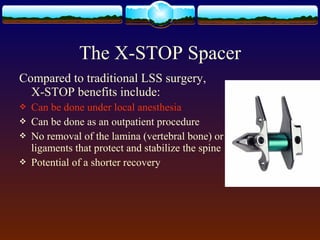
Compared to traditional LSS surgery,
X-STOP benefits include:
 Can be done under local anesthesia
 Can be done as an outpatient procedure
 No removal of the lamina (vertebral bone) or
ligaments that protect and stabilize the spine
 Potential of a shorter recovery
The X-STOP Spacer
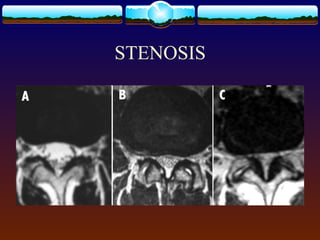
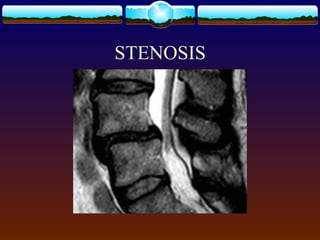
STENOSIS
STENOSIS
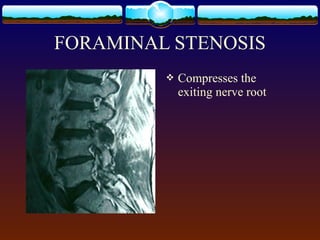
 Compresses the
exiting nerve root
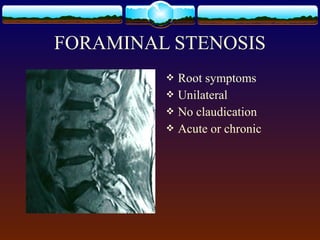
FORAMINAL STENOSIS
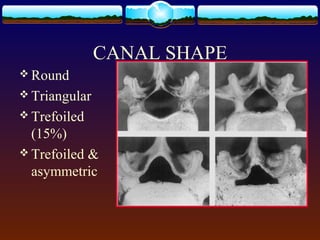
CANAL SHAPE
 Round
 Triangular
 Trefoiled
(15%)
 Trefoiled &
asymmetric
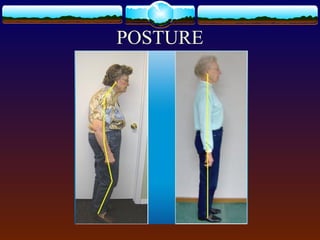
POSTURE
 Root symptoms
 Unilateral
 No claudication
 Acute or chronic
FORAMINAL STENOSIS
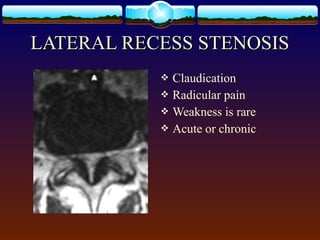
 Claudication
 Radicular pain
 Weakness is rare
 Acute or chronic
LATERAL RECESS STENOSISLATERAL RECESS STENOSIS
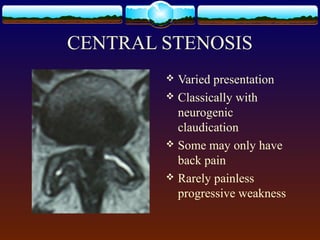
CENTRAL STENOSIS
 Varied presentation
 Classically with
neurogenic
claudication
 Some may only have
back pain
 Rarely painless
progressive weakness
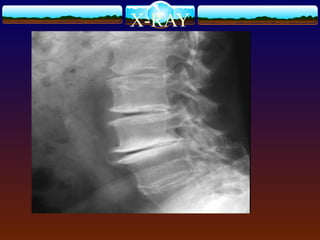
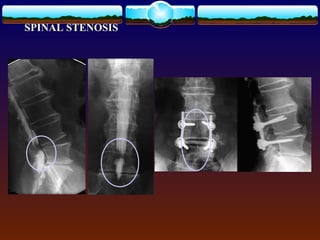
X-RAY
SPINAL STENOSIS
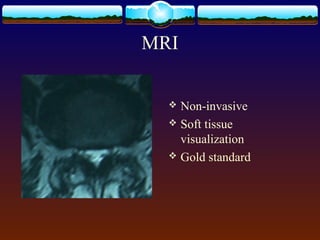
MRI
 Non-invasive
 Soft tissue
visualization
 Gold standard
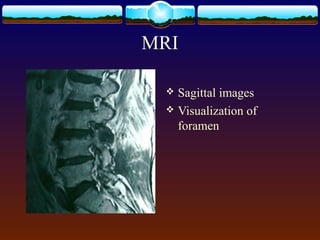
MRI
 Sagittal images
 Visualization of
foramen
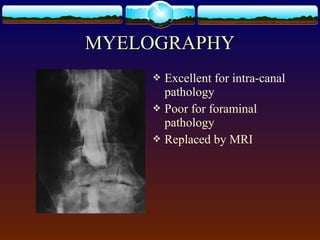
 Excellent for intra-canal
pathology
 Poor for foraminal
pathology
 Replaced by MRI
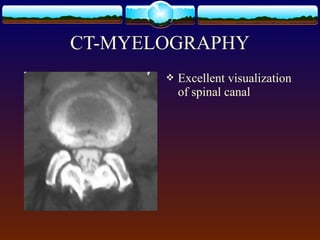
MYELOGRAPHYMYELOGRAPHY
 Excellent visualization
of spinal canal
CT-MYELOGRAPHY
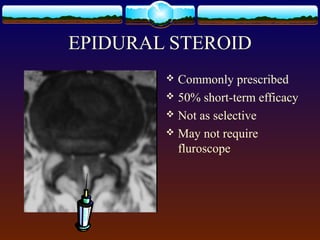
EPIDURAL STEROID
 Commonly prescribed
 50% short-term efficacy
 Not as selective
 May not require
fluroscope
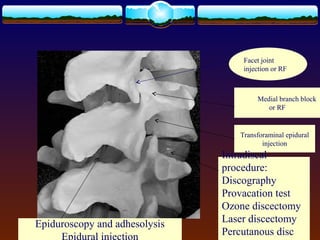
Facet joint
injection or RF
Medial branch block
or RF
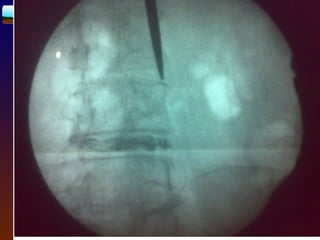
Transforaminal epidural
injection
Intradiscal
procedure:
Discography
Provacation test
Ozone discectomy
Laser discectomy
Percutanous disc
Epiduroscopy and adhesolysis
Epidural injection
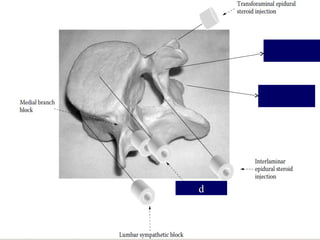
d
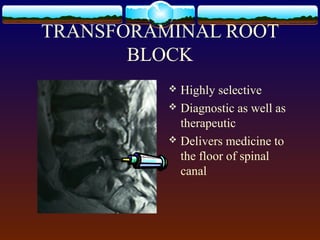
TRANSFORAMINAL ROOT
BLOCK
 Highly selective
 Diagnostic as well as
therapeutic
 Delivers medicine to
the floor of spinal
canal
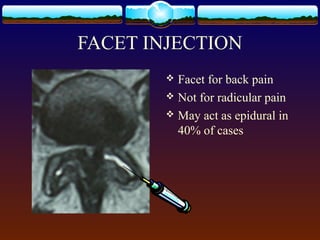
FACET INJECTION
 Facet for back pain
 Not for radicular pain
 May act as epidural in
40% of cases
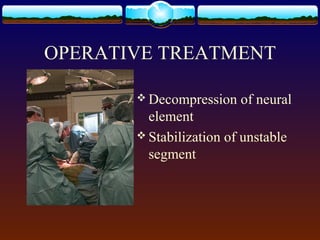
OPERATIVE TREATMENT
 Decompression of neural
element
 Stabilization of unstable
segment
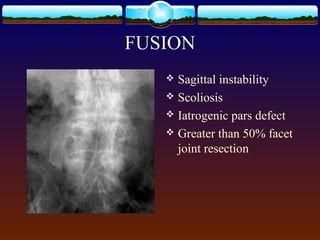
FUSION
 Sagittal instability
 Scoliosis
 Iatrogenic pars defect
 Greater than 50% facet
joint resection
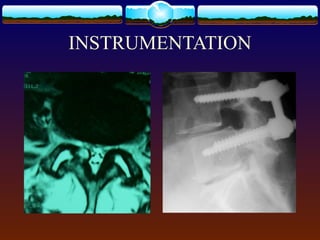
INSTRUMENTATION

Orthopedics 5th year, 5th lecture (Dr. Hamid)

  • 1.
  • 6.
    Introduction  Spondylolisthesis isa common cause for lower- back pain, radiculopathy, and neurogenic claudication among the adult population.  Definition: ant. slipping of the spine.  Site  Normal locking mechanism
  • 9.
    Classification (Wiltse etal 1976)  congenital,dysplastic  isthmic,* 5%,7year,gymnastic,wt,lifters,  degenerative,*L4-L5  pathologic,  iatrogenic,  traumatic.
  • 10.
    Epidemiology  level L4-L5.&L5-S1 F:M = 6:1  Black : White = 6:1 pathology
  • 11.
    Clinical Presentation  Hxacording to age of presentation  lower-back pain,  neurogenic claudication,  Vesicorectal disorder,  radiculopathy is present, the L5 nerve root most often is affected.L4 second most common 
  • 12.
    Physical Examination  lossof lumbar lordosis,flat buttock,sacrum,scoliosis  Transverse loin crese  Hip flexion contractures  Muscle atrophy  Fell- step-off at the listhetic level.  range of motion (ROM) usually is normal and occasionally hypermobility may exist.  Hamstring tightness  Neurological examination
  • 14.
    Imaging Studies  lumbarAP, lateral, and oblique views.  lateral flexion and extension,MRI  Meyerding’s system for grading: Grade 1 is 25%, Grade 2 is 50%, Grade 3 is 75%, Grade 4 is 100% displacement , GradeV --spondyloptosis
  • 15.
    Risk factors forprogression  Clinical ,gender,age,symptome,gaite  Radilogical,angle,typ sarcum,l5
  • 17.
  • 18.
    Non-operative treatment  1-dayto 2-day period rest-  short course of anti-inflammatory medications  Physiotherapy  Spinal support  Modification of activity  Psychological support  Epidural injection
  • 19.
    Surgical treatment ------Surgical goals pain reduction,  improvement of neurologic symptoms,  improvement in the quality of life. If attainment of these goals is unlikely, conservative treatment should be continued.
  • 20.
    Indications  indications : --progressiveneurologic deficit --cauda equina syndrome. --slip >50% and progressive - persistent radiculopathy -persistent and unremitting lower-back -pain for more than 6 months, -disabling symptom-affect work,sport
  • 21.
    Decompression Alone Laminectomy andPosterior Spinal Fusion (without Interpedicled Instrumentation( Decompression with Anterior and Posterior Spinal Fusion
  • 23.
  • 26.
  • 28.
  • 30.
    Lumbar Spinal Stenosis Normal canal  “Narrowing of osteoligamentous vertebral canal and/or the intervertebral foramina causing compression of the thecal sac and/or the caudal nerve roots”  Classification  ----congenital  -----aquired
  • 31.
    Lumbar Spinal Stenosis Developmental & Congenital ----Idiopathic narrowing -Short pedicles -Reduced interpedicular dist. --Bone dysplasias ---Achondroplasia
  • 32.
    Acquired or Degenerative Spondylosis  Facet lig flavum  Chronic PID  Post-traumatic  Tumor  Infection  Spondylolisthesis  pagets
  • 33.
    Pathoanatomy  Adult degenerativelumbar spinal stenosis (ie Acquired stenosis)  Facet hypertrophy  Vertebral osteophytes  thickened ligamentum flavum  Disc protrusions  Overall decreased volume of spinal canal
  • 35.
    Stenotic  Vertebrae providebody support  Discs act as “shock absorbers”  Vertebra protects spinal cord and nerves  Nerves have space and are not pinched  As we age, ligaments and bone can thicken  Narrowing is called “stenosis”  Narrowing squeezes nerves in spinal canal and nerve roots exiting spine to legs  Result - pain & numbness in back and legs Nerve Root Spinal Canal Lumbar Vertebra Bone (Facet Joint) Healthy Intervertebral Disc Thickened Ligament Flavum Pinched Nerve Root Narrowed Spinal Canal
  • 36.
    Clinical Presentation  Hx-age-ach-heaviness,n,symptoms  neurogenic claudication with intermittent pain radiating to the thighs or legs.
  • 37.
    Claudication,ppppsn  Neurogenic  Painproxdist  Relief w/ flexion sitting,squating  Extension worsens pain  Better w/ stairs  Pulses wnl  Skin wnl  +/- Neuro deficits  Vascular  Pain dist prox  Relief w/ standing  Pain not positional  Pulses diminished  Mottled skin  Neuro exam wnl
  • 38.
    EMG-NCS  Differentiation betweenneuropathy and radiculopathy
  • 39.
    Evaluation  AP &Lat radiographs 20-16  Flex/ext films to reval stability  CT 16-11  MRI  Lumbar myelography + CT  Evaluation of extent of neural element compression
  • 40.
    Treatment  Non-Operative  NSAIDs Physical therapy Stretching, strengthening,  heat, electrical stimulation,Activity modification  Bracing- especially w/ spondylolisthesis  Steroid injection-
  • 41.
    Non-Operative Treatment  Goodfor non-progressive minimally debilitating conditions  Pt getting better  non op  Pt getting worse  Surgery
  • 42.
    Surgery?  Indications  Worseningneuro sx, bowel bladder dysfunction, cauda equina syn, debilitating pain  Best candidate  Predominantly leg pain  Clinical exam ∝ Imaging studies  Mild to moderate neuro deficit  No back pain (excluding spondylolisthesis)
  • 43.
    Operative Treatment  Laminectomy Bilaterallaminectomies for all affected levels  If discectomy performed, consider arthrodesis  Hemilaminectomy  Pts w/ unilateral symp  Better preserves post op stability  Difficulty in accessing Contralateral side Neural foramen  Risk for dural tear
  • 44.
    Operative Treatment  Laminoplasty Hinging open the lamina on one side, interpositioning the resected spinous process  Increased size of spinal canal  X-Stop  Device designed to selectively impart relative flexion at one symptomatic motion segment of the spine
  • 45.
    The X-STOP® Spacer Supraspinous ligament Spinous process  Spaceronly limits extension  Wings prevent side-to-side and upward migration  Preserves your supraspinous ligament, which prevents backward migration  Preserves anatomy  Treats LSS symptoms, not “anatomy”
  • 46.
    Compared to traditionalLSS surgery, X-STOP benefits include:  Can be done under local anesthesia  Can be done as an outpatient procedure  No removal of the lamina (vertebral bone) or ligaments that protect and stabilize the spine  Potential of a shorter recovery The X-STOP Spacer
  • 47.
  • 48.
  • 49.
     Compresses the exitingnerve root FORAMINAL STENOSIS
  • 50.
    CANAL SHAPE  Round Triangular  Trefoiled (15%)  Trefoiled & asymmetric
  • 51.
  • 52.
     Root symptoms Unilateral  No claudication  Acute or chronic FORAMINAL STENOSIS
  • 53.
     Claudication  Radicularpain  Weakness is rare  Acute or chronic LATERAL RECESS STENOSISLATERAL RECESS STENOSIS
  • 54.
    CENTRAL STENOSIS  Variedpresentation  Classically with neurogenic claudication  Some may only have back pain  Rarely painless progressive weakness
  • 55.
  • 56.
  • 57.
    MRI  Non-invasive  Softtissue visualization  Gold standard
  • 58.
    MRI  Sagittal images Visualization of foramen
  • 59.
     Excellent forintra-canal pathology  Poor for foraminal pathology  Replaced by MRI MYELOGRAPHYMYELOGRAPHY
  • 60.
     Excellent visualization ofspinal canal CT-MYELOGRAPHY
  • 61.
    EPIDURAL STEROID  Commonlyprescribed  50% short-term efficacy  Not as selective  May not require fluroscope
  • 62.
    Facet joint injection orRF Medial branch block or RF Transforaminal epidural injection Intradiscal procedure: Discography Provacation test Ozone discectomy Laser discectomy Percutanous disc Epiduroscopy and adhesolysis Epidural injection
  • 63.
  • 66.
    TRANSFORAMINAL ROOT BLOCK  Highlyselective  Diagnostic as well as therapeutic  Delivers medicine to the floor of spinal canal
  • 67.
    FACET INJECTION  Facetfor back pain  Not for radicular pain  May act as epidural in 40% of cases
  • 68.
    OPERATIVE TREATMENT  Decompressionof neural element  Stabilization of unstable segment
  • 69.
    FUSION  Sagittal instability Scoliosis  Iatrogenic pars defect  Greater than 50% facet joint resection
  • 70.

Editor's Notes

  • #36 The vertebrae are the building blocks, providing support for your head and body while the discs act as cushions, or “shock absorbers.” In addition to providing support, the spine encloses and protects a column of nerve tissues called the spinal cord. The spinal cord is surrounded by a bony channel called the spinal canal. In the lumbar spine, nerve roots pass out of the spinal canal through the intervertebral foramen, where they extend down into your back and legs. In the healthy spine, there is space between the spinal cord and the borders of the spinal canal so that the nerves are free and are not pinched. However, as we age the ligaments and bone that surround the spinal canal can thicken. This thickening results in narrowing of the spinal canal, which is called “spinal stenosis.” The spinal cord and nerve fibers that exit the spinal canal (nerve roots) become crowded and pinched due to this narrowing, resulting in pain and numbness in the back and legs.
  • #46 The X-STOP device relieves the symptoms of lumbar spinal stenosis by limiting extension without any significant restriction of flexion or lateral rotation. Additionally, the X-STOP Spacer addresses many of the traditional concerns about destabilization of the spine associated with invasive decompressive procedures such as laminectomy. The X-STOP procedure does not typically require removal of bony structures or the supraspinous ligament. Preserving the supraspinous ligament has the added benefit of working along with the device’s wings to prevent lateral and posterior migration.