Spondylolisthesis
Spondylolisthesis
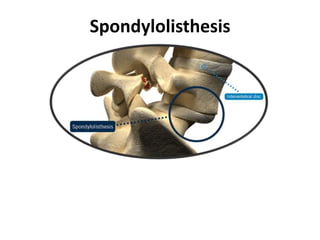
o Spondylolisthesis is the forward displacement of a
vertebra, especially the fifth lumbar vertebra.
 Do not get confuse with-
o Spondylosis- is degenerative osteoarthritis of the joints
between the center of the spinal vertebrae or neural
foramina.
o Spondylitis- is an inflammation of the vertebra.
o Spondylolysis- is a defect of a vertebra. More specifically it
is defined as a defect in the pars interarticularis of the
vertebral arch.
Spondylolisthesis
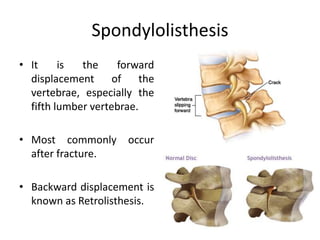
• It is the forward
displacement of the
vertebrae, especially the
fifth lumber vertebrae.
• Most commonly occur
after fracture.
• Backward displacement is
known as Retrolisthesis.
Causes
• Most commonly occur after fracture.
• May occur due to-
– Birth defect in that area of the spine
– Sudden injury (acute trauma).
• In adult most common cause is-
– Abnormal wear on the cartilage and bones, such as
arthritis.
Classification
• Types of spondylolisthesis-
– Isthmic
• there is a defect in a portion of the
vertebra called the pars interarticularis.
• Isthmic spondylolisthesis can be caused
by-repetitive trauma and is more common
in athletes exposed to hyperextension
motions, including gymnasts and football
linemen.
– Degenerative
• Degenerative spondylolisthesis occurs due
to arthritic changes in the joints of the
vertebrae due to cartilage degeneration.
• Degenerative spondylolisthesis is more
common in older patients.
– Pathologic
• Pathologic spondylolisthesis is caused by a
defect in the bone caused by abnormal bone,
such as from a tumor.
– Traumatic
• Traumatic spondylolisthesis is due to
direct trauma or injury to the
vertebrae.
• This can be caused by a fracture of
the pedicle, lamina, or facet joints
that allows the front portion of the
vertebra to slip forward with respect
to the back portion of the vertebra.
– Pathologic
• Pathologic spondylolisthesis is
caused by a defect in the bone
caused by abnormal bone, such as
from a tumor.
– Dysplastic
• Dysplastic spondylolisthesis is
caused by a defect in the formation
of part of the vertebra called the
facet that allows it to slip forward.
• This is a condition that a patient is
born with (congenital).
Clinical Feature
• Symptoms
1) Lower back pain.
2) Muscle tightness (tight
hamstring muscle).
3) Pain, numbness, or tingling in
the thighs and buttocks.
4) Stiffness.
5) Weakness in the legs.
6) Loss of bladder or bowel
control, in rare cases.
• Sign
1) Tenderness in the area of
the vertebra that is out of
place.
2) Leaning-forward or semi-
kyphotic posture.
3) Waddle.
4) A noticeable atrophy in
the gluteal muscles due to
lack of use.
Diagnosis
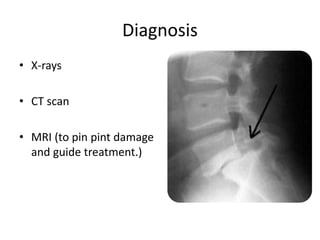
• X-rays
• CT scan
• MRI (to pin pint damage
and guide treatment.)
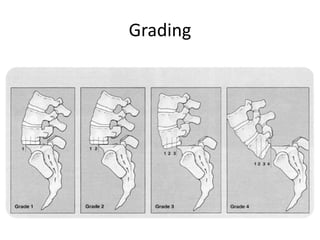
Grading of spondylolisthesis
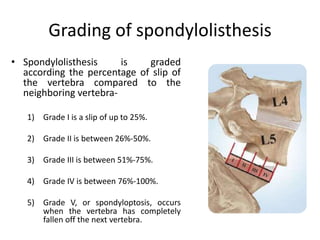
• Spondylolisthesis is graded
according the percentage of slip of
the vertebra compared to the
neighboring vertebra-
1) Grade I is a slip of up to 25%.
2) Grade II is between 26%-50%.
3) Grade III is between 51%-75%.
4) Grade IV is between 76%-100%.
5) Grade V, or spondyloptosis, occurs
when the vertebra has completely
fallen off the next vertebra.
Grading
Treatment
• Treatment methods-
– Conservative
• Stop any physical activity that
may lead to vertebral damage.
• Physical therapy can evaluate
and address postural and
compensatory movement
abnormalities.
• Anti-inflammatory medications
(NSAIDS) in combination with
acetaminophen to relieve pain.
– Surgical
• Degenerative
spondylolisthesis with spinal
stenosis is one of the most
common indications for spine
surgery among older adults.
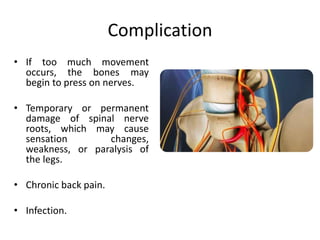
Complication
• If too much movement
occurs, the bones may
begin to press on nerves.
• Temporary or permanent
damage of spinal nerve
roots, which may cause
sensation changes,
weakness, or paralysis of
the legs.
• Chronic back pain.
• Infection.

Spondylolisthesis

  • 1.
  • 2.
    Spondylolisthesis o Spondylolisthesis isthe forward displacement of a vertebra, especially the fifth lumbar vertebra.  Do not get confuse with- o Spondylosis- is degenerative osteoarthritis of the joints between the center of the spinal vertebrae or neural foramina. o Spondylitis- is an inflammation of the vertebra. o Spondylolysis- is a defect of a vertebra. More specifically it is defined as a defect in the pars interarticularis of the vertebral arch.
  • 3.
    Spondylolisthesis • It isthe forward displacement of the vertebrae, especially the fifth lumber vertebrae. • Most commonly occur after fracture. • Backward displacement is known as Retrolisthesis.
  • 4.
    Causes • Most commonlyoccur after fracture. • May occur due to- – Birth defect in that area of the spine – Sudden injury (acute trauma). • In adult most common cause is- – Abnormal wear on the cartilage and bones, such as arthritis.
  • 5.
    Classification • Types ofspondylolisthesis- – Isthmic • there is a defect in a portion of the vertebra called the pars interarticularis. • Isthmic spondylolisthesis can be caused by-repetitive trauma and is more common in athletes exposed to hyperextension motions, including gymnasts and football linemen. – Degenerative • Degenerative spondylolisthesis occurs due to arthritic changes in the joints of the vertebrae due to cartilage degeneration. • Degenerative spondylolisthesis is more common in older patients. – Pathologic • Pathologic spondylolisthesis is caused by a defect in the bone caused by abnormal bone, such as from a tumor. – Traumatic • Traumatic spondylolisthesis is due to direct trauma or injury to the vertebrae. • This can be caused by a fracture of the pedicle, lamina, or facet joints that allows the front portion of the vertebra to slip forward with respect to the back portion of the vertebra. – Pathologic • Pathologic spondylolisthesis is caused by a defect in the bone caused by abnormal bone, such as from a tumor. – Dysplastic • Dysplastic spondylolisthesis is caused by a defect in the formation of part of the vertebra called the facet that allows it to slip forward. • This is a condition that a patient is born with (congenital).
  • 6.
    Clinical Feature • Symptoms 1)Lower back pain. 2) Muscle tightness (tight hamstring muscle). 3) Pain, numbness, or tingling in the thighs and buttocks. 4) Stiffness. 5) Weakness in the legs. 6) Loss of bladder or bowel control, in rare cases. • Sign 1) Tenderness in the area of the vertebra that is out of place. 2) Leaning-forward or semi- kyphotic posture. 3) Waddle. 4) A noticeable atrophy in the gluteal muscles due to lack of use.
  • 7.
    Diagnosis • X-rays • CTscan • MRI (to pin pint damage and guide treatment.)
  • 8.
    Grading of spondylolisthesis •Spondylolisthesis is graded according the percentage of slip of the vertebra compared to the neighboring vertebra- 1) Grade I is a slip of up to 25%. 2) Grade II is between 26%-50%. 3) Grade III is between 51%-75%. 4) Grade IV is between 76%-100%. 5) Grade V, or spondyloptosis, occurs when the vertebra has completely fallen off the next vertebra.
  • 9.
  • 10.
    Treatment • Treatment methods- –Conservative • Stop any physical activity that may lead to vertebral damage. • Physical therapy can evaluate and address postural and compensatory movement abnormalities. • Anti-inflammatory medications (NSAIDS) in combination with acetaminophen to relieve pain. – Surgical • Degenerative spondylolisthesis with spinal stenosis is one of the most common indications for spine surgery among older adults.
  • 11.
    Complication • If toomuch movement occurs, the bones may begin to press on nerves. • Temporary or permanent damage of spinal nerve roots, which may cause sensation changes, weakness, or paralysis of the legs. • Chronic back pain. • Infection.