High Grade
Spondylolisthesis
DR SUMIT SINHA
High Grade Spondylolisthesis
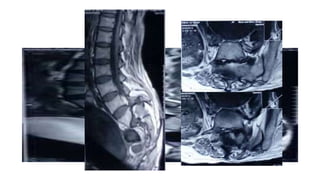
• VJ- 65 Yr old lady
• c/o Low Backache since 3-4years
• Radiation of pain to both lower limbs while walking
• Intermittent claudication
• O/E- power 5/5 B/l LL
• Numbness in L5,S1 dermatomes b/l
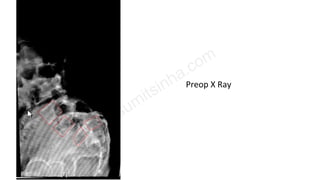
Preop X Ray
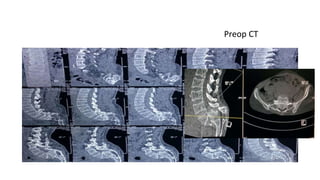
Preop CT
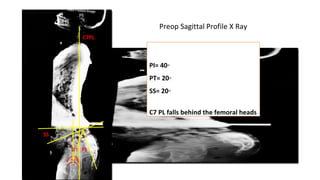
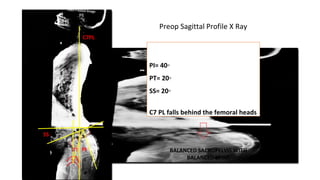
PI= 40◦
PT= 20◦
SS= 20◦
C7 PL falls behind the femoral heads
SS
PIPT
C7PL
Preop Sagittal Profile X Ray
Treatment ???
• Conservative
• In situ fusion only
• IS instrumented fusion with decompression
• Reduction with decompression and instrumented fusion posteriorly
or AP or Circumferentially
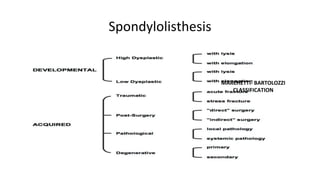
Spondylolisthesis
MARCHETTI- BARTOLOZZI
CLASSIFICATION
Spondylolisthesis
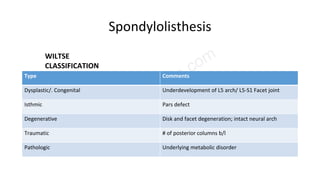
Type Comments
Dysplastic/. Congenital Underdevelopment of L5 arch/ L5-S1 Facet joint
Isthmic Pars defect
Degenerative Disk and facet degeneration; intact neural arch
Traumatic # of posterior columns b/l
Pathologic Underlying metabolic disorder
WILTSE
CLASSIFICATION
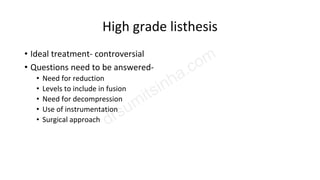
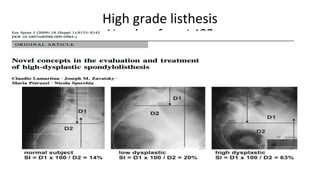
High grade listhesis
• Ideal treatment- controversial
• Questions need to be answered-
• Need for reduction
• Levels to include in fusion
• Need for decompression
• Use of instrumentation
• Surgical approach
High grade listhesis
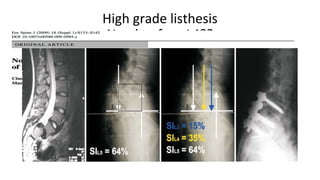
Fusion Levels
• Most recommend to include L4 for in situ fusion
High grade listhesis
Need to fuse L4??
High grade listhesis
Need to fuse L4??
High grade listhesis
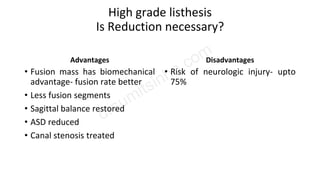
Is Reduction necessary?
Advantages
• Fusion mass has biomechanical
advantage- fusion rate better
• Less fusion segments
• Sagittal balance restored
• ASD reduced
• Canal stenosis treated
Disadvantages
• Risk of neurologic injury- upto
75%
High grade listhesis
Is Reduction necessary?
• What the evidence says?- Mixed literature
• Main concern in RE- postop neurologic deficit- dt-
• Direct pressure on root
• Extradural pressure on roots in reduced position
• Impingement of roots on iliolumbar ligaments
• Disc extruded in canal
High grade listhesis
Is Reduction necessary?
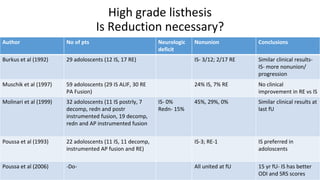
Author No of pts Neurologic
deficit
Nonunion Conclusions
Burkus et al (1992) 29 adoloscents (12 IS, 17 RE) IS- 3/12; 2/17 RE Similar clinical results-
IS- more nonunion/
progression
Muschik et al (1997) 59 adoloscents (29 IS ALIF, 30 RE
PA Fusion)
24% IS, 7% RE No clinical
improvement in RE vs IS
Molinari et al (1999) 32 adoloscents (11 IS postrly, 7
decomp, redn and postr
instrumented fusion, 19 decomp,
redn and AP instrumented fusion
IS- 0%
Redn- 15%
45%, 29%, 0% Similar clinical results at
last fU
Poussa et al (1993) 22 adoloscents (11 IS, 11 decomp,
instrumented AP fusion and RE)
IS-3; RE-1 IS preferred in
adoloscents
Poussa et al (2006) -Do- All united at fU 15 yr fU- IS has better
ODI and SRS scores
High grade listhesis
Is Reduction necessary?
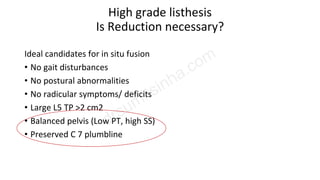
Ideal candidates for in situ fusion
• No gait disturbances
• No postural abnormalities
• No radicular symptoms/ deficits
• Large L5 TP >2 cm2
• Balanced pelvis (Low PT, high SS)
• Preserved C 7 plumbline
High grade listhesis
Is Reduction necessary?
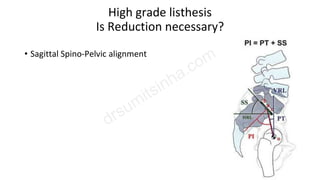
• Sagittal Spino-Pelvic alignment
High grade listhesis
Is Reduction necessary?
High grade listhesis
Is Reduction necessary?
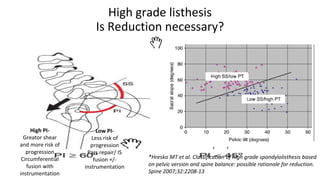
High PI-
Greator shear
and more risk of
progression
Circumferential
fusion with
instrumentation
Low PI-
Less risk of
progression
Pars repair/ IS
fusion +/-
instrumentation
*Hresko MT et al. Classification of high grade spondylolisthesis based
on pelvic version and spine balance: possible rationale for reduction.
Spine 2007;32:2208-13
High grade listhesis
Is Reduction necessary?
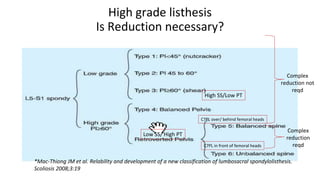
High SS/Low PT
Low SS/ High PT
C7PL over/ behind femoral heads
C7PL in front of femoral heads
Complex
reduction not
reqd
Complex
reduction
reqd
*Mac-Thiong JM et al. Relability and development of a new classification of lumbosacral spondylolisthesis.
Scoliosis 2008;3:19
High grade listhesis
Is Reduction necessary?
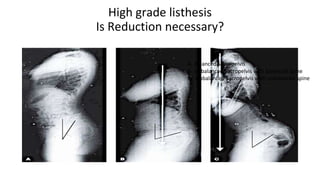
A- Balanced Sacropelvis
B- Unbalanced Sacropelvis with balanced Spine
C- Unbalanced Sacropelvis with unbalanced spine
High grade listhesis
Is Reduction necessary?
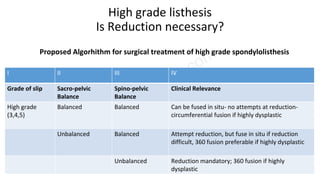
I II III IV
Grade of slip Sacro-pelvic
Balance
Spino-pelvic
Balance
Clinical Relevance
High grade
(3,4,5)
Balanced Balanced Can be fused in situ- no attempts at reduction-
circumferential fusion if highly dysplastic
Unbalanced Balanced Attempt reduction, but fuse in situ if reduction
difficult, 360 fusion preferable if highly dysplastic
Unbalanced Reduction mandatory; 360 fusion if highly
dysplastic
Proposed Algorhithm for surgical treatment of high grade spondylolisthesis
PI= 40◦
PT= 20◦
SS= 20◦
C7 PL falls behind the femoral heads
SS
PIPT
C7PL
BALANCED SACROPELVIS WITH
BALANCED SPINE
Preop Sagittal Profile X Ray
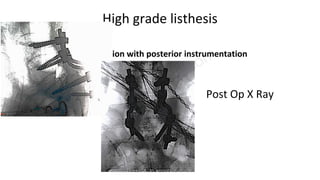
High grade listhesis
In Situ Fusion with posterior instrumentation
Post Op X Ray
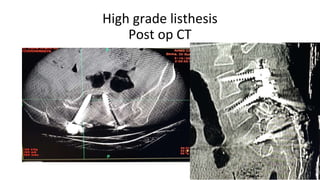
High grade listhesis
Post op CT
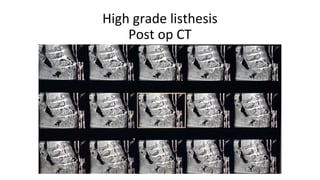
High grade listhesis
Post op CT
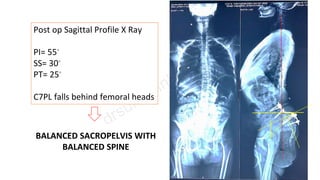
Post op Sagittal Profile X Ray
PI= 55◦
SS= 30◦
PT= 25◦
C7PL falls behind femoral heads
BALANCED SACROPELVIS WITH
BALANCED SPINE
THANK YOU

Fortis lecture High Grade Spondylolisthesis

  • 1.
  • 2.
    High Grade Spondylolisthesis •VJ- 65 Yr old lady • c/o Low Backache since 3-4years • Radiation of pain to both lower limbs while walking • Intermittent claudication • O/E- power 5/5 B/l LL • Numbness in L5,S1 dermatomes b/l
  • 3.
  • 4.
  • 6.
    PI= 40◦ PT= 20◦ SS=20◦ C7 PL falls behind the femoral heads SS PIPT C7PL Preop Sagittal Profile X Ray
  • 7.
    Treatment ??? • Conservative •In situ fusion only • IS instrumented fusion with decompression • Reduction with decompression and instrumented fusion posteriorly or AP or Circumferentially
  • 8.
  • 9.
    Spondylolisthesis Type Comments Dysplastic/. CongenitalUnderdevelopment of L5 arch/ L5-S1 Facet joint Isthmic Pars defect Degenerative Disk and facet degeneration; intact neural arch Traumatic # of posterior columns b/l Pathologic Underlying metabolic disorder WILTSE CLASSIFICATION
  • 10.
    High grade listhesis •Ideal treatment- controversial • Questions need to be answered- • Need for reduction • Levels to include in fusion • Need for decompression • Use of instrumentation • Surgical approach
  • 11.
    High grade listhesis FusionLevels • Most recommend to include L4 for in situ fusion
  • 12.
  • 13.
  • 14.
    High grade listhesis IsReduction necessary? Advantages • Fusion mass has biomechanical advantage- fusion rate better • Less fusion segments • Sagittal balance restored • ASD reduced • Canal stenosis treated Disadvantages • Risk of neurologic injury- upto 75%
  • 15.
    High grade listhesis IsReduction necessary? • What the evidence says?- Mixed literature • Main concern in RE- postop neurologic deficit- dt- • Direct pressure on root • Extradural pressure on roots in reduced position • Impingement of roots on iliolumbar ligaments • Disc extruded in canal
  • 16.
    High grade listhesis IsReduction necessary? Author No of pts Neurologic deficit Nonunion Conclusions Burkus et al (1992) 29 adoloscents (12 IS, 17 RE) IS- 3/12; 2/17 RE Similar clinical results- IS- more nonunion/ progression Muschik et al (1997) 59 adoloscents (29 IS ALIF, 30 RE PA Fusion) 24% IS, 7% RE No clinical improvement in RE vs IS Molinari et al (1999) 32 adoloscents (11 IS postrly, 7 decomp, redn and postr instrumented fusion, 19 decomp, redn and AP instrumented fusion IS- 0% Redn- 15% 45%, 29%, 0% Similar clinical results at last fU Poussa et al (1993) 22 adoloscents (11 IS, 11 decomp, instrumented AP fusion and RE) IS-3; RE-1 IS preferred in adoloscents Poussa et al (2006) -Do- All united at fU 15 yr fU- IS has better ODI and SRS scores
  • 17.
    High grade listhesis IsReduction necessary? Ideal candidates for in situ fusion • No gait disturbances • No postural abnormalities • No radicular symptoms/ deficits • Large L5 TP >2 cm2 • Balanced pelvis (Low PT, high SS) • Preserved C 7 plumbline
  • 18.
    High grade listhesis IsReduction necessary? • Sagittal Spino-Pelvic alignment
  • 19.
    High grade listhesis IsReduction necessary?
  • 20.
    High grade listhesis IsReduction necessary? High PI- Greator shear and more risk of progression Circumferential fusion with instrumentation Low PI- Less risk of progression Pars repair/ IS fusion +/- instrumentation *Hresko MT et al. Classification of high grade spondylolisthesis based on pelvic version and spine balance: possible rationale for reduction. Spine 2007;32:2208-13
  • 21.
    High grade listhesis IsReduction necessary? High SS/Low PT Low SS/ High PT C7PL over/ behind femoral heads C7PL in front of femoral heads Complex reduction not reqd Complex reduction reqd *Mac-Thiong JM et al. Relability and development of a new classification of lumbosacral spondylolisthesis. Scoliosis 2008;3:19
  • 22.
    High grade listhesis IsReduction necessary? A- Balanced Sacropelvis B- Unbalanced Sacropelvis with balanced Spine C- Unbalanced Sacropelvis with unbalanced spine
  • 23.
    High grade listhesis IsReduction necessary? I II III IV Grade of slip Sacro-pelvic Balance Spino-pelvic Balance Clinical Relevance High grade (3,4,5) Balanced Balanced Can be fused in situ- no attempts at reduction- circumferential fusion if highly dysplastic Unbalanced Balanced Attempt reduction, but fuse in situ if reduction difficult, 360 fusion preferable if highly dysplastic Unbalanced Reduction mandatory; 360 fusion if highly dysplastic Proposed Algorhithm for surgical treatment of high grade spondylolisthesis
  • 24.
    PI= 40◦ PT= 20◦ SS=20◦ C7 PL falls behind the femoral heads SS PIPT C7PL BALANCED SACROPELVIS WITH BALANCED SPINE Preop Sagittal Profile X Ray
  • 25.
    High grade listhesis InSitu Fusion with posterior instrumentation Post Op X Ray
  • 26.
  • 27.
  • 28.
    Post op SagittalProfile X Ray PI= 55◦ SS= 30◦ PT= 25◦ C7PL falls behind femoral heads BALANCED SACROPELVIS WITH BALANCED SPINE
  • 29.