


NAME : SHUBHAM MAHESHWARI
CLASS : BSC IV SEM
COLLEGE : RAI SAHEB BHANWAR
SINGH COLLEGE
NASRULLAGANJ
SUBMITTED TO : GYANRAO DHOTE
 Bioelectricity is fundamental to all of life’s processes.
Indeed, placing electrodes on the human body, or on
any living thing, and connecting them to a sensitive
voltmeter will show an assortment of both steady and
time-varying electric potentials depending on where
the electrodes are placed. These biopotentials result
from complex biochemical processes, and their study
is known as electrophysiology. We can derive much
information about the function, health, and well-being
of living things by the study of these potentials. To do
this effectively, we need to understand how
bioelectricity is generated, propagated, and optimally
measured.
 In an electrical sense, living things can be modeled as a bag of
water having various dissolved salts. These salts ionize in solution
and create an electrolyte where the positive and negative ionic
charges are available to carry electricity. Positive electric charge is
carried primarily by sodium and potassium ions, and negative
charges often are carried by chloride and hydroxyl. On a larger
scale, the total numbers of positive and negative charges in
biological fluids are equal, as illustrated in Fig. 17.1. This, in turn,
maintains net electroneutrality of living things with respect to
their environment. Biochemical processes at the cell molecular
level are intimately associated with the transfer of electric charge.
From the standpoint of bioelectricity, living things are analogous to
an electrolyte container filled with millions of small chemical
batteries. Most of these batteries are located at cell membranes
and help define things such as cell osmotic pressure and selectivity
to substances that
6
The Nature of Life
 Life
› During last 4 by adapted to many environments and
physico-chemical conditions
› Most organisms live at 1 atm and 0-40oC; Some Bacteria
can live up to 1400 atm or -18 to 104oC
› Unicellular Organisms vs Non Living Molecules (Amino
acids, RNA (ribonucleic acid)
 reproduction
 growth via nutrients and energy
 responds to outside stimuli
 Share same genetic code
 chemical uniformity
 C, O, H, N, P >> nucleic acids, proteins, carbohydrates, fats
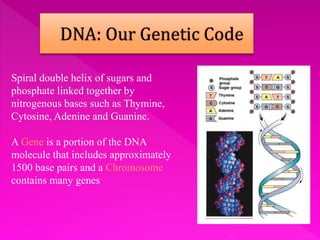
Spiral double helix of sugars and
phosphate linked together by
nitrogenous bases such as Thymine,
Cytosine, Adenine and Guanine.
A Gene is a portion of the DNA
molecule that includes approximately
1500 base pairs and a Chromosome
contains many genes
8
 All cells use the same genetic code
 Archaeobacteria- most primitive
› Heterotrophs: obtain energy from surroundings by some chemical
reaction
› Obtain energy by converting CO2 and H2 to CH4 or by the reduction
of sulfur compounds
 Eubacteria
› 10 Phyla, including cyanobacteria (Autotrophs: manufacture their
own food source)
 First Cells poorly developed metabolic systems
› absorbed nutrients directly
› fermentation
9
10
 Reproductive Potential
› potential for rapid expansion of a species in a given
geographical area
› a species will fill a niche until it reaches a climax
 Natural Selection (Darwin)
› interaction between genetics and environment
› “survival of the fittest” (H. Spencer)
› certain individuals are better suited (engineered)
for the habitat they inhabit
11
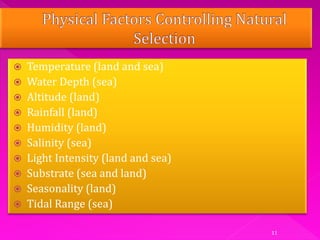
 Temperature (land and sea)
 Water Depth (sea)
 Altitude (land)
 Rainfall (land)
 Humidity (land)
 Salinity (sea)
 Light Intensity (land and sea)
 Substrate (sea and land)
 Seasonality (land)
 Tidal Range (sea)
Thanks
You

ORIGIN OF BIOELECTRICITY

  • 2.
    NAME : SHUBHAMMAHESHWARI CLASS : BSC IV SEM COLLEGE : RAI SAHEB BHANWAR SINGH COLLEGE NASRULLAGANJ SUBMITTED TO : GYANRAO DHOTE
  • 4.
     Bioelectricity isfundamental to all of life’s processes. Indeed, placing electrodes on the human body, or on any living thing, and connecting them to a sensitive voltmeter will show an assortment of both steady and time-varying electric potentials depending on where the electrodes are placed. These biopotentials result from complex biochemical processes, and their study is known as electrophysiology. We can derive much information about the function, health, and well-being of living things by the study of these potentials. To do this effectively, we need to understand how bioelectricity is generated, propagated, and optimally measured.
  • 5.
     In anelectrical sense, living things can be modeled as a bag of water having various dissolved salts. These salts ionize in solution and create an electrolyte where the positive and negative ionic charges are available to carry electricity. Positive electric charge is carried primarily by sodium and potassium ions, and negative charges often are carried by chloride and hydroxyl. On a larger scale, the total numbers of positive and negative charges in biological fluids are equal, as illustrated in Fig. 17.1. This, in turn, maintains net electroneutrality of living things with respect to their environment. Biochemical processes at the cell molecular level are intimately associated with the transfer of electric charge. From the standpoint of bioelectricity, living things are analogous to an electrolyte container filled with millions of small chemical batteries. Most of these batteries are located at cell membranes and help define things such as cell osmotic pressure and selectivity to substances that
  • 6.
    6 The Nature ofLife  Life › During last 4 by adapted to many environments and physico-chemical conditions › Most organisms live at 1 atm and 0-40oC; Some Bacteria can live up to 1400 atm or -18 to 104oC › Unicellular Organisms vs Non Living Molecules (Amino acids, RNA (ribonucleic acid)  reproduction  growth via nutrients and energy  responds to outside stimuli  Share same genetic code  chemical uniformity  C, O, H, N, P >> nucleic acids, proteins, carbohydrates, fats
  • 7.
    Spiral double helixof sugars and phosphate linked together by nitrogenous bases such as Thymine, Cytosine, Adenine and Guanine. A Gene is a portion of the DNA molecule that includes approximately 1500 base pairs and a Chromosome contains many genes
  • 8.
    8  All cellsuse the same genetic code  Archaeobacteria- most primitive › Heterotrophs: obtain energy from surroundings by some chemical reaction › Obtain energy by converting CO2 and H2 to CH4 or by the reduction of sulfur compounds  Eubacteria › 10 Phyla, including cyanobacteria (Autotrophs: manufacture their own food source)  First Cells poorly developed metabolic systems › absorbed nutrients directly › fermentation
  • 9.
  • 10.
    10  Reproductive Potential ›potential for rapid expansion of a species in a given geographical area › a species will fill a niche until it reaches a climax  Natural Selection (Darwin) › interaction between genetics and environment › “survival of the fittest” (H. Spencer) › certain individuals are better suited (engineered) for the habitat they inhabit
  • 11.
    11  Temperature (landand sea)  Water Depth (sea)  Altitude (land)  Rainfall (land)  Humidity (land)  Salinity (sea)  Light Intensity (land and sea)  Substrate (sea and land)  Seasonality (land)  Tidal Range (sea)
  • 12.