Visit https://testbankbell.com to download the full version and
explore more testbank or solutions manual
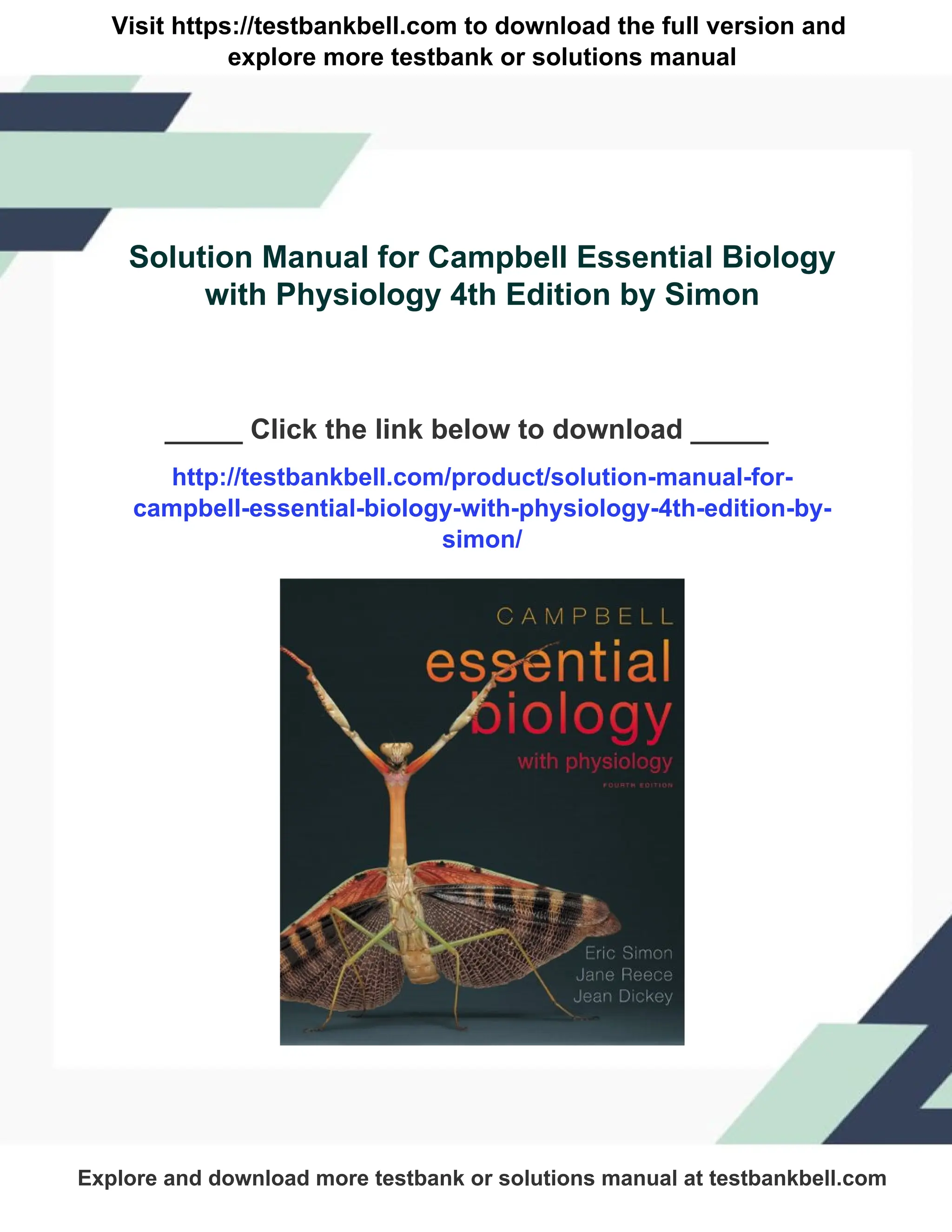
Solution Manual for Campbell Essential Biology
with Physiology 4th Edition by Simon
_____ Click the link below to download _____
http://testbankbell.com/product/solution-manual-for-
campbell-essential-biology-with-physiology-4th-edition-by-
simon/
Explore and download more testbank or solutions manual at testbankbell.com
Here are some recommended products that we believe you will be
interested in. You can click the link to download.
Campbell Essential Biology with Physiology 5th Edition
Simon Test Bank
http://testbankbell.com/product/campbell-essential-biology-with-
physiology-5th-edition-simon-test-bank/
Test Bank for Campbell Essential Biology with Physiology,
3rd Edition : Simon Reece
http://testbankbell.com/product/test-bank-for-campbell-essential-
biology-with-physiology-3rd-edition-simon-reece/
Test Bank for Campbell Essential Biology 7th by Simon
http://testbankbell.com/product/test-bank-for-campbell-essential-
biology-7th-by-simon/
Test Bank for Managerial Economics Applications Strategies
and Tactics Upper Level Economics Titles 13th Edition
James R McGuiga
http://testbankbell.com/product/test-bank-for-managerial-economics-
applications-strategies-and-tactics-upper-level-economics-titles-13th-
edition-james-r-mcguiga/
Test Bank for Essential Cell Biology 4th Edition Bruce
Alberts
http://testbankbell.com/product/test-bank-for-essential-cell-
biology-4th-edition-bruce-alberts/
Test Bank for Fundamentals of Selling Customers for Life
through Service, 12th Edition: Futrell
http://testbankbell.com/product/test-bank-for-fundamentals-of-selling-
customers-for-life-through-service-12th-edition-futrell/
Solution Manual for Introductory Chemistry A Foundation
9th by Zumdahl
http://testbankbell.com/product/solution-manual-for-introductory-
chemistry-a-foundation-9th-by-zumdahl/
Test Bank for General Organic and Biological Chemistry,
2nd Edition : Frost
http://testbankbell.com/product/test-bank-for-general-organic-and-
biological-chemistry-2nd-edition-frost/
Solution Manual for Horngren’s Accounting 11th canadian
Volume 1 by Miller-Nobles
http://testbankbell.com/product/solution-manual-for-horngrens-
accounting-11th-canadian-volume-1-by-miller-nobles/
Solution Manual for Starting Out With Visual Basic 2012,
6th Edition Gaddis, Irvine
http://testbankbell.com/product/solution-manual-for-starting-out-with-
visual-basic-2012-6th-edition-gaddis-irvine/
Copyright © 2013 Pearson Education, Inc. CHAPTER 1 Introduction: Biology Today 1
Solution Manual for Campbell Essential Biology with
Physiology 4th Edition by Simon
Download full chapter at: https://testbankbell.com/product/solution-
manual-for-campbell-essential-biology-with-physiology-4th-edition-by-
simon/
Introduction:
Biology Today
Why This Chapter Matters
1. We are living in the golden age of biology. Biological discoveries revolutionize medicine,
change agriculture, and impact human culture.
2. Life is united not by a single trait, but by a common set of characteristics. Appreciating
what it means to be living is as complex as life itself.
3. Life exists at many levels of biological organization. Understanding how these levels
interrelate provides insight into the mechanisms of living systems.
4. The diversity of life is nested into groups that are united and interrelated by their shared
evolutionary histories.
5. Science is a way of knowing and exploring our natural world. Most scientists use a
combination of two main forms of inquiry: discovery science and hypothesis-driven science.
6. Understanding how science is done reveals the power and limits of this form of knowledge.
Chapter Objectives
Biology and Society: Biology All Around Us
1. Describe three examples of how biology is woven into the fabric of society.
The Scope of Life
2. Describe seven properties or processes we associate with life.
3. List and give an example of each level of biological organization, starting with an ecosystem
and ending with atoms.
4. Describe the two main dynamic processes in an ecosystem.
CHAPTER
1
2 CHAPTER 1 Introduction: Biology Today Copyright © 2013 Pearson Education, Inc.
5. Compare the structure of prokaryotic and eukaryotic cells.
6. Distinguish between the three domains and four eukaryotic kingdoms of life.
Evolution: Biology’s Unifying Theme
7. Describe the two main points that Darwin made in his book On the Origin of Species by
Means of Natural Selection.
8. Describe the two observations that led Darwin to his inescapable conclusion. State this
conclusion.
9. Compare artificial and natural selection, noting similarities and differences.
The Process of Science
10. Compare discovery science and hypothesis-driven science. Provide examples of each
regarding the study of trans fats in the human diet.
11. Distinguish between a hypothesis and a theory. Explain why natural selection qualifies as
a scientific theory.
12. Distinguish science from other styles of inquiry.
13. Describe examples of the interdependence of technology and science.
Evolution Connection: Evolution in Our Everyday Lives
14. Explain how changes in the effectiveness of antibiotics illustrate natural selection.
Lecture Outline
I. Biology and Society: Biology All Around Us
1. We are living in a golden age of biology
2. Scientists are studying a myriad of questions that are relevant to our lives
a. How can errors in cell growth lead to cancer?
b. How do plants trap solar energy?
c. How do living creatures form ecological networks and how to human activities
disrupt them?
d. How did the great diversity of life on Earth evolve from the first microbes and how
does such evolution have an impact on human health?
e. How do mutations in genes lead to disease?
f. How can DNA—the molecular basis of heredity—be used in forensic investigations?
II. The Scope of Life
A. The Properties of Life
1. Biology is the scientific study of life
2. The study of biology encompasses
a. a wide scale of size and
b. a huge variety of life, both past and present.
B. Life at Its Many Levels
1. Biologists explore life at levels ranging from the biosphere to the molecules that
make up cells
C. Ecosystems
1. Each organism interacts continuously with its environment
Copyright © 2013 Pearson Education, Inc. CHAPTER 1 Introduction: Biology Today 3
a. Organisms interact continuously with the living and nonliving factors in the
environment.
b. All the living organisms in a specific area, along with all of the non-living factors
with which they interact, form an ecosystem.
2. The dynamics of any ecosystem depend on two main processes:
a. recycling of chemical nutrients and
b. flow of energy.
3. Within ecosystems
a. nutrients are recycled but
b. energy flows through.
D. Cells and Their DNA
1. The cell is the level at which the properties of life emerge
2. Cells are the lowest level of structure that can perform all activities required for life
3. All organisms are composed of cells
4. Cells are the subunits that make up multicellular organisms such as humans and trees
5. All cells share many characteristics
a. All cells are enclosed by a membrane that regulates the passage of materials
between the cell and its surroundings.
b. Every cell uses DNA as its genetic information.
6. We can distinguish two major types of cells:
a. The prokaryotic cell is
b. simpler and usually smaller and
c. characteristic of bacteria.
d. The eukaryotic cell is
i. subdivided by internal membranes into different functional compartments called
organelles and
ii. found in plants and animals.
7. All cells use DNA as the chemical material of genes, the units of inheritance that
transmit information from parents to offspring
8. The chemical language of DNA
a. is common to all organisms and
b. consists of just four molecular building blocks with names that are abbreviated
as A, G, C, T.
9. Genetic engineering has transformed the pharmaceutical industry and extended
millions of lives
10. The entire “book” of genetic instructions that an organism inherits is called its genome
11. The nucleus of each human cell packs a genome that is about 3 billion chemical
letters long
E. Life In Its Diverse Forms
1. Diversity is the hallmark of life
a. The diversity of known life includes about 1.8 million species that biologists have
identified and named.
b. Estimates of the total number of species range from 10 million to over 100 million.
F. Grouping Species: The Basic Concept
4 CHAPTER 1 Introduction: Biology Today Copyright © 2013 Pearson Education, Inc.
1. Biodiversity can be beautiful but overwhelming
2. Categorizing life into groups helps us deal with this complexity
3. Taxonomy is the branch of biology that names and classifies species
a. It formalizes the hierarchical ordering of organisms into broader and broader groups.
G. The Three Domains of Life
1. The three domains of life are
a. Bacteria,
b. Archaea, and
c. Eukarya.
2. Bacteria and Archaea have prokaryotic cells
3. Eukarya have eukaryotic cells
4. Eukarya include
a. Kingdom Plantae,
b. Kingdom Fungi,
c. Kingdom Animalia, and
d. Protists (multiple kingdoms).
5. Most plants, fungi, and animals are multicellular
6. Protists are generally single-celled
7. These three multicellular kingdoms are distinguished by how they obtain food
a. Plants produce their own sugars and other foods by photosynthesis.
b. Fungi are mostly decomposers, digesting dead organisms.
c. Animals obtain food by ingesting (eating) and digesting other organisms.
H. Unity in the Diversity of Life
1. Underlying the diversity of life is a striking unity, especially at the lower levels of
biological organization
a. For example, all life uses the genetic language of DNA.
2. Biological evolution accounts for this combination of unity and diversity
I. Evolution: Biology’s Unifying Theme
1. The history of life is a saga of a constantly changing Earth billions of years old
a. Fossils document this history.
2. Life evolves
a. Each species is one twig of a branching tree of life extending back in time through
ancestral species more and more remote.
b. Species that are very similar, such as the brown bear and polar bear, share a more
recent common ancestor.
J. The Darwinian View of Life
1. The evolutionary view of life came into focus in 1859 when Charles Darwin published
On the Origin of Species by Means of Natural Selection
2. Darwin’s book developed two main points:
a. Species living today descended from a succession of ancestral species in what
Darwin called “descent with modification,” capturing the duality of life’s
i. unity (descent) and
ii. diversity (modification).
Copyright © 2013 Pearson Education, Inc. CHAPTER 1 Introduction: Biology Today 5
b. Natural selection is the mechanism for descent with modification.
K. Natural Selection
1. Darwin was struck by the diversity of animals on the Galápagos Islands
2. He thought that adaptation to the environment and the origin of new species were
closely related processes
a. As populations separated by a geographic barrier adapted to local environments,
they became separate species.
L. Darwin’s Inescapable Conclusion
1. Darwin synthesized the theory of natural selection from two observations that were
neither profound nor original
a. Others had the pieces of the puzzle, but Darwin could see how they fit together.
2. Observation 1: Overproduction and competition
3. Observation 2: Individual variation
4. Conclusion: Unequal reproductive success
a. It is this unequal reproductive success that Darwin called natural selection.
b. The product of natural selection is adaptation.
5. Natural selection is the mechanism of evolution
M. Observing Artificial Selection
1. Artificial selection is the selective breeding of domesticated plants and animals by humans
2. In artificial selection, humans do the selecting instead of the environment
N. Observing Natural Selection
1. There are many examples of natural selection in action
a. Galápagos finches change beak size depending upon the size and shape of available
seeds.
b. Antibiotic-resistant bacteria have evolved in response to the overuse of antibiotics.
2. Darwin’s publication of The Origin of Species fueled an explosion in biological research
a. Evolution is one of biology’s best demonstrated, most comprehensive, and
longest-lasting theories.
b. Evolution is the unifying theme of biology.
O. The Process of Science
1. The word science is derived from a Latin verb meaning “to know.”
a. Science is a way of knowing, based on inquiry.
b. Science developed from our curiosity about ourselves and the world around us.
2. There are two main scientific approaches:
a. Discovery science is mostly about describing nature.
b. Hypothesis-driven science is mostly about explaining nature.
P. Discovery Science
1. Science seeks natural causes for natural phenomena
a. This limits the scope of science to the study of structures and processes that we can
observe and measure directly or indirectly.
2. The dependence on observations that people can confirm demystifies nature and
distinguishes science from belief in the supernatural
3. Verifiable observations and measurements are the data of discovery science
6 CHAPTER 1 Introduction: Biology Today Copyright © 2013 Pearson Education, Inc.
a. In biology, discovery science enables us to describe life at its many levels, from
ecosystems down to cells and molecules.
4. Discovery science
a. can stimulate us to ask questions and seek explanations and
b. uses a process of inquiry called the scientific method, consisting of a series of steps
that provide a loose guideline for scientific investigations.
c. Most modern scientific investigations can be described as hypothesis-driven
science.
i. A hypothesis is a tentative answer to a question — an explanation on trial.
ii. Although we don’t think of it in those terms, we use hypotheses in solving
everyday problems, like figuring out why a TV remote fails.
Q. Hypothesis-Driven Science
1. Once a hypothesis is formed, an investigator can use logic to test it
a. Then the hypothesis is tested by performing an experiment to see whether results
are as predicted.
b. This deductive reasoning takes the form of “If…then” logic.
III. The Process of Science: Are Trans Fats Bad for You?
1. One way to better understand how the process of science can be applied to real-world
problems is to examine a case study, an in-depth examination of an actual investigation
2. Dietary fat comes in different forms
3. Trans fats are a non-natural form produced through manufacturing processes called
hydrogenation
4. Trans fats
a. add texture,
b. increase shelf life, and
c. are inexpensive to prepare.
5. A study of 120,000 female nurses found that a diet with high levels of trans fats nearly
doubled the risk of heart disease
6. A hypothesis-driven study published in 2004
a. started with the observation that human body fat retains traces of consumed
dietary fat,
b. asked the question, Would the adipose tissue of heart attack patients be different
from a similar group of healthy patients?, and
c. formed the hypothesis that healthy patients’ body fat would contain less trans fats
than the body fat in heart attack victims.
7. The researchers set up an experiment to determine the amounts of fat in the adipose
tissue of 79 patients who had a heart attack
8. They compared these patients to the data for 167 patients who had not had a heart attack
9. This is an example of a controlled experiment, in which the control and experimental
groups differ only in one variable—the occurrence of a heart attack
10. The results showed significantly higher levels of trans fats in the bodies of the heart
attack patients
11. You would do well to read nutrition labels and avoid trans fats as much as possible in
your own diet
A. Theories in Science
Copyright © 2013 Pearson Education, Inc. CHAPTER 1 Introduction: Biology Today 7
1. What is a scientific theory, and how is it different from a hypothesis?
a. A scientific theory is much broader in scope than a hypothesis.
b. Theories only become widely accepted in science if they are supported by an
accumulation of extensive and varied evidence.
2. Scientific theories are not the only way of “knowing nature.”
3. Science, religion, and art are very different ways of trying to make sense of nature
B. The Culture of Science
1. Scientists build on what has been learned from earlier research
a. They pay close attention to contemporary scientists working on the same problem.
2. Cooperation and competition characterize the scientific culture
a. Scientists check the conclusions of others by attempting to repeat experiments.
b. Scientists are generally skeptics.
3. Science has two key features that distinguish it from other forms of inquiry. Science
a. depends on observations and measurements that others can verify and
b. requires that ideas (hypotheses) are testable by experiments that others can repeat.
C. Science, Technology, and Society
1. Science and technology are interdependent
a. New technologies advance science.
b. Scientific discoveries lead to new technologies.
c. For example, the discovery of the structure of DNA about 60 years ago led to a
variety of DNA technologies.
d. Technology has improved our standard of living in many ways, but it is a
double-edged sword.
e. Technology that keeps people healthier has enabled the human population to double
to 7 billion in just the past 40 years.
f. The environmental consequences of this population growth may be devastating.
IV. Evolution Connection: Evolution in Our Everyday Lives
1. Antibiotics are drugs that help cure bacterial infections
2. When an antibiotic is taken, most bacteria are typically killed
3. Those bacteria most naturally resistant to the drug can still survive
4. Those few resistant bacteria can soon multiply and become the norm and not the
exception
5. The evolution of antibiotic-resistant bacteria is a huge problem in public health
6. Antibiotics are being used more selectively
7. Many farmers are reducing the use of antibiotics in animal feed
8. It is important to note that the adaptation of bacteria to an environment containing an
antibiotic does not mean that the drug created the antibiotic resistance. Instead, the
environment screened the heritable variations that already existed among the existing
bacteria
Chapter Guide to Teaching Resources
The Scope of Life
Student Misconceptions and Concerns
8 CHAPTER 1 Introduction: Biology Today Copyright © 2013 Pearson Education, Inc.
1. Many students enter our courses with a limited appreciation of the diversity of life. Ask
any group of freshmen at the start of the semester to write down the first type of animal
that comes to mind, and the most frequent response is a mammal. (In my courses, over a
21-year period, more than 98% of the examples have been mammals.) As the diversity of
life is explored, the common heritage of biological organization can be less, and not more,
apparent. The diverse forms, habits, and ecological interactions overwhelm our senses with
differences. Emphasizing the diversity and unifying aspects of life is necessary for a
greater understanding of the evolutionary history of life on Earth.
2. We live in a world that is largely understood by what we can distinguish and identify with
our naked senses. However, the diversity of life and the levels of biological organization
extend well below the physical scale of our daily lives. For many students, appreciating the
diversity of the microscopic world is abstract, nearly on par with an understanding of the
workings of atoms and molecules. A laboratory opportunity to examine the microscopic
details of objects from our daily lives (the surface of potato chips, the structure of table salt
and sugar, the details of a blade of grass) can be an important sensory extension that
prepares the mind for greater comprehension of these minute biological details.
Teaching Tips
1. Consider asking students to bring to class a page or two of an article about biology that
appeared in the media in the last month. Alternatively, you could have each student e-mail a
Web address of a recent biology-related news event to you. You might even have them e-mail
relevant articles to you for each of the main topics you address throughout the semester.
2. The scientific organization Sigma Xi offers a free summary of the major science news
articles each weekday. The first few paragraphs of each article are included with a
hyperlink to the source of the entire article. The topics are most diverse and can be an
excellent way to be aware of daily scientific announcements and reports. Typically, about
ten articles are cited each weekday. Science In the News is part of the website at
www.americanscientist.org/.
3. For a chance to add a little math to the biological levels of organization, consider calculating
the general scale differences between each level of biological organization. For example, are
cells generally 5, 10, 50, or 100 times more massive than organelles? Are organelles generally
5, 10, 50, or 100 times more massive than macromolecules? For some levels of organization,
such as ecosystems, communities, and populations, size or scale differences are perhaps less
relevant and more problematic to consider. However, at the smaller levels, the sense of scale
might enhance an appreciation for levels of biological organization.
4. Help the class think through the diverse interactions between an organism and its environment.
In class, select an organism and have the class develop a list of environmental components that
interact with the organism. This list should include living and nonliving categories.
5. The U.S. Census Bureau maintains updated population clocks that estimate the U.S. and
world populations (www.census.gov/main/www/popclock.html). If students have a general
idea of the human population of the United States, statistics about the number of people
affected with a disease or disaster become more significant. For example, the current
population of the United States is more than 311,000,000 (2011). It is currently estimated
that at least 1 million people in the United States are infected with HIV. The number of
people infected with HIV is impressive and concerning, but not perhaps as meaningful as
the realization that this represents about one of every 311 people in the United States.
Although the infected people are not evenly distributed among geographic and ethnic
Copyright © 2013 Pearson Education, Inc. CHAPTER 1 Introduction: Biology Today 9
groups, if you apply this generality to the enrollments in your classes, the students might
better understand the tremendous impact of HIV infection.
6. The authors make an analogy between the four bases used to form genes and the 26 letters
of the English alphabet used to create words and sentences. One could also make an
analogy between the four bases and trains composed of four different types of railroad cars
(perhaps an engine, boxcar, tanker, and flatcar). Imagine how many different types of
trains one could make using just 100 rail cars of four different types. (The answer is 4100
.)
7. An excellent introduction to the domains and kingdoms of life is presented at
www.ucmp.berkeley.edu/exhibits/historyoflife.php.
Evolution: Biology’s Unifying Theme
Student Misconceptions and Concerns
1. Students often believe that Charles Darwin was the first to suggest that life evolves; the
early contributions by Greek philosophers and the work of Jean-Baptiste Lamarck may be
unappreciated. Consider emphasizing this earlier work in your introduction to Darwin’s
contributions.
2. Students often misunderstand the basic process of evolution and instead reflect a
Lamarckian point of view. Organisms do not evolve structures deliberately or out of want
or need. Individuals do not evolve. Evolution is a passive process in which the
environment favors one or more variations of a trait that naturally exist within a
population.
Teaching Tips
1. Many resources related to Charles Darwin are available on the Internet:
a. General evolution resources:
http://evolution.berkeley.edu/
http://nationalacademies.org/evolution/
http://ncse.com/
b. The complete works of Charles Darwin can be found at http://darwin-online.org.uk/
c. Details of Charles Darwin’s home are located at
http://williamcalvin.com/bookshelf/down_hse.htm
2. There are many variations of games that model aspects of natural selection. Here is one that is
appropriate for a laboratory exercise. Purchase several bags of dried grocery store beans of
diverse sizes and colors. Large lima beans, small white beans, red beans, and black beans are all
good options. Consider the beans “food” for the “predatory” students. To begin, randomly
distribute (throw) 100 beans of each of four colors onto a green lawn. Allow individual students
to collect beans over a set period, perhaps 3 minutes. Then count the total number of each color
of bean collected. Assume that the beans remaining undetected (still in the lawn) reproduce by
doubling in number. Calculate the number of beans of each color remaining in the field. For the
next round, count out the number of each color to add to the lawn so that the new totals on the
lawn will double the number of beans that students did not find in the first “generation.” Before
each predatory episode, record the total number of each color of beans that have “survived” in
the field. Then let your student “predators” out for another round of collection (generation).
Repeat the process for at least three or four “generations.” Note what colors of beans are favored
by the environment. Apply Darwin’s “facts” and inescapable conclusions to this exercise. Ask
students to speculate which colors might have been favored during another season or on a
10 CHAPTER 1 Introduction: Biology Today Copyright © 2013 Pearson Education, Inc.
parking lot.
3. Many websites devoted to domesticated species can be used to illustrate the variety of
forms produced by artificial selection. Those devoted to pigeons, chickens, and dogs have
proven to be especially useful.
The Process of Science
Student Misconceptions and Concerns
1. Contrasting the concept of faith with the tentative nature of science can help to define and
distinguish science from other ways of knowing. Students sometimes enter science classes
expecting absolutes of facts and rigid dogma. Instead, scientific knowledge is tentative,
reflecting degrees of confidence closely correlated to the strength of the evidence.
2. The authors’ distinction between natural and supernatural explanations is essential to
understanding the power and limits of scientific explanations.
3. Some students think that variables are somehow restricted in a controlled experiment. That
is, everything about the experiment is “controlled.” But as the textbook notes, controlled
experiments limit the differences between experimental and control groups, with only one
difference in most situations. That way, when a difference between the groups is
identified, it can be explained by the single difference between the groups.
Teaching Tips
1. Consider using a laboratory exercise to have your students plan and perhaps conduct
investigations using discovery science and a hypothesis-driven approach. Emphasize the
processes and not the significance of the questions. Students can conduct descriptive
surveys of student behavior (use of pens or pencils for taking notes, use of backpacks) or
test hypotheses using controlled trials. Students may need considerable supervision and
advice while planning and conducting their experiments.
2. Consider presenting your class with several descriptions of scientific investigations. Then
ask students to categorize each type of experiment as discovery science or
hypothesis-driven science. If students can work in small groups, encourage quick
discussions to clarify these two types of scientific investigations.
3. You might also present to your class descriptions of several scientific investigations that you
have written. Include in your descriptions numerous examples of improper methodology
(small sample size, several variables existing between the control and experimental groups,
failure to specifically test the hypothesis, and the like). Let small groups or individuals analyze
the experiments in class to identify the flaws. This critical analysis allows students the
opportunity to suggest the characteristics of good investigations in class.
4. Have your students explain why a coordinated “conspiracy” promoting a specific idea in
science is unlikely to succeed. Have your students describe aspects of science that would
check fraudulent or erroneous claims and/or political efforts.
5. The authors of Campbell’s Essential Biology note that the discovery of the structure and
functions of DNA has led to a variety of DNA technologies. This technology is discussed
in detail in Chapter 12.
Key Terms
biology
biosphere
controlled experiment
discovery science
eukaryotic cell
ecosystem
genes
hypothesis
12 CHAPTER 1 Introduction: Biology Today Copyright © 2013 Pearson Education, Inc.
hypothesis-driven
science
life
natural selection
prokaryotic cell
science
scientific method
theory
Word Roots
bio = life (biology: the scientific study of life)
eco = house (ecology: the study of how organisms interact with their environments)
hypo = below (hypothesis: a tentative explanation)
sphere = a ball (biosphere: the global ecosystem)
Relevant Songs to Play in Class
“She Blinded Me with Science,”
Thomas Dolby
“Weird Science,” Oingo Boingo
“The Scientist,” Coldplay
“Applied Science,” 311
“Science Is Real,” They Might Be Giants
“Put It to the Test,” They Might Be Giants
“The Sounds of Science,” Beastie Boys
“(What a) Wonderful World” (“Don’t Know
Much Biology. . .”), Sam Cooke
“Biology,” Joe Jackson
“Alive,” P.O.D.
Answers to End-of-Chapter Questions
The Process of Science
1. Suggested answer:
a. Hypothesis: Mice learn better when provided with food rewards.
Prediction: Over the course of several days, mice provided with food at the end of a
maze will take less time to correctly navigate the maze than mice that are not provided
with food at the end.
b. The control group was the mice given no food reward and the experimental group was
the mice provided with a food reward. A control group was needed for comparison. As
can be seen in the graph, even mice that were not provided with a food reward learned
to navigate the maze faster over time.
c. Variables such as diet, time of day, age, and gender were probably controlled so as to
minimize their effects on the results. Additional variables such as number of wrong
turns and speed of the mouse will also have to be measured to determine whether they
are actually learning better or just moving faster. For example, if both groups make the
same number of wrong versus correct turns in the maze, but the control group is
moving more slowly, then the time to completion may not be due to better learning,
especially if the mice are hungry
d. The data do support the above hypothesis because mice provided with food learned to
navigate the maze faster with fewer wrong turns than mice that were not provided with food.
2. Suggested answer: If scientists understand and can control cell division in other fruits and
vegetables, it may enable them to increase their size and marketability, like modern store-
bought tomatoes. All multicellular organisms, including humans, start as a single cell that
repeatedly divides. Understanding the genetic control of this cell division will therefore
help elucidate embryonic development, a fundamental component of eukaryotic biology.
12 CHAPTER 1 Introduction: Biology Today Copyright © 2013 Pearson Education, Inc.
Some diseases, such as cancer, are the result of problems with cell division, so
understanding this process better may lead to treatments and cures for these diseases.
Biology and Society
3. Students may get these stories from a variety of sources, such as the Internet, TV news and
documentaries, magazines, and radio. Questions to consider for each story include: What is
the biological connection? Does the reporting appear accurate? Are hypotheses being
tested? What new questions arise from this story? Does this change how the audience
perceives something afterward? Is there a connection to the students’ own life?
4. Some issues and questions to consider: Did the car have trouble starting or did you have to
find a new way to school this morning? How did you work around the fact that your TV
did not work today? Did you figure out what was wrong with your MP3 player? If
students’ narrative description of their hypothesis-driven experiment is thorough enough,
including their thought processes along the way, then the steps of the scientific method
should become readily apparent.
Additional Critical Thinking Questions
The Process of Science
1. Tobacco is the leading cause of preventable cancers today. In fact, there are very few
known cancers for which smoking is not considered a risk factor. The relationship between
cigarette smoking and disease has been studied for years. How can this problem be studied
at many different levels of biological organization? Give some examples.
Suggested answer: A scientist may try to identify the molecules in tobacco that cause cancer
and study how they affect cells (or DNA replication). At the organ level, a scientist may ask
how the smoke and the chemicals in the smoke damage the lungs and other organs in the body.
The statistical relationship between tobacco smoke and the incidents of lung cancer can be
studied at the population level. Finally, if a study on how smoke might affect organisms other
than humans were considered, then this would be at the community level.
2. A newspaper headline reads “Scientific Study Shows That Coffee Can Cut Risk of
Suicide.” The article states that in a 10-year study of 86,626 female nurses, there were 10
suicides among individuals who drank 2–3 cups of caffeinated coffee per day, compared
with 21 suicides among individuals who almost never drank coffee. The researcher notes
that these results were consistent with those of a previous study of 128,934 men and
women done virtually the same way. The article also includes the following: (a) mention
of a previous study indicating that the amount of caffeine in 2–3 cups of coffee tends to
increase the drinker’s general energy level, sense of well-being, and motivation to work;
(b) criticism by another scientist, who found the study flawed because it failed to address
how many nurses used antidepressant drugs; and (c) mention that the researcher recorded
the use of alcohol and tobacco by the nurses but did not record the number of nurses who
were depressed and told by their physicians not to drink coffee. Do you think the
conclusion in the headline is justified? Why or why not? How would you reword the
headline to reflect more accurately the study as described? What key elements of the
scientific process did the researcher use? Which ones were not used?
Suggested answer: The headline’s conclusion is not supported by the information in the
article. Although there were about half as many suicides among caffeinated-coffee-
drinking nurses, the study did not rule out the effects of other factors that could affect
suicide rates, such as antidepressant drugs and a physician’s advice. Also, the amount of
Copyright © 2013 Pearson Education, Inc. CHAPTER 1 Introduction: Biology Today 13
caffeine in a cup of coffee may vary; did the researcher take this into account (that is,
determine if the amount of caffeine intake was significantly different between the two
groups of nurses)? A headline such as “Preliminary Results May Point to Beneficial
Effects of Caffeine” would be more appropriate. The researcher used observations (results
of a previous study), then posed a question, a hypothesis (2–3 cups of coffee per day
reduces the rate of suicide among nurses), a prediction of a test outcome, and a test
(comparing the number of suicides in two groups of nurses). However, the study was
flawed, and the scientific process compromised, by a failure to consider all possible factors
influencing suicides. In addition to the concerns above, we cannot know about cause and
effect. What if depression typically causes a person to avoid coffee? Correlations do not
always lead to causes and effects.
3. Consider the following observation: A group of 10 overweight patients has high levels of
LDL (low-density lipoprotein) cholesterol. Based on this limited information and using the
scientific method, develop a question followed by a hypothesis. Design an experiment to
test your hypothesis (make sure to indicate a control) and indicate predicted results.
Suggested answer: A possible question that could be asked is “Is weight a factor in
developing high LDL cholesterol levels?” A possible hypothesis might be “Individuals
who are overweight will develop high levels of LDL cholesterol.” In this experiment, it
would be necessary to recruit overweight individuals for LDL cholesterol screening. The
participants should be screened so that their diets and exercise levels are similar.
Individuals in the control group should be matched to those in the experimental group
(exercise habits, diet habits) except that they are not overweight. Their LDL levels will
also be monitored. The predicted results might be that factors other than weight contribute
to elevated levels of LDL cholesterol. It should also be noted that this experiment does not
test whether or not high LDL levels cause people to be overweight!
Biology and Society
1. Intelligent design theory is an argument used by some people to challenge the teaching of
evolution in public schools. One of the supporters of this idea argues that certain biological
structures, such as the bacterial flagellum, require so many complex parts working together
in perfect synchronization that it is not possible that they could have evolved from simpler
structures. This argument has arisen, in various forms for more than 200 years, states that a
simpler structure could not perform the same function, which is evidence of “irreducible
complexity.” This is cited as evidence for an intelligent designer. Do you consider this
theory scientific? Why or why not? Would you support the inclusion of this theory in the
science classroom? If so, would you also support contrasting this theory to the theory of
evolution?
Some issues and questions to consider: Explain why intelligent design is not within the
boundaries of science. What experiments could we perform to test for a designer? If flaws
are discovered in evolutionary theory and other explanations are required, does that
automatically support intelligent design theory (a false dichotomy)? Can structures have
adaptive advantages that change as new parts are added or modified in the system? For
example, can the bones in bird wings have served another function before they became
adapted for flight?
Another Random Scribd Document
with Unrelated Content
THE IMMIGRANTS. See
RAWHIDE.
IMMIGRATION IN AMERICA'S HISTORY.
Coronet Instructional Films. 11 min.,
sd., b&w, 16 mm. © Coronet Instructional
Films, a division of Esquire,
Inc.; 4Jan60; MP10089.
THE IMMORAL WEST, AND HOW IT WAS LOST.
Films Pacifica. 62 min., sd., Eastman
color, 35 mm. © Films Pacifica,
Inc.; 1Jan62; LP21822.
THE IMMORTAL JOLSON. See
HOLLYWOOD AND THE STARS.
THE IMMORTAL SWAN. See
LE CYGNE IMMORTEL.
THE IMMOVABLE OBJECT. See
CHEYENNE.
IMMUNITY. See
DR. KILDARE.
IMPACT OF AN EXECUTION. See
FRED ASTAIRE'S PREMIERE THEATRE.
IMPACT '66. Chevrolet Motors Division.
Made by Jam Handy Organization.
70 min., sd., color, 35 mm. Eastman
color. © Chevrolet Motor Division,
General Motors Corp.; 15Apr66;
MU7693.
IMPASSE. Aubrey Schenck Enterprises.
Released by United Artists Corp.
100 min., sd., color, 35 mm.
© Aubrey Schenck Enterprises, Inc.;
15Jan69 (in notice: 1968); LP37338.
IMPASSE. See
COLT .45.
THE VIRGINIAN.
THE IMPATIENT BRIDES. See
THE TALL MAN.
IMPATIENT BULLET. See
SHOTGUN SLADE.
IMPEACHMENT. See
THE DEFENDERS.
THE IMPERFECT PRODIGY. See
THE NURSES.
IMPERIAL JADE. See
MR. GARLUND.
IMPERIALISM AND EUROPEAN EXPANSION.
Coronet Instructional Films. 14 min.,
sd., b&w, 16 mm. © Coronet Instructional
Films, a division of Esquire,
Inc.; 1Mar60; MP10085.
IMPLANTATION OF A DENTURE. Procter &
Gamble Co. 90 min., color. © Procter
& Gamble Co.; 22Mar65; MU7557.
THE IMPORTANCE OF A PERIODIC HEALTH
EXAMINATION. Professional Research.
8 min., sd., color, 8 mm. © Professional
Research, Inc.; 15May68; MP18518.
THE IMPORTANCE OF BEA 'N' WILLIE. See
THE BING CROSBY SHOW.
THE IMPORTANCE OF BEING 65937. See
BEN CASEY.
THE IMPORTANCE OF EARLY IMMUNIZATION.
See
RIGHT FROM THE START.
THE IMPORTANCE OF MICROORGANISMS. See
BIOLOGY SERIES II. Film no. 12.
THE IMPORTANCE OF SANITATION. International
Sanitary Supply Assn.
Made by Gilbert Altschul Productions.
19 min., sd., color, 16 mm. © International
Sanitary Supply Assn.; 18Apr68; MP18650.
THE IMPOSSIBLE DREAM. See
ALFRED HITCHCOCK PRESENTS.
THE IMPOSSIBLE YEARS. Marten Productions.
Released by Metro-Goldwyn-Mayer.
99 min., sd., color, 35 mm.
Panavision. Based on the play by
Bob Fisher & Arthur Marx. © Metro-Goldwyn-Mayer,
Inc.; 10May68; LP36114.
IMPOSTER. West End Brewing Co. of
Utica, N. Y. Made by Doyle Dane Bernbach.
60 sec., b&w. © West End
Brewing Co. of Utica, N.Y.; 5Jan60;
MU6837.
THE IMPOSTER. See
CHEYENNE.
COMBAT!
GUNSMOKE.
LAW OF THE PLAINSMAN. 3137.
THE IMPRACTICAL JOKE. See
THE DICK VAN DYKE SHOW.
IMPRACTICAL JOKER. See
THE FLINTSTONES.
SURFSIDE 6.
THE IMPRESARIO. See
JOHNNY MIDNIGHT.
IMPRINTING. Appleton-Century-Crofts.
1 reel, sd., color, 16 mm. Appl.
authors: Ellen P. Reese & P. P. G.
Bateson. © Meredith Corp.; 7Nov68;
MP18670.
THE IMPROBABLE FORM OF MASTER STURM,
THE NONGRADED HIGH SCHOOL. Institute
for Development of Educational Activities.
Made by Patterson Studios.
14 min., sd., color, 16 mm. © Institute
for Development of Educational
Activities, Inc.; 3Sep68; MP18612.
IMPROVE YOUR ORAL REPORTS. Coronet
Instructional Films. 14 min., sd.,
b&w, 16 mm. © Coronet Instructional
Films, division of Esquire, Inc.;
12Jun68; MP18275.
IMPROVE YOUR PUNCTUATION. Coronet Instructional
Films. 11 min., sd., b&w,
16 mm. © Coronet Instructional Films,
a division of Esquire, Inc.; 21Sep59;
MP9867.
IMPROVE YOUR STUDY HABITS. Coronet
Instructional Films. 11 min., sd.,
b&w, 16 mm. © Coronet Instructional
Films, a division of Esquire, Inc.;
1May61; MP11568.
IMPROVING AMERICA'S HEALTH. Coronet
Instructional Films. 11 min., sd.,
b&w, 16 mm. © Coronet Instructional
Films, a division of Esquire, Inc.;
2Nov59; MP9961.
IMPROVING STUDY HABITS. McGraw-Hill
Book Co. 14 min., sd., color, 16 mm.
(Junior High guidance series) Eastman
color. © McGraw-Hill Book Co.,
Inc.; 27Dec63; MP14212.
IMPROVING THREE-WAY COMMUNICATIONS.
American Management Assn. 24 min.,
sd., color, 16 mm. (Developing
supervisory leadership skills)
© American Management Assn., Inc.;
30Nov66 (in notice: 1967); MP17223.
IMPROVING YOUR VOCABULARY. Coronet
Instructional Films. 11 min., sd.,
b&w, 16 mm. © Coronet Instructional
Films, a division of Esquire, Inc.;
1Feb66; MP15782.
IMPROVISATION NO. 1. Edward Carlton
Snyder. 7 min., sd., color, 16 mm.
© Edward Carlton Snyder; 28Jun65;
MU7637.
IMPROVISATION NO. 2; IMPROVISATION NO. 4.
Edward Carlton Snyder. 10 min., sd.,
color, 16 mm. © Edward Carlton Snyder;
20Jul65; MU7639.
IMPROVISATION NO. 3. Edward Carlton
Snyder. 7 min., sd., color, 16 mm.
© Edward Carlton Snyder; 28Jun65;
MU7635.
IN A DEADLY FASHION. See
BORDER PATROL.
IN A FALLIBLE FABLE. Hanna-Barbera Productions.
Released by Columbia Pictures
Corp. 7 min., sd., color,
35 mm. (Loopy de Loop, no. 32) Eastman
color by Pathé. © Hanna-Barbera
Productions; 1Jun63 (in notice: 1962);
LP25372.
IN A FOREIGN QUARTER. See
CHECKMATE.
IN A MEDICAL LABORATORY. National
Committee for Careers in Medical
Technology. Made by Churchill
Productions. 28 min., sd., color,
16 mm. © National Committee for
Careers in Medical Technology;
1Nov66; MP16716.
IN A MIRROR, DARKLY. See
INVESTIGATORS.
IN A SPRING GARDEN. Weston Woods
Studios. 6 min., sd., color, 16 mm.
From the book. Appl. author: Morton
Schindel. © Weston Woods Studios,
Inc.; 15Nov67; LP35280.
IN AN EARLY WINTER. See
RENDEZVOUS.
IN AND OUT OF PSYCHOSIS. Jewish
Family Service. 107 min., sd., b&w,
16 mm. © Nathan W. Ackerman & Jewish
Family Service, Inc. of New York;
9May63 (in notice: 1962); LP26265.
IN ANDALUCIA. See
PUEBLO ANDALUZ.
IN ANY LANGUAGE. See
BOB HOPE PRESENTS THE CRYSLER THEATRE.
IN CASE OF ACCIDENT. See
EXPERT DRIVING SERIES. No. 2.
IN CASE OF EMERGENCY. See
LASSIE.
IN CASE OF EMERGENCY, CRY HAVOC. See
BEN CASEY.
IN CASE OF FIRE. (Fire drills and fire
safety) Encyclopaedia Britannica
Films. 20 min., sd., color, 16 mm.
Produced with the cooperation and
assistance of the National Safety
Council. © Encyclopaedia Britannica
Films, Inc.; 4Nov59; MP9988.
IN CASE OF FIRE. Yale University.
2 min., si., b&w, 16 mm. (YF-212)
© Yale University; 8Sep64; MP15195.
IN CASE OF WAR. See
CBS REPORTS.
IN COLD BLOOD. Pax Enterprises.
Released by Columbia Pictures Corp.
134 min., sd., b&w, 35 mm. Based
on the book by Truman Capote.
© Pax Enterprises, Inc.; 1Feb68 (in
notice: 1967); LP35901.
IN CONTROL. Chevrolet Motor Division.
Made by Jam Handy Organization.
16 min., sd., color, 16 mm. Ektachrome.
© Chevrolet Motor Division,
General Motors Corp.; 16Sep66;
MU7726.
IN DARKNESS WAITING. See
KRAFT SUSPENSE THEATRE.
IN DEFENSE OF HONOR. See
BONANZA.
IN DEFENSE OF ROME. See
THE ROOTS OF FREEDOM.
IN GRANDPA WE TRUST. See
THE REAL MCCOYS.
IN HARM'S WAY. Sigma Productions.
Released by Paramount Pictures Corp.
170 min., sd. b&w, 35 mm. Panavision.
Based on the novel by James
Bassett. © Sigma Productions, Inc.;
7Apr65; LP30826.
IN HIS IMAGE. See
THE TWILIGHT ZONE.
IN HIS STEPS. See
MAN FROM BLACKHAWK.
THE IN-LAW WHAMMY. See
MY THREE SONS.
IN LIKE FLINT. Saul David Productions.
Released by Twentieth Century-Fox
Film Corp. 114 min., sd., color,
35 mm. CinemaScope. © Twentieth
Century-Fox Film Corp.; 15Mar67;
LP34450.
IN MEMORIAM. See
77 SUNSET STRIP.
IN ONE HEAD AND OUT THE OTHER. See
THE RED SKELTON HOUR.
IN PRAISE OF PIP. See
THE TWILIGHT ZONE.
IN PURSUIT OF EXCELLENCE. See
BOB HOPE PRESENTS THE CRYSLER THEATRE.
IN REVERSE. Allstate Insurance Co.
18 min., sd., color, 16 mm. Produced
in cooperation with Evans
Industries. © Allstate Insurance
Co.; 22Jan62; MP16900.
IN SEARCH OF A PAST. See
OF BLACK AMERICA.
IN SEARCH OF A SON. See
THE DICK POWELL THEATRE.
IN SEARCH OF APRIL. See
RUN FOR YOUR LIFE.
IN SEARCH OF HART CRANE. See
U.S.A.: POETRY.
IN SEARCH OF KIM NOVAK. See
HOLLYWOOD AND THE STARS.
IN SEARCH OF REMBRANDT. National Educational
Television & Radio Center.
60 min., sd., color, 16 mm. Produced
in cooperation with National Gallery
of Art, Washington, D.C. © National
Educational Television & Radio Center;
30Sep69; MP19863.
IN SHAPE WITH VON DRAKE. See
WALT DISNEY'S WONDERFUL WORLD OF COLOR.
IN SPITE OF WALLS. Volkswagen of
America. 27 min., sd., color,
16 mm. A Marathon International
production. © Volkswagen of America;
15Jan69; MP19015.
IN THE AMERICAN GRAIN. See
EYE ON NEW YORK.
IN THE ARMY. See
OUT OF THE INKWELL.
IN THE BAG. See
HONEY WEST.
IN THE BALANCE. See
CAIN'S HUNDRED.
IN THE BEGINNING. Fred Martin. 10 min.,
sd., color, 16 mm. © Fred Martin;
23Nov64; MU7508.
IN THE BOX. West End Brewing Company
of Utica, N.Y. Made by Doyle Dane
Bernbach, Inc. 20 sec., sd. © West
End Brewing Co. of Utica, N.Y.;
27Jul61; MU7075.
IN THE COMPANY OF MEN. Newsweek.
52 min., sd., b&w, 16 mm. © Newsweek,
Inc.; 21May69; MP19339.
IN THE COOL OF THE DAY. Metro-Goldwyn-Mayer.
86 min., sd.,
color, 35 mm. Metrocolor. Panavision.
From the novel by Susan Ertz.
© Metro-Goldwyn-Mayer, Inc. &
John Houseman Productions, Inc.;
23May63; LP25501.
IN THE DARK. See
TURN OF FATE. No. 8132.
IN THE EYES OF LASSIE. See
LASSIE.
IN THE FOREST. Weston Woods Studios.
5 min., sd., b&w, 16 mm. (Picture
book parade) From the book of the
same title by Marie Hall Ets. Appl.
author: Morton Schindel. © Weston
Woods Studios, Inc.; 1Oct60; LP17371.
IN THE FRENCH STYLE. Casanna Productions.
Released by Columbia
Pictures Corp. 105 min., sd., b&w,
35 mm. Eastman color by Pathé.
Screenplay by Irwin Shaw, based upon
two of his stories: In the French
style & A year to learn the language.
© Casanna Productions, S.A.; 1Sep63
(in notice: 1962); LP26597.
IN THE GOOD OLD SUMMERTIME. See
THE LORETTA YOUNG SHOW. 6107.
IN THE HEAT OF THE NIGHT. Mirisch
Corp. Released by United Artists.
109 min., sd., color, 35 mm. Based
on a novel by John Ball. © Mirisch
Corp.; 2Aug67; LP34525.
IN THE MIDST OF SPLENDOR. See
LASSIE.
IN THE MORNING. See
PROCTER & GAMBLE CO. TELEVISION COMMERCIALS.
IN THE NAME OF LOVE A SMALL
CORRUPTION. See
BEN CASEY.
IN THE NICOTINE. Paramount Pictures
Corp. 6 min., sd., color, 35 mm.
(Modern Madcap cartoon) © Paramount
Pictures Corp.; 1Jun61; LP19589.
IN THE PAY OF THE C.I.A.: AN AMERICAN
DILEMMA. See
CBS NEWS SPECIAL REPORT.
IN THE PINK. Mirisch-Geoffrey
Depatie-Freleng. Released by United
Artists Corp. 7 min., sd., color, 35 mm.
© Mirisch-Geoffrey D-F; 18May67;
LP34376.
IN THE ROMAN CANDLE'S BRIGHT GLARE. See
DR. KILDARE.
IN THE SOUP. See
LEAVE IT TO BEAVER.
IN THE VALLEY OF THE SHADOW OF
DEATH. See
EXPEDITION.
IN THE WAKE OF A STRANGER. Crescent
Productions, Great Britain. Released
in the U.S. by Paramount Pictures
Corp. 69 min., sd., b&w, 35 mm. From
the novel by Ian Stuart Black.
© Crescent Productions, Ltd.; 1Jan58;
LP15861.
IN THIS CORNER JAN MURRAY. See
THE JOEY BISHOP SHOW.
IN WAYS MYSTERIOUS. See
WHIRLYBIRDS.
INADMISSIBLE EVIDENCE. Woodfall Film
Productions. Released by Paramount
Pictures Corp. 107 min., sd., b&w,
35 mm. From John Osborne's play.
© Paramount Pictures Corp.; 23Jun68;
LP36392.
INAUGURATION OF AIRMAIL SERVICE: INAUGURATION
OF AIR PASSENGER SERVICE.
Henry G. Bennett. 15 min., si.,
b&w, 16 mm. Appl. ti.; Inauguration
of airmail and passenger service,
Key West, Florida, to Havana, Cuba.
© Henry G. Bennett; 25Nov69; MU8125.
INAUGURATION PRESIDENT JOHNSON. See
THE SCREEN NEWS DIGEST. V. 7, no. 7.
INBREEDING AND HETEROSIS. Calvin Co.
30 min., sd., b&w, 16 mm. © Calvin
Co.; 29Apr60 (in notice: 1959);
MP10684.
THE INCAS. Coronet Instructional
Films. 11 min., sd., b&w, 16 mm.
© Coronet Instructional Films, a
division of Esquire, Inc.; 3Apr61;
MP11541.
THE INCHWORM'S GOT NO WINGS AT ALL. See
THE VIRGINIAN.
THE INCIDENT. Moned Associates. Released
by Twentieth Century-Fox Film
Corp. 11 reels, sd., b&w, 35 mm.
© Twentieth Century-Fox Film Corp.;
6Nov67; LP34997.
INCIDENT AT A CORNER. Shamley Productions.
53 min., sd., b&w, 16 mm.
(Ford startime) Based on Alfred
Hitchcock's Incident at a corner.
© Shamley Productions, Inc.; 5Apr60;
LP22864.
INCIDENT AT BLUEFIELD. See
RESTLESS GUN.
INCIDENT AT BORRASCA BEND. See
HAVE GUN—WILL TRAVEL.
INCIDENT AT CROSSBOW. See
TALES OF WELLS FARGO.
INCIDENT AT DAWSON FLATS. See
CHEYENNE.
INCIDENT AT INDIAN SPRINGS. See
CHEYENNE.
INCIDENT AT LINE SHACK 6. See
THE RIFLEMAN.
INCIDENT AT PAWNEE GUN. See
FRONTIER CIRCUS.
INCIDENT AT PHANTOM HILL. Universal
Pictures Co. 88 min., sd., color,
35 mm. Techniscope. © Universal
Pictures Co., Inc.; 6Aug66 (in
notice: 1965); LP35394.
INCIDENT AT RAPID CITY. See
THE DAKOTAS.
INCIDENT AT TUPELO. See
MAN FROM BLACKHAWK.
INCIDENT DOWN SOUTH. See
SILENT SERVICE. Series no. 2, 19-10.
INCIDENT IN A GLASS BLOWER'S SHOP.
Byron Bauer. 13 min., sd., color,
16 mm. © Byron D. Bauer; 25Apr69;
LP37186.
INCIDENT IN A SMALL JAIL. See
ALFRED HITCHCOCK PRESENTS.
INCIDENT IN AN ALLEY. Harvard Film
Corp. Released by United Artists
Corp. 83 min., sd., b&w, 35 mm.
From a story by Rod Serling.
© Harvard Film Corp.; 13Jan62 (in
notice: 1961); LP21895.
INCIDENT IN BEL AIR. See
MARKHAM.
INCIDENT IN INDIA. See
THE LORETTA YOUNG SHOW. 6117.
INCIDENT OF THE EAGLE. See
LASSIE.
INCIDENT ON A BRIDGE. See
ROUTE 66.
INCIDENT ON THE CHINA COAST. See
TV READER'S DIGEST.
INCIDENT OR ACCIDENT. Video Films.
14 min., sd., color, 16 mm. Appl.
author: John Ford. © Video Films,
Inc.; 1Nov68; MU7964.
INCIDENT.
For other titles beginning with Incident
See RAWHIDE.
INCLINED PLANE, WEDGE, AND SCREW.
Cenco Instruments Corp. Made by
Cenco Educational Films. 10 min.,
sd., color, 16 mm. (Our machine
series) Eastman color. © Cenco
Instruments Corp.; 13Sep63; MP14074.
THE INCOME TAX BIND. See
EYEWITNESS.
THE INCOME TAX CAPER. See
THE JOEY BISHOP SHOW.
INCOME TAX REBATE. See
THE HATHAWAYS.
INCOME TAX SHOW. See
AMOS 'N' ANDY.
THE JACK BENNY PROGRAM.
INCOMPLETE BLOCKS. See
DESIGN OF EXPERIMENTS. Course
program 15.
THE INCONSTANT AIR. U.S. National
Academy of Sciences. 27 min., sd.,
color, 16 mm. © U.S. National
Academy of Sciences; 1Nov60; MP10980.
THE INCREDIBLE DOKTOR MARKESAN. See
THRILLER.
THE INCREDIBLE JEWEL ROBBERY. See
GENERAL ELECTRIC THEATER.
THE INCREDIBLE JOURNEY. Walt Disney
Productions. Released by Buena Vista
Distribution Co. 80 min., sd., color,
35 mm. Technicolor. Based on the
book by Sheila Burnford. © Walt
Disney Productions; 20Aug63; LP26979.
THE INCREDIBLE MR. LIMPET. Warner
Bros. Pictures. 102 min., sd.,
color, 35 mm. Technicolor. From a
novel by Theodore Pratt. © Warner
Bros. Pictures, Inc.; 28Mar64 (in
notice: 1963); LP29436.
THE INCREDIBLE SEX REVOLUTION. Famous
Players Corp. 102 min., sd., b&w,
35 mm. Based on the Dr. Gladden
study on changing sex mores in our
modern civilization. Written &
directed by Albert Zugsmith. © Famous
Players Corp.; 17Dec65; LP32086.
THE INCREDIBLE TURK. See
THE TWENTIETH CENTURY.
AN INCREDIBLE VOYAGE. See
THE 21ST CENTURY.
THE INCREDIBLE WORLD OF HORACE
FORD. See
THE TWILIGHT ZONE.
THE INDELIBLE SILENCE. See
THE DEFENDERS.
INDEPENDENCE DAY IN BRAZIL, SEPT. 7,
1822. See
ALMANAC NEWSREEL. Sept. 7, 1960.
INDEPENDENT SEGREGATION. Calvin Co.
30 min., sd., b&w, 16 mm. © Calvin
Co.; 29Apr60 (in notice: 1959);
MP10661.
INDEXED-SEQUENTIAL FILE ORGANIZATION.
See
DISK RECORD FORMATS; INDEXED-SEQUENTIAL
FILE ORGANIZATION.
INDEXED SEQUENTIAL FILES. International
Business Machines Corp. 48 min.,
sd., b&w. Videotape. (Basic PL/I
topics) © International Business
Machines Corp.; 1Jul69; MP19571.
INDEXED SEQUENTIAL FILES. International
Business Machines Corp. 26 min., sd.,
b&w. Videotape (1 in.) (Cobol topics)
© International Business Machines
Corp.; 1Dec68; MP19435.
INDEXED SEQUENTIAL ORGANIZATION. See
DIRECT ACCESS. Lesson 535.
INDEXED SEQUENTIAL PROCESSING. See
DIRECT ACCESS. Lesson 536.
INDIA AT WAR. See
EYEWITNESS.
INDIA GAINS INDEPENDENCE. See
GREATEST HEADLINES OF THE CENTURY.
INDIA: THE LAND. Alpha Corp. of America.
8 min., sd., color, super 8 mm.
(The lands and people of Asia,
no. 3101) An Alpha Core-Concept film.
Loop film. © Alpha Corp. of America;
24Sep68; MP19649.
INDIA: THE PEOPLE. Alpha Corp. of America.
8 min., sd., color, super 8 mm.
(The lands and people of Asia,
no. 3102) An Alpha Core-Concept film.
Loop film. © Alpha Corp. of America;
24Sep68; MP19650.
INDIA: THE STRUGGLE FOR FOOD. McGraw-Hill
Book Co. 18 min., sd., color,
16 mm. Produced by McGraw-Hill Text-Films
in collaboration with Vision
Associates. © McGraw-Hill, Inc.;
30Apr68; MP18222.
INDIA 20 PEACE CORPS TRAINING. John
Howard, Jr. 24 min., b&w, 16 mm.
© John Howard, Jr.; 15Apr68; MU7911.
INDIA: URBAN CONDITIONS. McGraw-Hill
Book Co. 19 min., sd., color,
16 mm. Produced by McGraw-Hill Text-Films
in collaboration with Vision
Associates. © McGraw-Hill, Inc.;
30Apr68; MP18221.
INDIAN. See
COBBY'S HOBBIES.
THE INDIAN AFFAIRS AFFAIR. See
THE MAN FROM U.N.C.L.E.
INDIAN BUREAU STORY. See
WILD BILL HICKOK.
INDIAN DANCE. See
GILLETTE CO. TELEVISION COMMERCIALS.
QS-BB-3-60.
Welcome to our website – the ideal destination for book lovers and
knowledge seekers. With a mission to inspire endlessly, we offer a
vast collection of books, ranging from classic literary works to
specialized publications, self-development books, and children's
literature. Each book is a new journey of discovery, expanding
knowledge and enriching the soul of the reade
Our website is not just a platform for buying books, but a bridge
connecting readers to the timeless values of culture and wisdom. With
an elegant, user-friendly interface and an intelligent search system,
we are committed to providing a quick and convenient shopping
experience. Additionally, our special promotions and home delivery
services ensure that you save time and fully enjoy the joy of reading.
Let us accompany you on the journey of exploring knowledge and
personal growth!
testbankbell.com

Solution Manual for Campbell Essential Biology with Physiology 4th Edition by Simon
  • 1.
    Visit https://testbankbell.com todownload the full version and explore more testbank or solutions manual Solution Manual for Campbell Essential Biology with Physiology 4th Edition by Simon _____ Click the link below to download _____ http://testbankbell.com/product/solution-manual-for- campbell-essential-biology-with-physiology-4th-edition-by- simon/ Explore and download more testbank or solutions manual at testbankbell.com

  • 2.
    Here are somerecommended products that we believe you will be interested in. You can click the link to download. Campbell Essential Biology with Physiology 5th Edition Simon Test Bank http://testbankbell.com/product/campbell-essential-biology-with- physiology-5th-edition-simon-test-bank/ Test Bank for Campbell Essential Biology with Physiology, 3rd Edition : Simon Reece http://testbankbell.com/product/test-bank-for-campbell-essential- biology-with-physiology-3rd-edition-simon-reece/ Test Bank for Campbell Essential Biology 7th by Simon http://testbankbell.com/product/test-bank-for-campbell-essential- biology-7th-by-simon/ Test Bank for Managerial Economics Applications Strategies and Tactics Upper Level Economics Titles 13th Edition James R McGuiga http://testbankbell.com/product/test-bank-for-managerial-economics- applications-strategies-and-tactics-upper-level-economics-titles-13th- edition-james-r-mcguiga/
  • 3.
    Test Bank forEssential Cell Biology 4th Edition Bruce Alberts http://testbankbell.com/product/test-bank-for-essential-cell- biology-4th-edition-bruce-alberts/ Test Bank for Fundamentals of Selling Customers for Life through Service, 12th Edition: Futrell http://testbankbell.com/product/test-bank-for-fundamentals-of-selling- customers-for-life-through-service-12th-edition-futrell/ Solution Manual for Introductory Chemistry A Foundation 9th by Zumdahl http://testbankbell.com/product/solution-manual-for-introductory- chemistry-a-foundation-9th-by-zumdahl/ Test Bank for General Organic and Biological Chemistry, 2nd Edition : Frost http://testbankbell.com/product/test-bank-for-general-organic-and- biological-chemistry-2nd-edition-frost/ Solution Manual for Horngren’s Accounting 11th canadian Volume 1 by Miller-Nobles http://testbankbell.com/product/solution-manual-for-horngrens- accounting-11th-canadian-volume-1-by-miller-nobles/
  • 4.
    Solution Manual forStarting Out With Visual Basic 2012, 6th Edition Gaddis, Irvine http://testbankbell.com/product/solution-manual-for-starting-out-with- visual-basic-2012-6th-edition-gaddis-irvine/
  • 5.
    Copyright © 2013Pearson Education, Inc. CHAPTER 1 Introduction: Biology Today 1 Solution Manual for Campbell Essential Biology with Physiology 4th Edition by Simon Download full chapter at: https://testbankbell.com/product/solution- manual-for-campbell-essential-biology-with-physiology-4th-edition-by- simon/ Introduction: Biology Today Why This Chapter Matters 1. We are living in the golden age of biology. Biological discoveries revolutionize medicine, change agriculture, and impact human culture. 2. Life is united not by a single trait, but by a common set of characteristics. Appreciating what it means to be living is as complex as life itself. 3. Life exists at many levels of biological organization. Understanding how these levels interrelate provides insight into the mechanisms of living systems. 4. The diversity of life is nested into groups that are united and interrelated by their shared evolutionary histories. 5. Science is a way of knowing and exploring our natural world. Most scientists use a combination of two main forms of inquiry: discovery science and hypothesis-driven science. 6. Understanding how science is done reveals the power and limits of this form of knowledge. Chapter Objectives Biology and Society: Biology All Around Us 1. Describe three examples of how biology is woven into the fabric of society. The Scope of Life 2. Describe seven properties or processes we associate with life. 3. List and give an example of each level of biological organization, starting with an ecosystem and ending with atoms. 4. Describe the two main dynamic processes in an ecosystem. CHAPTER 1
  • 6.
    2 CHAPTER 1Introduction: Biology Today Copyright © 2013 Pearson Education, Inc. 5. Compare the structure of prokaryotic and eukaryotic cells. 6. Distinguish between the three domains and four eukaryotic kingdoms of life. Evolution: Biology’s Unifying Theme 7. Describe the two main points that Darwin made in his book On the Origin of Species by Means of Natural Selection. 8. Describe the two observations that led Darwin to his inescapable conclusion. State this conclusion. 9. Compare artificial and natural selection, noting similarities and differences. The Process of Science 10. Compare discovery science and hypothesis-driven science. Provide examples of each regarding the study of trans fats in the human diet. 11. Distinguish between a hypothesis and a theory. Explain why natural selection qualifies as a scientific theory. 12. Distinguish science from other styles of inquiry. 13. Describe examples of the interdependence of technology and science. Evolution Connection: Evolution in Our Everyday Lives 14. Explain how changes in the effectiveness of antibiotics illustrate natural selection. Lecture Outline I. Biology and Society: Biology All Around Us 1. We are living in a golden age of biology 2. Scientists are studying a myriad of questions that are relevant to our lives a. How can errors in cell growth lead to cancer? b. How do plants trap solar energy? c. How do living creatures form ecological networks and how to human activities disrupt them? d. How did the great diversity of life on Earth evolve from the first microbes and how does such evolution have an impact on human health? e. How do mutations in genes lead to disease? f. How can DNA—the molecular basis of heredity—be used in forensic investigations? II. The Scope of Life A. The Properties of Life 1. Biology is the scientific study of life 2. The study of biology encompasses a. a wide scale of size and b. a huge variety of life, both past and present. B. Life at Its Many Levels 1. Biologists explore life at levels ranging from the biosphere to the molecules that make up cells C. Ecosystems 1. Each organism interacts continuously with its environment
  • 7.
    Copyright © 2013Pearson Education, Inc. CHAPTER 1 Introduction: Biology Today 3 a. Organisms interact continuously with the living and nonliving factors in the environment. b. All the living organisms in a specific area, along with all of the non-living factors with which they interact, form an ecosystem. 2. The dynamics of any ecosystem depend on two main processes: a. recycling of chemical nutrients and b. flow of energy. 3. Within ecosystems a. nutrients are recycled but b. energy flows through. D. Cells and Their DNA 1. The cell is the level at which the properties of life emerge 2. Cells are the lowest level of structure that can perform all activities required for life 3. All organisms are composed of cells 4. Cells are the subunits that make up multicellular organisms such as humans and trees 5. All cells share many characteristics a. All cells are enclosed by a membrane that regulates the passage of materials between the cell and its surroundings. b. Every cell uses DNA as its genetic information. 6. We can distinguish two major types of cells: a. The prokaryotic cell is b. simpler and usually smaller and c. characteristic of bacteria. d. The eukaryotic cell is i. subdivided by internal membranes into different functional compartments called organelles and ii. found in plants and animals. 7. All cells use DNA as the chemical material of genes, the units of inheritance that transmit information from parents to offspring 8. The chemical language of DNA a. is common to all organisms and b. consists of just four molecular building blocks with names that are abbreviated as A, G, C, T. 9. Genetic engineering has transformed the pharmaceutical industry and extended millions of lives 10. The entire “book” of genetic instructions that an organism inherits is called its genome 11. The nucleus of each human cell packs a genome that is about 3 billion chemical letters long E. Life In Its Diverse Forms 1. Diversity is the hallmark of life a. The diversity of known life includes about 1.8 million species that biologists have identified and named. b. Estimates of the total number of species range from 10 million to over 100 million. F. Grouping Species: The Basic Concept
  • 8.
    4 CHAPTER 1Introduction: Biology Today Copyright © 2013 Pearson Education, Inc. 1. Biodiversity can be beautiful but overwhelming 2. Categorizing life into groups helps us deal with this complexity 3. Taxonomy is the branch of biology that names and classifies species a. It formalizes the hierarchical ordering of organisms into broader and broader groups. G. The Three Domains of Life 1. The three domains of life are a. Bacteria, b. Archaea, and c. Eukarya. 2. Bacteria and Archaea have prokaryotic cells 3. Eukarya have eukaryotic cells 4. Eukarya include a. Kingdom Plantae, b. Kingdom Fungi, c. Kingdom Animalia, and d. Protists (multiple kingdoms). 5. Most plants, fungi, and animals are multicellular 6. Protists are generally single-celled 7. These three multicellular kingdoms are distinguished by how they obtain food a. Plants produce their own sugars and other foods by photosynthesis. b. Fungi are mostly decomposers, digesting dead organisms. c. Animals obtain food by ingesting (eating) and digesting other organisms. H. Unity in the Diversity of Life 1. Underlying the diversity of life is a striking unity, especially at the lower levels of biological organization a. For example, all life uses the genetic language of DNA. 2. Biological evolution accounts for this combination of unity and diversity I. Evolution: Biology’s Unifying Theme 1. The history of life is a saga of a constantly changing Earth billions of years old a. Fossils document this history. 2. Life evolves a. Each species is one twig of a branching tree of life extending back in time through ancestral species more and more remote. b. Species that are very similar, such as the brown bear and polar bear, share a more recent common ancestor. J. The Darwinian View of Life 1. The evolutionary view of life came into focus in 1859 when Charles Darwin published On the Origin of Species by Means of Natural Selection 2. Darwin’s book developed two main points: a. Species living today descended from a succession of ancestral species in what Darwin called “descent with modification,” capturing the duality of life’s i. unity (descent) and ii. diversity (modification).
  • 9.
    Copyright © 2013Pearson Education, Inc. CHAPTER 1 Introduction: Biology Today 5 b. Natural selection is the mechanism for descent with modification. K. Natural Selection 1. Darwin was struck by the diversity of animals on the Galápagos Islands 2. He thought that adaptation to the environment and the origin of new species were closely related processes a. As populations separated by a geographic barrier adapted to local environments, they became separate species. L. Darwin’s Inescapable Conclusion 1. Darwin synthesized the theory of natural selection from two observations that were neither profound nor original a. Others had the pieces of the puzzle, but Darwin could see how they fit together. 2. Observation 1: Overproduction and competition 3. Observation 2: Individual variation 4. Conclusion: Unequal reproductive success a. It is this unequal reproductive success that Darwin called natural selection. b. The product of natural selection is adaptation. 5. Natural selection is the mechanism of evolution M. Observing Artificial Selection 1. Artificial selection is the selective breeding of domesticated plants and animals by humans 2. In artificial selection, humans do the selecting instead of the environment N. Observing Natural Selection 1. There are many examples of natural selection in action a. Galápagos finches change beak size depending upon the size and shape of available seeds. b. Antibiotic-resistant bacteria have evolved in response to the overuse of antibiotics. 2. Darwin’s publication of The Origin of Species fueled an explosion in biological research a. Evolution is one of biology’s best demonstrated, most comprehensive, and longest-lasting theories. b. Evolution is the unifying theme of biology. O. The Process of Science 1. The word science is derived from a Latin verb meaning “to know.” a. Science is a way of knowing, based on inquiry. b. Science developed from our curiosity about ourselves and the world around us. 2. There are two main scientific approaches: a. Discovery science is mostly about describing nature. b. Hypothesis-driven science is mostly about explaining nature. P. Discovery Science 1. Science seeks natural causes for natural phenomena a. This limits the scope of science to the study of structures and processes that we can observe and measure directly or indirectly. 2. The dependence on observations that people can confirm demystifies nature and distinguishes science from belief in the supernatural 3. Verifiable observations and measurements are the data of discovery science
  • 10.
    6 CHAPTER 1Introduction: Biology Today Copyright © 2013 Pearson Education, Inc. a. In biology, discovery science enables us to describe life at its many levels, from ecosystems down to cells and molecules. 4. Discovery science a. can stimulate us to ask questions and seek explanations and b. uses a process of inquiry called the scientific method, consisting of a series of steps that provide a loose guideline for scientific investigations. c. Most modern scientific investigations can be described as hypothesis-driven science. i. A hypothesis is a tentative answer to a question — an explanation on trial. ii. Although we don’t think of it in those terms, we use hypotheses in solving everyday problems, like figuring out why a TV remote fails. Q. Hypothesis-Driven Science 1. Once a hypothesis is formed, an investigator can use logic to test it a. Then the hypothesis is tested by performing an experiment to see whether results are as predicted. b. This deductive reasoning takes the form of “If…then” logic. III. The Process of Science: Are Trans Fats Bad for You? 1. One way to better understand how the process of science can be applied to real-world problems is to examine a case study, an in-depth examination of an actual investigation 2. Dietary fat comes in different forms 3. Trans fats are a non-natural form produced through manufacturing processes called hydrogenation 4. Trans fats a. add texture, b. increase shelf life, and c. are inexpensive to prepare. 5. A study of 120,000 female nurses found that a diet with high levels of trans fats nearly doubled the risk of heart disease 6. A hypothesis-driven study published in 2004 a. started with the observation that human body fat retains traces of consumed dietary fat, b. asked the question, Would the adipose tissue of heart attack patients be different from a similar group of healthy patients?, and c. formed the hypothesis that healthy patients’ body fat would contain less trans fats than the body fat in heart attack victims. 7. The researchers set up an experiment to determine the amounts of fat in the adipose tissue of 79 patients who had a heart attack 8. They compared these patients to the data for 167 patients who had not had a heart attack 9. This is an example of a controlled experiment, in which the control and experimental groups differ only in one variable—the occurrence of a heart attack 10. The results showed significantly higher levels of trans fats in the bodies of the heart attack patients 11. You would do well to read nutrition labels and avoid trans fats as much as possible in your own diet A. Theories in Science
  • 11.
    Copyright © 2013Pearson Education, Inc. CHAPTER 1 Introduction: Biology Today 7 1. What is a scientific theory, and how is it different from a hypothesis? a. A scientific theory is much broader in scope than a hypothesis. b. Theories only become widely accepted in science if they are supported by an accumulation of extensive and varied evidence. 2. Scientific theories are not the only way of “knowing nature.” 3. Science, religion, and art are very different ways of trying to make sense of nature B. The Culture of Science 1. Scientists build on what has been learned from earlier research a. They pay close attention to contemporary scientists working on the same problem. 2. Cooperation and competition characterize the scientific culture a. Scientists check the conclusions of others by attempting to repeat experiments. b. Scientists are generally skeptics. 3. Science has two key features that distinguish it from other forms of inquiry. Science a. depends on observations and measurements that others can verify and b. requires that ideas (hypotheses) are testable by experiments that others can repeat. C. Science, Technology, and Society 1. Science and technology are interdependent a. New technologies advance science. b. Scientific discoveries lead to new technologies. c. For example, the discovery of the structure of DNA about 60 years ago led to a variety of DNA technologies. d. Technology has improved our standard of living in many ways, but it is a double-edged sword. e. Technology that keeps people healthier has enabled the human population to double to 7 billion in just the past 40 years. f. The environmental consequences of this population growth may be devastating. IV. Evolution Connection: Evolution in Our Everyday Lives 1. Antibiotics are drugs that help cure bacterial infections 2. When an antibiotic is taken, most bacteria are typically killed 3. Those bacteria most naturally resistant to the drug can still survive 4. Those few resistant bacteria can soon multiply and become the norm and not the exception 5. The evolution of antibiotic-resistant bacteria is a huge problem in public health 6. Antibiotics are being used more selectively 7. Many farmers are reducing the use of antibiotics in animal feed 8. It is important to note that the adaptation of bacteria to an environment containing an antibiotic does not mean that the drug created the antibiotic resistance. Instead, the environment screened the heritable variations that already existed among the existing bacteria Chapter Guide to Teaching Resources The Scope of Life Student Misconceptions and Concerns
  • 12.
    8 CHAPTER 1Introduction: Biology Today Copyright © 2013 Pearson Education, Inc. 1. Many students enter our courses with a limited appreciation of the diversity of life. Ask any group of freshmen at the start of the semester to write down the first type of animal that comes to mind, and the most frequent response is a mammal. (In my courses, over a 21-year period, more than 98% of the examples have been mammals.) As the diversity of life is explored, the common heritage of biological organization can be less, and not more, apparent. The diverse forms, habits, and ecological interactions overwhelm our senses with differences. Emphasizing the diversity and unifying aspects of life is necessary for a greater understanding of the evolutionary history of life on Earth. 2. We live in a world that is largely understood by what we can distinguish and identify with our naked senses. However, the diversity of life and the levels of biological organization extend well below the physical scale of our daily lives. For many students, appreciating the diversity of the microscopic world is abstract, nearly on par with an understanding of the workings of atoms and molecules. A laboratory opportunity to examine the microscopic details of objects from our daily lives (the surface of potato chips, the structure of table salt and sugar, the details of a blade of grass) can be an important sensory extension that prepares the mind for greater comprehension of these minute biological details. Teaching Tips 1. Consider asking students to bring to class a page or two of an article about biology that appeared in the media in the last month. Alternatively, you could have each student e-mail a Web address of a recent biology-related news event to you. You might even have them e-mail relevant articles to you for each of the main topics you address throughout the semester. 2. The scientific organization Sigma Xi offers a free summary of the major science news articles each weekday. The first few paragraphs of each article are included with a hyperlink to the source of the entire article. The topics are most diverse and can be an excellent way to be aware of daily scientific announcements and reports. Typically, about ten articles are cited each weekday. Science In the News is part of the website at www.americanscientist.org/. 3. For a chance to add a little math to the biological levels of organization, consider calculating the general scale differences between each level of biological organization. For example, are cells generally 5, 10, 50, or 100 times more massive than organelles? Are organelles generally 5, 10, 50, or 100 times more massive than macromolecules? For some levels of organization, such as ecosystems, communities, and populations, size or scale differences are perhaps less relevant and more problematic to consider. However, at the smaller levels, the sense of scale might enhance an appreciation for levels of biological organization. 4. Help the class think through the diverse interactions between an organism and its environment. In class, select an organism and have the class develop a list of environmental components that interact with the organism. This list should include living and nonliving categories. 5. The U.S. Census Bureau maintains updated population clocks that estimate the U.S. and world populations (www.census.gov/main/www/popclock.html). If students have a general idea of the human population of the United States, statistics about the number of people affected with a disease or disaster become more significant. For example, the current population of the United States is more than 311,000,000 (2011). It is currently estimated that at least 1 million people in the United States are infected with HIV. The number of people infected with HIV is impressive and concerning, but not perhaps as meaningful as the realization that this represents about one of every 311 people in the United States. Although the infected people are not evenly distributed among geographic and ethnic
  • 13.
    Copyright © 2013Pearson Education, Inc. CHAPTER 1 Introduction: Biology Today 9 groups, if you apply this generality to the enrollments in your classes, the students might better understand the tremendous impact of HIV infection. 6. The authors make an analogy between the four bases used to form genes and the 26 letters of the English alphabet used to create words and sentences. One could also make an analogy between the four bases and trains composed of four different types of railroad cars (perhaps an engine, boxcar, tanker, and flatcar). Imagine how many different types of trains one could make using just 100 rail cars of four different types. (The answer is 4100 .) 7. An excellent introduction to the domains and kingdoms of life is presented at www.ucmp.berkeley.edu/exhibits/historyoflife.php. Evolution: Biology’s Unifying Theme Student Misconceptions and Concerns 1. Students often believe that Charles Darwin was the first to suggest that life evolves; the early contributions by Greek philosophers and the work of Jean-Baptiste Lamarck may be unappreciated. Consider emphasizing this earlier work in your introduction to Darwin’s contributions. 2. Students often misunderstand the basic process of evolution and instead reflect a Lamarckian point of view. Organisms do not evolve structures deliberately or out of want or need. Individuals do not evolve. Evolution is a passive process in which the environment favors one or more variations of a trait that naturally exist within a population. Teaching Tips 1. Many resources related to Charles Darwin are available on the Internet: a. General evolution resources: http://evolution.berkeley.edu/ http://nationalacademies.org/evolution/ http://ncse.com/ b. The complete works of Charles Darwin can be found at http://darwin-online.org.uk/ c. Details of Charles Darwin’s home are located at http://williamcalvin.com/bookshelf/down_hse.htm 2. There are many variations of games that model aspects of natural selection. Here is one that is appropriate for a laboratory exercise. Purchase several bags of dried grocery store beans of diverse sizes and colors. Large lima beans, small white beans, red beans, and black beans are all good options. Consider the beans “food” for the “predatory” students. To begin, randomly distribute (throw) 100 beans of each of four colors onto a green lawn. Allow individual students to collect beans over a set period, perhaps 3 minutes. Then count the total number of each color of bean collected. Assume that the beans remaining undetected (still in the lawn) reproduce by doubling in number. Calculate the number of beans of each color remaining in the field. For the next round, count out the number of each color to add to the lawn so that the new totals on the lawn will double the number of beans that students did not find in the first “generation.” Before each predatory episode, record the total number of each color of beans that have “survived” in the field. Then let your student “predators” out for another round of collection (generation). Repeat the process for at least three or four “generations.” Note what colors of beans are favored by the environment. Apply Darwin’s “facts” and inescapable conclusions to this exercise. Ask students to speculate which colors might have been favored during another season or on a
  • 14.
    10 CHAPTER 1Introduction: Biology Today Copyright © 2013 Pearson Education, Inc. parking lot. 3. Many websites devoted to domesticated species can be used to illustrate the variety of forms produced by artificial selection. Those devoted to pigeons, chickens, and dogs have proven to be especially useful. The Process of Science Student Misconceptions and Concerns 1. Contrasting the concept of faith with the tentative nature of science can help to define and distinguish science from other ways of knowing. Students sometimes enter science classes expecting absolutes of facts and rigid dogma. Instead, scientific knowledge is tentative, reflecting degrees of confidence closely correlated to the strength of the evidence. 2. The authors’ distinction between natural and supernatural explanations is essential to understanding the power and limits of scientific explanations. 3. Some students think that variables are somehow restricted in a controlled experiment. That is, everything about the experiment is “controlled.” But as the textbook notes, controlled experiments limit the differences between experimental and control groups, with only one difference in most situations. That way, when a difference between the groups is identified, it can be explained by the single difference between the groups. Teaching Tips 1. Consider using a laboratory exercise to have your students plan and perhaps conduct investigations using discovery science and a hypothesis-driven approach. Emphasize the processes and not the significance of the questions. Students can conduct descriptive surveys of student behavior (use of pens or pencils for taking notes, use of backpacks) or test hypotheses using controlled trials. Students may need considerable supervision and advice while planning and conducting their experiments. 2. Consider presenting your class with several descriptions of scientific investigations. Then ask students to categorize each type of experiment as discovery science or hypothesis-driven science. If students can work in small groups, encourage quick discussions to clarify these two types of scientific investigations. 3. You might also present to your class descriptions of several scientific investigations that you have written. Include in your descriptions numerous examples of improper methodology (small sample size, several variables existing between the control and experimental groups, failure to specifically test the hypothesis, and the like). Let small groups or individuals analyze the experiments in class to identify the flaws. This critical analysis allows students the opportunity to suggest the characteristics of good investigations in class. 4. Have your students explain why a coordinated “conspiracy” promoting a specific idea in science is unlikely to succeed. Have your students describe aspects of science that would check fraudulent or erroneous claims and/or political efforts. 5. The authors of Campbell’s Essential Biology note that the discovery of the structure and functions of DNA has led to a variety of DNA technologies. This technology is discussed in detail in Chapter 12. Key Terms biology biosphere controlled experiment discovery science eukaryotic cell ecosystem genes hypothesis
  • 15.
    12 CHAPTER 1Introduction: Biology Today Copyright © 2013 Pearson Education, Inc. hypothesis-driven science life natural selection prokaryotic cell science scientific method theory Word Roots bio = life (biology: the scientific study of life) eco = house (ecology: the study of how organisms interact with their environments) hypo = below (hypothesis: a tentative explanation) sphere = a ball (biosphere: the global ecosystem) Relevant Songs to Play in Class “She Blinded Me with Science,” Thomas Dolby “Weird Science,” Oingo Boingo “The Scientist,” Coldplay “Applied Science,” 311 “Science Is Real,” They Might Be Giants “Put It to the Test,” They Might Be Giants “The Sounds of Science,” Beastie Boys “(What a) Wonderful World” (“Don’t Know Much Biology. . .”), Sam Cooke “Biology,” Joe Jackson “Alive,” P.O.D. Answers to End-of-Chapter Questions The Process of Science 1. Suggested answer: a. Hypothesis: Mice learn better when provided with food rewards. Prediction: Over the course of several days, mice provided with food at the end of a maze will take less time to correctly navigate the maze than mice that are not provided with food at the end. b. The control group was the mice given no food reward and the experimental group was the mice provided with a food reward. A control group was needed for comparison. As can be seen in the graph, even mice that were not provided with a food reward learned to navigate the maze faster over time. c. Variables such as diet, time of day, age, and gender were probably controlled so as to minimize their effects on the results. Additional variables such as number of wrong turns and speed of the mouse will also have to be measured to determine whether they are actually learning better or just moving faster. For example, if both groups make the same number of wrong versus correct turns in the maze, but the control group is moving more slowly, then the time to completion may not be due to better learning, especially if the mice are hungry d. The data do support the above hypothesis because mice provided with food learned to navigate the maze faster with fewer wrong turns than mice that were not provided with food. 2. Suggested answer: If scientists understand and can control cell division in other fruits and vegetables, it may enable them to increase their size and marketability, like modern store- bought tomatoes. All multicellular organisms, including humans, start as a single cell that repeatedly divides. Understanding the genetic control of this cell division will therefore help elucidate embryonic development, a fundamental component of eukaryotic biology.
  • 16.
    12 CHAPTER 1Introduction: Biology Today Copyright © 2013 Pearson Education, Inc. Some diseases, such as cancer, are the result of problems with cell division, so understanding this process better may lead to treatments and cures for these diseases. Biology and Society 3. Students may get these stories from a variety of sources, such as the Internet, TV news and documentaries, magazines, and radio. Questions to consider for each story include: What is the biological connection? Does the reporting appear accurate? Are hypotheses being tested? What new questions arise from this story? Does this change how the audience perceives something afterward? Is there a connection to the students’ own life? 4. Some issues and questions to consider: Did the car have trouble starting or did you have to find a new way to school this morning? How did you work around the fact that your TV did not work today? Did you figure out what was wrong with your MP3 player? If students’ narrative description of their hypothesis-driven experiment is thorough enough, including their thought processes along the way, then the steps of the scientific method should become readily apparent. Additional Critical Thinking Questions The Process of Science 1. Tobacco is the leading cause of preventable cancers today. In fact, there are very few known cancers for which smoking is not considered a risk factor. The relationship between cigarette smoking and disease has been studied for years. How can this problem be studied at many different levels of biological organization? Give some examples. Suggested answer: A scientist may try to identify the molecules in tobacco that cause cancer and study how they affect cells (or DNA replication). At the organ level, a scientist may ask how the smoke and the chemicals in the smoke damage the lungs and other organs in the body. The statistical relationship between tobacco smoke and the incidents of lung cancer can be studied at the population level. Finally, if a study on how smoke might affect organisms other than humans were considered, then this would be at the community level. 2. A newspaper headline reads “Scientific Study Shows That Coffee Can Cut Risk of Suicide.” The article states that in a 10-year study of 86,626 female nurses, there were 10 suicides among individuals who drank 2–3 cups of caffeinated coffee per day, compared with 21 suicides among individuals who almost never drank coffee. The researcher notes that these results were consistent with those of a previous study of 128,934 men and women done virtually the same way. The article also includes the following: (a) mention of a previous study indicating that the amount of caffeine in 2–3 cups of coffee tends to increase the drinker’s general energy level, sense of well-being, and motivation to work; (b) criticism by another scientist, who found the study flawed because it failed to address how many nurses used antidepressant drugs; and (c) mention that the researcher recorded the use of alcohol and tobacco by the nurses but did not record the number of nurses who were depressed and told by their physicians not to drink coffee. Do you think the conclusion in the headline is justified? Why or why not? How would you reword the headline to reflect more accurately the study as described? What key elements of the scientific process did the researcher use? Which ones were not used? Suggested answer: The headline’s conclusion is not supported by the information in the article. Although there were about half as many suicides among caffeinated-coffee- drinking nurses, the study did not rule out the effects of other factors that could affect suicide rates, such as antidepressant drugs and a physician’s advice. Also, the amount of
  • 17.
    Copyright © 2013Pearson Education, Inc. CHAPTER 1 Introduction: Biology Today 13 caffeine in a cup of coffee may vary; did the researcher take this into account (that is, determine if the amount of caffeine intake was significantly different between the two groups of nurses)? A headline such as “Preliminary Results May Point to Beneficial Effects of Caffeine” would be more appropriate. The researcher used observations (results of a previous study), then posed a question, a hypothesis (2–3 cups of coffee per day reduces the rate of suicide among nurses), a prediction of a test outcome, and a test (comparing the number of suicides in two groups of nurses). However, the study was flawed, and the scientific process compromised, by a failure to consider all possible factors influencing suicides. In addition to the concerns above, we cannot know about cause and effect. What if depression typically causes a person to avoid coffee? Correlations do not always lead to causes and effects. 3. Consider the following observation: A group of 10 overweight patients has high levels of LDL (low-density lipoprotein) cholesterol. Based on this limited information and using the scientific method, develop a question followed by a hypothesis. Design an experiment to test your hypothesis (make sure to indicate a control) and indicate predicted results. Suggested answer: A possible question that could be asked is “Is weight a factor in developing high LDL cholesterol levels?” A possible hypothesis might be “Individuals who are overweight will develop high levels of LDL cholesterol.” In this experiment, it would be necessary to recruit overweight individuals for LDL cholesterol screening. The participants should be screened so that their diets and exercise levels are similar. Individuals in the control group should be matched to those in the experimental group (exercise habits, diet habits) except that they are not overweight. Their LDL levels will also be monitored. The predicted results might be that factors other than weight contribute to elevated levels of LDL cholesterol. It should also be noted that this experiment does not test whether or not high LDL levels cause people to be overweight! Biology and Society 1. Intelligent design theory is an argument used by some people to challenge the teaching of evolution in public schools. One of the supporters of this idea argues that certain biological structures, such as the bacterial flagellum, require so many complex parts working together in perfect synchronization that it is not possible that they could have evolved from simpler structures. This argument has arisen, in various forms for more than 200 years, states that a simpler structure could not perform the same function, which is evidence of “irreducible complexity.” This is cited as evidence for an intelligent designer. Do you consider this theory scientific? Why or why not? Would you support the inclusion of this theory in the science classroom? If so, would you also support contrasting this theory to the theory of evolution? Some issues and questions to consider: Explain why intelligent design is not within the boundaries of science. What experiments could we perform to test for a designer? If flaws are discovered in evolutionary theory and other explanations are required, does that automatically support intelligent design theory (a false dichotomy)? Can structures have adaptive advantages that change as new parts are added or modified in the system? For example, can the bones in bird wings have served another function before they became adapted for flight?
  • 19.
    Another Random ScribdDocument with Unrelated Content
  • 20.
    THE IMMIGRANTS. See RAWHIDE. IMMIGRATIONIN AMERICA'S HISTORY. Coronet Instructional Films. 11 min., sd., b&w, 16 mm. © Coronet Instructional Films, a division of Esquire, Inc.; 4Jan60; MP10089. THE IMMORAL WEST, AND HOW IT WAS LOST. Films Pacifica. 62 min., sd., Eastman color, 35 mm. © Films Pacifica, Inc.; 1Jan62; LP21822. THE IMMORTAL JOLSON. See HOLLYWOOD AND THE STARS. THE IMMORTAL SWAN. See LE CYGNE IMMORTEL. THE IMMOVABLE OBJECT. See CHEYENNE. IMMUNITY. See DR. KILDARE. IMPACT OF AN EXECUTION. See FRED ASTAIRE'S PREMIERE THEATRE. IMPACT '66. Chevrolet Motors Division.
  • 21.
    Made by JamHandy Organization. 70 min., sd., color, 35 mm. Eastman color. © Chevrolet Motor Division, General Motors Corp.; 15Apr66; MU7693. IMPASSE. Aubrey Schenck Enterprises. Released by United Artists Corp. 100 min., sd., color, 35 mm. © Aubrey Schenck Enterprises, Inc.; 15Jan69 (in notice: 1968); LP37338. IMPASSE. See COLT .45. THE VIRGINIAN. THE IMPATIENT BRIDES. See THE TALL MAN. IMPATIENT BULLET. See SHOTGUN SLADE. IMPEACHMENT. See THE DEFENDERS. THE IMPERFECT PRODIGY. See THE NURSES. IMPERIAL JADE. See
  • 22.
    MR. GARLUND. IMPERIALISM ANDEUROPEAN EXPANSION. Coronet Instructional Films. 14 min., sd., b&w, 16 mm. © Coronet Instructional Films, a division of Esquire, Inc.; 1Mar60; MP10085. IMPLANTATION OF A DENTURE. Procter & Gamble Co. 90 min., color. © Procter & Gamble Co.; 22Mar65; MU7557. THE IMPORTANCE OF A PERIODIC HEALTH EXAMINATION. Professional Research. 8 min., sd., color, 8 mm. © Professional Research, Inc.; 15May68; MP18518. THE IMPORTANCE OF BEA 'N' WILLIE. See THE BING CROSBY SHOW. THE IMPORTANCE OF BEING 65937. See BEN CASEY. THE IMPORTANCE OF EARLY IMMUNIZATION. See RIGHT FROM THE START. THE IMPORTANCE OF MICROORGANISMS. See BIOLOGY SERIES II. Film no. 12. THE IMPORTANCE OF SANITATION. International Sanitary Supply Assn.
  • 23.
    Made by GilbertAltschul Productions. 19 min., sd., color, 16 mm. © International Sanitary Supply Assn.; 18Apr68; MP18650. THE IMPOSSIBLE DREAM. See ALFRED HITCHCOCK PRESENTS. THE IMPOSSIBLE YEARS. Marten Productions. Released by Metro-Goldwyn-Mayer. 99 min., sd., color, 35 mm. Panavision. Based on the play by Bob Fisher & Arthur Marx. © Metro-Goldwyn-Mayer, Inc.; 10May68; LP36114. IMPOSTER. West End Brewing Co. of Utica, N. Y. Made by Doyle Dane Bernbach. 60 sec., b&w. © West End Brewing Co. of Utica, N.Y.; 5Jan60; MU6837. THE IMPOSTER. See CHEYENNE. COMBAT! GUNSMOKE. LAW OF THE PLAINSMAN. 3137. THE IMPRACTICAL JOKE. See THE DICK VAN DYKE SHOW. IMPRACTICAL JOKER. See
  • 24.
    THE FLINTSTONES. SURFSIDE 6. THEIMPRESARIO. See JOHNNY MIDNIGHT. IMPRINTING. Appleton-Century-Crofts. 1 reel, sd., color, 16 mm. Appl. authors: Ellen P. Reese & P. P. G. Bateson. © Meredith Corp.; 7Nov68; MP18670. THE IMPROBABLE FORM OF MASTER STURM, THE NONGRADED HIGH SCHOOL. Institute for Development of Educational Activities. Made by Patterson Studios. 14 min., sd., color, 16 mm. © Institute for Development of Educational Activities, Inc.; 3Sep68; MP18612. IMPROVE YOUR ORAL REPORTS. Coronet Instructional Films. 14 min., sd., b&w, 16 mm. © Coronet Instructional Films, division of Esquire, Inc.; 12Jun68; MP18275. IMPROVE YOUR PUNCTUATION. Coronet Instructional Films. 11 min., sd., b&w, 16 mm. © Coronet Instructional Films, a division of Esquire, Inc.; 21Sep59; MP9867. IMPROVE YOUR STUDY HABITS. Coronet
  • 25.
    Instructional Films. 11min., sd., b&w, 16 mm. © Coronet Instructional Films, a division of Esquire, Inc.; 1May61; MP11568. IMPROVING AMERICA'S HEALTH. Coronet Instructional Films. 11 min., sd., b&w, 16 mm. © Coronet Instructional Films, a division of Esquire, Inc.; 2Nov59; MP9961. IMPROVING STUDY HABITS. McGraw-Hill Book Co. 14 min., sd., color, 16 mm. (Junior High guidance series) Eastman color. © McGraw-Hill Book Co., Inc.; 27Dec63; MP14212. IMPROVING THREE-WAY COMMUNICATIONS. American Management Assn. 24 min., sd., color, 16 mm. (Developing supervisory leadership skills) © American Management Assn., Inc.; 30Nov66 (in notice: 1967); MP17223. IMPROVING YOUR VOCABULARY. Coronet Instructional Films. 11 min., sd., b&w, 16 mm. © Coronet Instructional Films, a division of Esquire, Inc.; 1Feb66; MP15782. IMPROVISATION NO. 1. Edward Carlton Snyder. 7 min., sd., color, 16 mm. © Edward Carlton Snyder; 28Jun65; MU7637. IMPROVISATION NO. 2; IMPROVISATION NO. 4.
  • 26.
    Edward Carlton Snyder.10 min., sd., color, 16 mm. © Edward Carlton Snyder; 20Jul65; MU7639. IMPROVISATION NO. 3. Edward Carlton Snyder. 7 min., sd., color, 16 mm. © Edward Carlton Snyder; 28Jun65; MU7635. IN A DEADLY FASHION. See BORDER PATROL. IN A FALLIBLE FABLE. Hanna-Barbera Productions. Released by Columbia Pictures Corp. 7 min., sd., color, 35 mm. (Loopy de Loop, no. 32) Eastman color by Pathé. © Hanna-Barbera Productions; 1Jun63 (in notice: 1962); LP25372. IN A FOREIGN QUARTER. See CHECKMATE. IN A MEDICAL LABORATORY. National Committee for Careers in Medical Technology. Made by Churchill Productions. 28 min., sd., color, 16 mm. © National Committee for Careers in Medical Technology; 1Nov66; MP16716. IN A MIRROR, DARKLY. See INVESTIGATORS.
  • 27.
    IN A SPRINGGARDEN. Weston Woods Studios. 6 min., sd., color, 16 mm. From the book. Appl. author: Morton Schindel. © Weston Woods Studios, Inc.; 15Nov67; LP35280. IN AN EARLY WINTER. See RENDEZVOUS. IN AND OUT OF PSYCHOSIS. Jewish Family Service. 107 min., sd., b&w, 16 mm. © Nathan W. Ackerman & Jewish Family Service, Inc. of New York; 9May63 (in notice: 1962); LP26265. IN ANDALUCIA. See PUEBLO ANDALUZ. IN ANY LANGUAGE. See BOB HOPE PRESENTS THE CRYSLER THEATRE. IN CASE OF ACCIDENT. See EXPERT DRIVING SERIES. No. 2. IN CASE OF EMERGENCY. See LASSIE. IN CASE OF EMERGENCY, CRY HAVOC. See BEN CASEY.
  • 28.
    IN CASE OFFIRE. (Fire drills and fire safety) Encyclopaedia Britannica Films. 20 min., sd., color, 16 mm. Produced with the cooperation and assistance of the National Safety Council. © Encyclopaedia Britannica Films, Inc.; 4Nov59; MP9988. IN CASE OF FIRE. Yale University. 2 min., si., b&w, 16 mm. (YF-212) © Yale University; 8Sep64; MP15195. IN CASE OF WAR. See CBS REPORTS. IN COLD BLOOD. Pax Enterprises. Released by Columbia Pictures Corp. 134 min., sd., b&w, 35 mm. Based on the book by Truman Capote. © Pax Enterprises, Inc.; 1Feb68 (in notice: 1967); LP35901. IN CONTROL. Chevrolet Motor Division. Made by Jam Handy Organization. 16 min., sd., color, 16 mm. Ektachrome. © Chevrolet Motor Division, General Motors Corp.; 16Sep66; MU7726. IN DARKNESS WAITING. See KRAFT SUSPENSE THEATRE. IN DEFENSE OF HONOR. See
  • 29.
    BONANZA. IN DEFENSE OFROME. See THE ROOTS OF FREEDOM. IN GRANDPA WE TRUST. See THE REAL MCCOYS. IN HARM'S WAY. Sigma Productions. Released by Paramount Pictures Corp. 170 min., sd. b&w, 35 mm. Panavision. Based on the novel by James Bassett. © Sigma Productions, Inc.; 7Apr65; LP30826. IN HIS IMAGE. See THE TWILIGHT ZONE. IN HIS STEPS. See MAN FROM BLACKHAWK. THE IN-LAW WHAMMY. See MY THREE SONS. IN LIKE FLINT. Saul David Productions. Released by Twentieth Century-Fox Film Corp. 114 min., sd., color, 35 mm. CinemaScope. © Twentieth Century-Fox Film Corp.; 15Mar67; LP34450.
  • 30.
    IN MEMORIAM. See 77SUNSET STRIP. IN ONE HEAD AND OUT THE OTHER. See THE RED SKELTON HOUR. IN PRAISE OF PIP. See THE TWILIGHT ZONE. IN PURSUIT OF EXCELLENCE. See BOB HOPE PRESENTS THE CRYSLER THEATRE. IN REVERSE. Allstate Insurance Co. 18 min., sd., color, 16 mm. Produced in cooperation with Evans Industries. © Allstate Insurance Co.; 22Jan62; MP16900. IN SEARCH OF A PAST. See OF BLACK AMERICA. IN SEARCH OF A SON. See THE DICK POWELL THEATRE. IN SEARCH OF APRIL. See RUN FOR YOUR LIFE. IN SEARCH OF HART CRANE. See
  • 31.
    U.S.A.: POETRY. IN SEARCHOF KIM NOVAK. See HOLLYWOOD AND THE STARS. IN SEARCH OF REMBRANDT. National Educational Television & Radio Center. 60 min., sd., color, 16 mm. Produced in cooperation with National Gallery of Art, Washington, D.C. © National Educational Television & Radio Center; 30Sep69; MP19863. IN SHAPE WITH VON DRAKE. See WALT DISNEY'S WONDERFUL WORLD OF COLOR. IN SPITE OF WALLS. Volkswagen of America. 27 min., sd., color, 16 mm. A Marathon International production. © Volkswagen of America; 15Jan69; MP19015. IN THE AMERICAN GRAIN. See EYE ON NEW YORK. IN THE ARMY. See OUT OF THE INKWELL. IN THE BAG. See HONEY WEST.
  • 32.
    IN THE BALANCE.See CAIN'S HUNDRED. IN THE BEGINNING. Fred Martin. 10 min., sd., color, 16 mm. © Fred Martin; 23Nov64; MU7508. IN THE BOX. West End Brewing Company of Utica, N.Y. Made by Doyle Dane Bernbach, Inc. 20 sec., sd. © West End Brewing Co. of Utica, N.Y.; 27Jul61; MU7075. IN THE COMPANY OF MEN. Newsweek. 52 min., sd., b&w, 16 mm. © Newsweek, Inc.; 21May69; MP19339. IN THE COOL OF THE DAY. Metro-Goldwyn-Mayer. 86 min., sd., color, 35 mm. Metrocolor. Panavision. From the novel by Susan Ertz. © Metro-Goldwyn-Mayer, Inc. & John Houseman Productions, Inc.; 23May63; LP25501. IN THE DARK. See TURN OF FATE. No. 8132. IN THE EYES OF LASSIE. See LASSIE. IN THE FOREST. Weston Woods Studios.
  • 33.
    5 min., sd.,b&w, 16 mm. (Picture book parade) From the book of the same title by Marie Hall Ets. Appl. author: Morton Schindel. © Weston Woods Studios, Inc.; 1Oct60; LP17371. IN THE FRENCH STYLE. Casanna Productions. Released by Columbia Pictures Corp. 105 min., sd., b&w, 35 mm. Eastman color by Pathé. Screenplay by Irwin Shaw, based upon two of his stories: In the French style & A year to learn the language. © Casanna Productions, S.A.; 1Sep63 (in notice: 1962); LP26597. IN THE GOOD OLD SUMMERTIME. See THE LORETTA YOUNG SHOW. 6107. IN THE HEAT OF THE NIGHT. Mirisch Corp. Released by United Artists. 109 min., sd., color, 35 mm. Based on a novel by John Ball. © Mirisch Corp.; 2Aug67; LP34525. IN THE MIDST OF SPLENDOR. See LASSIE. IN THE MORNING. See PROCTER & GAMBLE CO. TELEVISION COMMERCIALS. IN THE NAME OF LOVE A SMALL CORRUPTION. See
  • 34.
    BEN CASEY. IN THENICOTINE. Paramount Pictures Corp. 6 min., sd., color, 35 mm. (Modern Madcap cartoon) © Paramount Pictures Corp.; 1Jun61; LP19589. IN THE PAY OF THE C.I.A.: AN AMERICAN DILEMMA. See CBS NEWS SPECIAL REPORT. IN THE PINK. Mirisch-Geoffrey Depatie-Freleng. Released by United Artists Corp. 7 min., sd., color, 35 mm. © Mirisch-Geoffrey D-F; 18May67; LP34376. IN THE ROMAN CANDLE'S BRIGHT GLARE. See DR. KILDARE. IN THE SOUP. See LEAVE IT TO BEAVER. IN THE VALLEY OF THE SHADOW OF DEATH. See EXPEDITION. IN THE WAKE OF A STRANGER. Crescent Productions, Great Britain. Released in the U.S. by Paramount Pictures Corp. 69 min., sd., b&w, 35 mm. From
  • 35.
    the novel byIan Stuart Black. © Crescent Productions, Ltd.; 1Jan58; LP15861. IN THIS CORNER JAN MURRAY. See THE JOEY BISHOP SHOW. IN WAYS MYSTERIOUS. See WHIRLYBIRDS. INADMISSIBLE EVIDENCE. Woodfall Film Productions. Released by Paramount Pictures Corp. 107 min., sd., b&w, 35 mm. From John Osborne's play. © Paramount Pictures Corp.; 23Jun68; LP36392. INAUGURATION OF AIRMAIL SERVICE: INAUGURATION OF AIR PASSENGER SERVICE. Henry G. Bennett. 15 min., si., b&w, 16 mm. Appl. ti.; Inauguration of airmail and passenger service, Key West, Florida, to Havana, Cuba. © Henry G. Bennett; 25Nov69; MU8125. INAUGURATION PRESIDENT JOHNSON. See THE SCREEN NEWS DIGEST. V. 7, no. 7. INBREEDING AND HETEROSIS. Calvin Co. 30 min., sd., b&w, 16 mm. © Calvin Co.; 29Apr60 (in notice: 1959); MP10684.
  • 36.
    THE INCAS. CoronetInstructional Films. 11 min., sd., b&w, 16 mm. © Coronet Instructional Films, a division of Esquire, Inc.; 3Apr61; MP11541. THE INCHWORM'S GOT NO WINGS AT ALL. See THE VIRGINIAN. THE INCIDENT. Moned Associates. Released by Twentieth Century-Fox Film Corp. 11 reels, sd., b&w, 35 mm. © Twentieth Century-Fox Film Corp.; 6Nov67; LP34997. INCIDENT AT A CORNER. Shamley Productions. 53 min., sd., b&w, 16 mm. (Ford startime) Based on Alfred Hitchcock's Incident at a corner. © Shamley Productions, Inc.; 5Apr60; LP22864. INCIDENT AT BLUEFIELD. See RESTLESS GUN. INCIDENT AT BORRASCA BEND. See HAVE GUN—WILL TRAVEL. INCIDENT AT CROSSBOW. See TALES OF WELLS FARGO. INCIDENT AT DAWSON FLATS. See
  • 37.
    CHEYENNE. INCIDENT AT INDIANSPRINGS. See CHEYENNE. INCIDENT AT LINE SHACK 6. See THE RIFLEMAN. INCIDENT AT PAWNEE GUN. See FRONTIER CIRCUS. INCIDENT AT PHANTOM HILL. Universal Pictures Co. 88 min., sd., color, 35 mm. Techniscope. © Universal Pictures Co., Inc.; 6Aug66 (in notice: 1965); LP35394. INCIDENT AT RAPID CITY. See THE DAKOTAS. INCIDENT AT TUPELO. See MAN FROM BLACKHAWK. INCIDENT DOWN SOUTH. See SILENT SERVICE. Series no. 2, 19-10. INCIDENT IN A GLASS BLOWER'S SHOP. Byron Bauer. 13 min., sd., color, 16 mm. © Byron D. Bauer; 25Apr69;
  • 38.
    LP37186. INCIDENT IN ASMALL JAIL. See ALFRED HITCHCOCK PRESENTS. INCIDENT IN AN ALLEY. Harvard Film Corp. Released by United Artists Corp. 83 min., sd., b&w, 35 mm. From a story by Rod Serling. © Harvard Film Corp.; 13Jan62 (in notice: 1961); LP21895. INCIDENT IN BEL AIR. See MARKHAM. INCIDENT IN INDIA. See THE LORETTA YOUNG SHOW. 6117. INCIDENT OF THE EAGLE. See LASSIE. INCIDENT ON A BRIDGE. See ROUTE 66. INCIDENT ON THE CHINA COAST. See TV READER'S DIGEST. INCIDENT OR ACCIDENT. Video Films. 14 min., sd., color, 16 mm. Appl. author: John Ford. © Video Films,
  • 39.
    Inc.; 1Nov68; MU7964. INCIDENT. Forother titles beginning with Incident See RAWHIDE. INCLINED PLANE, WEDGE, AND SCREW. Cenco Instruments Corp. Made by Cenco Educational Films. 10 min., sd., color, 16 mm. (Our machine series) Eastman color. © Cenco Instruments Corp.; 13Sep63; MP14074. THE INCOME TAX BIND. See EYEWITNESS. THE INCOME TAX CAPER. See THE JOEY BISHOP SHOW. INCOME TAX REBATE. See THE HATHAWAYS. INCOME TAX SHOW. See AMOS 'N' ANDY. THE JACK BENNY PROGRAM. INCOMPLETE BLOCKS. See DESIGN OF EXPERIMENTS. Course program 15.
  • 40.
    THE INCONSTANT AIR.U.S. National Academy of Sciences. 27 min., sd., color, 16 mm. © U.S. National Academy of Sciences; 1Nov60; MP10980. THE INCREDIBLE DOKTOR MARKESAN. See THRILLER. THE INCREDIBLE JEWEL ROBBERY. See GENERAL ELECTRIC THEATER. THE INCREDIBLE JOURNEY. Walt Disney Productions. Released by Buena Vista Distribution Co. 80 min., sd., color, 35 mm. Technicolor. Based on the book by Sheila Burnford. © Walt Disney Productions; 20Aug63; LP26979. THE INCREDIBLE MR. LIMPET. Warner Bros. Pictures. 102 min., sd., color, 35 mm. Technicolor. From a novel by Theodore Pratt. © Warner Bros. Pictures, Inc.; 28Mar64 (in notice: 1963); LP29436. THE INCREDIBLE SEX REVOLUTION. Famous Players Corp. 102 min., sd., b&w, 35 mm. Based on the Dr. Gladden study on changing sex mores in our modern civilization. Written & directed by Albert Zugsmith. © Famous Players Corp.; 17Dec65; LP32086. THE INCREDIBLE TURK. See
  • 41.
    THE TWENTIETH CENTURY. ANINCREDIBLE VOYAGE. See THE 21ST CENTURY. THE INCREDIBLE WORLD OF HORACE FORD. See THE TWILIGHT ZONE. THE INDELIBLE SILENCE. See THE DEFENDERS. INDEPENDENCE DAY IN BRAZIL, SEPT. 7, 1822. See ALMANAC NEWSREEL. Sept. 7, 1960. INDEPENDENT SEGREGATION. Calvin Co. 30 min., sd., b&w, 16 mm. © Calvin Co.; 29Apr60 (in notice: 1959); MP10661. INDEXED-SEQUENTIAL FILE ORGANIZATION. See DISK RECORD FORMATS; INDEXED-SEQUENTIAL FILE ORGANIZATION. INDEXED SEQUENTIAL FILES. International Business Machines Corp. 48 min., sd., b&w. Videotape. (Basic PL/I topics) © International Business
  • 42.
    Machines Corp.; 1Jul69;MP19571. INDEXED SEQUENTIAL FILES. International Business Machines Corp. 26 min., sd., b&w. Videotape (1 in.) (Cobol topics) © International Business Machines Corp.; 1Dec68; MP19435. INDEXED SEQUENTIAL ORGANIZATION. See DIRECT ACCESS. Lesson 535. INDEXED SEQUENTIAL PROCESSING. See DIRECT ACCESS. Lesson 536. INDIA AT WAR. See EYEWITNESS. INDIA GAINS INDEPENDENCE. See GREATEST HEADLINES OF THE CENTURY. INDIA: THE LAND. Alpha Corp. of America. 8 min., sd., color, super 8 mm. (The lands and people of Asia, no. 3101) An Alpha Core-Concept film. Loop film. © Alpha Corp. of America; 24Sep68; MP19649. INDIA: THE PEOPLE. Alpha Corp. of America. 8 min., sd., color, super 8 mm. (The lands and people of Asia, no. 3102) An Alpha Core-Concept film. Loop film. © Alpha Corp. of America;
  • 43.
    24Sep68; MP19650. INDIA: THESTRUGGLE FOR FOOD. McGraw-Hill Book Co. 18 min., sd., color, 16 mm. Produced by McGraw-Hill Text-Films in collaboration with Vision Associates. © McGraw-Hill, Inc.; 30Apr68; MP18222. INDIA 20 PEACE CORPS TRAINING. John Howard, Jr. 24 min., b&w, 16 mm. © John Howard, Jr.; 15Apr68; MU7911. INDIA: URBAN CONDITIONS. McGraw-Hill Book Co. 19 min., sd., color, 16 mm. Produced by McGraw-Hill Text-Films in collaboration with Vision Associates. © McGraw-Hill, Inc.; 30Apr68; MP18221. INDIAN. See COBBY'S HOBBIES. THE INDIAN AFFAIRS AFFAIR. See THE MAN FROM U.N.C.L.E. INDIAN BUREAU STORY. See WILD BILL HICKOK. INDIAN DANCE. See GILLETTE CO. TELEVISION COMMERCIALS. QS-BB-3-60.
  • 44.
    Welcome to ourwebsite – the ideal destination for book lovers and knowledge seekers. With a mission to inspire endlessly, we offer a vast collection of books, ranging from classic literary works to specialized publications, self-development books, and children's literature. Each book is a new journey of discovery, expanding knowledge and enriching the soul of the reade Our website is not just a platform for buying books, but a bridge connecting readers to the timeless values of culture and wisdom. With an elegant, user-friendly interface and an intelligent search system, we are committed to providing a quick and convenient shopping experience. Additionally, our special promotions and home delivery services ensure that you save time and fully enjoy the joy of reading. Let us accompany you on the journey of exploring knowledge and personal growth! testbankbell.com