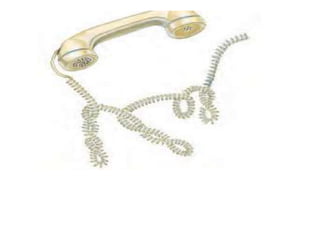
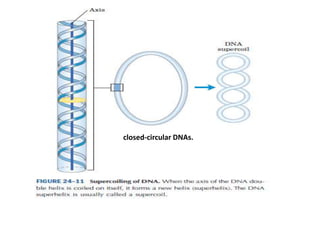
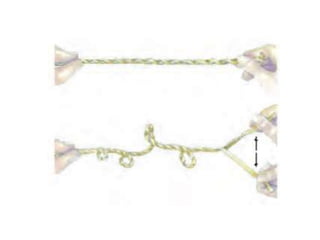
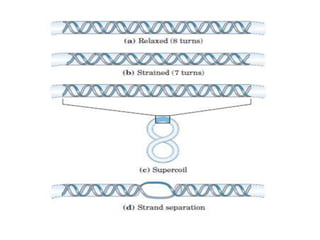
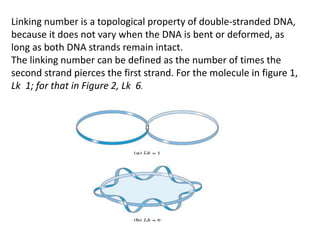
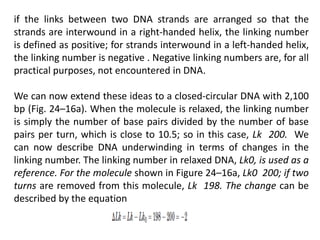
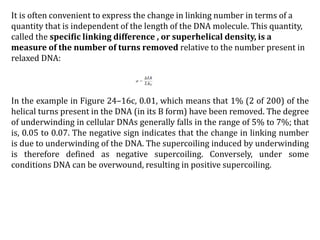
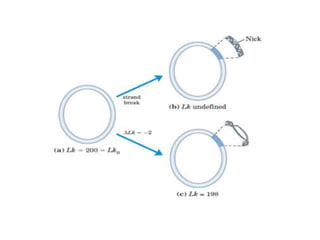
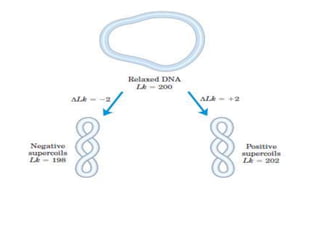
DNA supercoiling occurs when the DNA double helix further coils upon itself, introducing structural strain. Supercoiling is generally manifested as underwinding of the DNA double helix in closed circular DNA molecules, resulting in fewer helical turns than expected. This underwinding can be quantified based on the linking number, which represents the number of times one strand pierces the other, and the superhelical density, which expresses the change in linking number relative to relaxed DNA. Cellular DNA typically has a superhelical density of -0.05 to -0.07, indicating 5-7% underwinding that introduces negative supercoiling.


![ANIMAL_CELL_,_TISSUE_AND_ORGAN_CULTURE[1].pptx](https://cdn.slidesharecdn.com/ss_thumbnails/animalcelltissueandorganculture1-260204172026-4462b440-thumbnail.jpg?width=640&height=640&fit=bounds)

