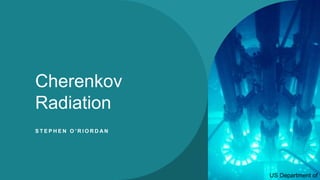
Cherenkov
Radiation
S T E P H E N O ’ R I O R D A N
US Department of
Outline of Presentation
EXPLANATION
OF CHERENKOV
RADIATION
FORMALISM
HISTORY OF THE
DISCOVERY
USES IN
CREATIVE
MEDIA
APPLICATIONS
Explanation of Cherenkov Radiation
• Electromagnetic radiation emitted when a charged particle passes through a
dielectric medium at a speed greater than the phase velocity of light in that medium.
• Basically it’s electrons moving FTL.
• The upper limit of c still exists but the speed of light in a medium could be 0.75c
(water) or 0.66c (glass). Charged particles can enter the medium at a higher speed
still.
• Cherenkov radiation is an effect that occurs as a result of the particle slowing down
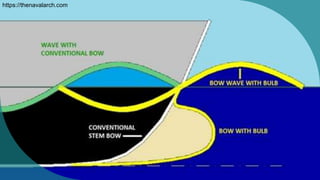
• A common analogy is the sonic boom of an aircraft.
History of the Discovery
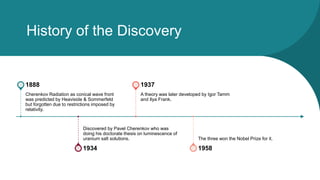
Cherenkov Radiation as conical wave front
was predicted by Heaviside & Sommerfeld
but forgotten due to restrictions imposed by
relativity.
1888
Discovered by Pavel Cherenkov who was
doing his doctorate thesis on luminescence of
uranium salt solutions.
1934
A theory was later developed by Igor Tamm
and Ilya Frank.
1937
The three won the Nobel Prize for it.
1958
History of the Discovery
• Cherenkov identified a blue glow around a radioactive preparation in water during
experiments. This was because he was using gamma rays to excite the uranium
salts rather than visible light.
• Marie Curie overserved a pale blue light in highly concentrated radium in 1910 but
didn’t investigate.
• In 2019 a team of researches discovered Cherenkov light from the vitreous humor of
patients undergoing radiotherapy. This explained patients reporting “flashes of bright
or blue light”.
The Actual Physics of it
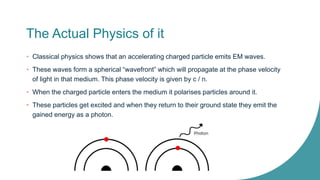
• Classical physics shows that an accelerating charged particle emits EM waves.
• These waves form a spherical “wavefront” which will propagate at the phase velocity
of light in that medium. This phase velocity is given by c / n.
• When the charged particle enters the medium it polarises particles around it.
• These particles get excited and when they return to their ground state they emit the
gained energy as a photon.
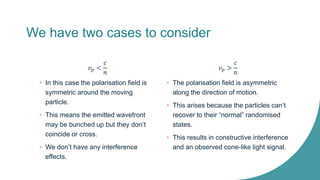
We have two cases to consider
𝑣𝑝 <
𝑐
𝑛
• In this case the polarisation field is
symmetric around the moving
particle.
• This means the emitted wavefront
may be bunched up but they don’t
coincide or cross.
• We don’t have any interference
effects.
𝑣𝑝 >
𝑐
𝑛
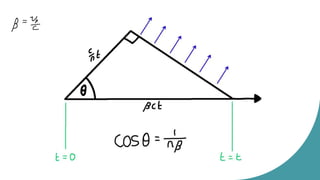
• The polarisation field is asymmetric
along the direction of motion.
• This arises because the particles can’t
recover to their “normal” randomised
states.
• This results in constructive interference
and an observed cone-like light signal.
Maritime-Executive
https://thenavalarch.com
Wikipedia Commons
Cherenkov Radiation in a Vacuum
• So far we’ve talked about Cherenkov radiation occurring in mediums as the phase
speed of light is slower. This should mean it’s impossible in a vacuum, right?
• A vacuum is actually filled with empheral/virtual particles that momentarily move in
an out of existence.
• When a strong electromagnetic field is applied it can imbue the vacuum with an
effective anisotropic refractive index.
• This can allow Cherenkov Radiation to occur in a vacuum.
Godzilla: King of the Monsters
Creative Media • Radiation is commonly portrayed as green
in movies. This is a myth.
• As mentioned before Cherenkov
Radiation actually emits a blue glow in
Nuclear Pools.
• The green colour likely comes from a few
radioactive compounds which glow green
including radium that was used in clock
dials and uranium glass
• Uranium and Plutonium for example are
just grey metals.
Applications
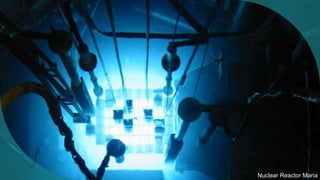
• Cherenkov Radiation is used in open pool reactors to identify the remaining
radioactive of spent fuel rods.
• Astrophysics Experiments
• High-Energy Gamma Rays or Cosmic Rays
• Particle Physics Experiments
• Identifying particles in a particle accelerator.
Nuclear Reactor Maria
Astrophysics
Experiments
• When high energy cosmic rays hit the Earth’s
atmosphere Cherenkov Radiation occurs. This
creates a cone of light on the ground that can be
detected.
• Additionally the high energy particle interacts with
the atoms in the air which can create a cascade of
additional particle.
• Each of these particles can also create Cherenkov
light.
• Current instruments that detect this are:
• H.E.S.S.
• MAGIC
• VERITAS
Imaging Atmospheric Chernekov Telescope
• Used to detect photons with energys in the range of 50GeV to 50TeV
• Space based detectors are generally ineffective due to size limitation but IACTs
essentially use the Earth’s Atmosphere as the detection medium.
• The air shower produces a flash of radiation lasting between 5 and 20ns.
• The instrument usually comprises a large mirror which reflects the light onto an array
of photomultiplier tubes
• The most effective method is to have an array of telescopes spaced far apart. This is
because muons that are produced by the air shower create Cherenkov light which
can be difficult to filter out. This light cone is extremely narrow though.
Particle
Physics
Experiments
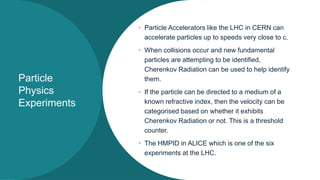
• Particle Accelerators like the LHC in CERN can
accelerate particles up to speeds very close to c.
• When collisions occur and new fundamental
particles are attempting to be identified,
Cherenkov Radiation can be used to help identify
them.
• If the particle can be directed to a medium of a
known refractive index, then the velocity can be
categorised based on whether it exhibits
Cherenkov Radiation or not. This is a threshold
counter.
• The HMPID in ALICE which is one of the six
experiments at the LHC.
HMPID-ALICE
• Used to identify charged particles such as pions, kaons, protons.
• HMPID is a Ring Imaging Cherenkov detector with two main parts:
• Radiator medium
• Photon detector
• It has 7 RICH counters each 1.4m x 1.3m each.
• It measures the angle of emission 𝜃 that we discussed before to calculate the
velocity.
Summary • History of the discovery
• Explanation and formalism
• Hollywood not understanding radiation
• Applications
• Open Pool Reactors
• Astrophysics Experiments (IACTs)
• Particle Physics Experiments (HMPID-ALICE)

Cherenkov Radiation

  • 1.
    Cherenkov Radiation S T EP H E N O ’ R I O R D A N US Department of
  • 2.
    Outline of Presentation EXPLANATION OFCHERENKOV RADIATION FORMALISM HISTORY OF THE DISCOVERY USES IN CREATIVE MEDIA APPLICATIONS
  • 3.
    Explanation of CherenkovRadiation • Electromagnetic radiation emitted when a charged particle passes through a dielectric medium at a speed greater than the phase velocity of light in that medium. • Basically it’s electrons moving FTL. • The upper limit of c still exists but the speed of light in a medium could be 0.75c (water) or 0.66c (glass). Charged particles can enter the medium at a higher speed still. • Cherenkov radiation is an effect that occurs as a result of the particle slowing down • A common analogy is the sonic boom of an aircraft.
  • 4.
    History of theDiscovery Cherenkov Radiation as conical wave front was predicted by Heaviside & Sommerfeld but forgotten due to restrictions imposed by relativity. 1888 Discovered by Pavel Cherenkov who was doing his doctorate thesis on luminescence of uranium salt solutions. 1934 A theory was later developed by Igor Tamm and Ilya Frank. 1937 The three won the Nobel Prize for it. 1958
  • 5.
    History of theDiscovery • Cherenkov identified a blue glow around a radioactive preparation in water during experiments. This was because he was using gamma rays to excite the uranium salts rather than visible light. • Marie Curie overserved a pale blue light in highly concentrated radium in 1910 but didn’t investigate. • In 2019 a team of researches discovered Cherenkov light from the vitreous humor of patients undergoing radiotherapy. This explained patients reporting “flashes of bright or blue light”.
  • 6.
    The Actual Physicsof it • Classical physics shows that an accelerating charged particle emits EM waves. • These waves form a spherical “wavefront” which will propagate at the phase velocity of light in that medium. This phase velocity is given by c / n. • When the charged particle enters the medium it polarises particles around it. • These particles get excited and when they return to their ground state they emit the gained energy as a photon.
  • 8.
    We have twocases to consider 𝑣𝑝 < 𝑐 𝑛 • In this case the polarisation field is symmetric around the moving particle. • This means the emitted wavefront may be bunched up but they don’t coincide or cross. • We don’t have any interference effects. 𝑣𝑝 > 𝑐 𝑛 • The polarisation field is asymmetric along the direction of motion. • This arises because the particles can’t recover to their “normal” randomised states. • This results in constructive interference and an observed cone-like light signal.
  • 9.
  • 10.
  • 11.
  • 13.
    Cherenkov Radiation ina Vacuum • So far we’ve talked about Cherenkov radiation occurring in mediums as the phase speed of light is slower. This should mean it’s impossible in a vacuum, right? • A vacuum is actually filled with empheral/virtual particles that momentarily move in an out of existence. • When a strong electromagnetic field is applied it can imbue the vacuum with an effective anisotropic refractive index. • This can allow Cherenkov Radiation to occur in a vacuum.
  • 14.
    Godzilla: King ofthe Monsters
  • 15.
    Creative Media •Radiation is commonly portrayed as green in movies. This is a myth. • As mentioned before Cherenkov Radiation actually emits a blue glow in Nuclear Pools. • The green colour likely comes from a few radioactive compounds which glow green including radium that was used in clock dials and uranium glass • Uranium and Plutonium for example are just grey metals.
  • 16.
    Applications • Cherenkov Radiationis used in open pool reactors to identify the remaining radioactive of spent fuel rods. • Astrophysics Experiments • High-Energy Gamma Rays or Cosmic Rays • Particle Physics Experiments • Identifying particles in a particle accelerator.
  • 17.
  • 18.
    Astrophysics Experiments • When highenergy cosmic rays hit the Earth’s atmosphere Cherenkov Radiation occurs. This creates a cone of light on the ground that can be detected. • Additionally the high energy particle interacts with the atoms in the air which can create a cascade of additional particle. • Each of these particles can also create Cherenkov light. • Current instruments that detect this are: • H.E.S.S. • MAGIC • VERITAS
  • 19.
    Imaging Atmospheric ChernekovTelescope • Used to detect photons with energys in the range of 50GeV to 50TeV • Space based detectors are generally ineffective due to size limitation but IACTs essentially use the Earth’s Atmosphere as the detection medium. • The air shower produces a flash of radiation lasting between 5 and 20ns. • The instrument usually comprises a large mirror which reflects the light onto an array of photomultiplier tubes • The most effective method is to have an array of telescopes spaced far apart. This is because muons that are produced by the air shower create Cherenkov light which can be difficult to filter out. This light cone is extremely narrow though.
  • 20.
    Particle Physics Experiments • Particle Acceleratorslike the LHC in CERN can accelerate particles up to speeds very close to c. • When collisions occur and new fundamental particles are attempting to be identified, Cherenkov Radiation can be used to help identify them. • If the particle can be directed to a medium of a known refractive index, then the velocity can be categorised based on whether it exhibits Cherenkov Radiation or not. This is a threshold counter. • The HMPID in ALICE which is one of the six experiments at the LHC.
  • 21.
    HMPID-ALICE • Used toidentify charged particles such as pions, kaons, protons. • HMPID is a Ring Imaging Cherenkov detector with two main parts: • Radiator medium • Photon detector • It has 7 RICH counters each 1.4m x 1.3m each. • It measures the angle of emission 𝜃 that we discussed before to calculate the velocity.
  • 22.
    Summary • Historyof the discovery • Explanation and formalism • Hollywood not understanding radiation • Applications • Open Pool Reactors • Astrophysics Experiments (IACTs) • Particle Physics Experiments (HMPID-ALICE)

Editor's Notes

  • #6 Cherenkov was able to identify a characteristic blue glow in the water around the radioactive material he was preparing. This was because he was using higher energy gamma rays to excite the uranium salts rather than visible light, which was more common at the time. However, this wasn’t the first time this glow had been identified. Marie Curie saw a similar glow in Radium in 1910. Cherenkov was just the first to explore it. To show that this is still something of ongoing interest, in 2019 a team of researches discovered Cherenkov light from the vitreous humour of patients undergoing radiotherapy. That’s the gel like substance your eye is made of. This explained why patients had reported seeing a blue light whilst undergoing radiotherapy.
  • #19 High Energy Stereoscopic System in Namibia Major Atmospheric Gamma Imaging Cherenkov Telescopes in Canary Islands Very Energetic Radiation Imaging Telescope Array System in Arizona
  • #21 High Momentum Particle Identification Detector A Large Ion Collider Experiment