ORGANIZATIONAL FUNCTION:
       OPERATIONS
By: Maritess Araña-Pagunuran & Noreen M. Morales
OPERATIONS
• (pl) the     agency     of    an
  organization    charged      with
  carrying   on    the    principal
  planning and operating functions
  of a headquarters and its
  subordinate units . (merriam-
 webster.com)
OPERATIONS
• A function or a “presence” that
  exists within the context of a
  dynamic and on-going business.
• In the broadest sense, it is a
  service function.
              (Ferrara Consulting Group)
OPERATIONS MANAGEMENT
• is    the   business     function   that
  plans, organizes, coordinates, and
  controls the resources needed to
  produce a company’s goods and
  services.    It   involves     managing
  people, equipment, technology, informati
  on, and many other resources.
                               http://www.scribd.com
FUNCTIONS

• Get things done
• Produce goods/services for the
  customers
• Orchestrate all the resources needed to
  produce the final product
• Transform organizational inputs to
  outputs
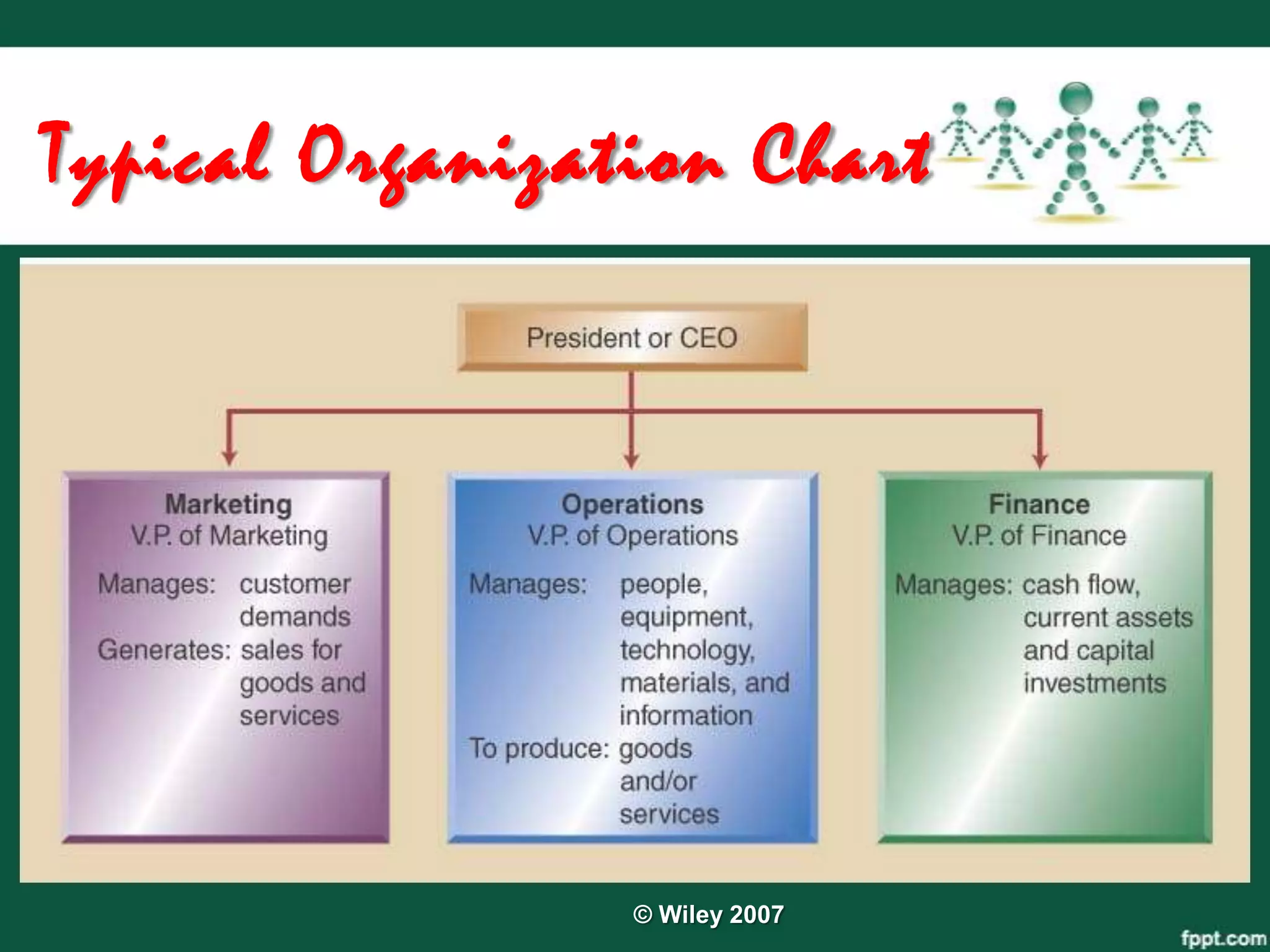
Typical Organization Chart


                 © Wiley 2007
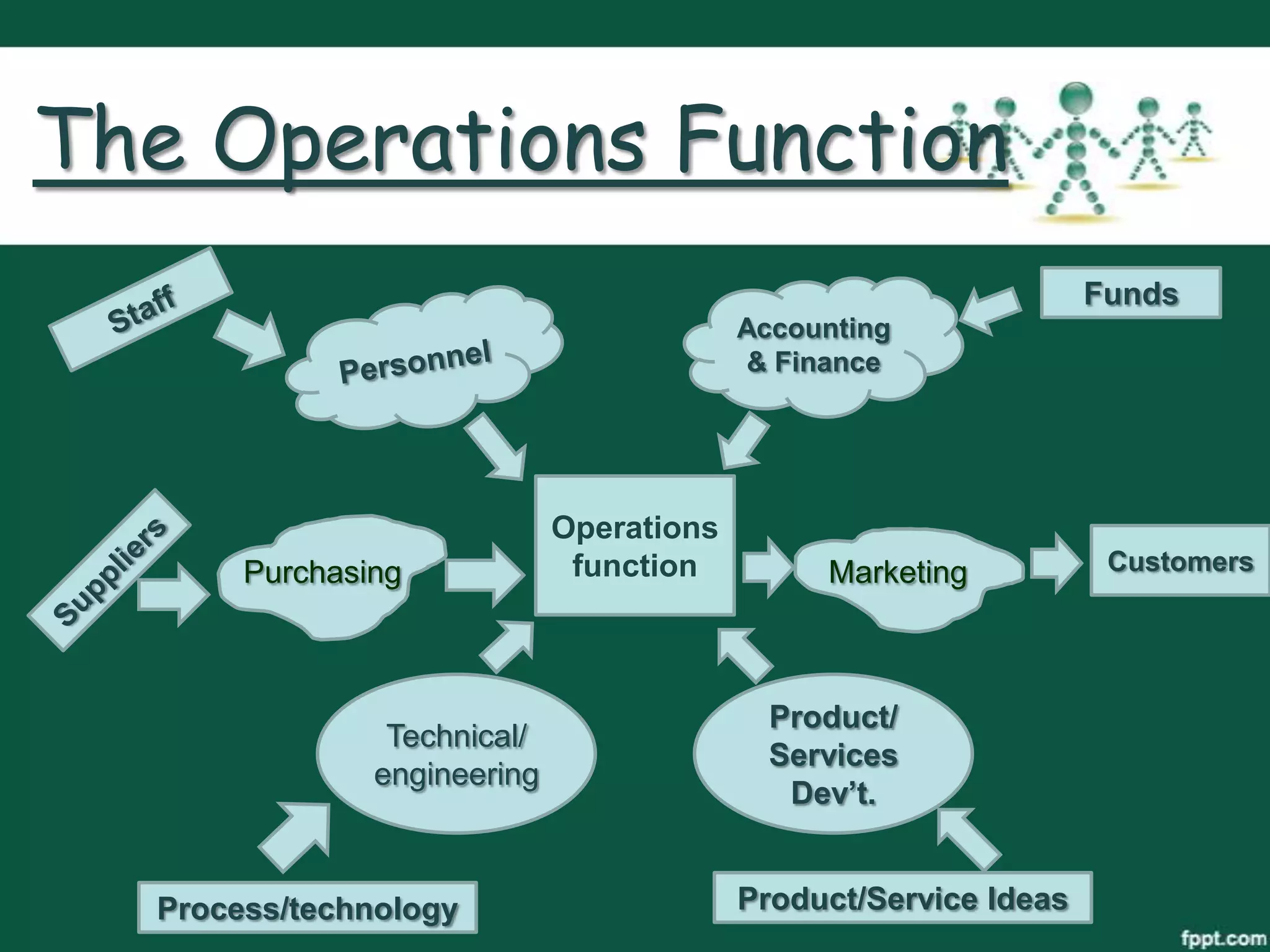
The Operations Function
                                                                  Funds
                                          Accounting
                                          & Finance


                             Operations
       Purchasing             function         Marketing           Customers


                                            Product/
                Technical/
                                            Services
               engineering
                                             Dev‟t.


  Process/technology                      Product/Service Ideas
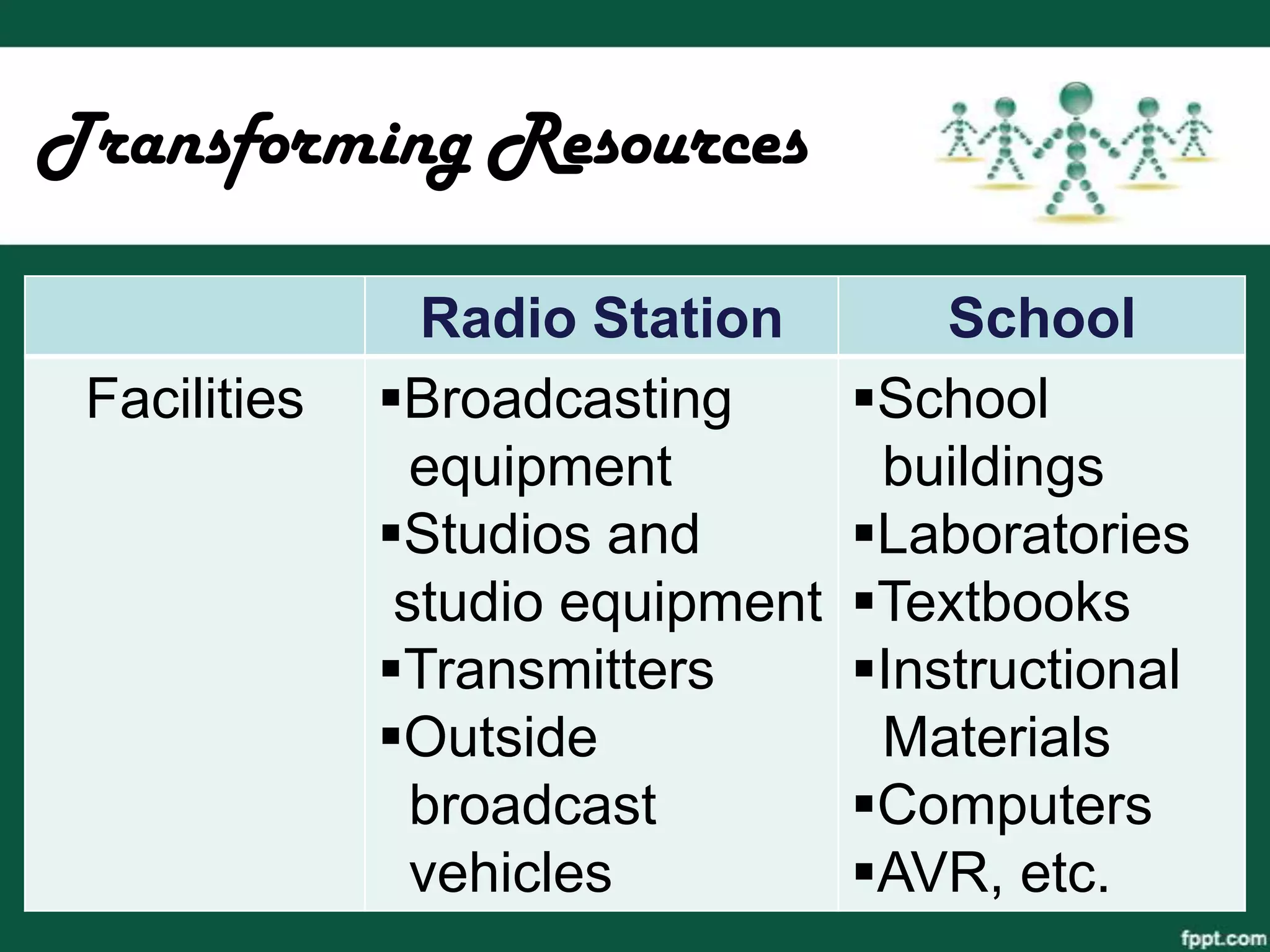
Transforming Resources

                Radio Station         School
 Facilities   Broadcasting       School
                equipment          buildings
              Studios and        Laboratories
               studio equipment   Textbooks
              Transmitters       Instructional
              Outside             Materials
                broadcast         Computers
                vehicles          AVR, etc.
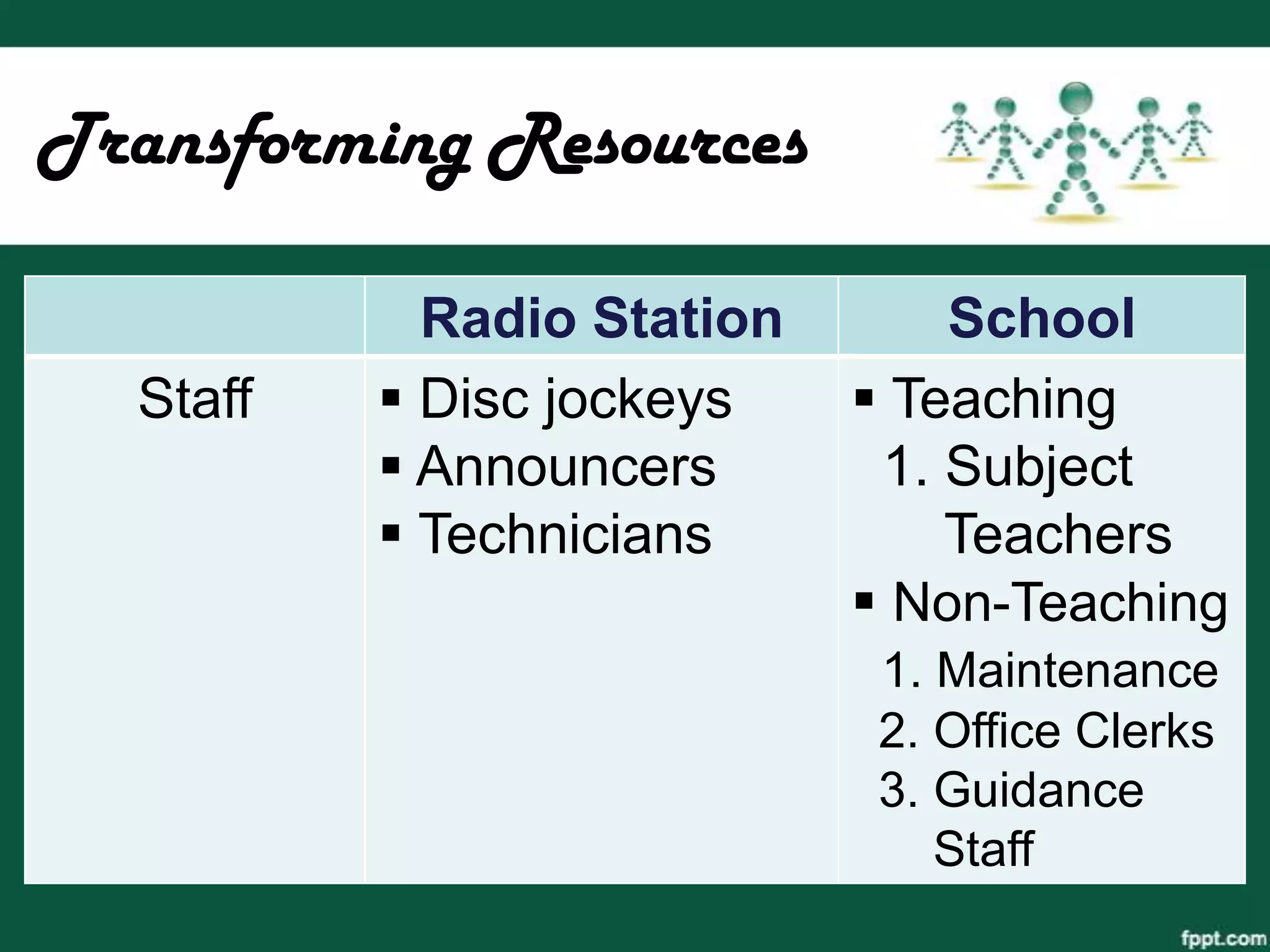
Transforming Resources

            Radio Station       School
  Staff    Disc jockeys     Teaching
           Announcers       1. Subject
           Technicians         Teachers
                             Non-Teaching
                             1. Maintenance
                             2. Office Clerks
                             3. Guidance
                                Staff
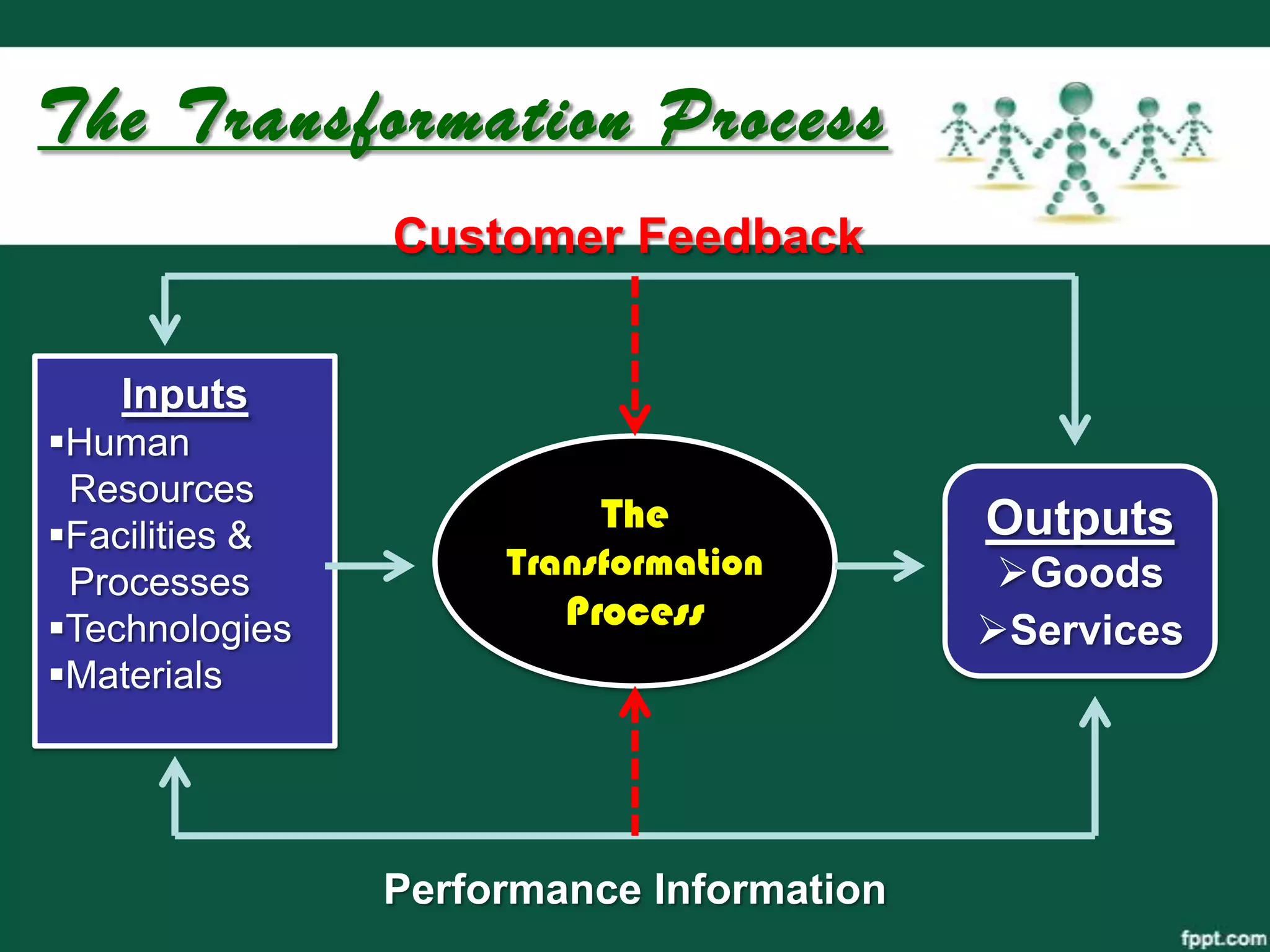
The Transformation Process
                Customer Feedback


   Inputs
Human
 Resources
Facilities &
                          The             Outputs
                     Transformation        Goods
 Processes
Technologies           Process           Services
Materials


                Performance Information
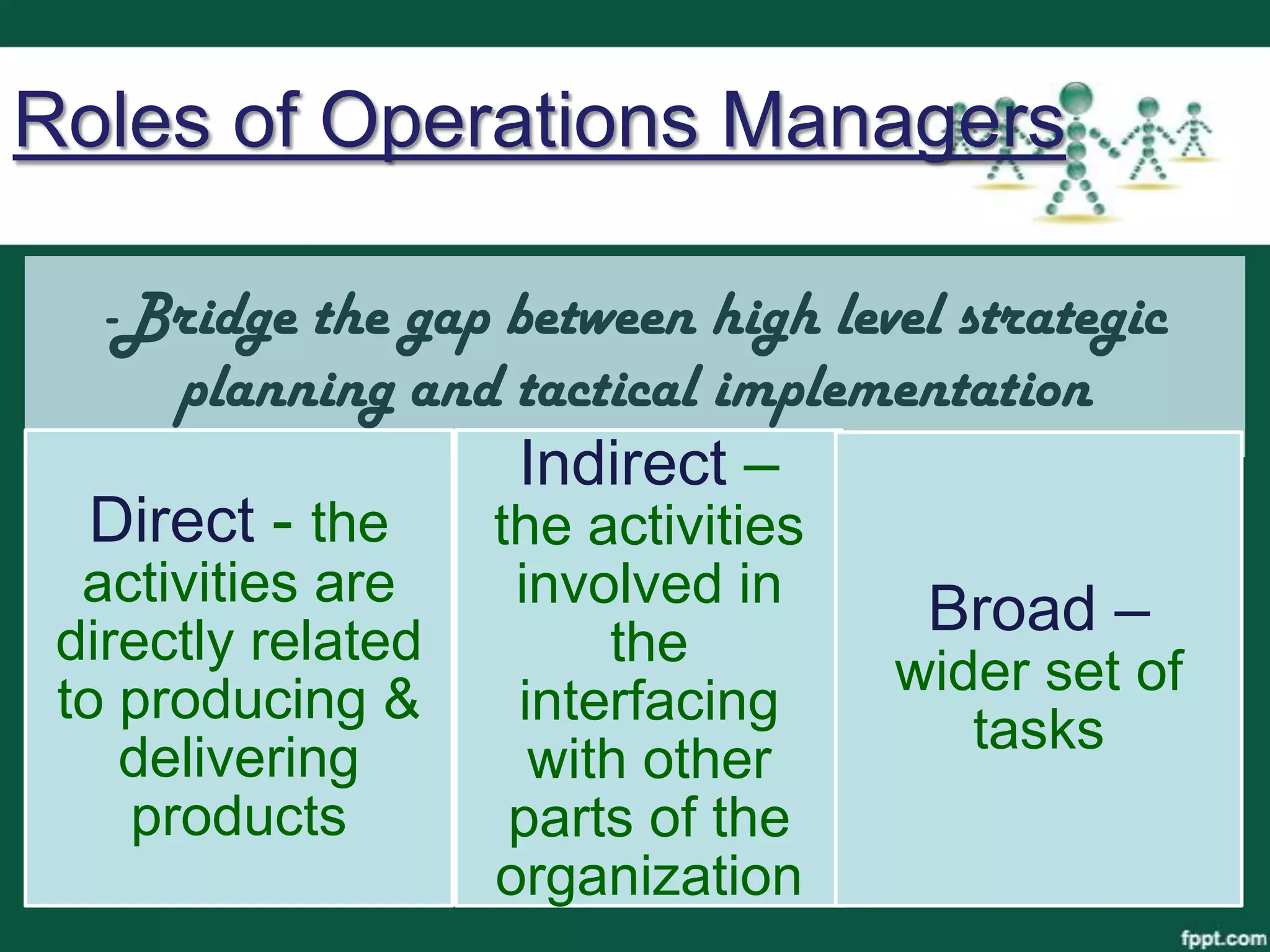
Roles of Operations Managers

   -Bridge the gap between high level strategic
      planning and tactical implementation
                    Indirect –
  Direct - the    the activities
  activities are   involved in
 directly related      the
                                    Broad –
 to producing &                    wider set of
                    interfacing
    delivering                        tasks
                     with other
    products       parts of the
                   organization
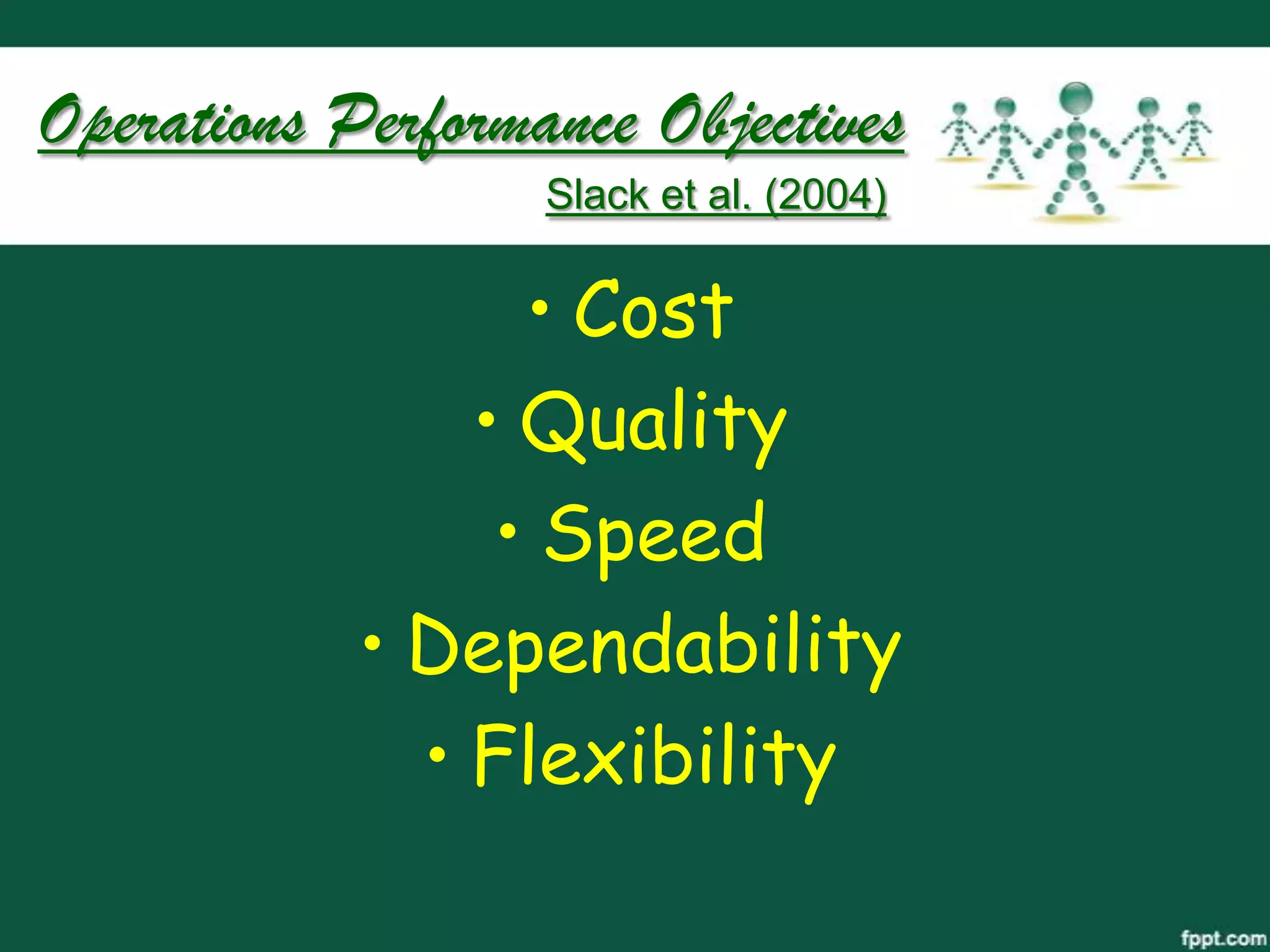
Operations Performance Objectives
                   Slack et al. (2004)


                  • Cost
                • Quality
                 • Speed
            • Dependability
              • Flexibility
TRADE-OFF
                Skinner (1969)


•The concept based on the
 premise that it is impossible
 to excel simultaneously at all
 aspects of operations
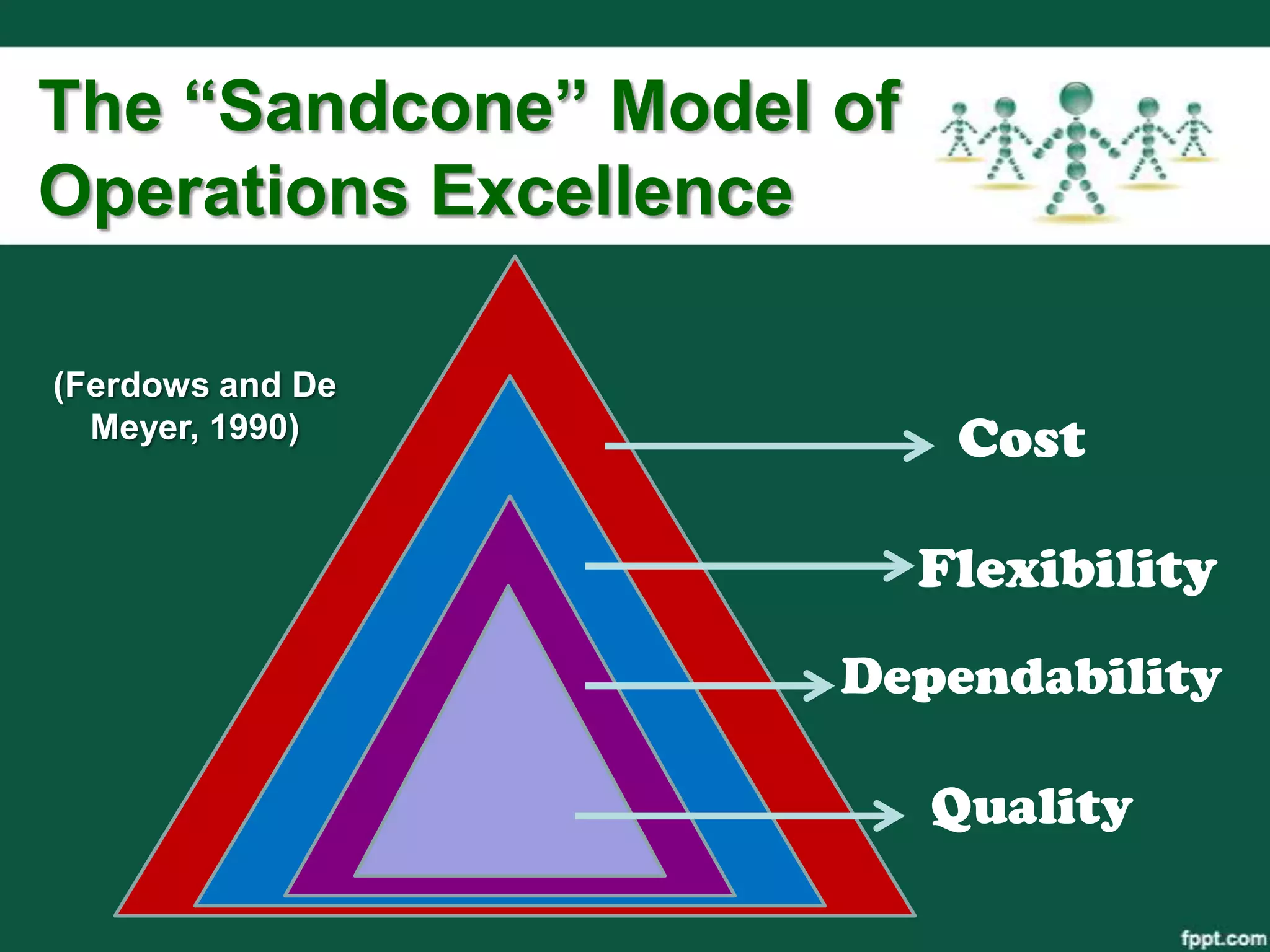
The “Sandcone” Model of
Operations Excellence

(Ferdows and De
  Meyer, 1990)             Cost

                          Flexibility
                     Dependability

                          Quality
CASE STUDY # 1
Easy Jet: Low Cost Air Travel
Aim:       Minimize Operations Cost
Through…
  1. use of the internet to reduce distribution
  cost
  2. ticketless travel
  3. no free on-board catering
  4. efficient use of airports
  5. paperless operations
Four-stage Model of the Strategic Role
of Operations (Hayes and Wheelwright, 1984)

               INTERNALLY NEUTRAL
      S
               The operations function is
      T          internally focused and
      A      reactive. They are viewed as
      G     “necessary evil”. The best that
      E         the org hopes for is that
              operations “don’t screw up”.
      1
Stage 2 – Externally Neutral
• The operations function tries to be as good
  as the competition, or to achieve parity with
  industry norms.
• Is likely to benchmark its operations
  against its competitors
• Adopts best practice in its industry so that it
  does not hold the organization back
Stage 3 – Internally Supportive
• The operations function seeks to provide
  credible support for the organizations
  business strategy
• Organization’s operations are likely to be
  amongst the best in its industry
• Operations strategy will be developed
  which will be derived from, and support the
  business strategy.
Stage 4 – Externally Supportive

• The operations function provides the basis of
  competitive advantage for the
  organization, by setting the standard in their
  industry
• Is likely to aim to be world class
• Operations exceeds customers expectations
• Operations is managed proactively
Operations Strategy


• Concerns      the    pattern     of
  strategic decisions and actions
  which            set            the
  role, objectives, and activities of
  operations
                           (Slack et al., 2004)
Operations Strategy


• A pattern in a stream of actions
  realized through a combination
  of deliberate and emergent
  actions
                   (Mintzberg and Waters, 1985)
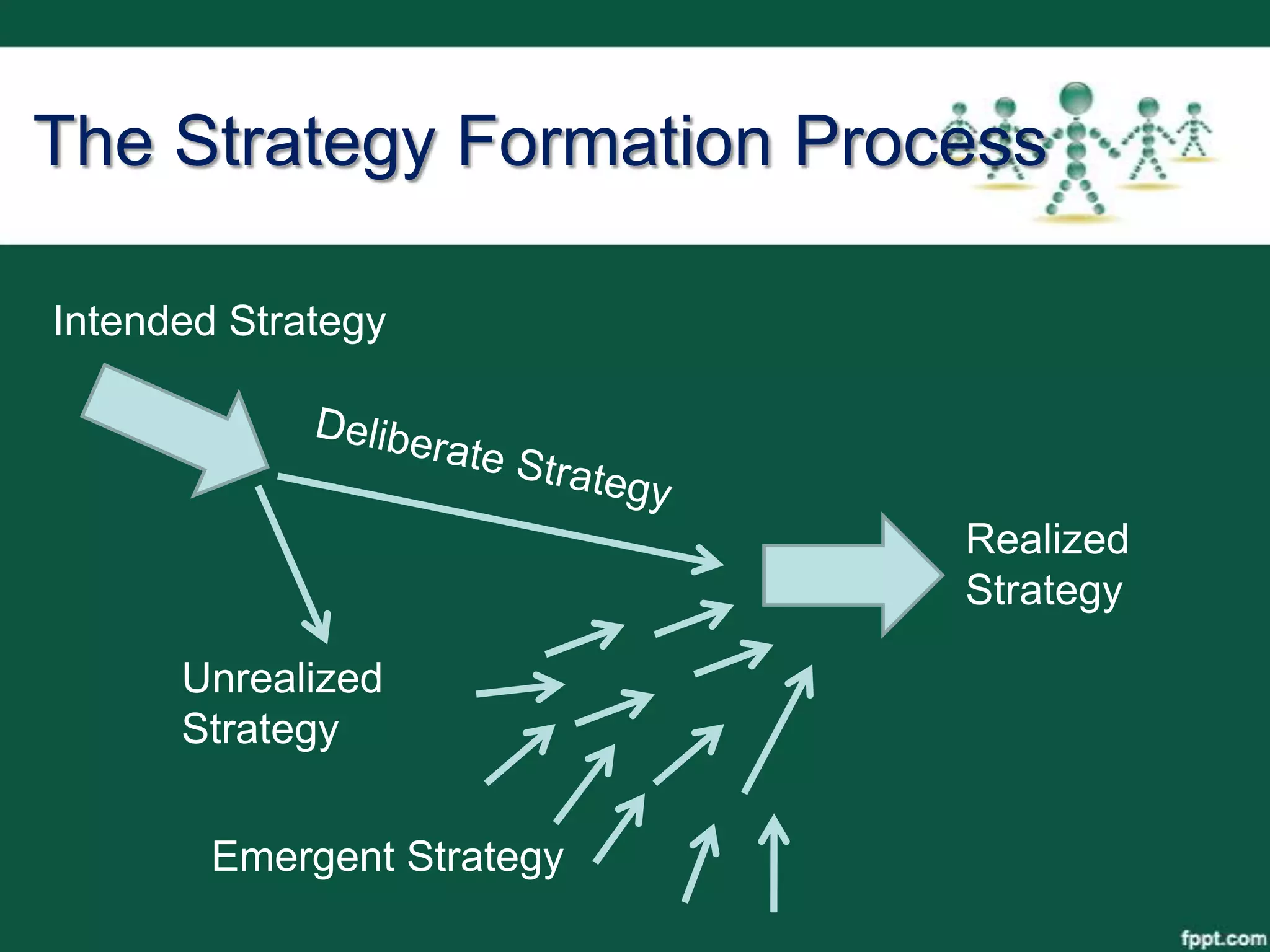
The Strategy Formation Process

Intended Strategy


                            Realized
                            Strategy

      Unrealized
      Strategy


        Emergent Strategy
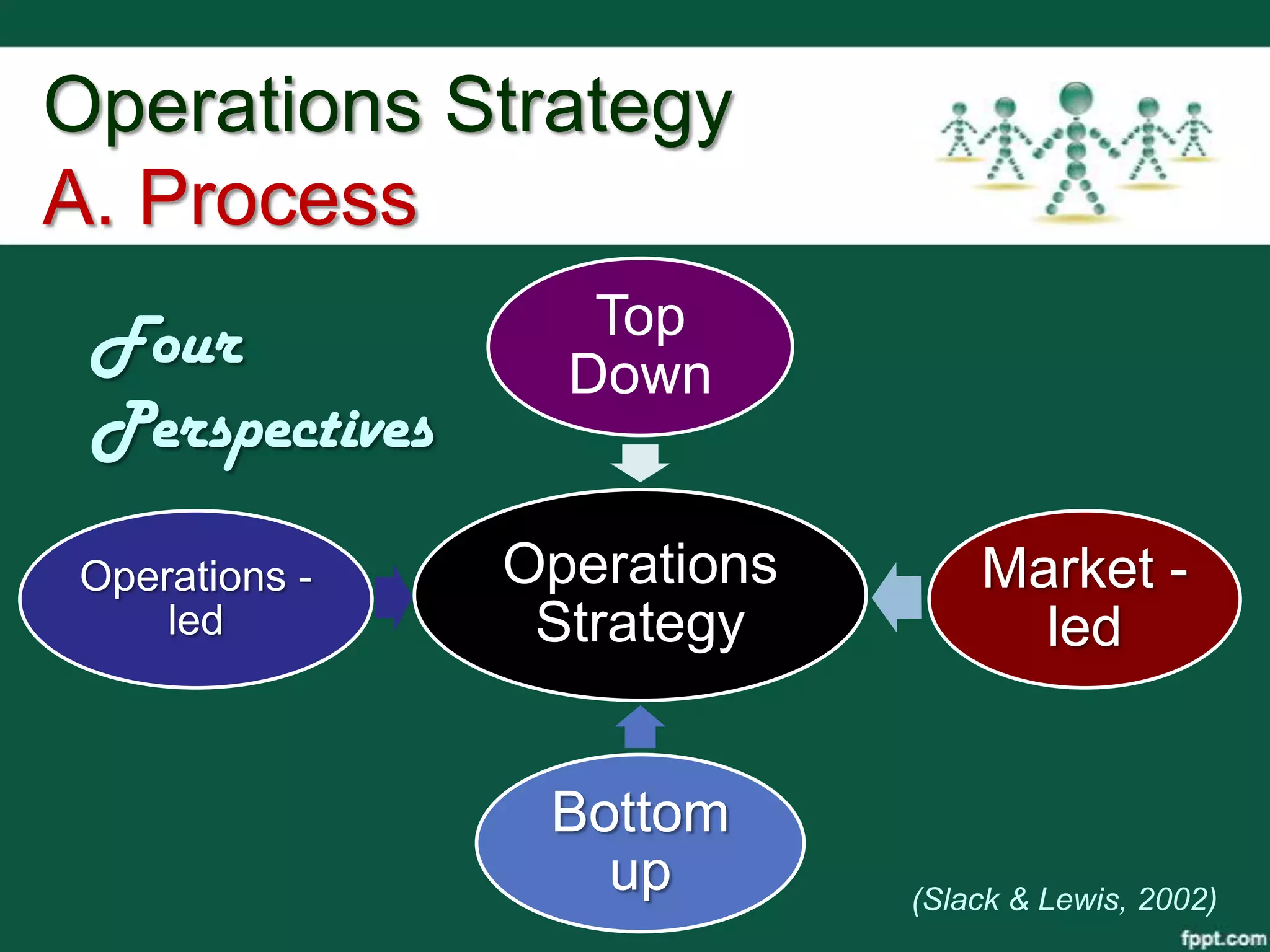
Operations Strategy
A. Process
 Four              Top
                  Down
 Perspectives

 Operations -   Operations       Market -
     led         Strategy          led


                 Bottom
                   up        (Slack & Lewis, 2002)
Operations Strategy
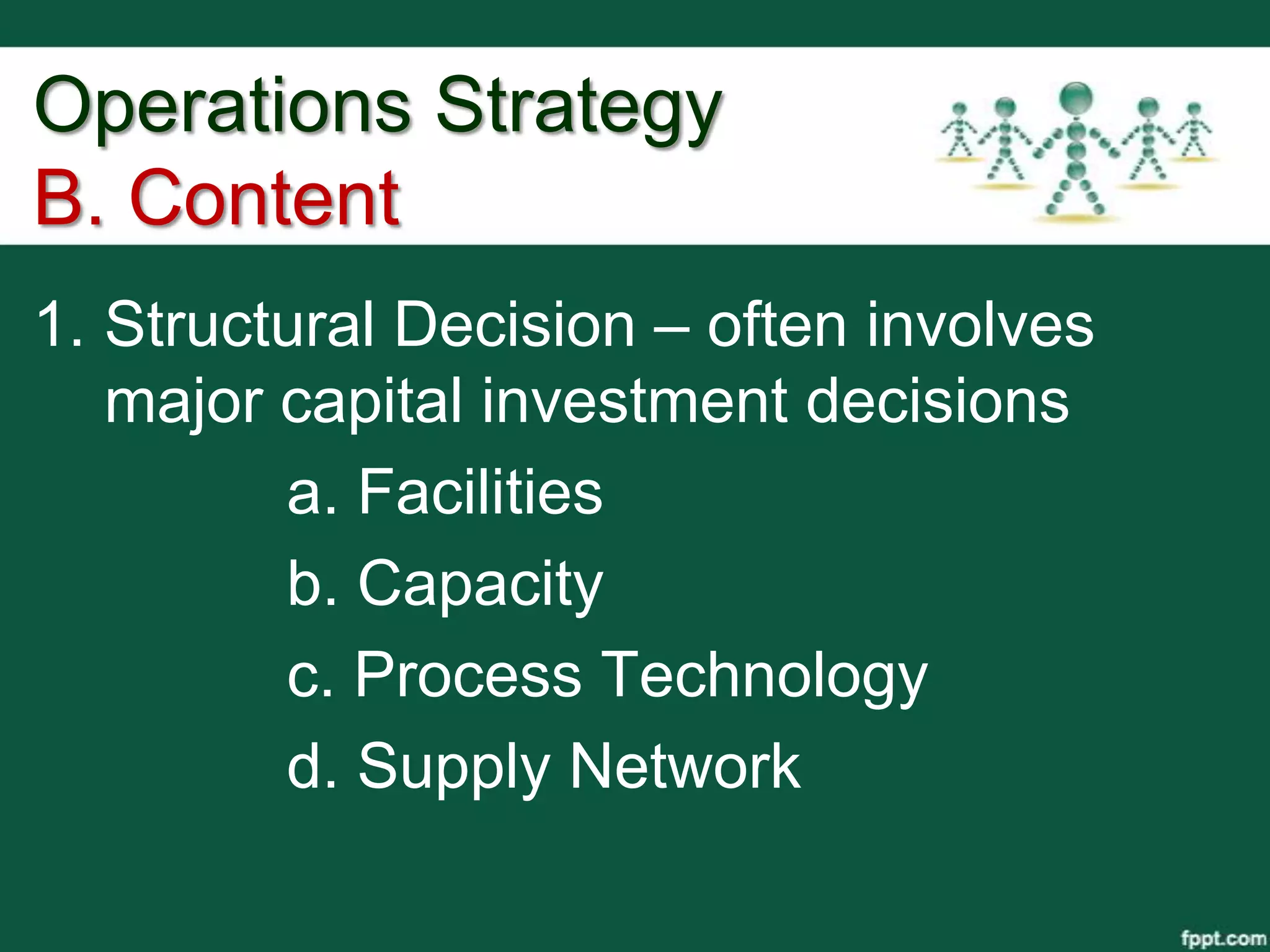
B. Content
1. Structural Decision – often involves
   major capital investment decisions
         a. Facilities
         b. Capacity
         c. Process Technology
         d. Supply Network
Operations Strategy
B. Content
2. Infrastructural Decision
          a. Planning and Control
          b. Quality
          c. Work Organization
          d. Human Resources
          f. New Product Development
          g. Performance Measurement
CONCLUSIONS
A well-defined and a robust operations
 would manifest the following functions:
• Actively manage the planning and
  budget and aggregate findings into a
  cohesive strategic plan
• Provide highly effective tactical
  execution or program management for
  all major initiatives
CONCLUSIONS

• Provide a bridge between strategic
  vision and operational readiness
• Create a balance between each
  operating groups to ensure maximum
  performance
• Manage an effective communications
  process and build consensus
CONCLUSIONS

• Implement and manage key quality
  metrics and performance standards
• Manage a human capital plan that
  includes reliable succession planning
• Business process re-engineering and
  auditing to ensure best practices across
  all departments
CONCLUSIONS

• Manage overall costs and productivity
  consistent with financial objectives
• Provide oversight and guidance in all
  major third party alliance, including
  appropriate due diligence
• Conduct contract reviews to ensure
  operational compliance
References:
Ferdows, K. and de Meyer, A. (1990) Journal of Operations Management 9 (2);
   168-184
Hayes, R.H. and Wheelwright, S.C. (1984) Restoring Our Competitive edge:
   Competing through Manufacturing, New York: John Wily & Sons.
Mintzberg, H. and Waters, J.A. (1985) „Of Strategies, deliberate and emergent‟,
   Strategic Management Journal 6: 257-72.
Skinner, W. (1969) „Manufacturing: The missing link in corporate strategy‟,
   Harvard Business Review 47 (3):136-145
Slack, N., Chambers, S., and Johnston, R. (2004) Operations Management (4th
   edition), Harlow: Pearson Education
Slack, N. and Lewis, M. (2002) Operations Strategy, Harlow: Pearson
   Education
http://www.EasyJet.com
http://www.ferraraconsulting.com
http://www.merriam-webster.com
http://scribd.com/doc/48843212/Introduction-to-Operations-management

Organizational Function: Operations

  • 1.
    ORGANIZATIONAL FUNCTION: OPERATIONS By: Maritess Araña-Pagunuran & Noreen M. Morales
  • 2.
    OPERATIONS • (pl) the agency of an organization charged with carrying on the principal planning and operating functions of a headquarters and its subordinate units . (merriam- webster.com)
  • 3.
    OPERATIONS • A functionor a “presence” that exists within the context of a dynamic and on-going business. • In the broadest sense, it is a service function. (Ferrara Consulting Group)
  • 4.
    OPERATIONS MANAGEMENT • is the business function that plans, organizes, coordinates, and controls the resources needed to produce a company’s goods and services. It involves managing people, equipment, technology, informati on, and many other resources. http://www.scribd.com
  • 5.
    FUNCTIONS • Get thingsdone • Produce goods/services for the customers • Orchestrate all the resources needed to produce the final product • Transform organizational inputs to outputs
  • 6.
  • 7.
    The Operations Function Funds Accounting & Finance Operations Purchasing function Marketing Customers Product/ Technical/ Services engineering Dev‟t. Process/technology Product/Service Ideas
  • 8.
    Transforming Resources Radio Station School Facilities Broadcasting School equipment buildings Studios and Laboratories studio equipment Textbooks Transmitters Instructional Outside Materials broadcast Computers vehicles AVR, etc.
  • 9.
    Transforming Resources Radio Station School Staff  Disc jockeys  Teaching  Announcers 1. Subject  Technicians Teachers  Non-Teaching 1. Maintenance 2. Office Clerks 3. Guidance Staff
  • 10.
    The Transformation Process Customer Feedback Inputs Human Resources Facilities & The Outputs Transformation Goods Processes Technologies Process Services Materials Performance Information
  • 11.
    Roles of OperationsManagers -Bridge the gap between high level strategic planning and tactical implementation Indirect – Direct - the the activities activities are involved in directly related the Broad – to producing & wider set of interfacing delivering tasks with other products parts of the organization
  • 12.
    Operations Performance Objectives Slack et al. (2004) • Cost • Quality • Speed • Dependability • Flexibility
  • 13.
    TRADE-OFF Skinner (1969) •The concept based on the premise that it is impossible to excel simultaneously at all aspects of operations
  • 14.
    The “Sandcone” Modelof Operations Excellence (Ferdows and De Meyer, 1990) Cost Flexibility Dependability Quality
  • 15.
    CASE STUDY #1 Easy Jet: Low Cost Air Travel Aim: Minimize Operations Cost Through… 1. use of the internet to reduce distribution cost 2. ticketless travel 3. no free on-board catering 4. efficient use of airports 5. paperless operations
  • 16.
    Four-stage Model ofthe Strategic Role of Operations (Hayes and Wheelwright, 1984) INTERNALLY NEUTRAL S The operations function is T internally focused and A reactive. They are viewed as G “necessary evil”. The best that E the org hopes for is that operations “don’t screw up”. 1
  • 17.
    Stage 2 –Externally Neutral • The operations function tries to be as good as the competition, or to achieve parity with industry norms. • Is likely to benchmark its operations against its competitors • Adopts best practice in its industry so that it does not hold the organization back
  • 18.
    Stage 3 –Internally Supportive • The operations function seeks to provide credible support for the organizations business strategy • Organization’s operations are likely to be amongst the best in its industry • Operations strategy will be developed which will be derived from, and support the business strategy.
  • 19.
    Stage 4 –Externally Supportive • The operations function provides the basis of competitive advantage for the organization, by setting the standard in their industry • Is likely to aim to be world class • Operations exceeds customers expectations • Operations is managed proactively
  • 20.
    Operations Strategy • Concerns the pattern of strategic decisions and actions which set the role, objectives, and activities of operations (Slack et al., 2004)
  • 21.
    Operations Strategy • Apattern in a stream of actions realized through a combination of deliberate and emergent actions (Mintzberg and Waters, 1985)
  • 22.
    The Strategy FormationProcess Intended Strategy Realized Strategy Unrealized Strategy Emergent Strategy
  • 23.
    Operations Strategy A. Process Four Top Down Perspectives Operations - Operations Market - led Strategy led Bottom up (Slack & Lewis, 2002)
  • 24.
    Operations Strategy B. Content 1.Structural Decision – often involves major capital investment decisions a. Facilities b. Capacity c. Process Technology d. Supply Network
  • 25.
    Operations Strategy B. Content 2.Infrastructural Decision a. Planning and Control b. Quality c. Work Organization d. Human Resources f. New Product Development g. Performance Measurement
  • 26.
    CONCLUSIONS A well-defined anda robust operations would manifest the following functions: • Actively manage the planning and budget and aggregate findings into a cohesive strategic plan • Provide highly effective tactical execution or program management for all major initiatives
  • 27.
    CONCLUSIONS • Provide abridge between strategic vision and operational readiness • Create a balance between each operating groups to ensure maximum performance • Manage an effective communications process and build consensus
  • 28.
    CONCLUSIONS • Implement andmanage key quality metrics and performance standards • Manage a human capital plan that includes reliable succession planning • Business process re-engineering and auditing to ensure best practices across all departments
  • 29.
    CONCLUSIONS • Manage overallcosts and productivity consistent with financial objectives • Provide oversight and guidance in all major third party alliance, including appropriate due diligence • Conduct contract reviews to ensure operational compliance
  • 30.
    References: Ferdows, K. andde Meyer, A. (1990) Journal of Operations Management 9 (2); 168-184 Hayes, R.H. and Wheelwright, S.C. (1984) Restoring Our Competitive edge: Competing through Manufacturing, New York: John Wily & Sons. Mintzberg, H. and Waters, J.A. (1985) „Of Strategies, deliberate and emergent‟, Strategic Management Journal 6: 257-72. Skinner, W. (1969) „Manufacturing: The missing link in corporate strategy‟, Harvard Business Review 47 (3):136-145 Slack, N., Chambers, S., and Johnston, R. (2004) Operations Management (4th edition), Harlow: Pearson Education Slack, N. and Lewis, M. (2002) Operations Strategy, Harlow: Pearson Education http://www.EasyJet.com http://www.ferraraconsulting.com http://www.merriam-webster.com http://scribd.com/doc/48843212/Introduction-to-Operations-management