GLOBAL HUMAN RESOURCE
MANAGEMENT
Instructor
Mr. Shyamasundar Tripathy
Definition of Global Human
Resource Management/IHRM
 IHRM is the process of procuring, allocating and

effectively utilizing human resources in multinational
corporation.
What is Global Human Resource
Management
As a field it is about: the understanding, researching,
applying and revising all human resource activities in
their internal and external contexts as they impact
the process of managing human resources in
enterprises throughout the global environment to
enhance the experience of multiple stakeholders,
including investors, customers, employees, partners,
suppliers, environment, and society.
Forms of International HRM
 Operation of parent-country firms
 Operation of foreign firms in the home country
 Operation of Third party nationals
 Employment of foreign citizens (or recent immigrants

and/or their families
Strategic objective of GHRM/IHRM
 Problem of integration.(HQ to Subsidiary)
 Problem of differentiation.(Flexibility in policies and






practices)
Involves constantly changing perspectives
Requires more involvement in employees personal
lives
Is influenced by more external sources.
Involves a greater level of risk than typical domestic
HRM
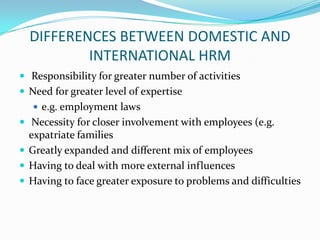
DIFFERENCES BETWEEN DOMESTIC AND
INTERNATIONAL HRM
 Responsibility for greater number of activities
 Need for greater level of expertise
 e.g. employment laws

 Necessity for closer involvement with employees (e.g.

expatriate families
 Greatly expanded and different mix of employees
 Having to deal with more external influences
 Having to face greater exposure to problems and difficulties
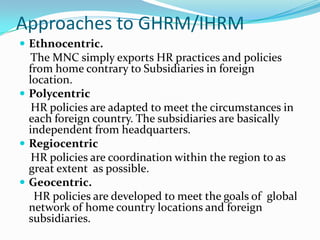
Approaches to GHRM/IHRM
 Ethnocentric.

The MNC simply exports HR practices and policies
from home contrary to Subsidiaries in foreign
location.
 Polycentric
HR policies are adapted to meet the circumstances in
each foreign country. The subsidiaries are basically
independent from headquarters.
 Regiocentric
HR policies are coordination within the region to as
great extent as possible.
 Geocentric.
HR policies are developed to meet the goals of global
network of home country locations and foreign
subsidiaries.
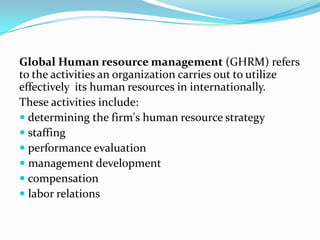
Global Human resource management (GHRM) refers
to the activities an organization carries out to utilize
effectively its human resources in internationally.
These activities include:
 determining the firm's human resource strategy
 staffing
 performance evaluation
 management development
 compensation
 labor relations
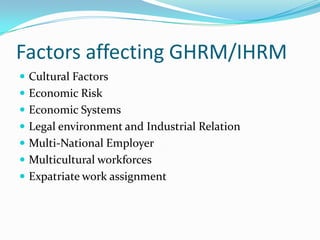
Factors affecting GHRM/IHRM
 Cultural Factors
 Economic Risk
 Economic Systems
 Legal environment and Industrial Relation

 Multi-National Employer
 Multicultural workforces
 Expatriate work assignment
THE STRATEGIC ROLE OF INTERNATIONAL HRM
Success in international business requires that HRM
policies be congruent with the firm’s strategy
STAFFING POLICY
Staffing policy is concerned with the selection of
employees who have the skills required to perform a
particular job.
 Types of Staffing Policy
 Expatriate Managers
TRAINING AND MANAGEMENT DEVELOPMENT
 Training begins where selection ends and it focuses

upon preparing the manager for a specific job
 Management development is concerned with

developing the skills of the manager over his or her
career with the firm
 Training for Expatriate Managers
 Repatriation of Expatriates

 Management Development and Strategy
PERFORMANCE APPRAISAL
How should the performance of expatriate managers be
evaluated?
 Performance Appraisal Problems
 Guidelines for Performance Appraisal
COMPENSATION
How should compensation packages be structured for
expatriates?
 National Differences in Compensation
 Expatriate Pay
INTERNATIONAL LABOR RELATIONS
 A key issue in international labor relations is the

degree to which organized labor is able to limit the
choices available to an international business
 A firm's ability to pursue a transnational or global

strategy can be significantly constrained by the actions
of labor unions
 The Concerns of Organized Labor
 The Strategy of Organized Labor

 Approaches to Labor Relations
Thank you

Global hrm

  • 1.
  • 2.
    Definition of GlobalHuman Resource Management/IHRM  IHRM is the process of procuring, allocating and effectively utilizing human resources in multinational corporation.
  • 3.
    What is GlobalHuman Resource Management As a field it is about: the understanding, researching, applying and revising all human resource activities in their internal and external contexts as they impact the process of managing human resources in enterprises throughout the global environment to enhance the experience of multiple stakeholders, including investors, customers, employees, partners, suppliers, environment, and society.
  • 4.
    Forms of InternationalHRM  Operation of parent-country firms  Operation of foreign firms in the home country  Operation of Third party nationals  Employment of foreign citizens (or recent immigrants and/or their families
  • 5.
    Strategic objective ofGHRM/IHRM  Problem of integration.(HQ to Subsidiary)  Problem of differentiation.(Flexibility in policies and     practices) Involves constantly changing perspectives Requires more involvement in employees personal lives Is influenced by more external sources. Involves a greater level of risk than typical domestic HRM
  • 6.
    DIFFERENCES BETWEEN DOMESTICAND INTERNATIONAL HRM  Responsibility for greater number of activities  Need for greater level of expertise  e.g. employment laws  Necessity for closer involvement with employees (e.g. expatriate families  Greatly expanded and different mix of employees  Having to deal with more external influences  Having to face greater exposure to problems and difficulties
  • 7.
    Approaches to GHRM/IHRM Ethnocentric. The MNC simply exports HR practices and policies from home contrary to Subsidiaries in foreign location.  Polycentric HR policies are adapted to meet the circumstances in each foreign country. The subsidiaries are basically independent from headquarters.  Regiocentric HR policies are coordination within the region to as great extent as possible.  Geocentric. HR policies are developed to meet the goals of global network of home country locations and foreign subsidiaries.
  • 8.
    Global Human resourcemanagement (GHRM) refers to the activities an organization carries out to utilize effectively its human resources in internationally. These activities include:  determining the firm's human resource strategy  staffing  performance evaluation  management development  compensation  labor relations
  • 9.
    Factors affecting GHRM/IHRM Cultural Factors  Economic Risk  Economic Systems  Legal environment and Industrial Relation  Multi-National Employer  Multicultural workforces  Expatriate work assignment
  • 10.
    THE STRATEGIC ROLEOF INTERNATIONAL HRM Success in international business requires that HRM policies be congruent with the firm’s strategy
  • 11.
    STAFFING POLICY Staffing policyis concerned with the selection of employees who have the skills required to perform a particular job.  Types of Staffing Policy  Expatriate Managers
  • 12.
    TRAINING AND MANAGEMENTDEVELOPMENT  Training begins where selection ends and it focuses upon preparing the manager for a specific job  Management development is concerned with developing the skills of the manager over his or her career with the firm
  • 13.
     Training forExpatriate Managers  Repatriation of Expatriates  Management Development and Strategy
  • 14.
    PERFORMANCE APPRAISAL How shouldthe performance of expatriate managers be evaluated?  Performance Appraisal Problems  Guidelines for Performance Appraisal
  • 15.
    COMPENSATION How should compensationpackages be structured for expatriates?  National Differences in Compensation  Expatriate Pay
  • 16.
    INTERNATIONAL LABOR RELATIONS A key issue in international labor relations is the degree to which organized labor is able to limit the choices available to an international business  A firm's ability to pursue a transnational or global strategy can be significantly constrained by the actions of labor unions
  • 17.
     The Concernsof Organized Labor  The Strategy of Organized Labor  Approaches to Labor Relations
  • 18.