Operations Management

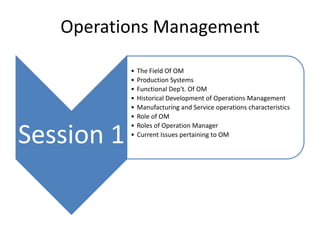
            •   The Field Of OM
            •   Production Systems
            •   Functional Dep't. Of OM
            •   Historical Development of Operations Management
            •   Manufacturing and Service operations characteristics
            •   Role of OM


Session 1
            •   Roles of Operation Manager
            •   Current Issues pertaining to OM
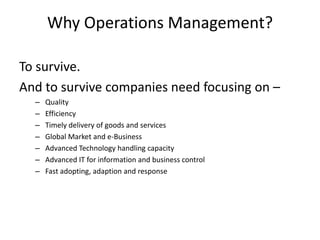
Why Operations Management?

To survive.
And to survive companies need focusing on –
  –   Quality
  –   Efficiency
  –   Timely delivery of goods and services
  –   Global Market and e-Business
  –   Advanced Technology handling capacity
  –   Advanced IT for information and business control
  –   Fast adopting, adaption and response
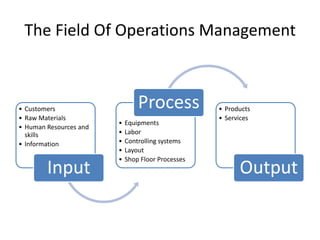
The Field Of Operations Management


• Customers                     Process            • Products
• Raw Materials                                    • Services
                        •   Equipments
• Human Resources and
  skills                •   Labor
• Information           •   Controlling systems
                        •   Layout
                        •   Shop Floor Processes
        Input                                            Output
Definition
• Operations management is the business
  function that is responsible for managing and
  coordinating the resources needed to produce
  a company’s products and services.

• Without operations management there would
  be no products or services to sell.
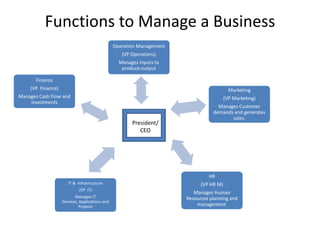
Functions to Manage a Business
                                                Operation Management
                                                   (VP Operations)
                                                  Manages Inputs to
                                                   produce output

       Finance
    (VP Finance)                                                                           Marketing
Manages Cash Flow and                                                                    (VP Marketing)
    investments
                                                                                    Manages Customer
                                                                                  demands and generates
                                                                                         sales.
                                                       President/
                                                          CEO


                                                                                HR
                      IT & Infrastructure                                    (VP HR M)
                            (VP IT)
                                                                          Manages Human
                          Manages IT                                   Resources planning and
                   Services, Applications and
                             Projects                                      management
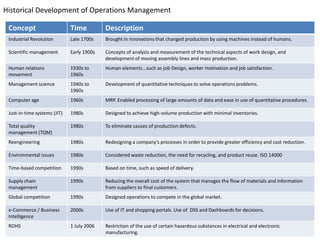
Historical Development of Operations Management

 Concept                      Time          Description
 Industrial Revolution        Late 1700s    Brought in innovations that changed production by using machines instead of humans.

 Scientific management        Early 1900s   Concepts of analysis and measurement of the technical aspects of work design, and
                                            development of moving assembly lines and mass production.
 Human relations              1930s to      Human elements , such as job Design, worker motivation and job satisfaction.
 movement                     1960s
 Management science           1940s to      Development of quantitative techniques to solve operations problems.
                              1960s
 Computer age                 1960s         MRP. Enabled processing of large amounts of data and ease in use of quantitative procedures.

 Just-in-time systems (JIT)   1980s         Designed to achieve high-volume production with minimal inventories.

 Total quality                1980s         To eliminate causes of production defects.
 management (TQM)
 Reengineering                1980s         Redesigning a company’s processes in order to provide greater efficiency and cost reduction.

 Environmental issues         1980s         Considered waste reduction, the need for recycling, and product reuse. ISO 14000

 Time-based competition       1990s         Based on time, such as speed of delivery.

 Supply chain                 1990s         Reducing the overall cost of the system that manages the flow of materials and information
 management                                 from suppliers to final customers.
 Global competition           1990s         Designed operations to compete in the global market.

 e-Commerce / Business        2000s         Use of IT and shopping portals. Use of DSS and Dashboards for decisions.
 Intelligence
 ROHS                         1 July 2006   Restriction of the use of certain hazardous substances in electrical and electronic
                                            manufacturing.
Various departments in Operations Management
                                                                         [Assignment 1- Try to answer and fill the column to help your favorite co.]
General Decisions to be made              Decisions specific to product or service                              Department
What are the unique features of the                                                                             Operations strategy


                                                                                                                                           Decision
                                                                                                                                           Strategic
business that will make it competitive?
What are the unique features of the                                                                             Product design
product?
What are the unique features of the                                                                             Process selection
process that give the product its
unique characteristics?
What sources of supply should we use                                                                            Supply chain
to ensure regular and timely receipt of                                                                         managements
the exact materials we need? How do
we manage these sources of supply?
How will managers ensure the quality                                                                            Quality management
of the product, measure quality, and
identify quality problems?
What is the expected demand for the                                                                             Forecasting
product?
Where will the facility be located?                                                                             Location analysis

How large should the facility be?                                                                               Capacity planning

How should the facility be laid out?                                                                            Facility layout

What are the different jobs and how and                                                                         Job design and work
who can do those tasks and measure the                                                                          measurement
performance


                                                                                                                                           Decision
                                                                                                                                           Tactical
When will orders be                                                                                             Inventory
placed and how much will be kept in                                                                             management
stock?
Who will work on what schedule?                                                                                 Scheduling
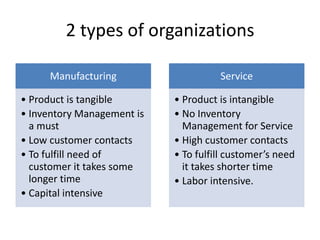
2 types of organizations

     Manufacturing                    Service

• Product is tangible       • Product is intangible
• Inventory Management is   • No Inventory
  a must                      Management for Service
• Low customer contacts     • High customer contacts
• To fulfill need of        • To fulfill customer’s need
  customer it takes some      it takes shorter time
  longer time               • Labor intensive.
• Capital intensive
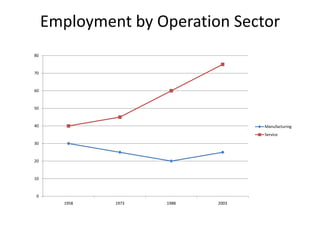
Employment by Operation Sector
80


70


60


50


40                                 Manufacturing
                                   Service
30


20


10


 0
       1958   1973   1988   2003
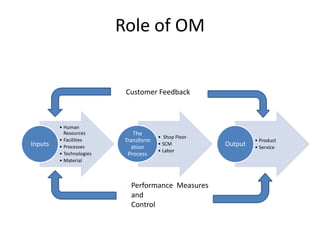
Role of OM


                           Customer Feedback


         • Human
           Resources           The
                                       • Shop Floor
         • Facilities      Transform                           • Product
Inputs   • Processes          ation
                                       • SCM          Output   • Service
                                       • Labor
         • Technologies     Process
         • Material


                             Performance Measures
                             and
                             Control
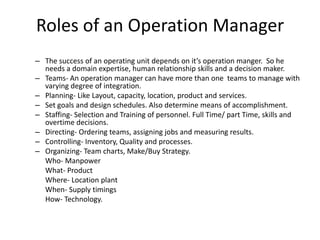
Roles of an Operation Manager
– The success of an operating unit depends on it’s operation manger. So he
  needs a domain expertise, human relationship skills and a decision maker.
– Teams- An operation manager can have more than one teams to manage with
  varying degree of integration.
– Planning- Like Layout, capacity, location, product and services.
– Set goals and design schedules. Also determine means of accomplishment.
– Staffing- Selection and Training of personnel. Full Time/ part Time, skills and
  overtime decisions.
– Directing- Ordering teams, assigning jobs and measuring results.
– Controlling- Inventory, Quality and processes.
– Organizing- Team charts, Make/Buy Strategy.
  Who- Manpower
  What- Product
  Where- Location plant
  When- Supply timings
  How- Technology.
Current issues in OM
• Manufacturing facilities in India –Electronics/ Automobiles/Food.
• Labor unrest in operations.
• Security issues in e-Transactions: B2B, B2C, C2C portals and payment
  gateways.
• Environmental issues – Implementing ISO 14000, ROHS in operations.
  Kyoto protocol.
• Issues pertaining Lean manufacturing implementation
• Issues pertaining implementing ERP Systems- Business Intelligence
  Tools, SCM Dashboards.
• Advancement is technologies and it’s handling in operations.
• Global Market and Operations.
• Emerging Asia dominance.

Om001

  • 1.
  • 2.
    Operations Management • The Field Of OM • Production Systems • Functional Dep't. Of OM • Historical Development of Operations Management • Manufacturing and Service operations characteristics • Role of OM Session 1 • Roles of Operation Manager • Current Issues pertaining to OM
  • 3.
    Why Operations Management? Tosurvive. And to survive companies need focusing on – – Quality – Efficiency – Timely delivery of goods and services – Global Market and e-Business – Advanced Technology handling capacity – Advanced IT for information and business control – Fast adopting, adaption and response
  • 4.
    The Field OfOperations Management • Customers Process • Products • Raw Materials • Services • Equipments • Human Resources and skills • Labor • Information • Controlling systems • Layout • Shop Floor Processes Input Output
  • 5.
    Definition • Operations managementis the business function that is responsible for managing and coordinating the resources needed to produce a company’s products and services. • Without operations management there would be no products or services to sell.
  • 6.
    Functions to Managea Business Operation Management (VP Operations) Manages Inputs to produce output Finance (VP Finance) Marketing Manages Cash Flow and (VP Marketing) investments Manages Customer demands and generates sales. President/ CEO HR IT & Infrastructure (VP HR M) (VP IT) Manages Human Manages IT Resources planning and Services, Applications and Projects management
  • 7.
    Historical Development ofOperations Management Concept Time Description Industrial Revolution Late 1700s Brought in innovations that changed production by using machines instead of humans. Scientific management Early 1900s Concepts of analysis and measurement of the technical aspects of work design, and development of moving assembly lines and mass production. Human relations 1930s to Human elements , such as job Design, worker motivation and job satisfaction. movement 1960s Management science 1940s to Development of quantitative techniques to solve operations problems. 1960s Computer age 1960s MRP. Enabled processing of large amounts of data and ease in use of quantitative procedures. Just-in-time systems (JIT) 1980s Designed to achieve high-volume production with minimal inventories. Total quality 1980s To eliminate causes of production defects. management (TQM) Reengineering 1980s Redesigning a company’s processes in order to provide greater efficiency and cost reduction. Environmental issues 1980s Considered waste reduction, the need for recycling, and product reuse. ISO 14000 Time-based competition 1990s Based on time, such as speed of delivery. Supply chain 1990s Reducing the overall cost of the system that manages the flow of materials and information management from suppliers to final customers. Global competition 1990s Designed operations to compete in the global market. e-Commerce / Business 2000s Use of IT and shopping portals. Use of DSS and Dashboards for decisions. Intelligence ROHS 1 July 2006 Restriction of the use of certain hazardous substances in electrical and electronic manufacturing.
  • 8.
    Various departments inOperations Management [Assignment 1- Try to answer and fill the column to help your favorite co.] General Decisions to be made Decisions specific to product or service Department What are the unique features of the Operations strategy Decision Strategic business that will make it competitive? What are the unique features of the Product design product? What are the unique features of the Process selection process that give the product its unique characteristics? What sources of supply should we use Supply chain to ensure regular and timely receipt of managements the exact materials we need? How do we manage these sources of supply? How will managers ensure the quality Quality management of the product, measure quality, and identify quality problems? What is the expected demand for the Forecasting product? Where will the facility be located? Location analysis How large should the facility be? Capacity planning How should the facility be laid out? Facility layout What are the different jobs and how and Job design and work who can do those tasks and measure the measurement performance Decision Tactical When will orders be Inventory placed and how much will be kept in management stock? Who will work on what schedule? Scheduling
  • 9.
    2 types oforganizations Manufacturing Service • Product is tangible • Product is intangible • Inventory Management is • No Inventory a must Management for Service • Low customer contacts • High customer contacts • To fulfill need of • To fulfill customer’s need customer it takes some it takes shorter time longer time • Labor intensive. • Capital intensive
  • 10.
    Employment by OperationSector 80 70 60 50 40 Manufacturing Service 30 20 10 0 1958 1973 1988 2003
  • 11.
    Role of OM Customer Feedback • Human Resources The • Shop Floor • Facilities Transform • Product Inputs • Processes ation • SCM Output • Service • Labor • Technologies Process • Material Performance Measures and Control
  • 12.
    Roles of anOperation Manager – The success of an operating unit depends on it’s operation manger. So he needs a domain expertise, human relationship skills and a decision maker. – Teams- An operation manager can have more than one teams to manage with varying degree of integration. – Planning- Like Layout, capacity, location, product and services. – Set goals and design schedules. Also determine means of accomplishment. – Staffing- Selection and Training of personnel. Full Time/ part Time, skills and overtime decisions. – Directing- Ordering teams, assigning jobs and measuring results. – Controlling- Inventory, Quality and processes. – Organizing- Team charts, Make/Buy Strategy. Who- Manpower What- Product Where- Location plant When- Supply timings How- Technology.
  • 13.
    Current issues inOM • Manufacturing facilities in India –Electronics/ Automobiles/Food. • Labor unrest in operations. • Security issues in e-Transactions: B2B, B2C, C2C portals and payment gateways. • Environmental issues – Implementing ISO 14000, ROHS in operations. Kyoto protocol. • Issues pertaining Lean manufacturing implementation • Issues pertaining implementing ERP Systems- Business Intelligence Tools, SCM Dashboards. • Advancement is technologies and it’s handling in operations. • Global Market and Operations. • Emerging Asia dominance.