HUMAN RESOURCE
PLANNING
Human Resource is an important corporate asset and
the overall performance of companies depends upon
the way it is put to use.
Globally Major issues in today’s organizations are skill
shortages, competency gaps, redundancies,
downsizing, rightsizing.
HUMAN RESOURCE PLANNING
The process of analyzing and identifying the need for and
availability of Human Resources so that the Organization
can meet its objectives.
The Process of determining an Organization’s human
resources needs.
Or
 “HRP includes estimation of how many qualified
people are necessary to carry out the assigned
activities, how many people will be available, and
what , if anything, must be done to ensure that
personnel supply equals personnel demand at the
appropriate time in the future.”
-Terry L.Leap and Michael
 Forecast future requirements of human resources with
different levels of skills.
 Assess surplus or shortage, if any, human resources available
over a specified period of time. Anticipate the impact of
technology on job and requirements for human resources.
 The ultimate objective is to relate future human resources to
future enterprise needs so as to maximize the future return on
investment in human resources.
 Control the human resources already deployed in the
organization.
 Provide lead time available to select and train the
required additional human resource over a specified
time period.
 Large numbers of employees who retire, die, leave
organizations, or become incapacitated because of
physical or mental ailments, need to be replaced by
new employees. Human Resource Planning ensures
smooth supply of workers without interruption
1. FUTURE PERSONNEL NEEDS
• Surplus or deficiency in staff strength
• Results in the anomaly of surplus labour with the lack
of top executives
2. COPING WITH CHANGE
• Enables an enterprise to cope with changes in
competitive forces, markets, technology, products &
government regulations
3. CREATING HIGHLY TALENTED PERSONNEL
• HR manager must use his/her ingenuity to attract &
retain qualified & skilled personnel
• Succession planning
4. PROTECTION OF WEAKER SECTIONS
• SC/ST candidates, physically handicapped, children of
the socially disabled & physically oppressed and
backward class citizens.
5. INTERNATIONAL STRATEGIES
• Fill key jobs with foreign nationals and re-assignment
of employees from within or across national borders
6. FOUNDATION FOR PERSONNEL FUNCTIONS
• Provides information for designing & implementing
recruiting, selection, personnel movement(transfers,
promotions, layoffs) & training & development
7. INCREASING INVESTMENTS IN HUMAN
RESOURCES
• Human assets increase in value
8. RESISTANCE TO CHANGE AND MOVE
• Proper planning is required to do this
9. OTHER BENEFITS
• Upper management has a better view of the HR
dimensions of business decision
• More time is provided to locate talent
• Better opportunities exist to include women &
minority groups in future growth plans
• Better planning of assignments to develop
managers can be done
 Interfacing with strategic planning and scanning the environment
 Taking an inventory of the company’s current human resources
 Forecasting demand for human resources
 Forecasting the supply of HR from within the organization and in
the external labor market
 Comparing forecasts of demand and supply
 Planning the actions needed to deal with anticipated shortage or
overages
 Feeding back such information into the strategic planning process.
I. TYPE & STRATEGY OF ORGANISATION
Internal growth
Informal
Inflexible
Growth through M & A
Reactive
Flexible
Proactive
Formal
II. ORGANIZATIONAL GROWTH CYCLES &
PLANNING
• Embryonic stage – No personnel planning
• Growth stage – HR forecasting is essential
• Maturity stage – Planning more formalized & less
flexible
• Declining stage – Planning for layoff,
retrenchment & retirement
III. ENVIRONMENTAL UNCERTAINITIES
• Political, social & economic changes
• Balancing programmes are built into the HRM
programme through succession planning,
promotion channels, layoffs, flexi time, job
sharing, retirement, VRS, etc….
IV. TIME HORIZONS
• Short-term & Long-term plans
V. TYPE & QUALITY OF FORECASTING
INFORMATION
• Type of information which should be used in
making forecasts
VI. NATURE OF JOBS BEING FILLED
• Difference in employing a shop-floor worker & a
managerial personnel
VII. OFF-LOADING THE WORK
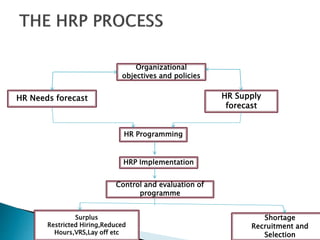
Organizational
objectives and policies
HR Needs forecast HR Supply
forecast
HR Programming
HRP Implementation
Control and evaluation of
programme
Surplus
Restricted Hiring,Reduced
Hours,VRS,Lay off etc
Shortage
Recruitment and
Selection
 Demand forecasting is the process of
estimating the future quantity and quality of
people required.
 The basis of the forecast must be the annual
budget and long-term corporate plan,
translated into activity levels for each
function and department
 Demand forecasting must consider several
factors both internal and external.
 Among external factors are
competition(foreign
and domestic), economic climate, laws and
regulatory bodies, changes in technology
and
social factors.
 Internal factors include budget constraints,
production levels, new products and services,
organizational structure and employee
separation.
 Demand forecasting helps to :
◦ Quantify the jobs necessary for producing a given
number of goods
◦ Prevent shortage of people where and when they
are needed most
◦ Determine what staff-mix is desirable in the future
◦ Monitor compliance with legal requirements with
regard to reservation of jobs
◦ Asses appropriate staffing levels in different parts
of
the organization so as to avoid unnecessary costs
 Managerial judgment
 Ratio-trend analysis
 Work study techniques
 Delphi technique
 Other techniques
 In this all managers sit together, discuss and
arrive at a figure which would be the future
demand for labour.
 This technique may involve a ‘bottom-up’ or
‘top-down’ approach. A combination of both
could yield positive results.
 This is the quickest forecasting technique.
 This technique involves studying past ratios,
say, between the number of workers and
sales in an organization and forecasting
future ratios, making some allowance for
changes in the organization or its method.
 Work study techniques can be used when it is
possible to apply work measurement to
calculate the length of operations and the
amount of labour required.
• This technique is the method of forecasting
personnel needs.
• It solicits estimates of personnel needs from
a group of experts, usually managers.
• The HRP experts act as intermediaries,
summarize the various responses and report
the findings back to the experts.
• Summaries and surveys are repeated until the
experts opinion begin to agree.
Supply forecasting measures the no of
people likely to be available from within and
outside an organisation,after making
allowance for absenteeism, internal
movements and promotions, wastage and
changes in hours and other conditions of
work.
 Quantify no of people and positions expected
in near future.
 Clarify the staff mixes.
 Prevent shortage of people
 Asses present staffing levels in different parts
of organization.
 Existing human resources
 Internal sources of supply
 External sources of supply
• Skill inventories – info about non-managers.
1. Personal data
2. Skills
3. Special qualifications
4. Salary and job history
5. Company data
6. Capacity of individual
7. Special preference of individual
• Management inventories
1. Work history
2. Strengths
3. Weakness
4. Promotion potential
5. Career goals
6. Personal data
7. Number and types of employees supervised
8. Total budget managed
9. Previous management duties.
 HR planning and analysis
 Equal employment
 Staffing
 HR development
 Compensation and benefits
 Health,saftey and security
 Employee and labor relations
 Inflows and outflows
IS= current supply – outflow + inflow
 Turnover rate
No of seperations during one year × 100
Avg no of employees during the year
 Conditions of work and absenteeism.
Absenteeism is given by
no of persons – days lost
×100
Avg no of persons × no of working days
 Productivity level
 Movement among jobs
 New blood and new experience
 To replenish old personnel
 Organizational growth and diversification
 After personal demand and supply are
forecast the vacancies should be filled at right
time with right employees.
 Converting HR plan into action.
 Action programmes are..
 Recruitment
 Selection & placement
 Training and development
 Retraining & redeployment
 The retention plan
 The redundance plan
 The succession plan
 If Shortage of employees
- Do-
 Hire new full-time employees
 Offer incentives for postponing retirement
 Re-hire retired employees on part-time basis
 Attempt to reduce turnover
 Bring in over-time for present employees
 Subcontract work to another company
 Hire temporary employees
 Re-engineer to reduce needs
 If surplus of employees is expected
-Do-
 Do not replace employees who leave
 Offer incentives for early retirement
 Transfer or reassign excess employees
 Use slack time for employees training or
equipment maintenance
 Reduce work hours
 Pay off employee
 It covers no. of trainees required
 It necessary for existing staff
 Identification of resource personal for
conducting development programmes
 Frequency of training and development
programmes
 Budget allocation
 Retraining and redeployment:
◦ New skill should be imported to existing employee
Retention plan:
Compensation plan
Performance appraisal
Employees leaving in search of green pastures
The induction criss
Shortages
Unstable recruits
 Who is to be redundant and where and when
 Plans for re-development or re-training
 Steps to be taken to help redundant
employees finding new jobs
 Policy for declaring redundancies
 Programme for consulting with unions or
staff associations
 Analysis of demand
 Audit of existing executives
 Planning of individual career path
 Career counseling
 Accelerated promotions
 Performance related training and
development
 Planned strategic recruitment
 Filling the openings
 Establish the reporting procedures
 Identifying who are in post and those who are
in pipe line
 It should report employment costs against
budget and trends in wastage and
employment ratios
 Institute of Applied Manpower Research
 Requisites for successful HRP
 Recognize of corporate planning
 Backing of top management for HRP
 HRP responsibilities should be centralized
 Personnel record must be complete, up-date and readily
available
 The time horizon of plan should be long for remedial
action
 The techniques of planning should be best suit
 Plans should be prepared by skill level
 Data collection, analysis, techniques of planning should
be constantly revised
 People question the importance of making HR practices
future oriented and role assigned to HR practitioners in
formulation of organizational strategies
 HR practitioners are perceived as expert in handling
personnel matters, but are not experts in managing
business.
 HR information often is incompatible with the information
used in strategy formulation.
 Conflicts may exist between short term and long term HR
needs.
 Conflicts between quantitative and qualitative approaches
to HRP.
 Non-involvement of operating managers renders HRP
ineffective.

Human Resource Planning

  • 1.
  • 2.
    Human Resource isan important corporate asset and the overall performance of companies depends upon the way it is put to use. Globally Major issues in today’s organizations are skill shortages, competency gaps, redundancies, downsizing, rightsizing.
  • 3.
    HUMAN RESOURCE PLANNING Theprocess of analyzing and identifying the need for and availability of Human Resources so that the Organization can meet its objectives. The Process of determining an Organization’s human resources needs. Or
  • 4.
     “HRP includesestimation of how many qualified people are necessary to carry out the assigned activities, how many people will be available, and what , if anything, must be done to ensure that personnel supply equals personnel demand at the appropriate time in the future.” -Terry L.Leap and Michael
  • 6.
     Forecast futurerequirements of human resources with different levels of skills.  Assess surplus or shortage, if any, human resources available over a specified period of time. Anticipate the impact of technology on job and requirements for human resources.  The ultimate objective is to relate future human resources to future enterprise needs so as to maximize the future return on investment in human resources.
  • 7.
     Control thehuman resources already deployed in the organization.  Provide lead time available to select and train the required additional human resource over a specified time period.
  • 8.
     Large numbersof employees who retire, die, leave organizations, or become incapacitated because of physical or mental ailments, need to be replaced by new employees. Human Resource Planning ensures smooth supply of workers without interruption
  • 9.
    1. FUTURE PERSONNELNEEDS • Surplus or deficiency in staff strength • Results in the anomaly of surplus labour with the lack of top executives 2. COPING WITH CHANGE • Enables an enterprise to cope with changes in competitive forces, markets, technology, products & government regulations 3. CREATING HIGHLY TALENTED PERSONNEL • HR manager must use his/her ingenuity to attract & retain qualified & skilled personnel • Succession planning 4. PROTECTION OF WEAKER SECTIONS • SC/ST candidates, physically handicapped, children of the socially disabled & physically oppressed and backward class citizens.
  • 10.
    5. INTERNATIONAL STRATEGIES •Fill key jobs with foreign nationals and re-assignment of employees from within or across national borders 6. FOUNDATION FOR PERSONNEL FUNCTIONS • Provides information for designing & implementing recruiting, selection, personnel movement(transfers, promotions, layoffs) & training & development 7. INCREASING INVESTMENTS IN HUMAN RESOURCES • Human assets increase in value 8. RESISTANCE TO CHANGE AND MOVE • Proper planning is required to do this
  • 11.
    9. OTHER BENEFITS •Upper management has a better view of the HR dimensions of business decision • More time is provided to locate talent • Better opportunities exist to include women & minority groups in future growth plans • Better planning of assignments to develop managers can be done
  • 12.
     Interfacing withstrategic planning and scanning the environment  Taking an inventory of the company’s current human resources  Forecasting demand for human resources  Forecasting the supply of HR from within the organization and in the external labor market
  • 13.
     Comparing forecastsof demand and supply  Planning the actions needed to deal with anticipated shortage or overages  Feeding back such information into the strategic planning process.
  • 14.
    I. TYPE &STRATEGY OF ORGANISATION Internal growth Informal Inflexible Growth through M & A Reactive Flexible Proactive Formal
  • 15.
    II. ORGANIZATIONAL GROWTHCYCLES & PLANNING • Embryonic stage – No personnel planning • Growth stage – HR forecasting is essential • Maturity stage – Planning more formalized & less flexible • Declining stage – Planning for layoff, retrenchment & retirement III. ENVIRONMENTAL UNCERTAINITIES • Political, social & economic changes • Balancing programmes are built into the HRM programme through succession planning, promotion channels, layoffs, flexi time, job sharing, retirement, VRS, etc….
  • 16.
    IV. TIME HORIZONS •Short-term & Long-term plans V. TYPE & QUALITY OF FORECASTING INFORMATION • Type of information which should be used in making forecasts VI. NATURE OF JOBS BEING FILLED • Difference in employing a shop-floor worker & a managerial personnel VII. OFF-LOADING THE WORK
  • 17.
    Organizational objectives and policies HRNeeds forecast HR Supply forecast HR Programming HRP Implementation Control and evaluation of programme Surplus Restricted Hiring,Reduced Hours,VRS,Lay off etc Shortage Recruitment and Selection
  • 18.
     Demand forecastingis the process of estimating the future quantity and quality of people required.  The basis of the forecast must be the annual budget and long-term corporate plan, translated into activity levels for each function and department
  • 19.
     Demand forecastingmust consider several factors both internal and external.  Among external factors are competition(foreign and domestic), economic climate, laws and regulatory bodies, changes in technology and social factors.  Internal factors include budget constraints, production levels, new products and services, organizational structure and employee separation.
  • 20.
     Demand forecastinghelps to : ◦ Quantify the jobs necessary for producing a given number of goods ◦ Prevent shortage of people where and when they are needed most ◦ Determine what staff-mix is desirable in the future ◦ Monitor compliance with legal requirements with regard to reservation of jobs ◦ Asses appropriate staffing levels in different parts of the organization so as to avoid unnecessary costs
  • 21.
     Managerial judgment Ratio-trend analysis  Work study techniques  Delphi technique  Other techniques
  • 22.
     In thisall managers sit together, discuss and arrive at a figure which would be the future demand for labour.  This technique may involve a ‘bottom-up’ or ‘top-down’ approach. A combination of both could yield positive results.
  • 23.
     This isthe quickest forecasting technique.  This technique involves studying past ratios, say, between the number of workers and sales in an organization and forecasting future ratios, making some allowance for changes in the organization or its method.
  • 24.
     Work studytechniques can be used when it is possible to apply work measurement to calculate the length of operations and the amount of labour required.
  • 25.
    • This techniqueis the method of forecasting personnel needs. • It solicits estimates of personnel needs from a group of experts, usually managers. • The HRP experts act as intermediaries, summarize the various responses and report the findings back to the experts. • Summaries and surveys are repeated until the experts opinion begin to agree.
  • 26.
    Supply forecasting measuresthe no of people likely to be available from within and outside an organisation,after making allowance for absenteeism, internal movements and promotions, wastage and changes in hours and other conditions of work.
  • 27.
     Quantify noof people and positions expected in near future.  Clarify the staff mixes.  Prevent shortage of people  Asses present staffing levels in different parts of organization.
  • 28.
     Existing humanresources  Internal sources of supply  External sources of supply
  • 29.
    • Skill inventories– info about non-managers. 1. Personal data 2. Skills 3. Special qualifications 4. Salary and job history 5. Company data 6. Capacity of individual 7. Special preference of individual
  • 30.
    • Management inventories 1.Work history 2. Strengths 3. Weakness 4. Promotion potential 5. Career goals 6. Personal data 7. Number and types of employees supervised 8. Total budget managed 9. Previous management duties.
  • 31.
     HR planningand analysis  Equal employment  Staffing  HR development  Compensation and benefits  Health,saftey and security  Employee and labor relations
  • 32.
     Inflows andoutflows IS= current supply – outflow + inflow  Turnover rate No of seperations during one year × 100 Avg no of employees during the year
  • 33.
     Conditions ofwork and absenteeism. Absenteeism is given by no of persons – days lost ×100 Avg no of persons × no of working days  Productivity level  Movement among jobs
  • 34.
     New bloodand new experience  To replenish old personnel  Organizational growth and diversification
  • 35.
     After personaldemand and supply are forecast the vacancies should be filled at right time with right employees.
  • 36.
     Converting HRplan into action.  Action programmes are..  Recruitment  Selection & placement  Training and development  Retraining & redeployment  The retention plan  The redundance plan  The succession plan
  • 37.
     If Shortageof employees - Do-  Hire new full-time employees  Offer incentives for postponing retirement  Re-hire retired employees on part-time basis  Attempt to reduce turnover  Bring in over-time for present employees  Subcontract work to another company  Hire temporary employees  Re-engineer to reduce needs
  • 38.
     If surplusof employees is expected -Do-  Do not replace employees who leave  Offer incentives for early retirement  Transfer or reassign excess employees  Use slack time for employees training or equipment maintenance  Reduce work hours  Pay off employee
  • 39.
     It coversno. of trainees required  It necessary for existing staff  Identification of resource personal for conducting development programmes  Frequency of training and development programmes  Budget allocation
  • 40.
     Retraining andredeployment: ◦ New skill should be imported to existing employee Retention plan: Compensation plan Performance appraisal Employees leaving in search of green pastures The induction criss Shortages Unstable recruits
  • 41.
     Who isto be redundant and where and when  Plans for re-development or re-training  Steps to be taken to help redundant employees finding new jobs  Policy for declaring redundancies  Programme for consulting with unions or staff associations
  • 42.
     Analysis ofdemand  Audit of existing executives  Planning of individual career path  Career counseling  Accelerated promotions  Performance related training and development  Planned strategic recruitment  Filling the openings
  • 43.
     Establish thereporting procedures  Identifying who are in post and those who are in pipe line  It should report employment costs against budget and trends in wastage and employment ratios
  • 44.
     Institute ofApplied Manpower Research  Requisites for successful HRP  Recognize of corporate planning  Backing of top management for HRP  HRP responsibilities should be centralized  Personnel record must be complete, up-date and readily available  The time horizon of plan should be long for remedial action  The techniques of planning should be best suit  Plans should be prepared by skill level  Data collection, analysis, techniques of planning should be constantly revised
  • 45.
     People questionthe importance of making HR practices future oriented and role assigned to HR practitioners in formulation of organizational strategies  HR practitioners are perceived as expert in handling personnel matters, but are not experts in managing business.  HR information often is incompatible with the information used in strategy formulation.  Conflicts may exist between short term and long term HR needs.  Conflicts between quantitative and qualitative approaches to HRP.  Non-involvement of operating managers renders HRP ineffective.